Disclosure: airfryerkitchensupply.com is reader-supported. When you buy through links on our site, we may earn an affiliate commission at no extra cost to you.
Where to buy
Every pick in this guide to the best affordable electric mixers is sold on Amazon, and that is where we recommend buying. Electric mixers span hand and stand formats, and Amazon’s listings make it easy to verify the details that matter — motor type, included attachments, bowl size — for the exact configuration you are considering. Use the links in this section for the fastest route to each pick, or the Check on Amazon buttons inside each review if you want to read the full listing first. Prices on electric mixers shift often with sales and colour choices, so check the current price on Amazon rather than trusting a figure quoted anywhere else.
- Hamilton Beach 4 Quart Electric Stand Mixer, 7 Speeds — Best Overall: Check the current price on Amazon
- Hamilton Beach 6-Speed Electric Hand Mixer with QuickBurst (62682G) — Best Budget: Check the current price on Amazon
- KitchenAid Classic Series 4.5 Quart Tilt-Head Stand Mixer (K45SS) — Best Upgrade: Check the current price on Amazon
- Cuisinart Power Advantage 5-Speed Hand Mixer (HM-50) — Best for Deep Bowls: Check the current price on Amazon
- KitchenAid 5 Ultra Power Speed Hand Mixer (KHM512) — Best for Tidy Bakers: Check the current price on Amazon
- Cuisinart Precision Pro 5.5-Quart Digital Stand Mixer (SMD-50) — Best Digital Controls: Check the current price on Amazon
A word on the search itself: “electric mixer” is how many shoppers describe the whole category, hand and stand together, usually because they are upgrading from mixing by hand and want a motor to do the work. This guide honours that intent — it covers the best affordable electric options in both formats, and the buying guide explains how to choose between them, because the format decision matters far more than any single specification.
Introduction
The best affordable electric mixers solve a problem so ordinary it hides in plain sight: mixing by hand is slow, tiring and inconsistent. Creaming butter by hand takes ten minutes and an aching shoulder, and the result still trails what a motor does in three. Whipping egg whites by hand is a test of character nobody needs. An electric mixer — hand or stand — removes the labour and, more importantly, removes the variability: the motor does not get tired at minute four, so your meringue and your arm both survive. The affordable tier of electric mixers is now good enough that the only real question left is which format fits your kitchen, your recipes and your storage.
Hand and stand electric mixers divide the work cleanly. The hand mixer is the sprinter: out of the drawer in seconds, perfect for batters, frostings, whipped cream and potatoes, washed and stored in a minute. The stand mixer is the workhorse: it kneads dough, handles double batches, and works hands-free while you do everything else a recipe demands. Most of this guide’s readers will be replacing arm power, not choosing between luxuries, so the picks below are badged by the upgrade they represent — the best first electric mixer, the best budget one, the best one to grow into — rather than by a single ranking that would hide those differences.
Every pick was verified as a real, currently sold model through the maker’s own listing before writing began. The reviews give each machine’s strengths, trade-offs and verdict, with specification boxes limited to details confirmed on the listings themselves. After the reviews, the buying guide covers motors, speeds and attachments in the depth this purchase deserves, the how-to section walks through your first mixes with an electric mixer, and the FAQ handles the questions new owners ask most — including the one about whether the upgrade is worth it at all. (It is.)
In this guide
Quick Picks
Six electric mixers, hand and stand, held to one standard: the motor must do the whole job — no fading in thick batter, no violent first speed, no missing attachments. Here is the short version.
Hamilton Beach 4 Quart Electric Stand Mixer, 7 Speeds — Best Overall. The complete electric upgrade in one box: planetary action, a 300-watt motor, and whisk, beater, dough hook and splash guard included. It earns the top badge because planetary mixing action covers the whole bowl, a feature cheap stand mixers often fake, and because hands-free mixing is the single biggest quality-of-life jump from mixing by hand. Check on Amazon
Hamilton Beach 6-Speed Electric Hand Mixer with QuickBurst (62682G) — Best Budget. The least money that buys a proper electric mixer: a 250-watt motor that holds its speed in thick dough, six speeds and a burst button. It earns the budget badge because its motor has honest headroom for thick cookie dough and stiff frosting, not just thin batters — the exact point where cheaper electric mixers fail. Check on Amazon
KitchenAid Classic Series 4.5 Quart Tilt-Head Stand Mixer (K45SS) — Best Upgrade. The electric mixer to grow into: metal construction, ten speeds, a 4.5-quart bowl and an attachment hub for pasta, grinding and more. It earns the upgrade badge because metal construction and a proven drivetrain give it a lifespan budget plastic mixers cannot match, so it is the last mixer most kitchens need to buy. Check on Amazon
Cuisinart Power Advantage 5-Speed Hand Mixer (HM-50) — Best for Deep Bowls. A 220-watt hand mixer with extra-long beaters and a 60-inch swivel cord, built for real kitchen geometry. It earns its badge because extra-long beaters reach the bottom of deep bowls and pots for in-pot mashing — the job shallower mixers leave half done. Check on Amazon
KitchenAid 5 Ultra Power Speed Hand Mixer (KHM512) — Best for Tidy Bakers. Five speeds, Turbo Beater II accessories with no centre post to clog, and a lockable swivel cord. It earns the tidy badge because the Turbo Beater II shape mixes thoroughly and releases batter cleanly, with no centre post to clog — the easiest wash-up in this guide. Check on Amazon
Cuisinart Precision Pro 5.5-Quart Digital Stand Mixer (SMD-50) — Best Digital Controls. The big-bowl stand mixer with digital controls and three preprogrammed settings for common tasks. It earns its badge because preprogrammed settings take the guesswork out of common tasks for beginners, on top of the same generous 5.5-quart capacity as its dial-controlled sibling. Check on Amazon
How These Picks Were Chosen
Every model was verified against the manufacturer’s current listing before writing — no remembered specifications, no discontinued models. The affordable brief filtered the field to budget and entry tiers, and the “electric” framing of the keyword shaped the shortlist: both hand and stand formats are represented, because buyers using this search term are choosing a motor, not a format, and a guide that only answered half the question would waste their time. Within the brief, models were judged on motor behaviour under load, the gentleness of their lowest speed, mixing action and beater design, the attachment set in the box, and storage reality.
Badges describe the upgrade each machine represents, from first electric mixer to long-term upgrade, because that is the journey this search’s readers are on. Where the market has gaps, the guide notes them: there is no affordable electric mixer that kneads like a premium stand mixer while costing like a hand mixer, and the reviews are explicit about which jobs belong to which format rather than letting a badge imply otherwise.
The 6 Best Affordable Electric Mixers

Hamilton Beach 4 Quart Electric Stand Mixer, 7 Speeds — Best Overall
This is the affordable stand mixer formula done completely: planetary mixing action, a 300-watt motor, seven speeds, and whisk, beater and dough hook plus a splash guard in the box. It suits first-time stand mixer buyers, small families and bakers who mix weekly but not heavily. As an electric mixer purchase, it is the most complete step up from mixing by hand that the affordable tier offers. It is less suited to frequent lean-bread bakers, whose dough loads will test a mixer at this tier.
Strengths
- Planetary mixing action covers the whole bowl, a feature cheap stand mixers often fake
- Complete kit in the box: whisk, flat beater, dough hook and splash guard
- Carry handle and lighter body make it genuinely easy to store in a cupboard
Trade-offs
- 4-quart bowl suits standard batches; double batches crowd it
- Lighter construction walks slightly on the counter under stiff dough
- Seven speeds are enough, but low-speed finesse trails the KitchenAid models
| Motor | 300 watts |
| Bowl | 4 quart |
| Speeds | 7 |
| Attachments | Whisk, flat beater, dough hook |
| Included extra | Splash guard, mixing guide |
The single most important stand mixer feature is planetary action — the beater spins while also travelling around the bowl — and it is the feature budget models most often quietly omit, leaving a ring of unmixed batter at the bowl’s edge. This Hamilton Beach has true planetary action, and that is why it headlines the affordable end of this guide: the mixing itself is right, even if the body is lighter than the premium machines.
Around that core, the details are practical. The splash guard with its pour spout keeps flour in, the mixing guide printed for the machine maps speeds to tasks so beginners are not guessing, and the handle on top acknowledges the truth that a mixer this light will live in a cupboard and travel to the counter. For cakes, cookies, frostings and soft doughs in standard batch sizes, it does the whole job for a fraction of the premium price.
The electric-mixer lens flatters this machine: the jump from hand-power to hands-free electric power is the largest single upgrade in home baking, and this is where it costs least to make completely. Creaming, whipping and kneading soft dough all stop being labour the day it arrives.
Best for: households upgrading from hand mixing who want the full electric experience in one box / Not suited for: frequent bakers of stiff double-batch bread dough
Check the current price on Amazon

Hamilton Beach 6-Speed Electric Hand Mixer with QuickBurst (62682G) — Best Budget
This is the hand mixer for anyone who wants one dependable tool for cakes, cookies, whipped cream and the occasional batch of mashed potatoes without paying for features they will never touch. It suits first-apartment kitchens, occasional bakers and anyone replacing a worn-out mixer on a tight budget. It is less suited to bakers who knead heavy bread dough weekly, because no hand mixer in this class is built for that job.
Strengths
- 250-watt motor has honest headroom for thick cookie dough and stiff frosting, not just thin batters
- QuickBurst button gives a short extra surge of power exactly when a batter turns heavy mid-mix
- Snap-on storage case keeps the beaters attached to the mixer, so nothing gets lost in a drawer
Trade-offs
- Traditional beaters are not the easiest shape to clean in the corners, and dough can climb them on thick mixes
- No dough hooks or whisk in the box, so attachments for bread or meringue cost extra later
- Plastic housing keeps it light but does not feel as solid as the metal-bodied models above it in price
| Motor | 250 watts |
| Speeds | 6, plus QuickBurst boost |
| Attachments | Traditional beaters |
| Storage | Snap-on storage case |
| Extra feature | Bowl Rest edge notch |
What makes this model the default affordable recommendation is how little it asks you to think about. The speed lever sits where your thumb already rests, the first speed is genuinely slow enough to fold flour into a batter without dusting the counter, and the Bowl Rest notch on the back lets you set the mixer down on the rim of the bowl between additions instead of laying it on the counter in a puddle of batter. Those are small things, but they are the things you notice every single time you bake.
In longer sessions the motor is the story. Affordable hand mixers often quote peak wattage and then fade when a dough thickens; this one holds its speed through oatmeal cookie dough and cream-cheese frosting without the pitch of the motor climbing into strain. It will still slow on a double batch of stiff dough, and that is your cue to finish by hand rather than force it. Treat it as a batter-and-dough-assist tool rather than a kneading machine and it lasts for years.
As the first electric mixer many readers will buy, it teaches the right lesson: the value of a motor is not raw power but consistency. It mixes at the speed you set, for as long as the recipe needs, which is precisely what your arm cannot do — and it does so at the bottom of the affordable range.
Best for: first electric mixer buyers and occasional bakers on a firm budget / Not suited for: weekly bread bakers who need dough hooks and kneading strength
Check the current price on Amazon

KitchenAid Classic Series 4.5 Quart Tilt-Head Stand Mixer (K45SS) — Best Upgrade
The Classic is the entry point to the KitchenAid stand mixer system: a metal-bodied, tilt-head machine with a 4.5-quart bowl and the attachment hub that opens the door to pasta rollers, grinders and more later. It suits regular bakers who want a machine for a decade, not a season. It is less suited to very large families or double-batch bread bakers, who should look at 5.5-quart and bowl-lift models.
Strengths
- Metal construction and a proven drivetrain give it a lifespan budget plastic mixers cannot match
- Attachment hub accepts the wide KitchenAid accessory range, so the machine grows with you
- 59-point planetary mixing reaches around the bowl for thorough, even results
Trade-offs
- Highest price among the affordable stand mixers here, though it is the entry KitchenAid
- 4.5-quart bowl is tight for double batches of bread dough
- Tilt-head design needs overhead clearance to open fully under cabinets
| Bowl | 4.5 quart, stainless steel |
| Speeds | 10 |
| Design | Tilt-head, metal construction |
| Mixing action | 59-point planetary touchpoints |
| Attachments | Flat beater, dough hook, wire whip; attachment hub for optional KitchenAid attachments |
There is a reason the Classic is the default recommendation in affordable stand mixers despite costing more than the plastic-bodied competition: stand mixers are stressed machines, and metal gears and a metal body are what survive ten years of bread dough. The tilt-head design is the friendlier format for home kitchens, too — the head lifts back so the bowl and beater come off without a wrestling match, and adding ingredients mid-mix is easy.
The 59 touchpoint figure describes the beater’s planetary path around the bowl, and in practice it means less unmixed flour hiding at the bottom and fewer scraping stops. Capacity is the honest limit: a single loaf, a standard cake, a batch of cookies — all comfortable. Two loaves at once will push dough up the hook. Buy it as a long-term single-batch machine and it is the best value in this guide measured in years, not dollars.
As an upgrade path, the hub is the argument: the mixer you buy for cakes this year drives a pasta roller next year and a grain mill the year after, all from the same motor you already own and store. Few electric appliances grow like that, and none at this tier grow into as large an ecosystem.
Best for: committed bakers buying the electric mixer they intend to keep for a decade / Not suited for: strict budgets or routine double-batch bread baking
Check the current price on Amazon
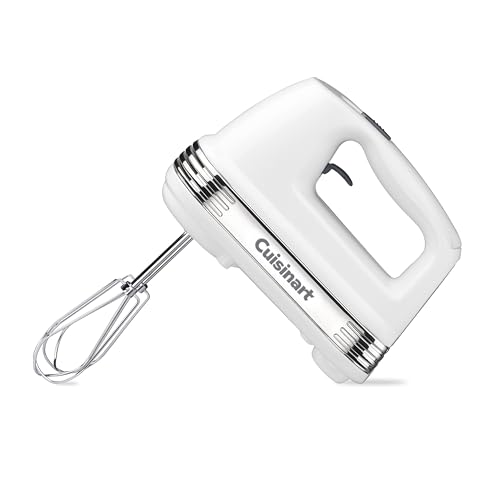
Cuisinart Power Advantage 5-Speed Hand Mixer (HM-50) — Best for Deep Bowls
The HM-50 is Cuisinart’s straightforward affordable hand mixer: a 220-watt motor, five speeds, extra-long beaters that reach into deep bowls and stockpots, and a long swivel cord. It suits practical bakers, people who mash potatoes in the pot, and anyone whose kitchen outlet is never where they need it. Attachment collectors should look at the 9-speed model instead, since this kit is beaters only.
Strengths
- Extra-long beaters reach the bottom of deep bowls and pots for in-pot mashing
- 220-watt motor is strong for a five-speed model at this tier
- Long 60-inch swivel cord gives real freedom around the counter
Trade-offs
- Beaters only; no whisk or dough hooks included
- Five speeds without a slow-start feature, so start carefully with flour
- Older, plainer design than the newer models in this guide
| Motor | 220 watts |
| Speeds | 5 |
| Attachments | Extra-long beaters |
| Cord | 60-inch swivel cord |
| Cleaning | Dishwasher-safe beaters |
Some mixers compete on features; this one competes on reach. The extra-long beaters sound like a trivial spec until you are mashing potatoes in the pot they cooked in, or mixing a double batch in your deepest bowl, and the beaters of a shorter mixer are churning the top layer while the bottom stays untouched. Here, the beaters get to the bottom, and the long cord means the pot can stay on the stove while you work.
The rest of the package is deliberately plain: five speeds, an easy-clean smooth housing with no crevices for batter to hide in, and beaters that go in the dishwasher. It has been in Cuisinart’s line for years because the formula works. If your mixing is mostly batters, potatoes and the occasional frosting, this is affordable done sensibly.
In-pot work is the unglamorous heart of electric mixing for many households — potatoes, soups finished with a swirl, sauces in the pan they cooked in. A hand mixer that reaches, with a cord that reaches further, is the right electric tool for that kitchen, and this is the one built for it.
Best for: practical cooks who mix and mash in deep bowls and pots / Not suited for: bakers who need a whisk and dough hooks in the box
Check the current price on Amazon

KitchenAid 5 Ultra Power Speed Hand Mixer (KHM512) — Best for Tidy Bakers
KitchenAid’s entry hand mixer suits bakers who value control and clean handling over raw attachment count. The Turbo Beater design has no centre post, so batters do not build up in the middle of the beater. It suits neat, methodical bakers and smaller households. It is less suited to anyone who wants dough hooks and a whisk included at this price, because KitchenAid sells this model as a focused two-beater tool.
Strengths
- Turbo Beater II shape mixes thoroughly and releases batter cleanly, with no centre post to clog
- Lockable swivel cord stays out of the bowl and out of the way for left- or right-handed use
- Smooth, quiet motor manners feel a step above most affordable hand mixers
Trade-offs
- Only beaters in the box; whisk and dough hooks are separate purchases
- Five speeds is enough for most tasks but keen bakers may want finer steps
- Costs more than Hamilton Beach rivals with similar headline power
| Speeds | 5 |
| Attachments | Stainless Steel Turbo Beater II accessories |
| Cord | Lockable swivel cord |
| Cleaning | Dishwasher-safe beaters |
The detail that sells this mixer is invisible until you wash it. Conventional beaters have a centre post where batter packs in and dries; the Turbo Beater II’s open design leaves nowhere for batter to hide, so a rinse and a run through the dishwasher genuinely finishes the job. For bakers who mix several times a week, that daily convenience compounds.
In use, the five speeds are well chosen rather than merely counted. The lowest is a true gentle fold, the middle speeds cover creaming and batter work, and the top speed whips respectably even without a dedicated whisk. The swivel cord sounds like a footnote until you have dragged a fixed cord through a bowl of frosting for the third time. This is the tidy person’s affordable hand mixer: fewer attachments, better manners.
Electric mixers live or die by how much friction they add to a recipe, and washing up is half that friction. A mixer whose beaters rinse clean in seconds gets used for small jobs a dirtier tool would be skipped for — and a mixer that gets used is the one that was worth buying.
Best for: neat, frequent bakers who value easy cleaning and calm motor manners / Not suited for: buyers who want whisk and dough hooks included at this price
Check the current price on Amazon
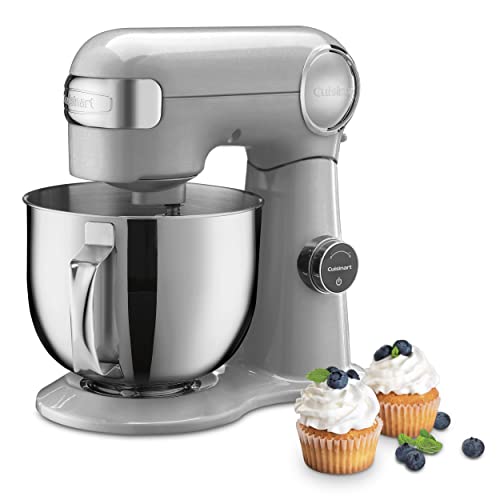
Cuisinart Precision Pro 5.5-Quart Digital Stand Mixer (SMD-50) — Best Digital Controls
The digital Precision Pro takes the SM-50 formula and adds electronic controls with preprogrammed settings for common prep tasks, for bakers who like pressing a preset instead of memorising speed charts. It suits tech-comfortable bakers and anyone who wants the big 5.5-quart bowl with a more guided experience. Traditionalists who prefer a simple dial and lever may find the standard SM-50 the better buy.
Strengths
- Preprogrammed settings take the guesswork out of common tasks for beginners
- Same generous 5.5-quart capacity as the SM-50
- Digital speed control is precise and repeatable from recipe to recipe
Trade-offs
- Electronics add a failure mode that a mechanical dial does not have
- Costs more than the standard SM-50 for controls, not mixing power
- Digital interface is a matter of taste; some bakers simply prefer a lever
| Bowl | 5.5 quart |
| Speeds | 12 |
| Controls | Digital, with 3 preprogrammed food prep settings |
| Attachments | Whisk, flat mixing paddle, dough hook |
| Included extra | Splash guard |
Preprogrammed settings on a mixer are easy to dismiss as decoration, but for the bakers this guide is written for — people upgrading from a hand mixer or a first cheap stand mixer — they solve a real problem: not knowing which speed a recipe means by “medium”. A preset that whips, kneads or mixes at the maker’s tested settings turns that guesswork into a button press while you learn.
Underneath the interface sits the same capable hardware as the SM-50: a big bowl, twelve speeds, and the full paddle, whisk and hook set with a splash guard. The question is purely whether the digital layer earns its premium for you. If you bake from written recipes with vague speed language, it does. If you already mix by feel and sound, save the difference and buy the dial version.
For the electric-mixer buyer specifically, digital control is the modern face of the category: repeatable speeds mean the recipe that worked in March works identically in November. Consistency is what you bought a motor for, and this machine takes it furthest.
Best for: recipe-following bakers who want guided, repeatable speed control and a big bowl / Not suited for: traditionalists who prefer a mechanical dial and the lowest price
Check the current price on Amazon
Comparison Table
The table compresses the six picks into the facts that decide most electric mixer purchases: the badge, the key specification behind it, and who should buy it. Shortlist here, then read the full reviews before you commit.
| Pick | Badge | Key spec | Best for |
|---|---|---|---|
| Hamilton Beach 4 Quart Electric Stand Mixer, 7 Speeds Check on Amazon | Best Overall | 300W, 7 speeds, planetary action, full attachment set | Households upgrading from hand mixing who want the full electric experience in one box |
| Hamilton Beach 6-Speed Electric Hand Mixer with QuickBurst (62682G) Check on Amazon | Best Budget | 250W motor, 6 speeds + QuickBurst | First electric mixer buyers and occasional bakers on a firm budget |
| KitchenAid Classic Series 4.5 Quart Tilt-Head Stand Mixer (K45SS) Check on Amazon | Best Upgrade | 4.5-qt tilt-head, 10 speeds, metal construction | Committed bakers buying the electric mixer they intend to keep for a decade |
| Cuisinart Power Advantage 5-Speed Hand Mixer (HM-50) Check on Amazon | Best for Deep Bowls | 220W motor, extra-long beaters, 60-inch swivel cord | Practical cooks who mix and mash in deep bowls and pots |
| KitchenAid 5 Ultra Power Speed Hand Mixer (KHM512) Check on Amazon | Best for Tidy Bakers | 5 speeds, Turbo Beater II accessories, swivel cord | Neat, frequent bakers who value easy cleaning and calm motor manners |
| Cuisinart Precision Pro 5.5-Quart Digital Stand Mixer (SMD-50) Check on Amazon | Best Digital Controls | Digital controls, 12 speeds, 3 preprogrammed settings | Recipe-following bakers who want guided, repeatable speed control and a big bowl |
How to Choose an Electric Mixer: Format, Motor and Speeds
Format first, because it decides everything else. Choose a hand mixer if your mixing is batters, frostings, whipped toppings and potatoes, if storage is a drawer, and if you value a one-minute wash-up. Choose a stand mixer if dough, double batches or hands-free working feature in your cooking, and if the machine can have a permanent home. The 2-in-1 and digital options in the wider market blur this line, but the honest divide remains: hand mixers are held, stand mixers hold themselves, and your recipes know which one they need.
Motor and speeds come next, and both are widely misunderstood. Wattage is not comparable across brands — measurement methods differ — so use it only within one maker’s range. What you can compare is behaviour: does the mixer hold its speed as a batter thickens, and is its lowest speed genuinely slow? A slow, controlled first speed matters more than a long speed list, because the first seconds of mixing decide whether flour stays in the bowl and whether a batter is folded or beaten. Stand mixers add one more criterion: planetary action, the beater orbiting the bowl, without which the edges never get mixed. Every stand pick in this guide has it; any model you consider elsewhere should be checked for it by name.
Attachments complete the picture. The core set — beaters or flat beater, whisk, dough hook — covers the category; a mixer missing pieces will cost you the difference later in proprietary add-ons. After the core, judge the practicalities: cord length and swivel for hand mixers, bowl size matched to your typical batch for stand mixers, and storage that keeps the kit together. Buy the complete package that matches your workload, not the cheapest box that shares a category name.
What an Electric Mixer Changes in Everyday Cooking
It is worth being concrete about the upgrade, because “electric” sounds incremental and is not. Creaming butter and sugar by hand takes the better part of ten minutes and produces a dense result; an electric mixer does it in three and traps noticeably more air, which you taste as a lighter cake. Egg whites go from a fifteen-minute whisking ordeal to a two-minute setting. Mashed potatoes stop being a workout. Dough — with the right format — stops being a reason to buy bread instead of baking it. Recipes you currently avoid because a step says “beat for eight minutes” come back onto the menu, and recipes you already make come out more consistent, because a motor’s minute four is identical to its minute one.
The budget framing follows from that. An affordable electric mixer is not a compromise version of the real thing; at the hand mixer end it is the real thing, mature and inexpensive because the machine is simple. At the stand mixer end, affordable means choosing which premium traits to forgo — some longevity, some refinement, some capacity — and this guide’s reviews name those trade-offs pick by pick so the choice is yours rather than the marketing department’s. Check the current price on Amazon for the configuration you settle on; electric mixer prices move with colour and season more than most categories.
How to Use an Electric Mixer: Your First Five Mixes
An electric mixer is easy to use and easy to use badly. These steps build the habits that separate the two, roughly in the order your first week of ownership will teach them.
- Assemble before you switch on. Attachments click or twist in with the mixer unplugged; beaters are often a matched pair with one collared shaft — check the manual once and it becomes automatic. Never change attachments with the mixer plugged in and your finger near the speed control.
- Start low, always. Beaters submerged, speed at its lowest, then step up as the mixture comes together. This single habit prevents flour clouds, splashed milk and overworked batters.
- Cream properly. Butter at cool room temperature, medium speed, and patience: you are waiting for the mixture to visibly lighten in colour and texture. That trapped air is structure your cake cannot get any other way.
- Add eggs singly, dry ingredients in stages. Eggs one at a time, each absorbed before the next; flour in two or three additions at the lowest speed, stopping the moment the last streak disappears. Overmixing after flour is the most common cause of tough cakes.
- Whip with commitment and attention. Cream and egg whites want higher speeds and a watchful eye: set the speed, then check every few seconds near the end. Both pass their peak quickly, and there is no way back from overwhipped cream except making butter.
- Knead only in the right format, at low speed. Stand mixer, dough hook, low gear, and a batch sized to the bowl. A hand mixer’s hooks are for bringing soft dough together, not for the full knead.
- Clean immediately. Attachments rinsed at once never need soaking; bowls wash easier warm. Wipe the mixer body with a damp cloth — batter in the vents is the one cleaning job that gets worse with time.
Keep those habits and the machine’s side of the bargain is simple: it will deliver the same mix, at the same speed, every time you ask. That repeatability — not power, not features — is what you actually bought.
Corded, Cordless and Digital: The New Electric Mixer Questions
Three newer variations deserve a plain answer each. Cordless hand mixers, represented in this programme’s wider guides by models like the KitchenAid Go, remove the cord entirely and genuinely change where you can mix — at an island, at the stove, in a serving bowl at the table. Their trade is discipline: a battery must be charged before the baking day, not discovered flat during it. For most kitchens a corded mixer remains the default, but for kitchens with one badly placed outlet, cordless is a solution, not a gimmick.
Digital controls, represented here by the Cuisinart Precision Pro, trade the mechanical dial for presets and exact repeatability. They suit bakers who follow written recipes closely and want “medium” to mean the same thing every time. Mechanical controls suit bakers who mix by ear and want a machine with one less electronic system to age. Neither is more “electric” than the other; they are two interfaces on the same idea. Choose by how you cook, and let the bowl, motor and attachments — the parts that touch food — carry more weight in the decision than the control panel does.
Common Buying Mistakes
Assuming “electric” means one kind of product
Shoppers searching for an electric mixer often buy the first format they see reviewed, then discover their recipes needed the other one. Hand and stand mixers overlap in the middle — batters and frostings — and diverge at the edges: dough and volume belong to stands, speed and storage belong to hands. Decide your format from your recipe list before you compare a single model.
Comparing wattage across brands
Peak power, working power and marketing power are three different numbers wearing one label. A mixer that holds speed in thick batter with a modest rating is a better machine than one that fades with a bigger number on the box. Judge by behaviour and by the workload the maker rates the machine for — the reviews above do exactly that.
Skipping the slow-speed test
The most-used speeds on any electric mixer are the bottom two, and the most common cheap-mixer failure is a “slow” speed that is not slow. Slow-start and anti-splatter features sound like garnish and are actually the difference between a calm kitchen and a flour-dusted one. Weight them heavily.
Buying the stand mixer without a home for it
A stand mixer that lives in its box gets used twice a year. Measure the counter or cupboard it will occupy — including tilt-head clearance — before buying, and if the honest answer is that there is no home, buy the best hand mixer instead and enjoy using it weekly.
Forgetting that attachments are part of the price
A bare mixer plus a separately bought whisk and hooks often costs more than the complete-kit model it undercut on the shelf. Compare total kits, not headline prices — several picks in this guide win their badges on exactly that arithmetic.
Final Recommendation
Start with format, then buy the badge that matches. For the complete electric upgrade in one box, choose the Hamilton Beach stand mixer — Best Overall Check the current price on Amazon. For the least money that buys a proper motor, choose the Hamilton Beach hand mixer — Best Budget Check the current price on Amazon. For the machine you keep for a decade, stretch to the KitchenAid Classic — Best Upgrade Check the current price on Amazon. Deep-bowl cooks should take the Cuisinart HM-50’s reach seriously, tidy bakers the KitchenAid KHM512’s wash-up, and recipe-followers the Cuisinart digital model’s presets. Any of the six will change your cooking more than its price suggests — that is what a motor does.
- Hamilton Beach 4 Quart Electric Stand Mixer, 7 Speeds — Best Overall: Check the current price on Amazon
- Hamilton Beach 6-Speed Electric Hand Mixer with QuickBurst (62682G) — Best Budget: Check the current price on Amazon
- KitchenAid Classic Series 4.5 Quart Tilt-Head Stand Mixer (K45SS) — Best Upgrade: Check the current price on Amazon
Related guides in this series: Best Affordable Mixers Best Affordable Hand Mixers Best Affordable Kitchen Mixers Best Affordable Mixers For Baking Best Affordable Mixers Bed Bath And Beyond
Frequently Asked Questions
What is the difference between a hand mixer and a stand mixer?
A hand mixer is a motor with beaters that you hold and move around the bowl: cheap, small, quick to wash, ideal for batters, frostings, whipped cream and potatoes. A stand mixer holds itself over its own bowl: it works hands-free, kneads dough properly and handles larger batches, at a higher price and with a permanent footprint. Most kitchens’ weekly mixing suits a hand mixer; dough and volume justify a stand.
Is an electric mixer worth it if I only bake occasionally?
Yes — arguably it is worth most to occasional bakers, because it removes the effort that makes baking feel like an event. A budget hand mixer costs little, stores in a drawer, and turns a twenty-minute hand-mixing chore into three minutes. Occasional bakers who knead, though, should still respect the format boundary and borrow or buy stand power for dough days.
How powerful does an electric mixer need to be?
Powerful enough to hold its speed in your thickest mixture — and that is a behaviour, not a number, because wattage is measured inconsistently across brands. Within one brand’s range, higher ratings generally mean more headroom. Across brands, judge by mixing action, gearing and the workload in the reviews rather than by arithmetic.
Can an electric hand mixer replace a stand mixer?
For batters, frostings, whipped cream and mashed potatoes, yes, entirely. For kneading bread dough, mixing double batches, or any job where you want to walk away while it works, no — those are the stand mixer’s reasons to exist. Many households own a hand mixer for years before adding a stand mixer, and some never need to.
Are digital controls on a mixer worth paying for?
For bakers who cook from written recipes, yes: presets and precise, repeatable speeds remove the guesswork from instructions like “beat on medium”. For experienced bakers who mix by sound and feel, a dial does the same job for less. The Cuisinart digital pick in this guide pairs its controls with a genuinely large bowl, so the premium buys capacity as well as guidance.
How do I make an electric mixer last?
Respect its workload — do not force stiff dough in a hand mixer or overload a stand mixer’s bowl — clean attachments promptly, keep vents clear of flour dust, and store the whole kit together so nothing is lost or bent. Matched to its job, an affordable electric mixer should serve for years; the metal-bodied upgrade pick is a decade-scale purchase.

