Disclosure: airfryerkitchensupply.com is reader-supported. When you buy through links on our site, we may earn an affiliate commission at no extra cost to you.
Where to buy
Shopping for the best 6 qt standing mixers starts with one honest fact: the exact 6.0-quart bowl has largely disappeared from current line-ups. KitchenAid replaced its old 6-quart bowl-lift line with 5.5-quart and 7-quart models, so today’s real choice sits in a bracket around the size you searched for — close-capacity machines from 5.5 to 7 quarts that do the same jobs. Every pick below is a current, real machine verified against Amazon’s catalogue on the day this guide was written. Confirm the bowl size and the included attachments on the listing itself, because the same model name is sold in several bundles.
- KitchenAid 5.5-Qt Bowl-Lift Stand Mixer (KSM55) — check price on Amazon; choose the listing sold or shipped by Amazon or the brand’s own store, and confirm the exact model variant before you buy.
- Bosch Universal Plus Stand Mixer (6.5 Qt) — check price on Amazon; choose the listing sold or shipped by Amazon or the brand’s own store, and confirm the exact model variant before you buy.
- KitchenAid 7 Quart Bowl-Lift Stand Mixer (KSM70) — check price on Amazon; choose the listing sold or shipped by Amazon or the brand’s own store, and confirm the exact model variant before you buy.
- Cuisinart Precision Master Stand Mixer (SM-50, 5.5 Qt) — check price on Amazon; choose the listing sold or shipped by Amazon or the brand’s own store, and confirm the exact model variant before you buy.
- Ankarsrum Assistent Original Stand Mixer (AKM6230) — check price on Amazon; choose the listing sold or shipped by Amazon or the brand’s own store, and confirm the exact model variant before you buy.
- KitchenAid Commercial Series 8-Qt Bowl Lift Stand Mixer (KSM8990) — check price on Amazon; choose the listing sold or shipped by Amazon or the brand’s own store, and confirm the exact model variant before you buy.
The best 6 qt standing mixers were, for years, the default recommendation for serious home bakers: big enough for a double batch of cookies or two loaves of bread dough, small enough to live on a counter. If you have come looking for that exact size, you deserve a straight answer before a shopping list. The classic 6-quart class has been re-drawn by its biggest maker. KitchenAid’s long-running Professional 600 — the machine that defined the size — has given way to a 5.5-quart bowl-lift and a 7-quart bowl-lift, and most rival brands have settled at 5.5, 6.5 or 7 quarts instead.
That is not a problem in practice. Bowl capacity is a working-range figure, not a precision instrument: what matters is how much flour a machine can knead without straining, how it handles a single egg white at the small end, and whether the bowl, beaters and motor are built for the way you actually bake. This guide therefore ranks the six standing mixers that bracket the old 6-quart class most honestly — three below or at the line, three just above it — and tells you plainly which side of the line your baking belongs on.
If you bake mostly single batches — one cake, one tray of cookies, a dozen muffins — the 5.5-quart picks will feel roomy and will cost you less counter space and money. If you regularly double recipes, bake bread weekly, or make holiday batches for a crowd, step up to the 6.5- and 7-quart picks and do not look back. Everything in between is decided by drive design, attachments and how much you value a quiet, cool-running motor over a low price.
One promise before the picks: every capacity figure in this guide is the figure from the machine’s own verified listing, and every badge maps to a real kitchen rather than a marketing segment. Where a machine is the wrong answer for a common baking pattern, the review says so in its verdict line — because a mixer this size is a ten-year purchase, and the cheapest mistake is buying the wrong one first.
In this guide
Quick Picks
Short on time? The KitchenAid 5.5-Qt Bowl-Lift is the closest living relative of the classic 6-quart machine and the safest buy for most kitchens. Bread bakers should look hard at the Bosch Universal Plus, and anyone who doubles every recipe should go straight to the KitchenAid 7-Qt Bowl-Lift.
- Best Overall: KitchenAid 5.5-Qt Bowl-Lift Stand Mixer (KSM55) — the direct successor to the classic 6-quart KitchenAid, with 11 speeds including a half-speed fold and the full attachment ecosystem. — Check on Amazon
- Best for Bread Dough: Bosch Universal Plus Stand Mixer (6.5 Qt) — a bottom-drive 6.5-quart design that kneads bread dough better than anything else at its size and stores in half the height. — Check on Amazon
- Best for Big Batches: KitchenAid 7 Quart Bowl-Lift Stand Mixer (KSM70) — the step-up for bakers who outgrew 6 quarts — a 7-quart bowl-lift with a generous accessory set in the box. — Check on Amazon
- Best Value: Cuisinart Precision Master Stand Mixer (SM-50, 5.5 Qt) — a 12-speed, 5.5-quart tilt-head with a complete accessory set at a friendlier tier than the big names. — Check on Amazon
- Best Premium: Ankarsrum Assistent Original Stand Mixer (AKM6230) — the Swedish rotating-bowl icon — a 7-litre-class machine that kneads like nothing else and is built to be serviced, not replaced. — Check on Amazon
- Best Heavy-Duty: KitchenAid Commercial Series 8-Qt Bowl Lift Stand Mixer (KSM8990) — an NSF-certified commercial bowl-lift for micro-bakeries, market stalls and anyone who has killed a domestic mixer. — Check on Amazon
How These Picks Were Chosen
Every machine in this guide was verified as a current Amazon listing on the day of writing, and we matched each pick to the exact model and bowl size in its listing title — no discontinued model numbers, no marketplace ghosts. Machines that failed that check, however famous, were left out or written about without a purchase link.
We then ranked the verified machines on the things that decide whether a big standing mixer earns its counter space over ten years of use: kneading capacity with stiff dough, low-speed control for folding and starting flour-heavy mixes without a flour cloud, the attachment ecosystem you can grow into, and honest build — metal gearing and a frame that does not walk across the counter under load.
One more filter mattered for this particular keyword: honesty about size. Several machines are marketed with generous language around capacity while their bowls measure smaller, and a few genuinely large machines hide behind modest model names. We went by the bowl size stated in each verified listing and by each design’s real working behaviour, and where a pick sits above or below the exact 6-quart line, the review says so in plain words rather than rounding quietly in the brand’s favour.
- Verified current listing with the bowl size stated in the listing title itself
- Kneading strength with bread dough, not just cake batter performance
- Low-speed finesse: gentle fold and soft-start behaviour for small loads
- Attachment ecosystem — pasta, grinding, milling and specialty tools
- Build quality you can feel: weight, gearing, bowl and beater materials
- Counter reality: height under standard cabinets and day-to-day storage
The 6 Best 6 Qt Standing Mixers

KitchenAid 5.5-Qt Bowl-Lift Stand Mixer (KSM55) — Best Overall
If your mental picture of a 6 qt standing mixer is the old KitchenAid Professional 600, this is its modern heir. The KSM55 keeps the bowl-lift architecture — the bowl cranks up to the head on a lever, which is the stable, wobble-free design you want for dough — and pairs it with a 5.5-quart stainless bowl and 11 speeds, including a half-speed setting made for folding. It suits bakers who want the classic machine’s behaviour in a slightly trimmer footprint, and who plan to use the front attachment hub for pasta rollers, grinders and mills over the years.
Strengths
- Bowl-lift frame stays planted under heavy dough loads where tilt-heads can flex
- 11 speeds with a genuine half-speed fold for delicate work
- Front hub accepts the deep KitchenAid attachment catalogue
Trade-offs
- Half a quart smaller than the 6-quart brief — double batches of stiff dough are near its ceiling
- Bowl-lift design needs the bowl seated exactly on its pins, which takes a week of habit
- Heavier than tilt-head rivals, so it is a leave-it-out machine, not a cupboard machine
| Model | KSM55 series bowl-lift |
| Bowl | 5.5-quart stainless steel (verified in listing title) |
| Speeds | 11, including 1/2-speed fold |
| Included | Flat beater, dough hook, wire whip |
The reason to buy this machine over cheaper 5.5-quart rivals is control at the extremes. At the bottom end, the half-speed fold lets you incorporate flour or fold egg whites without the violent first spin that coats many counters in a white dusting. At the top end, the bowl-lift frame and the machine’s mass keep it composed with a full bowl of bagel dough, the load that makes lighter mixers creep and complain. Whipping is equally composed: the wire whip reaches small quantities better than you would expect from a bowl this size, though a single egg white will always be happier in a hand mixer.
Ownership is the other half of the case. KitchenAid’s attachment hub is the largest ecosystem in the category, parts and service are easy to find, and the three included tools — flat beater, dough hook and wire whip — are the correct starter set rather than a padded bundle. If you are replacing a dead Professional 600 and wondering whether the smaller bowl will frustrate you: for one-loaf and standard double-cookie-batch work, it will not. Only bakers who routinely maxed out the old 6-quart bowl should read on to the 7-quart pick instead.
Best for: bakers who want the classic 6-quart KitchenAid experience, modernised, with the full attachment ecosystem / Not suited for: bakers who regularly maxed out a true 6-quart bowl with double dough batches
Check on Amazon — check the current price on Amazon and confirm the variant, included accessories and seller before ordering.
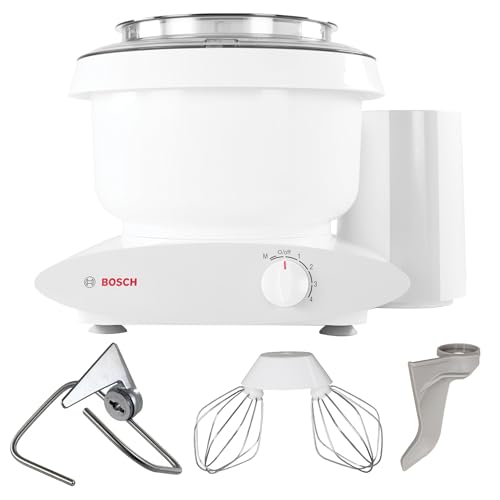
Bosch Universal Plus Stand Mixer (6.5 Qt) — Best for Bread Dough
The Bosch Universal Plus ignores every convention of the standing mixer category: the motor sits in the base, the 6.5-quart bowl is driven from below, and the whole machine is short enough to slide into a cupboard. That layout makes it the strongest kneader in this guide — the bottom-drive design pulls dough down into the hook instead of climbing it — and a favourite of bread bakers who make large, whole-grain batches. It suits households that bake bread weekly and value capacity and storage over the classic stand-mixer silhouette.
Strengths
- Bottom-drive kneading handles large, stiff, whole-grain doughs without strain or bowl climbing
- 6.5-quart bowl is the closest true capacity to the 6-quart brief — and slightly above it
- Low, light body stores in a standard cupboard, unlike tall bowl-lift machines
Trade-offs
- The open-top bowl and twin-whip system take a session or two to learn
- Plastic bowl on many bundles (a stainless bowl version exists — check the listing)
- Looks and feels different from a classic stand mixer, which puts off traditionalists
| Model | Bosch Universal Plus |
| Motor | 500 watt (verified in listing title) |
| Bowl | 6.5 quarts |
| Included in this bundle | Wire whips, dough hook, dough hook extender |
Bread is where the Bosch earns its badge. Owners who bake four-loaf batches or high-hydration doughs with heavy wholemeal flour consistently find it works the dough rather than fighting it, and the dough hook extender in this bundle keeps smaller batches centred on the hook. The twin wire whips, driven from below, whip cream and egg whites quickly and evenly, and because the bowl is open at the top with no central head in the way, adding ingredients mid-mix is the easiest in this guide.
The compromises are real but specific. The drive tower in the middle of the bowl means scraping is a different motion than you are used to, the standard bowl is plastic rather than steel on many bundles, and the machine’s talents are concentrated in mixing and kneading — its attachment ecosystem exists but is narrower than KitchenAid’s. If your baking is 60 percent bread, none of that matters: this is the pick. If your baking is 60 percent layer cakes and frostings, the KitchenAid above is the more natural tool.
Best for: bread bakers making large or whole-grain batches who also want a machine that stores away / Not suited for: bakers who want the classic stand-mixer look and the widest attachment catalogue
Check on Amazon — check the current price on Amazon and confirm the variant, included accessories and seller before ordering.

KitchenAid 7 Quart Bowl-Lift Stand Mixer (KSM70) — Best for Big Batches
Some bakers search for 6-quart mixers because that is the size they know, when the honest truth is they outgrew it years ago. The KSM70 is KitchenAid’s answer: a 7-quart bowl-lift machine with 11 speeds, the same half-speed fold as its smaller sibling, and a fuller accessory bundle that includes a double flex-edge beater. It suits high-volume home bakers — the ones who bake for school sales, big families, church kitchens and holiday production runs — and anyone tired of splitting recipes in half.
Strengths
- 7-quart bowl swallows double and triple batches that strain 5.5–6-quart machines
- Accessory-rich box, including a double flex-edge beater for bowl scraping
- Same 11-speed control and half-speed fold as the smaller KSM55
Trade-offs
- Big and heavy — measure your counter-to-cabinet height before ordering
- Small loads (two egg whites, a cup of cream) sit low in the wide bowl
- Costs meaningfully more than the 5.5-quart model for capacity you may not use
| Model | KSM70 series bowl-lift |
| Bowl | 7-quart stainless steel |
| Speeds | 11, including 1/2-speed fold |
| Included | Double flex-edge beater plus 4 other accessories (per listing title) |
Capacity is a quality-of-life feature you feel every single bake. With the 7-quart bowl, a double batch of chocolate-chip cookie dough mixes in one go with headroom to spare, and a large enriched dough — panettone, brioche for a crowd — kneads without the bowl threatening to overflow on the rise of the mix. The flex-edge beater earns its place too: in a bowl this wide, a plain flat beater leaves a band of unmixed butter and sugar at the wall, and the double flex edge quietly removes most of that scraping.
The cautions are about fit, in both senses. Physically, this is a tall, heavy bowl-lift that wants a permanent home on the counter; check the clearance under your wall cabinets with the bowl raised. In use, minimum loads matter: the whisk sits higher above a small volume of liquid in a 7-quart bowl, so tiny jobs still belong to a hand mixer. Buy it for the batches you actually make at your busiest — if those are double batches and up, this is the most satisfying machine in the guide.
Best for: high-volume bakers who double and triple recipes and bake for crowds / Not suited for: small households baking single small batches, or tight counters with low cabinets
Check on Amazon — check the current price on Amazon and confirm the variant, included accessories and seller before ordering.

Cuisinart Precision Master Stand Mixer (SM-50, 5.5 Qt) — Best Value
The Cuisinart SM-50 is the value pick done properly: a 5.5-quart stainless bowl, 12 speeds, a tilt-head design that makes beater changes effortless, and a splash guard with a pour spout included rather than sold separately. It suits bakers who want a real, metal-bodied standing mixer for cakes, cookies and occasional bread without paying the premium-brand tax, and who would rather have a complete kit in one box than a bare machine plus a shopping list.
Strengths
- 12 speeds give finer low-end control than most budget rivals
- Complete box: whisk, paddle, dough hook and splash guard with pour spout
- Tilt-head access makes swapping tools and scraping genuinely easy
Trade-offs
- Tilt-head frame is less rigid than bowl-lift designs with very stiff dough
- Attachment ecosystem is small next to KitchenAid’s
- Motor is tuned for home batches — continuous heavy bread production is beyond its brief
| Model | SM-50 Precision Master |
| Bowl | 5.5-quart stainless steel |
| Speeds | 12 |
| Included | Chef’s whisk, mixing paddle, dough hook, splash guard with pour spout |
In daily baking the SM-50 feels like a machine designed by people who bake. The tilt head clicks back and stays back, the bowl locks with a positive twist, and the speed dial’s lowest settings are genuinely low — you can start a bowl of flour-heavy batter without wearing it. Twelve speeds sound like marketing until you are folding whipped cream into a mousse and discover the in-between speeds are exactly where you live. For cakes, frostings, meringues and cookie dough, it is honestly all the mixer most households need.
Where it concedes ground is the heavy end. A full 5.5-quart load of stiff bagel or wholemeal dough works the tilt-head joint harder than a bowl-lift frame, and you can feel the head nod under the load — occasional loaves are fine, a weekly four-loaf routine belongs to the Bosch or the KitchenAids. Judge it by your real menu: if bread is a sometimes food in your kitchen, the SM-50 is the smart money in this guide.
Best for: cake, cookie and batter bakers who want a complete, well-priced 5.5-quart package / Not suited for: weekly bread producers kneading large stiff doughs
Check on Amazon — check the current price on Amazon and confirm the variant, included accessories and seller before ordering.
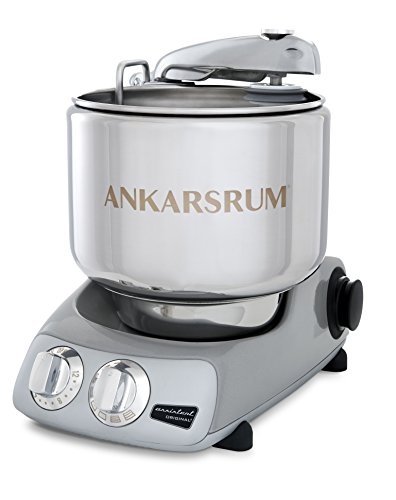
Ankarsrum Assistent Original Stand Mixer (AKM6230) — Best Premium
The Ankarsrum Assistent has been made in Sweden, in recognisably the same form, for decades, and it works unlike anything else here: the large stainless bowl rotates while a roller and scraper work the dough against its wall. The result is a kneading action that mimics hand work and handles very large dough quantities with an ease that embarrasses conventional designs. It suits committed bakers who buy appliances once, keep them for decades, and care more about dough quality than about matching the neighbours’ countertop.
Strengths
- Rotating-bowl kneading is exceptionally gentle and effective on large dough batches
- Huge working capacity in the 7-litre-class bowl for bulk baking
- Legendary serviceability and longevity; a buy-once machine
Trade-offs
- A learning curve: the roller-and-scraper method is unlike any other mixer
- Premium pricing well above the rest of this guide
- Whipping small quantities needs the separate smaller bowl and whisk set-up
| Model | AKM6230 Assistent Original |
| Design | Rotating bowl with roller and scraper |
| Origin | Made in Sweden |
| Finish verified | Jubilee Silver |
Watch an Ankarsrum knead and the difference is obvious within a minute: instead of a hook dragging dough around, the bowl turns and the roller folds the dough against the scraper in a slow, rhythmic press that develops gluten without tearing or overheating it. Bakers who make big lean doughs — the kind that climb hooks and stall motors — tend to become quietly evangelical about it, and the machine’s multi-decade production run means parts, bowls and accessories remain available long after trendier models are orphaned.
It asks something of you in return. The first few bakes involve learning how the roller position, scraper and speed interact, and the separate plastic bowl with twin whisks for cakes and creams is a second system to store. The price is also firmly premium. But as an answer to the 6-quart question — what is the best large standing mixer to own for twenty years — the Ankarsrum is the connoisseur’s correct answer, and the one machine here that professional bakers regularly keep at home.
Best for: committed bakers who want the finest large-batch kneading and a machine built for decades / Not suited for: bakers who want familiar controls, a low price, or one bowl that does everything
Check on Amazon — check the current price on Amazon and confirm the variant, included accessories and seller before ordering.

KitchenAid Commercial Series 8-Qt Bowl Lift Stand Mixer (KSM8990) — Best Heavy-Duty
This is the guide’s ceiling pick, included because some readers searching for a 6-quart standing mixer are really shopping for a small commercial machine and do not know the category exists. The KSM8990 is KitchenAid’s NSF-certified commercial countertop mixer: an 8-quart bowl-lift built for duty cycles no domestic model is rated for. It suits micro-bakeries, farmers-market producers, community kitchens and serious home bakers whose ‘hobby’ now has customers.
Strengths
- NSF commercial certification and a build rated for sustained daily production
- 8-quart bowl handles the largest batches in this guide
- Bowl-lift stability with commercial-grade fit and finish
Trade-offs
- Far more machine — and money — than a home kitchen needs
- Large footprint and weight demand a permanent, sturdy station
- Domestic niceties and colour choices are not the point here
| Model | KSM8990 Commercial Series |
| Bowl | 8-quart bowl-lift |
| Certification | NSF certified (per listing title) |
| Speeds | 10-speed, gear-driven |
The difference between this and the domestic 7-quart model is not the extra quart; it is the duty rating. A commercial mixer is built to run batch after batch, day after day, with serviceable parts and a drivetrain that treats a full bowl of stiff dough as a normal Tuesday rather than a stress test. If you sell what you bake — even at one market stall — that reliability is not a luxury, it is the difference between a tool and a liability, and the NSF certification can matter for inspected premises.
For purely domestic use, be honest with yourself: the KSM70 above does the same recipes with a friendlier accessory bundle and a friendlier price, and neither machine will make your bread taste different. The KSM8990 earns its place in this guide for the reader whose mixer is effectively a business asset. For that reader, it is not the expensive option — replacing a burnt-out domestic mixer every two seasons is the expensive option.
Best for: micro-bakeries, market producers and community kitchens needing commercial duty / Not suited for: ordinary home baking, where the 7-quart domestic model is the rational buy
Check on Amazon — check the current price on Amazon and confirm the variant, included accessories and seller before ordering.
Comparison Table
| Pick | Badge | Key spec | Best for |
|---|---|---|---|
| KitchenAid 5.5-Qt Bowl-Lift Stand Mixer (KSM55) — Check on Amazon | Best Overall | 5.5-qt bowl-lift, 11 speeds | bakers who want the classic 6-quart KitchenAid experience, modernised, with the full attachment ecosystem |
| Bosch Universal Plus Stand Mixer (6.5 Qt) — Check on Amazon | Best for Bread Dough | 6.5-qt bottom-drive, 500W | bread bakers making large or whole-grain batches who also want a machine that stores away |
| KitchenAid 7 Quart Bowl-Lift Stand Mixer (KSM70) — Check on Amazon | Best for Big Batches | 7-qt bowl-lift, 11 speeds | high-volume bakers who double and triple recipes and bake for crowds |
| Cuisinart Precision Master Stand Mixer (SM-50, 5.5 Qt) — Check on Amazon | Best Value | 5.5-qt tilt-head, 12 speeds | cake, cookie and batter bakers who want a complete, well-priced 5.5-quart package |
| Ankarsrum Assistent Original Stand Mixer (AKM6230) — Check on Amazon | Best Premium | Rotating 7L-class bowl, roller kneading | committed bakers who want the finest large-batch kneading and a machine built for decades |
| KitchenAid Commercial Series 8-Qt Bowl Lift Stand Mixer (KSM8990) — Check on Amazon | Best Heavy-Duty | 8-qt commercial bowl-lift, NSF | micro-bakeries, market producers and community kitchens needing commercial duty |
Read the bowl sizes in this table as a bracket, not a ladder: 5.5 quarts serves most households completely, 6.5–7 quarts serves batch bakers, and 8 quarts is commercial territory. The right choice is the smallest bowl that holds your largest regular batch with headroom — oversizing a mixer makes small jobs worse, not better.
How to Choose the Right 6 Qt Standing Mixer
Start with flour weight, not bowl quarts
Quarts describe the bowl; flour weight describes the work. A mixer that happily creams butter in a full bowl may strain at half that bowl filled with bread dough, because dough is dense and fights back. As a working rule, a 5.5-quart machine kneads a standard one-to-two-loaf dough comfortably, a 6.5–7-quart machine doubles that, and anything beyond belongs to the commercial pick. If a recipe’s flour weight is the number you know, shop by that — it is the figure experienced bakers actually compare.
Also consider the small end, which brochures never mention. Wide bowls and high beaters are clumsy with two egg whites or half a cup of cream. If your baking life is mostly small, a mid-size bowl plus a decent hand mixer for tiny jobs beats one giant machine for everything.
Bowl-lift versus tilt-head versus bottom-drive
Bowl-lift machines (the KitchenAids here) hold the head still and crank the bowl up to it. The frame is rigid, which is why they dominate the heavy-dough end of the market, and the design slides under cabinets more easily than a tilted head — but you must seat the bowl on its pins correctly every time. Tilt-head machines (the Cuisinart) are friendlier minute-to-minute: the head flips back for beater changes and scraping, at the cost of some flex under stiff loads.
Bottom-drive (the Bosch) and rotating-bowl (the Ankarsrum) designs abandon the overhead head entirely. Both knead superbly and store more easily; both ask you to learn a slightly different technique. None of the four architectures is ‘best’ — they are optimised for different kitchens, and this guide’s badges map them to those kitchens.
- Choose bowl-lift for dough-heavy work and under-cabinet storage
- Choose tilt-head for easy access, scraping and beater swaps
- Choose bottom-drive or rotating-bowl for maximum kneading quality and compact storage
Speeds, watts and other marketing numbers
Spec sheets in this category reward scepticism. Wattage figures are measured differently by different makers — peak draw versus sustained output — so a higher number does not guarantee a stronger knead; drive design and gearing matter more, which is why the 500-watt bottom-drive Bosch out-kneads nominally stronger rivals. Speed counts are similar: what matters is not whether a dial goes to 10 or 12, but how slow the slowest speed truly is and whether the machine starts gently. A genuine low fold speed and a soft start protect both your batter and your countertop.
Treat ‘flour capacity’ claims the same way. Makers publish them under ideal conditions with cooperative dough. In a real kitchen, hydration, flour type and batch shape all move the number. Buy with headroom: if your biggest regular dough sits at a model’s published limit, that model is too small for you, whatever the bowl’s quart figure says.
Budget tiers, honestly
The search’s tier breaks into three honest bands. The value band buys you a competent 5.5-quart tilt-head like the Cuisinart — plenty for cakes and cookies. The mid band buys bowl-lift rigidity, better low-speed control and the big attachment ecosystems; this is where most serious bakers should land. The premium band — Ankarsrum, the commercial KitchenAid — buys longevity and duty rating rather than better cake. Spend into the band that matches your weekly reality, not your most ambitious December.
What Happened to the Classic 6-Quart Size?
It is worth understanding why your search lands on 5.5s and 7s. The 6-quart class was defined by one machine — KitchenAid’s Professional 600 — sold for many years to exactly the bakers now replacing theirs. When KitchenAid redesigned its bowl-lift line, it re-cut the sizes around new motors and bowls, landing at 5.5 and 7 quarts. Rival brands had already scattered: Bosch at 6.5, Ankarsrum at roughly 7 litres, Cuisinart at 5.5. The ‘6-quart mixer’ did not get worse; it got absorbed into a bracket.
The practical consequence: if you own accessories or a spare bowl for an older 6-quart machine, do not assume they fit the new models — check bowl and beater compatibility by model number, not by quart size. And if a listing anywhere advertises a brand-new 6-quart big-brand machine at a suspiciously gentle price, treat it as a red flag: the genuine current machines are the ones in this guide, at the sizes in this guide.
Attachments: The Ecosystem Is the Real Product
A standing mixer is a motor with a hub, and over a decade the hub may matter more than the bowl. Pasta rollers, meat grinders, grain mills, spiralizers and ice-cream makers turn one appliance into a counter of them — but only within one brand’s system. KitchenAid’s hub catalogue is the deepest, which is a genuine reason to choose its machines even when a rival kneads slightly better. Bosch and Ankarsrum offer their own useful ranges, strongest in milling and food processing. Cuisinart’s is the slimmest.
Before you buy, list the two attachments you would realistically purchase in the next three years and confirm they exist for your chosen machine, by model number. That five-minute check prevents the most expensive mistake in this category: a superb mixer that cannot grow with you, replaced early by one that can.
Noise, Heat and the Ten-Year View
A large mixer is one of the few appliances you can reasonably expect to own for a decade or more, so judge it the way you would a good knife. Noise is the first long-term factor: all of these machines are audible under load, but the character differs — gear-driven bowl-lifts produce a purposeful mechanical note, the Bosch’s base-drive is a lower hum, and the Ankarsrum is the quietest of the group at dough speeds. If you bake early in the morning in a small house, that difference is not trivial.
Heat is the second. Any mixer kneading stiff dough converts effort into warmth in both the dough and the motor housing; a machine that feels merely warm after a full knead is healthy, while one that smells hot is being over-asked. The picks in this guide were chosen partly for thermal headroom — motors and gear trains sized so that a normal large batch sits well inside their comfort zone rather than at its edge.
Finally, think about service. Bowls dent, beaters lose coatings, drive parts wear. The brands in this guide all sell replacement bowls and tools by model number, and the Ankarsrum and commercial KitchenAid go further with genuinely serviceable designs. A mixer you can repair is cheaper over ten years than a slightly cheaper mixer you must replace — the maths of this category always favours the machine with parts support.
How to Set Up and Get the Best From a Large Standing Mixer
A big standing mixer rewards ten minutes of setup more than any other small appliance. Do these steps once, in order, and the machine will feel twice as capable.
- Measure first: check the height from counter to the underside of your wall cabinets, and for tilt-head models, the extra arc the head needs to open fully.
- Seat the bowl correctly — on a bowl-lift, both pins engaged and the lift lever raised fully; on a tilt-head, the bowl twisted locked before the head comes down.
- Check beater-to-bowl clearance with the maker’s adjustment (often a single screw on the neck or lift): the flat beater should just clear the bowl floor — a coin placed in the bowl should nudge, not jam.
- Start every flour-heavy mix at the lowest speed for 20–30 seconds before raising it; this one habit eliminates most flour clouds and much motor strain.
- Knead at the maker’s recommended dough speed (usually speed 2 on KitchenAid-style machines) — faster is not better for gluten or for gears.
- For small whipping jobs in a big bowl, tilt the bowl slightly or switch to a hand mixer; do not chase two egg whites around a 7-quart bowl.
- Wash beaters and bowl promptly, dry the hub socket, and store the bowl off the machine if your kitchen is humid.
After the first month, revisit the clearance check: bowls and beaters settle, and a millimetre of adjustment is the difference between unmixed flour at the bottom and a clean, even mix.
Common Buying Mistakes
- Buying quarts instead of capacity. A bigger bowl does not knead more dough by default — check flour-weight capacity and drive design, not just the number on the box.
- Ignoring cabinet clearance. Bowl-lift machines need their full height; tilt-heads need opening arc. Measure before the box arrives, not after.
- Running dough at high speed. Most makers specify one low kneading speed. High-speed kneading overheats motors and tears gluten.
- Assuming old bowls fit new models. The 6-quart generation’s bowls and beaters often do not fit the 5.5/7-quart successors. Verify by model number.
- Skipping the attachment plan. Choosing the wrong ecosystem is a slow, expensive mistake. Decide your likely attachments first.
- Leaving small jobs to a giant bowl. Tiny loads mix badly in big bowls. A cheap hand mixer alongside is the professional solution, not an admission of defeat.
Final Recommendation
If you take one machine from this guide, take the KitchenAid 5.5-Qt Bowl-Lift: it is the true heir to the 6-quart classic, with the control, ecosystem and build most bakers actually need. Bread specialists should choose the Bosch Universal Plus without hesitation, batch bakers the KitchenAid 7-Qt, and value hunters the Cuisinart SM-50. The Ankarsrum is the connoisseur’s lifetime machine, and the commercial KitchenAid is there for readers whose baking has quietly become a business.
Whichever you choose, buy it by exact model number, confirm the bowl and tools in the listing, and check price on Amazon at the moment of purchase — bundles and finishes change, and the right variant matters more than a small price wobble.
Keep exploring the cluster: Best 6qt Mixers Best Affordable Stand Mixers Best 10 Quart Mixers Best 20qt Dough Mixers Best Affordable Kitchen Mixers
Frequently Asked Questions
Is a 5.5-quart mixer big enough if I wanted a 6-quart?
For almost everyone, yes. The half-quart difference disappears in normal use: a 5.5-quart bowl handles standard double cookie batches and one-to-two-loaf doughs. Only bakers who regularly filled a 6-quart bowl to the brim with stiff dough will feel the squeeze — and they are better served stepping up to 6.5 or 7 quarts anyway.
Why did KitchenAid stop making the 6-quart size?
The 6-quart Professional 600 was replaced when KitchenAid redesigned its bowl-lift line, which now brackets the old size at 5.5 and 7 quarts with updated motors, speeds and accessories. The newer machines add a half-speed fold the old line lacked, so the redesign is an upgrade in control even where the bowl shrank slightly.
Bowl-lift or tilt-head — which is better for bread?
Bowl-lift, generally. The rigid frame handles stiff dough without the head flexing, which is why every heavy-duty pick in this guide is a bowl-lift, bottom-drive or rotating-bowl design. Tilt-heads knead occasional loaves happily, but weekly large batches favour the stiffer architectures.
How much flour can a 6-quart-class mixer knead?
Treat flour weight, not bowl volume, as the limit. Machines in this class typically knead doughs built on roughly a kilo or more of flour comfortably, with the Bosch and Ankarsrum at the strong end thanks to their drive designs. Always follow your model’s stated flour capacity — exceeding it is the fastest way to shorten a mixer’s life.
Can a big standing mixer whip one egg white?
Poorly. In a 5.5–7-quart bowl, a single white barely reaches the whisk. Two or more whites are fine. For genuinely small jobs, bakers who own big mixers almost universally keep an inexpensive hand mixer in a drawer — it is the right tool and costs very little.
How long should a mixer in this class last?
A decade is a reasonable expectation for the bowl-lift and premium machines here, and the Ankarsrum and commercial KitchenAid are built with longer horizons in mind. Longevity depends less on brand than on treatment: kneading within the stated flour capacity, using the specified dough speed, and letting the motor rest between back-to-back heavy batches will double the working life of any machine in this guide.
Are the attachments from my old 6-quart KitchenAid compatible?
The front-hub attachments generally carry across KitchenAid generations, but bowls and beaters are model-specific and often do not transfer between the old 6-quart line and the new 5.5/7-quart machines. Check compatibility against your exact model number before assuming anything fits.


