Disclosure: airfryerkitchensupply.com is reader-supported. When you buy through links on our site, we may earn an affiliate commission at no extra cost to you.
Where to buy
Shopping for the best 6 channel power mixers means first decoding how this category counts. A powered mixer’s ‘channels’ may mean total inputs, line inputs or — the number that actually matters — microphone preamps. A box labelled 12-channel may offer only four mic inputs, while the Peavey in this guide is sold in a bundle literally described as a 6-channel powered mixer because it carries six mic channels. This guide counts mic preamps, verifies every pick as a current Amazon listing, and ranks the six powered mixers that serve a small band, church, school or karaoke rig best.
- Peavey PVi 6500 All In One Powered Mixer — check price on Amazon; choose the listing sold or shipped by Amazon or the brand’s own store, and confirm the exact model variant before you buy.
- Behringer Europower PMP550M Powered Mixer — check price on Amazon; choose the listing sold or shipped by Amazon or the brand’s own store, and confirm the exact model variant before you buy.
- Rockville RPM47 Powered 5 Channel Mixer/Amplifier — check price on Amazon; choose the listing sold or shipped by Amazon or the brand’s own store, and confirm the exact model variant before you buy.
- Yamaha EMX5 Powered Mixer — check price on Amazon; choose the listing sold or shipped by Amazon or the brand’s own store, and confirm the exact model variant before you buy.
- Behringer Europower PMP500MP3 Powered Mixer — check price on Amazon; choose the listing sold or shipped by Amazon or the brand’s own store, and confirm the exact model variant before you buy.
- Rockville RPM45 4 Channel Powered Mixer — check price on Amazon; choose the listing sold or shipped by Amazon or the brand’s own store, and confirm the exact model variant before you buy.
The best 6 channel power mixers solve a specific, honourable problem: a small group of people needs to be heard, tonight, through two speakers, without a separate amplifier rack, a sound engineer or a prayer. A powered mixer puts the mixer and the power amplifier in one box — plug in microphones and passive speakers, and you have a PA. Six mic channels is the classic size for it: a small band, a worship team, a school assembly, a wedding DJ with live singers, a karaoke host who takes the job seriously.
But the category’s labelling will mislead you if you let it. Manufacturers count channels the way that makes the box sound biggest — total inputs including stereo line pairs — while your band counts microphones. A ’12-channel’ powered mixer with four mic preamps is, for a five-singer group, a 4-channel mixer with decoration. Every pick in this guide was therefore chosen by its mic-preamp count and its amplifier’s honest usefulness, and the reviews state the real configuration in plain language.
There is a second honesty issue: wattage. Powered mixers are advertised in peak watts, a number with almost no relationship to how loud the box plays in a room. What matters is the RMS (continuous) rating into your speakers’ impedance, and whether the amplifier stays clean at the volume your room needs. This guide translates where the verified listings allow it, and tells you plainly where a headline wattage should be discounted.
The six picks span the real market: a proven all-in-one from Peavey, two Behringers at different sizes, two Rockvilles built for institutions and value buyers, and a Yamaha that shows what the step-up buys. If your rig is small and your budget is finite, one of them is your box — and the verdict lines will tell you which in one sentence each.
In this guide
Quick Picks
The Peavey PVi 6500 is the safest buy — a genuine 6-mic-channel all-in-one from a PA brand with decades of small-venue history. The Behringer PMP550M is the budget benchmark, and the Yamaha EMX5 is the step-up for sound quality and headroom.
- Best Overall: Peavey PVi 6500 All In One Powered Mixer — the genuine article — a 6-mic-channel powered mixer from the brand that practically invented the small-venue all-in-one. — Check on Amazon
- Best Budget: Behringer Europower PMP550M Powered Mixer — a 500-watt, 5-channel powered mixer with Klark Teknik effects and feedback detection at the friendliest tier in this guide. — Check on Amazon
- Best Compact: Rockville RPM47 Powered 5 Channel Mixer/Amplifier — a compact wood-cabinet powered mixer with Bluetooth, 24 effects and an honestly-stated RMS figure alongside the peak number. — Check on Amazon
- Best Sound Quality: Yamaha EMX5 Powered Mixer — a 12-input powered mixer from Yamaha’s EMX line — the step-up for preamp quality, effects and calm headroom. — Check on Amazon
- Best for Karaoke and Playback: Behringer Europower PMP500MP3 Powered Mixer — an ultra-compact 8-channel powered mixer with a built-in MP3 player and reverb — built for hosts, presenters and playback-led events. — Check on Amazon
- Best for Churches and Schools: Rockville RPM45 4 Channel Powered Mixer — a simple 4-channel powered mixer marketed honestly at churches and schools — included for rigs that need fewer, simpler channels. — Check on Amazon
How These Picks Were Chosen
Verification came first, as always: each pick was confirmed as a current Amazon listing, with its configuration taken from the listing title. That process matters doubly in pro audio, where discontinued powered mixers circulate for years through third-party sellers at fantasy prices. If the model could not be confirmed as a live, current listing from its maker, it is not in this guide.
Ranking then weighed the things a small PA lives or dies by: mic-preamp count and quality, amplifier honesty and speaker matching, the graphic EQ and feedback tools that rescue real rooms, effects that vocalists actually use, and the unglamorous matter of cooling — powered mixers work hard in warm rooms, and fan design decides whether a box survives a summer of weddings.
- Verified current listing, configuration taken from the listing itself
- Mic-preamp count stated honestly — the number your band actually gets
- Amplifier rated in usable terms for typical 8-ohm passive speakers
- Graphic EQ and feedback control for real, reflective rooms
- Usable vocal effects (reverb/delay) built in
- Cooling and build suited to regular transport and warm venues
The 6 Best 6 Channel Power Mixers
Peavey PVi 6500 All In One Powered Mixer — Best Overall
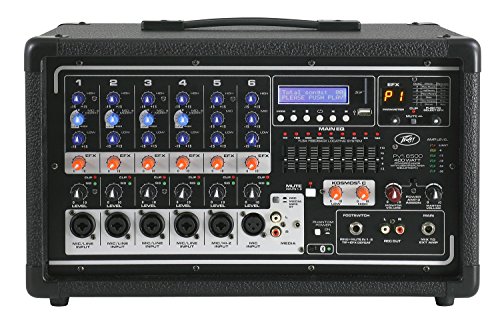
The PVi 6500 is the pick against which this category is judged, and its bundle listings describe it in the exact words of this search: a 400-watt, 6-channel powered live sound mixer. Peavey has built small all-in-one PAs longer than most of its rivals have existed, and the PVi formula is mature: mic channels with proper preamps, built-in digital effects for vocals, a graphic EQ for the room, and an amplifier sized for real small-venue work. It suits small bands, churches, schools and function acts who want one box, from a brand with a service network, that simply works every time it is switched on.
Strengths
- True 6-mic-channel configuration — the count matches the keyword
- Peavey’s small-PA heritage: sensible layout, proven reliability, real support
- Built-in effects and graphic EQ cover the small-venue checklist in one box
Trade-offs
- Design is utilitarian — no Bluetooth-era frills on the base unit
- 400-watt class output suits small-to-medium rooms, not outdoor crowds
- Heavier, traditional powered-mixer format rather than a featherweight box
| Model | PVi 6500 |
| Format | All-in-one powered mixer |
| Channels | 6 mic channels (per bundle listing description) |
| Class | 400-watt powered mixer class |
What you are buying with the Peavey is judgement accumulated over decades of small gigs. The channel layout puts the controls a volunteer operator needs where their hands expect them, the effects are the vocal reverbs and delays that actually get used rather than a menu of novelties, and the amplifier is specified for the passive speakers small venues actually own. In a school hall or a church annex, that maturity translates into a setup that sounds right quickly — the scarcest resource at any small event.
It is equally honest about its ceiling. A 400-watt-class powered mixer fills a hall, a pub or a marquee for a few hundred people; it does not do festival lawns, and pushing it there produces the strained, harsh sound that gives small PAs a bad name. Work within its room size and it is the most trustworthy box in this guide — the one we would hand to a community venue and forget about, in the best sense.
A final ownership note: Peavey’s dealer and service footprint in small-format PA is deep, and the PVi line’s longevity means manuals, parts and knowledgeable help remain findable. For an institution buying with a committee’s money, that boring virtue often matters more than any feature — and it is a large part of why this box, rather than a flashier rival, takes the top badge.
Best for: small bands, churches and schools wanting a proven 6-mic-channel all-in-one / Not suited for: large or outdoor venues needing serious amplifier headroom
Check on Amazon — check the current price on Amazon and confirm the variant, included accessories and seller before ordering.

Behringer Europower PMP550M Powered Mixer — Best Budget
The PMP550M is the budget benchmark of the powered-mixer world: a compact 500-watt, 5-channel box carrying a Klark Teknik multi-effects processor and Behringer’s FBQ feedback detection system, which lights up the EQ sliders where feedback is building so you can pull exactly that frequency down. One mic channel shy of the search’s six, it is included because most ‘six-channel’ shoppers run four or five mics — and for them this is the smart money. It suits solo acts, duos, small worship teams, presenters and karaoke hosts who need a real PA on a strict budget.
Strengths
- FBQ feedback detection is genuinely useful for inexperienced operators
- Klark Teknik effects give vocals a polish cheap boxes usually lack
- Compact, light and simple — a one-person load-in
Trade-offs
- Five channels, not six — count your mics before choosing it
- 500-watt headline is a peak-style figure; real output is small-room class
- Wireless-ready means the receiver is an add-on, not included
| Model | PMP550M Europower |
| Channels | 5 (per listing title) |
| Power | 500 watt class |
| Effects | Klark Teknik multi-FX processor |
| System | FBQ feedback detection |
The FBQ system is why this little box punches above its tier. Feedback is the small-PA problem — the squeal that empties rooms and terrifies volunteer operators — and FBQ’s trick of illuminating the offending EQ band turns a panic into a procedure: see the light, pull that slider, carry on. Paired with a graphic EQ and respectable effects, the PMP550M gives an inexperienced operator tools that genuinely compensate for inexperience, which is most of what a budget PA needs to do.
Set expectations correctly and it rewards you. This is a small-room amplifier: a café, a classroom, a pub corner, a garden party with modest speakers. Feed it efficient 8-ohm speakers, keep the master level sane, and it sounds clean and confident. Ask it to fill a sports hall and it will tell you, audibly, that you bought the wrong box — the Yamaha further down this list exists for that reader.
As a first powered mixer it is also a kind school: the layout teaches real signal flow, the effects teach restraint (a little reverb flatters; a lot drowns), and the whole rig — this box and two passive speakers — fits in a car boot with room for the mic stands. For the price tier, nothing else in the guide teaches and performs this well at once.
Best for: solo acts, duos and small teams on a strict budget with up to five mics / Not suited for: six-mic line-ups or medium rooms needing real amplifier headroom
Check on Amazon — check the current price on Amazon and confirm the variant, included accessories and seller before ordering.

Rockville RPM47 Powered 5 Channel Mixer/Amplifier — Best Compact
The RPM47 is Rockville’s compact entry: a 5-channel powered mixer in a wood cabinet with Bluetooth streaming, a USB interface, 24 DSP effects, a 7-band EQ and phantom power for condenser mics. Credit where due — its listing states both the 1800W peak and the 450W RMS figure, an honesty the category needs more of. It suits small venues, rehearsal rooms, houses of worship with modest congregations and mobile entertainers who want modern conveniences — phone streaming for break music, USB for simple recording — in a tidy, affordable box.
Strengths
- Bluetooth and USB interface bring a small rig up to date
- 24 DSP effects and 7-band EQ cover vocals and room tuning
- RMS stated alongside peak in the listing — honest specification
Trade-offs
- Five channels — a small line-up box, not a full band’s
- Rockville’s support network is thinner than Peavey or Yamaha’s
- Wood cabinet looks smart but wants care in transit
| Model | RPM47 |
| Channels | 5 powered channels |
| Power | 450W RMS / 1800W peak (per listing title) |
| Effects | 24 DSP effects |
| EQ | 7-band graphic |
| Extras | Bluetooth, USB interface, phantom power |
Read the RPM47’s specification the way this guide teaches: 450 watts RMS is the number to plan around, and it is a respectable figure for a compact box — enough for a pair of typical passive speakers in a small-to-medium room at sensible levels. The 1800-watt peak is marketing weather. Judged on its real rating, plus Bluetooth for break music and a USB interface for capturing a service or a set, the RPM47 is a thoroughly modern small-rig centre at a friendly price.
The compromises are scale and support. Five channels is a hard ceiling — a four-piece band with a spare mic is already negotiating — and Rockville, while established in this value segment, does not match the legacy brands’ service depth if something fails in year three. For a rehearsal room, a small congregation, a café or a mobile DJ who sings, neither compromise bites. For a growing band, buy the Peavey or Yamaha and grow into them instead.
One practical virtue deserves mention: the traditional wood-cabinet format is easy to rack-adjacent stack, sits stably on a table, and its control layout is immediately legible to a volunteer. In institutional settings — the school hall, the village venue — legibility is a feature, and this box has it.
Best for: small venues and mobile acts wanting Bluetooth and USB in a compact powered mixer / Not suited for: line-ups needing six or more mic channels
Check on Amazon — check the current price on Amazon and confirm the variant, included accessories and seller before ordering.

Yamaha EMX5 Powered Mixer — Best Sound Quality
The EMX5 is what the step-up buys. Yamaha’s EMX powered mixers are the refined end of the all-in-one market: high-quality mic preamps, a well-judged DSP effects section, flexible EQ and an amplifier with the kind of clean headroom that keeps vocals intelligible at the back of the room. Marketed as a 12-input design, its mic-channel count comfortably covers the six-mic brief with room for instruments and playback. It suits working small bands, quality-conscious churches and venues where the PA is a permanent fixture rather than a weekly wrestling match.
Strengths
- Yamaha preamps and DSP are a clear class above the budget boxes
- Flexible input count covers six mics plus instruments and playback
- Clean amplifier headroom keeps sound composed at working volumes
Trade-offs
- Costs meaningfully more than the budget picks — you pay for quality
- No Bluetooth streaming on this generation’s formula
- Bigger commitment for a rig that only leaves the cupboard monthly
| Model | EMX5 |
| Inputs | 12-input stereo powered mixer (per listing title) |
| Effects | DSP effects |
| Maker | Yamaha |
Sound quality in a powered mixer is mostly preamps and headroom, and the EMX5 wins on both. Its mic preamps stay quiet and open at the gains small-venue vocals need, so the house sound is clarity rather than hiss-and-shout; and the amplifier’s composure at working level means the last rows hear words, not distortion. Yamaha’s effects, as usual, are tuned by people who mix live for a living — the reverbs flatter a voice without washing it, which is the whole job.
The EMX5 also respects the operator. The layout is uncluttered, the EQ is musical rather than surgical, and the box feels built for a decade of Friday nights. Against that, it costs real money and skips the Bluetooth convenience of cheaper rivals — a defensible trade (a streaming input is a cable away) but one to make knowingly.
If your venue’s sound matters to you — if you have winced at a muddy vocal in a hall you care about — this is the pick the guide points to. The budget boxes are good; this is the one that makes a small room sound like someone competent is in charge, because its design assumes someone is learning to be.
Best for: working small bands and venues that prioritise sound quality and headroom / Not suited for: strict budgets or buyers who need Bluetooth built in
Check on Amazon — check the current price on Amazon and confirm the variant, included accessories and seller before ordering.

Behringer Europower PMP500MP3 Powered Mixer — Best for Karaoke and Playback
The PMP500MP3 is the playback specialist: an ultra-compact 500-watt, 8-channel powered mixer whose built-in MP3 player (from USB media) and reverb are aimed squarely at karaoke hosts, fitness instructors, presenters and party acts whose show runs on tracks with live voices over the top. The channel count exceeds the search’s six because playback-led rigs count differently — what matters is mics plus track sources, handled in one small box. It suits mobile entertainers who want the lightest possible rig that still sounds like a PA, not a Bluetooth speaker with ambitions.
Strengths
- Built-in MP3 playback removes a laptop or phone from the signal chain
- Ultra-compact format — the smallest load-in in this guide
- Reverb on board for the karaoke and presentation use case
Trade-offs
- Mic-preamp count is lower than the channel headline suggests — check your mic needs
- 500-watt class is small-room power, honestly applied
- Fewer EQ and routing tools than the band-focused picks
| Model | PMP500MP3 Europower |
| Channels | 8 (per listing title) |
| Power | 500 watt class |
| Playback | Built-in MP3 player |
| Effects | Reverb |
Karaoke and presentation work punish rigs in a specific way: the tracks are the show, the voices ride on top, and the operator is also the performer. The PMP500MP3 is shaped exactly for that life. Tracks live on USB media inside the mixer — no phone notifications interrupting the chorus, no Bluetooth dropouts — and a simple reverb gives amateur singers the flattering space that makes karaoke feel like karaoke. Setup is minutes, teardown is one box and two speakers.
As a band mixer it is the wrong tool, and the review should say so plainly: mic inputs are fewer than the headline implies, the EQ is basic, and the amplifier is small-room class. But judged on its actual brief — the working host, the instructor, the party act — it is the most fit-for-purpose pick in this guide, and its compactness is a genuine professional virtue when you load in and out alone, twice a night, every weekend.
Buy it as a specialist and it will delight you; buy it as a cheap way to mix a six-piece band and it will not. The badge says karaoke and playback because that is where this box earns its money.
Best for: karaoke hosts, instructors and presenters running tracks plus live mics / Not suited for: bands needing six full mic channels and detailed EQ
Check on Amazon — check the current price on Amazon and confirm the variant, included accessories and seller before ordering.
Rockville RPM45 4 Channel Powered Mixer — Best for Churches and Schools
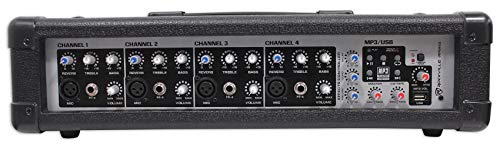
The RPM45 closes the guide with an honesty pick in the other direction: four channels, not six. Its listing names its audience outright — churches and schools — and its specification matches that life: USB playback, echo and delay for voices, XLR and TRS inputs, fan cooling for long assemblies, and a stated 450W RMS at 8 ohms. It suits the many small venues whose real line-up is two mics, a keyboard and a laptop, and whose operator is a volunteer who needs the box to be obvious. If that is your venue, buying six channels of complexity is not prudence; it is clutter.
Strengths
- Deliberately simple — the volunteer-friendly end of the category
- Echo and delay cover the vocal needs of services and assemblies
- Fan cooling and a stated RMS rating suit long, warm-room duty
Trade-offs
- Four channels is a hard ceiling — no room to grow the line-up
- 15V phantom power suits many condensers but not all — check your mics
- Basic EQ compared with the band-focused picks
| Model | RPM45 |
| Channels | 4 |
| Power | 450W RMS at 8 ohms (per listing title) |
| Effects | Echo and delay |
| Extras | USB playback, fan cooling |
There is a quiet wisdom in buying the box your venue actually needs. A four-channel powered mixer in a small church or school gets used correctly by whoever is on duty, because there is nothing on it they do not understand. The RPM45’s echo and delay give a spoken voice presence in a reflective hall, the USB playback handles hymns, tracks and assembly music without a laptop chain, and fan cooling matters more than glamour when the box runs a full morning in a warm room.
Its limits are printed on the front: four channels. A growing worship band will outgrow it within a year, and the guide’s other picks exist for them. The 15-volt phantom power deserves one check, too — most small condensers tolerate it, but a mic that insists on full 48V will not run from this box. Verify your two or three actual microphones against it and, if they pass, this simple machine may serve your venue better than any six-channel rival.
That is the closing lesson of the whole guide, really: channel counts are needs, not scores. The best powered mixer is the one whose channels, power and controls match the room and the people in it — no more, no less.
Best for: small churches, schools and halls running a few mics plus playback / Not suited for: any line-up that will grow past four channels
Check on Amazon — check the current price on Amazon and confirm the variant, included accessories and seller before ordering.
Comparison Table
| Pick | Badge | Key spec | Best for |
|---|---|---|---|
| Peavey PVi 6500 All In One Powered Mixer — Check on Amazon | Best Overall | 6 mic channels, 400W class | small bands, churches and schools wanting a proven 6-mic-channel all-in-one |
| Behringer Europower PMP550M Powered Mixer — Check on Amazon | Best Budget | 5 channels, 500W class, FBQ | solo acts, duos and small teams on a strict budget with up to five mics |
| Rockville RPM47 Powered 5 Channel Mixer/Amplifier — Check on Amazon | Best Compact | 5 channels, 450W RMS, Bluetooth | small venues and mobile acts wanting Bluetooth and USB in a compact powered mixer |
| Yamaha EMX5 Powered Mixer — Check on Amazon | Best Sound Quality | 12-input powered, Yamaha DSP | working small bands and venues that prioritise sound quality and headroom |
| Behringer Europower PMP500MP3 Powered Mixer — Check on Amazon | Best for Karaoke and Playback | 8 channels, MP3 player built in | karaoke hosts, instructors and presenters running tracks plus live mics |
| Rockville RPM45 4 Channel Powered Mixer — Check on Amazon | Best for Churches and Schools | 4 channels, 450W RMS, USB playback | small churches, schools and halls running a few mics plus playback |
The channel column in this table counts what your band can plug in, not what the box’s marketing prefers. Match it to your actual mic list, then check the amplifier’s RMS honesty — the picks that state an RMS figure are telling you something good about their makers.
How to Choose the Right 6 Channel Power Mixer
Counting channels like an engineer, not a brochure
Three different numbers hide inside the word ‘channel’. Total inputs counts every socket, including stereo line pairs counted once or twice depending on the maker’s optimism. Line channels accept keyboards, phones and playback. Mic channels — with XLR inputs and preamps — are what singers and spoken voices need, and they are always the scarcest. When you shop, list your microphones first: that count, plus one spare, is your true channel requirement. Then add line sources. Any box whose mic count falls short is the wrong box regardless of its headline.
This is why the guide’s picks wear their real configurations openly: the Peavey’s six mic channels are the keyword fulfilled; the five-channel boxes serve the many rigs that run four or five mics; and the four-channel Rockville serves venues whose honesty about their needs saves them money and complexity.
Watts: peak, RMS and your speakers
Peak watts measure a moment; RMS watts measure the evening. An amplifier advertised at several thousand peak watts may deliver a few hundred continuous — which is fine, if you plan around the continuous figure. Match the amplifier to your speakers: the speakers’ impedance (usually 8 ohms for small PA cabinets) and their power handling should bracket the mixer’s RMS output, and efficient speakers will always beat more watts into inefficient ones. If a listing states only a peak figure, treat the real output as small-room class until proven otherwise.
Headroom is the other half. A PA run at half its clean capacity sounds relaxed; the same PA at its limit sounds harsh and fatiguing, and runs hot. If your room is at the top of a box’s comfort zone, the correct move is the next box up — in this guide, the Yamaha — not a braver hand on the master fader.
- Plan around RMS (continuous) watts into your speakers’ impedance
- Efficient speakers plus modest watts beat inefficient speakers plus heroics
- Buy headroom: the right box cruises at your loudest moment
Powered mixer versus mixer-plus-amplifier
A powered mixer trades flexibility for simplicity: one box, one mains lead, speaker cables out. For small rigs that set up and tear down often, that simplicity is worth real money in time and reliability — there are fewer connections to fail and nothing to wire backwards. Separate components earn their complexity when a rig grows: more power, monitor mixes, outboard processing. At six channels and below, the all-in-one wins for almost everyone; this guide’s category exists because that trade is usually correct.
The features that matter in real rooms
Graphic EQ is not decoration — it is how you tame a reflective hall’s boom and ring. Feedback tools (FBQ-style detection or a simple, well-spaced graphic) matter more than exotic effects. One good reverb and a delay cover nearly all vocal needs. Phantom power matters if you use condenser mics — and check its voltage, because compact boxes sometimes supply less than the full 48V. Bluetooth and USB playback are conveniences that earn their place for break music and tracks. Rank those, in roughly that order, above channel-count bragging.
Setting Up a Small PA Without the Squeal
Feedback is geometry before it is electronics. Place the speakers in front of the microphones, aimed at the audience and away from walls where possible; keep mics behind the speaker line and never pointed at a cabinet. Set each mic’s gain so the loudest expected moment stays out of the red, then bring the master up to the room — gain first, volume second, in that order, every time. Ring out the room at soundcheck: raise the master slowly, note the first frequency that wants to sing, and cut it a few decibels on the graphic EQ. Two or three such cuts buy you a clean, confident system.
Then respect the result. The volume you proved at soundcheck is the system’s honest ceiling; asking for more mid-show just re-invites the squeal. A small PA run inside its limits sounds professional. The same PA run past them sounds like a small PA — the distinction audiences actually hear.
Powered Mixers in the Age of Powered Speakers
An honest guide should acknowledge the rival technology: powered speakers, with amplifiers built into each cabinet, paired with a small unpowered mixer. That architecture has real virtues — power matched to each speaker, easy expansion — and for new rigs built around recording or streaming it often wins. The powered mixer survives because of the rigs that already exist: the world’s school halls and churches are full of good passive speakers, and a powered mixer is the single-box way to drive them, with one purchase and no re-cabling.
If you own passive speakers you like, this guide’s category is your most economical path and the picks above are its best current answers. If you own nothing and your future includes recording, read this cluster’s USB-recording guide as well before deciding — the cheapest rig is the one you only buy once, whichever architecture it turns out to be.
Cables, Stands and the Unglamorous Half of the Budget
Every powered-mixer budget quietly splits in two: the box, and everything that makes the box useful. Two speaker cables of proper gauge and sensible length, two stands that put the cabinets at head height, enough mic cables to reach every position with slack, and a case or cover for the mixer itself. Shopped carelessly, that second half adds half again to the bill; shopped not at all, it arrives as a series of gig-day emergencies. Plan it with the same care as the mixer and the whole rig costs less than one emergency purchase at a music shop an hour before doors.
Height deserves its sentence: speakers on stands, tweeters at or above head height, transform a small PA more than any amplifier upgrade in this guide. A modest box on stands will out-perform a powerful box on the floor every night of the week, because sound that travels over heads reaches the back row while sound fired at knees does not. If your budget forces a choice between a bigger mixer and proper stands, buy the stands.
How to Set Up a 6 Channel Powered Mixer for a Small Gig
Twenty unhurried minutes, in this order, will give you a cleaner sound than an hour of mid-show fiddling.
- Position speakers first: on stands, at head height or above, in front of the performance area and angled slightly into the room.
- Connect speakers with proper speaker cables (never instrument cables) and confirm the impedance load matches the mixer’s rating.
- With all faders down and the master at zero, connect microphones and instruments; set channel EQ flat to start.
- Soundcheck each mic one at a time: raise its gain until the loudest moment nearly peaks, then back off slightly.
- Add effects last and sparingly — a short reverb that you notice only when it is muted is the right amount for most voices.
- Ring out the room: raise the master gradually, cut any frequency that begins to ring on the graphic EQ, and note your safe ceiling.
- Play break music at low level to confirm playback channels, then set and mark the master position with tape.
- After the gig, power down in reverse order — master down, then off — and coil speaker cables separately from mic cables.
Keep a one-page setup card with your rig: channel assignments, gain positions that worked, and the EQ cuts your regular room needs. Small venues run on volunteers, and the card is how last month’s good sound survives this month’s new helper.
Common Buying Mistakes
- Counting total inputs instead of mic preamps. A ’12-channel’ box with four mic inputs cannot mix a five-singer group. Count XLR mic channels against your actual line-up.
- Believing peak watts. Plan around RMS into your speakers’ impedance. Peak figures are marketing weather, not power.
- Using instrument cables for speakers. Speaker connections need proper speaker cable. Instrument cable under amplifier load is a failure waiting for its moment.
- Speakers behind the microphones. Geometry causes feedback before electronics do. Cabinets in front of the mic line, always.
- Buying six channels for a four-channel life. Complexity confuses volunteers and costs money. The simplest box that fits your line-up is the professional choice.
- Skipping the soundcheck ring-out. Two EQ cuts at soundcheck prevent the mid-service squeal that no amount of mid-service panic fixes elegantly.
Final Recommendation
For most readers, the Peavey PVi 6500 is the answer: a true six-mic-channel powered mixer from the category’s most experienced maker. Budget rigs should take the Behringer PMP550M and its feedback-fighting smarts; quality-first venues the Yamaha EMX5; playback-led acts the PMP500MP3; compact modern rigs the Rockville RPM47; and genuinely small venues should embrace the RPM45’s simplicity without a flicker of embarrassment.
Buy by exact model, confirm the mic-channel count and speaker compatibility in the listing, and check price on Amazon when you order. In pro audio, the variant and bundle details — cables, cases, speaker pairings — move value around more than the headline price does.
Keep exploring the cluster: Best 8 Channel Power Mixers Best 8 Channel Mixers With Echo And Eq Best 8 Channel Usb Recording Mixers Best 5 Channel Mixers Best 10 Channel Mixers Best Affordable Sound Mixers
Frequently Asked Questions
How many mic channels does a small band actually need?
Count every simultaneous voice and mic’d instrument, then add one spare for a guest, a second guitar mic or a failure swap. A four-piece with three singers typically lands at five or six — which is why this size class exists. Drum kits in small venues usually go unmic’d or with a single overhead, keeping the count sane.
Can a powered mixer drive any passive speakers?
Most small passive PA speakers, yes — provided the total impedance load stays within the mixer’s rating (commonly 8 ohms per side, or two 8-ohm cabinets in parallel per side on many designs) and the speakers’ power handling brackets the amplifier’s RMS output. Check both figures before connecting; the manuals state them plainly.
What does phantom power do, and do I need it?
Phantom power (usually 48V, less on some compact boxes) runs condenser microphones and some DI boxes through the mic cable. Dynamic mics — the small-venue standard — ignore it safely. If you use condensers for choir, instruments or recording, confirm the mixer’s phantom voltage suits them; the RPM45’s 15V supply in this guide is the example to check against.
Powered mixer or powered speakers — which is better now?
If you already own good passive speakers, a powered mixer is the economical one-box upgrade. If you are starting from nothing and expect to record or expand, an unpowered mixer with powered speakers is often the more flexible architecture. Neither is universally better; the existing half of your rig decides.
Why does my PA feed back at low volume?
Usually geometry and gain structure, not volume: a mic too close to a speaker, a reflective wall behind the performers, or channel gain set so high the system lives on the edge. Reposition first, set gain properly, then use the graphic EQ to trim the ringing frequency — in that order.
How loud is a 400-watt-class powered mixer, really?
In a small-to-medium hall with reasonably efficient speakers, comfortably loud for speech and live music for a few hundred people — with headroom to spare if the speakers are efficient. Outdoors or in large, absorbent rooms, the same box runs out of clean level quickly. Room and speakers decide loudness at least as much as the amplifier does.
Can I record from a powered mixer?
Simply, yes: most of these boxes offer a line-level record or main output that feeds a phone, a recorder or a streaming laptop at usable quality. What they will not give you is a multitrack USB interface with a separate track per channel — that is the unpowered USB-mixer category’s job, covered in this cluster’s recording guide. For a straight stereo capture of a service or a set, a powered mixer’s record output is honestly enough for most small venues.


