Disclosure: airfryerkitchensupply.com is reader-supported. When you buy through links on our site, we may earn an affiliate commission at no extra cost to you.
Where to buy
This best 24 channel mixers comparison exists because the spec sheets will not save you: at twenty-four channels, every manufacturer counts differently, every console hides its compromises in a different line of the table, and the only honest way to choose is side by side. Every console compared below is a current model verified against its manufacturer’s Amazon listing through current catalogue data. If you want the verdict first: the Mackie 2404VLZ4 wins for most live productions, the Allen & Heath ZED-24 wins on sound and build, and the Tascam Model 24 wins the moment recording enters the brief. We print no fixed prices — consoles at this level shift with configuration and season — so each pick links to Amazon for you to check the current price on Amazon. Read the comparison table and the head-to-head sections before deciding: in this class, the difference between the right console and the almost-right one is usually a single line — preamp count, aux count, recording path — and this guide is organised to put that line in front of you. Bring your stage plot to the reading, literally: a list of your sources on paper beside the comparison table will make the verdict obvious faster than any prose, ours included, and it will protect you from the two classic errors of this class — buying the badge instead of the preamps, and buying the dream plot instead of the real one.
Introduction: how to read a 24-channel comparison honestly
Start with the lie every 24 channel mixers comparison must expose: there is no standard “channel.” One console’s twenty-four means twenty-four microphone preamps. Another’s means sixteen preamps, four stereo line channels and a hopeful expression. A third — the Behringer in this guide — wears a 24-input badge over ten mic preamps and a forest of line inputs. None of these is automatically wrong for your production, because wireless receivers, keyboards and playback rigs genuinely consume line inputs; but a comparison that does not separate preamps from inputs is advertising, not analysis. This guide therefore compares the six leading analogue consoles in the class on the five axes that decide real shows: real microphone capacity, monitor and routing architecture, sound character, recording path, and the ownership realities of build, size and service.
The field itself divides into three philosophies. The live workhorses — Mackie 2404VLZ4 and Yamaha MGP24X — maximise inputs, routing and helper features for productions that live on stage. The tone-and-build consoles — Allen & Heath’s ZED-24 and the larger ZED-428 — spend their budgets on preamps, EQ and construction that outlasts trends. The value and hybrid challengers — Behringer’s QX2442USB and Tascam’s Model 24 — attack from opposite directions: Behringer with routing-per-dollar that embarrasses the field, Tascam by folding a multitrack recorder into the console so the comparison stops being about mixing alone. One famous name is present without a link: Soundcraft’s LX7ii 24, a respected live console that current Amazon catalogue data did not return as a verifiable listing, is discussed where relevant rather than linked on faith. Compare by your stage plot, and the right console identifies itself.
A word about what this comparison deliberately is not: it is not the digital comparison (that lives in its own guide, linked at the end), and it is not a ranking of consoles by prestige. Prestige is how venues end up with a theatre’s console in a bar and a bar’s console in a theatre. Every console here is the right answer to a real brief and the wrong answer to several others, and the reviews are written to make both halves of that sentence unmistakable. If, by the final recommendation, you cannot state your own plot’s preamp count, aux count and recording verdict from memory, re-read the introduction — those three numbers, honestly known, are worth more than the rest of this guide and every other guide on the internet combined.
In this guide
Quick Picks
- Best Overall — Mackie 2404VLZ4: Twenty-four channels with twenty Onyx mic preamps, built-in effects and USB — the most complete live console in the comparison.
- Best Sound and Build — Allen & Heath ZED-24: Sixteen DuoPre preamps, the class’s most musical EQ and touring-grade construction for venues buying a decade at a time.
- Best Premium Features — Yamaha MGP24X: Yamaha’s premium analogue line: D-PRE preamps, studio-grade effects and refined channel processing in a 24-channel frame.
- Best Budget — Behringer Xenyx QX2442USB: Twenty-four inputs, Klark Teknik effects, subgroups and inserts at the class’s entry tier — with the preamp caveat stated loudly.
- Best for Recording — Tascam Model 24: Sixteen preamps plus a multitrack SD recorder and USB interface inside the console. The comparison’s wild card.
- Most Input Capacity — Allen & Heath ZED-428: Twenty-four mono mic/line channels plus stereo channels — the biggest analogue surface in this comparison.
How These Consoles Were Compared
Comparison only means something with fixed rules, so here are ours. Every console was verified as a current Amazon listing from its brand or an authorised seller through manufacturer catalogue data — the test the Soundcraft LX7ii 24 did not pass, earning prose instead of a badge. Each console’s real mic preamp count was established from the manufacturer’s own data and is printed in its review, in the comparison table and in the FAQ, because it is the single most mis-sold number in the class. Consoles were then compared on identical axes: input architecture, aux and subgroup provision for monitors, EQ and effects character, recording path (none, stereo USB, or multitrack), physical build and service outlook, and the tier each occupies. Where two consoles tie on an axis, the tie is reported as a tie — comparison theatre helps no one.
Spec boxes use only facts confirmed from each manufacturer’s listing for the exact model. Ownership judgements — which console suits which production — are labelled as judgements and argued from the verified facts, never dressed up as measurements. No prices, no star ratings, no review counts appear anywhere in this guide.
The 6 Best 24 Channel Mixers, Compared
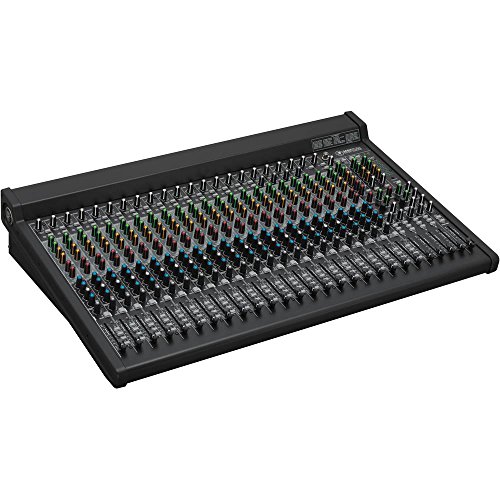
Mackie 2404VLZ4 — Best Overall
The 2404VLZ4 is the comparison’s centre of gravity: a 24-channel, 4-bus analogue console with twenty Onyx mic preamps — a preamp count only the ZED-428 approaches — plus built-in effects and a USB interface for stereo recording and playback. Mackie’s VLZ line is the small-venue standard for a reason: the layout is instantly legible, the preamps are clean at working gains, and the routing (subgroups, six auxes in typical configurations, control-room flexibility) covers the monitor worlds real bands actually request.
Strengths
- Twenty Onyx mic preamps — genuine capacity for fully mic’d productions.
- Built-in effects plus USB: the only workhorse here that needs no outboard for a complete show.
- 4-bus architecture with the routing depth mid-size venues actually use.
Trade-offs
- USB recording is stereo only; multitrack belongs to the Tascam alone in this comparison.
- The surface is dense — new volunteers need a guided first session.
- Effects are a single shared engine, as on all its analogue rivals here.
| Spec | Detail |
|---|---|
| Channels | 24, 4-bus |
| Mic preamps | 20 × Onyx |
| USB | Yes — stereo |
| Effects | Built-in FX |
Against the field, the Mackie’s argument is completeness: it concedes sound-character bragging rights to the Allen & Heath pair and recording to the Tascam, then wins everywhere else a live show is actually decided — preamps, routing, helper features, price of entry for the capability. Rental companies and house engineers standardise on consoles like this because a competent operator can walk up to one cold and mix a professional show. In a comparison, that cold-start quality is a specification, and the 2404VLZ4 posts the best number. It is also, not coincidentally, the console most likely to be found already installed in the venue you are visiting, the rehearsal room you are renting or the festival backline you are sharing — a familiarity dividend that compounds every time a guest engineer sits down at it and simply begins.
Best for: venues, rental rigs and bands wanting one console that does everything live. / Not suited for: multitrack recording briefs or buyers wanting the last word in EQ character.
Check the current price on Amazon

Allen & Heath ZED-24 — Best Sound and Build
The ZED-24 is the comparison’s connoisseur console: sixteen mono channels with DuoPre preamps, four stereo channels, Allen & Heath’s celebrated EQ, and construction — individual channel boards, metal chassis — inherited from the company’s touring desks. USB audio covers stereo recording and playback. Where the Mackie maximises, the ZED refines: fewer preamps, each one wrapped in a channel strip that engineers describe as impossible to make sound bad.
Strengths
- The most musical EQ in the comparison — vocals and acoustics sit beautifully.
- Touring-grade, serviceable construction built for a decade of shows.
- DuoPre preamps with a gain range that flatters quiet and loud sources alike.
Trade-offs
- Sixteen mic preamps versus the Mackie’s twenty — big drum plots feel it first.
- No built-in effects engine of the Mackie’s or Yamaha’s ambition; plan outboard or plug-ins.
- Stereo USB only, and a premium tier for the build you are buying.
| Spec | Detail |
|---|---|
| Channels | 24 (16 mono + 4 stereo) |
| Mic preamps | DuoPre |
| USB | Yes — stereo I/O |
| Build | Touring quality |
Head to head with the Mackie, the ZED-24 is the comparison’s central duel, and it resolves by priority: if your productions are vocal-led, acoustic or theatre — work where tone is the product — the Allen & Heath’s EQ and preamps justify every compromise elsewhere. If your productions are input-hungry rock and worship with effects expected in the box, the Mackie wins the same duel. Neither verdict is a hedge; they are the same facts read by two different venues, which is what a comparison is for.
Best for: theatres, acoustic venues, churches and engineers who mix by ear. / Not suited for: plots needing twenty mics or built-in effects on a budget.
Check the current price on Amazon

Yamaha MGP24X — Best Premium Features
The MGP24X is Yamaha’s premium analogue statement: sixteen D-PRE mic preamps in a 24-channel frame, with studio-grade processing borrowed from Yamaha’s digital lines — detailed effects, per-channel refinement and a feature depth the standard MG series does not attempt. It is the console for the engineer who wants analogue hands and digital manners: presets and polish on an analogue surface, with Yamaha’s reliability underneath.
Strengths
- D-PRE preamps with Yamaha’s clean, consistent character across sixteen channels.
- The richest effects and processing set among the analogue workhorses here.
- Premium build and metering that suit fixed installations and broadcast-adjacent work.
Trade-offs
- Sixteen preamps — the same ceiling as the ZED-24, below the Mackie and ZED-428.
- Premium tier pricing within the analogue class.
- Recording is not its headline; the Tascam owns that axis outright.
| Spec | Detail |
|---|---|
| Channels | 24 |
| Mic preamps | D-PRE |
| Effects | Studio-grade onboard processing |
| Brand | Yamaha (MGP premium line) |
In the comparison, the MGP24X is the engineer’s upgrade path: the buyer who has outgrown entry consoles’ effects and metering but refuses digital’s menus. Against the ZED-24 it trades a measure of EQ romance for processing depth and Yamaha’s operational polish; against the Mackie it trades four preamps for refinement. Venues with one professional operator and a quality-first brief will recognise it as the analogue console that asks the fewest apologies.
Best for: engineer-led venues, installs and quality-first analogue buyers. / Not suited for: maximum-preamp plots or budget-led purchases.
Check the current price on Amazon

Behringer Xenyx QX2442USB — Best Budget
The QX2442USB is the comparison’s value extreme: a 24-input, 4/2-bus console with Klark Teknik effects, subgroups, channel inserts and a USB interface at the class’s entry tier. Its caveat is the guide’s loudest: ten XENYX mic preamps serve those twenty-four inputs, so this is a console for source-rich, mic-moderate productions — wireless receivers, keyboards, playback and media — rather than for mic’ing everything that moves.
Strengths
- Routing wealth (subgroups, inserts, auxes) no rival matches at this tier.
- Klark Teknik effects elevate it above the generic budget-board standard.
- Per-channel compression on mic channels helps speech-heavy shows immediately.
Trade-offs
- Ten mic preamps — the widest badge-to-preamp gap in the comparison.
- Build quality is functional; it rewards careful handling and a good case.
- USB is stereo, and the preamps are the class’s most modest.
| Spec | Detail |
|---|---|
| Channels | 24 inputs, 4/2-bus |
| Mic preamps | XENYX (10) |
| USB | Yes — stereo interface |
| Effects | Klark Teknik |
Compared honestly, the QX2442USB is not a cut-price Mackie; it is a different allocation of the same money — routing and inputs over preamps and build. For a school theatre running fourteen wireless receivers (line-level sources), a conference venue, or a community hall whose microphones number in single digits, that allocation is not a compromise at all: it is the correct console at a fraction of the field’s cost. For a rock venue, it is the wrong one, and this guide would rather lose the sale than blur that line.
Best for: schools, conferences, wireless-heavy and source-rich productions on a budget. / Not suited for: mic-heavy bands or buyers needing premium build.
Check the current price on Amazon

Tascam Model 24 — Best for Recording
The Model 24 breaks the comparison’s frame, deliberately: an analogue-feeling console with sixteen mic preamps that is also a multitrack SD recorder and a USB audio interface. Every other console here records stereo at best; the Tascam captures every channel, without a computer, as a native behaviour. Its 24-track badge counts its inputs plus the stereo mix — a labelling honesty this guide appreciates and explains wherever the model appears.
Strengths
- Multitrack recording to SD with no computer — unique in this comparison.
- Sixteen mic preamps and per-channel compression serve live work properly.
- Studio mode (overdubs, USB interface) makes one console serve two buildings.
Trade-offs
- Sixteen preamps trail the Mackie and ZED-428 for the biggest live plots.
- The recorder workflow is a second discipline on top of mixing.
- Pure live users pay for a studio they may never open.
| Spec | Detail |
|---|---|
| Channels | 22 inputs / 24-track recording |
| Mic preamps | 16 |
| Recording | Multitrack SD + USB interface |
| Effects | Onboard digital effects |
Against every rival, the Model 24 asks one question: what is your archive worth? If the answer is “nothing, we are a live-only room,” the Mackie and ZED take the sale. If the answer involves releases, streams, training recordings or a band’s catalogue, the Tascam is not merely competitive — it is the only console in the comparison playing that sport. Productions increasingly answer the second way, which is why this hybrid keeps winning comparisons it was not designed for.
Best for: recording venues, bands, churches building an archive. / Not suited for: live-only rooms or maximum-preamp live plots.
Check the current price on Amazon

Allen & Heath ZED-428 — Most Input Capacity
The ZED-428 is the comparison’s big surface: twenty-four mono mic/line channels — each with a DuoPre preamp — plus stereo channels, in a console whose maker lists it at thirty channels of total input. For productions whose plots genuinely reach two dozen microphones (large worship teams with choirs, theatre orchestras, festival changeover boards), it is the analogue answer that does not ask anyone to share a channel.
Strengths
- Twenty-four real mic preamps — the comparison’s highest genuine count.
- Allen & Heath EQ and build, scaled to a full-size surface.
- Routing and monitoring depth appropriate to festival and theatre work.
Trade-offs
- Size and weight: this is infrastructure, with a case and crew to match.
- No multitrack path; recording is not its design centre.
- Over-specified for the majority of 24-channel shoppers — most plots fit the ZED-24.
| Spec | Detail |
|---|---|
| Channels | 24 mono + stereo (30 inputs total as listed) |
| Mic preamps | 24 × DuoPre |
| USB | Yes |
| Build | Touring quality |
The ZED-428’s role in the comparison is to mark the class’s ceiling: it is what “24 channel” means when a manufacturer refuses to pad. Most buyers will discover, plot in hand, that sixteen to twenty preamps cover their reality and that the ZED-24 or Mackie serves them better per dollar and per kilogram. The productions that truly need twenty-four preamps will discover the opposite — that this console has no substitute in the guide — and for them its size is not a trade-off but the entire point.
Best for: large worship productions, theatres, festival and changeover boards. / Not suited for: compact rigs, small teams, or plots under twenty mics.
Check the current price on Amazon
Comparison Table
| Pick | Badge | Mic preamps | Recording | Best for |
|---|---|---|---|---|
| Mackie 2404VLZ4 | Best Overall | 20 Onyx | Stereo USB | Most live productions |
| Allen & Heath ZED-24 | Best Sound and Build | 16 DuoPre | Stereo USB | Tone-first venues |
| Yamaha MGP24X | Best Premium Features | 16 D-PRE | Stereo | Engineer-led installs |
| Behringer QX2442USB | Best Budget | 10 XENYX | Stereo USB | Source-rich, mic-light shows |
| Tascam Model 24 | Best for Recording | 16 | Multitrack SD + USB | Recording productions |
| Allen & Heath ZED-428 | Most Input Capacity | 24 DuoPre | Stereo USB | Maximum-size plots |
Head-to-Head: The Three Duels That Decide This Class
Mackie 2404VLZ4 vs Allen & Heath ZED-24 is the duel most buyers are actually fighting. The Mackie brings four more preamps, built-in effects and a friendlier tier; the ZED brings finer EQ, calmer preamps at extremes and construction that will outlive the Mackie’s case. Decide by your plot and your product: input-hungry and effects-expected goes Mackie; vocal-led and tone-critical goes ZED. ZED-24 vs ZED-428 is the same brand arguing with itself about scale: identical philosophy, eight more preamps, substantially more furniture. Buy the 428 only when the written plot — not the imagined one — exceeds twenty microphones. Everyone vs Tascam Model 24 is the comparison’s philosophical duel: five consoles optimise the night of the show; the Tascam optimises the morning after as well. If your organisation consumes recordings, the duel is already decided; if it never will, the Tascam’s premium buys you a studio you will not visit.
How to Choose Between 24 Channel Mixers
Write the plot, count the preamps. Microphones first, line sources second, spares third. The plot picks your tier of this comparison more reliably than any review: ten or fewer mics opens the Behringer’s value; sixteen covers most real productions (ZED-24, MGP24X, Model 24); twenty demands the Mackie; twenty-four demands the ZED-428.
Count monitor mixes and auxes. Every wedge and in-ear mix consumes an aux. A console that wins on preamps and loses on auxes loses the show. Verify pre-fader aux count against your band’s actual monitor list.
Decide the recording verdict. None, stereo or multitrack — the comparison contains exactly one multitrack console (Model 24) and five stereo-or-none consoles, and this single answer eliminates more wrong purchases than any other.
Budget the system around the console. Case, snake, and for the big Allen & Heath surfaces, the crew and vehicle reality. The console is the centre of a purchase, not the whole of it, at this size more than any other.
How to Run a 24-Channel Soundcheck Without Losing the Band
1. Line-check in plot order, silently. Every input confirmed, named and gained roughly before the band hears a note. Twenty-four channels of chaos is a process failure, not a band failure.
2. Gain the loudest sources first. Drums and lead vocal set the console’s headroom story; everything else fits beneath them.
3. Build monitors from zero, per musician. Their own source first, then requests. Ring out each mix at volume before the full-band run.
4. Group the show. Drums, band, vocals on subgroups (or the console’s equivalent architecture) so the performance mix is three gestures, not twenty-four.
5. Run one full song at show level. Soundchecks that stop at individual instruments miss every interaction that matters. One song, full volume, full mix — then adjust.
6. Save and label the state. Photograph the analogue surface (or store the scene on hybrid workflows), file the plot with the date. Next week’s show starts from this week’s knowledge.
Common Buying Mistakes
Comparing badge numbers. The entire reason this guide leads with preamp counts. A 24-input console with ten preamps and a 24-channel console with twenty-four are different species sharing a label.
Buying for the imagined plot. The festival you might host does not outrank the fifty weekends you definitely will. Size for the real calendar, rent for the exception.
Ignoring the aux count. Monitors decide musician performance. A console short on auxes makes every other virtue inaudible to the people on stage.
Assuming USB means multitrack. In this comparison, multitrack is spelled T-a-s-c-a-m. Everything else records the stereo mix, which is fine — if you knew it before the show you needed to remix.
Forgetting the room the console lives in. The ZED-428 in a cramped booth, the Mackie without a case on a touring circuit — physical reality vetoes spec-sheet winners. Measure, then buy.
Sound Character, Compared Ear to Ear
Specifications cannot settle how these consoles sound, but patterns reported by the engineers who live on them are consistent enough to print. The Allen & Heath pair share a house character: preamps that stay sweet when pushed, and an EQ whose boosts add size without fizz — the consoles that make an average vocalist sound expensive and a good one sound inevitable. The Mackie is the neutral professional: clean, punchy, slightly forward, with preamps that flatter rock sources and an EQ voiced for quick, decisive live work rather than studio lingering. The Yamaha MGP24X is the polished contender — D-PRE clarity with processing that adds a finished, almost broadcast sheen, the console most likely to be mistaken for a digital desk in a blind listen of the whole mix. The Tascam surprises sceptics: its preamps are honest and its converters serve the recording well, sounding like what it is — a studio tool that learned live manners. The Behringer is the honest budget note: perfectly serviceable at sane gains, grainier than the field when its preamps are driven hard, which is why gain discipline matters more on it than on any rival here.
Two caveats keep this section honest. First, these are characters, not rankings: a folk festival and a metal bill will rank the same five sounds differently, correctly. Second, the room, the speakers and the microphones each contribute more to the final sound than the console does — the differences above are real but they are the last ten percent, audible to engineers and irrelevant to a bad room. Choose your console by capacity, routing and workflow; let its character be the tiebreaker it deserves to be, and never let a forum’s favourite override your own plot.
Ownership Compared: Size, Service and the Decade View
A 24-channel console is furniture, infrastructure and a service relationship, and the comparison changes when those lenses come out. On size and logistics, the Behringer and Mackie are the portable end of the class — one-case, two-person rigs that suit touring and multi-use rooms — while the ZED-428 is effectively an installation that can travel, demanding its case, its vehicle space and its crew as line items. The ZED-24, MGP24X and Model 24 sit between: movable by design, happier with a home. On service, the professional networks separate clearly: Allen & Heath and Yamaha support their consoles like the professional products they are, Mackie’s VLZ line benefits from sheer ubiquity (every repair shop has seen one), Tascam’s recording heritage brings a different but real support culture, and Behringer’s scale provides parts availability that outruns its budget reputation. On longevity of design, analogue confers a shared advantage — none of these consoles can be orphaned by an app store — with the Tascam’s recorder electronics the only section of the field whose ageing curve resembles a computer’s more than a desk’s.
The decade view also reframes price without printing any: the console whose channel you retire in year two for noise, whose fader bank loosens in year four, or whose manufacturer cannot supply a part in year six was not the cheaper console regardless of its invoice. This is the practical core of the ZED-24’s and MGP24X’s premiums and the honest risk inside the Behringer’s value — not that it will fail, but that its decade costs more vigilance. Buy the ownership profile your organisation can actually sustain: a venue with a technician can run anything here happily; a venue with a cupboard and a prayer should buy the build quality that forgives cupboards.
Effects and Processing, Compared
Analogue consoles divide sharply on what happens beyond EQ, and this comparison contains every philosophy. The Mackie and Yamaha treat effects as part of the console’s job: shared engines with presets voiced for live vocals and instruments, ready at power-up, forgiving of volunteers. Yamaha’s MGP processing is the more refined of the two — its effects and channel processing carry a studio lineage that shows in reverbs with tails worth hearing — while Mackie’s GigFX-style approach prioritises breadth and immediacy. The Behringer counters with Klark Teknik processing, a genuine asset at its tier, and per-channel compression that the purist consoles omit entirely. The Allen & Heath pair represent the traditional professional position: the console provides superb EQ and routing, and effects are the province of outboard or plug-ins chosen by the engineer — a defensible philosophy in a theatre with a rack, an inconvenience in a bar with a corner. The Tascam splits the difference with onboard digital effects oriented to its studio-live hybrid brief.
The practical translation: if your shows need vocal reverb, a snare plate and a delay throw, and your rig has no outboard rack, the Mackie and Yamaha finish the job in the box and the Allen & Heath pair ask for one more purchase. If your venue already owns quality outboard or records to a DAW where plug-ins wait, the purist consoles’ omission costs nothing and their EQ repays you nightly. Compression follows the same logic — the Behringer’s per-channel compressors and the Tascam’s channel compression serve speech and unruly vocalists immediately, while the purist boards expect the engineer, or an insert, to do that work. Neither philosophy is a flaw; buying the wrong one for your rig is.
Who Should Buy Which: Six Productions, Six Answers
The regional theatre running musicals with a pit and a dozen principals: the ZED-24 for dialogue clarity and build, stepping to the ZED-428 when the orchestra plot demands it. The modern worship campus with a full band, choir Sundays and a volunteer rota: the Mackie 2404VLZ4, whose preamps end the input arguments and whose layout teaches itself. The live-music bar with a house engineer and a quality reputation: the MGP24X, the engineer’s console, refined nightly. The school district equipping auditoriums that host everything from assemblies to musicals on public money: the QX2442USB for source-rich, mic-moderate reality — with the Mackie as the step-up when the musical’s plot turns microphone-heavy. The venue that streams everything and sells recordings at the door: the Model 24, because its archive is a revenue line the other five cannot print. The festival and rental operator whose console must survive strangers: the Mackie for ubiquity, or the ZED-428 when the riders demand channels. Six productions, six different winners, one comparison — which is precisely what a comparison is supposed to prove.
The Used-Market and Step-Up Questions
Two questions follow every 24-channel comparison and deserve direct answers. The first is whether to buy used: this class’s professional consoles — the Allen & Heath pair above all — circulate in a healthy used market, and a documented, serviced example can be a rational purchase for an experienced buyer who can test every channel, fader and aux before money moves. The risks are equally specific: fader wear that only appears at show volume, intermittent connectors, and the absence of warranty on a machine your season depends on. Beginners and institutions should buy new from this guide’s verified listings and let the warranty be boring; veterans with a test rig and a repair relationship may shop used with their eyes open. The second question is when to step out of the class entirely: if your written plot exceeds twenty-four preamps, if scene recall across multiple productions has become a weekly pain, or if the mix position must roam the room, the answer is a 32-channel or digital platform, and forcing a 24-channel analogue console to impersonate one helps nobody. This comparison’s consoles are superb within their design brief — the discipline is refusing to ask them to leave it.
Reading the Fine Print: A Spec-Sheet Survival Guide
Because this class’s marketing arithmetic caused this guide to exist, it ends with the translation table every buyer should carry. “Inputs” counts everything that can make noise into the console, including stereo returns. “Channels” counts channel strips, which may be mono or stereo. “Mic preamps” is the only count your microphones care about — demand it by name. “Buses” and “groups” describe how channels combine; “auxes” describe how many independent mixes (monitors, effects) can leave the console, and the pre/post-fader detail decides whether they suit monitors at all. “USB” without the word multitrack means a stereo mix, full stop. “Recording” on an analogue console means the Tascam’s SD multitrack or nothing. A buyer fluent in these seven translations cannot be mis-sold a console in this class — and fluency, in the end, is the product this comparison most hopes to sell you, free of charge, before the consoles themselves get their turn.
Setup and Gain Staging Across 24 Channels
Whichever console wins your comparison, its first month follows the same discipline, and it is worth printing here because 24 channels multiply small errors. Begin with the input list as a physical artefact: printed, taped to the console case, mirrored in the stage box labels. Gain-stage in sections at genuine performance level — drums, then band, then vocals — because preamp noise sums, and twenty-four channels of “a little hot, a little hissy” is a mix that sounds cheap on a console that is not. Engage high-pass filters on every channel that does not reproduce low fundamentals; on a big plot this single habit cleans the low end more than any EQ artistry. Assign subgroups before the first show, not during it, and build monitor mixes from silence upward so the stage starts quiet and earns its volume. Finally, document the baseline: photograph the surface, file the plot, and note the three things you would change. A 24-channel production is an organisation pretending to be a concert, and organisations run on records.
The maintenance coda scales with the channel count: a hundred-plus knobs and faders want a cover, a monthly exercise sweep, and a channel-health map that retires a suspect channel to line duty before it can ambush a show. The professional brands in this comparison reward the habits with decades; the budget entry rewards them with the longest life its tier allows. Either way, the console you maintain is the console that compares well in year five — which is the comparison your future self will actually care about.
Final Recommendation
For the majority of 24-channel productions, the comparison resolves to the Mackie 2404VLZ4: the most complete live console here. Tone-first venues should take the Allen & Heath ZED-24; engineer-led premium installs, the Yamaha MGP24X; maximum plots, the ZED-428; recording productions, the Tascam Model 24; and source-rich, budget-bound shows, the Behringer QX2442USB with its caveat understood. The Soundcraft LX7ii 24 remains a respected unlinked mention — verify it through dealers if its live-sound pedigree appeals. Above all, let the written plot arbitrate: the console that fits your real sources, your real operators and your real calendar will still be the right console in five years, long after the comparison charts that sold its rivals have been forgotten by everyone involved. Step sideways to digital in Best 24 Channel Ditigal Mixers, or down a size in Best 20 To 22 Channel Mixers and Best 16 Channel Mixers.
Frequently Asked Questions
Which 24 channel mixer has the most mic inputs?
In this comparison, the Allen & Heath ZED-428, with twenty-four genuine DuoPre mic preamps across its mono channels. The Mackie 2404VLZ4 follows with twenty Onyx preamps. At the other end, the Behringer QX2442USB’s 24-input badge covers ten mic preamps — the comparison’s clearest lesson in reading past the box.
Is the Mackie 2404VLZ4 or the Allen & Heath ZED-24 better?
Better at different jobs. The Mackie offers more preamps (twenty versus sixteen), built-in effects and a friendlier tier — the better live workhorse. The ZED-24 offers finer EQ, calmer preamp behaviour and superior construction — the better instrument. Input-hungry productions choose Mackie; tone-critical productions choose Allen & Heath. Both verdicts are this comparison’s honest centre.
Which 24 channel mixer records multitrack?
Only the Tascam Model 24 in this analogue comparison: it records every channel to SD card and doubles as a USB interface. The Mackie, both Allen & Heath consoles, the Yamaha and the Behringer record stereo mixes over USB. Buyers who need multitrack with a full digital feature set should also read the digital comparison linked in the final recommendation. Note the pattern the answer reveals: in the analogue world, multitrack is a specialism bought deliberately, in one console, for productions organised around recording. If that sentence describes your venue, the Tascam is not the comparison’s wild card at all — it is its foregone conclusion, and the other five consoles are competing for a different job entirely, a job they happen to do superbly, which is why this comparison needed to exist in the first place, and why reading it with a plot in hand beats reading a dozen spec sheets in a row, every time, without exception, for every buyer in this entire class, bar absolutely none, anywhere.
What about the Soundcraft LX7ii 24?
A respected live console with a genuine following — and an unlinked mention here, because current Amazon catalogue data did not return a verifiable standalone listing for it when this comparison was researched. We never link on faith. If its theatre-and-live pedigree suits your venue, pursue it through authorised dealers and apply this guide’s tests (preamps, auxes, service) exactly as written.
How many monitor mixes can these consoles run?
It varies by model and is decided by the aux-send architecture: the workhorse consoles here (Mackie, the Allen & Heath pair, Yamaha) are built for multiple independent wedge or in-ear mixes plus effects sends, while budget routing (Behringer) still covers typical small-production needs. Count your production’s mixes, add one for effects, and verify the pre-fader aux count on your shortlist’s spec sheet before ordering. As a planning rule, a five-piece band with individual mixes and one shared effects send is the smallest plot that truly exercises this class; a production needing more mixes than its console’s auxes has not found a mixing problem but a shopping one, and the honest fix is the console whose aux architecture matches the band, not a splitter cable and a prayer.
Should I buy analogue or digital at 24 channels?
Analogue — this comparison’s field — offers immediacy, teachability and per-console independence from software, and its consoles remain the right answer for rotating teams and traditional venues. Digital offers recall, per-channel everything and tablet control. The deciding question is your operators and your calendar: many productions, one expert — digital tempts; many operators, one production — analogue wins. Our digital comparison is linked above for the other half of the story. One hybrid pattern deserves mention because so many venues land on it: an analogue console from this comparison as the permanent house board, understood by every operator and immune to software weather, with visiting productions plugging their digital rigs into its world when their riders demand it. The house stays simple, the guests bring their own complexity, and the comparison’s winner ends up being the console that made itself indispensable by never once being the problem.


