Disclosure: airfryerkitchensupply.com is reader-supported. When you buy through links on our site, we may earn an affiliate commission at no extra cost to you.
Where to buy
Every faucet below is sold on Amazon, where you can confirm the mounting configuration before ordering. The anchor pick for a two-hole deck is the Moen Essie 87014SRS on Amazon — one of the very few faucets whose manufacturer data explicitly covers 2-hole installation. Compare it with the Delta Boyd with soap dispenser, the Delta Lenta, the Kraus Oletto, the WEWE pull-down and the Delta Nicoli. Check the current price on Amazon for the exact configuration, and measure your two holes’ spacing carefully before you order anything.
Introduction: the two-hole deck, explained honestly
The best 2 hole kitchen faucets are a small and misunderstood category, so here is the truth up front: almost no kitchen faucet is designed to mount through exactly two holes by itself. A two-hole deck is a pattern you complete, not a faucet type. In practice, a two-hole kitchen sink takes one of three arrangements: a single-hole faucet in one hole and a soap dispenser in the other; a single-hole faucet plus a separate side sprayer; or — the rare native case — a faucet whose mounting kit is genuinely rated for a two-hole configuration. The standout example of that third case is in this guide: Moen’s verified product data for the Essie lists 1, 2, 3 or 4-hole installation with the deck plate included, which makes it the only mainstream faucet we could confirm that treats two holes as a first-class configuration rather than a workaround.
Why do two-hole decks exist at all? They appear on older stainless sinks, on some bar and prep sinks, on RV and marine galleys, and on custom stone counters drilled conservatively by fabricators who preferred drilling less stone rather than more. Owners discover the pattern mid-remodel, when the old faucet comes off and the expected third hole is not there. The good news is that a two-hole deck is not a limitation to suffer — the faucet-plus-accessory arrangement is genuinely useful, putting soap or a sprayer exactly where a three-hole owner has to give up deck space to get it. This guide, verified model by model through Amazon data for this site, gives you the native option, the dispenser-bundled option, and the best single-hole faucets to build the arrangement around.
Measure before anything else. Note the distance between your two holes’ centers, the diameter of each hole, and the deck thickness. Most single-hole faucets need a hole around 1.3 to 1.5 inches and, if the two holes are close together, you must confirm the faucet’s base and the accessory’s base will not collide — a faucet escutcheon and a dispenser flange can overlap on tight spacing. The buying guide below turns those measurements into a decision.
One more orientation point: the two holes are rarely a surprise to the home’s previous history. A two-hole deck usually means the original installation was a faucet and a sprayer, or a faucet and nothing at all on a bar sink, and the under-sink space will often still show the evidence — a capped line, an old sprayer hose clip, a dispenser bottle bracket. Read that evidence before you plan; it tells you where hoses used to run and where your new pull-down’s loop can run without snagging, and occasionally it tells you the second hole is already plumbed for exactly the accessory you wanted.
In this guide
Quick Picks
- Best Overall: Moen Essie 87014SRS — verified for 1, 2, 3 or 4-hole installation with deck plate included; Power Clean spray, Reflex docking, dispenser included for the spare hole. Check the current price on Amazon
- Best Faucet-and-Dispenser Set: Delta Boyd 19893Z-SPSD-DST — pull-down faucet bundled with a matching soap dispenser, ShieldSpray technology, MagnaTite docking. Check the current price on Amazon
- Best Design Pairing: Delta Lenta 19802Z-SP-DST — sculpted single-hole faucet at 16.25 inches overall; pair with a dispenser or sprayer in the second hole. Check the current price on Amazon
- Best Premium Pairing: Kraus Oletto KPF-2820SFS — brass-body single-hole faucet, 16.63 inches overall, published dimensions for precise planning. Check the current price on Amazon
- Best Budget True 1-Hole: WEWE Pull-Down — purpose-built 1-hole faucet, 15.7 inches overall, three spray modes, 1.8 GPM. Check the current price on Amazon
- Best Modern Alternative: Delta Nicoli 19867LF-SS — contemporary single-hole, single-handle pull-down in stainless for a clean two-hole arrangement. Check the current price on Amazon
How These Picks Were Chosen
We started with the only question that matters for this deck: what, verifiably, can each faucet do with two holes?, we confirmed the Essie’s manufacturer-stated 1-to-4-hole range — the native solution. We confirmed the Boyd’s bundled dispenser, which makes it a complete two-hole answer in one box. The remaining picks are single-hole faucets chosen for the pairing role: each had to have a verified single-hole configuration, dimensions we could check against tight two-hole spacing, and a reason to be the faucet half of the arrangement — design (Lenta), construction (Oletto), budget and true 1-hole specialization (WEWE), or contemporary styling at a mainstream tier (Nicoli).
What we rejected matters too. Several faucets claim broad hole compatibility in retailer copy that their manufacturer data does not support — when the data said “1 or 3 hole,” we treated the faucet as a 1-or-3-hole faucet, usable here only in its 1-hole role with the second hole given to an accessory. And we rejected the idea of recommending two-handle centersets for two-hole decks: a centerset’s handles and spout need their own mounting points, and pretending otherwise is how faucets get returned. This guide’s honesty about what each pick actually does with the second hole is the whole point of the page.
A further word on verification method, because this category attracts more listing fiction than most. Hole compatibility is exactly the kind of claim that gets copied between listings, inflated by sellers, and repeated by content sites that never check. Our rule was that compatibility had to appear in the manufacturer’s own product data as returned by Amazon listing data — the same data feed the brand maintains for its retail partners. That is why the Essie’s 1-to-4-hole range is stated here with confidence, why the WEWE is described as strictly 1-hole (its data is admirably specific), and why several famous faucets appear in this guide only in the pairing role rather than with compatibility claims their data does not make. When you shop beyond this list, apply the same rule: if the manufacturer’s specification does not say it, the faucet does not do it.
Budget Tiers for a Two-Hole Arrangement
An arrangement is bought in two parts, so budget in two parts. The faucet tiers follow the usual pattern — the WEWE anchors the budget end with credible published specifications, the Nicoli and Essie sit in the mainstream brand tier, the Boyd bundles mid-tier technology with its dispenser, and the Lenta and Oletto are the premium faucet halves. The accessory half has its own tiers, and the dispenser is where false economy bites: the cheapest dispensers have pumps that sputter within a year and finishes that match nothing, while a brand-matched dispenser (bundled with the Boyd, included with the Essie) costs modestly and disappears into the arrangement. Our advice is to allocate the accessory roughly a tenth of the faucet’s budget and to buy it from the faucet’s brand whenever a bundle does not already settle the question.
The 6 Best 2 Hole Kitchen Faucets
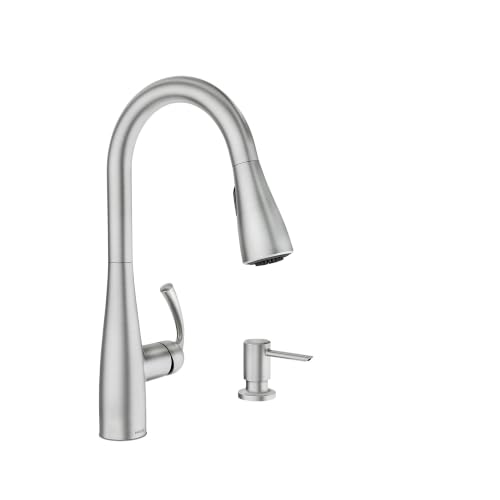
Moen Essie 87014SRS — Best Overall
The Essie is the answer we give first because it is the only faucet here whose own manufacturer data names 2-hole installation. Moen lists the Essie for 1, 2, 3 or 4-hole configurations with the deck plate included, and the box includes a dispenser that can be filled with soap or lotion — so on a two-hole deck you can run the faucet through the plate arrangement and put the second hole to work, or mount the faucet solo and use the dispenser in hole two. It suits remodels on older sinks, RV and bar decks, and anyone who wants one box that solves the pattern. It does not suit buyers wanting a bold design statement.
Strengths
- Verified 1, 2, 3 or 4-hole compatibility — the widest of any mainstream faucet we have checked.
- Power Clean spray and Reflex docking: Moen’s current core technology, not a stripped variant.
- Included dispenser turns the second hole into a feature; Duralock quick-connect simplifies the install.
Trade-offs
- Transitional styling is pleasant rather than distinctive.
- At 15.75 inches overall, check cabinet clearance like any mid-height faucet.
- The flexible configuration means more parts in the box and a few more minutes of install decisions.
Spec snapshot (verified): Install: 1, 2, 3 or 4 hole, deck plate included · Overall height 15.75 in · Dimensions 8.78 x 2.31 x 15.75 in · Finish: Spot Resist Stainless · Spray: Power Clean with Reflex system
In a category built on workarounds, the Essie is the engineered solution, and it behaves like one: the same spray force and docking as Moen’s standard-height flagships, a finish that hides daily evidence, and a configuration kit that adapts instead of forcing. If your two-hole deck is in a main kitchen and you want the faucet decision to be simple and final, this is it. The dispenser is the detail owners end up praising — a two-hole deck with the Essie gives you an integrated soap dispenser that a three-hole owner has to sacrifice a hole or a plate position to get.
Best for: any two-hole deck wanting a native, one-box solution / Not suited for: design-led kitchens wanting a statement faucet

Delta Boyd 19893Z-SPSD-DST — Best Faucet-and-Dispenser Set
The Boyd is Delta’s bundle answer: a pull-down kitchen faucet sold with its matching soap dispenser, which maps perfectly onto a two-hole deck — faucet in one hole, dispenser in the other, both in SpotShield Stainless, both designed together. Delta’s verified data adds ShieldSpray technology (a concentrated stream inside a protective sphere of water, for force with far less splatter), DIAMOND Seal technology rated by Delta to last twice the industry standard, and MagnaTite magnetic docking. It suits family kitchens that will actually use a dispenser daily. It does not suit buyers who want the second hole for a sprayer or filtered water instead.
Strengths
- Faucet and matching dispenser in one box — the complete two-hole arrangement, coordinated.
- ShieldSpray gives forceful cleaning with contained splatter, per Delta’s data.
- MagnaTite docking and DIAMOND Seal valve from Delta’s upper lines.
Trade-offs
- Commits the second hole to soap — no sprayer or dispenser alternatives later without a swap.
- SpotShield Stainless is the bundled finish; other finishes change the configuration.
- Dispenser bottles need refilling from below or above depending on model — a small recurring chore.
Spec snapshot (verified): Configuration: pull-down faucet with included soap dispenser · Finish: SpotShield Stainless · Docking: MagnaTite magnetic · Spray: ShieldSpray · Valve: DIAMOND Seal (per Delta API feature data)
The Boyd understands something about two-hole decks: the second hole is not a problem, it is an assignment, and soap is the assignment most kitchens use most. Bundling the dispenser removes the finish-matching gamble of buying one separately — Delta’s SpotShield on the faucet and the dispenser actually match, which third-party pairings often fail to do. Add Delta’s better spray and docking technologies and the Boyd becomes the pick for a family kitchen that wants the arrangement decided in one purchase.
Best for: two-hole family kitchens that want faucet plus dispenser, matched and done / Not suited for: decks where hole two is reserved for a sprayer or filter tap

Delta Lenta 19802Z-SP-DST — Best Design Pairing
If the faucet half of your two-hole arrangement should carry the kitchen’s design, the Lenta is the choice: a sculpted, broad-arc single-hole faucet, verified at 16.25 inches overall, in SpotShield Stainless. Pair it with a quality dispenser or a separate sprayer in the second hole. It suits modern remodels on two-hole stone counters, where a conservative faucet would waste the deck’s clean look. It does not suit tight budgets or traditional styling.
Strengths
- The strongest design in this guide — a genuine sculptural object at the sink.
- Verified dimensions let you plan the pairing’s spacing precisely.
- SpotShield finish keeps the wide surfaces clean with minimal wiping.
Trade-offs
- The second-hole accessory is a separate purchase and a separate finish-matching decision.
- Premium tier pricing for the faucet alone.
- Single-hole only — no plate tricks if the deck pattern changes later.
Spec snapshot (verified): Install: single hole · Overall height 16.25 in · Dimensions 9.13 x 1.5 x 16.25 in · Finish: SpotShield Stainless · Variant note: this configuration is the without-dispenser version per listing data
The Lenta’s broad, low-slung arc is an advantage on a two-hole deck specifically: its visual weight sits in the arc rather than in a cluster of deck hardware, so the faucet plus a slim dispenser reads as a designed pair instead of two appliances sharing a counter. Delta’s engineering underneath — integrated lines, magnetic-era docking design, a finish tested against corrosion beyond industry norms — supports the styling with substance. Choose it when the kitchen’s look is the project and the second hole’s job (soap, usually) is already decided.
Best for: modern two-hole counters where the faucet is the design anchor / Not suited for: tight budgets or buyers wanting everything in one box

Kraus Oletto KPF-2820SFS — Best Premium Pairing
The Oletto is the construction-first pairing choice: a brass-body, single-hole pull-down with the most completely published dimensions in this guide — 16.63 inches overall, 8.75-inch spout height, 8.88-inch reach, 1.8 GPM. On a two-hole deck, that dimensional honesty is gold: you can lay out the faucet and the second-hole accessory on paper and know they fit. It suits deep sinks, long-horizon owners and hard-water homes (easy-clean nozzles, spot-free finish). It does not suit buyers wanting a pause mode or multi-pattern spray.
Strengths
- Brass body with ceramic cartridge — the long-service construction standard.
- Complete published dimensions including spout height and reach.
- Reach Technology hose with swivel adapter for a full, untwisted range of motion.
Trade-offs
- Two spray functions only.
- Accessory for hole two is a separate purchase.
- Tallest pick here — verify cabinet clearance.
Spec snapshot (verified): Install: single hole · Overall height 16.63 in · Spout height 8.75 in · Spout reach 8.88 in · Flow 1.8 GPM · Body: brass · Finish: Spot Free Stainless Steel
Kraus built its reputation on exactly this kind of buyer: someone who reads the dimension table. The Oletto’s pre-attached water lines and quick-connect hose make the under-sink work shorter than most, and the faucet’s dense, damped feel is what brass buys you. On a two-hole deck in a kitchen you own and intend to keep, pairing the Oletto with a good dispenser is the premium version of the arrangement — the one you install once and stop thinking about.
Best for: long-horizon owners and deep sinks wanting published specs and brass construction / Not suited for: buyers wanting three spray modes or a bundled accessory

WEWE Pull-Down — Best Budget True 1-Hole
Most “1-hole” faucets are 1-or-3 designs with the plate left off. This WEWE is a dedicated single-hole faucet — no deck plate in the box, a mounting system specified for 1.30 to 1.50-inch holes and decks up to 1.76 inches thick, three spray modes and a CEC-listed 1.8 GPM flow. On a two-hole deck it is the budget faucet half of the pairing, leaving the second hole for an inexpensive dispenser. It suits rentals, first homes and thick stone counters. It does not suit anyone who might later need it on a 3-hole deck without a plate.
Strengths
- Purpose-built 1-hole mounting with published hole and deck-thickness ranges.
- Three spray modes with easy-clean silicone nozzles; SUS 304 body.
- Ceramic cartridge tested to 500,000 cycles and cUPC / NSF 61 and 372 certifications per the manufacturer.
Trade-offs
- No deck plate included — it can never cover extra holes.
- Online-only brand support.
- Accessory for the second hole is on you to source and match.
Spec snapshot (verified): Install: 1 hole only · Overall height 15.7 in · Flow 1.8 GPM (CEC listed) · Fits holes 1.30–1.50 in, decks to 1.76 in · Body: SUS 304 stainless
The WEWE’s specialization is its honesty: it does one mounting pattern, publishes the tolerances, and prices accordingly. On a two-hole deck, that focus is a virtue — the faucet mounts cleanly with no plate overhang eating into the space where the dispenser or sprayer base needs to sit, which on tight two-hole spacing is a real fitting concern. Pair it with a simple stainless dispenser and the whole arrangement lands at a budget tier while looking deliberate.
Best for: budget two-hole arrangements and thick counters needing a true 1-hole faucet / Not suited for: future 3-hole decks or plate-dependent installs

Delta Nicoli 19867LF-SS — Best Modern Alternative
The Nicoli is Delta’s contemporary single-hole pull-down in stainless — clean lines, a single handle, and the mainstream Delta feature set — for buyers who want the pairing arrangement in a current, minimal style without the Lenta’s premium. It suits modern and transitional kitchens on two-hole decks where the second hole will take a dispenser. It does not suit buyers needing verified specialty dimensions — Delta’s listing data for this model is thinner than the Oletto’s — or traditional styling.
Strengths
- Current Delta design language at a mainstream tier.
- Single-hole configuration verified in the manufacturer’s title data.
- Delta’s national parts and support network behind it.
Trade-offs
- Published specification depth is thinner than some rivals — confirm dimensions on the listing before pairing on tight spacing.
- Accessory for hole two is a separate purchase.
- Styling is contemporary only.
Spec snapshot (verified): Install: single hole · Handle: single · Finish: stainless · Line: Delta Nicoli 19867LF-SS (per Amazon title data)
Think of the Nicoli as the safe modern default for the pairing: a current Delta, sensibly priced within its brand, that will look right in the large middle of kitchen styles and be serviceable for decades. On a two-hole deck it leaves the visual field calm, which lets a well-chosen dispenser or a sprayer base sit beside it without a design argument. If the Lenta is the statement and the Oletto is the engineering pick, the Nicoli is the one you buy when you want to stop deliberating and still end up with the right faucet. Its mainstream position also means that if you later sell the home, the faucet reads as a recent, recognizable update rather than an experiment.
Best for: modern two-hole kitchens wanting a mainstream Delta at a sensible tier / Not suited for: buyers needing fully published dimension tables
Comparison Table
| Pick | Badge | Key spec | Best for |
|---|---|---|---|
| Moen Essie 87014SRS | Best Overall | Verified 1–4 hole incl. 2 | Native two-hole solution |
| Delta Boyd 19893Z-SPSD-DST | Best Faucet-and-Dispenser Set | Dispenser included, ShieldSpray | One-box arrangement |
| Delta Lenta 19802Z-SP-DST | Best Design Pairing | Single hole, 16.25 in | Modern design anchor |
| Kraus Oletto KPF-2820SFS | Best Premium Pairing | Brass body, full dimensions | Long-horizon quality |
| WEWE Pull-Down | Best Budget True 1-Hole | 1-hole only, 15.7 in | Budget pairings |
| Delta Nicoli 19867LF-SS | Best Modern Alternative | Single hole, single handle | Mainstream modern |
How to Choose a Faucet for a 2 Hole Deck
Decide what the second hole is for before you choose the faucet, because the answer reorganizes the shortlist. If it is soap, the Boyd bundle or the Essie (with its included dispenser) finish the decision in one box; any other pick means sourcing a dispenser whose finish family matches. If it is a side sprayer, the faucet must have a diverter — which in practice means the Essie’s flexible kit or a faucet designed for a sprayer, not a random single-hole model. If it is filtered water or an air gap for a dishwasher, any single-hole pick works and the accessory’s base diameter becomes the constraint. If you genuinely do not know, the Essie is the hedge: its kit covers the widest range of futures.
Then check geometry. Measure the center-to-center spacing of your two holes and the diameter of each. A single-hole faucet’s mounting typically needs a hole of about 1.3 to 1.5 inches (the WEWE publishes 1.30–1.50), and the faucet base plus the accessory base need room to sit side by side without their flanges overlapping — on very tight spacing, a slim faucet like the WEWE or Nicoli pairs more easily than a wide-based design. Finally, check deck thickness against the faucet’s published maximum (the WEWE’s 1.76 inches is generous for stone); a faucet whose mounting shank is too short for a thick counter is a return waiting to happen.
Spacing deserves one more paragraph, because two-hole decks come in two geometries and they are not interchangeable. On the common pattern, the holes sit in a line parallel to the backsplash, a few inches apart, and the arrangement reads left-to-right: faucet, then accessory, positioned for the user’s dominant hand. On the less common pattern — mostly older and RV decks — the holes sit front-to-back or diagonally, which can put the accessory behind the faucet where a dispenser pump is awkward to reach. Front-to-back decks favor a compact faucet with a rear or side lever and an accessory with a small base; if your deck is diagonal, dry-fitting (or even a cardboard template of both bases) is worth ten minutes before any order. Geometry, not hole count, is what makes a two-hole arrangement feel designed rather than improvised.
How to Install a Faucet on a Two-Hole Deck
The sequence mirrors a standard install with two additions. Shut off the stops, remove the old faucet, and clean both holes and the surrounding deck — two-hole decks are often old, and old decks carry decades of sealant and scale that defeat new gaskets. Dry-fit everything first: set the faucet and the second-hole accessory in place without tightening, and check from above that the bases do not foul each other and that the faucet’s lever swings clear of the accessory and the backsplash. Only then mount the faucet, snug its hardware, and connect the supplies. Install the accessory second — dispenser pumps and sprayer bases have their own mounting nuts, and working room under the sink disappears fast, so do the faucet’s connections while the space is still open.
Flush the faucet with its aerator removed, test the pull-down through its full travel (confirm the hose loop does not snag on the dispenser’s bottle or the accessory’s lines), and paper-towel every joint. Problem: the faucet base and dispenser flange overlap → shift to a slimmer dispenser or rotate the faucet’s escutcheon orientation if the design allows; do not force both down onto a shared edge, which guarantees a rocking faucet. Problem: the mounting nut runs out of thread on a thick deck → the faucet’s shank is too short for your counter; this is a specification mismatch, not an installation failure, and the fix is a model with a published longer mounting range. Problem: the second hole is an odd diameter → measure it honestly; dispenser and sprayer bases tolerate a range, but a hole far outside it needs a wider-flange accessory, not sealant heroics.
Budget an extra half hour for a two-hole install compared with a standard one — not because any step is harder, but because the dry-fit and the accessory sequencing reward patience, and because older decks hide small surprises (a seized hole cover, a corroded mounting nut from a previous era) that are trivial when you have time and miserable when you do not. Work in the morning, with the plumbing aisle still open, and the whole category of problem stays small.
The Three Two-Hole Arrangements, in Depth
Arrangement one — faucet plus soap dispenser — is the modern default, and it is the arrangement both bundled picks (Essie, Boyd) are built around. Its virtues are daily: soap at a pump instead of a bottle, a cleaner counter line, and a deck that looks intentional. Its one maintenance reality is refilling: top-fill dispensers refill from above in seconds, while undermount-bottle designs need the bottle unscrewed from below, which is a two-minute job a few times a year. If you cook with cast iron and wash by hand constantly, this is your arrangement.
Arrangement two — faucet plus side sprayer — is the classic, and it has a technical gatekeeper: the faucet must contain a diverter. That is why this guide does not casually pair any single-hole faucet with a sprayer. The Essie’s configuration kit is the mainstream route; purpose-built two-handle-with-spray faucets (covered in our side spray guide) assume a four-hole deck and do not shrink to two. If your two holes are faucet-plus-sprayer from a previous era, check whether the original faucet’s diverter pattern is what you are replacing, and expect the Essie class of flexible faucet to be the practical modern answer.
Arrangement three — faucet plus a water accessory — covers filtered-water taps, instant-hot dispensers and dishwasher air gaps. These accessories have small footprints, which makes them the easiest pairing on tight spacing, and they are the arrangement most common on custom stone counters, where the second hole was drilled deliberately for the accessory rather than inherited. If your household drinks filtered water all day, this arrangement quietly becomes the most-used hole on the deck — plan its position (usually behind or beside the faucet, within easy reach of a glass) with the same care as the faucet itself.
Soap Dispensers: the Small Print
Since the dispenser is the most common second-hole assignment, it deserves its own scrutiny. Capacity varies — most residential dispensers hold enough for weeks of family use — and the pump mechanism is the wear item, so a dispenser from the faucet’s own brand (as bundled with the Boyd, or included with the Essie) has the same parts-availability logic as the faucet itself. Finish matching is the other trap: stainless finishes differ subtly between brands, and a dispenser bought separately from a no-name listing will often be visibly a different metal tone at arm’s length. Bundles exist precisely to solve this. Finally, placement: if you are drilling or assigning holes, the dispenser should sit on the side of your dominant hand, close enough to tap with the back of a soapy hand without reaching across the faucet.
Where Two-Hole Decks Live: RVs, Bars and Older Homes
In RVs and marine galleys, two holes are a space decision: the galley sink is small, the counter is precious, and a faucet plus one accessory is all the deck there is. The picks that serve these decks best are the ones with published mounting ranges and modest footprints — the WEWE’s specified hole and deck ranges suit thin RV counters, and its 15.7-inch height respects RV cabinet clearances. Bar and prep sinks follow the same logic at residential scale: a second, small sink gets a real faucet and a dispenser or sprayer, and the arrangement should be chosen as a pair, not as a main-kitchen hand-me-down. In older homes, the two-hole deck is usually an inheritance — a stainless sink from an era of simpler faucets — and the right instinct is to keep the sink if it is sound. Sinks outlive faucets by decades, and every pick in this guide exists to let a good old sink work with a modern faucet.
Converting Away From Two Holes — and Why You Probably Should Not
Every two-hole owner eventually asks whether to “fix” the deck to a standard pattern. The honest answer is that the deck is not broken. A replacement sink buys you the standard patterns at the price of a sink, its installation, and often countertop work — hundreds of dollars and a weekend, spent to solve a problem this guide solves with a faucet choice. Drilling is the middle path, and it is material-dependent: stainless decks drill cleanly with the right saw and technique, while cast iron, fireclay and stone punish amateurs permanently. The case for converting is real only when the sink itself is at end of life — stained, chipped, or sized wrong for the household — in which case choose the new sink’s deck for the faucet you actually want, including the two-handle and four-hole patterns in our other guides, rather than defaulting to one hole because it is fashionable.
There is also a resale-flavored myth to retire: that a two-hole deck signals an outdated kitchen to buyers. What buyers read is the faucet and the arrangement’s coherence. A gleaming Essie with its dispenser, or a Lenta paired with a matching dispenser, reads as a designed kitchen; a standard three-hole deck with a tired faucet reads as a project. Spend on the visible, working layer — which is the advice this entire category embodies.
Maintenance Notes for Two-Hole Arrangements
An arrangement has two components, so maintenance splits accordingly. The faucet wants the standard routine: aerator rinsed of scale, finish wiped with a damp cloth, cartridge replaced by model number when a drip eventually starts. The accessory wants its own: dispenser pumps should be flushed with warm water when they begin to sputter (dried soap is the usual cause, and a pump replacement is the backup), dispenser bottles should be rinsed at refill time rather than endlessly topped up over old soap, and a sprayer’s hose loop should be checked whenever you are under the sink for anything else. Once a year, look at the underside of the deck itself: two-hole decks are often old decks, and the earliest sign of a failing sink or a weeping mounting is visible from below long before it is visible from above. Catching it there is the difference between reseating a gasket and replacing a cabinet floor.
Common Buying Mistakes
- Assuming a “2-hole faucet” is a standard product type. It is an arrangement. Only the Essie here is manufacturer-rated for 2-hole mounting as a faucet configuration.
- Buying the faucet before assigning the second hole. Soap, sprayer and filter tap lead to different faucets (the sprayer needs a diverter in the faucet).
- Ignoring base collision on tight spacing. Dry-fit both components before tightening anything down, and check the lever’s swing against the accessory as well.
- Forgetting deck thickness. Two-hole decks are often thick stone or old castings; check the faucet’s published mounting range.
- Covering the spare hole with a plate and calling it done. A hole cover is fine, but a working dispenser costs little more and pays daily. At minimum, cover the hole properly — an open hole is a water path into the cabinet.
- Trusting a compatibility claim you cannot trace to the manufacturer. Hole claims are the most inflated copy in the category. If the brand’s own specification data does not state the configuration, assume it does not exist.
Final Recommendation
For most two-hole decks, buy the Moen Essie — it is the one faucet actually rated for your deck, dispenser included. If you want the arrangement bundled by Delta with stronger spray technology, take the Boyd. Building a pairing instead? The Lenta for design, the Oletto for construction, the WEWE for budget, the Nicoli for the modern mainstream. Whichever route you take, measure the deck first and assign the second hole deliberately; a two-hole arrangement chosen on purpose looks and works like a designed kitchen, because it is one. For the neighboring deck patterns, see Best 3 Hole Kitchen Faucets and Best 4 Hole Kitchen Faucets, the sprayer-first view in Best 2 Handle Kitchen Faucets With Side Spray, and the height classes in Best 14 Inch Kitchen Faucets.
Frequently Asked Questions
Do they make faucets specifically for 2-hole sinks?
Very few. The Moen Essie is the mainstream exception, with manufacturer data explicitly covering 1, 2, 3 or 4-hole installation. Everything else in this category is an arrangement: a single-hole faucet plus an accessory (dispenser, sprayer or filter tap) in the second hole. This is not a deficiency of the market so much as a reflection of how the decks arose — as simplified or inherited patterns rather than as a designed standard — and it is why a two-hole owner should shop the arrangement as a whole, the way this guide is organized, instead of hunting for a mythical dedicated product type that only one major faucet honestly claims to be.
What is the second hole on a kitchen sink for?
Most commonly a soap dispenser or a side sprayer. It can also host a filtered-water tap, a dishwasher air gap (required in some jurisdictions), or an instant hot-water dispenser. On many two-hole decks it was originally drilled for a sprayer that a previous owner removed, which is why the under-sink area often still has the hose clips and capped fittings from that original installation — worth a look before you assume anything about what the hole can become.
Can I put a 3-hole faucet on a 2-hole sink?
Only if the faucet’s configuration genuinely works with fewer holes — for example, a 1-or-3-hole faucet used in its 1-hole mode, which describes several of the pairing picks in this guide. A faucet that needs three mounting points (such as a two-handle centerset) cannot be adapted to two holes, no matter how the listing photographs it. Check the manufacturer’s stated configurations, not the listing headline, and if the configuration you need is not stated in the brand’s own data, treat the answer as no.
Can I drill a third hole in my sink?
In stainless steel, yes, with the correct hole saw, cutting oil and care — it is a common plumber task. In cast iron, fireclay, granite or composite sinks, drilling ranges from risky to effectively impossible without specialist tooling, and a mistake is permanent. On those decks, the arrangements in this guide are the right answer.
What size are the holes on a 2-hole sink?
Typically the faucet hole is around 1.35 to 1.5 inches and the accessory hole similar, but older and custom decks vary. Measure both holes’ diameters and their center-to-center spacing; faucet listings that publish mounting ranges (the WEWE’s 1.30–1.50-inch hole range, for instance) let you verify fit before ordering.
Should the second hole hold a dispenser or a sprayer?
Soap, for most households: a dispenser is used every day, eliminates the bottle by the sink, and needs no diverter in the faucet. Choose the sprayer if you routinely rinse large items or fill vessels outside the sink — and then choose a faucet, like the Essie configuration or a sprayer-designed model, whose body includes the diverter a sprayer requires.
How do I cover a second hole I am not using yet?
With a sink hole cover — a small metal cap that clamps through the hole — in a finish family matching your faucet. It is a legitimate temporary or even permanent answer, and it keeps the option open: owners frequently cover the hole for a year, discover whether they miss a dispenser or a sprayer, and then assign it with evidence instead of guessing. What not to do is leave the hole open (it admits water to the cabinet with every splash) or seal it with caulk alone, which fails invisibly and traps moisture against the deck.
Are two-hole decks a sign of an old kitchen?
They are a sign of a deck drilled for a simpler era’s faucets — or, on custom counters, of a designer who wanted exactly one accessory. The age signal buyers actually read is the faucet and the finish, not the hole count. A current faucet in a coherent two-hole arrangement reads as a maintained kitchen; the guides on this site exist because thousands of owners make exactly that update every year, and because a well-kept older sink under a modern faucet photographs better than a new sink under a tired one.


