Disclosure: airfryerkitchensupply.com is reader-supported. When you buy through links on our site, we may earn an affiliate commission at no extra cost to you.
Where to buy
Every pick in this guide to the best 1400 watt coffee makers was verified against a current Amazon listing, so the models, capacities and specifications below are the manufacturers’ own.
Wattage claims live in listing titles and spec tables, and they are worth verifying before you buy — every pick below has its 1400W rating confirmed in its verified Amazon listing. Check the current configuration on the listing, because urn sizes and espresso variants shift between sellers.
- Lemoeyes 15L Stainless Steel Coffee Urn, 1400W — Check the current price on Amazon
- Lumicasaler 15L Commercial Coffee Urn, 1400W — Check the current price on Amazon
- Unnsiapit Commercial Coffee Urn, 15L Stainless Steel, 1400W — Check the current price on Amazon
- Mixpresso Espresso Machine for Nespresso OriginalLine Capsules, 1400W — Check the current price on Amazon
- CHULUX 20Bar Compact Espresso Coffee Maker, 1400W — Check the current price on Amazon
- Aromaster 1400W Espresso Machine with Milk Frother — Check the current price on Amazon
Shopping for the best 1400 watt coffee makers teaches you something most buyers never learn: wattage is a heating specification, not a quality grade. Fourteen hundred watts describes how much electrical power the heating element can draw — which governs how fast water heats and how well temperature holds during brewing. It does not guarantee good coffee, and it is not printed on most drip machines at all, because drip brands compete on capacity and features instead. Search for 1400 watts and the market answers with two categories that do advertise power: large commercial coffee urns and pump espresso machines.
That split defines this guide. On one side, 1400W urns from brands like Lemoeyes, Lumicasaler and Unnsiapit heat fifteen liters of water for event service — at that volume, wattage is the difference between an urn that is ready when guests arrive and one that is still warming up. On the other side, 1400W espresso machines from Mixpresso, CHULUX and Aromaster use the power for fast heat-up and stable shot temperatures in a compact countertop body. These are genuinely different tools united by one number, and this guide treats them that way: pick by the job, then let the wattage confirm the machine can do it.
One more piece of honesty before the picks: a standard North American kitchen circuit is typically rated 15 amps, which at household voltage puts a practical ceiling not far above this class. A 1400W appliance is a serious draw — run it on a circuit that is not already feeding a microwave or a toaster oven, or you will learn about your breaker panel at the worst possible moment. Every pick below was verified with its 1400W rating present in the listing.
In this guide
Quick Picks
Three 1400W urns for volume service and three 1400W espresso machines for the counter — choose your category first, then your model.
- Best Overall 1400W Urn — Lemoeyes 15L Stainless Steel Coffee Urn, 1400W: A 15-liter stainless urn whose 1400W element brings event-scale water to temperature fast and holds it there. Check price on Amazon.
- Best 1400W Urn for Temperature Control — Lumicasaler 15L Commercial Coffee Urn, 1400W: The thermostat urn: adjustable temperature across a wide range, so one vessel serves coffee, tea and hot water properly. Check price on Amazon.
- Best 1400W Urn for Catering Value — Unnsiapit Commercial Coffee Urn, 15L Stainless Steel, 1400W: A four-gallon percolator urn at 1400W, positioned as the value route to commercial-scale coffee service. Check price on Amazon.
- Best 1400W Espresso — Capsule Convenience — Mixpresso Espresso Machine for Nespresso OriginalLine Capsules, 1400W: A 1400W capsule espresso machine with fast heat-up and the huge OriginalLine capsule ecosystem behind it. Check price on Amazon.
- Best Compact 1400W Espresso — CHULUX 20Bar Compact Espresso Coffee Maker, 1400W: A compact pod espresso machine pairing a 1400W boiler with a 20-bar pump and auto shut off for safety. Check price on Amazon.
- Best 1400W Espresso for Milk Drinks — Aromaster 1400W Espresso Machine with Milk Frother: The milk-drink pick: a 1400W ground-espresso machine with a frother for lattes and cappuccinos, plus one-touch descaling. Check price on Amazon.
How These Picks Were Chosen
The first selection filter was verification of the headline claim itself: a pick had to show its 1400W rating in its verified listing, not in a seller’s bullet-point embellishment. That filter removed the vague middle of the market — drip machines with unknown or lower wattage wearing ‘powerful’ language — and left the two categories where wattage is a stated, checkable specification.
Within the urns, we ranked by capacity, temperature control and intended duty: a thermostat-equipped urn suits mixed beverage service, while simpler percolator urns suit straight coffee at scale. Within the espresso machines, we ranked by format — capsule convenience versus ground-coffee flexibility — and by whether the machine covers milk drinks or expects a separate frother.
We deliberately did not rank across the two categories. Declaring an urn ‘better’ than an espresso machine because both draw 1400 watts would be exactly the category error this guide exists to correct. Each pick is the best answer to a different question, and the reviews say which question.
The 6 Best 1400 Watt Coffee Makers

1. Lemoeyes 15L Stainless Steel Coffee Urn, 1400W — Best Overall 1400W Urn
The Lemoeyes 15L urn is a 1400W stainless steel coffee urn in the 77-cup class, built as a hot beverage dispenser for events and large gatherings.
The Lemoeyes earns the top urn slot on the combination that matters at event scale: fifteen liters of capacity and a 1400W element to heat it. Wattage in an urn is really about time — the time between filling the urn and serving the first cup, and the recovery time when you top it up mid-event. At 1400W, this urn heats its full batch at a pace that respects a catering timeline, and the stainless body cleans up quickly when the event ends.
Strengths
- 1400W heating for a big 15L batch — fast recovery between brews
- 77-cup class capacity covers large events in a single fill
- Stainless steel body wipes down easily after events
Trade-offs
- 15 liters is heavy when full — fill it where it will serve
- Commercial size is overkill for home kitchens
- Generic brand; confirm spigot parts availability before an event season
| Key spec | 15L / 77-cup urn, 1400W, stainless steel, hot beverage dispenser |
|---|---|
| Format | 15L / 77-cup urn, 1400W, stainless steel |
Plan the logistics honestly: fifteen liters of water alone weighs about fifteen kilograms, so the urn gets filled where it will serve, not carried full across a venue. The spigot and lid are the daily-touch parts — rinse them after every event and descale the tank on a schedule, because an urn that sits stored with mineral film inside will flavor the next event’s first batch. Used that way, a big 1400W urn is one of the most reliable appliances in event service.
Who should skip it: anyone whose ‘events’ are six-person brunches. This is a 77-cup-class vessel, and brewing a tenth of its capacity wastes energy and produces tired coffee. The espresso picks below exist for households, and smaller urns exist for smaller gatherings. Match the vessel to the crowd and the 1400W element becomes an asset instead of an appetite.
Best for: caterers, churches, offices and event hosts serving large groups / Not suited for: home kitchens or small gatherings — the capacity is the point and the problem
Check on Amazon — check price on Amazon before you buy, since listings and configurations change.

2. Lumicasaler 15L Commercial Coffee Urn, 1400W — Best 1400W Urn for Temperature Control
Lumicasaler’s 15L commercial urn runs a 1400W element with an adjustable thermostat spanning hot-water to brewing temperatures, for catering-style service.
Lumicasaler’s 15L urn adds the feature event hosts actually use: an adjustable thermostat spanning roughly 86 to 230 degrees Fahrenheit. Coffee wants one temperature, green tea wants a lower one, and plain hot water service wants a third — a fixed-temperature urn forces compromises that a dial solves. Combined with the 1400W element’s heating pace, it is the most flexible large urn in this guide.
Strengths
- Adjustable thermostat across a wide range suits coffee, tea and hot water service
- 1400W element brings a full 15L batch up to temperature efficiently
- Commercial positioning with a stainless build for repeated event use
Trade-offs
- Thermostat dial needs a test batch to learn its real-world accuracy
- Large footprint in storage between events
- Not a home drip replacement — it percolates/holds at event scale
| Key spec | 15L commercial urn, 1400W, adjustable thermostat 86–230°F |
|---|---|
| Format | 15L commercial urn, 1400W, adjustable thermostat 86–230°F |
A thermostat dial on a commercial urn is a tool, not a guarantee: dial accuracy varies, so run a test batch with a thermometer before your first real event and mark the dial positions that produce your target temperatures. That fifteen-minute calibration converts a generic urn into a known instrument, and it is the difference between hosts who trust their equipment and hosts who hover over it. After calibration, the wide range genuinely covers a full beverage program from one vessel.
The rest of the urn discipline applies unchanged: fill in place, descale on schedule, and store it dry. Commercial buyers should also confirm spigot and gasket availability with the seller before a busy season — on any urn, the spigot seal is the part that eventually wears, and discovering that during a wedding reception is the wrong timeline.
Best for: event hosts running a mixed beverage program from a single urn / Not suited for: buyers who only ever serve black coffee — the simpler urns above and below cost less
Check on Amazon — check price on Amazon before you buy, since listings and configurations change.
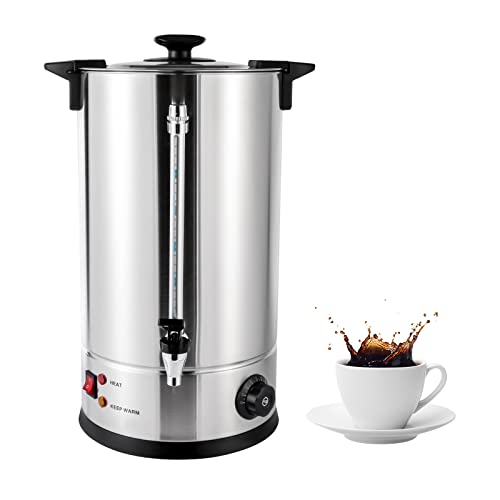
3. Unnsiapit Commercial Coffee Urn, 15L Stainless Steel, 1400W — Best 1400W Urn for Catering Value
The Unnsiapit 15L commercial urn is a 1400W stainless percolator-dispenser in the four-gallon class for event coffee service.
The Unnsiapit covers the same fifteen-liter, 1400W ground as the picks above with a percolator design and a value orientation. Percolator brewing cycles water through the grounds repeatedly, producing the bold, hot, hold-for-hours coffee that event service actually runs on — nobody is judging delicate tasting notes at a conference break, and an urn that keeps coffee assertively hot for a three-hour event is doing its job correctly.
Strengths
- 1400W percolator brewing at a 15L event scale
- Doubles as a hot beverage dispenser after brewing
- Stainless construction suits rental halls, offices and churches
Trade-offs
- Percolator flavor profile is bolder and less nuanced than drip
- Full 15L batches need a lot of ground coffee per brew
- Generic brand support is thinner than Hamilton Beach or West Bend
| Key spec | 15L / 4-gallon urn, 1400W, percolator-style brewer dispenser |
|---|---|
| Format | 15L / 4-gallon percolator urn, 1400W, stainless steel |
Percolator flavor is the trade to accept knowingly: repeated cycling extracts more bitterness than a single-pass drip, especially if the urn sits at a rolling perk for hours. The management technique is simple — once the batch is brewed, let the urn hold temperature rather than actively perk, and the coffee stays in its best window far longer. Hosts who learn that one habit get consistently better event coffee from any percolator urn.
As with the other generic commercial brands here, support runs through the seller rather than a national service network. For a venue that brews weekly, that is acceptable; for a business whose revenue depends on the urn daily, the established brands in our urn guides deserve a look alongside. For occasional-to-regular event duty, the value equation here is sound.
Best for: budget-conscious venues and hosts who need commercial volume without commercial-brand pricing / Not suited for: daily-duty commercial operations that need a national service network
Check on Amazon — check price on Amazon before you buy, since listings and configurations change.

4. Mixpresso Espresso Machine for Nespresso OriginalLine Capsules, 1400W — Best 1400W Espresso — Capsule Convenience
Mixpresso’s capsule espresso machine runs a 1400W heating system for Nespresso OriginalLine capsules, delivering fast single-serve espresso at home.
Crossing to the espresso side of the 1400W world, the Mixpresso is the convenience pick: a capsule machine whose 1400W heating system brings it to brewing temperature quickly and holds shot temperatures stable across back-to-back drinks. It works with Nespresso OriginalLine capsules, which means hundreds of roasts and blends — including third-party capsules — are available anywhere, with zero grinding, dosing or cleanup beyond emptying the capsule bin.
Strengths
- 1400W heating means fast heat-up and stable espresso temperatures
- Works with the wide Nespresso OriginalLine capsule ecosystem
- Compact countertop footprint for a true pump espresso machine
Trade-offs
- Capsule-only — no ground coffee option
- Capsule cost per cup exceeds drip or ground espresso over time
- 1400W is the rating, not a guarantee — shot quality still depends on the capsule
| Key spec | 1400W single serve espresso, Nespresso OriginalLine capsule compatible |
|---|---|
| Format | 1400W capsule espresso, Nespresso OriginalLine compatible |
Capsule economics deserve one honest paragraph. Per cup, capsules cost several times what ground coffee costs, and the gap compounds over years of daily drinking. What the premium buys is consistency and time: every shot is dosed correctly by construction, and the morning routine is measured in seconds. For households that value the ritual of espresso without the hobby of espresso, that trade is rational — and the 1400W system ensures the machine’s side of the bargain, temperature and speed, is properly kept.
The limitation is the format’s ceiling: you cannot adjust dose, grind or extraction, so your results are bounded by the capsules you buy. Drinkers who later fall in love with espresso often graduate to ground-coffee machines — at which point this Mixpresso becomes the office or guest machine, a role it fills gracefully for years.
Best for: households wanting fast, consistent espresso with zero learning curve / Not suited for: budget-focused daily drinkers or aspiring home baristas who want control
Check on Amazon — check price on Amazon before you buy, since listings and configurations change.

5. CHULUX 20Bar Compact Espresso Coffee Maker, 1400W — Best Compact 1400W Espresso
The CHULUX compact espresso maker combines a 1400W boiler with a 20-bar pump for pod espresso, with auto shut off in a small countertop body.
The CHULUX compact pairs its 1400W boiler heating with a 20-bar pump in one of the smaller bodies in this guide, which makes it the pick for tight counters, office kitchens and dorm-adjacent setups where a full espresso machine cannot live. Auto shut off is a genuinely useful addition in shared spaces — the machine does not sit hot and energized all day because the last user forgot it.
Strengths
- 1400W boiler heating pairs with a 20-bar Italian-style pump for real extraction pressure
- Auto shut off adds safety for forgetful morning routines
- Compact body fits small counters and office kitchens
Trade-offs
- Pod-compatible format limits you to capsule coffee
- Small water tank needs frequent refills for households
- No milk system — lattes need a separate frother
| Key spec | 20-bar pump, 1400W boiler heating, Nespresso pod compatible, auto shut off |
|---|---|
| Format | 20-bar pump, 1400W boiler, pod compatible, auto shut off |
Understand what the two headline numbers do. The 1400W boiler governs heat-up speed and temperature recovery between shots; the 20-bar pump rating describes maximum pressure capability, while actual espresso extraction happens around nine bars — the headroom exists so the pump is not straining at working pressure. Neither number rescues a stale capsule, which is why pod freshness and storage still decide the cup more than the spec sheet does.
The compact format’s costs are a small water tank and no milk system. A household of latte drinkers will add a frother or choose the Aromaster below; a household of straight espresso and Americano drinkers will never miss what is not there. Sized correctly, the CHULUX is the most space-efficient way in this guide to put real 1400W espresso on a counter.
Best for: small kitchens and offices wanting real pod espresso in minimal space / Not suited for: milk-drink households — there is no frother on board
Check on Amazon — check price on Amazon before you buy, since listings and configurations change.

6. Aromaster 1400W Espresso Machine with Milk Frother — Best 1400W Espresso for Milk Drinks
Aromaster’s 1400W espresso machine adds a milk frother and one-touch descaling to a 20-bar compact platform, for home espresso drinks beyond straight shots.
The Aromaster is the only pick in this guide that covers the full café menu at home: a 1400W, 20-bar espresso platform with an integrated milk frother, so lattes and cappuccinos come from one machine on one counter. For households whose coffee order is a milk drink more often than a straight shot, that integration is the entire decision — the capsule picks above cannot follow you there without a second appliance.
Strengths
- 1400W system with a milk frother covers lattes and cappuccinos, not just shots
- One-touch descaling simplifies the maintenance espresso machines demand
- Stainless steel finish at a compact size
Trade-offs
- Frother adds cleaning steps after every milk drink
- Ground-coffee espresso has a learning curve for new owners
- Compact tank and drip tray need regular emptying
| Key spec | 1400W, 20-bar, milk frother included, one-touch descaling |
|---|---|
| Format | 1400W, 20-bar, milk frother, one-touch descaling |
Ground espresso asks more of its owner than capsules do: dosing, tamping and dialing in a grind are skills measured in weeks, and the first fortnight’s shots will be uneven. The Aromaster’s one-touch descaling at least removes the most annoying maintenance task from the learning curve. Buyers willing to climb the short skill slope are rewarded with the lowest per-cup cost in the espresso half of this guide and the freedom of any bean from any roaster.
Milk systems impose a cleaning discipline that cannot be negotiated: the frother gets rinsed after every use, every time, because dried milk in a steam path is both a flavor and a hygiene problem. Households honest about that habit will love this machine; households that know they will skip it should choose a capsule pick and a separate, simpler frothing arrangement instead.
Best for: latte and cappuccino households ready to learn ground espresso / Not suited for: set-and-forget buyers — milk systems and ground coffee both demand routine
Check on Amazon — check price on Amazon before you buy, since listings and configurations change.
Comparison Table
| Pick | Badge | Key spec | Best for |
|---|---|---|---|
| Lemoeyes 15L Stainless Steel Coffee Urn, 1400W | Best Overall 1400W Urn | 15L / 77-cup urn, 1400W, stainless steel, hot beverage dispenser | caterers, churches, offices and event hosts serving large groups |
| Lumicasaler 15L Commercial Coffee Urn, 1400W | Best 1400W Urn for Temperature Control | 15L commercial urn, 1400W, adjustable thermostat 86–230°F | event hosts running a mixed beverage program from a single urn |
| Unnsiapit Commercial Coffee Urn, 15L Stainless Steel, 1400W | Best 1400W Urn for Catering Value | 15L / 4-gallon urn, 1400W, percolator-style brewer dispenser | budget-conscious venues and hosts who need commercial volume without commercial-brand pricing |
| Mixpresso Espresso Machine for Nespresso OriginalLine Capsules, 1400W | Best 1400W Espresso — Capsule Convenience | 1400W single serve espresso, Nespresso OriginalLine capsule compatible | households wanting fast, consistent espresso with zero learning curve |
| CHULUX 20Bar Compact Espresso Coffee Maker, 1400W | Best Compact 1400W Espresso | 20-bar pump, 1400W boiler heating, Nespresso pod compatible, auto shut off | small kitchens and offices wanting real pod espresso in minimal space |
| Aromaster 1400W Espresso Machine with Milk Frother | Best 1400W Espresso for Milk Drinks | 1400W, 20-bar, milk frother included, one-touch descaling | latte and cappuccino households ready to learn ground espresso |
How to Choose a 1400 Watt Coffee Maker
Choose the category before the model, because the wattage is the only thing these machines share. If your problem is volume — events, offices, gatherings — you are buying an urn, and the deciding specs are capacity in liters, temperature control and spigot quality. If your problem is a better morning cup, you are buying an espresso machine, and the deciding specs are capsule versus ground format and whether milk drinks are in your life. A buyer who starts from the job never ends up comparing an urn against an espresso machine on the same spreadsheet row.
Understand what 1400 watts buys in each category. In an urn, it buys time: fifteen liters of water is a serious thermal mass, and 1400W brings it to serving temperature meaningfully faster than a 1000W element, with better recovery when cold water tops up the tank. In an espresso machine, it buys readiness and stability: short heat-up, and temperature that does not sag on the second and third shots. In both cases the wattage is infrastructure — it enables the experience rather than flavoring it.
Check your circuit like an adult. A 1400W appliance draws close to the practical limit of a standard 15-amp kitchen circuit, and it will not share that circuit gracefully with a microwave, toaster oven or kettle running at the same time. Identify which outlets share a breaker with your other heating appliances and give the coffee maker a circuit it can dominate. Breaker trips are not a product defect; they are arithmetic announcing itself.
Finally, price the consumables and the care, not just the machine. Capsule espresso carries a per-cup premium forever; ground espresso carries a grinder and a learning curve; urns carry descaling and storage. The right 1400W machine is the one whose ongoing costs — money, minutes and attention — your household will still be happily paying a year from now.
Wattage, Explained Honestly: What 1400W Does and Does Not Mean
Wattage is power: the rate at which the machine converts electricity into heat. All else equal, a higher-wattage element heats a given volume of water faster and recovers temperature more quickly when cold water enters the system. That is the entire physical claim, and it is a real one — but notice what it does not say. It does not say the water reaches a better temperature, only that it reaches temperature faster. It does not say the extraction is better, because extraction also depends on pressure, grind, dose and distribution. And it does not say anything at all about build quality or longevity.
This is why drip coffee makers rarely advertise wattage: in a drip machine, the water volume is small and the brew is a single pass, so once a modest threshold is met, extra wattage changes the experience very little. Wattage becomes a headline only where the thermal job is genuinely large — heating fifteen liters in an urn — or genuinely demanding — holding precise temperatures through pressurized extraction in espresso. The 1400W figure in this guide is meaningful precisely because the categories here are the ones where power is a binding constraint.
The buyer’s takeaway is a two-step test for any wattage-led listing. First, ask whether the category’s job is power-limited; if it is not, ignore the number entirely. Second, if it is, treat the wattage as a threshold to clear rather than a score to maximize — a well-built 1400W machine will serve you better than a poorly built machine wearing a bigger number. Specifications are admission tickets, not trophies.
How to Set Up a 1400W Coffee Maker Safely and Get the Best From It
Step 1: Place it on the right circuit. Identify a counter outlet whose breaker is not shared with your microwave or toaster oven, plug the machine in directly — no power strips, no extension cords — and confirm the outlet and plug sit firmly. Heating appliances and loose connections are a combination to avoid on principle.
Step 2: Run a water-only first cycle. For an urn, fill partway and bring it to temperature, then drain through the spigot to flush manufacturing residue and test the seal. For an espresso machine, run two or three water-only shots. This flush is also your leak check and your thermostat sanity check, done at a moment when a problem costs nothing.
Step 3: Calibrate before the first real use. Urn owners should verify the thermostat against a kitchen thermometer and mark the dial. Espresso owners should pull the first shots with coffee they know, adjusting one variable at a time. A machine you have calibrated is an instrument; a machine you have not is a rumor.
Step 4: Build the descale and rinse rhythm from day one. Hard water plus high wattage equals fast scale, because hot elements are where minerals precipitate. Put descaling on the calendar at the interval your water hardness demands, rinse milk systems after every use, and store urns dry and open. The 1400W machines in this guide will repay the routine with years of full-power performance.
Ownership Notes: Running a High-Wattage Appliance for Years
High-wattage appliances age at their heating elements and their seals, and both failure paths are slowed by the same two habits: descaling and dry storage. Scale is the element’s enemy because it insulates — a scaled element runs hotter internally to deliver the same water temperature, which stresses the element and the thermostat controlling it, which produces the slow performance decline owners describe as a machine ‘getting tired.’ Descaling on a calendar rather than on symptoms keeps the element working at its designed temperatures, and it is the cheapest longevity intervention available for any machine in this guide.
Seals and gaskets are the second path. Urn spigots, espresso group seals and boiler fittings all live in hot water and all eventually harden or wear. The owner’s contribution is gentleness: do not force a stiff spigot, do not overtighten fittings, and store urns with lids ajar so gaskets are not compressed for months at a time. When a seal does eventually weep, it is a small part and a small job on a machine that was otherwise maintained — and a catastrophe only on a machine whose owner discovers, mid-event, that maintenance was a real thing after all.
Reading a 1400W Listing Like an Electrician
A wattage figure in a listing is a claim, and like every claim in this program it survives or dies on verification. The strongest form of the claim is the one used by every pick in this guide: the wattage appears in the product’s own title or specification table, where the manufacturer states it as a rating. Weaker forms — a wattage mentioned only in a seller’s bullet points, or in an answer to a customer question — deserve a discount, because marketplace listings accumulate embellishments the way urns accumulate scale. When the number decides your purchase, find it in the manufacturer’s own specification, or treat the machine as unverified and choose a pick whose number you can check.
The second check is the plug and the circuit behind it. North American 1400W appliances are built for standard outlets, but ‘standard’ conceals a range: older homes, long circuits and shared kitchen breakers all reduce what a given outlet will happily deliver. A machine that trips a breaker is not necessarily defective — it may be honestly drawing its rated power into a circuit that was already spoken for. The electrician’s habit is to ask what else lives on the circuit before blaming the appliance, and it will save most buyers a return, a review and a support call.
Finally, read wattage together with volume. Fourteen hundred watts heating fifteen liters is a workhorse; the same wattage heating a single espresso shot is a sprinter. The number alone ranks nothing — the number divided by the job is the actual specification, and it is why this guide refused to rank an urn against an espresso machine. Specifications are ratios wearing single numbers as disguises, and the buyer who divides before comparing shops a full level above the buyer who merely reads.
Descaling a High-Wattage Machine: The Maintenance That Protects the Number
Scale is wattage’s natural predator. The minerals in tap water precipitate preferentially onto hot surfaces, and a 1400W element is the hottest surface in the building — so the machines in this guide accumulate insulating scale faster than their low-power cousins, and the symptom is precisely the loss of the thing you bought: heat-up slows, recovery sags, and the thermostat works harder to deliver temperatures the element can no longer reach efficiently. Owners describe the machine as ‘getting old.’ It is not old; it is insulated, and the cure costs a descaling cycle rather than a replacement.
The rhythm that prevents it is calendar-based, not symptom-based, because by the time symptoms announce themselves the scale is already thick. Monthly descaling suits hard-water homes in daily service; quarterly suits soft water or occasional use; urns in event service should be descaled by event count, because every full batch is a full mineral load. The solution itself is ordinary — a commercial descaler or a citric-acid or vinegar cycle per the manufacturer’s direction — and the ten minutes it takes is the cheapest performance insurance in this entire category.
Build the habit into the machine’s home: keep the descaler beside the urn’s storage spot or under the espresso machine’s counter, and mark the calendar where the machine’s owner will actually see it. Maintenance systems that depend on memory fail at exactly the rate memory does. The 1400W machines in this guide are built to deliver their number for years — the descale calendar is how the owner holds up their half of that specification.
Two Kitchens, One Number: How an Urn Host and an Espresso Household Each Use 1400W
Consider the urn host first: a community hall preparing for a Saturday fundraiser. Her 1400W urn goes on ninety minutes before the doors, filled at its serving table, and the wattage she paid for announces itself as margin — the batch is at temperature with time to spare, the thermostat holds it there through a three-hour event, and a mid-event top-up recovers quickly enough that the line never learns it happened. For her, the number is insurance purchased against the only unforgivable event failure, which is coffee that is not ready. She will never think about extraction curves, and she does not need to: her machine’s power is pointed entirely at readiness, and readiness is her whole brief.
Now consider the espresso household: two adults, weekday mornings measured in minutes, a counter the size of a cutting board. Their 1400W machine heats while the kettle would still be thinking, pulls a first shot at a stable temperature, and pulls a second shot immediately after without the sag that makes the second cup a compromise. For them the number is not about volume at all — it is about the disappearance of waiting from a routine that happens five hundred times a year. The same specification, pointed at a thermal mass in one kitchen and at tempo in the other, is doing two completely different jobs, and both buyers would be right to insist on it.
The moral is the one this guide opened with, now with faces on it: wattage is infrastructure, and infrastructure is judged by the life it supports. When you shop this category, name your life first — the hall, the counter, the crowd, the clock — and let the number confirm the machine can carry it. The buyers in trouble are never the ones who bought too few watts. They are the ones who bought the number itself, and discovered at home that a specification is not a use case.
A Final Word on Numbers and Trust
Every guide in this program verifies its products against the same catalog, and this one leaned on that verification harder than most, because its entire premise is a number. A wattage that appears in a manufacturer’s own listing can be checked by any reader in thirty seconds — and a guide whose central claim is checkable is a guide that has nowhere to hide, which is exactly where a buying guide should want to be. When you compare the picks here against machines you find elsewhere, hold them to the same standard: the number in the manufacturer’s specification, or it did not happen.
That standard will occasionally cost you a tempting listing whose wattage lives only in a bullet point, and it will occasionally cost us a pick we wanted to include. It is worth the price on both sides. Specifications you can verify compound into purchases you do not regret, and in a category defined by a single number, the discipline of checking it is not pedantry — it is the entire skill the category demands.
Common Buying Mistakes
- Treating wattage as a quality score. A 1400W rating describes heating power, not coffee quality. Category fit, format and build decide satisfaction; wattage only confirms the machine can do its category’s thermal job.
- Sharing the circuit with another heating appliance. A 1400W coffee maker plus a microwave on one 15-amp circuit is a breaker trip with a timer on it. Give the machine its own circuit headroom.
- Using a power strip or extension cord. Heating appliances belong plugged directly into a wall outlet. Strips and cords add resistance and heat exactly where you least want them.
- Buying an urn for household mornings. A 15-liter urn making two cups is slow, wasteful and produces tired coffee. Match vessel size to the actual crowd.
- Ignoring capsule running costs. The cheapest 1400W espresso machine can become the most expensive way to drink coffee if it locks a heavy daily habit into premium capsules. Price the year, not the machine.
Final Recommendation
If your 1400-watt search began with an event to serve, buy the urn that matches your program: the Lemoeyes for straightforward large-batch coffee, the Lumicasaler if temperature flexibility across coffee, tea and hot water matters, and the Unnsiapit for catering value. If it began with a better morning cup, the Mixpresso is the zero-effort espresso route, the CHULUX is the compact one, and the Aromaster is the milk-drink machine worth learning.
Whichever side of the category you land on, respect the two disciplines this guide keeps returning to: give a 1400W appliance a circuit it can call its own, and keep scale off its heating element with a regular descaling rhythm. Do those two things and the wattage you paid for will still be there, working at full strength, years from now.
Shortlist again: Lemoeyes 15L Stainless Steel Coffee Urn, 1400W, Lumicasaler 15L Commercial Coffee Urn, 1400W and Unnsiapit Commercial Coffee Urn, 15L Stainless Steel, 1400W cover the three most common needs in this category.
Keep exploring the same coffee maker cluster: Best 20 Cup Coffee Makers Best 30 50 Cup Coffee Makers Best 50 Cup Coffee Makers Best 12 Cup Coffee Makers Best 14 Cup Coffee Makers
Frequently Asked Questions
Is 1400 watts a lot for a coffee maker?
It is at the high end for home coffee equipment. Most drip machines draw less and do not advertise the figure; 1400W appears mainly on large urns that heat many liters and on espresso machines that need fast, stable heating. It is a substantial draw — close to what a standard kitchen circuit comfortably supplies to one appliance.
Does higher wattage make coffee taste better?
Not directly. Wattage governs how fast water heats and how well temperature holds. Taste comes from the coffee, the grind, the ratio and the extraction. A 1400W machine creates the conditions for good coffee; it cannot create the coffee itself.
Can I run a 1400W coffee maker on a normal kitchen outlet?
Yes, on a standard outlet — provided the circuit is not simultaneously feeding another heating appliance. Plug directly into the wall, skip power strips, and if the breaker trips when the microwave runs, move one of the two appliances to a different circuit.
Why do so few drip coffee makers list 1400 watts?
Because drip brewing is not power-limited at household volumes: once the element can heat a carafe’s worth of water in reasonable time, more wattage adds little. Brands compete on capacity, programmability and thermal carafes instead — the specs that change a drip buyer’s morning.
1400W urn or a regular coffee maker for a party?
For a party of twenty or more servings, the urn wins: it brews and holds in one vessel at serving temperature. For a dinner party of eight, a regular 12 or 14-cup machine is faster to set up and tastes fresher. The crossover sits around fifteen to twenty cups actually consumed.
Do 1400W espresso machines really need 20-bar pumps too?
The two numbers do different jobs: wattage heats, the pump pressurizes. Twenty bars is a maximum capability rating; espresso extracts around nine bars. Both figures are normal for this class — judge the machine by its format fit for your household, not by chasing the largest numbers.


