Disclosure: airfryerkitchensupply.com is reader-supported. When you buy through links on our site, we may earn an affiliate commission at no extra cost to you.
Where to buy
All six machines in this guide to the best 2 lb bread machines are current Amazon listings, verified through Amazon’s own product data before we wrote a word about them. Start with the Zojirushi Home Bakery Virtuoso Plus if you want the best 2 lb loaf outright, the Cuisinart Convection CBK-210 if crust matters most, the Cuisinart Compact CBK-110 if counter space is tight, the KBS 17-in-1 if you want a ceramic pan and dual heaters, the Hamilton Beach 29987 if budget leads the decision, and the KITCHENARM 29-in-1 if you want the widest program library in the class. Check the current price on Amazon for the one you choose, and confirm the listing is the standalone machine rather than a bundle before you order.
Introduction: Why 2 Lb Is the Size Class Worth Shopping Carefully
The best 2 lb bread machines sit in the sweet spot of the whole category, and that is not marketing language — it is arithmetic. A 2 lb loaf is roughly a standard sandwich loaf: enough for a family’s toast and lunches for a couple of days, small enough to finish while it is still good. Machines built around that size are the ones manufacturers refine year after year, which is why the strongest models in bread making — the best heaters, the best pans, the most honest gluten-free programs — cluster in this class. Go smaller and you are in compact territory with real compromises. Go bigger and you are shopping a short list of family-size machines with wide footprints.
But “2 lb” on a box can mean three different things, and separating them is the whole job of this guide. On some machines, 2 lb is the maximum loaf and the pan is sized exactly for it. On others, 2 lb is the middle setting of three, which is more flexible but means the pan is larger than a 2 lb dough strictly needs. And on a few listings, “2 lb” describes flour-plus-water math the finished loaf never quite reaches. We verified each pick’s capacity claim against its listing data, and in the reviews below we tell you plainly which kind of 2 lb machine each one is.
One more thing this class gets right: ingredient economy. A 2 lb loaf uses a manageable amount of flour per bake, so experimenting — a new whole-wheat ratio, a seeded loaf, a gluten-free test — does not waste a sack of ingredients when a recipe misses. That is part of why we steer new bakers to this size even when a bigger machine tempts them. You will bake more often, learn faster, and waste less in a 2 lb machine than in any other class.
In this guide
Quick Picks
- Best Overall 2 Lb: Zojirushi Home Bakery Virtuoso Plus BB-PDC20BA — A true 2 lb machine with dual heaters, dedicated gluten-free and whole-wheat programs, and a 13-hour timer. The benchmark of the class.
- Best 2 Lb for Crust: Cuisinart Convection Bread Maker CBK-210 — Convection fan for an oven-style crust, 16 programs including a sourdough starter cycle, and an automatic mix-in dispenser.
- Best Compact 2 Lb: Cuisinart Compact Automatic Bread Maker CBK-110 — Full 2 lb capacity in a compact body, with 12 programs, three loaf sizes, three crust shades, and a paddle-removal alert.
- Best 2 Lb for a Ceramic Pan: KBS 17-in-1 Bread Maker — 710W dual heaters, a healthy ceramic pan, an automatic nut dispenser, three loaf sizes, and a 15-hour timer in a stainless steel body.
- Best Budget 2 Lb: Hamilton Beach Digital Bread Maker 29987 — 2 lb capacity with 14 settings including artisan and gluten-free cycles, at a budget-tier price. Check price on Amazon.
- Best 2 Lb for Program Variety: KITCHENARM 29-in-1 Smart Bread Machine — 29 programs, explicit 2 lb / 1.5 lb / 1 lb sizes, a gluten-free setting, and a customizable homemade cycle.
How These Picks Were Chosen
Every candidate for this guide had to pass a capacity test first: the machine’s listing data had to confirm a genuine 2 lb loaf capability — not a flour-weight claim, not a “family size” shrug. We verified listings on our own site’s connection, and we dropped machines whose 2 lb claim we could not confirm, whose listings had dissolved into third-party reseller bundles, or whose size settings topped out below 2 lb despite the marketing. That filter is stricter than it sounds, and it is the reason this list has six machines instead of a padded dozen.
Survivors were then scored on what matters specifically at this size. Baking evenness at full load: a 2 lb dough mass is thick, and weak heating leaves the center of the crumb underdone while the base over-browns, so dual heaters, convection, and strong elements scored high. Size flexibility below 2 lb: households do not bake 2 lb every time, so machines offering 1 lb and 1.5 lb settings earned credit. Kneading strength: a full 2 lb whole-wheat dough is one of the stiffest loads a countertop machine handles. Pan and paddle practicality: release quality, coating type, and whether the paddle can come out before baking. And timer range, because the classic 2 lb use case is loading the machine at night and slicing at breakfast.
As with every guide on this site, recalled models were excluded, no pick earned its place through a manufacturer relationship, and each review below follows our teardown format — who the machine suits, three strengths, three trade-offs, the verified specs only, and a blunt verdict. Where a machine’s 2 lb is a middle setting rather than its maximum, we say so, because that distinction changes how the pan behaves with smaller loads and it is exactly the kind of detail a capacity-focused guide exists to surface.
The 6 Best 2 Lb Bread Machines

Zojirushi Home Bakery Virtuoso Plus BB-PDC20BA — Best Overall 2 Lb
The Virtuoso Plus is a true 2 lb machine — its pan, heaters, and programs are all engineered around exactly this loaf size — and it shows in the finished bread. A heater in the lid works with the main element so a full-size 2 lb loaf browns evenly instead of emerging with a pale crown, which is the visual signature of cheaper machines working at their limit. Dedicated gluten-free and whole-wheat programs handle the two doughs that stress a 2 lb platform hardest, and the 13-hour timer covers the overnight use case completely. If you bake at this size weekly and want the machine that treats 2 lb as its home turf rather than its ceiling, this is it.
Strengths
- Dual heaters sized for a full 2 lb loaf — even browning top and bottom, no pale crown.
- Dedicated gluten-free and whole-wheat programs with timing genuinely adjusted for those doughs.
- 13-hour delay timer makes the load-at-night, slice-at-breakfast routine dependable.
Trade-offs
- Premium tier: you pay for consistency that occasional bakers may not bake often enough to appreciate.
- Full-size footprint with a lid that needs vertical clearance under cabinets.
- Dual kneading blades leave two small holes at the base of the loaf.
Key specs (verified)
- Loaf size: 2 lb
- Programs include: gluten-free, whole-wheat
- Heating: dual heaters
- Delay timer: 13 hours
Why does the “true 2 lb” distinction matter in practice? Because a machine designed around this exact mass proofs and bakes with timing tuned for it. Machines stretching up from a smaller platform tend to under-proof a full load; machines for which 2 lb is the smallest sensible bake in an oversized pan can over-brown the crust before the center sets. The Virtuoso Plus threads that needle, and its whole-wheat program is the clearest proof: stiff, slow-rising dough gets the longer rise it needs, and the lid heater finishes the top while the dense crumb bakes through. Gluten-free bakers get the other half of the bargain — a program built for a batter-style dough rather than a renamed basic cycle.
Ownership is equally thought through: the pan releases a big loaf without a fight, parts like pans and blades are standard replaceable items, and the machine’s consistency means your proven recipe stays proven. In a size class full of adequate machines, this is the one we recommend without qualifiers. Check the current price on Amazon.
Best for: weekly 2 lb bakers, whole-wheat and gluten-free households, overnight-timer users / Not suited for: small households that mostly bake 1 lb loaves, tight budgets, cramped counters

Cuisinart Convection Bread Maker CBK-210 — Best 2 Lb for Crust
A 2 lb loaf has more crust surface than any other home size, so crust quality matters more here than anywhere — and crust is precisely what the CBK-210’s convection fan is for. Moving air evens out the bake and deepens color, giving a 2 lb loaf a firmer, more oven-like exterior than still-air machines manage. Around that fan, Cuisinart builds 16 programs including a sourdough starter cycle and an automatic mix-in dispenser, in a machine sized for a full 2 lb bake. Pick it when the pale, soft crust of typical machine bread is the thing you want to fix.
Strengths
- Convection fan delivers the best-colored, firmest crust on a 2 lb loaf in this guide.
- 16 programs include a sourdough starter cycle for bakers who maintain a starter.
- Automatic mix-in dispenser adds nuts, seeds, and fruit at the right moment in the cycle.
Trade-offs
- The fan adds faint noise during baking and is one more moving part than still-air rivals carry.
- Convection browns enthusiastically; sweet doughs on the darkest setting can overshoot until you learn the machine.
- Full-size body — confirm counter depth and cabinet clearance first.
Key specs (verified)
- Loaf size: 2 lb
- Programs: 16, including sourdough starter
- Baking: convection fan
- Mix-ins: automatic dispenser
A note of honesty about that sourdough program, because 2 lb shoppers ask about it constantly: the cycle maintains starter and handles sourdough-style dough, but no bread machine — this one included — produces a true artisan sourdough loaf with an open crumb and a shattering crust. That takes a Dutch oven. What the CBK-210 genuinely delivers is the best in-machine crust in this class plus a useful starter station, and judged on those honest terms it earns its place. For seeded and fruit loaves at the full 2 lb size, the dispenser is the quiet hero: add-ins land after the hard early kneading, so they survive as pieces instead of being ground into the dough.
If you are upgrading from a basic 2 lb machine and wondering whether the step up changes anything real, this is the upgrade where it does — the difference is visible on every slice. Check the current price on Amazon.
Best for: crust-focused bakers, upgraders from a basic 2 lb machine, seeded and fruit loaves / Not suited for: true-sourdough seekers, noise-sensitive overnight bakers, compact kitchens

Cuisinart Compact Automatic Bread Maker CBK-110 — Best Compact 2 Lb
Compact bread machines usually cap out at 1 or 1.5 lb, which is why the CBK-110 is interesting: it bakes a genuine 2 lb loaf in a compact body, without asking you to downsize your recipes. It keeps the features that matter at this size — 12 programs, three loaf sizes, three crust shades, a 13-hour delay start — and adds a paddle-removal alert, a beep that tells you the last moment to pull the kneading paddle before baking so the loaf comes out without the usual hole. Apartment bakers, small kitchens, and anyone whose counter is already spoken for should start here.
Strengths
- True 2 lb capacity in a compact footprint — the rare small machine that does not shrink your loaf.
- Paddle-removal alert lets you bake hole-free loaves, a feature usually found on pricier machines.
- Three loaf sizes and three crust shades cover the realistic range of everyday baking.
Trade-offs
- Compact machines concentrate heat; the darkest crust shade runs assertive, so start one shade lighter.
- 12 programs is a sensible set, not an expansive one — no starter cycle or dispenser here.
- The smaller body means a smaller viewing window and controls; big hands will find it tidier than roomy.
Key specs (verified)
- Loaf size: up to 2 lb, 3 loaf sizes
- Programs: 12
- Crust: 3 shades
- Delay start: 13 hours; paddle-removal alert
The paddle-removal alert deserves more credit than it usually gets. The paddle hole is the most common cosmetic complaint in all of bread-machine baking, and the standard fixes are a collapsible paddle (expensive) or guesswork about when the last knead ends (frustrating). An alert timed by the machine itself is the simple, honest solution: hear the beep, lift the lid, pull the paddle with a floured hand, close the lid, and the loaf bakes clean. Combined with the compact body, it makes the CBK-110 the most thoughtfully designed small 2 lb machine we verified.
Who should skip it? Bakers who want a dispenser for hands-off raisin bread, and households that will use the 2 lb setting daily and could justify the Zojirushi’s dual heaters. Everyone else with a small kitchen is well served. Check the current price on Amazon.
Best for: apartments and small kitchens, bakers who hate the paddle hole, households wanting size flexibility / Not suited for: dispenser seekers, bakers wanting premium dual-heater evenness, very heavy daily use

KBS 17-in-1 Bread Maker — Best 2 Lb for a Ceramic Pan
The KBS takes a different route into this class: a 710W platform with dual heaters, a ceramic pan instead of a conventional nonstick coating, a convection design, and a 2.2 lb maximum capacity with three loaf sizes — so a 2 lb bake sits comfortably inside its range rather than at its absolute limit. Add an automatic nut dispenser, a touch panel, three crust colors, and a 15-hour delay timer, and you have the feature-rich alternative for buyers who like modern controls and are specifically shopping for a ceramic-coated pan. That headroom above 2 lb is this machine’s quiet advantage: it is not straining at the size this guide is about.
Strengths
- Ceramic pan answers buyers who want to avoid conventional nonstick coatings.
- Dual heaters plus 710W of power bake a 2 lb loaf evenly, with capacity headroom to spare.
- Automatic nut dispenser, 17 programs, and a 15-hour timer — the longest delay in this guide.
Trade-offs
- Ceramic coatings reward gentle handling; metal utensils and abrasive pads will shorten its life.
- The brand’s support network is thinner than the legacy names here — keep your purchase records.
- A 2.2 lb maximum means the pan is slightly oversized for 1 lb bakes; small loaves spread wider and bake flatter.
Key specs (verified)
- Capacity: up to 2.2 lb, 3 loaf sizes
- Power: 710W; heating: dual heaters, convection design
- Pan: ceramic
- Programs: 17; crust colors: 3; delay timer: 15 hours
The ceramic question is worth a straight answer. Ceramic coatings release bread well and suit buyers avoiding traditional nonstick, but they are a coating, not a miracle material: treat the pan like the Zojirushi’s or Cuisinart’s — soak, soft sponge, no metal — and it serves well; treat it roughly and it will wear like any coated pan. The dual heaters are the less debated virtue. At 2 lb, even heating is the difference between a loaf that is done at the top and one that is done everywhere, and this machine’s owners are buying that evenness plus the dispenser convenience in a stainless steel body that looks at home on a modern counter.
One sizing tip specific to this pick: because 2 lb is a middle setting here, match your recipe to the 2 lb size selection carefully rather than the maximum — the how-to section below explains why that matching matters more on multi-size machines. Check the current price on Amazon.
Best for: ceramic-pan shoppers, feature-focused buyers, long delay-timer users / Not suited for: rough pan handlers, buyers who prioritize legacy-brand support, mostly-1 lb bakers

Hamilton Beach Digital Bread Maker 29987 — Best Budget 2 Lb
The budget end of the 2 lb class is crowded with machines that cut capacity, programs, or both. The 29987 cuts neither in any way that matters: a full 2 lb loaf capacity, 14 programmable settings including artisan and gluten-free cycles, and a delay start, in a white and stainless finish that does not look like the cheapest thing on the counter. It has one heating arrangement and no dispenser, and its loaves will have the standard paddle hole and a somewhat paler top than the premium picks. For a first 2 lb machine — or a second machine for a cabin, rental, or college apartment — those are the right corners to cut.
Strengths
- Full 2 lb capacity at a budget tier — no capacity penalty for spending less.
- 14 settings including artisan and gluten-free cycles cover the realistic home repertoire.
- Delay start supports the overnight routine that makes a 2 lb machine so useful.
Trade-offs
- Single-zone heating means a paler top crust than dual-heater or convection models produce.
- No mix-in dispenser: fruit and seeded loaves need add-ins dropped in by hand at the signal.
- Materials and control feel are a clear tier below the premium picks in this guide.
Key specs (verified)
- Loaf capacity: 2 lb
- Programs: 14 settings, including artisan and gluten-free
- Controls: digital, with delay start
- Finish: white and stainless steel
Here is the honest math of the budget tier at this size. The loaves from this machine will make fine toast and sandwiches, its dough cycle will quietly transform pizza night, and its gluten-free cycle — while not as refined as the Zojirushi’s dedicated program — lets a household test gluten-free baking without a premium commitment. What you give up is the last degree of evenness and crust, the very things a new baker is least equipped to judge and a frequent baker will eventually want. That is why our standard advice holds: buy this tier to learn whether you are a bread-machine household; upgrade later only if the answer is yes, twice a week.
Do not buy it expecting the results described in the Zojirushi review above, and do not let anyone sell you a no-name budget rival instead — at this tier, a mainstream brand with real parts support is worth more than a longer program list. Check the current price on Amazon.
Best for: first-time 2 lb buyers, budget-led households, second-machine duty / Not suited for: crust perfectionists, hands-off mix-in bakers, heavy whole-grain schedules
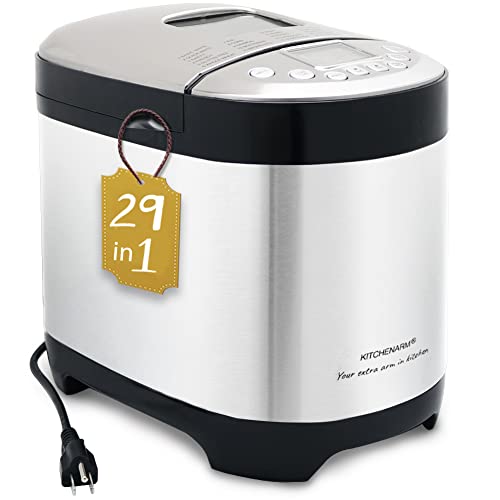
KITCHENARM 29-in-1 Smart Bread Machine — Best 2 Lb for Program Variety
Where most 2 lb machines offer a dozen programs, the KITCHENARM offers 29 — and, more usefully, a homemade cycle that lets you adjust the phases yourself once the presets stop fitting your recipes. Its size settings are explicit and exactly on-topic for this guide: 2 lb, 1.5 lb, and 1 lb, with a gluten-free setting and whole-wheat support in a stainless steel body. It is the pick for the baker who treats a bread machine as a small programmable oven-kneader and wants the widest canvas in the class. If you will use three programs forever, this machine’s depth is wasted on you — buy the Hamilton Beach and be happy.
Strengths
- 29 programs — the broadest library in the 2 lb class — plus a customizable homemade cycle.
- Explicit 2 lb / 1.5 lb / 1 lb settings make size matching unambiguous.
- Dedicated gluten-free setting and whole-wheat capability cover the demanding doughs.
Trade-offs
- Program abundance means menu complexity; expect a learning period and keep the manual close.
- A smaller brand than the legacy names here, with a correspondingly smaller support footprint.
- Many of the 29 programs are variations most households will rarely touch — value depends on your curiosity.
Key specs (verified)
- Loaf sizes: 2 lb, 1.5 lb, 1 lb
- Programs: 29, including gluten-free and a homemade cycle
- Body: stainless steel
- Positioning: whole-wheat capable
The homemade cycle is the feature to weigh, because raw program count flatters every machine that prints it. A customizable cycle lets an experienced baker lengthen a whole-wheat rise on a cold day, shorten a knead for a delicate enriched dough, or save a personal program for the household loaf once it is perfected. That is real capability, and in this class it is rare at any tier. The recipes included with the machine give new owners a starting library tuned to its pan and timing, which shortens the trial-and-error phase considerably.
Our caution is about fit, not quality: this is a machine for bakers who will explore it. Bought as a one-button appliance, its menus will feel like friction. Bought as an instrument, it is the most flexible 2 lb platform we verified. Check the current price on Amazon.
Best for: experimental bakers, households wanting one machine for many dough types, homemade-cycle tinkerers / Not suited for: one-button minimalists, buyers prioritizing legacy-brand support, the merely curious about program counts
Comparison Table
| Pick | Badge | Key spec | Best for |
|---|---|---|---|
| Zojirushi Virtuoso Plus BB-PDC20BA | Best Overall 2 Lb | Dual heaters, 13-hour timer, GF and whole-wheat programs | Weekly bakers wanting the benchmark loaf |
| Cuisinart Convection CBK-210 | Best 2 Lb for Crust | Convection fan, 16 programs, dispenser | Bakers who prioritize crust |
| Cuisinart Compact CBK-110 | Best Compact 2 Lb | Compact body, 3 sizes, paddle-removal alert | Small kitchens, hole-free loaves |
| KBS 17-in-1 | Best 2 Lb for a Ceramic Pan | 710W dual heaters, ceramic pan, 15-hour timer | Ceramic-pan and feature shoppers |
| Hamilton Beach 29987 | Best Budget 2 Lb | 14 settings including artisan and gluten-free | First-time and budget buyers |
| KITCHENARM 29-in-1 | Best 2 Lb for Program Variety | 29 programs, homemade cycle, 3 sizes | Experimental bakers |
How to Choose Among the Best 2 Lb Bread Machines
Begin by deciding which kind of 2 lb machine you are buying, because the three kinds behave differently. A true 2 lb machine — the Zojirushi in this guide — is engineered around this exact loaf and gives the most consistent results at full size, but offers less flexibility to bake small. A middle-setting machine — the KBS and KITCHENARM — treats 2 lb as one stop on a range, which is ideal if your household alternates between a big weekend loaf and small weekday bakes. A compact 2 lb machine — the Cuisinart CBK-110 — trades some heating headroom for a footprint that fits real kitchens. None of these is the wrong answer; buying one while expecting another’s behavior is how disappointment happens.
Then check the flour math on any recipe you plan to live on. A 2 lb loaf typically starts from roughly three to four cups of flour depending on the recipe style, and whole-wheat versions sit at the demanding end of that range for both kneading strength and rise time. If your staple loaf is whole wheat, weight your decision toward the machines with dedicated whole-wheat programming and strong, even heating. If your staple is a white or mixed-flour sandwich loaf, every machine in this guide will serve you, and you can let footprint, pan coating, and budget decide.
What a 2 Lb Pan Means for Slices, Storage, and Freezing
Loaf size is really slice size in disguise. A 2 lb loaf from a horizontal or compact-vertical pan slices into pieces that fit a standard toaster and make a proper sandwich — the unglamorous reason this class outsells every other. Plan storage before your first bake, not after: a 2 lb loaf is two to three days of bread for most households, which is exactly the window in which homemade bread is at its best. The rhythm that works is bake, cool fully, slice what the next two days need, and freeze the rest in slices that toast straight from frozen. Bakers who leave a whole 2 lb loaf on the counter for a week and conclude that machine bread “goes stale fast” are really describing a storage plan, not a machine.
Heating, Coatings, and Timers: The Specs That Matter at 2 Lb
At this loaf mass, heating design is the spec that most predicts satisfaction. Dual heaters and convection exist because a thick 2 lb crumb insulates its own center; single-element machines compensate with longer bakes and still tend to deliver a paler top. Pan coating is the second practical spec: conventional nonstick is the default and releases beautifully, ceramic suits buyers avoiding it, and in both cases gentle hand-washing is the price of a long-lived pan. Timers are the third: a 13- to 15-hour delay range covers every realistic overnight scenario, and the difference between the timers in this guide matters less than whether you will actually use one — most 2 lb owners do, weekly.
How to Set Up a 2 Lb Bread Machine and Nail the First Bake
Step 1: Place it for the lid, not just the base. A 2 lb machine needs counter depth for the body and vertical clearance for the open lid. If it must live under cabinets, slide it forward before baking so steam escapes freely and the lid opens fully.
Step 2: Weigh your ingredients, and respect the 2 lb recipe. Use a recipe written for a 2 lb loaf, not a scaled guess. Weigh the flour if you can; if you measure by volume, spoon and level. Total dough weight should match the 2 lb setting you are about to select.
Step 3: Load liquids, then flour, then yeast in its well. Liquids first, flour covering them, yeast in a shallow well in the flour, salt at a corner away from the yeast. On a delay timer this separation is what keeps the yeast dormant until the cycle begins.
Step 4: Select size, program, and a medium crust for bake one. Choose the 2 lb size setting explicitly — on multi-size machines it is a selection, not a default — pick the program that matches your flour, and start at the middle crust shade so you have room to adjust in both directions.
Step 5: Audit the dough ball during the first knead. At five to ten minutes in, the dough should be a smooth ball that is slightly tacky and cleans the pan sides. Dry and shaggy means add water a spoonful at a time; wet and slack means add flour the same way. A 2 lb dough shows its state clearly at this size — learn to read it and your loaves become repeatable.
Step 6: Cool, then slice, then store with a plan. Turn the loaf out promptly, remove the paddle from the base if it traveled with the loaf, cool on a rack for at least half an hour, and slice only what the next two days need. Freeze the remainder in slices.
A Note on Flour: Choosing and Storing for a 2 Lb Machine
Because a 2 lb machine goes through flour at a satisfying pace, flour choice and storage stop being background details. Bread flour, with its higher protein, gives a 2 lb loaf the structure to rise tall without collapsing at this larger mass, and it is the safer default for this size; all-purpose flour works in most recipes but produces a slightly softer, lower loaf, which some households prefer for sandwiches. Whole-wheat flour drinks more water than white flour and benefits from the dedicated whole-wheat programs in this guide, which give it the longer rise its bran content demands. Whatever you buy, store it sealed and dry, and if your kitchen is warm or you bake through a bag slowly, keep whole-grain flours in the freezer — their natural oils stale faster than refined flour’s, and a rancid note in the flour becomes a rancid note in every loaf. Finally, when you change flour brands, expect your proven recipe to need a spoonful more or less water for a bake or two; the first-knead dough check in the setup section is how you catch that difference before it becomes a dense loaf.
Delay-Timer Baking at 2 Lb: Getting Overnight Bread Right
The delay timer is the feature that turns a 2 lb machine from an appliance into a routine, and it is also the feature new owners most often get subtly wrong. The mechanics are simple — the machine waits, then runs the full cycle so the loaf finishes at the hour you set — but three details decide whether you wake to a perfect loaf or a collapsed one. First, ingredient separation matters more on a timer than in any other bake: yeast must sit dry in its flour well, away from liquid and salt, for the whole waiting period, or it activates early and exhausts itself before the bake. Second, skip perishable ingredients on long delays. A loaf built on water, flour, salt, yeast, and a little oil or butter powder waits safely for many hours; a dough rich in fresh milk and egg should not sit at room temperature all night, so bake enriched loaves on a short delay or none. Third, remember that the timer ends at a finished loaf, and a finished loaf left sitting in a closed, steamy machine softens its own crust — set the finish time close to when you will actually get up, and turn the loaf out promptly.
There is also a sizing subtlety specific to this class. A 2 lb dough has enough mass to hold its temperature and ferment steadily through a cool night, which makes overnight 2 lb bakes notably forgiving — one more reason this size is the timer-baking sweet spot. In a warm kitchen, shorten the delay or use slightly cooler liquid, because a long, warm wait can over-proof even a well-separated dough. Once you have run two or three overnight bakes and adjusted for your kitchen’s temperature, the routine becomes the most reliable thing in your week: load after dinner, slice at breakfast, freeze what the next two days will not use.
Cleaning and Care: Keeping a 2 Lb Machine Baking Evenly
Care for a 2 lb machine is a five-minute discipline with an outsized payoff, because the pan and paddle determine how evenly every loaf bakes and releases. After each bake, let the pan cool until it is safe to handle, then soak it in warm water for ten minutes. A 2 lb bake leaves more residue than a small one, and soaking lifts it without the scrubbing that wears coatings — ceramic and conventional nonstick alike. Wash by hand with a soft sponge, dry the pan thoroughly, and pay attention to the drive socket underneath and the paddle’s shaft, the two spots where moisture and dough residue collect. A paddle that turns gritty or stiff should be soaked longer and brushed gently around the shaft; a paddle that seizes mid-knead under a full 2 lb load is almost always a paddle that was put away damp and doughy too many times.
Monthly, with the machine cool and unplugged, wipe the baking chamber and the area around the heating element with a barely damp cloth. Flour dust drifts everywhere during loading — more flour per bake means more dust at this size — and a heavy buildup can smoke faintly during a hot bake and subtly insulate the element. Check the lid’s steam vents stay clear, especially on convection models where airflow is part of the baking system. Store the machine with the lid ajar if it will sit unused for weeks, so the interior stays fresh. Finally, treat the pan and paddle as the wear items they are: every pick in this guide has replaceable pans and paddles available, and swapping a worn pan in year five restores like-new release for a fraction of a new machine’s cost. Owners who follow this routine measure their machines’ lives in decades and thousands of loaves, not in warranty periods.
Common Buying Mistakes
Trusting the box’s “2 lb” without checking the settings. Some machines advertise a flour-weight figure rather than a finished-loaf size. Buy from listings whose size settings you can verify — every pick in this guide passed that check.
Loading a 2 lb recipe on the wrong size setting. On multi-size machines, a full recipe baked on a 1.5 lb setting under-bakes the center. Selecting the size is part of the recipe.
Assuming compact means compromised capacity — or the reverse. The compact pick here truly bakes 2 lb, but compact bodies concentrate heat; judge crust settings accordingly and start lighter.
Ignoring the paddle plan. Decide before you buy how you will handle the paddle hole: a removal alert, a collapsible design on a bigger machine, or cheerful acceptance. It is a small thing that owners mention for years.
Overbuying programs, underbuying heating. Twenty-nine programs will not fix a pale, unevenly baked loaf. At 2 lb, heaters and pan quality are the purchase; programs are the garnish.
Storing the loaf wrong and blaming the machine. Refrigeration stales bread fastest, and a week on the counter is too long for preservative-free baking. Slice and freeze instead.
Final Recommendation
Buy the Zojirushi Virtuoso Plus if you want the best 2 lb loaf this class produces and will bake weekly. Buy the Cuisinart CBK-210 if crust is your priority, the Cuisinart CBK-110 if your kitchen is small but your loaves are not, the KBS 17-in-1 if a ceramic pan and dual heaters appeal, the Hamilton Beach 29987 if you are buying your first machine on a budget, and the KITCHENARM 29-in-1 if you want a programmable platform to grow into. Check the current price on Amazon for the model you choose.
Shopping the wider category? These companion guides cover the neighboring questions: 10 Best Bread Machines, Best Bread Machines Horizontal Loaves, Best Bread Machines Under $100, Best Bread Machines For Pizza Dough, Best Bread Machines With Removable Paddle, and Best Bread Flour For Bread Machines.
Related guides
Frequently Asked Questions
How many cups of flour does a 2 lb loaf use?
Most 2 lb recipes call for roughly three to four cups of flour, varying with flour type and how much liquid, egg, or enrichment the recipe carries. The reliable method is to follow a recipe written for a 2 lb loaf and weigh the flour when you can, rather than scaling a smaller recipe by feel.
Is a 2 lb bread machine too big for a household of two?
Not if you freeze slices. A two-person household that eats toast or sandwiches most days will finish a 2 lb loaf inside its best window, especially sliced and frozen after day two. If you bake only occasionally and eat little bread, choose a machine in this guide with 1 lb and 1.5 lb settings so the same machine covers small bakes.
Why is the center of my 2 lb loaf dense or under-baked?
The usual causes are a recipe whose weight does not match the selected size setting, too little liquid for the flour, tired yeast, or a dense whole-wheat dough run on a basic program. Match the setting to the recipe, check the dough ball during the first knead, and use the whole-wheat program for whole-wheat flour.
Can a 2 lb machine bake gluten-free bread well?
Yes, with the right program. Gluten-free dough behaves like a batter and needs a gentle mix and a single rise, so a dedicated gluten-free cycle — offered by several picks in this guide — matters far more than raw power. Results will be a tender sandwich-style loaf, not a crusty artisan bread.
What is the difference between a 2 lb maximum and a 2 lb middle setting?
A machine whose maximum is 2 lb has a pan sized exactly for that loaf and timing tuned to it. A machine where 2 lb is a middle setting has a larger pan and offers bigger and smaller options; it is more flexible, but small loaves spread wider in the bigger pan and bake flatter. Both bake a proper 2 lb loaf when the size setting matches the recipe.
How do I keep a 2 lb loaf fresh without preservatives?
Cool it completely, keep two days’ worth in a bread bag or box at room temperature, and freeze the rest in slices. Toast slices straight from the freezer. Avoid the refrigerator, which stales bread faster than room temperature storage.


