Disclosure: airfryerkitchensupply.com is reader-supported. When you buy through links on our site, we may earn an affiliate commission at no extra cost to you.
Where to buy
Every pick in this guide to the best affordable blenders for smoothies is sold through Amazon, and availability in the affordable tier moves fast — models get refreshed, colors sell out, and last year’s version often lingers at a discount. Use the links below to check the current version of each pick before you buy:
- Ninja Professional Plus Blender BN701 — Check the current price on Amazon
- Hamilton Beach Power Elite Blender 58148AG — Check the current price on Amazon
- nutribullet Full-Size Blender Combo NBF50500 — Check the current price on Amazon
- Ninja Professional Blender BL610 — Check the current price on Amazon
- Oster Pro 1200 Blender — Check the current price on Amazon
- NutriBullet Pro 900 Special Edition — Check the current price on Amazon
If a listing shows a different model number than the one named here, you are looking at a different machine — back out and search the exact model instead of assuming it is an upgrade.
Introduction
Finding the best affordable blenders for smoothies is mostly an exercise in ignoring the wrong numbers. The budget shelf is crowded with machines advertising huge wattage figures that say almost nothing about whether frozen strawberries come out silky or gritty. What actually decides a good cheap smoothie is blade geometry, pitcher shape, and whether the motor can sustain a thick vortex for a full minute without stalling or smelling hot. This guide focuses on exactly that: six blenders in the affordable tier that genuinely crush ice and frozen fruit, hold up to daily use, and do not ask you to pay premium-brand money for the privilege.
One honest note about the affordable tier before we start: at this end of the market, no blender does everything. Budget motors are loud. Budget pitchers are usually plastic unless you deliberately choose glass. Seals and blade assemblies are wear parts, not lifetime components. The picks below were chosen because they handle the core smoothie job — frozen fruit, ice, leafy greens, protein powder, nut butter — without those compromises getting in the way of breakfast. Where a pick has a real weakness, we say so plainly in its Trade-offs section rather than burying it.
We also kept the category honest. A blender that only works with fresh fruit and yogurt is not a smoothie blender in any useful sense, so everything here was checked against the frozen test: ice cubes and frozen fruit with limited liquid, the combination that stalls weak motors and exposes dull blades. If a model is famous but cannot do that job at this price level, it did not make the list.
In this guide
Quick Picks
- Best Overall: Ninja Professional Plus Blender BN701 — a 1400 peak-watt motor, a big 72 oz pitcher, and preset programs that make frozen smoothies a one-button job. Check price on Amazon
- Best Budget: Hamilton Beach Power Elite Blender 58148AG — a glass jar, 700 watts, and a Wave Action system that pulls ingredients down into the blades instead of leaving chunks stranded at the top. Check price on Amazon
- Best for Smoothie-First Households: nutribullet Full-Size Blender Combo NBF50500 — a 1200W full-size pitcher plus a 24 oz single-serve cup, so the same base covers family batches and solo shakes. Check price on Amazon
- Best for Big Batches: Ninja Professional Blender BL610 — the long-running 1000W, 72 oz workhorse that has been anchoring budget smoothie routines for years. Check price on Amazon
- Best Glass Jar: Oster Pro 1200 Blender — a glass jar, seven speeds, and a dual-direction blade that reverses to pull stubborn mixtures back into the cutting zone. Check price on Amazon
- Best Personal-Size: NutriBullet Pro 900 Special Edition — a 900W extractor-style blender for one-person smoothies blended straight in the drinking cup. Check price on Amazon
How These Picks Were Chosen
We started with the full field of countertop and personal blenders sold in the affordable tier on Amazon and verified every candidate against the manufacturer’s current lineup, so nothing here is a discontinued model being cleared out under a confusingly similar name. Each pick’s identity — brand, model number, motor rating, and pitcher size — was confirmed through Amazon’s own product data before it earned a link in this article.
From there, four criteria did the cutting. First, frozen performance: the blender had to handle ice and frozen fruit as a core job, not an occasional party trick. Second, pitcher practicality: capacity had to match the badge we gave it, and the jar had to be shaped to sustain a vortex rather than throwing ingredients up the walls. Third, controls a tired person can use at 6 a.m. — presets and simple dials scored well; fussy touch panels did not. Fourth, ownership cost: replacement jars, blade assemblies, and gaskets had to be findable, because a cheap blender with no spare parts is expensive the first time something cracks.
We deliberately excluded two kinds of products. The first is the no-name high-wattage blender with a spectacular spec sheet and no service network behind it; those machines are lottery tickets. The second is the premium high-performance blender wearing an “affordable” costume because it happens to be discounted this week — if its normal home is the premium tier, it belongs in a premium guide, and we point you to the right comparisons in the Final Recommendation instead.
A final methodological note: smoothie performance was judged on the recipes people actually repeat — a frozen berry and banana blend, a green smoothie with leafy vegetables, and a thick peanut-butter-and-frozen-banana blend — rather than on showpiece tasks like crushing a full jar of ice alone. A blender that wins the ice stunt but leaves kale stringy has its priorities backwards, and the rankings here reflect that ordering throughout.
The 6 Best Affordable Blenders for Smoothies

1. Ninja Professional Plus Blender BN701 — Best Overall
The BN701 is the blender we would hand to most people asking this exact question, because it removes the two biggest frustrations of cheap smoothie making: stalling on frozen fruit and needing to babysit the blend. Its stacked-blade design and 72 oz pitcher create a strong vortex, and the Auto-iQ presets run timed patterns of pulsing and pausing that do the “stop, shake, restart” dance for you. If your household makes smoothies more than three times a week, this is the affordable machine that feels least like a compromise.
Strengths
- 1400 peak-watt motor with genuine headroom for ice and frozen fruit
- Three Auto-iQ presets, including a dedicated smoothie program
- Large 72 oz pitcher suits families and batch prep
Trade-offs
- It is loud — full-speed frozen blends are not early-morning-quiet
- The tall pitcher needs cabinet clearance or counter space to store
- Stacked blades are sharp and unforgiving when washing by hand
| Spec | Detail |
|---|---|
| Motor | 1400 peak watts |
| Pitcher | 72 oz |
| Programs | 3 Auto-iQ presets |
| Care | Dishwasher-safe parts |
In daily use, the smoothie preset is the feature that earns its keep. You load frozen mango, spinach, yogurt, and a splash of milk, press one button, and the machine cycles through the short bursts that break up the frozen mass before settling into the sustained spin that smooths it out. Texture lands closer to a café smoothie than most budget blenders manage, with far fewer unblended berry seeds and ice shards. It also handles the thick end of the smoothie spectrum — frozen banana and peanut butter blends that make lesser motors bog down — as long as you respect the liquid minimums in the manual.
Where it earns a caveat is greens. Like every blender in this price class, it will reduce kale and spinach well in a liquid-heavy blend, but a very dry, leaf-heavy mix can leave fine flecks. That is a texture preference issue rather than a failure, and it is shared by everything on this page.
Best for: households that blend daily and want one-button frozen smoothies / Not suited for: anyone who needs a quiet blender or has low cabinets

2. Hamilton Beach Power Elite Blender 58148AG — Best Budget
The Power Elite is the answer when the budget is genuinely tight and the smoothie habit is real. Hamilton Beach’s Wave Action system is not marketing fluff: the jar’s shape continuously folds the mixture down into the blades, which is exactly the problem cheap blenders usually have — ingredients riding above the blade line, spinning uselessly. At 700 watts it will not win a spec-sheet contest, but in the jar, it punches above its number on fresh and lightly frozen blends.
Strengths
- Wave Action jar design keeps ingredients moving into the blades
- Glass jar resists staining and odor retention better than budget plastic
- Twelve functions including puree and ice crush give useful range
Trade-offs
- 700 watts means fully frozen, low-liquid blends need patience and pulsing
- The 40 oz jar is small for families
- Glass is heavier and breakable if dropped
| Spec | Detail |
|---|---|
| Motor | 700 watts |
| Jar | 40 oz glass |
| Functions | 12, including puree and crush ice |
| System | Wave Action |
The honest way to use this blender is to work with it rather than against it: liquid first, soft ingredients next, frozen fruit last, and use the ice-crush function in short bursts before blending through. Treated that way, it produces a perfectly respectable morning smoothie — banana, frozen berries, yogurt, and milk come out smooth, and protein powder disappears without clumps. Treat it like a premium machine and dump a solid brick of frozen fruit in with no liquid, and it will remind you what you paid for it.
For a first blender, a dorm-adjacent kitchen, or a household where smoothies are a few-times-a-week habit rather than a religion, this is the sensible floor of the market — a real brand, a real jar, and parts you can actually replace.
Best for: tight budgets, small households, and fresh-to-lightly-frozen smoothies / Not suited for: daily heavy frozen blends or big families

3. nutribullet Full-Size Blender Combo NBF50500 — Best for Smoothie-First Households
Most affordable blenders force a choice: a real pitcher or a personal cup. The nutribullet Full-Size Combo refuses the choice. Its 1200W base drives a 64 oz pitcher for family smoothies and a 24 oz tumbler for the solo shake you blend, cap, and carry out the door. For households where smoothie-making is the main event — not one job among twenty — that two-format flexibility is worth more than extra speed settings you will never touch.
Strengths
- 1200W base covers both full-size and single-serve blending
- 64 oz pitcher plus 24 oz tumbler included in the box
- Extractor-style blades do an excellent job on seeds and skins
Trade-offs
- Plastic pitcher rather than glass
- Fewer manual speed gradations than dial-controlled rivals
- The base footprint is wide for a small counter
| Spec | Detail |
|---|---|
| Motor | 1200 watts |
| Pitcher | 64 oz |
| Also included | 24 oz tumbler cup |
| Care | Dishwasher safe |
Texture is this machine’s calling card. The nutribullet blade-and-cyclonic-action approach was built for nutrient-extraction style drinks, and it shows in green smoothies: spinach and kale break down fine, raspberry seeds are reduced well, and the result pours smooth rather than pulpy. The pitcher handles a four-person batch without drama, and because the same base runs the tumbler, weekday solo smoothies do not dirty the big jar — a small thing that, in practice, decides whether the habit survives busy weeks.
It is less convincing as a general kitchen machine — hot soup blending and dough are not its brief — but this article is about smoothies, and for smoothies specifically, the combo format is the smartest money in the affordable tier.
Best for: smoothie-focused households mixing solo and family batches / Not suited for: buyers who want glass jars or one machine for every kitchen task
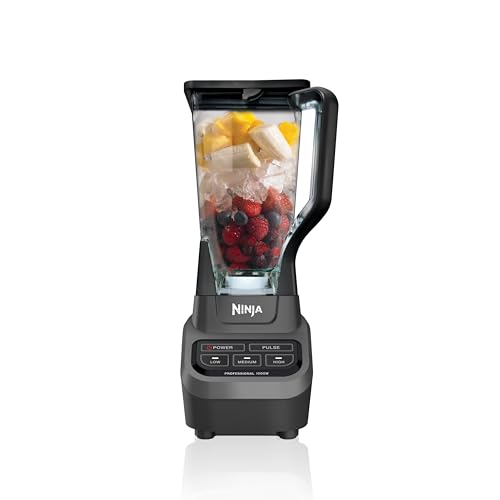
4. Ninja Professional Blender BL610 — Best for Big Batches
The BL610 is the elder statesman of affordable smoothie blenders: 1000 watts, a 72 oz pitcher, Ninja’s Total Crushing blade stack, and a design that has stayed in production because it works. If your smoothie routine involves a full pitcher — meal-prep batches, a family of four, post-workout shakes for two adults who both want a large glass — this is the budget machine with the capacity and the track record.
Strengths
- 72 oz pitcher is among the largest in the affordable tier
- Total Crushing blades were designed specifically for ice and frozen fruit
- Simple, proven controls with nothing to learn
Trade-offs
- No preset programs — you manage blend time yourself
- At 1000 watts it is a step behind the BN701 on the thickest blends
- Basic styling and a tall profile
| Spec | Detail |
|---|---|
| Motor | 1000 watts |
| Pitcher | 72 oz |
| Blades | Total Crushing technology |
| Care | Dishwasher-safe parts |
What the BL610 lacks in automation it returns in predictability. Three speeds and a pulse button are all most smoothie recipes ever need, and the stacked blade column processes the full height of the pitcher, so a full load of frozen fruit and greens blends evenly instead of leaving a smoothie on the bottom and a salad on top. Owners tend to keep these machines for years, and replacement pitchers and blade assemblies remain easy to find — a real ownership advantage over newer, flashier rivals.
Choose it over the BN701 if you value simplicity and capacity over presets, or if it is the one on sale when you are buying. Choose the BN701 if the one-button smoothie program will genuinely get used every day.
Best for: families and batch preppers who want proven, simple capacity / Not suited for: anyone who wants walk-away preset programs
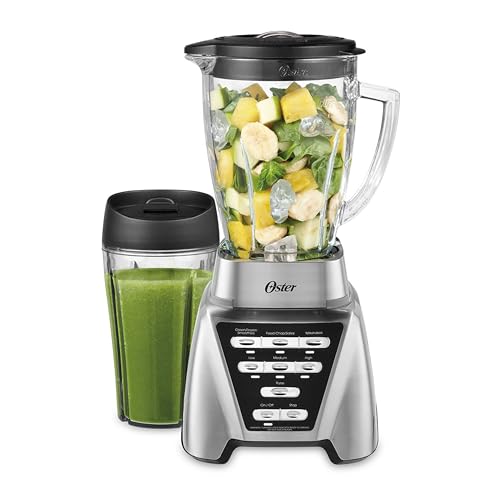
5. Oster Pro 1200 Blender — Best Glass Jar
Plastic pitchers dominate the affordable tier, which is why the Oster Pro 1200 stands out: a proper glass jar, seven speeds, Smart Settings programs, and a dual-direction blade that periodically reverses to drag settled ingredients back into the cutting path. If you make smoothies with turmeric, berries, or anything else that stains and scents plastic — or you simply prefer glass on principle — this is the affordable pick built for you.
Strengths
- Glass jar resists stains, odors, and scratching
- Dual-direction blade technology reduces stuck, unblended pockets
- Includes a 24 oz smoothie cup for single servings
Trade-offs
- Glass jar is heavy when full and needs two-handed pouring
- Brushed-nickel styling shows fingerprints
- Not the quietest at full speed
| Spec | Detail |
|---|---|
| Jar | Glass |
| Speeds | 7 with Smart Settings technology |
| Blade | Dual-direction |
| Also included | 24 oz smoothie cup |
The reversing blade is more than a gimmick for smoothie work. Thick mixtures — frozen fruit with Greek yogurt and very little liquid — tend to form a stationary dome above the blades in ordinary blenders. The Pro 1200’s reverse cycles break that dome up, so the blend finishes with less stopping and scraping. Oster’s all-metal drive heritage also matters here: the coupling that connects motor to blade is a known wear point on cheap blenders, and Oster’s long history with metal drive components is reassuring at this price.
It will not out-muscle the Ninjas on a pitcher of pure ice, but for the smoothies people actually make every day, it is a refined, durable-feeling machine — and the only one here your turmeric latte habit cannot permanently tint yellow.
Best for: glass-jar loyalists and thick, low-liquid smoothie fans / Not suited for: anyone who finds a full glass jar too heavy to pour one-handed

6. NutriBullet Pro 900 Special Edition — Best Personal-Size
Sometimes the most affordable smoothie blender is the one that skips the pitcher entirely. The NutriBullet Pro 900 blends in the cup you drink from, using a 900W extractor blade that is genuinely excellent at the one-person smoothie: frozen fruit, greens, protein powder, ice — loaded, twisted on, and done in under a minute. If you live alone, blend for one, and hate washing a full-size pitcher, this format will get used more than any countertop machine.
Strengths
- 900W extractor blade produces very smooth single servings
- Blend-in-cup format means almost no washing up
- Compact base stores in a drawer-adjacent footprint
Trade-offs
- One serving at a time — useless for family batches
- No variable speeds; it is on or off
- Cups and blades are consumables over years of use
| Spec | Detail |
|---|---|
| Motor | 900 watts |
| Format | Personal extractor blender |
| Best load | Single-serve smoothies and shakes |
| Care | Cups and lids are easy-rinse |
The Pro 900’s real talent is texture per dollar for one person. Its cyclonic action pulls ingredients through the blade continuously, so a spinach-and-frozen-berry smoothie comes out uniform instead of layered. It is also the fastest route from ingredients to door: blend, swap the blade for a lid, leave. The limits are equally clear — try to make smoothies for three people and you will spend longer on repeat batches than a pitcher blender would have taken, and hot liquids are off the menu entirely.
Think of it as the specialist on this list: not the best affordable blender for every smoothie drinker, but the best one for the solo smoothie drinker, full stop.
Best for: solo smoothie drinkers who value speed and minimal cleanup / Not suited for: families or anyone blending for more than one person
Comparison Table
| Pick | Badge | Key spec | Best for |
|---|---|---|---|
| Ninja Professional Plus BN701 | Best Overall | 1400 peak W, 72 oz, Auto-iQ presets | Daily family smoothies |
| Hamilton Beach Power Elite 58148AG | Best Budget | 700W, 40 oz glass jar, Wave Action | Tight budgets, small households |
| nutribullet Full-Size Combo NBF50500 | Best for Smoothie-First Households | 1200W, 64 oz pitcher + 24 oz cup | Mixed solo and family blending |
| Ninja Professional BL610 | Best for Big Batches | 1000W, 72 oz pitcher | Batch prep and families |
| Oster Pro 1200 | Best Glass Jar | Glass jar, 7 speeds, dual-direction blade | Thick blends, stain-prone recipes |
| NutriBullet Pro 900 Special Edition | Best Personal-Size | 900W extractor, blend-in-cup | Solo smoothie drinkers |
How to Choose an Affordable Blender for Smoothies
Start with your frozen ratio, because that single habit separates the field. If most of your smoothies are fresh fruit, yogurt, and juice, almost any blender in this guide will satisfy you, and the Hamilton Beach Power Elite’s price starts to look very smart. If frozen fruit and ice are the base of nearly every blend — the cheaper, healthier, more common pattern — you need either serious blade design or serious wattage, and the Ninjas and the nutribullet Combo earn their step up in cost. Be honest here; buying for the smoothies you wish you made is how blenders end up in donation boxes.
Motor power: read it correctly
Wattage figures in this tier mix two different numbers: rated watts and peak watts, which is why a “1400W” Ninja and a “700W” Hamilton Beach are not as far apart in practice as the boxes suggest. Peak wattage describes the motor’s momentary maximum at startup or under strain; sustained blending power is lower. What matters more for smoothies is whether the motor-blade-pitcher system sustains a vortex. A well-shaped 700W jar that keeps food moving through the blades will out-blend a poorly shaped 1000W jar that throws everything to the walls in the first three seconds. Use wattage as a rough tier marker, then weigh jar design and blade layout — which is exactly how the picks above were ranked.
Pitcher size and material
Match capacity to your real serving count. A 72 oz pitcher is a family tool; filled for one person, it blends badly because the ingredients spread too thin to vortex. A 40 oz jar is the sweet spot for one or two smoothies. On material: glass resists stains and odors and feels substantial, but it is heavy and breakable; modern BPA-free plastic is lighter, tougher, and fine for cold smoothies, though it will eventually cloud and hold onto strong flavors like turmeric and garlic-heavy green blends. If you blend daily and hate lingering smells, glass — the Oster Pro 1200 or the Power Elite — is worth prioritizing.
Controls: presets vs. manual speeds
Presets such as Ninja’s Auto-iQ are genuinely useful for smoothies because frozen blends benefit from pulse-pause cycles that a person standing at the counter rarely bothers to perform. Manual speeds give you more control for everything else and fewer electronics to fail. For a smoothie-dedicated buyer, presets win. For a buyer who will also puree, chop, and experiment, a good dial or speed range ages better. Neither is wrong — but know which cook you are.
The hidden costs: parts and cleaning
Budget blenders die by a thousand cuts: a cracked jar, a worn gasket, a blade assembly that dulls. Before buying, confirm the brand sells replacement jars and blade assemblies for that model — Ninja, Oster, Hamilton Beach, and nutribullet all do, which is a quiet reason they dominate this list. Cleaning matters just as much: every pick here has dishwasher-safe parts, but the fastest daily routine is a rinse, a drop of dish soap, a cup of warm water, and a ten-second blend. If a blender is annoying to clean, you will stop making smoothies, and then the cheapest blender was the one you never bought.
How to Get a Smooth Blend From a Budget Blender
Technique closes most of the gap between an affordable blender and a premium one. Follow this order and method:
- Load in the right order. Liquids first, then soft ingredients (yogurt, fresh fruit, greens), then powders, and frozen fruit and ice last, on top. This lets the vortex form before the heavy frozen load drops in.
- Respect the liquid floor. Most full-size pitchers need roughly a cup of liquid per full load to sustain a vortex; personal cups need enough to cover the blade. A too-dry blend is the number one cause of stalls and motor strain.
- Pulse before you commit. Five or six short pulses break the frozen mass into movable pieces. Then blend continuously for 45–60 seconds — most gritty smoothies are simply under-blended, not under-powered.
- Use the tamper or the pause. If your model has a tamper, work the corners. If not, stop once, push the mixture down with a spatula, and restart. Never reach in while the base is plugged in and the jar is mounted.
- Rest a struggling motor. If the pitch rises and the motor smells hot, stop for a minute. Affordable motors have thermal cutoffs; tripping one repeatedly shortens the machine’s life.
- Clean immediately. Rinse, soap, warm water, ten-second blend, rinse again. Dried smoothie residue is the enemy of gaskets and your future enthusiasm.
Care and Maintenance That Keep a Budget Blender Alive
Affordable blenders rarely die dramatically; they fade. The blade dulls, the gasket flattens, the jar clouds, and one morning the smoothie is chunky and the base smells faintly electrical. Almost all of that fade is preventable with habits that cost nothing.
First, protect the blade assembly. Never run the jar empty on high “to clean it,” and do not use the blender as a spice or coffee grinder unless the manufacturer explicitly rates it for dry grinding — frozen fruit is a wet, forgiving load, while dry hard goods hammer the blade edges and bearings. When hand-washing a stacked-blade assembly like Ninja’s, use a brush and wash away from the edges; those blades are the sharpest object in most kitchens.
Second, mind the gasket. That thin rubber ring is the difference between a sealed jar and a counter full of smoothie. Rinse it rather than baking it in a hot dishwasher cycle every day, check it monthly for flattening or cracks, and replace it at the first sign of weeping — gaskets for every brand in this guide are cheap and sold separately, which is precisely why these brands were chosen. A jar left assembled and wet in the sink will grow a smell no smoothie deserves; store the jar dry, loosely assembled, with the lid ajar.
Third, treat the motor kindly. Blend in bursts for thick loads, let a hot-smelling base rest, and never defeat the thermal cutoff by immediately restarting a stalled machine again and again. Finally, descale the jar’s cloudiness with a warm water and baking-soda soak rather than abrasive pads, which scratch plastic into permanent haze. Do these things and the difference between a two-year blender and a five-year blender is mostly luck; skip them and even the best pick on this page will feel tired by next summer.
Common Buying Mistakes
- Buying on peak wattage alone. Jar shape and blade design decide smoothie texture more than the biggest number on the box.
- Choosing capacity for guests, not for Tuesday. An oversized pitcher blends single servings badly. Buy for your routine, not your dinner party.
- Ignoring the replacement-parts question. A blender with no available spare jar or blade assembly is disposable, whatever the warranty says.
- Expecting premium silence. Affordable motors are loud. If quiet matters, plan blend times around the household rather than expecting the machine to whisper.
- Blending hot liquids in a personal cup. Sealed extractor cups are not vented for heat and pressure. Soup belongs in a vented pitcher — or an immersion blender.
- Skipping the liquid. “Just frozen fruit” is a stall, a strained motor, and a chunky result in any affordable machine.
Matching the Blender to Your Smoothie Routine
The most useful way to shop this list is by routine, not by spec sheet. Consider the three patterns below and notice how each one changes which pick is “best” — the right affordable blender is the one whose strengths line up with the mornings you actually have.
The weekday solo smoothie
One person, one smoothie, out the door. Volume is small, speed and cleanup dominate, and the pitcher question answers itself: you do not need one. The NutriBullet Pro 900’s blend-in-cup format was built for this pattern, and its 900W extractor blade makes a genuinely smooth drink from frozen fruit and greens in about a minute. The nutribullet Combo’s 24 oz tumbler covers the same pattern if you also blend for others on weekends. What both formats share is the lowest friction in the category — and friction, not texture, is what kills weekday habits.
The family breakfast rotation
Three to five smoothies, some frozen, some picky. Here capacity and presets earn their money: a 72 oz pitcher (BN701 or BL610) makes one blend instead of three, and a smoothie preset means whoever is on breakfast duty — including a teenager — gets a consistent result. The BN701’s Auto-iQ programs make it the default choice; the BL610 is the pick if your household prefers dead-simple controls and the lowest complexity. Budget for the pitcher size here, not for extra features: nobody in a busy kitchen has ever wished their blender had a more decorative control panel.
The green-smoothie and meal-prep routine
If your blends lean fibrous — kale, celery, ginger, frozen mango, chia — you are asking the most of an affordable machine, and the ranking tightens. Prioritize the strongest vortex: the BN701 for full batches, the nutribullet Combo or Pro 900 for extraction-style texture, and plan on the full minute of blending plus adequate liquid. Meal preppers should also think about the second jar problem: blending a week’s base mixture in one session is exactly where the BL610’s capacity and cheap replacement pitchers become a quiet advantage. And if your routine regularly includes nut butters or very thick spoonable bowls, be honest that you are shopping at the top of the affordable tier or beyond it — the picks here will do occasional thick blends with technique, but daily nut butter is premium-tier work.
Blade Design, Jar Shape, and Why Cheap Blenders Stall
To understand why two blenders with similar wattage produce completely different smoothies, picture what happens inside the jar in the first five seconds. The blades spin, the liquid nearest them accelerates, and a vortex — a spinning funnel — is supposed to form, dragging the contents down in a continuous cycle. When the vortex holds, every strawberry passes through the blades dozens of times and the smoothie turns silky. When it collapses, the mixture splits into a fast-spinning layer at the bottom and a stationary mass on top, and no amount of extra blending time fixes it. Nearly every difference between the picks in this guide comes down to how reliably each machine holds that vortex with frozen ingredients.
Three design choices decide it. The first is blade geometry. Ninja’s stacked column puts blades at several heights, so it processes the mixture at multiple levels at once — a brute-force solution that works especially well with big frozen loads. Traditional bottom-blade designs, like Oster’s, depend more on jar shape and on tricks like the Pro 1200’s dual-direction reversing, which periodically flips the flow and knocks the stationary mass back down. Extractor blades, like nutribullet’s, sit under a narrow cup and use the cup’s tight diameter to keep everything in the cutting zone — which is why personal blenders punch so far above their wattage.
The second choice is jar shape. Wide jars give ingredients room to escape the vortex; tapered jars funnel them back in. This is why the 40 oz Hamilton Beach, with its Wave Action ridges molded into the jar walls, blends above its 700W weight: the ridges constantly redirect the flow downward. It is also why a half-empty 72 oz pitcher struggles with a single smoothie — the same mixture in a smaller vessel would vortex beautifully.
The third is motor behavior under load. Affordable motors are mostly universal motors: powerful for their size, loud, and dependent on airflow for cooling. When a thick blend bogs them down, they heat quickly. Good affordable blenders manage this with thermal protection and with presets that pulse instead of grinding continuously. Stalling is rarely a power problem in the abstract — it is a heat and flow problem, and technique (liquid first, pulse first, frozen last) is the free fix.
Affordable vs. Premium Blenders: What the Extra Money Actually Buys
It is fair to ask what you give up by staying in the affordable tier, because the honest answer shapes whether you should. Premium high-performance blenders buy you four things: sustained power that purees a frozen brick without technique, quieter operation through better motor isolation and jar design, finer texture on the hardest ingredients (nut butters, seed-heavy blends, fibrous greens with minimal liquid), and warranties measured in many years rather than a few seasons. If you make nut butter weekly or blend twice a day for a household, that tier earns its price, and our Final Recommendation points to the comparisons that cover it.
What the extra money does not buy is a categorically better basic smoothie. A banana-berry-yogurt smoothie from the BN701 or the nutribullet Combo is, for most palates, indistinguishable from the same recipe made in a machine costing several times more. The affordable tier’s real compromises show up at the edges: noise you cannot blend around at 5 a.m., jars you will eventually replace, and textures on green smoothies that stop at “smooth with fine flecks” rather than “perfectly uniform.” For the large majority of smoothie drinkers, those edges are exactly where they should save the money — which is the entire premise of this guide, and why every pick here was chosen to be excellent at the smoothie job first and everything else second.
Final Recommendation
For most people, the Ninja Professional Plus BN701 is the right answer: it is the affordable blender that makes frozen smoothies feel effortless, and effortlessness is what keeps a smoothie habit alive. If the budget is the whole story, the Hamilton Beach Power Elite covers fresh and lightly frozen blends for remarkably little money, and if you blend for one, the NutriBullet Pro 900 will quietly become the most-used appliance you own.
Still deciding? These guides in the same series go deeper on neighboring questions: Best Affordable Blenders, Best Affordable Blenders For Green Smoothies, Best Affordable Blenders For Frozen Drinks, Best Affordable Single Serve Blenders, and Best All Around Kitchen Blenders Including Smoothies.
One last piece of advice whichever pick you choose: spend the first week learning your machine’s liquid minimums and pulse rhythm with cheap ingredients — bananas, frozen berries, milk — before you load it with expensive protein powders and supplements. Every blender in this guide has a personality, and ten smoothies of practice will teach you more about yours than any spec sheet. After that, the routine runs itself, which is the whole point of buying the right affordable blender in the first place.
Related guides
Frequently Asked Questions
How many watts does an affordable blender need for smoothies?
For fresh-fruit smoothies, 500–700 watts in a well-designed jar is enough. For daily frozen fruit and ice, look for strong blade design backed by roughly 900–1400 peak watts in this tier — the system matters more than the number alone, which is why the picks above were ranked on jar and blade design alongside power.
Can a budget blender crush ice without dying early?
Yes, if ice crushing is part of its design brief — the Ninja models and the Oster Pro 1200 here are built for it. What kills budget motors is not ice itself but dry, overloaded, sustained straining. Pulse first, keep enough liquid in the jar, and let a struggling motor rest.
Is glass or plastic better for a smoothie pitcher?
Glass resists stains, odors, and scratches, and it is the better choice for turmeric- and berry-heavy routines; it is also heavier and breakable. Plastic is lighter and tougher against drops, and for cold smoothies it performs identically. Choose based on your clumsiness and your recipes, not on blending performance.
Why is my smoothie still gritty in a new blender?
Usually time and liquid, not power. Blend a full 45–60 seconds, make sure there is enough liquid to sustain a vortex, and load frozen ingredients on top rather than at the blade. Berry seeds and kale fibers also have a floor in this price tier — very fine flecks are normal, chunks are not.
Do I need presets like Auto-iQ?
They help more than most features at this price. Frozen smoothies benefit from pulse-pause cycles that break up the frozen mass before the long blend, and presets automate exactly that. If you are happy to pulse manually, a simpler machine like the BL610 does the same job for less complexity. Presets also make results repeatable for other household members, which matters more than enthusiasts admit.
How long should an affordable blender last?
With daily use, realistic expectations are a few years of service from the jar and blade assembly, with the motor base often lasting longer. Choosing a brand with available replacement jars, gaskets, and blade assemblies — as all six picks here have — is what turns a cheap blender into a long-lived one.
Are affordable blenders good for green smoothies with kale and spinach?
Yes, with the right expectations and technique. Spinach disappears almost completely in every pick here. Kale and other fibrous greens blend smoothest in the stronger machines — the BN701, the nutribullet Combo, and the Pro 900 — and always blend better with adequate liquid and a full minute of blending. Fine green flecks in a budget green smoothie are normal; recognizable leaf pieces mean the blend was too dry or too short, not that the blender failed.
What is the cheapest type of blender that still makes a decent smoothie?
A personal extractor-style blender is the value sweet spot for one person, because its narrow cup keeps ingredients in the blades and it needs no pitcher at all — the NutriBullet Pro 900 in this guide is the step-up version of that idea, and simpler personal models sit below it. For households, a basic full-size model like the Hamilton Beach Power Elite is the floor we would recommend; below that tier, motors and jars stop surviving frozen fruit, couplings strip, and the savings evaporate into a replacement purchase within the year.


