Disclosure: airfryerkitchensupply.com is reader-supported. When you buy through links on our site, we may earn an affiliate commission at no extra cost to you.
Where to Buy
The best powerful blenders for smoothies are judged by a drink that exposes everything: frozen fruit that must vanish, greens that must stop being strings, seeds that must stop being grit. Every machine below was confirmed on a live listing, and each was chosen because its power is aimed at smoothie work specifically — the jar sizes, programs and cup formats that decide whether a morning blend is silk or a chore to chew.
- Vitamix Propel Series 510, 48 oz, Black — Check the current price on Amazon
- nutribullet Full-Size Blender Combo NBF50500, 1200W — Check the current price on Amazon
- Ninja Nutri-Blender Pro BN401, 1100 Peak Watts — Check the current price on Amazon
- KitchenAid K400 Variable Speed Blender, Passion Red, 56 oz — Check the current price on Amazon
- Breville Fresh & Furious BBL620, Silver — Check the current price on Amazon
- Oster Vortex Plus Glass Blender, 1200W, 76 oz — Check the current price on Amazon
The best powerful blenders for smoothies solve a texture problem that weaker machines negotiate with. A proper smoothie has no survivors: no ice chips rattling in the straw, no kale ribbons, no raspberry seeds sanding the tongue, no frozen banana coins hiding at the bottom of the cup. Getting there takes more than speed — it takes a jar or cup that keeps the whole mixture passing through the blades, enough sustained power to finish fibrous and frozen ingredients in the same run, and a program or technique that gives the blend its full working time. That is the standard this guide buys to.
Smoothie households are not one household. Some blend a single cup at dawn and run; some make a pitcher for a family table; some treat the smoothie as a meal with nut butter, oats and protein to incorporate. The picks here are arranged around those lives: a mid-size professional jar, a full-size combo with a personal cup, a dedicated personal powerhouse, two preset-friendly countertop machines at different tiers, and a value model whose smoothie program punches above its station. Somewhere in that spread is the machine that matches your mornings.
We also take a position some guides avoid: for smoothies, format beats raw power. A personal cup that blends and travels will be used five hundred times by an owner who would abandon a giant jar by February, while a family that blends in pitcher quantities needs the vortex only a full jar creates. Read the reviews with your actual routine in view — who drinks, how many, how frozen, how green — and choose the powerful machine whose format disappears into that routine.
In this guide
Quick Picks
Vitamix Propel Series 510, 48 oz, Black — Best Overall for Smoothies. A 48-ounce jar, a true smoothie program and benchmark texture: the complete smoothie machine for most households. Check price on Amazon.
nutribullet Full-Size Blender Combo NBF50500, 1200W — Best Pitcher-and-Cup Combo. A 64-ounce pitcher and a tumbler cup on a 1200W base: smoothie power in whichever format the day demands. Check price on Amazon.
Ninja Nutri-Blender Pro BN401, 1100 Peak Watts — Best Personal Smoothie Power. Concentrated personal power with Auto-iQ and two travel cups: the solo smoothie routine perfected. Check price on Amazon.
KitchenAid K400 Variable Speed Blender, Passion Red, 56 oz — Best Preset Smoothie Cycle. A tuned smoothie preset, a dial for particular drinkers and a right-sized jar: balanced daily smoothie power. Check price on Amazon.
Breville Fresh & Furious BBL620, Silver — Best Mid-Tier Smoothie Finish. High-torque, auto-cleaning and even on ice: a mid-tier machine whose smoothie finish feels flagship. Check price on Amazon.
Oster Vortex Plus Glass Blender, 1200W, 76 oz — Best Value Smoothie Capacity. A 76-ounce glass jar, a real smoothie program and a go cup at a value tier: family smoothie power without the premium. Check price on Amazon.
How These Picks Were Chosen
Candidates were matched to live Amazon listings before a word was written, confirming each model’s jar or cup configuration, programs and included accessories. Smoothie machines are sold in bewildering variant families — the same name with different cups, jars or preset sets — so the verified listing, not a review of a cousin model, grounded every specification and inclusion claimed in this guide.
Performance criteria were smoothie-specific. Frozen-fruit reduction came first: a full load of frozen strawberries, mango and banana should finish without chunks or a stalled layer. Green finishing came second: kale, spinach stems and celery should lose their stringiness within a normal cycle. Seed handling, protein-powder incorporation without wall-caking, and pour consistency — a smoothie that ribbons rather than separates in the glass — all counted. Programs with a dedicated smoothie cycle earned credit because they encode the pulse-ramp-run rhythm smoothies want.
Ownership criteria were weighted for a daily appliance: dishwasher-safe jars and cups, lids that seal for transport, footprint at the coffee-station end of the counter, and cleaning that takes under a minute on a weekday. We noted honestly where a pick’s power exceeds its format — a superb jar in the wrong size is still the wrong machine for a solo drinker. As throughout this program, no prices or fixed ratings are printed; check the current price on Amazon for the exact configuration you intend to live with.
The 6 Best Powerful Blenders for Smoothies

Vitamix Propel Series 510, 48 oz, Black — Best Overall for Smoothies
The Propel 510 is the smoothie specialist’s Vitamix: a 48-ounce jar sized exactly for the one-to-three-serving reality of smoothie households, three programs with a dedicated smoothie cycle, and the circulation that makes this brand the texture benchmark. Frozen fruit enters the vortex and stays there, greens are cut until they disappear, and the finished smoothie pours as one substance rather than a layered separation of juice and pulp. For most smoothie drinkers, this is the machine the search ends at.
Strengths
- 48-ounce jar is the smoothie sweet spot for one to three servings
- Three programs include a smoothie cycle tuned for frozen blends
- Professional-grade circulation finishes greens and seeds properly
Trade-offs
- No personal cup, so solo drinkers blend in the jar and pour
- Premium tier for a primarily-smoothie appliance
- Programs cover the essentials; exotic settings live on bigger siblings
| Jar | 48 oz container |
| Programs | 3 programs including smoothie |
| Controls | Variable speed with pulse |
| Cleaning | Self-cleaning program |
Its size discipline is the quiet genius. A 48-ounce jar blends a single generous smoothie without the ingredients spreading uselessly across a wide base, yet still covers a couple’s breakfast or a parent’s and child’s portions in one run. The self-cleaning program handles the berry-and-protein residue that makes smoothie jars unpleasant by day three. It lacks a travel cup, so the routine is blend, pour, rinse — a fair trade for texture this complete, and the reason daily smoothie makers who have tried both formats so often settle here.
Best for: One-to-three-serving smoothie households wanting the best texture / Not suited for: Solo commuters who insist on blending directly in a travel cup
Check the current price on Amazon

nutribullet Full-Size Blender Combo NBF50500, 1200W — Best Pitcher-and-Cup Combo
The Full-Size Combo refuses to choose between the pitcher household and the cup household, because many homes are both depending on the day. Its 1200-watt base drives a 64-ounce pitcher for family smoothie rounds and a 24-ounce tumbler for the solo blend-and-go, and that flexibility is precisely what a smoothie routine needs to survive contact with real life — weekends and weekdays rarely ask for the same vessel.
Strengths
- A 64-ounce pitcher for family smoothies and a tumbler cup for solo ones
- 1200 watts is serious smoothie power in both formats
- Dishwasher-safe parts suit a daily-use appliance
Trade-offs
- Two formats mean two sets of parts to store
- Cup texture on heavy greens trails the Vitamix jar
- Pitcher is generous for a single small smoothie
| Motor | 1200W |
| Pitcher | 64 oz |
| Cup | 24 oz tumbler cup |
| Care | Dishwasher-safe parts |
In the pitcher, frozen fruit reduces completely and family quantities pour evenly; in the tumbler, the extraction-style blending that made this brand famous handles the frozen-fruit-and-liquid core of a personal smoothie with no transfer and no extra washing. Greens in the cup finish well rather than perfectly, the honest tax of the format. Everything goes in the dishwasher, which for a machine used daily is not a convenience but a condition of continued use. For mixed-format smoothie homes, this is the most practical powerful pick here.
Best for: Households alternating between family pitchers and solo cups / Not suited for: Texture perfectionists blending green smoothies daily
Check the current price on Amazon
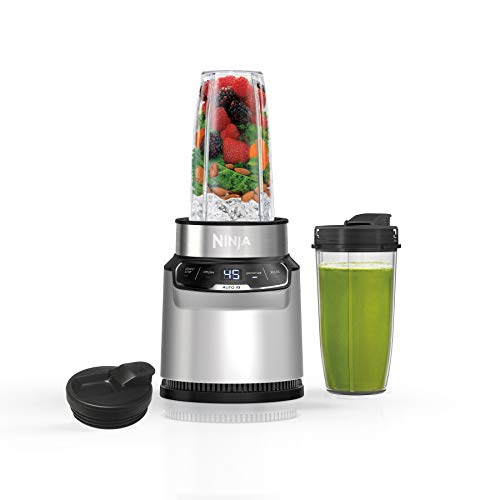
Ninja Nutri-Blender Pro BN401, 1100 Peak Watts — Best Personal Smoothie Power
The BN401 is the powerful answer for the solo smoothie drinker: 1100 peak watts driving two Auto-iQ programs in a personal format, blending frozen fruit, ice and powders directly in one of two 24-ounce cups that then travel. Its power story is about concentration — all that force applied to a single serving, so frozen strawberries and ice meet the blades with nowhere to hide and the finished smoothie is genuinely smooth rather than personal-blender chunky.
Strengths
- 1100 peak watts in a personal format crushes frozen fruit completely
- Two Auto-iQ programs make the morning routine one-touch
- Blend in the cup you carry: no pitcher, no transfer, no extra washing
Trade-offs
- 24-ounce ceiling rules out family batches entirely
- Personal format cannot match a vortex jar on fibrous greens
- Peak-watt figure describes burst strength for short personal blends
| Motor | 1100 peak watts |
| Cups | Two 24 oz to-go cups |
| Programs | 2 Auto-iQ programs |
| Care | Dishwasher-safe parts |
The routine it enables is the product: cup on base, program pressed, cup off base, lid on, door closed behind you, with the cup going in the dishwasher at night. Two cups mean one is always clean, a detail that decides whether a routine survives a busy week. Its limits are definitional — there is no pitcher, no family batch, and fibrous greens finish a notch below a big vortex jar — but for the commuter, gym-goer or single-serving household it was designed for, those limits never appear in practice. This is personal smoothie power done completely.
Best for: Solo drinkers and commuters blending one serving at a time / Not suited for: Families needing pitcher quantities
Check the current price on Amazon

KitchenAid K400 Variable Speed Blender, Passion Red, 56 oz — Best Preset Smoothie Cycle
The K400 in Passion Red is the smoothie pick for buyers who want presets with a dial in reserve. Its smoothie program handles the standard frozen-fruit routine at one touch, while the variable dial lets particular drinkers finish a blend at exactly their thickness — a small freedom that matters when the same two people make the same two smoothies every morning and have opinions about both. The 56-ounce jar is honestly sized for couples and small families rather than inflated for a spec sheet.
Strengths
- A dedicated smoothie preset alongside ice-crush and icy-drink programs
- Variable dial allows manual finishing for personal thickness preferences
- 56-ounce jar suits couples and small families precisely
Trade-offs
- Mid-power machine: the thickest green blends reward patience
- No personal cup in this configuration
- The bold finish is a commitment your kitchen must enjoy
| Jar | 56 oz |
| Controls | Variable speed dial |
| Programs | Preset recipe programs including Smoothie (per K400 family listing) |
| Design | Countertop statement finish in Passion Red |
Performance is confident mid-tier power: frozen fruit disappears, ice crushes for the icy-drinks program, and greens finish smooth with the full cycle allowed to run. It will not match the Propel 510’s authority on a jar packed with kale stems and frozen mango, and there is no travel cup, so the pour-and-rinse routine applies. What it offers instead is balance — real smoothie competence, controls for both lazy and particular moods, and a machine handsome enough to live on the counter where daily appliances must live to be used.
Best for: Couples and small families who blend smoothies daily / Not suited for: High-volume or heavy-green smoothie specialists
Check the current price on Amazon
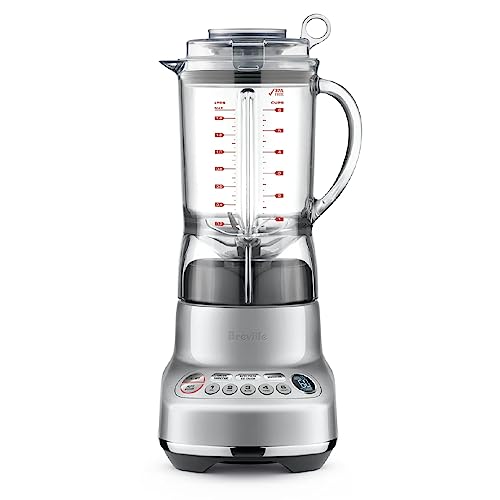
Breville Fresh & Furious BBL620, Silver — Best Mid-Tier Smoothie Finish
The Fresh & Furious earns its name in smoothie work: a high-torque motor that keeps frozen loads moving, multiple speeds for control, and an auto-clean function that acknowledges this machine will be used every day and must be effortless to reset. Torque is the right smoothie virtue — a frozen banana and a cup of ice do not care about top blade speed; they care whether the motor keeps turning when the load binds, and this one’s character is built around exactly that moment.
Strengths
- High-torque character suits frozen smoothie loads that stall lesser motors
- Auto-clean function makes the daily rinse a button press
- Even, furious ice work supports smoothie and frozen drink double duty
Trade-offs
- Less program depth than the flagship picks
- Mid-tier jar capacity for family-scale rounds
- Torque-first tuning favors results over quietness
| Motor focus | High-torque motor |
| Controls | Multiple speed settings |
| Cleaning | Auto-clean function |
| Work | Smoothies and ice crushing highlighted |
Smoothies come out even and properly cold, ice crushes for the frozen drinks that share a summer with smoothie season, and the controls stay simple enough for a household where several people blend with different levels of interest. It gives up the flagship program libraries and the biggest jars, and it is not a quiet machine, but as a mid-tier daily smoothie engine it covers the work with unusual completeness. Buyers stepping up from an entry blender will feel the difference in the first glass: this is what finished tastes like.
Best for: Daily smoothie makers stepping up to real torque / Not suited for: Program collectors and very large households
Check the current price on Amazon

Oster Vortex Plus Glass Blender, 1200W, 76 oz — Best Value Smoothie Capacity
The Vortex Plus is the value route to powerful smoothies at family scale: 1200 watts, a 76-ounce glass jar, four iBlend programs that include a dedicated Smoothie cycle, and a Blend-N-Go cup for the single servings that would otherwise dirty the big jar. That combination — capacity, a real smoothie program and a personal option — usually costs a tier more, which is why this pick anchors the affordable end of the page without apologizing for its blending.
Strengths
- A smoothie program among four iBlend auto cycles
- Huge 76-ounce glass jar for family and party smoothie volume
- Blend-N-Go cup covers the solo serving without dirtying the jar
Trade-offs
- Glass jar is heavy to handle full and unforgiving if dropped
- Reversible blade system is clever but adds a learning curve
- Value-tier finish next to the premium picks
| Motor | 1200W |
| Jar | 76 oz glass jar, dishwasher safe |
| Programs | 4 iBlend auto programs including Smoothie and Frozen Drink |
| Extras | Blend-N-Go cup; reversible steel blades |
The reversible blade design is its party trick, running blades in both directions to keep ingredients cycling through the cutting zone, and in smoothie work it translates to fewer unblended pockets in a full jar. Glass brings weight and a drop-risk that plastic jars forgive, so households with young helpers should weigh that honestly. Judged on smoothies per dollar at family volume, though, the Vortex Plus is the strongest argument here: big, programmed, flexible and priced like it wants to be used daily rather than admired.
Best for: Families wanting smoothie capacity and programs at a value tier / Not suited for: Households likely to drop a heavy glass jar
Check the current price on Amazon
Comparison Table
| Pick | Badge | Key Spec | Best For |
|---|---|---|---|
| Vitamix Propel Series 510, 48 oz, Black | Best Overall for Smoothies | 48 oz container | One-to-three-serving smoothie households wanting the best texture |
| nutribullet Full-Size Blender Combo NBF50500, 1200W | Best Pitcher-and-Cup Combo | 1200W | Households alternating between family pitchers and solo cups |
| Ninja Nutri-Blender Pro BN401, 1100 Peak Watts | Best Personal Smoothie Power | 1100 peak watts | Solo drinkers and commuters blending one serving at a time |
| KitchenAid K400 Variable Speed Blender, Passion Red, 56 oz | Best Preset Smoothie Cycle | 56 oz | Couples and small families who blend smoothies daily |
| Breville Fresh & Furious BBL620, Silver | Best Mid-Tier Smoothie Finish | High-torque motor | Daily smoothie makers stepping up to real torque |
| Oster Vortex Plus Glass Blender, 1200W, 76 oz | Best Value Smoothie Capacity | 1200W | Families wanting smoothie capacity and programs at a value tier |
How to Choose a Powerful Blender for Smoothies
Smoothie texture is a physics problem disguised as a recipe. This guide covers the five decisions that determine it: format, frozen-load handling, green finishing, program design and the daily-cleaning reality — so the powerful blender you choose produces silk on a tired weekday, not just on the day it arrives.
Format first: cup, jar or both
Decide the vessel before the motor. A personal cup system wins when one person blends one serving and leaves; a 48- to 64-ounce jar wins when servings multiply or ingredients get leafy and bulky; a combo wins when the household honestly does both across a week. Format errors cannot be fixed by power — a solo drinker with a giant jar owns a daily washing burden, and a family with a personal cup owns a queue. The picks here are organized by format precisely because it is the decision everything else hangs from.
Frozen fruit is the real power test
Frozen strawberries, mango and banana are denser and less forgiving than ice, and a smoothie blender’s worth is measured in how completely a full frozen load disappears. Look for the system evidence: a jar vortex that keeps frozen pieces circulating, a cup format that concentrates force on a single serving, a torque-rich motor that does not fade as the load binds. Soft-fruit performance proves nothing; every blender in a store can blend a ripe banana. Buy for the frozen bag, because that is what your smoothies are actually made of.
Greens and seeds separate the good from the finished
Spinach forgives; kale stems, celery and chia do not. Finishing greens takes sustained circulation at speed — the last twenty seconds of a cycle are where strings become silk — while seeds need repeated passes through the blade zone that only a true vortex or a concentrated cup provides. If your smoothies are green by design, weight the jar-format picks and full programs heavily. If your greens are a handful of spinach in a fruit smoothie, every pick here will satisfy you, and format should decide instead.
A smoothie program is a recipe encoded
The pulse to settle, the ramp to engage, the sustained run to finish, the brief rest to fold — a good smoothie cycle encodes the technique a careful human would use, and then repeats it identically at 6 a.m. That repeatability is worth real money to daily drinkers. Manual dials serve households with strong preferences and variable recipes. Most smoothie routines are gloriously repetitive, which is why programs dominate this category’s picks; be honest about whether yours is an exception before paying for control you will not use.
Daily cleaning is a design feature
A smoothie blender is used more often than any other countertop machine, and its ownership cost is paid in rinsing. Self-cleaning programs, dishwasher-safe jars and cups, and lids without residue traps decide whether the machine is still in daily service in month six. Berry pigments, protein films and banana residue all punish delay, so the two-minute rule — rinse or run the clean cycle before leaving the kitchen — matters more than any accessory. Choose the pick whose cleaning matches your real discipline, not your aspirational one.
Green smoothies: the advanced class
A green smoothie is the final examination of a smoothie blender, because it combines every hard input at once: frozen fruit for density, leafy stems for fiber, seeds for grit and often ice for body. The machines that pass do so with circulation and time — a vortex that keeps the whole mixture passing the blades for a full minute or more, until the surface pulls down in a steady funnel and the texture between the fingers is uniform. Technique stacks the odds: greens go in with the liquid so they are captured early rather than rafting on top, frozen fruit goes last, and the cycle is allowed to complete without the cook’s impatience editing it. The Propel 510’s jar format is the benchmark here, but every pick on this page can produce a genuinely smooth green smoothie when loaded and run as this guide describes — and every one of them can produce a stringy one when it is not.
Smoothie bowls and spoonable blends
The smoothie bowl asks a blender to do smoothie work at half the liquid, and that changes the machine requirements in ways drink-focused buyers miss. A bowl mixture is too thick to circulate without help, so a tamper or a jar geometry that folds aggressively becomes essential, and the personal-cup formats that dominate drink smoothies struggle unless the batch is small and the fruit is cut fine. The method matters as much as the model: frozen fruit in small pieces, just enough liquid to start movement, tamper working the corners continuously, and the discipline to stop while the texture is still spoonable rather than blending on into a warm, thin soup. Jar picks with tampers and programs are the honest recommendation for bowl devotees; cup owners should treat bowls as an occasional small-batch experiment rather than a daily promise, and everyone should expect the first attempts to teach more than they impress.
Sweetness, balance and the sugar question
A powerful blender makes it effortless to build smoothies that are effectively desserts, because frozen fruit, juices and sweetened yogurts blend into something that tastes like a treat and counts, in the drinker’s mind, as health. The machine cannot make that judgment, but the cook can, and the blender’s real gift is that it makes the unsweetened version genuinely pleasant: fully finished greens lose their raw edge, frozen banana and mango provide body and sweetness without syrup, and a pinch of salt and a squeeze of citrus sharpen flavors that sugar usually carries. Households managing sugar for any reason will find that texture is the lever — a completely smooth, very cold smoothie reads as indulgent at sugar levels where a gritty, warm one reads as a compromise. That is a concrete, non-medical reason the power in this guide matters: it widens the range of recipes that satisfy.
A week of smoothies: the prep system that keeps the habit
Daily smoothie habits are won or lost on Sunday, in the freezer. The system that works is portioning: smoothie packs assembled in bags or tubs — fruit, greens and all — so a weekday blend is liquid plus one pack plus sixty seconds, with no measuring and no decision fatigue at dawn. Greens freeze well in the packs and blend more completely from frozen, since freezing breaks their cell walls; bananas should be peeled before freezing, a sentence that exists because everyone learns it exactly once the other way. Keep a running inventory on the freezer door, rotate packs so none fossilize, and let the machine’s self-cleaning or dishwasher-safe parts close the loop each morning. The blender is the visible appliance of the habit, but the freezer system is the habit itself, and the picks here were chosen to serve it without friction.
Smoothies for athletes and very hungry people
A training smoothie is a meal wearing a drink’s clothes, and it stresses a blender differently from a fruit smoothie: oats, nut butters, seeds, frozen fruit and protein all arrive in the same cup, and the machine must integrate them into something drinkable rather than a layered geology. The method that works is sequencing — liquid and powder first with a brief pre-blend, nut butter next so it emulsifies rather than clinging, frozen fruit last — and the format that works is whichever vessel the athlete will actually use at 6 a.m. after a session, which is why the personal and combo picks hold their own against the jar flagships in this guide. Thickness is a feature here, not a flaw: a meal smoothie should pour slowly and satisfy, and the cook should resist thinning it toward a juice. The power in these machines earns its place by making density drinkable.
Kids’ smoothies and the breakfast negotiation
For children, a smoothie succeeds on color, sweetness and the absence of detectable virtue, and a powerful blender serves all three: spinach disappears into a berry blend’s color and flavor when it is fully finished, while a lesser machine leaves the green flecks and strings that start the negotiation nobody wins. Frozen banana is the peacemaker ingredient — it sweetens, thickens and chills in one move — and a machine that can pulverize it from fully frozen, alongside frozen berries and a handful of greens, produces the drink that ends breakfast arguments in the households that own one. Serving format matters as much as recipe: a cup with a lid and a wide straw, in a color the child chose, outperforms a lecture about nutrition at every age under ten. The picks here were judged with that table in mind, because a smoothie uneaten is just produce with ambitions.
When a smoothie is too thick, too thin or too foamy
Three faults account for nearly every disappointing smoothie, and each has a mechanical cure. Too thick to pour usually means the frozen-to-liquid ratio outran the jar’s circulation: add liquid a spoonful at a time and re-run briefly, or next time load a little more liquid beneath the frozen layer. Too thin means the opposite arithmetic, cured by frozen fruit rather than ice, which adds body as it chills instead of diluting as it melts. Foam and separation come from over-blending after the texture has set — the machine whips air into a finished drink and warms it toward splitting — and the cure is discipline: blend to the even motor note and the steady funnel, then stop. These are small judgments, but they are the entire distance between a smoothie that tastes made and one that tastes attempted, and every machine in this guide will honor them.
Travel, work and the smoothie away from home
A smoothie habit eventually leaves the kitchen — to offices, gyms, job sites and school runs — and the format choices in this guide decide how gracefully it travels. Blend-and-go cups are the obvious answer for the commute, but the details matter: a cup that seals completely, fits the car’s holder and opens without a smoothie geyser is a system, while a leaking cup is a laundry program. For workplace blending, the personal machines earn a second look, since a compact base at the office with frozen fruit in its freezer removes the transport problem entirely and keeps the drink at its freshest. Either way, temperature is the enemy across a morning: an insulated bottle or a frozen pack beside the cup keeps a smoothie at drinking quality for hours, while a bare cup in a warm bag separates into a reminder of good intentions. Choose the travel format with the same care as the machine, and the habit survives the commute it was built for.
How to Make a Perfectly Smooth Smoothie in a Powerful Blender
This sequence works in jars and personal cups alike and fixes the three common smoothie failures — chunks at the bottom, strings in the middle and a separated, foamy top — by loading and running the blend the way the physics of the machine prefers.
Step 1: Layer by density, liquid at the base
Pour in milk, yogurt, juice or water first, then powders and nut butters, then leafy greens, then soft fruit, with frozen fruit and ice last and on top. The liquid base lets the vortex form immediately; frozen ingredients descend into it progressively instead of forming a frozen raft the blades cannot reach. In a personal cup the order inverts as you fill it, so the liquid still ends up nearest the blades when the cup is flipped onto the base.
Step 2: Give powders and oats a head start
Protein powder, oats, cocoa and seed blends should meet the liquid before the frozen load lands, and benefit from a ten-second pre-blend or a minute of soaking while you gather fruit. This prevents the dry-wall cake of powder that survives a full cycle plastered above the blend line, and lets oats hydrate enough to disappear into the texture rather than announcing themselves as flakes in the finished glass.
Step 3: Run the full cycle — then run ten seconds more
Use the smoothie program where one exists, and resist stopping at the first moment the mixture looks uniform; appearance leads texture by about fifteen seconds. Greens and seeds finish in that final stretch. If blending manually, start low to engage the load, climb to full speed, and hold it while the surface pulls down in a steady funnel and the motor note evens out. That even note is the sound of a finished smoothie.
Step 4: Check the pour, adjust once, finish briefly
A finished smoothie ribbons off the jar in a slow, glossy fold and coats a spoon. If it pours in watery spurts, the next one wants less liquid or more frozen fruit; if it glugs and traps air pockets, it wants a spoonful more liquid and a short finishing run. Adjust the current glass once, briefly, rather than re-blending it into foam — over-blending after the texture sets only whips in air and warms the drink toward separation.
Step 5: Rinse the vessel before anything dries
Smoothie residue — banana film, berry pigment, protein crust — sets faster than any other blender mess. Rinse the jar or cup immediately, run the self-clean or a soap-and-water blend, and wash lids and seals where sugars hide. Thirty seconds now keeps the machine tasting neutral, so tomorrow’s green smoothie does not arrive with yesterday’s peanut butter as an unlisted ingredient.
Common Buying Mistakes
Buying a pitcher for a one-cup life
The most common smoothie mistake is format pride: a magnificent 72-ounce jar bought by a person who blends one serving, resents washing it by week three, and quietly stops blending by week six. Personal and combo systems exist because routines die of friction, not of insufficient power. Match the vessel to the serving you actually make on an ordinary Tuesday and the habit — and the health you bought it for — survives.
Stopping the cycle at the first smooth look
A smoothie can look blended while kale strings and seed grit remain suspended in it, because the eye reads the surface and the tongue reads everything. The finishing seconds at full speed are where texture is actually completed. Owners who habitually stop early conclude their blender underperforms; owners who let cycles complete conclude the opposite, about the same machines. Time is an ingredient here — spend it.
Drowning the blend in liquid to make it easier
Excess liquid produces a thin, separating drink and hides weak technique: the mixture moves, so it looks successful, then splits in the glass into juice and pulp. A powerful blender’s vortex wants a thicker mixture than instinct suggests. Add liquid in stages to the minimum that keeps circulation, and let frozen fruit provide body. The result pours like a smoothie instead of flavored milk with ambitions.
Adding protein powder last, on top of frozen fruit
Powder dumped onto a frozen load never reaches the liquid; it cakes on the jar wall or puffs into the lid and survives the cycle as dry pockets that explode in the mouth mid-sip. Powders belong in the liquid layer at the start, ideally with a brief pre-mix. This single ordering change fixes the most common complaint about protein smoothies without any change of machine or brand of powder.
Leaving the jar to soak as a cleaning strategy
Soaking a smoothie jar mostly marinates its seals in sugar water while the residue above the waterline dries anyway. The effective routine is faster than the lazy one: rinse at once, soap-blend or self-clean for half a minute, done. Machines retired to the cupboard for smelling faintly of old banana were rarely defective; they were soaked, sealed and forgotten, one busy morning at a time.
Final Recommendation
Most smoothie households should buy the Propel 510: its jar size, smoothie program and texture authority cover the daily reality of one to three servings better than anything else here. Mixed-format homes get more from the nutribullet Combo’s pitcher-and-cup flexibility, solo drinkers from the BN401’s concentrated personal power, and couples who like a dial alongside their preset from the K400. The Fresh & Furious is the mid-tier step-up pick, and the Vortex Plus delivers family capacity and a real smoothie program at the friendliest tier on the page.
Whichever you choose, run the full cycle, load in layers and rinse immediately, and a powerful blender will repay you in the only currency that matters at breakfast: a smoothie that is actually smooth, every single morning, without a second thought about the machine that made it.
Keep researching the cluster: Best Powerful Blenders Best Power Blenders Best Blenders For Smoothies Best Personal Blenders Best Blenders For Green Smoothies Best Blenders For Frozen Fruit
Frequently Asked Questions
What size blender is best for smoothies?
For one to three servings, a 48- to 56-ounce jar is the sweet spot: big enough for a couple’s breakfast, small enough that a single smoothie still circulates properly. Solo drinkers are better served by a personal cup system, and families blending four or more servings should look at 64 ounces and up. The mistake is buying for the largest imagined batch; buy for the ordinary day, because that is the batch the machine must make effortlessly forever.
Why does my smoothie have kale strings even in a strong blender?
Usually the cycle ended early, the greens were loaded dry on top of frozen fruit, or the jar was too large for the batch to circulate. Load greens in the liquid layer, use the full smoothie program, and give fibrous greens their finishing seconds at full speed. The jar-format picks here — especially the Propel 510 — finish greens most completely; personal cups handle spinach beautifully but ask more time of kale stems.
Can a powerful blender handle frozen fruit without thawing?
Yes — that is precisely the job this class exists for. Frozen strawberries, mango, banana and berries should reduce completely when the load is layered over liquid and given a full cycle. Partial thawing is never required and usually counterproductive, since frozen fruit provides the body and cold that make a smoothie a smoothie. If chunks survive, the cause is loading order or an interrupted cycle, not the fruit’s temperature.
Is a smoothie program better than blending manually?
For a repeated daily smoothie, yes: the program encodes the pulse, ramp and sustained finish that produce a consistent texture, and it does so identically when you are half awake. Manual control wins for experimental recipes and for drinkers with a precise personal thickness they adjust by ear. Many owners use the program ninety percent of the time and the dial for the rest, which is why picks offering both age the most gracefully.
How do I stop protein powder from clumping or coating the jar?
Add it to the liquid first, before any frozen ingredients, and let it meet the vortex at the start of the blend — a ten-second pre-run with just liquid and powder makes clumps nearly impossible. Powder added last lands on dry surfaces and survives as pockets. Scraping the wall once mid-cycle fixes an already-loaded jar, but the ordering habit is the permanent cure, and it costs nothing.
How long should a smoothie blend run?
Longer than the moment it first looks smooth. A typical frozen smoothie wants forty-five to ninety seconds of total running, with greens and seeds at the upper end, because texture finishes after appearance does. Listen for the motor note to settle into an even churn and watch the surface pull into a steady funnel; when both hold for several seconds, the smoothie is done. Stopping at the first visual blend is the most common cause of gritty results.


