Disclosure: As an Amazon Associate, airfryerkitchensupply.com earns from qualifying purchases. Links on this page are affiliate links; they cost you nothing extra. Prices and availability change often, so check the current Amazon listing before you buy.
A vegetable chopper buying guide has one job: to stop you buying the wrong mechanism. Shoppers in this category rarely fail by choosing a bad brand; they fail by choosing a press when they needed a mincer, a maximalist bundle when they needed one honest grid, or a featherweight hinge when their cooking runs on sweet potatoes. This vegetable chopper buying guide therefore works in a deliberate order. First, what the tool does and the main types, so the vocabulary is settled. Then the picks at a glance, so you can see the field. Then the deciding criteria, written as the questions you should actually ask, in the order they should be asked. Then the picks again in detail, matched to real households, and finally the setup, care, and mistakes that decide whether the purchase still pleases you in a year. Prices are deliberately absent — they change too often to print honestly — so every pick is placed by qualitative tier: entry, mid, or premium-leaning. What never changes is the engineering, and engineering is what this guide buys.
Key Takeaways
- Choose the mechanism first: hinged press for dice, plunger for small quick jobs, electric for mincing. No model excels at another mechanism’s job.
- The hinge is the product. Everything else is accessories; the hinge and lid absorb the force of every press and set the tool’s lifespan.
- Two grids cover most kitchens: a small dice and a large dice. Extra inserts only earn their washing if your cooking genuinely varies weekly.
- Pusher fit decides daily pleasure: a pusher that clears its grid cleanly saves fingers, time, and temper at every single use.
- Cleaning is a design feature: smooth grids, a cleaning comb, and dishwasher-tolerant parts predict long-term use better than any feature list.
- Safety is built into the routine: pusher-only pressing, brush-only washing, guarded storage, crack checks — set out in full below.
In this guide
What a Vegetable Chopper Does and the Main Types
At its core, a vegetable chopper trades knife skill for mechanism: instead of guiding a blade through food freehand, you let a fixed blade geometry do the cutting while you supply only force or electricity. The output the category promises is consistency — pieces of one size that cook at one rate — plus speed on repetition and a contained work area. It does not promise slicing finesse, and it does not handle soft, ripe produce gracefully. Within that promise, four types divide the market, and a vegetable chopper buying guide that blurs them together has failed before it starts.
The Hinged Press Chopper
The dominant design: a container, a blade grid, and a hinged lid with a pusher plate. Food sits on the grid; one firm press drives it through; dice fall into the container. Interchangeable grids change the cut size, and larger sets add slicing, julienne, and grating inserts. The press is the dicing champion of the category — the most uniform output, the best batch economics, the happiest relationship with hard vegetables when the hinge is strong. Its costs are physical: the largest footprint, the most parts to wash, and a dependence on hinge quality that makes cheap examples a false economy. The Mueller Pro-Series and the Fullstar are this type’s standard-bearers, at mid and entry tiers respectively, and the differences between them are mostly hinge, fit, and finish.
The Single-Grid Press
A focused variant of the press that keeps one dice size and pours all its engineering into doing that one cut beautifully: a precisely fitted pusher, a comfortable lid, a container designed for actual cooking rather than for a feature list. The OXO Good Grips Vegetable and Onion Chopper defines the type. What you give up is range; what you gain is the fastest wash-up in the category, the least storage, and a tool so uncomplicated that it gets used on evenings when a bigger set would stay in the cupboard. For households whose chopping is overwhelmingly “dice an onion, dice a pepper,” this type is not a compromise — it is the correct answer wearing a smaller box.
The Plunger or Push Chopper
Here a spring-loaded plunger drives food through a small grid in repeated strokes, rotating the food between pushes, as in the Brieftons QuickPush. The type is compact, quick to start, and sized for small jobs: an onion, a few carrots, a handful of nuts. Its output is a serviceable chop rather than a precision dice, because repeated strokes inevitably vary the pieces. Owners who understand that trade love it; owners who expected press-quality dice from a plunger write the category’s most predictable disappointed reviews. Storage and washing are the lightest of any manual type.
The Electric Mini-Chopper
A small motor, a work bowl, and a spinning stacked blade — the Ninja Express Chop is the type specimen. Nothing is pressed and nothing is diced: the blade chops and minces by impact, and your only control is pulse duration. For garlic, herbs, nuts, breadcrumbs, and onions bound for cooked bases, it is the fastest tool in this guide. For anything whose appearance matters, its uneven, juice-releasing output is the wrong result. It also carries the electric overheads — cord, motor storage, noise — and belongs in this guide as a genuine alternative for mince-led cooking, not as a press substitute. Cooks whose “chopping” is mostly mincing should start here and in best blenders choppers and grinders, not with the presses.
Compact and Direct-to-Container Designs
A smaller family, represented by the NutriChopper, presses food directly into a storage container with swappable plates, collapsing prep and storage into one motion. The type suits meal-prep households and very small kitchens, trading batch capacity and heavy-duty strength for neatness and footprint. It is a legitimate fifth answer to a specific lifestyle rather than a rival to the full presses.
Blade Safety: Read Before You Buy, Follow Every Time You Chop
Every type above puts extremely sharp blades or grids at the centre of its design, and the safety rules are identical across all of them. Treat this block as part of the purchase: if a household will not follow these rules, the correct buying decision is not to buy.
- Press food with the pusher or lid only — never with your fingers. Awkward piece? Open the press, reposition the food, press again. On plunger models, the hand stays on the plunger cap, never inside the chamber.
- Wash blades with a brush, moving away from the edge — never wash a blade grid bare-handed in soapy water. Suds hide edges; a grid you cannot see can cut you. Keep blades visible from tap to drying rack.
- Clear clogged grids with the cleaning comb or a brush from the back side. Fingertips and knife points are both forbidden — one risks you, the other dulls the blades.
- Store blades guarded and out of children’s reach: inserts in their storage box or inside the lidded container, never loose in a drawer, never left on a counter.
- Check for cracked plastic before every use. A cracked hinge, lid, or grid frame can collapse mid-press toward the blades. Retire cracked parts immediately; do not “finish the job” on a damaged tool.
- Keep the base planted: dry, flat surface, non-slip base down, and stop if the unit starts to skate while you press.
Followed consistently, these rules make chopping one of the more controlled cutting activities in the kitchen, because the cut itself is enclosed. The injuries in this category come from shortcuts around the rules, not from the rules failing.
Vegetable Chopper Buying Guide: Top Picks at a Glance
| Pick | Badge | Type | Tier | Choose it if… |
|---|---|---|---|---|
| Mueller Pro-Series Vegetable Chopper | Best Overall | Hinged press, multi-grid | Mid | You dice in volume and want the strongest hinge in the class |
| OXO Good Grips Vegetable and Onion Chopper | Best for Everyday Onions | Single-grid press | Mid | One dice size covers your cooking and you value a fast wash-up |
| Fullstar Vegetable Chopper | Best for Variety | Hinged press, many inserts | Entry | You want to try dicing, slicing, and spiralizing in one box |
| Brieftons QuickPush Food Chopper | Best for Small Jobs | Plunger | Entry–mid | Your jobs are one onion at a time in a small kitchen |
| NutriChopper | Best for Meal Prep | Compact direct-to-container | Entry–mid | You chop straight into storage for the week’s portions |
| Ninja Express Chop | Best for Mincing | Electric | Mid | Your chopping is garlic, herbs, nuts, and cooked bases |
Every pick is at its qualitative tier, in the detailed reviews below. Read the criteria sections first if you are undecided — the table is a map, not a verdict.
How Much Chopping Do You Actually Do?
This is the first question because volume silently decides everything else. Be honest about a real week, not an aspirational one. If diced vegetables appear in your cooking four or more times a week — soups, curries, stir-fries, salads, tray bakes — a full press pays for its cupboard space and wash-up many times over, and hinge quality becomes worth paying for. If the honest count is once or twice, a compact or single-grid design fits better, because a tool matched to a small workload gets used while an oversized one gets avoided. If most of your “chopping” is really mincing — garlic for every dish, herbs, a small onion for a sauce — the electric type is your answer and the presses are a detour. Volume also sets container size: batch cooks need a container that swallows a family pile without mid-onion emptying stops, while solo cooks are better served by a small tub that does not dwarf a single pepper. There is no virtue in buying for the cook you hope to become; buy for the Tuesday you actually live.
Which Vegetables Dominate Your Prep?
The second question is about produce, because the types divide sharply by what they handle. Firm vegetables — onions, peppers, carrots, potatoes, celery, courgettes — are press country, and the harder your mix (sweet potato, swede, dense squash in modest pieces), the more hinge strength matters. Soft and ripe produce rewrites the answer: ripe tomatoes defeat every grid, and a kitchen built on fresh tomato sauces and salads should keep its money for a great knife, per best chef knife sets. Slicing-led cooking — gratins, pickles, slaws — belongs to the mandoline, and this guide will not sell you a press as a slicer; the honest comparison is in vegetable chopper vs mandoline slicer. Herbs and garlic point electric. Mixed kitchens — and most are mixed — should buy for the dominant job and let the knife keep the rest; a chopper that owns seventy percent of your prep is a success, not a failure.
How Strong Does the Hinge Need to Be?
Stronger than the marketing suggests, if hard vegetables are regulars. The hinge and lid absorb the full force of every press, multiplied by every day of use, and they are where this category goes to die. Judge strength by design, not by adjectives: thick, slightly forgiving plastic outlasts thin brittle mouldings; hinges that spread load across the lid outlast two small stressed pivots; a grid that seats firmly prevents the angled strikes that twist lids. Judge it also by your own technique, present and future: sizing pieces to the grid and pressing centred, with a flat palm, can double a hinge’s working life, while forcing oversize sweet potato will shorten any hinge’s. If your household includes an enthusiastic teenager who will press first and read instructions never, buy the strongest hinge in the class and treat it as insurance. The Mueller’s reputation rests exactly here.
How Much Washing Will You Honestly Tolerate?
Ask this before falling for a bundle, because wash-up is the category’s true running cost and the leading cause of abandonment. Every press session ends with grid, pusher, lid, and container at the sink. Designs differ meaningfully: a single smooth grid with a well-fitted pusher rinses in about ninety seconds, while a many-insert session — especially with a slicing blade and a spiralizer cone — can triple that and adds guarded drying and storage for each sharp part. Dishwasher tolerance helps but does not abolish the grid-brushing step, and hand-washing the grid keeps edges keener and keeps sharp parts visible rather than buried in a rack. The honest self-test: picture the tool dirty at 9 p.m. after a long day. If the picture makes you reach for the knife instead, buy the simpler design — the OXO exists precisely for you — because the best chopper is the one whose cleaning you will actually do. The full method, including stain and odour care, is in how to clean a vegetable chopper.
How Much Storage Can It Claim?
A full press set is one of the larger objects in the small-appliance class, and its box of inserts needs a home that respects the safety rules: guarded, dry, and out of children’s reach, which in practice means a cupboard shelf or a deep drawer with the storage box intact — not a jumble drawer. Measure your intended spot before buying, including the container. Compact types and plungers exist for kitchens where that space simply does not exist, and choosing them is good judgement, not defeat. Also consider where the tool will live relative to where you cook: a chopper stored in a high cupboard or a garage box is a chopper in retirement, whatever its reviews said. Reachability is a feature; count it.
How to Prioritise by Use Case
The batch-cooking family: prioritise hinge strength, container capacity, and a two-grid set. Your pick is the Mueller Pro-Series; your technique priority is sizing hard vegetables; your reward is soup and curry prep measured in minutes. The weeknight couple: prioritise wash-up speed and a footprint that can live within reach. Your pick is the OXO; one dice size will cover more of your cooking than you expect. The first-kitchen experimenter: prioritise breadth while you learn your own habits, accepting the washing that comes with it. Your pick is the Fullstar, with the understanding that a later, focused purchase may replace it once your repertoire settles. The small-space solo cook: prioritise compactness and immediacy — the Brieftons QuickPush for chop jobs, the NutriChopper if meal prep is your rhythm. The mince-led cook: prioritise pulse control and bowl size in an electric — the Ninja Express Chop — and keep a knife for the little dice you do need. Every profile also inherits the same non-negotiables: the safety routine, the crack check, and a storage spot that keeps blades guarded.
The Picks in Detail

Mueller Pro-Series Vegetable Chopper — Best Overall
The Mueller earns the top badge on load-bearing merit: the strongest hinge-and-lid assembly in its class, a pusher that clears its grids cleanly, and a container sized for real batches. Its two principal dice grids cover the great majority of home cooking, and it handles sized sweet potato with the least flex of any manual pick here. Strengths: press feel, dice quality, batch capacity. Trade-offs: the largest storage footprint of the manual picks, and a grid that still demands the full brush routine. Best for: families and batch cooks. Not suited for: tiny kitchens or minimalists. Tier: mid.

OXO Good Grips Vegetable and Onion Chopper — Best for Everyday Onions
The OXO is the connoisseur’s pick: one dice grid, perfected. The pusher sweeps the grid cleaner than rivals’, the grip and lid make pressing feel controlled, and the marked container with its pour spout shows genuine cooking sense. It is the fastest press here to wash and the easiest to store of the full presses. Strengths: refinement, cleaning speed, everyday ergonomics. Trade-offs: one cut size, modest capacity, no slicing. Best for: couples and small households who dice daily. Not suited for: batch day or multi-cut cooking. Tier: mid.

Fullstar Vegetable Chopper — Best for Variety
The Fullstar packs the widest repertoire in the guide — multiple dice grids, slicing and julienne inserts, spiralizing — into an entry-tier box. The core press is competent; the hinge is adequate for ordinary vegetables and sized pieces; the value is in the survey it lets a new cook conduct of their own habits. Strengths: breadth, accessibility, experimentation. Trade-offs: more parts to wash, dry, and store guarded; not the press for daily hard-vegetable punishment. Best for: first-time buyers and variety seekers. Not suited for: heavy daily use or wash-up minimalists. Tier: entry. Keen spiralizers should also read spiralizer buying guide.

Brieftons QuickPush Food Chopper — Best for Small Jobs
The QuickPush removes every barrier between deciding to chop and chopping: no setup, no counter space, a rinse for a wash-up. Its plunging action produces a lively, slightly uneven chop that suits cooked dishes and quick meals, and its size respects small kitchens. Strengths: immediacy, compactness, simplicity. Trade-offs: uniformity below press standard, small chamber, hand works over the housing so discipline matters. Best for: solo cooks and quick jobs. Not suited for: presentation dice or batches. Tier: entry–mid.
NutriChopper — Best for Meal Prep
The NutriChopper’s direct-to-container design turns chopping into portioning: dice or slice straight into the tub, lid it, and the prep is stored. Meal-preppers and small households are its natural constituency, and its swappable plates add modest range. Strengths: containment, footprint, prep-to-fridge flow. Trade-offs: capacity, and a press built for moderate rather than heavy loads. Best for: meal prep and packed lunches. Not suited for: family batches or hard-vegetable volume. Tier: entry–mid.
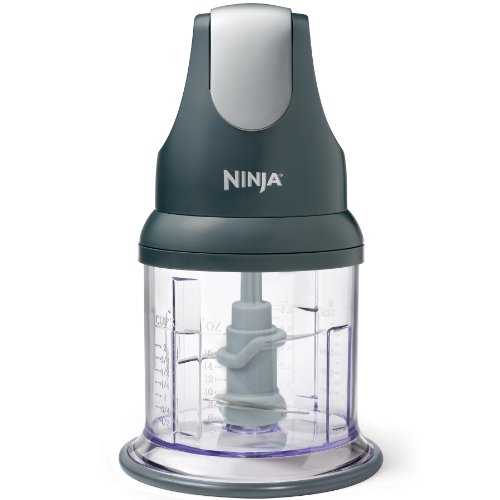
Ninja Express Chop — Best for Mincing
The electric pick plays a different sport and wins it: garlic, herbs, nuts, breadcrumbs, and cooked-base onions, pulsed to your chosen fineness in seconds, with a bowl and blade that wash without drama. It cannot dice and does not claim your salsa. Strengths: mincing speed, versatility across dry and wet small jobs, easy cleaning. Trade-offs: no dice, cord and motor to store, pulse skill to learn. Best for: mince-led cooking and sauce bases. Not suited for: salads, garnishes, presentation cuts. Tier: mid. Compare full-size alternatives in best food processors.
First Setup and Care Essentials
Unbox with the safety rules in hand: wash every part before first use, keeping blades visible and brushing rather than handling edges; identify each insert and store the set in its box from day one, because the storage habit formed at unboxing is the one that lasts. On first use, seat the grid until it clicks, run one empty press to feel the pusher alignment, and start with an onion — the category’s friendliest test — before graduating to carrots and sized sweet potato. Establish the closing ritual immediately: brush the grid from the back under the tap, rinse pusher and lid, wash the container, dry everything fully, and store blades guarded and out of children’s reach. Monthly, inspect hinge, lid, and grid frame for cracks, and check that the non-slip base still grips. Retire any cracked part at once. That is the whole maintenance regime — five minutes a month and ninety seconds a session — and it is the difference between a chopper that serves for years and one that becomes a cautionary tale.
Mistakes to Avoid When Buying
Buying by insert count rather than by mechanism and hinge. Buying a press to slice, or an electric to dice. Buying for an aspirational cooking life instead of your actual Tuesdays. Ignoring storage until the box arrives and discovering the only available home is a rummage drawer — unsafe for blades and fatal to usage. Skipping the bundle check: insert sets under one model name change, so confirm the current listing’s contents. Overlooking the cleaning comb and storage box, two small inclusions that predict daily satisfaction out of all proportion to their size. And finally, treating the safety rules as packaging: the households that thrive with these tools adopt pusher-only pressing, brush-only washing, guarded storage, and crack checks as part of the purchase itself. For the value argument before you commit, read is a vegetable chopper worth it and the balanced ledger in vegetable chopper pros and cons.
Grid Sizes and Cut Styles, Explained in Cooking Terms
Grid choice is a cooking decision disguised as a hardware specification. A small dice maximises surface area: pieces soften fast, take colour at the edges, and melt into whatever they join — the right cut for sauce bases, soffritto, salsas, and any dish where vegetables are the foundation rather than the feature. A large dice preserves identity: distinct cubes of carrot in a stew, potato in a curry, pepper in a salad, each needing the longer cooking their size implies and rewarding it with texture. Sticks and batons, where a set offers them, serve stir-fries, crudités, and the air fryer, where uniform batons crisp evenly and season evenly — a point worth pairing with air fryer cooking times for vegetables once your chopper is home. Julienne inserts produce fine matchsticks for slaws and garnishes, competently but without a mandoline’s speed or grace. Slicing inserts are the weakest offering in most sets: usable for a gratin in a pinch, outclassed by any dedicated slicer. The buying translation is simple: ensure the two dice sizes are present and well made, treat sticks as a welcome bonus, and discount slicing and julienne heavily when comparing bundles — they are the inserts most likely to be photographed once and stored forever.
Materials and Build Quality: What to Inspect
Three materials decide a chopper’s life. The blade grids should be stainless steel, firmly set in their frames without wobble, and evenly spaced — wobble produces ragged dice today and angled pusher strikes tomorrow. The body plastics divide into the brittle and the forgiving: rigid, glassy mouldings crack at hinges under repeated load, while slightly resilient plastics absorb the press’s shock for years; you cannot test this from a photograph, which is why owner accounts mentioning hard vegetables are the best available evidence. The pusher deserves the same scrutiny as the blades it serves — its fingers should be stout, evenly moulded, and visibly aligned to the grid pattern, because a pusher that flexes leaves food behind and tempts the fingertip clear-out the safety rules forbid. Smaller build details compound: a non-slip base that actually grips, a container with a lid for storage, hinges that move without creaking when new. None of this requires expertise to assess in person, and all of it outranks colour, branding, and insert count. When two models compete, choose the one whose load-bearing parts look overbuilt; in this category, overbuilt is correctly built.
Three Shoppers, Three Right Answers
Shopper one cooks Sunday batches for a family of five — soups, curries, a freezer restock — and arrived wanting the biggest bundle on the page. Walked through the criteria, the volume question dominates: her workload is heavy, hard-vegetable-rich, and weekly. The right answer is the Mueller, two grids, strongest hinge, with the bundle money redirected to nothing at all — saved. Her risk was never under-buying features; it was under-buying hinge. Shopper two cooks for one in a studio flat, mostly stir-fries and salads, and arrived convinced he needed a full press because “that’s what a chopper is.” His honest volume is three small jobs a week and his storage is one shallow drawer. The Brieftons QuickPush — or the NutriChopper for his meal-prep Sundays — serves his actual life; a full press would have become guarded-storage furniture. Shopper three makes fresh salsa twice a week and pasta sauces on Sundays, and arrived torn between a press and the Ninja. Her jobs split cleanly by output: salsa wants press dice, sauce bases want electric mince. The honest answer is the press first, because salsa is the dish where substitution fails visibly, with the electric as a planned second purchase — the two-mechanism kitchen that experienced owners converge on. Three shoppers, three different “best choppers,” one method: volume, produce, hinge, washing, storage, in that order.
Warranties, Spares and the Long View
Choppers are inexpensive enough that warranty terms rarely headline a listing, but two long-view checks are worth thirty seconds. First, replacement grids: blades outlast bodies in this category, yet a lost or damaged grid on a model with no spares available retires the whole tool, so makers who sell individual inserts earn a quiet preference. Second, the maker’s general parts posture — a brand that lists replacement lids and pushers is telling you it expects its tools to be repaired rather than landfilled, which correlates with the load-bearing quality this guide keeps recommending. Keep the storage box and the receipt of what your bundle contained; if a part ever fails, knowing exactly which insert set you own turns a frustrating search into a single order. And keep perspective: even a mid-tier press that serves four years of weeknight cooking has repaid its tier many times over in knife minutes saved.
Manual or Electric: The Decision in Depth
Because the two families share a name and nothing else, this choice deserves its own pass. Choose manual — press or plunger — when the output you picture is pieces: dice you can see, count, and distribute through a dish. Manual tools are silent, cordless, instantly ready, and their result is deterministic — the grid decides the size, not your timing. Choose electric when the output you picture is a texture: mince, rubble, a base that disappears into a sauce. Electric rewards a learned pulse and punishes inattention with purée, and it asks for a socket, a wash of bowl and blade, and storage for a motor. Households that entertain the question seriously usually discover their cooking leans eighty-twenty one way, and should buy the eighty. The twenty can be covered by a knife today and by the other mechanism later, which is why so many settled kitchens own both a press and a mini electric without redundancy — they are not two choppers, they are two different tools that share a shelf and a name. If budget or space forces exactly one and your cooking is genuinely split, the press is the safer single purchase, because a knife can approximate mincing for small quantities while nothing in a manual kitchen approximates a grid’s dice.
Reading a Listing Like an Engineer
Product pages in this category are written to sell breadth; your job is to read for load. Translate as you go. “Multi-function” means count the dice grids and discount the rest. “Heavy duty” means nothing until you find hinge and lid described in structural terms or corroborated by owner accounts of hard vegetables. Photographs of the pusher against the grid are worth paragraphs: look for fingers that fill the grid pattern completely. A cleaning comb and a storage box in the contents list signal a maker who understands ownership; their absence signals a maker selling an unboxing. Check the contents list against the photographs, because bundles drift and the photograph may show an insert the current box omits. Treat capacity claims comparatively rather than absolutely — what matters is whether the container matches your batch size, which you know from your own cooking. And read the one-star reviews with the field guide from vegetable chopper reviews: separate the tomato tragedies and technique failures from the genuine hinge reports, and weight the latter heavily. Fifteen minutes of this reading is worth more than any single recommendation, including the ones in this guide.
The Whole Guide as a Five-Minute Checklist
If you read nothing else, run this sequence. One: name your dominant output — dice, chop, or mince — and let it choose the mechanism. Two: count your weekly chopping sessions honestly and let the count choose the size class. Three: list your three most-chopped vegetables and check them against the firm-produce fence; if ripe tomatoes headline the list, stop and buy a knife instead. Four: among models of the right mechanism and size, choose by hinge strength and pusher fit, using owner accounts of hard vegetables as evidence. Five: confirm the box contains two dice grids, a cleaning comb, and a storage box, and confirm you have a reachable, guarded home for it. Six: picture the dirty tool at 9 p.m. and confirm the wash-up still seems acceptable — if not, step down to the simpler design now rather than after a month of avoidance. Seven: adopt the safety routine as part of the purchase — pusher only, brush only, guarded storage, crack checks. A chopper chosen this way is very rarely regretted, because every step of the checklist corresponds to a documented way these purchases go wrong.
A Note on Seasons: When Choppers Earn Double
Demand on a chopper is not flat across the year, and buyers who purchase in a quiet month sometimes under-size for the loud ones. Soup and stew season loads the press with exactly its favourite work — root vegetables, onions, celery — in batch quantities. Preserving and pickling season adds cucumbers, peppers, and onions in volume. Salad season shifts the balance toward the large grid and the knife’s share of soft produce. Barbecue season brings peppers and onions for skewers and salsas, where even dice is a visible quality difference. None of this changes which model to buy, but it should inform the capacity and hinge questions if your year has a pronounced peak: buy for the busiest month you actually cook, not the average one, because a tool that copes in October and collapses in December’s batch season has failed at the moment of maximum need. The exception is storage — if the peak is brief and storage is tight year-round, the compact designs plus a borrowed knife for the peak remains a rational compromise.
Gifting a Vegetable Chopper Without Getting It Wrong
A meaningful share of these tools change hands as gifts, and the failure rate among gifted choppers is the category’s worst — not because the tools differ, but because the giver skips the matching work this guide exists to do. If you are buying for someone else, the checklist still applies; you simply answer it from observation of their kitchen rather than your own. Watch what they cook: a soup-and-curry household is press country, a garlic-in-everything household may be electric country, and a confident knife cook with fast, even dice may honestly need neither — in which case the thoughtful gift is a great board or knife care, not a gadget that duplicates their skill. Storage is the gift-giver’s special trap: never give a full press set to a kitchen you have not seen, because the box needs a guarded, reachable home the recipient may not have. Include the storage box and cleaning comb if the bundle offers variants, and include the safety conversation — not as a lecture, but as the four rules that make the tool pleasant rather than hazardous. A chopper given with that much thought lands like equipment; given casually, it lands like clutter with blades.
Why This Guide Prints No Prices and No Star Ratings
A short note on method, because it shapes every recommendation above. Prices in this category move with promotions, bundles, and seasons, and any figure printed here would be wrong for a large share of readers within weeks — so picks are placed by tier instead, which describes the engineering you are paying for rather than a number that expires. Star ratings and review counts are omitted for the same reason, with an additional one: an average score blends the batch cook’s delight and the tomato-presser’s fury into a single meaningless digit, while the detailed accounts underneath the score remain genuinely informative. This guide has used those accounts throughout, weighted for specificity and length of ownership. Judge the picks by the fit arguments attached to them, check the current listing for the number that applies on the day you buy, and the decision will age better than either a printed price or a borrowed average.
Before You Buy: A Vegetable Chopper Fit, Space and Routine Checklist
Buying a vegetable chopper takes an afternoon; living with it happens at the prep area, where onions, peppers and salads begin, while getting uniform pieces quickly for weeknight cooking and meal preparation, and that daily reality is what this section judges. So work backwards from daily life: fix the routine, the space and the people in your mind first, and only then weigh the features that looked persuasive on a product page. The first check is that the blade grids match the dice and slice sizes your recipes actually use, and it outranks everything else, because no styling or extra capacity compensates when that basic fit is wrong. Equally, beware of under-buying for a routine that happens daily, since a small saving at purchase is repaid in irritation every week the vegetable chopper stays in service.
A vegetable chopper rarely has one user. Children, partners, guests and grandparents all interact with it differently, and the best choice is the one the whole household can live with, not just the purchaser. Before ordering, list everything the first week of use requires and confirm, item by item, whether it arrives with the vegetable chopper or has to be found separately. Try this decision exercise: write down three non-negotiable jobs, one acceptable compromise and one walk-away flaw. If a candidate survives that list, it deserves its place on the shortlist. Prevention is unglamorous and effective: rinsing blades immediately, using the cleaning tool and drying every part before assembly, done consistently, protects performance better than any occasional rescue effort after problems have set in.
- Confirm the first two fit checks against your own home, not a showroom.
- Name the three jobs it must do well and the one compromise you accept.
- Verify the included parts in the current listing and note anything extra to source.
- Settle the weekly care routine and the storage or drying spot in advance.
- Write down the dimensions of the space and the clearances around it before shortlisting.
The second check is whether the container, lid and blades come apart for complete washing, a point shoppers skip because it is hard to judge from photographs, yet it is painfully obvious within the first week of ownership. Delegation exposes weak choices. A vegetable chopper that only works in one person’s hands, with one person’s knack, is a fragile solution for a shared home. Decide whether the placement is permanent or provisional, and buy accordingly, because a vegetable chopper chosen for a fixed home and one chosen to move, fold or travel are different designs wearing similar names. Anything heavy, hot, sharp, load-bearing or electrically powered deserves a respectful pause in the decision, and the maker’s own guidance, read before purchase, is part of the specification.
Dead heats between two candidates are broken by weaknesses, not strengths: pick the vegetable chopper whose compromises fall on the jobs you do least often. Cleaning time is an ownership cost like any other, so favour the design whose care routine fits the time you genuinely have, not the time you would have in an ideal week. When performance slips, troubleshoot in order: position, load, cleanliness, alignment and whether the routine has quietly changed since the vegetable chopper arrived all come before blaming the item itself. Plan the end at the beginning: a vegetable chopper should be repairable, passable on, recyclable or at least easy to dispose of responsibly when its service ends, and designs differ widely on this.
If a guest can use the vegetable chopper correctly without instruction, the design is intuitive; if they cannot, expect the same friction, softened only by habit, in your own routine. Photograph complicated setups before you change them and note settings that worked. With a vegetable chopper, your own records become the manual for your particular home. Wear arrives at predictable points: hinges, seals, edges, handles, surfaces and anything that is folded, dragged, filled or emptied. Inspect those areas in photographs and descriptions before you buy. Compatibility deserves a slower look than it usually gets, because a vegetable chopper never works alone; it must suit the surfaces, fittings, storage, light and other items already around it.
Get the tape measure out before you get the shortlist out. Written measurements settle arguments that photographs start, especially around clearances that only matter when the vegetable chopper is actually in use. Where a thing lives determines how often it is used. If reaching the vegetable chopper involves moving other things first, usage will quietly fall away, whatever your intentions at purchase. Every item leaves a footprint on the home beyond its dimensions: noise, mess, heat, moisture, effort or visual clutter. Weigh that footprint for a vegetable chopper as seriously as its size. Shortlists should shrink ruthlessly. A vegetable chopper that fails a basic fit check is not a bargain at a lower price or a compromise worth making; it is simply the wrong item.
Attention is a budget too. A vegetable chopper that needs remembering, scheduling, monitoring or special handling spends it, so count that cost alongside the physical ones. Beware of solving a problem you do not have, because the largest or most elaborate version of a vegetable chopper adds cleaning, storage and cost in effort to a routine a simpler version would have served perfectly. Ownership is easier with a small paper trail. Keep the instructions, note the model details from the listing, and record any quirk as it appears rather than reconstructing it months later. Every household has an unusual week, and for yours it may be that chopping one small onion, where setting up and washing can exceed the saving; buy for that week as well as the ordinary one.
Routines change across the year, so ask whether the vegetable chopper still makes sense in the opposite season, during holidays, or when the household grows, shrinks or rearranges the room it lives in. Weekday and weekend versions of the same routine can want different things from a vegetable chopper, so check your choice against both rhythms rather than averaging them into a routine nobody actually lives. The failure pattern to plan against is food forced through the wrong grid, bending blades and leaving half-cut pieces, and it seldom arrives suddenly; it builds through small, ordinary habits that nobody notices during the first few weeks. There is always a learning curve, however small. Decide who in the household faces the steepest part of it with this vegetable chopper and whether the design helps or hinders them.
Frequently Asked Questions
What is the best type of vegetable chopper for a beginner?
A mid-tier hinged press with two dice grids is the most forgiving start: it produces proper dice from the first onion, teaches the category’s technique in one session, and its enclosed cut is beginner-friendly provided the safety rules are followed — pusher only, brush washing, guarded storage. Beginners who cook small should consider the single-grid OXO instead, whose simplicity and fast wash-up build the habit fastest. Avoid starting with a maximalist bundle unless you enjoy washing; complexity is the enemy of a new habit.
How do I know if a chopper’s hinge is strong enough?
Look for design evidence rather than adjectives: thick, slightly flexible-feeling lid plastic; hinge geometry that spreads load rather than concentrating it on two small pivots; a grid that seats with a positive click so presses land squarely. Then protect whatever you buy with technique — size hard vegetables to the grid and press centred with a flat palm. Owner reviews that mention sweet potato specifically are the most informative stress reports available; a model praised there has earned it.
Is a more expensive chopper worth it over a budget one?
Moving from entry to mid tier buys hinge strength, pusher fit, and cleaning refinement — the three qualities that decide year-three satisfaction — and for daily cooks that trade is usually worth it. Moving beyond mid buys convenience and finish more than capability. What extra money never buys is an exemption from the category’s physics: every tier needs sized pieces, brush washing, and guarded storage, and every tier fails on ripe tomatoes. Spend on the load-bearing parts, not on insert counts.
Can a vegetable chopper replace my food processor?
Only if your processor use was mostly small chopping jobs. A press chopper dices better than a processor and sets up faster, but it cannot shred, slice in volume, purée, or make dough. An electric mini-chopper covers mincing at small scale only. Most households find the chopper replaces the processor for weeknight prep while the processor keeps its occasional big jobs — and if your processor already lives in a hard-to-reach cupboard, the chopper’s accessibility may matter more than the processor’s range. See best compact food processors for the middle ground.
Which chopper is best if I hate washing up?
The single-grid OXO, by design: one smooth grid, a pusher that clears it well, and the fewest parts in the press class, rinsed in about ninety seconds if you wash immediately. The electric Ninja is the runner-up, with a bowl and blade that clean simply. The honest caveat is that no chopper washes itself, and the habit matters more than the model — a grid brushed at once is a small job on any design, and a grid left overnight is a big job on all of them.
What should I check on the listing before I buy?
Confirm the exact insert set included, since bundles under one model name change over time; confirm a cleaning comb and storage box are included; check whether parts are described as dishwasher-safe and on which rack; look for replacement grid availability if you are buying for the long term; and verify the container has a non-slip base. Ignore printed star ratings and review counts as decision inputs — they shift constantly — and weight detailed owner accounts that describe specific vegetables, hinges, and wash-ups instead.
Related Reading
Put this guide to work with how to choose a vegetable chopper for the step-by-step method, vegetable chopper review for the deep dive, and is a mandoline slicer worth it if slicing keeps pulling at your attention. Prep belongs on a good board — see best cutting boards for home cooks — and evenly diced vegetables reward you most in the air fryer, per how to air fry vegetables evenly.


