Disclosure: airfryerkitchensupply.com is reader-supported. When you buy through links on our site, we may earn an affiliate commission at no extra cost to you.
Key Takeaways
- For most adults who read, charge a phone, or keep anything at the bedside overnight, the answer to “is a nightstand worth it” is yes — it is one of the cheapest pieces of furniture per year of daily use in the whole home.
- A nightstand earns its money by doing four jobs at once: a surface at mattress height, enclosed storage, a home for charging, and a lamp stand. A substitute that does only one of those jobs is not really a substitute.
- It is not worth it if your bedside load is genuinely just a phone, if the gap beside your bed is too narrow for even a compact stand, or if you are furnishing a room you will leave within months.
- The honest alternatives — a floating shelf, a small stool, a spare chair, a wall-mounted ledge — work best as a trial. Live with one for a month and your frustrations will tell you exactly which nightstand features you actually need.
- Buy once, buy the right height, and match the top surface to the top of your mattress. Height mistakes, not build quality, are the main reason nightstands disappoint.
Where to buy
Every nightstand named in this article was verified against Amazon catalog data before inclusion, and each one is sold on Amazon in single and, in some cases, paired configurations. If you want the full-feature default, start with the VASAGLE 23.6-inch nightstand with LED lights and charging station. If solid wood and zero assembly matter more than gadgets, look at the leovanni cherry wood nightstand set of 2. If the space beside your bed is genuinely tight, the Yoobure compact nightstand with charging station is the one built for that problem. Check price on Amazon on the listing itself, because finish, configuration and season all move what you pay, and no figure printed in an article stays true for long.
Is a Nightstand Worth It? Start With What Is on Your Floor Right Now
Ask “is a nightstand worth it” in a room where the bedside is already sorted and the question sounds silly. Ask it in a room where your phone charges on the floor, your water glass lives on a stack of paperbacks, your glasses spend the night somewhere you have to hunt for in the dark, and your alarm clock is balanced on a windowsill — and the question answers itself. The nightstand is not decorative furniture that happens to stand near a bed. It is the piece of furniture you interact with in the last sixty seconds before sleep and the first sixty seconds after waking, every single day, which makes it one of the highest-touch objects in your home. Few purchases get used twice a day, every day, for a decade. A nightstand that does its job well disappears into your routine so completely that you only notice it when it is gone — which is exactly what happens the first night in a new apartment, a guest room, or a furnished rental that skipped it.
That said, “worth it” is a verdict, not a slogan, and this article will argue both sides honestly. A nightstand costs money, occupies floor space that small bedrooms cannot spare, and competes with substitutes you may already own: a chair, a stool, a crate, a floating shelf. For some sleepers — minimalists whose entire bedside load is one phone, people in micro-studios where the bed is wedged wall to wall, anyone furnishing a room they will leave in a few months — the honest answer is no, or at least not yet. For most other people, the answer is yes, and the more useful question becomes which kind of nightstand is worth it for the way you actually live: a charging stand with drawers, a solid wood pair you keep for twenty years, a tall narrow tower for a tight corner, or a cheap compact stand that simply ends the floor-charging era.
To make that judgement concrete rather than theoretical, this article uses six real, currently sold nightstands as evidence, spanning the budget tier to solid wood pairs. Each one was verified against Amazon’s catalog before it was allowed in. They are not here as a shopping list first and an argument second; they are the test cases. If the case for owning a nightstand holds up across a budget fabric-drawer stand and a traditional walnut pair, it holds up generally. And where a substitute honestly beats a purchase — and sometimes it does — this article will say so plainly.
In this guide
Quick Picks: The Six Test Cases
- Best Overall — VASAGLE 23.6-inch nightstand: two drawers, LED lighting and a charging station in a full-width frame. The strongest all-round argument that a nightstand earns its place.
- Best Solid Wood Pair — leovanni cherry wood nightstand set of 2: solid wood, two drawers per stand, no assembly. The buy-it-for-decades case.
- Best for Small Spaces — Yoobure nightstand with charging station: compact footprint, fabric drawers and an open shelf. Proof that even a narrow gap can hold a real nightstand.
- Best Tall Storage — Furnulem tall nightstand: four fabric drawers plus a four-tier shelf and charging. The case for going vertical when floor space runs out.
- Best Modern Look — LYNCOHOME fluted nightstand: fluted drawer fronts, two drawers and charging in a 19.7-inch frame. The case that a nightstand can be the best-looking thing in the room.
- Best Traditional Pair — AMERLIFE walnut nightstand set of 2: solid wood, turned legs, a drawer and an open shelf per stand. The classic bedroom, bought once.
Read the verdicts below before you read the reviews. If your situation matches a “skip it” profile, the reviews are irrelevant to you, and no amount of drawer hardware changes that. If it matches a “buy it” profile, the reviews exist to make sure you buy the right one the first time — because the only nightstand that is not worth it is the wrong one bought twice.
How These Picks Were Chosen
The six stands in this article were chosen to represent the real decision, not to fill a grid. Together they cover the budget tier, the mid-range, and solid wood pairs; compact, standard and tall formats; fabric drawers, board construction and solid timber; and the two features that define modern bedside life, built-in charging and lighting. No prices are printed anywhere in this article, deliberately: bedside furniture pricing moves with finish, configuration and season, so each pick is positioned by tier in words, and the listing itself is the only honest place to check price on Amazon.
The judging criteria for a “worth it” analysis are different from a pure performance roundup. Each stand is weighed on cost of ownership over its realistic lifespan rather than its ticket tier, on how many of the four bedside jobs it actually covers, on the space it consumes relative to the storage it returns, and on what happens when your needs change — a stand that works in a first apartment and a later primary bedroom is worth more than one that only fits the room you have today. Assembly burden counts too, honestly: an evening of flat-pack frustration is a real cost, and a stand that arrives assembled has quietly paid part of its price back before you use it once.
Six Nightstands, Judged as Purchases

VASAGLE 23.6-Inch Nightstand with LED Lights and Charging Station — Best Overall
This is the stand that makes the general case most easily. At 23.6 inches wide with two drawers, an LED light feature and a built-in charging station, it covers all four bedside jobs — surface, enclosed storage, charging, lamp duty — in a single mid-range purchase. If your current setup is a phone on the floor and a book on the bed, this one purchase retires every workaround at once, which is the clearest possible definition of money well spent. It suits the primary bedroom of a couple where one side does the reading, charging and clutter-absorbing for two, and it suits anyone who wants to solve the bedside once and stop thinking about it.
Strengths
- Two real drawers swallow the bedside clutter — chargers, remotes, medication, notebooks — that makes a room look untidy no matter how often you tidy it.
- The charging station ends cable archaeology: devices charge on top, cables live in one place, and nothing sleeps on the floor.
- Full-width top fits a lamp, a book and a water glass at the same time, which is the actual nightly load for most readers.
Trade-offs
- At 23.6 inches wide it needs a real gap beside the bed; in a tight room it is simply too much furniture.
- Board construction in a bold ink black finish is a style commitment — it will not blend quietly into a pale, traditional room.
- The LED and charging features are only worth having if you will use them; a lamp-and-book sleeper pays for electronics they will ignore.
The deeper point this stand makes is about consolidation. Bought separately — a plain stand, a power strip solution, a small lamp workaround — the same jobs cost more in money and far more in fiddling. As a single purchase it is the mid-range doing what the mid-range should: not the cheapest, not heirloom, just complete. Check the current price on Amazon before judging the tier, because configuration changes it.
Best for: most primary bedrooms and anyone retiring a pile of workarounds in one purchase. / Not suited for: narrow gaps beside the bed or sleepers who want no electronics in their furniture. Check price on Amazon

leovanni Cherry Wood Nightstand Set of 2 — Best Solid Wood Pair
The leovanni pair is the long-game argument. Solid cherry-toned wood, two drawers per stand, a 22-inch width, and — the detail that quietly matters — no assembly required. A pair reframes the whole “worth it” question: instead of asking whether one stand justifies its price, you ask whether a matched, finished bedroom justifies a once-in-a-decade purchase, and for a primary bedroom you will sleep in for years, it usually does. The cost per year of a solid wood pair that outlasts two mattress replacements is lower than the cost per year of almost any budget stand bought twice.
Strengths
- Solid wood construction is repairable, refinishable and stable in a way board furniture is not — this is the tier that survives house moves.
- No assembly: the evening you would have spent with an Allen key is refunded immediately.
- Two drawers per stand, times two stands, is genuine storage — enough to empty a dresser drawer of bedside overflow entirely.
Trade-offs
- A pair is the biggest single outlay in this article; the tier only makes sense if you will keep the room for years.
- No built-in charging, so cables still need a tidy route of your own devising.
- The farmhouse character is distinct — in an ultra-modern room it will look like a guest from another house.
Judged as a purchase rather than a product, the pair wins on arithmetic and loses on flexibility. If there is any real chance you will reconfigure the room, split the pair across two homes, or move abroad within a couple of years, the commitment works against you. If the bedroom is settled, this is the closest thing to a permanent answer.
Best for: settled primary bedrooms, solid-wood loyalists, anyone who hates assembly. / Not suited for: renters on short horizons or rooms that change layout often. Check price on Amazon

Yoobure Nightstand with Charging Station and Fabric Drawers — Best for Small Spaces
The Yoobure is the rebuttal to the most common “not worth it” argument: “there is no room.” Built compact, with fabric drawers and an open storage shelf under a charging-equipped top, it fits gaps that reject standard stands, and it does so at a budget tier that lowers the stakes of the whole decision. For a first apartment, a dorm-adjacent bedroom, or the narrow side of a bed pushed near a wall, this is the stand that proves the category scales down gracefully instead of simply being absent.
Strengths
- Compact footprint fits the single-digit-inch gaps where the floor-charging problem is usually worst.
- Charging station with USB ports and outlets built in — the feature small-room sleepers need most, since the wall outlet is often behind the bed.
- Budget tier: if it turns out a nightstand is not for you, the lesson was learned cheaply.
Trade-offs
- Fabric drawers are light-duty — fine for chargers, socks and paperbacks, wrong for heavy hardback stacks.
- The small top is a one-lamp, one-book surface; a lamp plus a large water carafe plus a tablet will crowd it.
- Lightweight frames can wobble on thick carpet if loaded unevenly.
Its real value is as a proof of concept that happens to be permanent furniture. Many buyers start here expecting to upgrade and never do, because a compact stand that charges everything and hides the clutter has quietly covered the whole job description.
Best for: small bedrooms, first apartments, the cramped side of the bed. / Not suited for: heavy storage loads or anyone who wants furniture that feels substantial. Check price on Amazon

Furnulem Tall Nightstand with LED and Charging Station — Best Tall Storage
The Furnulem argues that the nightstand’s footprint problem is solved vertically. Four fabric drawers stacked over a four-tier storage shelf, topped with a charging station and LED lighting, give it more storage than stands twice its width. For the sleeper whose bedside load is genuinely large — books in rotation, craft supplies, a CPAP-adjacent clutter of accessories kept in neutral terms as “nighttime essentials,” a household’s worth of remotes — the tall format converts dead air beside the bed into the hardest-working storage column in the room.
Strengths
- Four drawers plus open shelving: the most storage per square inch of floor in this article.
- Charging and LED lighting built in, so the top stays free for a lamp and a book.
- Tall profile suits high platform and storage beds whose mattress tops defeat standard-height stands.
Trade-offs
- Fabric drawers again cap the weight per drawer; this is volume storage, not a strongbox.
- A tall, narrow piece must be loaded bottom-heavy and is the wrong choice in a household where it will be climbed or pulled on.
- Visually it reads more “storage tower” than “bedroom furniture,” which some rooms will not forgive.
Worth-it verdicts hinge on matching the format to the failure mode. If your complaint is “everything lives on the floor because there is nowhere to put it,” width is not your problem — volume is, and this is the pick that addresses it.
Best for: heavy bedside loads, high beds, rooms where floor space is the scarcest resource. / Not suited for: households needing tip-proof furniture or a classic bedroom look. Check price on Amazon
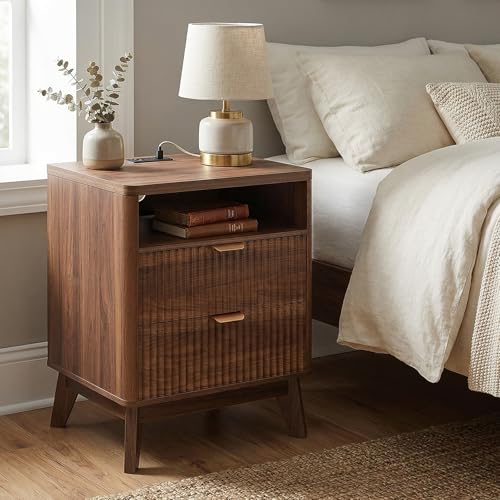
LYNCOHOME Fluted Nightstand with Charging Station — Best Modern Look
The LYNCOHOME makes the aesthetic case, which sceptics dismiss too quickly. A nightstand is the piece of bedroom furniture you see closest, longest and in the softest light; a fluted-front, warm brown stand at 19.7 inches wide with two drawers and a charging station genuinely changes how finished a bedroom feels, and a room that feels finished is a room you keep tidy — the drawers get used, the surface stays clear. Design is not decoration here; it is the mechanism that makes the storage habits stick.
Strengths
- Fluted drawer fronts deliver a custom-furniture look at a mid-range tier.
- Two drawers plus charging covers the standard bedside job list without excess.
- At under 20 inches wide it fits most standard gaps while still reading as a full piece of furniture.
Trade-offs
- Sold as a single stand; matching a pair means buying two and accepting the pair price that follows.
- The statement finish narrows your future bedding and furniture choices more than a neutral stand would.
- No open shelf, so oversized books and items you grab nightly must fit the drawers or live on top.
If the honest reason you are hesitating is that every nightstand you have seen looks like a compromise, this is the one that removes the objection. You will pay a modest premium over the plainest equivalent, and for a piece you look at twice a day for years, that premium is among the easiest to justify in this article.
Best for: design-led bedrooms, mid-range budgets, standard gaps. / Not suited for: buyers who need open-shelf access or a matched pair at a pair price. Check price on Amazon

AMERLIFE Walnut Nightstand Set of 2 — Best Traditional Pair
The AMERLIFE pair is the traditionalist’s answer: solid wood in a walnut finish, turned legs, one drawer and one open shelf per stand, sold as a matched set of two. The drawer-plus-shelf layout is the oldest bedside formula there is, and it persists because it maps perfectly onto real behaviour — closed storage for the unsightly, open shelf for the book you are actually reading. As a purchase, it competes directly with the leovanni pair: the AMERLIFE leans vintage and decorative, the leovanni leans farmhouse and drawer-heavy.
Strengths
- Solid wood with turned legs — the construction and silhouette that read as “real furniture” in any decade.
- Drawer plus open shelf is the most behaviour-friendly layout: nightly items visible, clutter hidden.
- A matched pair finishes a primary bedroom in one decision, with easy assembly rather than a full build.
Trade-offs
- One drawer per stand is half the enclosed storage of the leovanni pair — heavy clutter needs another home.
- No charging features; the traditional look is bought with modern convenience.
- Turned legs and a vintage stance will fight a low, minimalist platform bed visually.
Between the two solid wood pairs, choose by storage honesty: if your bedside load is a book, glasses and a phone, this pair is sufficient and prettier for it; if your load includes a drawerful of everything, the leovanni’s second drawer earns its keep nightly.
Best for: traditional primary bedrooms and guest rooms that deserve better than leftovers. / Not suited for: heavy enclosed-storage needs or tech-first sleepers. Check price on Amazon
Comparison Table
| Pick | Badge | Key spec | Best for |
|---|---|---|---|
| VASAGLE 23.6-inch | Best Overall | 2 drawers, LED, charging station, 23.6 in wide | Primary bedrooms wanting one complete fix |
| leovanni cherry wood pair | Best Solid Wood Pair | Solid wood, 2 drawers each, no assembly, 22 in wide | Settled rooms, buy-once buyers |
| Yoobure compact | Best for Small Spaces | Fabric drawers, shelf, charging, compact footprint | Tight gaps, first apartments |
| Furnulem tall | Best Tall Storage | 4 fabric drawers, 4-tier shelf, LED, charging | Big bedside loads, high beds |
| LYNCOHOME fluted | Best Modern Look | Fluted fronts, 2 drawers, charging, 19.7 in wide | Design-led bedrooms |
| AMERLIFE walnut pair | Best Traditional Pair | Solid wood, drawer + open shelf, turned legs | Classic rooms, guest bedrooms |
Read the table as a map of the argument rather than a ranking. Every row is a different answer to “what would make a nightstand worth it for me?” — completeness, longevity, fit, volume, beauty or tradition. The wrong row is the only bad purchase on the page.
What a Nightstand Actually Does: The Benefits, Weighed Honestly
Strip away the styling and a nightstand performs four jobs, and its worth is simply the sum of how much you need each one. The first job is a surface at the right height. Reaching down to the floor from a lying position, or up to a dresser, dozens of times a week is a small misery that compounds; a top surface level with the top of your mattress puts water, glasses, phone and book exactly where your hand expects them, half asleep, in the dark. The second job is enclosed storage within arm’s reach. Every bedroom accumulates bedside-only items — charging cables, lip balm, a notebook, tissues, medication, the remote for the bedroom television — and without a drawer they live on the surface, which is why so many bedrooms look permanently one day behind tidy. The third job is charging infrastructure. Modern bedside life runs on at least one cable, usually two, and a nightstand gives those cables a fixed home instead of a nightly migration across the floor. The fourth job is holding a lamp at reading height, which sounds trivial until you have read by a ceiling light or a phone torch for a month.
There is also a fifth, quieter benefit: symmetry and finish. A bed flanked by stands looks intentional, and rooms that look intentional get treated better — an unglamorous truth that anyone who has lived with both setups will confirm. Guest rooms make the benefit obvious from the other side: the single most common guest-room complaint is nowhere to put a phone, a glass of water and a pair of glasses at once, and the cheapest possible stand fixes it completely. Weigh the benefits against your own load, though. If your honest nightly inventory is a phone and nothing else, jobs one, two and four shrink toward zero, and the case collapses — which is why the next sections argue the other side just as hard.
The Real Costs: Money, Space and Everything Else
The money is the obvious cost, and the honest way to frame it is per year, not per purchase. A budget-tier stand that serves five years costs less per year than the takeaway coffees of a single month; a solid wood pair that serves twenty years costs less per year still. Nightstands are among the cheapest furniture categories in the home relative to lifespan, which is why the “worth it” answer tilts yes so often. But the ticket is not the only cost. Space is the second: every stand consumes a strip of floor and, more importantly, fixes the bed’s position in the room. In a small bedroom, a stand on each side can be the difference between a door that opens fully and one that does not. The third cost is commitment — a matched pair in a strong style narrows every future choice in the room, from bedding colour to the next bed frame.
There are also running costs of a sort. Flat-pack stands cost an evening of assembly. Charging stands add one more device drawing standby power and one more cable ecosystem to manage. Drawers accumulate junk with gravitational reliability and need an occasional purge. None of these is a reason to skip the purchase, but a fair verdict counts them: the nightstand is worth it when the four jobs outweigh a modest outlay, a strip of floor, an hour of assembly and a drawer you must occasionally empty of expired everything. For most sleepers that trade is not close. For the profiles in the next section, it genuinely is.
Who Should Buy One — and Who Should Honestly Skip It?
Buy one if you charge anything at the bedside, read in bed even occasionally, keep more than two items within reach overnight, share the bedroom and want the clutter contained, or are furnishing a guest room. Buy one if your glasses, water or medication currently sleep on the floor — that is not a storage preference, it is a nightly hazard and a nightly annoyance, and it ends the day the stand arrives. Buy one if you are settling into a home for two years or more; the per-year arithmetic only improves with time.
Skip it, for now, if your entire bedside load is one phone that charges in the kitchen by deliberate habit. Skip it if the bed is wedged between walls with literally no gap — a wall solution, covered below, serves you better than a stand you cannot fit. Skip it if you are in a short-let, a dorm with provided furniture rules, or a life season where everything you own must fit in a car; a stand is exactly the category of object that gets abandoned in moves, and an abandoned purchase is never worth it. And skip the pair, even if you buy one stand: the far side of a bed against a wall needs nothing, and symmetry for its own sake is how budgets leak.
The undecided middle — most readers — should run the trial described in the alternatives section: live with a substitute for two to four weeks, note every friction, and let the list of frictions choose the stand. A purchase made from evidence is the one that never feels wasted.
Cheaper Alternatives: Floating Shelves, Stools, Chairs and Honest Substitutes
The strongest argument against buying a nightstand is that you may already own its replacement. A floating shelf mounted at mattress height is the best of the substitutes: it holds a phone, glasses and a paperback, costs very little, consumes no floor, and works in gaps where no stand fits. Its limits are hard ones — no storage, no lamp of any size, a strict weight ceiling, and holes in the wall that renters may not be allowed to make. A small stool or side table you already own covers the surface job well and the storage job not at all; as a permanent answer it slowly accumulates the same surface clutter a drawer exists to hide. A spare dining chair is the classic student solution and is better than its reputation — surface plus a rung for a draped cable — but it reads as temporary forever and holds a lamp badly. A storage crate or stack of sturdy boxes is the budget improviser’s pick: some storage, some surface, no dignity, and a genuine tripping edge in the dark. A wall-mounted ledge or headboard shelf suits beds against walls and cable-free sleepers. And the bedside caddy — a fabric organiser that tucks under the mattress — is the true minimalist’s answer, holding phone, glasses, book and remote with zero furniture at all.
Judge each substitute against the four jobs. The caddy covers storage and charging access but no surface and no lamp. The shelf covers surface but not storage. The chair covers surface and a lamp, precariously, and nothing else. Only the nightstand covers all four, which is precisely why the substitutes work best as trials: whichever job you find yourself missing, night after night, is the feature your eventual purchase must have. If after a month you miss nothing, congratulations — you have your verdict, and it cost you nothing. That is the alternatives section working as intended, not failing.
How to Decide: Audit Your Load and Measure Your Space
This is the practical core of the article — a five-step decision you can finish in fifteen minutes, which converts “is a nightstand worth it” from a vibe into a measurement.
Step 1: The floor audit. Tonight, before bed, photograph or list everything within arm’s reach of your pillow: on the floor, on the bed, on the windowsill. That list is your true bedside load. Two items or fewer, all pocket-sized, points toward a caddy or shelf. Four or more, or anything bulky, points toward a stand with a drawer.
Step 2: The charging count. Count devices that charge overnight and where their cables currently live. One device with a behaved cable is manageable without furniture. Two devices, or any cable that crosses a walkway, makes a stand with charging — like the Furnulem tall nightstand or the VASAGLE — worth a clear premium in daily calm.
Step 3: Measure the gap and the mattress. Measure the floor gap beside the bed in inches, and the height from floor to the top of the mattress. Your stand’s top should land level with the mattress top or an inch or two below it; a stand far below forces the floor-reach problem back in, and one far above turns every reach into a climb and every water glass into a spill waiting to fall on you. Width must fit the gap with a small breathing margin — this single measurement eliminates half the catalogue honestly.
Step 4: Set the tier by horizon, not by taste. Staying under a year: budget tier or a substitute. Two to five years: mid-range, where the charging stands live. Settled for the long term: solid wood, bought once. The horizon rule prevents both errors — heirloom furniture for a temporary room, and throwaway furniture for a permanent one.
Step 5: Run the substitute trial if still torn. Shelf, stool or caddy for two to four weeks, with a note on your phone for every friction. Buy the stand whose feature list matches the friction list, and no other. A stand bought this way is, empirically, the one people keep.
When Is a Nightstand Most Worth It? Timing and Triggers
Some moments tilt the verdict decisively. A new mattress is the biggest one: thicker modern mattresses raise the sleeping surface, and the stand that matched the old bed now sits uselessly low — replacing both together is cheaper in frustration than adapting for years. A new home or a bedroom repaint is the natural moment for a pair, because the room is already disrupted and the stands complete the reset. Setting up a guest room before visitors arrive converts the purchase from self-indulgence to hospitality, and a modest pair like the AMERLIFE walnut set of 2 lifts the whole room’s welcome. A new baby, a new medical device kept at the bedside, or a partner moving in all multiply the bedside load overnight, and the stand that was optional becomes infrastructure. Conversely, the worst time to buy is mid-move, mid-renovation dust, or in the first week of a new home before you know how you actually use the room — measure twice, live a fortnight, then buy once.
Moves, Resale and Changing Rooms: The Long View
A fair worth-it analysis also asks what happens at the end of the stand’s time with you. Here the tiers separate cleanly. Budget stands are effectively disposable: they move badly, resell for almost nothing, and are usually left behind or given away — acceptable at their tier, provided you knew it going in. Mid-range stands move house adequately and hold modest second-hand value if the finish survives. Solid wood pairs are the only tier that behaves like an asset: they survive movers, sell quickly in any local marketplace because everyone recognises real timber, and can migrate from primary bedroom to guest room to a child’s room across decades, working in every role. That migration path matters more than it sounds. The most common reason a good nightstand leaves a home is not failure but promotion — the room gets a new pair, and the old pair becomes the guest room’s upgrade. A stand with a second and third life in your own home has, in effect, three chances to be worth its price, and it usually only needs one. When you run the per-year arithmetic, run it across the whole household lifespan, not just the first bedroom it stands in.
Common Buying Mistakes
Buying by photograph instead of by measurement. The styled listing photo hides scale; the tape measure does not. Height mismatch with the mattress is the single most common regret, and it is entirely preventable in step 3 above. Buying a pair for a bed with one usable side. Symmetry is not a function. Choosing open shelves with a clutter problem. If the point of the purchase is hiding the mess, visible storage defeats it — drawers exist for a reason. Paying for features you will never use. LED lighting and charging are worth it for the sleeper who uses them nightly and dead weight for the one who does not; be honest about which you are. Ignoring the assembly line in the listing. An evening of flat-pack is a real price; the no-assembly solid wood pair charges part of its premium in exactly that currency. Matching the stand to the room you wish you had. A fluted statement piece in a room of plain rental furniture will look lonely, and a plain stand in a finished room will look like a placeholder; buy for the room that exists, or the room you are actively creating this season — not a someday room.
Final Recommendation
So, is a nightstand worth it? For the large majority of sleepers, yes — plainly, and by a wide margin. It is a low-tier purchase measured against a decade of twice-daily use, it retires a cluster of small nightly frictions in a single decision, and its substitutes each cover only part of the job. The verdict flips only for the true minimalist, the wall-wedged bed, and the short-horizon room — and those readers should take the floating shelf or the caddy with this article’s blessing. If you are buying: the VASAGLE 23.6-inch nightstand is the default answer for a primary bedroom, the LYNCOHOME fluted nightstand is the answer when the room’s look matters as much as its storage, and the leovanni pair is the answer when the room is settled for good. Buyers still narrowing the field should read our Best Nightstand roundup for the full ranked list, compare the hands-on verdicts in Nightstand Reviews, work through the criteria in the Nightstand Buying Guide, and use How To Choose A Nightstand for the measuring method in full. The balanced case for and against the category itself is laid out in Nightstand Pros And Cons, and a single-model deep dive waits in Nightstand Review. Measure the gap, audit the load, buy once — and let the floor beside your bed go back to being just a floor.
Frequently Asked Questions
Is a nightstand worth it for a small bedroom?
Usually yes, and small bedrooms benefit most, because they have the least spare surface anywhere else. The trick is format: a compact stand like the Yoobure or a tall narrow one like the Furnulem returns more storage than the floor it takes. If the gap is under a hand’s width, switch to a floating shelf or bedside caddy instead of forcing furniture in.
Can I get away with just one nightstand for a double bed?
Yes, if only one side is used or accessible. One well-chosen stand on the active side, with a drawer and charging, covers the real load; the second stand in most couples’ bedrooms is partly furniture, partly symmetry. Buy the single first — adding its match later is easy, unbuying is not.
What can I use instead of a nightstand?
A floating shelf at mattress height, a small stool, a spare chair, a storage crate, a wall ledge, or a bedside caddy that tucks under the mattress. Each covers one or two of the four bedside jobs — surface, storage, charging, lamp — so pick the substitute that covers the jobs you actually have, and treat the rest as a trial before buying.
How long does a nightstand last?
Budget fabric-and-board stands typically serve several years of daily use before drawers or finishes tire. Mid-range board stands last longer with basic care. Solid wood pairs are effectively indefinite — they survive moves, refinishing and style changes, which is why their higher tier usually wins the per-year calculation in a settled home.
Is a nightstand with a charging station worth the extra cost?
If two or more devices charge at your bedside, yes: the built-in station ends cable sprawl and floor charging in one step, and the premium over the equivalent plain stand is modest within the same tier. If your phone charges in another room by habit, the feature is dead weight — buy the plainer stand and spend the difference on the drawer count instead.
Should a guest room have nightstands?
It is the highest-value place for them after the primary bedroom. Guests arrive with a phone, glasses, water and medication and nowhere sanctioned to put any of it; even a modest stand on the used side of the guest bed removes the single most common guest-room discomfort. A matched traditional pair makes the room feel deliberately hosted rather than improvised.