Disclosure: As an Amazon Associate, airfryerkitchensupply.com earns from qualifying purchases. Links on this page are affiliate links; they cost you nothing extra. Prices and availability change often, so check the current Amazon listing before you buy.
Weighing up ironing board pros and cons sounds simple until you live with one, because the same design choices that make a board excellent on a Sunday morning make it annoying on a Tuesday night. This balanced assessment works through the genuine advantages and the honest disadvantages, with the reasoning behind each, then translates the trade-offs for different households, compares the board with its real alternatives, and finishes with the buying and care habits that shrink the cons list in practice.
Quick Verdict and Key Takeaways
The pros of owning a proper board are finish, speed, garment care and safety compared with every improvised surface. The cons are storage, set-up effort, and the discipline a tall, folding, heat-adjacent object demands in a home. It suits households with regular shirts, uniforms, bedding or sewing. It does not suit minimalists whose wardrobe never creases or whose storage is already at war. On balance, for any household that irons weekly, the pros are structural and the cons are manageable, and most of this article is about managing them well.
- Strongest pro: a stable, padded surface turns iron heat into a crisp finish with fewer passes.
- Strongest con: storage and set-up friction, which decide whether the board gets used at all.
- Most underestimated pro: pressing doubles as garment inspection and care.
- Most underestimated con: a neglected, scorched cover quietly ruins results for months.
In this guide
The Pros in This Ironing Board Pros and Cons Assessment
Pro: A Proper Surface Produces a Proper Finish
Shirts are the benchmark garment, and a good board makes their order of work feel natural: collar, yoke, sleeves and cuffs worked over the nose, then the body panels on the broad surface, with the garment rotated rather than the iron forced around corners. When a board is the right height and does not rock, a shirt becomes a rhythm instead of a wrestling match, and that rhythm is what turns a weekly pile into twenty calm minutes. If shirts are your main load, judge every board by how its nose, height range and iron rest serve that rhythm.
Padding works as a team with the cover. A felted, heat-reflective padding layer bounces steam and heat back up through the garment, so you effectively press both sides at once and can often skip flipping a shirt to do the reverse. Thin foam padding compresses quickly in the middle, creating a shallow valley where water pools and collars refuse to lie flat. When you handle a board in a shop or read a description closely, look for language about layered padding rather than a single thin sheet, and plan on the cover being a consumable: it wears, it scorches, and it is meant to be replaced long before the frame gives up.
Pro: Stability Makes Ironing Safer and Faster
The single most important quality in any board is stability, and it is also the quality that is hardest to judge from a photograph. A board that looks solid in a listing can still rock on its feet the moment you lean into a stubborn crease, and that rocking is not a minor annoyance. A wobbling board under a hot iron is a genuine burn hazard, because your free hand instinctively reaches out to steady the surface while the other hand is holding an iron that is hot enough to scorch fabric and skin alike. Judge stability by the whole system: how widely the legs spread, how firmly the feet grip the floor, how much flex the top shows when you press down near the nose, and whether the height lock holds without creeping during a long session.
A steady board also produces better results, which is the part people underestimate. When the surface does not bounce, the iron stays in full contact with the fabric, steam penetrates evenly instead of escaping sideways, and you need fewer passes over the same seam. Fewer passes means less heat stress on delicate fibres, less shine on dark trousers, and a session that finishes sooner. When a board flexes, you compensate by pressing harder, and pressing harder is exactly what crushes pile fabrics, flattens embroidery, and pushes creases sideways into new wrinkles a few inches away.
Pro: Height Adjustment Protects Your Back
Working height decides whether ironing is a chore you finish fresh or one you finish with an aching back and shoulders. The right height lets your forearm stay roughly level as the iron glides, so the weight of the iron does the pressing and your shoulder is not shrugging or pushing down on every stroke. Too low and you stoop, and the stoop creeps into your lower back within minutes. Too high and you lift the iron with your shoulder and wrist, which tires the arm and makes the iron tippy at the end of each pass. A board with a wide, easy height range serves a whole household, because the right height for one person is rarely the right height for another.
Adjust the height before you plug anything in, and test it with the motion you will actually use: stand as you would to press a shirt, rest your hand flat on the board, and check that your elbow keeps a comfortable bend. Sitting to iron is a legitimate choice for long sessions, especially when pressing sewing pieces or working through a basket slowly, and a board that lowers far enough for a chair gives you that option. What matters is that the locking mechanism holds the chosen height firmly from the first garment to the last, without the slow sinking that makes you finish the session pressing on a surface that has quietly dropped.
Pro: Clothes Look Better and Last Longer
There is also a clothing-care argument that rarely gets made. Garments that are pressed look newer for longer, seams sit where they were made to sit, and you are less tempted to replace a shirt that merely looks tired. Pressing is also an inspection: at the board you notice the loose button, the fraying cuff and the small stain while they are still small problems. A board earns its cupboard space partly as a pressing surface and partly as the place where clothes get looked after properly.
Different fabrics ask different things of the board. Cotton and linen reward a firm, well-padded surface and plenty of steam, and they are forgiving of a board with a broad top. Silk, viscose and delicate synthetics ask for a smooth, clean cover above all, because any roughness, residue or scorched patch will show on them or, worse, stick. Dark wool trousers show shine if you press hard on a bouncy board, so steadiness protects the finish. Pleats, whether on a skirt or a curtain heading, need the tapered nose and the patience to let each pleat cool and set before you move on, which a board that stays put makes far easier.
Pro: One Board Serves Many Jobs
Think about the garments you actually press, not the garments you imagine pressing. A household that irons work shirts and school uniforms every week lives at the nose of the board. A household whose real load is bedding, curtains and table linen lives at the wide end. Sewists and quilters are a third case again: they press fabric lengths, seams and blocks constantly, often for longer sessions, and they value a broad, rock-steady surface and a cover that grips cotton without letting it skate. Matching board shape to your dominant load is the difference between a tool that disappears into the routine and one you argue with every Sunday evening.
Bedding is the load that exposes every weakness. A duvet cover is heavy, wide and determined to slide off, so you work in sections, keep the bulk of the fabric supported rather than dragging on the floor, and rely on the wide end of the board. Sheets pick up floor dust and pet hair if they trail, so the board becomes a clean island and your technique is about keeping the fabric on it. Table linen adds stains and heirloom fragility to the problem; a clean cover is non-negotiable, because pressing a white tablecloth on a marked cover can set a mark rather than remove a crease.
Pro: The Running Costs Are Tiny
Once you own a board, keeping it excellent costs almost nothing but attention. The consumable is the cover, replaced when it scorches or thins, and the maintenance is a wipe, a dry storage habit and an occasional glance at feet and locks. Compared with services that press for you, or with replacing shirts that look tired before their time, a board is one of the cheapest quality-of-appearance tools a household can own, and it asks for no power, no refills and no bench space of its own while it works.
The Cons, Stated Honestly
Con: Storage Is a Real and Permanent Cost
Storage is where many boards lose their owners. A board that is awkward to carry, that pinches fingers when it folds, or that will not stand safely in the cupboard is a board that gets left open in the corner, gathering dust and becoming a shelf for un-ironed laundry, which is the first step toward never ironing at all. Consider where the folded board will live before you buy: a narrow gap beside a wardrobe, a hook inside a utility cupboard, flat under a bed, or standing in a laundry corner. Measure that space in the plain sense of checking it honestly, and picture carrying the board through your own doorways, because the best board for your home is the one you can set up in under a minute without a struggle.
Weight cuts both ways. A heavier frame usually feels steadier in use and less likely to skate across a smooth floor when you pull a heavy sheet toward you. A lighter frame is kinder on stairs, easier for smaller or older users to handle, and more likely to be fetched for a single shirt rather than avoided. There is no virtue in the heaviest board if the person doing the ironing dreads lifting it. The honest question is who will move this board, how far, and how often, and the answer should steer the choice as firmly as any feature list.
Con: Set-Up and Put-Away Take Effort Every Time
Folding mechanisms deserve a close look because they are the moving part you will operate thousands of times. The lever should be reachable without crouching blindly under a hot board, the action should be smooth rather than a sudden collapse, and the legs should fold flat enough that the board stores without springing open in the cupboard. Keep fingers clear of the scissor points of the frame as it closes; most board injuries at home are pinches and collapses during set-up and put-away, not during the pressing itself. A calm, practised fold, done the same way every time, is part of using the tool safely.
A good session starts before the iron is hot. Sort the basket by fabric so you can work from the most delicate items, which need the least heat, up to cotton and linen, which need the most, without constantly adjusting and waiting. Fill the iron, set up the board fully, check the cover is smooth, and put a hanger rail, a chair back or the end of the board to work as a landing zone for finished pieces so they do not crease again in a pile. Pressing a garment beautifully and then dropping it in a heap is the most common way households waste the effort a board makes possible.
Con: A Wobbling Board Is a Hazard, Not a Nuisance
Set-up discipline matters as much as build quality. Always open a board on a flat, hard floor rather than on thick carpet where the feet can sink unevenly, and always open the legs fully until the lock engages before you place anything on the top. Never lean your body weight on the nose of the board to reach a far corner; walk around to the other side instead, or slide the garment toward you. Keep the iron in its heel rest position, standing upright on the iron rest or on its heel, whenever your hand leaves it, and route the cord so that a passing foot cannot catch it and pull the iron toward the edge.
Children and boards do not mix, and this needs to be said plainly. Children must not climb on an ironing board, hang from its nose, or play underneath it while it is open. A board is a tall, narrow, top-heavy structure by design, and a child pulling on the edge can collapse it in a second, bringing a hot iron down with it. Fold the board away between sessions if children are in the house, store it where it cannot be pulled over, and never leave a hot iron unattended on an open board while you answer the door or check on dinner.
Con: Covers Wear, Scorch and Get Neglected
The cover and the padding beneath it are the working surface of the board, and their condition decides more of your result than the frame underneath. A thin cover lets the metal mesh pattern of the top print through onto smooth fabrics, leaving a faint grid on a shirt back that only shows up in daylight. A scorched cover is worse: scorch marks transfer heat unevenly, rough patches drag against silk and synthetics, and a brittle, heat-damaged surface can mark light-coloured garments. Be honest about the cover you own. If it is thin, shiny with wear, or yellowed and rough in the centre where the iron always parks, replacing the cover is the cheapest genuine upgrade in all of laundry care.
Fitting a replacement cover properly is a small skill worth learning. A cover should be pulled snug and smooth, secured so it cannot creep as you drag a heavy duvet cover across it, and free of wrinkles of its own, because every wrinkle in the cover becomes a wrinkle pressed into the garment. Elastic edges, drawstrings and fastening straps all work when they are tensioned evenly from the nose backward. Take an extra minute here; ironing on a loose cover is like writing on paper that slides around the desk, and the frustration people blame on their iron is often a loose cover underneath the work.
Con: Tabletop and Cheap Boards Compromise
Tabletop boards deserve an honest paragraph of their own. They trade stability for storage, and that trade is sometimes right and sometimes wrong. On a solid table, with a small load of tops and tea towels, a tabletop board is quick, kind to your back in a different way, and tucks into a drawer or hangs inside a cupboard door. But it sits on whatever wobble the table already has, its short surface forces constant repositioning of anything larger than a shirt, and there is no iron rest worth the name, so the hot iron ends up sharing the table edge. Choose a tabletop board for small loads and tight storage, not as a cheaper substitute for full-size pressing.
Con: It Is One More Tall Object in a Busy Home
A board in use occupies real floor space, blocks a doorway’s worth of room, and concentrates a hot iron, a cord and a folding frame in one place. In a calm laundry corner that is nothing. In a small kitchen with children, pets and dinner all happening at once, it is a genuine planning problem, and the honest answer is scheduling and placement rather than denial: iron when and where the room can give the board its space, and fold it away the moment the session ends.
What the Trade-Offs Mean for You
For the weekly family household, the trade-offs resolve easily: the finish and garment-care pros arrive every week, while the storage con is paid once in a cupboard reorganisation. For the small-apartment household, the cons press harder, and the answer is usually a lighter, narrower board bought with clear eyes, or a deliberate decision that a steamer fits the wardrobe better. For the sewist, the pros multiply because the board is a workbench as much as a laundry tool, and a wide, steady board earns its space daily. For the occasional presser, the honest verdict is that the cons may win, and there is no shame in that verdict; owning the wrong tool helps nobody.
The value of a board is measured in garments rescued and minutes saved, not in features. A creased shirt that goes unworn, a dress that stays in the wardrobe because it needs pressing, bedding that looks tired on the bed: these are small daily costs that a decent board quietly removes. Against that, the honest costs of ownership are space, set-up time and the discipline of putting the thing away. Households that iron weekly almost always find the exchange favourable. Households that reach for a steamer for two garments a month may honestly not, and no review should pretend otherwise.
Context: Boards Against the Alternatives
Against a garment steamer, the board wins on crispness, pleats, collars and bedding, and loses on speed for a single hanging garment and on storage. Against ironing on a table with a towel, the board wins on every measure that matters, including the safety of having a defined place for the iron. Against a press service, the board wins on cost over time, immediacy and control, and loses on effort entirely. The picks below are the boards most often weighed in this comparison.
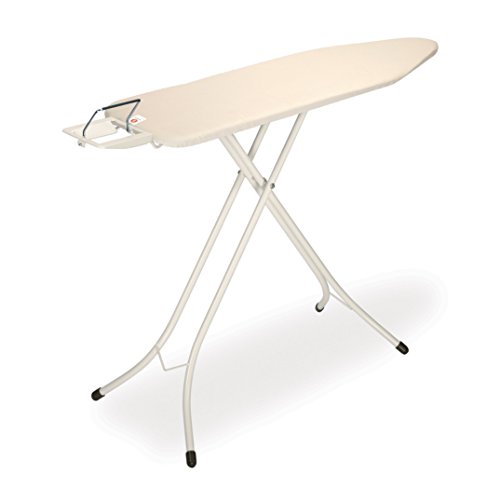
Brabantia Ironing Board
The Brabantia Ironing Board is a premium-tier board known for a sturdy frame, a smooth height action and covers that fit properly, aimed at households that iron often and want the set-up to feel effortless. In daily use, judge it the way you would judge any board in this guide: open it on a flat floor, lock the legs fully, press down near the nose to feel for flex, and run a shirt over the tapered end to see whether the shape suits your routine. Check the cover honestly too, because on this board, as on every board, a thin or tired cover will undo the good work of a decent frame.
Choose this side of the comparison if the board will be a weekly station and you want the comparison with services and steamers to end quickly.
Bartnelli Ironing Board
The Bartnelli Ironing Board is a mid-tier board that leans into a wide, shaped top and a built-in iron rest, popular with people who press a lot of shirts and bedding. In daily use, judge it the way you would judge any board in this guide: open it on a flat floor, lock the legs fully, press down near the nose to feel for flex, and run a shirt over the tapered end to see whether the shape suits your routine. Check the cover honestly too, because on this board, as on every board, a thin or tired cover will undo the good work of a decent frame.
Choose this side if your comparison is really about capacity: bedding and sewing loads that no steamer or tabletop substitute handles gracefully.
Homemaid Living Ironing Board
The Homemaid Living Ironing Board is an entry-to-mid-tier board that keeps the design simple, light to carry and easy to store, suited to smaller homes and lighter weekly loads. In daily use, judge it the way you would judge any board in this guide: open it on a flat floor, lock the legs fully, press down near the nose to feel for flex, and run a shirt over the tapered end to see whether the shape suits your routine. Check the cover honestly too, because on this board, as on every board, a thin or tired cover will undo the good work of a decent frame.
Choose this side if the storage con is your deciding factor and you need the board that asks the least of a small home.
How to Buy Smart
Buying smart means weighting the pros you will actually collect and pre-solving the cons you can predict. List your real weekly load, measure your storage, decide who carries the board, and then shop the stability and cover standards first and the extras last. Check replacement cover availability for any board you shortlist, because that single detail decides whether the cover con stays small for the life of the frame. And treat the safety points as buying criteria, not fine print: a board that locks firmly, stands on a flat floor without rocking, and stores where children cannot pull it over is a better buy than a cleverer board that fails any of those.
Board shape is a quiet decision with daily consequences. The tapered nose exists so that shirts can be pulled over the end, letting you press shoulders, yoke and sleeves without fighting a square corner, and so trousers can be slipped on to press legs one layer at a time. A wider rear section gives you room for bedding, table linen and the broad panels of dresses and coats. Very wide boards feel luxurious with sheets but can be awkward in a narrow room, where you keep catching the edge as you turn. Very narrow boards store beautifully and handle shirts well, then make a duvet cover feel like wrestling a sail in a corridor.
Setup and Care That Reduce the Cons
Technique on the board is mostly about letting the tools work. Glide with the grain of the fabric, use long strokes rather than scrubbing back and forth, lift and place rather than pushing the iron around corners, and give steam a moment to relax fibres before the soleplate flattens them. Work one section fully, then move the garment, rather than skimming the whole piece repeatedly. Stubborn creases usually need moisture and a pause, not more force; force on a board that flexes simply moves the problem. Finish each piece with a few seconds of cooling on the board or straight onto a hanger, because a crease set while the fabric is warm and then disturbed is a crease half wasted.
Care of the board itself is brief but real. Let the cover cool and dry before folding the board away, especially after heavy steaming, so the padding does not stay damp in a closed cupboard. Wipe the top if starch or residue builds up, check the feet for grit that could scratch flooring, and glance at the frame and lock now and then for anything loose or bent. A board stored dry, folded correctly and kept where it will not be knocked over will serve for years; a board stored damp, forced shut or used as a general-purpose table will not, and its decline will show up as wobble, marks and frustration long before it actually breaks.
Padding works as a team with the cover. A felted, heat-reflective padding layer bounces steam and heat back up through the garment, so you effectively press both sides at once and can often skip flipping a shirt to do the reverse. Thin foam padding compresses quickly in the middle, creating a shallow valley where water pools and collars refuse to lie flat. When you handle a board in a shop or read a description closely, look for language about layered padding rather than a single thin sheet, and plan on the cover being a consumable: it wears, it scorches, and it is meant to be replaced long before the frame gives up.
Bottom Line
The pros of an ironing board are about the clothes; the cons are about the house. Households that can give the board a storage home and a flat floor to stand on collect the pros in full and feel the cons lightly. Households that cannot should choose a smaller format or a different tool without regret. That is the whole balance, and everything above is the working-out.
Tabletop boards deserve an honest paragraph of their own. They trade stability for storage, and that trade is sometimes right and sometimes wrong. On a solid table, with a small load of tops and tea towels, a tabletop board is quick, kind to your back in a different way, and tucks into a drawer or hangs inside a cupboard door. But it sits on whatever wobble the table already has, its short surface forces constant repositioning of anything larger than a shirt, and there is no iron rest worth the name, so the hot iron ends up sharing the table edge. Choose a tabletop board for small loads and tight storage, not as a cheaper substitute for full-size pressing.
Working height decides whether ironing is a chore you finish fresh or one you finish with an aching back and shoulders. The right height lets your forearm stay roughly level as the iron glides, so the weight of the iron does the pressing and your shoulder is not shrugging or pushing down on every stroke. Too low and you stoop, and the stoop creeps into your lower back within minutes. Too high and you lift the iron with your shoulder and wrist, which tires the arm and makes the iron tippy at the end of each pass. A board with a wide, easy height range serves a whole household, because the right height for one person is rarely the right height for another.
Adjust the height before you plug anything in, and test it with the motion you will actually use: stand as you would to press a shirt, rest your hand flat on the board, and check that your elbow keeps a comfortable bend. Sitting to iron is a legitimate choice for long sessions, especially when pressing sewing pieces or working through a basket slowly, and a board that lowers far enough for a chair gives you that option. What matters is that the locking mechanism holds the chosen height firmly from the first garment to the last, without the slow sinking that makes you finish the session pressing on a surface that has quietly dropped.
Storage is where many boards lose their owners. A board that is awkward to carry, that pinches fingers when it folds, or that will not stand safely in the cupboard is a board that gets left open in the corner, gathering dust and becoming a shelf for un-ironed laundry, which is the first step toward never ironing at all. Consider where the folded board will live before you buy: a narrow gap beside a wardrobe, a hook inside a utility cupboard, flat under a bed, or standing in a laundry corner. Measure that space in the plain sense of checking it honestly, and picture carrying the board through your own doorways, because the best board for your home is the one you can set up in under a minute without a struggle.
Weight cuts both ways. A heavier frame usually feels steadier in use and less likely to skate across a smooth floor when you pull a heavy sheet toward you. A lighter frame is kinder on stairs, easier for smaller or older users to handle, and more likely to be fetched for a single shirt rather than avoided. There is no virtue in the heaviest board if the person doing the ironing dreads lifting it. The honest question is who will move this board, how far, and how often, and the answer should steer the choice as firmly as any feature list.
Folding mechanisms deserve a close look because they are the moving part you will operate thousands of times. The lever should be reachable without crouching blindly under a hot board, the action should be smooth rather than a sudden collapse, and the legs should fold flat enough that the board stores without springing open in the cupboard. Keep fingers clear of the scissor points of the frame as it closes; most board injuries at home are pinches and collapses during set-up and put-away, not during the pressing itself. A calm, practised fold, done the same way every time, is part of using the tool safely.
Different fabrics ask different things of the board. Cotton and linen reward a firm, well-padded surface and plenty of steam, and they are forgiving of a board with a broad top. Silk, viscose and delicate synthetics ask for a smooth, clean cover above all, because any roughness, residue or scorched patch will show on them or, worse, stick. Dark wool trousers show shine if you press hard on a bouncy board, so steadiness protects the finish. Pleats, whether on a skirt or a curtain heading, need the tapered nose and the patience to let each pleat cool and set before you move on, which a board that stays put makes far easier.
Bedding is the load that exposes every weakness. A duvet cover is heavy, wide and determined to slide off, so you work in sections, keep the bulk of the fabric supported rather than dragging on the floor, and rely on the wide end of the board. Sheets pick up floor dust and pet hair if they trail, so the board becomes a clean island and your technique is about keeping the fabric on it. Table linen adds stains and heirloom fragility to the problem; a clean cover is non-negotiable, because pressing a white tablecloth on a marked cover can set a mark rather than remove a crease.
Shirts are the benchmark garment, and a good board makes their order of work feel natural: collar, yoke, sleeves and cuffs worked over the nose, then the body panels on the broad surface, with the garment rotated rather than the iron forced around corners. When a board is the right height and does not rock, a shirt becomes a rhythm instead of a wrestling match, and that rhythm is what turns a weekly pile into twenty calm minutes. If shirts are your main load, judge every board by how its nose, height range and iron rest serve that rhythm.
A good session starts before the iron is hot. Sort the basket by fabric so you can work from the most delicate items, which need the least heat, up to cotton and linen, which need the most, without constantly adjusting and waiting. Fill the iron, set up the board fully, check the cover is smooth, and put a hanger rail, a chair back or the end of the board to work as a landing zone for finished pieces so they do not crease again in a pile. Pressing a garment beautifully and then dropping it in a heap is the most common way households waste the effort a board makes possible.
Technique on the board is mostly about letting the tools work. Glide with the grain of the fabric, use long strokes rather than scrubbing back and forth, lift and place rather than pushing the iron around corners, and give steam a moment to relax fibres before the soleplate flattens them. Work one section fully, then move the garment, rather than skimming the whole piece repeatedly. Stubborn creases usually need moisture and a pause, not more force; force on a board that flexes simply moves the problem. Finish each piece with a few seconds of cooling on the board or straight onto a hanger, because a crease set while the fabric is warm and then disturbed is a crease half wasted.
Care of the board itself is brief but real. Let the cover cool and dry before folding the board away, especially after heavy steaming, so the padding does not stay damp in a closed cupboard. Wipe the top if starch or residue builds up, check the feet for grit that could scratch flooring, and glance at the frame and lock now and then for anything loose or bent. A board stored dry, folded correctly and kept where it will not be knocked over will serve for years; a board stored damp, forced shut or used as a general-purpose table will not, and its decline will show up as wobble, marks and frustration long before it actually breaks.
The value of a board is measured in garments rescued and minutes saved, not in features. A creased shirt that goes unworn, a dress that stays in the wardrobe because it needs pressing, bedding that looks tired on the bed: these are small daily costs that a decent board quietly removes. Against that, the honest costs of ownership are space, set-up time and the discipline of putting the thing away. Households that iron weekly almost always find the exchange favourable. Households that reach for a steamer for two garments a month may honestly not, and no review should pretend otherwise.
There is also a clothing-care argument that rarely gets made. Garments that are pressed look newer for longer, seams sit where they were made to sit, and you are less tempted to replace a shirt that merely looks tired. Pressing is also an inspection: at the board you notice the loose button, the fraying cuff and the small stain while they are still small problems. A board earns its cupboard space partly as a pressing surface and partly as the place where clothes get looked after properly.
The single most important quality in any board is stability, and it is also the quality that is hardest to judge from a photograph. A board that looks solid in a listing can still rock on its feet the moment you lean into a stubborn crease, and that rocking is not a minor annoyance. A wobbling board under a hot iron is a genuine burn hazard, because your free hand instinctively reaches out to steady the surface while the other hand is holding an iron that is hot enough to scorch fabric and skin alike. Judge stability by the whole system: how widely the legs spread, how firmly the feet grip the floor, how much flex the top shows when you press down near the nose, and whether the height lock holds without creeping during a long session.
Set-up discipline matters as much as build quality. Always open a board on a flat, hard floor rather than on thick carpet where the feet can sink unevenly, and always open the legs fully until the lock engages before you place anything on the top. Never lean your body weight on the nose of the board to reach a far corner; walk around to the other side instead, or slide the garment toward you. Keep the iron in its heel rest position, standing upright on the iron rest or on its heel, whenever your hand leaves it, and route the cord so that a passing foot cannot catch it and pull the iron toward the edge.
Living With the Trade-Offs: A Ironing Board After the First Month
The honest test of any ironing board starts after the novelty fades, when the advantages you bought it for meet the small frictions of ordinary weeks. This section looks at how the balance described earlier plays out in month two and beyond, which drawbacks shrink once you adapt, and which ones grow louder the longer you live with them.
On the plus side, the strengths of a good ironing board compound quietly. Week after week of pressing clothes, linens and sewing projects, the convenience stops registering as a benefit and simply becomes how the household runs, which is the real sign a purchase has landed. The advantage is largest for households whose routine matches the design brief, and smallest for anyone who bought it for an occasional job it happens to do adequately.
The drawbacks, though, have a pattern worth naming: they concentrate at the extremes. The recurring disappointment is a board that rocks because the feet are uneven or the floor is not level. Add the steady upkeep, because washing or replacing the cover before scorch marks transfer, and checking padding wear, and you have the true cost of ownership, which is measured in attention rather than money. None of these cons arrive on day one; they accumulate, which is why short first-impression reviews so rarely mention them.
Weighing the two sides comes down to frequency. If your household hits the strong cases several times a week and the weak cases rarely, the balance is clearly favourable. If your routine leans the other way, the honest answer flips, and a simpler or different design will serve you better. Test your own pattern against the edge case too: large items like duvet covers, which test board width far more than shirts do. How often that happens in your home is the single best predictor of which side wins.
A Final Decision Checklist
- Credit the plus side only where it repeats weekly, starting with whether it suits pressing clothes, linens and sewing projects.
- Debit the minus side honestly: the recurring complaint is a board that rocks because the feet are uneven or the floor is not level.
- Count upkeep as a standing cost, because washing or replacing the cover before scorch marks transfer, and checking padding wear.
- Check the fit claims against your home, since leg style stability on your floor type and the storage space when folded.
- Test the con that matters most, because large items like duvet covers, which test board width far more than shirts do.
- Write down your two most frequent uses and ask which side of the ledger each one lands on.
- Keep packaging and paperwork until the first full week shows whether the cons are liveable.
- Photograph the setup once it works well, so later frustration can be compared with the good baseline.
- Judge compatibility once more before ordering parts or accessories, remembering that leg style stability on your floor type and the storage space when folded.
Frequently Asked Questions
What is the biggest advantage of an ironing board?
The biggest advantage is the combination of a stable, padded, heat-working surface and a proper place for the iron, which together produce a crisper finish in fewer passes than any improvised alternative. Shirts, pleats, bedding and sewing all show the difference immediately, and the garment-care benefit of pressing and inspecting clothes regularly compounds over the life of a wardrobe.
What is the biggest disadvantage?
Storage and set-up friction. A full-size board needs a home, needs carrying, and needs a minute of proper set-up on a flat floor every time. If that friction is high in your home, the board will be avoided and its advantages never collected, which is why this assessment treats storage as a first-order issue rather than a footnote.
Are ironing boards dangerous?
A board used properly is a safe, ordinary household tool. The risks come from misuse: a wobbling board under a hot iron, legs not fully locked, leaning body weight on the nose, a cord trailing where feet catch it, and children climbing or hanging on the frame, which can collapse it. Set up on a flat floor, park the iron on its heel or rest, and fold the board away from children, and the risks are well controlled.
Is a steamer better than an ironing board?
Neither is simply better; they do different work. A steamer is faster for freshening hanging garments and kinder to some delicate pieces. A board and iron are better for crisp shirts, collars, pleats, trousers, bedding and sewing. Many households that care about clothes own the board as the foundation and treat the steamer, if they have one, as the quick assistant.
Do cheap boards have more cons?
Generally yes, in predictable places: thinner covers that print the board pattern through, frames that flex and rock sooner, and height locks that creep during a session. A cheap board used occasionally can still be the right buy, but a cheap board used weekly tends to collect its saving back in frustration, which is why the pros and cons above are weighted by how often you iron.
How do I reduce the cons of a board I already own?
Replace a tired cover, which removes the most common hidden con in one step. Give the board a fixed storage home so set-up friction falls. Iron in sorted batches so the set-up is paid once for many garments. And adopt the safety routine every time: flat floor, legs locked, iron parked properly, board folded away promptly when the session ends.
Related Guides and Next Reads
Keep building your laundry routine with these companion guides from the same programme: our ironing board review, the ironing board reviews roundup, our ironing board buying guide, is an ironing board worth it, our clothes iron review, the clothes iron buying guide, best bed sheet sets for a crisp, pressed finish, closet organisers that keep pressed clothes tidy, blackout curtains worth pressing before you hang them. Each one covers the partner decision to this one, so you can match the iron, the surface and the storage to each other instead of buying each piece in isolation.
A Closer Look in Practice
A Closer Look in Practice
A Closer Look in Practice
A Closer Look in Practice
A Closer Look in Practice
A Closer Look in Practice
Weigh this purchase by how often you actually iron, not by how tidy the board looks folded away. If shirts, uniforms and pressed bedding pass through your laundry every week, the stability, height adjustment and generous surface of a full-size board from Brabantia, Bartnelli or Homemaid Living will repay the storage space it claims. If you press one garment a month, that same footprint becomes the bigger cost. Choose the board whose legs lock firmly, whose cover you will replace when it thins, and whose folded home you have already measured.

