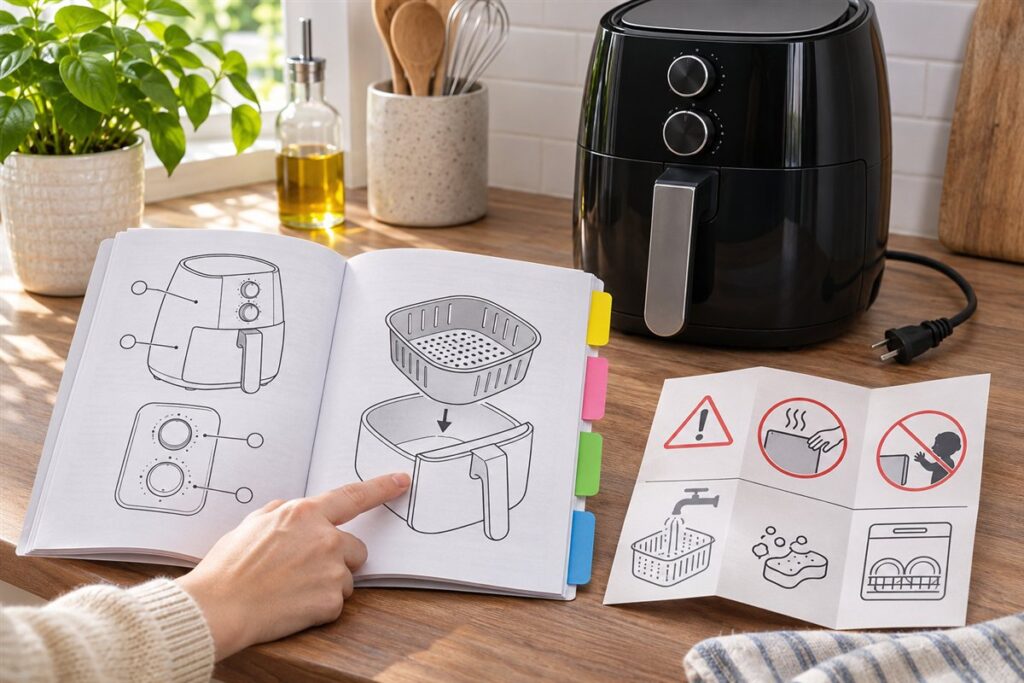
The manual is the most reliable source of information about your own air fryer, yet many people skip it. A few minutes spent reading the right sections can save frustration later. This guide shows which parts to read first and how to find answers when something goes wrong.
Read These Sections First
You do not need to read every page in order. Begin with the parts that affect safe, correct use.
- Important safety instructions, usually near the front.
- The parts diagram, which names each piece of your model.
- Before first use, which often covers washing and a short empty run.
- Control panel explanations, including any presets.
- Cleaning and care, which describes what can be washed and how.
Where to Find Common Answers
| Question | Look for this section |
|---|---|
| Where can I put it? | Placement and clearance notes |
| What can go in the basket? | Accessories and cookware guidance |
| Can I use foil or paper? | Tips or restrictions on liners |
| Why is it smoking? | Troubleshooting table |
| How do I clean it? | Cleaning and maintenance |
| How long can it run? | Timer and operation notes |
Understand the Symbols and Terms
Manuals use symbols, such as warning triangles, and short phrases like “do not immerse.” Learn what each one means, because they mark the points where mistakes are most costly. If a term is unclear, such as “preheat,” “shake,” or “cool-down,” look for a short definition near the front of the booklet or in the control section. Keep a note of anything that confuses you, then check the maker’s support page.
Keep It Handy
A manual is only helpful if you can find it. Store the paper copy in a drawer near the unit, or save a digital copy on your phone or computer. Many makers publish a version online, which you can search for words like “cleaning” or “error code.” Write the model number on the cover, since support teams usually ask for it.
- Photograph the label with the model number and wattage.
- Bookmark the maker’s support page.
- Keep the receipt with the manual.
When you try a new feature, read its section again first. Manuals often hide useful details in small notes, such as which accessories fit, how full the basket can be, or how long to let the unit cool before cleaning. Marking those pages with a sticky note saves time later.
Understanding Warnings and Cautions
The warning pages are the part of a manual most people skim, yet they carry the information that prevents injury and damage. Manuals usually sort notices by seriousness. A warning generally refers to something that could cause harm to a person, while a caution or notice refers to a risk of damaging the appliance or the food. The exact wording varies, so look at how your manual defines each label near the start of the safety section.
Read the warnings with your own kitchen in mind. If one says to keep the unit away from walls, look at where yours sits. If another says not to operate it on a soft surface, check the counter or mat underneath. Warnings about cords, water, and children apply to daily habits, so it helps to picture each one while you read.
- Note any restriction on extension leads or power strips.
- Look for rules about what must never go in the basket.
- Check what the manual says about leaving the unit unattended.
If you do not understand a notice, do not guess. Look for a definition in the manual or ask the maker.
Using the Specifications Page
Near the back of many manuals is a short specifications section with the model number, voltage, power rating, and capacity. This page confirms that you are reading the right manual and that the appliance suits your electricity supply. Compare the model number on the page with the one printed on the rating label of your unit. Makers often publish similar-looking models with slightly different numbers, and instructions can differ.
The same page may list maximum fill levels, temperature range, and timer range. These help you set sensible limits. For example, if a maximum load is stated, follow it. If a temperature range is given, you know the highest setting the unit is designed to use. Some manuals also list the materials of removable parts, which helps when you choose cleaning products.
Take a photo of this page and keep it with your photo of the label. If you contact support, the model number, rating, and purchase date are the first things you will be asked for. Having them ready saves time and avoids confusion if your manual covers more than one model in the same series.
Cooking Charts and Preset Guidance
Most manuals include a cooking chart listing foods with suggested temperatures, times, and amounts. Treat it as a starting point rather than an instruction that guarantees results. Charts are written for a typical load and a typical food, while your food may be thicker, colder, or more tightly packed.
When you try a new food, begin at the lower end of the chart range and check partway through. Make notes in the margin of the manual about what worked for you, such as a minute less for thin cuts or a shake halfway for small pieces. Over time, your annotated chart becomes more useful than the printed one.
- Check the amounts listed, because the time is tied to the quantity.
- Read the notes about shaking, turning, or preheating.
- Use a food thermometer where safe doneness matters, as the manual or food safety guidance suggests.
Preset buttons follow the same logic. They save steps, but they use fixed settings, so look up what each one does in the manual. If a preset gives results that you do not like, switch to manual settings and adjust.
Care Tables and Troubleshooting Sections
The cleaning and troubleshooting parts of the manual are where you will spend time if something goes wrong. Cleaning sections tell you which parts may be washed, which should only be wiped, and which tools to avoid. Follow them closely, since using the wrong method can damage coatings or get water into places it should not be.
Troubleshooting tables are usually organized by symptom, with a likely cause and a suggested action. Search for the sign you see, such as no power, smoke, or an unusual noise, and read the whole row. Often the first suggestion is something simple, such as reseating the basket. Try suggestions in order, and stop if you reach one that tells you to contact the maker.
Error codes are common on digital models. The manual should list them with meanings. Write down the code exactly as it appears before you power the unit off, since the code is useful to the support team. If your manual has no mention of a code you see, check the maker’s website for an updated version of the document. Do not try any procedure that the manual does not describe, such as opening the casing.
Warranty, Registration, and Getting Help
The last pages often include warranty terms and contact details. They are easy to ignore until you need them, so read them when you first set up the appliance. Look for how long the warranty lasts, what it covers, and what voids it. Common exclusions include misuse and unauthorized repair, so it pays to follow the instructions closely.
Check whether registration is available or required, and whether proof of purchase is needed for a claim. Keep the receipt with the manual, or take a photo of it. If the manual lists a support phone number, email, or web form, save it where you can find it later.
When you do contact support, be ready with the model number, the purchase date, and a short description of the issue, along with what you have already tried. Mention any error code and when the problem happens. If the manual does not answer your question, ask the maker directly and note their answer. A clear record makes follow-up easier if the issue continues, and it helps you decide whether service or replacement is the better route.
FAQ
What if my manual is missing?
Search for the model number on the maker’s website, where a digital copy is often available. Use only the version that matches your exact model.
Do the cooking charts apply to every food?
They are general guides. Treat them as a loose first range, then adjust to your food and your own unit.
Which part of the manual should I read first on a new air fryer?
Start with the safety instructions and the before-first-use section, then the parts diagram and cleaning notes. You can come back to the rest as needed.
Why does my manual cover more than one model?
Some makers publish one booklet for a series. Use the model number to find the sections that apply to your unit, and ignore features it does not have.
Can I trust a manual I found on a third-party site?
It is safer to use the version from the maker, matched to your exact model number. Other sources may be out of date or for a different model.
How do I find error codes in the manual?
Look in the troubleshooting section or an index at the back. If the code is not listed, check the maker's support page.
Is the warranty section worth reading?
Yes, because it tells you what is covered and what could void the cover. Read it early and keep the receipt.
What should I write in the manual's margins?
Notes on times and temperatures that suit your food, the date you bought the unit, and any support contact details.
Does the manual explain how to descale or deep clean?
Some do. Check the cleaning and maintenance section, and follow only the methods it describes.
The Short Version
Read the safety section, the parts diagram, first-use steps and cleaning notes first. Learn the symbols, keep the manual where you can find it, and follow it for anything about placement, power or care.