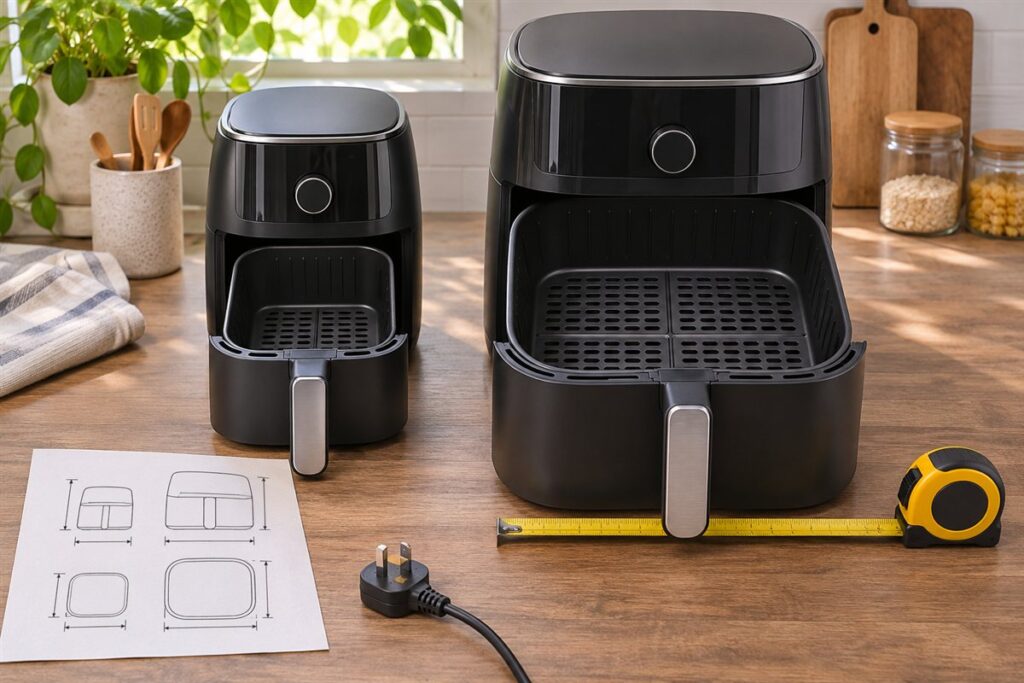
A specification list can look like a wall of numbers, but each line answers a simple question about size, power or control. Once you know what each term means, you can judge whether a model fits your kitchen and your cooking. This guide defines the common terms with examples.
Capacity
Capacity describes the volume of the basket or cooking space, often in quarts or liters. It gives a rough idea of how much food fits at one time, but real results depend on how food is arranged. A pile of fries and a single layer of wings use the basket differently. Some makers also give a portion guide, such as how many people a size suits. Treat that as a loose guide.
Wattage and Power
Wattage shows how much electrical power the unit draws while heating. Higher wattage often goes with larger units, but it does not tell you how well food will cook. It does matter for your home circuits, since using many high-power appliances at once can overload an outlet. Voltage and plug type are also listed, and they must match your local supply.
Temperature Range and Timer
The temperature range tells you the lowest and highest settings. A wide range suits both gentle reheating and high-heat browning. The timer range shows how long you can cook before resetting. Check that both are given in the scale you use, either Celsius or Fahrenheit.
Reference Table
| Spec term | What it means | Why it matters |
|---|---|---|
| Capacity | Basket volume | How much you can cook at once |
| Wattage | Power draw | Circuit use and heating ability |
| Dimensions | Outside height, width, depth | Fit on your counter and cabinet |
| Weight | Mass of the empty unit | Ease of moving and storing |
| Cord length | Reach to an outlet | Placement options |
| Presets | Stored programs | Convenience for common foods |
| Basket material | Surface and coating | Cleaning and care rules |
Reading Between the Lines
Some terms are not strictly defined, so read them carefully. Words such as “family size” or “extra large” differ between makers. Look for measured numbers instead. If a page leaves out a figure, such as cord length or outside size, check the manual or contact the maker. Also look at whether the listed dimensions include handles and vents, since those affect fit.
- Match the unit of measure on every spec.
- Check that the listed capacity refers to the basket, not the whole body.
- Confirm voltage and plug type for your region.
Turning Capacity Into Real Meals
A capacity figure on its own is hard to picture, so translate it into the meals you actually cook. Start by listing your usual portions: a side of fries for two, a whole chicken, a tray of wings for guests, a single reheated slice. Then compare the basket shape to those foods. A tall, narrow basket handles a stack of vegetables but spreads out a batch of wings poorly, while a wide, shallow basket does the opposite.
Remember that air fryers cook best when air can move around the food. A basket that is technically full will give uneven results, so the usable capacity is smaller than the label suggests. If you often cook for more people than the listed portion guide suggests, plan on cooking in rounds or choose a larger basket.
- Check whether the figure is for the basket, the whole cavity, or a combined set of zones.
- Look at the inside depth and width, not only the volume.
- Think about the largest item you will cook and see whether it fits flat.
Dual-basket models split the space, so the capacity of each side may be smaller than the total. Read the listing carefully to see which number applies.
Power Ratings and Your Home Electrics
Wattage is more than a number for comparison. It tells you how much electrical load the appliance places on your outlet and circuit. Air fryers draw a lot of power while heating, and sharing a circuit with a kettle, toaster, or microwave can trip a breaker. Check which outlets in your kitchen share a circuit and avoid running several high-power appliances together.
The rating label on the unit and the spec page should list voltage, frequency, and plug type. These must match what your home supplies. If you move between regions or buy from an overseas seller, confirm compatibility rather than assuming a plug adapter solves the problem. An adapter changes the shape of the plug, not the voltage.
Cord length is another practical detail. A short cord keeps you near the outlet, and manuals often advise against extension leads because of the heavy draw. Think about where the unit will sit and whether an outlet is within reach. If the listing does not give cord length, check the manual or ask the seller. Make sure that the spot you choose also leaves space around the vents.
Controls, Modes, and What They Tell You
The control section of a spec list shows how you will use the machine every day. Dial controls are simple and tend to be quick to set, while digital touch panels can offer more precise settings and stored programs. Neither is better in every case; it depends on what you prefer. Look at whether the display shows temperature and time while cooking, and whether you can adjust them without stopping the unit.
Listings may mention modes such as roast, bake, reheat, or dehydrate. Treat these as shortcuts that use set temperatures and times, and check the manual to see what they do. A unit with fewer modes but a wide, adjustable range can be more flexible than one with many presets.
- Check for a preheat option and whether it is automatic or manual.
- Look for a pause or shake reminder if you want one.
- See whether the unit has an automatic shut-off and what triggers it.
Also consider noise and display brightness if the unit sits in a living area. These are rarely stated precisely, so read the manual and listing details with care.
Build, Materials, and Cleaning Notes
Spec sheets often hide useful information about build quality in short phrases. Look at what the basket and tray are made of and whether there is a coating. Coated surfaces are easy to wipe but can be damaged by metal tools or abrasive pads, so the care instructions matter. Check if the basket and tray are listed as dishwasher safe, and read the exact wording in the manual, since the term can apply to some parts only.
The outside material affects how hot the unit gets and how it looks over time. Glossy finishes show fingerprints, and textured ones hide them. Handles should feel solid, with no wobble, and the basket should slide in and seat firmly.
Weight is a practical measure too. A heavy unit may be stable on the counter but awkward to lift into a cupboard. If you plan to store it between uses, check height against your shelf. Look for details about replacement parts: whether baskets and trays can be bought separately, and whether the maker lists how long parts are supported. These are questions worth asking before you buy, especially for models you plan to use daily.
Questions to Ask Before You Buy
Once you can read the spec list, use it to build a short set of questions. Does the stated capacity match the way I cook? Do the voltage and plug suit my home? Are the dimensions, including handle and vents, right for my counter and cupboard? Does the cooking range include the temperatures I want? Can I clean every removable part easily?
Next, compare the claims to the evidence. If a page uses vague terms but gives no measurements, look for the manual or ask the seller. Be careful with numbers quoted without a unit, or which differ between the product page and the manual. When there is a conflict, the manual is generally the better guide.
- Check the warranty length and what it covers.
- Find out whether support is available in your region.
- Look at what is included in the box, such as racks or trays.
Finally, rank your priorities. Size, ease of cleaning, and controls matter to different people in different ways. Decide which two or three count most, and let those guide your choice instead of trying to chase every figure on the page.
FAQ
Does higher wattage mean better cooking?
Not by itself. Design, airflow and capacity also play a role, so use wattage as one of several clues.
Are presets important?
They are convenient, but manual temperature and time controls cover every food. Choose based on how you like to cook.
Is a bigger air fryer always better?
No. A larger unit takes more counter space and can use more power. Choose a size that suits your usual portions and your storage.
Can I use my air fryer on a power strip?
Many manuals advise plugging into a wall outlet directly because of the high power draw. Check yours before using any extension.
What does dishwasher safe mean for an air fryer?
It usually refers to certain removable parts. Check the manual to see exactly which ones, since the body must never be washed in a dishwasher.
Should I trust capacity labels from different brands equally?
Not necessarily. Makers can measure and describe capacity in different ways, so compare basket dimensions and read how the figure was defined.
Do digital controls make an air fryer better?
They can give more precise settings, but dials are simple and quick. Pick the style you find easier to use.
How do I find out if replacement parts are available?
Check the maker's support page or ask the seller before buying. Look for the part names in the manual.
What should I do if the listing and manual disagree?
Rely on the manual for your exact model, and contact the maker or seller if you need confirmation.
The Short Version
Capacity, wattage, dimensions and temperature range answer the main questions about size, power and control. Compare numbers in matching units, be careful with vague marketing words, and check the manual for anything missing.