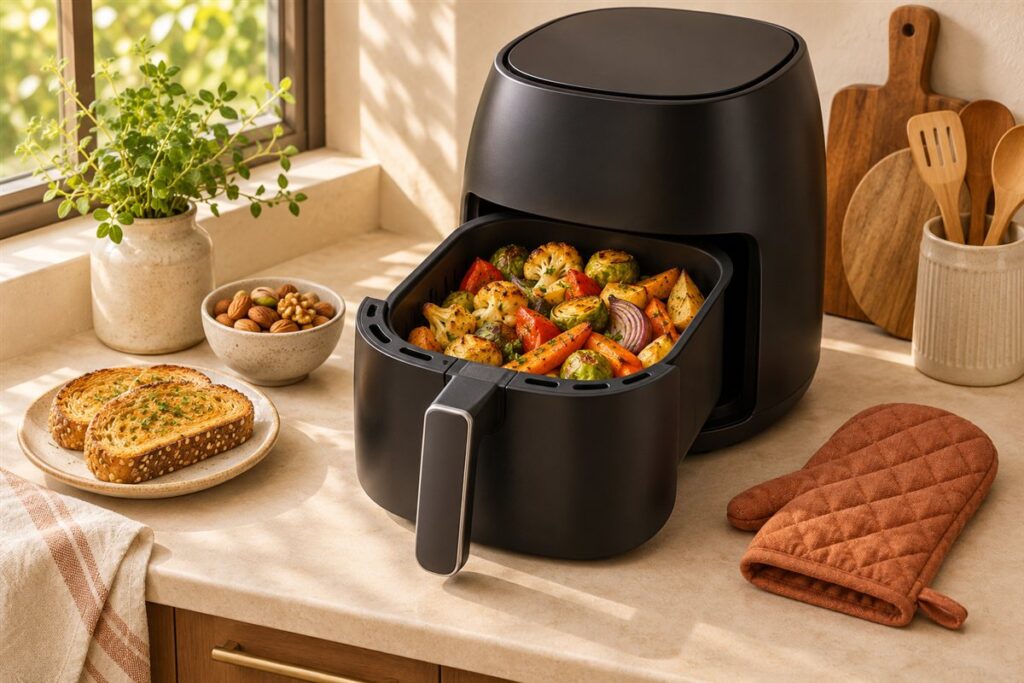
An air fryer can cook eggs in a few different ways, including whole in the shell, baked in ramekins, or set in silicone cups. Timing varies a lot by model and egg size, so treat the numbers below as general guides and adjust as you learn how your machine behaves.
Whole Eggs in the Shell
This method gives a result similar to boiled eggs without a pot of water. Cooks often use a moderate setting of around 250-300 F for about 12-16 minutes, depending on how firm they like the yolk.
- Preheat the air fryer if your manual suggests it.
- Place eggs in the basket in a single layer with a little space between them.
- Cook for the time you chose, then move the eggs to a bowl of ice water.
- Chill for several minutes before peeling.
Be gentle when placing eggs in the basket, because a crack can leak and make a mess. If you hear a pop, stop the machine and let it cool before opening.
Baked Eggs in Ramekins
For a soft, set egg, grease a small heat-safe ramekin, crack an egg inside, and season it. Set the ramekin in the basket and cook at around 300-350 F for roughly 6-10 minutes. Add cheese or herbs near the end if you like.
Make sure the dish fits without touching the heating area, and use ramekins that the maker says are suitable for high heat.
Egg Bites in Silicone Cups
Whisk eggs with a splash of milk, pour into silicone cups, and add fillings such as chopped vegetables or cheese. Cook at a moderate setting for about 8-12 minutes, until the centers look set and no longer wet.
Comparing the Three Methods
| Method | Best for | General time |
|---|---|---|
| In the shell | Snacks, salads, meal prep | About 12-16 minutes |
| Ramekin | Breakfast, single servings | About 6-10 minutes |
| Silicone cups | Batch cooking, fillings | About 8-12 minutes |
Safety and Doneness Notes
Egg dishes should be cooked according to official food-safety guidance, which often calls for firm whites and set yolks or a stated internal temperature. Check that guidance for your region, especially when serving young children, older adults, or anyone with special dietary needs. Keep eggs in the fridge until you cook them, and follow the maker’s manual for the basket and any accessories.
Egg Freshness and Peeling
If you cook eggs in the shell, their age affects how easily they peel. Very fresh eggs have a membrane that clings to the shell, so pieces of white often come away with it. Eggs that have been in the refrigerator for a week or more usually peel more cleanly. If you plan to make a batch for deviled eggs or salads, consider buying them a little ahead of time.
Check eggs before use. Crack any doubtful egg into a separate bowl first, and discard cracked or dirty-looking shells. Store eggs in their carton in the refrigerator, on a shelf rather than the door, where temperature swings are more frequent. Check the date on the carton, and follow local guidance about egg storage, since practices differ between countries.
Starting temperature also changes results. Eggs taken straight from the refrigerator are more likely to crack when they meet hot air than eggs that sat out briefly, though leaving them out for long periods is not recommended for safety. If you want consistent timing, use eggs from the same place each time. Once cooked, an ice-water bath stops the cooking and loosens the shell, making peeling easier. Crack the shell all over by rolling it gently on the counter, then peel under a little running water, starting from the wider end where the air pocket is.
Choosing Ramekins and Molds
For baked eggs and egg bites, the vessel is as important as the egg. Look for containers that are heat-safe in an air fryer and that fit inside your basket with room to spare. Oven-safe ceramic or glass ramekins, metal tins, and silicone cups are common choices. Always check the manufacturer’s guidance, as not every material tolerates direct high heat or sudden temperature changes.
- Ceramic and glass: Heat gently and evenly, keep warm longer, but are heavy and slower to heat. Avoid shocking a hot dish with cold water.
- Metal: Conducts heat quickly, which browns the bottoms faster. Handle with care as it gets hot.
- Silicone: Flexible, easy to release, and light. Place cups on a flat tray or in a rack so they do not tip.
Grease the container lightly so the egg releases cleanly. Size changes the cooking time: a small, shallow dish cooks faster than a deep one. Leave a little headroom, because eggs puff slightly when heated and can overflow. Lift the containers out with tongs or heat-safe gloves, since the sides get hot, and let them rest briefly before eating so the center finishes setting.
Mix-Ins That Work Well
Eggs take on nearly any flavor, so mix-ins are where you can customize. The main rule is to prepare them first, so the egg is the only thing that has to cook. Raw meat, for example, should be cooked before it goes in, and watery vegetables should be sauteed or squeezed dry to avoid weeping.
Good partners include cooked bacon or sausage crumbles, diced ham, sauteed mushrooms, spinach (wilted and squeezed), peppers, onions, tomatoes patted dry, herbs, and grated cheese. Cut pieces small so they distribute evenly and do not make the mixture too heavy. Roughly a spoonful or two per cup of egg is a reasonable starting point, though your container size will decide.
Seasoning should be balanced. Salt, pepper, and a small splash of milk or cream can improve texture, but too much liquid makes the egg watery. Cheeses and cured meats bring their own salt, so taste before adding more. For a custardy result, whisk the eggs thoroughly until uniform. For a fluffier result, whisk more vigorously to incorporate air. Place any topping that browns easily, such as cheese, on top and watch the surface, since the element sits close above.
Doneness Levels and Texture
Egg doneness is a spectrum, and small timing changes make a visible difference. For eggs in the shell, shorter cooking leaves a runny or jammy yolk with a barely set white, medium cooking gives a creamy center, and longer cooking firms the yolk completely. Because machines vary, run a test batch and note the result, then adjust by small increments.
For baked eggs, look at the white and the surface. A set white with a slightly wobbly yolk indicates a soft center. A fully firm surface that does not jiggle means a hard-cooked yolk. The eggs continue to cook from residual heat after you remove them, particularly in hot ceramic dishes, so pull them just before they reach your target.
Overcooked eggs develop a rubbery white and a dry, sometimes grayish-green ring around the yolk. This is harmless but less pleasant. Undercooked texture can be a concern for some groups, such as pregnant people, young children, older adults, and anyone with a weakened immune system, who are often advised to eat eggs cooked until firm. If in doubt, cook longer and follow local food safety guidance. Use a timer, and use an ice bath for shell-on eggs to stop cooking at the right moment.
Storing and Using Cooked Eggs
Cooked eggs are handy for meal prep, but they need careful storage. Cool hard-cooked eggs quickly, and refrigerate them promptly. Unpeeled hard-cooked eggs generally keep for around a week in the refrigerator, while peeled ones should be kept in a covered container and eaten sooner. Egg bites and baked egg dishes should also be cooled and refrigerated in a covered container, and eaten within a few days.
Reheat gently. Egg bites do well with a short warm-up in the air fryer or microwave until hot all the way through, which can take less time than expected, so check often. Hard-cooked eggs can be reheated, but the whites tend to turn rubbery; they are better eaten cold or chopped into other dishes. Shell-on eggs can burst when reheated in a microwave, so never reheat them in the shell.
Use cooked eggs in sandwiches, salads, grain bowls, ramen, fried rice, and breakfast wraps. A batch of egg bites makes an easy grab-and-go breakfast. Label containers with the date, and discard any eggs that smell sulfurous or sour or have a slimy surface. Avoid leaving cooked eggs out at room temperature for long periods, and do not freeze whole hard-cooked eggs, because the whites turn watery and tough.
FAQ
Why did my egg crack in the basket?
Sudden heat and a hard surface can cause cracks. Try a lower setting, handle eggs gently, and place them on a rack or liner if your manual allows it.
Can I cook scrambled eggs?
Yes, in a small greased heat-safe pan set in the basket. Stir once or twice, and expect the cooking time to be short, often only a few minutes.
Do I need to poke a hole in the shell?
It is not required. Some cooks make a tiny pinprick at the wide end to release pressure, but it can also let bacteria in, so many skip it.
How do I stop the eggs from rolling around?
Place them in a small heat-safe ramekin or on a silicone ring, or tuck them between other items so they sit still when the basket moves.
Can I make fried eggs?
Yes, in a greased small pan or mold that fits your basket. Watch the whites, since there is no direct contact heat from below.
Why does the yolk have a green ring?
This is a harmless reaction from overcooking. Shorter cooking and an ice bath help avoid it.
Are eggs in the air fryer safe to eat soft?
It depends on your situation. Many food safety agencies advise firm eggs for higher-risk groups, so cook until fully set if that applies to you.
Can I cook many eggs at once?
Spread them out in a single layer with space around them. Overcrowding can cause uneven results.
What do I do if an egg cracks during cooking?
Let the machine cool, remove the egg, and clean the basket. Cracked eggs that leaked can be eaten if fully cooked, but use judgment and discard any that look unusual.
The Short Version
Air fryers handle shell eggs, ramekin eggs, and silicone cup bites. Use general ranges as a base, adjust for your model, and confirm doneness with food-safety guidance and your maker’s manual.