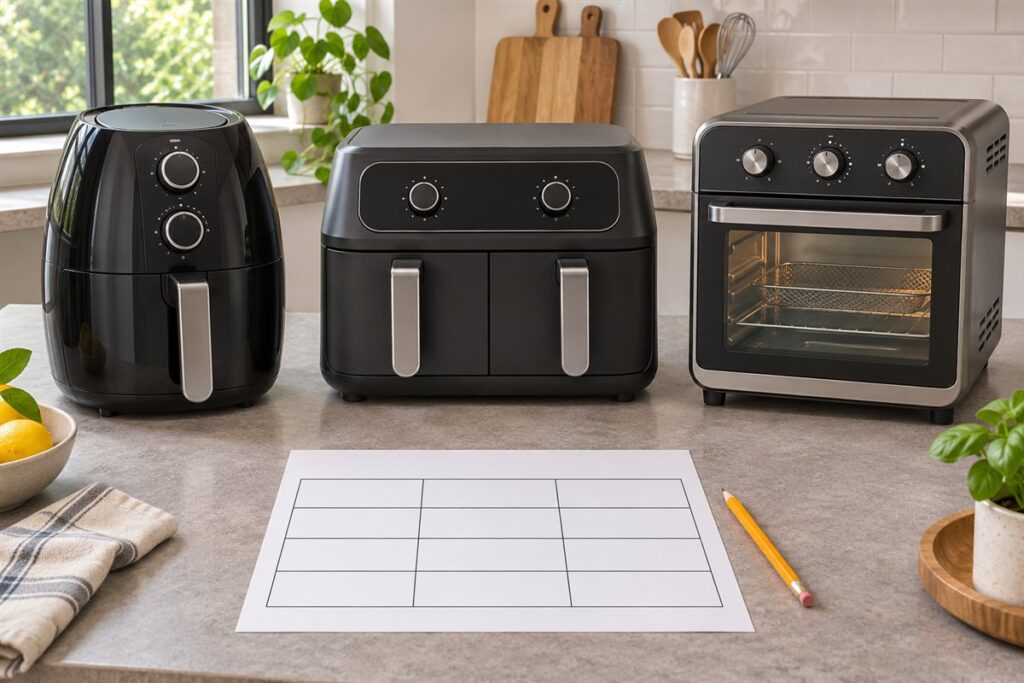
Comparing air fryers is easier when you use the same checklist for each model. Write down the details that matter to you, check them against the maker’s listed specifications, and ignore the rest. This guide gives a simple way to line up two or three models and see which one fits your kitchen.
Step One: Define What You Need
Before you look at any model, decide what you want it to do. Your needs shape every later choice.
- Note how many people you usually cook for.
- List the foods you expect to cook most often.
- Measure the counter and cabinet space available.
- Decide whether you prefer simple dials or digital controls.
- Choose how much effort you will put into cleaning.
Step Two: Build a Comparison Worksheet
Create a simple table with a column for each model and a row for each factor. Fill in the figures from the maker’s specification page, and mark anything you cannot find as unknown.
| Factor | Why it matters | What to look for |
|---|---|---|
| Capacity | Limits batch size | Listed volume and portion guidance |
| Outside size | Must fit your space | Height, width, depth, clearance |
| Wattage | Affects power draw | Number on the label |
| Temperature range | Sets what you can cook | Minimum and maximum settings |
| Cleaning parts | Affects daily effort | Removable basket, coating care notes |
| Included parts | Saves buying extras | Racks, trays, manual |
Step Three: Compare Like With Like
Check that the figures use the same measure. Capacity can be listed in quarts or liters, and sizes in inches or centimeters. Convert if needed, so you do not mix units. Be cautious about claims that cannot be measured, such as “faster” or “more powerful,” unless the page describes how the claim was made.
- Compare capacity with capacity, not with marketing names.
- Compare outside dimensions with your measured space.
- Compare wattage only alongside capacity, since larger units often draw more.
Step Four: Weigh Daily Use
Features that look appealing on paper may not matter in practice. Think about how you will actually use the unit. A clear display, a basket that is easy to remove, and a handle that stays comfortable all affect everyday satisfaction. Read the manual, if it is available online, to see how cleaning and use are described. Pay attention to noise notes and any placement rules, particularly for small kitchens.
Finally, write a one-line verdict for each model, such as “fits my counter, small basket” or “roomy, but needs more clearance.” Seeing the trade-offs in plain words makes the final choice easier, and it keeps you from drifting toward whichever option has the longest feature list.
Reading Capacity Claims Carefully
Capacity figures are the first thing most listings show, but they need interpretation. A number in quarts or liters refers to volume, not the amount of food that fits in a single layer. A tall basket and a wide basket with the same volume cook different amounts. Look for interior dimensions, basket shape and any note on how many servings or pieces the maker suggests.
Keep in mind how you cook. If you mostly make a single portion of fries or a couple of chicken pieces, a smaller basket is fine. If you cook for a family, the usable surface area matters more than the headline number. Imagine arranging food in one layer with gaps, because that is how air fryers work best.
Different makers measure capacity differently, so comparing numbers from two brands can be misleading. Use the dimensions, photos of food in the basket and customer pictures to judge. Also check the maximum fill line, if there is one, and whether the maker states a weight limit. A model that appears large on paper may be cramped if the basket has a divider or a raised center. When comparing, note exterior size too, because a big outside does not always mean a big inside.
Controls and Presets That Actually Matter
Controls shape daily use. Dial models are simple, with a time and temperature knob, and often easy to use with wet or greasy hands. Touch panels can offer precise settings and presets, but some people find them fiddly. Consider who will use the unit and how comfortable they are with each type.
Presets can be handy but are not required. Ask whether a preset is just a time-and-temperature shortcut that you could set manually, or if it changes fan speed or heating pattern. Presets for foods you cook often, such as fries or chicken, can save time, but many appear on the panel and are rarely touched. A wide temperature range and a clear timer are generally more useful than many preset icons.
- Check the temperature range and how finely it can be adjusted.
- See whether the unit pauses when you remove the basket.
- Look for an audible alert or shake reminder.
- Check whether settings are remembered or reset after each use.
Read the manual if the listing offers it, and see how the maker explains the functions. Features that sound good in marketing text may be explained more modestly in the manual.
Build Quality, Coating and Parts Availability
Look past the front panel to the parts that wear. The basket and drawer take the most use, so check how they are made. Read about the type of coating and what the maker says about cleaning. Look for handles that feel secure and a basket that locks in place firmly. The weight of the unit can hint at sturdiness, though it is not a guarantee.
Consider the long term. Ask whether replacement baskets, trays or racks are sold separately. If a coating wears out or a part is lost, being able to replace it can extend the life of the appliance. Check the warranty length and terms, including what is covered and how a claim is made.
Check cord length and position, as a short cord can limit placement. Look at the feet and the base, which should keep the unit stable. Review the vents and the exterior material, and think about how easy it is to wipe clean. When you read customer feedback, look for recurring comments about the same issue rather than single complaints. Patterns across many comments are more informative than a single opinion. Treat all feedback as personal impressions rather than facts.
Running Costs, Noise and Space Needs
Models differ in power draw, noise and footprint. The listing usually states wattage. A higher wattage can mean faster heating, but it also draws more electricity and may require its own outlet. Check your household circuits and avoid sharing an outlet with other heavy appliances.
Noise is harder to compare. Makers seldom provide consistent figures, so use customer comments with caution, remembering that people hear things differently. If you cook in an open-plan space, a quieter unit may matter. Look for comments that describe the sound in the context of daily use.
Measure your counter and cabinet before you compare models. Include clearance for vents, which the manual specifies, and the space needed to open the basket or door. Consider the height under wall cabinets, because hot air rises. Think about where you will store the unit, and how often you will lift it. A heavy or bulky unit that lives in a cupboard may be used less. Choose something that matches your habits, not your best intentions.
Making the Final Decision and Avoiding Regret
After gathering information, narrow the list. Rank your needs: size, controls, cleaning, price tier, warranty and any special features. Drop models that fail a must-have, such as fitting in your space or having a feature you need. Then compare the remaining ones side by side on what you decided matters.
Be wary of paying for features you will not use. Extra functions such as dehydrating, rotisserie or multi-level cooking are valuable if you will use them, and just extra cost and cleaning if you will not. On the other hand, do not skimp on core parts like a basket that suits your cooking.
- Check the return policy so you can send it back if it does not suit.
- Keep the packaging for the first few weeks.
- Test with simple foods first, and read the manual before cooking.
- Note any issues early, while return and warranty windows are open.
Decisions feel easier when you accept that no model is perfect. Pick the one that meets your priorities with reasonable trade-offs, and then focus on learning to use it well.
FAQ
How many models should I compare?
Two or three is plenty. More than that tends to cause confusion and delay.
Do more presets mean a better unit?
Not necessarily. Many cooks use manual settings most of the time, so choose the controls you will actually use.
Is a bigger air fryer always better?
No. A larger unit takes more space and may be harder to clean, so pick a size that fits your usual portions and kitchen.
Should I choose digital or dial controls?
It comes down to preference. Dials are simple and quick, while digital panels offer finer control and presets.
How important is the warranty?
It is worth reading, since it shows what the maker will cover and for how long. Check the terms for parts such as the basket and heating element.
Can I trust customer reviews?
They can highlight recurring issues, but they are individual opinions. Look for patterns across many comments and compare with the listing details.
Do I need an air fryer with a window?
A window can make monitoring easier, but it is not necessary. Many people are happy checking by opening the basket.
Does wattage tell me how well it cooks?
Not by itself. Airflow design, basket shape and settings all play a role.
Are dishwasher-safe parts a must?
They can save time, but hand washing is often gentler for coatings. Check the manual for what the maker recommends.
The Short Version
Define your needs, build a worksheet, compare matching units, and think about daily use. A short, honest checklist beats a long list of features you will never touch.