Disclosure: As an Amazon Associate, airfryerkitchensupply.com earns from qualifying purchases. Links on this page are affiliate links; they cost you nothing extra. Prices and availability change often, so check the current Amazon listing before you buy.
Most chest freezer reviews read like a catalogue, because most chest freezers honestly are similar boxes — and that is exactly why useful chest freezer reviews have to dig at the differences that survive the first month of ownership: how the lid behaves, how the frost builds, how the size feels once it is loaded, and how each brand’s approach suits a particular household. This round-up reviews the category as a field, brand by brand, so you can see where the real choices lie before you fall for the first big box with a tempting badge on it.
Key Takeaways
- The category divides by buying position, not by technology: garage-ready assurance, mainstream all-rounders, value simplicity, compact specialists and wide-range global brands.
- Lid behaviour, gasket quality and basket provision differ more between models than cooling performance does, and they decide daily satisfaction.
- Almost every chest freezer is manual-defrost; treat defrosting as scheduled maintenance, not a flaw.
- Size regret runs both ways — measure your space, your doorway path and your shopping habits before choosing.
- Child safety, lid safety and safe disposal of old units are part of owning this category, not fine print.
Short version: there is no single best chest freezer, only a best match. A garage household in a cold climate, an apartment dweller needing a compact box, and a hunter filling a freezer with a season’s game should buy three different machines, and the reviews below are organised to make that match obvious.
In this guide
How These Chest Freezer Reviews Were Put Together
Each brand review below is built the same way: what the maker actually specialises in, what that means for the chest freezers it sells, who the resulting machines suit, and who should look elsewhere. That restraint is deliberate: a review that admits what it has not verified is worth more than one padded with numbers nobody checked.
The shared ground first. Every pick here is a top-opening, manual-defrost chest freezer with one interior well and at least a basic basket provision in most configurations, sold for home food storage. All of them share the category’s physics: cold air pooled in the well, steady temperatures, excellent outage behaviour when kept closed and reasonably full. They differ in size coverage, control type, garage readiness, locks and lights, warranty culture and dealer footprint — and those differences, dull as they sound, are the ones owners actually live with. The single-model deep dive lives in our chest freezer review; this page is the map of the whole field.
The Field at a Glance
Think of the market in five positions. At the assurance end sit garage-ready and mainstream models from established refrigeration names, bought by households that want the freezer to disappear into their lives for a decade. In the middle, large global manufacturers offer wide size ranges and modern controls at competitive tiers. At the value end, retail brands strip the proposition to its essentials for buyers solving one storage problem cheaply. Alongside them, compact specialists serve small spaces with unusual care, and niche cooling brands cover secondary and portable-adjacent roles. None of these positions is inherently better; each is a bet on what you value, and the reviews below take them one at a time.
GE Garage Ready Chest Freezer
The GE Garage Ready Chest Freezer represents the GE approach to this category: garage-ready positioning and a long appliance heritage. The garage-ready angle is the headline here, and it is a practical one: a freezer that keeps performing when the garage swings from summer heat to winter cold removes the most common reason garage freezers disappoint. For households whose only realistic freezer location is the garage, that design brief matters more than almost any convenience feature, and it is the first thing to weigh with this pick.
Best for: households whose priorities line up with the GE approach described above. Not suited for: buyers whose main need falls outside that approach — if your storage pattern, space, or climate demands something different, another pick in this guide will serve you better. As a tier, treat this model as a mid-to-premium option within the chest freezer category, and check the current Amazon listing for the configuration and details that apply when you are ready to buy.
Living with the GE Garage Ready Chest Freezer day to day follows the pattern its position implies. Expect the category-standard experience — deep stacking, basket access at the top, periodic defrosting — shaped by GE’s priorities. Owners who match the pick to their placement and habits report the boring satisfaction this category is famous for; owners who buy a position that fights their household — a non-garage-ready unit in a freezing garage, a compact box for bulk meat storage — report the opposite, and the mismatch, not the machine, is usually the story.

Frigidaire Chest Freezer
The Frigidaire Chest Freezer represents the Frigidaire approach to this category: a mainstream refrigeration name with wide retail availability. Frigidaire’s strength in this category is the reassurance of a mainstream refrigeration specialist with broad model coverage and a wide service footprint. For buyers who want the chest freezer equivalent of a safe pair of hands — a known name, straightforward controls and none of the uncertainty of an obscure label — this is the natural reference point in the line-up.
Best for: households whose priorities line up with the Frigidaire approach described above. Not suited for: buyers whose main need falls outside that approach — if your storage pattern, space, or climate demands something different, another pick in this guide will serve you better. As a tier, treat this model as a mid-range option within the chest freezer category, and check the current Amazon listing for the configuration and details that apply when you are ready to buy.
Living with the Frigidaire Chest Freezer day to day follows the pattern its position implies. Expect the category-standard experience — deep stacking, basket access at the top, periodic defrosting — shaped by Frigidaire’s priorities. Owners who match the pick to their placement and habits report the boring satisfaction this category is famous for; owners who buy a position that fights their household — a non-garage-ready unit in a freezing garage, a compact box for bulk meat storage — report the opposite, and the mismatch, not the machine, is usually the story.
Insignia Chest Freezer
The Insignia Chest Freezer represents the Insignia approach to this category: a value-focused retail brand aimed at straightforward storage. Insignia’s pitch is simplicity at a value tier: the essential job of keeping food frozen solid, without paying for features a storage freezer does not really need. For a first chest freezer, a rental property, or a second unit dedicated to one job such as game, garden produce or party ice and drinks overflow, that stripped-back value case is genuinely persuasive.
Best for: households whose priorities line up with the Insignia approach described above. Not suited for: buyers whose main need falls outside that approach — if your storage pattern, space, or climate demands something different, another pick in this guide will serve you better. As a tier, treat this model as a entry-level option within the chest freezer category, and check the current Amazon listing for the configuration and details that apply when you are ready to buy.
Living with the Insignia Chest Freezer day to day follows the pattern its position implies. Expect the category-standard experience — deep stacking, basket access at the top, periodic defrosting — shaped by Insignia’s priorities. Owners who match the pick to their placement and habits report the boring satisfaction this category is famous for; owners who buy a position that fights their household — a non-garage-ready unit in a freezing garage, a compact box for bulk meat storage — report the opposite, and the mismatch, not the machine, is usually the story.
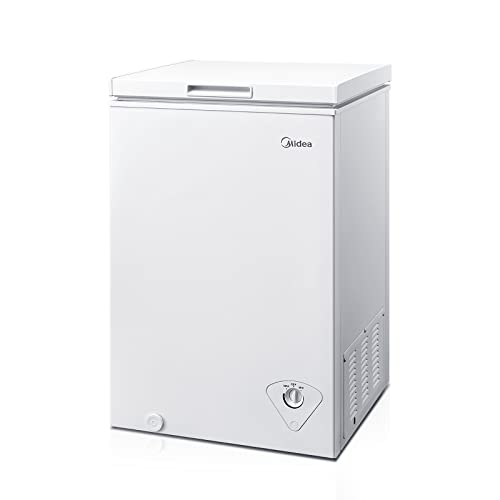
Midea Chest Freezer
The Midea Chest Freezer represents the Midea approach to this category: a large global appliance maker with broad size coverage. Midea brings the scale of one of the world’s largest appliance manufacturers, and in this category that tends to show up as wide size coverage and modern touches filtering down through the range. Buyers who want to fine-tune the size to an exact nook, or who like the idea of a big manufacturer’s parts and support pipeline behind a storage appliance, will find this pick easy to shortlist.
Best for: households whose priorities line up with the Midea approach described above. Not suited for: buyers whose main need falls outside that approach — if your storage pattern, space, or climate demands something different, another pick in this guide will serve you better. As a tier, treat this model as a mid-range option within the chest freezer category, and check the current Amazon listing for the configuration and details that apply when you are ready to buy.
Living with the Midea Chest Freezer day to day follows the pattern its position implies. Expect the category-standard experience — deep stacking, basket access at the top, periodic defrosting — shaped by Midea’s priorities. Owners who match the pick to their placement and habits report the boring satisfaction this category is famous for; owners who buy a position that fights their household — a non-garage-ready unit in a freezing garage, a compact box for bulk meat storage — report the opposite, and the mismatch, not the machine, is usually the story.

Danby Chest Freezer
The Danby Chest Freezer represents the Danby approach to this category: a compact-appliance specialist with a long track record in smaller formats. Danby has built its name on compact appliances, and that heritage suits smaller chest freezers particularly well: apartments, cabins, offices and tight utility rooms are its home turf. If your constraint is floor space rather than budget, and you want a smaller cabinet from a maker that specialises in exactly that format, this is the pick designed around your problem.
Best for: households whose priorities line up with the Danby approach described above. Not suited for: buyers whose main need falls outside that approach — if your storage pattern, space, or climate demands something different, another pick in this guide will serve you better. As a tier, treat this model as a entry-to-mid-range option within the chest freezer category, and check the current Amazon listing for the configuration and details that apply when you are ready to buy.
Living with the Danby Chest Freezer day to day follows the pattern its position implies. Expect the category-standard experience — deep stacking, basket access at the top, periodic defrosting — shaped by Danby’s priorities. Owners who match the pick to their placement and habits report the boring satisfaction this category is famous for; owners who buy a position that fights their household — a non-garage-ready unit in a freezing garage, a compact box for bulk meat storage — report the opposite, and the mismatch, not the machine, is usually the story.

Koolatron Chest Freezer
The Koolatron Chest Freezer represents the Koolatron approach to this category: a brand known for compact and niche cooling products. Koolatron is the niche player in this group, a brand many buyers first meet through compact and portable cooling. In a chest freezer context that makes it an interesting alternative for buyers with unusual spaces or secondary storage jobs, and a reminder to compare the whole market rather than only the biggest household names before deciding.
Best for: households whose priorities line up with the Koolatron approach described above. Not suited for: buyers whose main need falls outside that approach — if your storage pattern, space, or climate demands something different, another pick in this guide will serve you better. As a tier, treat this model as a entry-to-mid-range option within the chest freezer category, and check the current Amazon listing for the configuration and details that apply when you are ready to buy.
Living with the Koolatron Chest Freezer day to day follows the pattern its position implies. Expect the category-standard experience — deep stacking, basket access at the top, periodic defrosting — shaped by Koolatron’s priorities. Owners who match the pick to their placement and habits report the boring satisfaction this category is famous for; owners who buy a position that fights their household — a non-garage-ready unit in a freezing garage, a compact box for bulk meat storage — report the opposite, and the mismatch, not the machine, is usually the story.
What Actually Differs Between Models
Lids, Hinges and Gaskets
Open and close each candidate in your mind a thousand times, because that is what ownership is. A lid that holds itself open at full extension, closes with even gasket compression, and carries a lock if children or a garage setting call for one will be appreciated every single day. A lid that drifts down, a gasket that gaps at the corners, hinges that feel strained by the lid’s weight — these small things compound into frost, effort and annoyance. The second safety habit is about the lid itself. A chest freezer lid is wide, insulated and surprisingly heavy, and on many models it is balanced to stay open only within a certain arc. Lean in carelessly, bump the lid while your head and shoulders are over the opening, or let a child pull at the edge, and that lid can come down hard. Open the lid fully until you feel it settle into its held position before you lean in, keep one hand aware of it while you dig, and never leave the lid propped at a half angle while you walk away to fetch something. Teach everyone in the household, especially taller children and teenagers who will actually use the freezer, to open it fully and close it deliberately rather than letting it drop. A dropped lid is also hard on the hinges and the gasket over time, so the gentle habit protects both people and the appliance.
Controls, Lights and Alarms
Controls range from a simple numbered dial to electronic panels with temperature displays, and the honest assessment is that simple suits this category well: you set a chest freezer cold and leave it alone for months. A display earns its place if the freezer holds high-value contents — a season’s game, expensive meat — where a temperature alarm that warns of a failure can save real money. An interior light sounds trivial until you are digging in a dim garage at night; if your placement is dark, weight it more heavily than reviewers in bright showrooms do.
Baskets, Dividers and the Organisation Question
Living with a chest freezer well is mostly an organisation problem, because everything stacks in one deep well and gravity is not your friend. The households that love their chest freezers almost always use containers: removable baskets for the items they grab weekly, sturdy bins or reusable bags that group food by type, and a simple rule that new purchases go to the bottom while older stock rotates to the top. Freeze food flat in sealed bags wherever you can — flat packages stack like books, thaw faster and waste almost no space compared with bulky odd-shaped parcels. Label everything with contents and the month it went in, because frozen food is remarkably anonymous after a few weeks and mystery packages are the ones that eventually get thrown away. A vacuum sealer pairs naturally with a chest freezer here, since well-sealed flat packs resist freezer burn far longer than loose wrapping. Keep a short inventory list on the lid or on your phone; it takes a minute to update and it stops the classic failure of buying a third bag of something already buried at the bottom.
Basket provision varies more than buyers expect: some models ship with a single basket, others with several, and the difference decides how workable the top layer of the freezer is. When comparing models, count the baskets, check whether extras are available, and picture your weekly items living in them. It is a small specification with an outsized effect on whether the freezer feels organised or archaeological.
Chest Freezer Reviews by Household
The bulk-buying family. Prioritise capacity, a lock, and baskets enough to run a rotation system; any of the mainstream or garage-ready picks serves well, and size honesty matters more than brand. Pair the freezer with vacuum sealer deals worth checking and a labelling habit and the economics of warehouse shopping open up fully.
The gardener, hunter or angler. Steady deep cold and maximum volume are the brief; manual defrost is your friend, and a temperature alarm is worth real money when a season’s work is inside. Look at the larger end of the mainstream and global ranges, and plan the defrost calendar around your seasons.
The apartment or small-home buyer. The compact specialists earn their place here: measure the nook, the doorways and the lid swing, keep expectations matched to a smaller well, and enjoy overflow storage that quietly fixes an overcrowded kitchen freezer. Danby’s and Koolatron’s positions in the field above were built for you.
The garage household in a real climate. Garage readiness is your first filter, before size, before brand. The garage is where many chest freezers live, and it asks more of the appliance than a climate-controlled room does. Summer heat makes the compressor work harder, winter cold in unheated spaces can confuse basic thermostats on models not designed for it, and dust, humidity and the occasional bump from a car or a bike all take their toll. Models marketed as garage ready are built and tested to keep working across a wider range of ambient temperatures, which is exactly the failure mode that catches ordinary freezers in cold snaps, when a too-cold garage can make a standard unit stop cooling properly. If your freezer will live in a garage, a basement with big seasonal swings, or an outbuilding, treat garage readiness as a real feature worth prioritising rather than a marketing extra. Wherever it sits, keep the freezer level, out of direct sun, clear of stored clutter that blocks airflow, and on a surface that can tolerate the weight of a fully loaded cabinet, which is considerable.
Ownership Realities Every Review Should Admit
Most chest freezers are manual-defrost appliances, and that is a deliberate trade rather than a defect. Without a defrost heater cycling on and off, a manual-defrost chest freezer holds a steadier, colder temperature and tends to be gentler on food over long storage, which is one reason chest freezers are favoured for bulk meat and long-haul storage. The cost is an occasional defrosting session: frost builds slowly on the interior walls, and when it grows thick enough to steal meaningful space or stop the lid sealing cleanly, you empty the freezer into coolers or insulated boxes, unplug it, let the ice melt away, wipe the interior dry, and restart it before reloading. Never hack at frost with a knife or metal scraper, which can puncture a line and end the appliance’s life in one slip; warm towels and patience do the job safely. For most households this is a once-or-twice-a-year chore measured in part of an afternoon, and planning it for a low-stock week makes it painless.
Freezing is a pause button, not a steriliser, and honest food safety starts there. Freezing food does not kill most bacteria; it simply stops them multiplying while the food stays properly frozen. That means food that was questionable going in is still questionable coming out, and the clock on safe eating effectively resumes when the food thaws. Keep the freezer cold enough that food stays frozen solid — the widely used guidance is zero degrees Fahrenheit or below — and use a simple appliance thermometer if your model has no display, because dials drift and settings are not temperatures. Thaw food safely: in the refrigerator overnight, under cold running water in a sealed bag, or in the microwave when you will cook it straight away. Never thaw perishable food on the counter at room temperature, and never refreeze raw meat that has fully thawed and sat out. When in doubt about how long something has been frozen or how it was handled, throw it out; no saved portion is worth a bout of food poisoning.
A chest freezer deserves one safety conversation before any other, and it concerns children. A chest freezer is a heavy, insulated box with a lid that closes from the top, and a curious child who climbs inside can become trapped, because the lid is difficult or impossible to push open from within and the sealed interior holds very little air. Never let children climb into, play in, or hide inside a chest freezer, not even for a moment and not even with the lid open while you turn your back. Treat the freezer the way you treat a pool: an appliance that is simply not a play space, ever. If your model offers a lid lock, use it consistently, and keep the key somewhere children cannot reach. When you retire an old freezer, the same hazard follows it to the curb: before any old freezer or refrigerator leaves your control, remove the door or lid entirely, or securely disable the latch, following standard safe-disposal practice, so no child can ever be trapped inside a discarded unit. An empty old freezer with its lid still attached is one of the most dangerous objects a household can set out, and taking two minutes to remove the lid removes the hazard completely.
Placement is an electrical and ventilation decision as much as a floor-space one. A chest freezer needs a properly grounded outlet, and it should not share a circuit that already carries heavy loads if you can avoid it, because a tripped breaker that nobody notices can quietly cost you a freezer full of food. Avoid extension cords for a permanent installation; plug the appliance directly into the wall outlet as the manual directs. Leave the clearance the manufacturer specifies around the cabinet so the compressor and coils can shed heat — a freezer squeezed into a sealed alcove works harder, runs longer and ages faster. Keep the area dry, keep the cord where it cannot be pinched by the cabinet or walked on, and if the freezer ever trips a breaker repeatedly, smells of hot wiring, or shows a damaged cord, stop using it and have it checked rather than resetting and hoping. Finally, never attempt to repair the sealed refrigeration system yourself: the refrigerant circuit is a job for a qualified technician, full stop.
How to Use These Reviews
Start with your placement and your household profile, shortlist two or three picks that match, then work through the chest freezer buying guide for the criteria in depth and chest freezer pros and cons for the honest downside ledger. If the value question is still open, is a chest freezer worth it argues it from the money and the lifestyle both. Check the current listing for the exact configuration you are buying, confirm the dimensions against your measured space and path, and only then commit.
Reviewing the Ownership Experience, Not Just the Box
Freezer Burn, Explained Properly
Freezer burn deserves a clear explanation, because it is widely misunderstood. It is not spoilage and it is not dangerous; it is dehydration — moisture leaving the food’s surface into the dry freezer air, leaving pale, tough, flavourless patches. It happens through packaging, not around the appliance: air left in a bag, a loose wrap, a torn seal, a container opened and reclosed for months. The defences are entirely in your hands — wrap tightly, expel air, seal well, portion sensibly so containers are not reopened endlessly, and eat in rotation so nothing lives at the back for a year. Vacuum sealing is the strongest defence, which is why it appears throughout this cluster; good wrapping discipline is a close second and costs nothing.
Wrapping Materials, Compared Honestly
Wrapping materials are a small decision with a long shadow. Heavy freezer bags with the air pressed out suit most foods and freeze flat beautifully. Rigid containers suit liquids and delicate items, at the cost of air space and stacking efficiency; leave headroom for expansion and fill them as full as that allows. Foil and butcher-style paper wraps serve large joints and whole fish well when applied tightly in double layers. Vacuum sealing outperforms all of them for long storage by removing the air that causes dehydration, and pairs with flat freezing perfectly. The rule that unifies the shelf: whatever you choose, the enemy is trapped air and time — minimise the first and rotate against the second, and quality takes care of itself.
Reading the Sounds Your Freezer Makes
A chest freezer should be a quiet appliance, and its sounds are a useful diagnostic language. The normal vocabulary is a low compressor hum, an occasional click as the control cycles, and soft creaks as the cabinet responds to temperature. New vocabulary deserves attention: a rattle often means the cabinet is not level or something stored against it is vibrating; constant running without cycling off suggests a gasket leak, an overloaded cabinet, blocked ventilation or a room hotter than the unit can handle; a sudden silence in a warm room, with food softening, means check the power, the breaker and the plug before anything else. Most causes are placement and loading, not machinery — which is good news, because those are yours to fix.
Paperwork Worth Keeping
Keep the paperwork the way you keep the inventory: briefly and in one place. The manual tells you your model’s clearances, control behaviour and defrost procedure — the specifics that generic advice cannot. The receipt and a photograph of the data plate settle warranty questions without archaeology. Note the date of each defrost and any service visit on the same page. If the freezer ever misbehaves, that small file turns a vague complaint into a solvable problem, and if you sell the appliance on, it makes you the seller everyone wishes they had bought from.
What Reviewers Notice After a Season of Use
Zoning the Well Like a Warehouse
Zone the well the way a warehouse zones its floor. The baskets are the fast-moving shelf: bread, vegetables in use, the open bags, this week’s proteins. Below them, arrange the well in rough territories — raw meat in one area, prepared meals in another, produce and baking in a third — using bins or sturdy bags as the walls the cabinet does not provide. Keep the oldest stock toward the top of each territory and load new purchases beneath it, so rotation happens by gravity rather than by willpower. Zones feel like over-engineering for exactly one week; by the second month they are the reason you can find anything in under a minute with the lid up and the cold staying where it belongs.
Storing Meat to a Standard
Storing meat well is where a freezer earns its reputation. Portion bulk purchases into meal sizes before freezing, because thawing a family pack to use a third of it wastes the rest’s quality. Wrap tightly with air expelled — vacuum sealing is the benchmark — and freeze portions flat so they stack and thaw evenly. Keep raw meat grouped and contained so nothing can drip onto other food as it freezes or during a thaw mishap, and observe the ordinary hygiene of the kitchen: clean hands and boards, prompt freezing, safe thawing in the refrigerator. Label with the cut and the date; ‘beef, mystery cut’ is a label that helps no one in four months’ time.
Depth Notes From Long-Term Ownership
Temperature Discipline: Trust, but Verify
Temperature discipline is the quiet skill of freezer ownership. Put a simple appliance thermometer in the well and read it weekly for the first month, then whenever you load a large shop or finish a defrost. You are learning your own freezer’s personality: how far the control must sit to hold a true freezing temperature in your room’s conditions, how long recovery takes after a big load, and whether the corners differ from the centre. Once you know that personality, the dial stops being a guess and the food inside stops being a gamble. If the reading ever drifts upward without explanation — a heavy load, a hot room, a long browse with the lid up — find the cause before you trust the contents, and remember that food which has fully thawed and warmed belongs in the bin, not back in the cold.
Freezing Flat: the Technique That Changes Everything
Freezing flat is the single technique that most improves life with this format. Soups, sauces, minced meat, marinades and blanched vegetables all go into sturdy sealed bags, the air pressed out, the bag laid flat to freeze on a tray or the freezer floor. Frozen flat, a bag is a tile: it stacks in neat piles, files upright like a book once solid, thaws in a fraction of the time of a lump, and wastes almost no space. A freezer full of tiles is a freezer you can read at a glance, and reading the freezer at a glance is what turns rotation from a chore into a habit. Keep one tray or flat board as the freezing station, move tiles to their category zone once solid, and the system maintains itself.
The Inventory Habit
An inventory sounds like administration and behaves like money. The simplest version is a notebook or phone note with three columns — what went in, when, and roughly how much — crossed off as things are eaten. The freezer-specific magic is in the eating order it creates: meals get planned from the oldest stock, the bottom layer stops being a surprise, and shopping lists write themselves from the gaps. Households that keep even a rough inventory report the same two discoveries: they waste almost nothing, and they stop buying duplicates of food they already own. Update it when you load and when you cook; thirty seconds each way is the whole cost.
Loading Without Warming the Whole Well
Loading technique matters more than loading speed. Add food in sensible batches rather than one enormous warm load, spread new items so cold air can reach them, and leave the baskets for last so the weekly layer stays on top. Food should go in already cold or at room temperature for raw ingredients being frozen fresh — never hot, which warms its neighbours and makes the compressor labour. Freeze liquids in bags laid flat or containers with headroom, because expansion is real and a split container in a deep well is a miserable clean-up. Once the load is frozen through, consolidate: tiles together, zones restored, inventory updated while your memory of the session is fresh.
The Baker’s Freezer
Bakers quietly get exceptional value from this format. Flour and whole grains keep their freshness far longer frozen, and are protected from pantry pests into the bargain. Butter and nuts, both prone to picking up flavours and turning at room temperature over time, thrive in the freezer’s steady cold. Doughs, par-baked goods, finished cakes and cookie dough portions all freeze predictably, turning a baking day into a month of near-instant results. Wrap baked goods against air with particular care, since their open crumb dehydrates readily, and let the inventory note track what is ready-baked versus what still needs the oven — a distinction that matters at short notice.
Produce: Blanch, Tray, Bag
Garden and market produce rewards a little preparation before it meets the cold. Most vegetables keep their colour, texture and flavour far better when blanched briefly and cooled before freezing, which halts the enzyme activity that otherwise degrades them slowly even at freezer temperatures. Fruit freezes well on trays first, then bagged, so pieces stay separate and pourable. Herbs freeze happily in oil or water in small portions. Spread the work across the harvest rather than facing it all in one weekend, freeze in the portion sizes your cooking actually uses, and label with the variety — the difference between plum and cherry tomatoes matters in February.
Patterns Across Chest Freezer Listings Worth Verifying Yourself
Reading across many chest freezer listings and owner reports, the same patterns surface again and again, and they are more useful than any single verdict. This section gathers those recurring signals, explains what each one usually means in practice, and shows how to verify the important ones against the specific listing you are considering.
Across owner reports on the chest freezer, praise clusters in a predictable place: households whose routine centres on bulk buying, batch cooking and seasonal food storage are consistently the happiest, and their reviews read almost boringly satisfied. Complaints cluster just as predictably around fit, which is why the first pattern to check in any listing is whether it states clearly the facts behind the footprint, lid clearance and the path through doorways the freezer must travel on delivery day. Vague dimensions in a listing correlate with disappointed reviews more than any design flaw does.
The second pattern is the slow complaint. Early reviews glow; the criticisms that arrive months later describe frost building faster than expected because the lid seal is dirty or the freezer is opened in long browsing sessions. When you read reviews, sort mentally by ownership length rather than enthusiasm, and give extra weight to anyone describing the upkeep honestly, because defrosting on a planned day, wiping the seal and keeping an inventory list so food is not buried and forgotten. Reports that mention a model like Frigidaire Chest Freezer holding up after a year of regular use tell you more than a dozen five-line first impressions.
The third pattern is mismatch, not malfunction. Owners who checked compatibility in advance, meaning garage or basement temperatures, outlet access and whether the lid can open fully under low ceilings, rarely report the product failing them, while owners who assumed it would fit their setup supply most of the one-paragraph horror stories. Use reviews, then, as a checklist of things to verify on your chosen listing, and run the edge case early yourself: a power cut, when a full, unopened freezer protects food far longer than a half-empty one that keeps being checked. Verified against your own home, the crowd consensus becomes a reliable guide instead of background noise.
A Final Decision Checklist
- In listings, look first for clear statements behind the footprint, lid clearance and the path through doorways the freezer must travel on delivery day; vagueness here predicts complaints.
- In owner reports, weight long-term posts describing how frost building faster than expected because the lid seal is dirty or the freezer is opened in long browsing sessions developed.
- Treat upkeep reports as data, because defrosting on a planned day, wiping the seal and keeping an inventory list so food is not buried and forgotten is where ownership verdicts are decided.
- Cross-check compatibility claims, since garage or basement temperatures, outlet access and whether the lid can open fully under low ceilings is the mismatch owners report most.
- Verify the edge case yourself rather than trusting reviews, because a power cut, when a full, unopened freezer protects food far longer than a half-empty one that keeps being checked.
- Write down your two most frequent uses and search reviews from owners with the same ones.
- Keep packaging and paperwork until your own first week confirms the consensus.
- Photograph the setup once it works well, so you can compare it with review photographs later.
- Cross-check seasonal differences, since heat, guests and holiday loads test a chest freezer differently from ordinary weeks.
- Cross-check the fit again after a week of real use, when the footprint can be judged against experience rather than hope.
- Verify against listings that the largest regular job, not the largest imaginable one, when judging whether the size is right.
- Search owner reports for the shortlist against your written criteria, not against whichever listing photographs best.
- Search owner reports for the failure signs monthly, so you catch the stage where frost building faster than expected because the lid seal is dirty or the freezer is opened in long browsing sessions is still a five-minute fix.
- Cross-check notes on what worked, in the room where the chest freezer is used, where future-you will actually find them.
- Verify against listings that the upkeep into an existing routine, because defrosting on a planned day only happens reliably when it rides on a habit.
- Verify against listings that every included part against the listing description on arrival day, while an exchange is still painless.
- Note how often owners the edge case on a quiet day first, since a power cut is a poor thing to meet unprepared.
- Note how often owners the person who cleans it most a veto, because their friction decides how long it stays in service.
- Note how often owners sound, weight and effort during normal use, the everyday qualities that decide long-term satisfaction.
- Cross-check instructions photographed on your phone, so troubleshooting never starts with a search through drawers.
Frequently Asked Questions
Which chest freezer brand is most reliable?
Chest freezers are mechanically simple appliances, and reliability in this category tracks build basics — gasket quality, hinge strength, a level installation and proper ventilation — more than badges. Established refrigeration names bring wider service networks, which matters if something does go wrong. The most reliable choice is the well-matched one: a correctly sized, correctly placed freezer from any of the mainstream makers in this round-up, installed by the manual and not overloaded against a wall.
Are garage-ready chest freezers worth choosing?
If the freezer will live somewhere with real temperature swings — an unheated garage in a cold climate, an outbuilding, a basement that bakes in summer — yes: garage-ready models are designed to keep cooling correctly across a wider ambient range, and the classic failure of a standard freezer in a freezing garage is that it quietly stops protecting your food. In a climate-controlled room, the feature adds little and your money is better spent on size or baskets.
How many baskets should a chest freezer come with?
Enough to hold everything you reach for weekly without digging: for most households that means at least one basket in a compact model and two or more in a family-size cabinet. Baskets are the top layer of your organisation system, and models differ here more than buyers expect. Check what is included, whether extras can be bought, and picture your bread, vegetables and open bags living in them before you commit to a model.
Do chest freezers use a lot of electricity?
They run around the clock, so the honest answer is that they use a steady, modest amount rather than a lot. The design helps: thick insulation, a top-opening lid that keeps cold air pooled inside, and no frost-free heater cycles. A freezer kept mostly full runs more efficiently than an empty one, and correct sizing is the biggest lever you control. Check the energy label on the specific model you are considering for its own consumption figure.
What is the difference between these reviews and a single-product review?
This page reviews the field: brands, positions and the differences that matter between models. A single-product review goes deep on one machine’s design, performance and ownership instead. Use this round-up to shortlist, then read deeply on your finalists — this site’s in-depth treatment of the category starts with its chest freezer review, and the buying guide turns the shortlist into a decision with sizing, placement and feature criteria.
When is the best time to buy a chest freezer?
Retail pricing for appliances moves with seasonal promotions, holiday events and model changeovers, and stock of popular sizes can thin out during harvest and hunting seasons and ahead of holidays, when demand peaks. The practical advice is to decide your size and shortlist in advance, then buy when the model you actually want is available at a fair listing — a freezer bought in a rush at the wrong size costs more in regret than any promotion saves.
Related Guides
Keep researching with these guides: the in-depth chest freezer review; the chest freezer buying guide; chest freezer pros and cons; how to choose a chest freezer; the best upright freezers; electric meat grinders for home use.

