Disclosure: As an Amazon Associate, airfryerkitchensupply.com earns from qualifying purchases. Links on this page are affiliate links; they cost you nothing extra. Prices and availability change often, so check the current Amazon listing before you buy.
This chest freezer review is written for the household standing in the garage with a tape measure, wondering whether a deep, top-opening freezer will genuinely change how they shop and cook — or just become a very cold storage box for forgotten food. To answer that properly, this chest freezer review looks at the category the way an owner experiences it: the first setup, the weekly rhythm of loading and digging, the defrost weekend, the power cut, and the quiet economics of buying food when it is cheap and eating it months later. One representative pick anchors the hands-on discussion, with the wider field compared honestly alongside it.
Key Takeaways
- A chest freezer is the most space-efficient, cold-holding way to store frozen food at home, and it suits bulk buying, batch cooking, gardening, hunting and large families best.
- The real costs are floor space, manual defrosting, and the discipline needed to keep a deep cabinet organised.
- Garage placement is common and sensible, but only models designed for wide temperature swings should be trusted in an unheated space.
- Safety is simple but non-negotiable: never let children climb inside, manage the heavy lid carefully, and remove the lid or door before disposing of any old freezer.
- Buy the size your household will keep mostly full, not the largest cabinet that physically fits.
Verdict in brief: if you buy food in bulk, cook ahead, or keep losing the overcrowded freezer compartment battle in your kitchen refrigerator, a chest freezer is one of the most satisfying appliances you can add to a home. If you live alone, move often, or know you will never organise it, the same box becomes an expensive guilt container. The rest of this review explains where the line falls.
In this guide
What a Chest Freezer Is and Where It Fits
A chest freezer is a standalone freezer built as an insulated chest: a deep rectangular cabinet with a hinged lid on top, a compressor below or behind, and one open interior well, usually with one or two removable wire baskets suspended near the top. There are no shelves and no door bins, and that simplicity is the whole point. The design maximises usable volume per inch of floor space, because almost nothing inside is given over to shelving structures, and it maximises cold retention, because the cold air sits in the well like water in a bathtub instead of pouring out when you open it.
In the home, a chest freezer plays the role of long-term storage. Your refrigerator’s freezer is the working drawer — this week’s meals, the open bag of peas, the ice cream in rotation. The chest freezer is the warehouse behind it: the bulk packs, the batch-cooked sauces, the garden glut, the holiday bird bought early, the bread from the good bakery across town. Households that shop at warehouse clubs, buy meat in quantity, garden seriously, hunt or fish, or cook for a crowd will fill one almost without trying. Households that buy fresh every few days and rarely freeze anything beyond ice and leftovers will not, and for them the honest advice in this review is that the category itself, not any particular model, is the wrong purchase.
Sizes run from compact cabinets suited to an apartment corner up to large family models that anchor a garage wall, and the buying decision is mostly about matching that scale to your household, which the sizing section below covers in detail. Almost all chest freezers are manual-defrost, most have a simple dial or electronic control, a drain for defrost water on many models, and little else — and that austerity is a feature, because there is very little to break. the best upright freezers take the opposite approach, trading some efficiency and capacity for shelved, upright access, and the comparison matters enough that this site covers it in a dedicated head-to-head guide.
Chest Freezer Review: Design, Build and Setup
Build quality in this category shows up in unglamorous places. The lid should close with a soft, even compression of the gasket all the way around, because that seal is what keeps cold in and frost out; a gasket that kinks, gaps at the corners or feels loose will grow frost faster and run the compressor harder. Hinges should hold the lid open hands-free at full extension — you will load this freezer with both arms full of frozen food, and a lid that needs propping is a daily irritation and a safety issue. The interior liner should feel smooth and tough rather than thin and flexy, the baskets should slide without rattling out of their rails, and the whole cabinet should sit level and solid, with adjustable feet on many models to settle it on an uneven garage floor.
Setup is genuinely simple, which is part of the category’s appeal. Let the freezer stand upright for several hours after delivery before switching it on if it travelled on its side, so the compressor oil settles back where it belongs. Position it with the ventilation clearance the manual specifies, level it, plug it directly into a grounded wall outlet, set the control to a mid position, and let it pull down to freezing temperature before loading it — adding a full load of room-temperature food to a warm cabinet makes the compressor work hard and warms everything unevenly. Load in stages if you are filling it from scratch, and from day one, load it the way you intend to live with it: baskets for weekly items, flat packs below, labels on everything.
The second safety habit is about the lid itself. A chest freezer lid is wide, insulated and surprisingly heavy, and on many models it is balanced to stay open only within a certain arc. Lean in carelessly, bump the lid while your head and shoulders are over the opening, or let a child pull at the edge, and that lid can come down hard. Open the lid fully until you feel it settle into its held position before you lean in, keep one hand aware of it while you dig, and never leave the lid propped at a half angle while you walk away to fetch something. Teach everyone in the household, especially taller children and teenagers who will actually use the freezer, to open it fully and close it deliberately rather than letting it drop. A dropped lid is also hard on the hinges and the gasket over time, so the gentle habit protects both people and the appliance.
Placement is an electrical and ventilation decision as much as a floor-space one. A chest freezer needs a properly grounded outlet, and it should not share a circuit that already carries heavy loads if you can avoid it, because a tripped breaker that nobody notices can quietly cost you a freezer full of food. Avoid extension cords for a permanent installation; plug the appliance directly into the wall outlet as the manual directs. Leave the clearance the manufacturer specifies around the cabinet so the compressor and coils can shed heat — a freezer squeezed into a sealed alcove works harder, runs longer and ages faster. Keep the area dry, keep the cord where it cannot be pinched by the cabinet or walked on, and if the freezer ever trips a breaker repeatedly, smells of hot wiring, or shows a damaged cord, stop using it and have it checked rather than resetting and hoping. Finally, never attempt to repair the sealed refrigeration system yourself: the refrigerant circuit is a job for a qualified technician, full stop.
Performance in Real Use
Bulk Buying and Warehouse Runs
This is the chest freezer’s home fixture. A warehouse-club run that would defeat a refrigerator freezer — family packs of chicken, a case of butter, bags of frozen fruit, a month of bread — disappears into a chest freezer with room to spare, and the savings from buying at bulk prices rather than weekly small-pack prices are the core economic argument for owning one. The freezer rewards a simple system: break bulk packs down into meal-size portions at home, seal them flat, label them, and file them by category. A chamber vacuum sealers explained or a good external sealer earns its keep here, because vacuum-sealed flat packs are the difference between a freezer that works like a filing cabinet and one that works like a ball pit.
Batch Cooking and Meal Preparation
For batch cookers, the chest freezer converts one big cooking session into weeks of easy weeknight meals. Soups, stews, sauces, casseroles and marinated proteins all freeze well in flat bags or stacked containers, and the chest format swallows a serious batch without the tetris of a shelved freezer. The performance detail that matters is freezing speed and steadiness: a manual-defrost chest freezer holds a consistently cold environment without the temperature cycling of frost-free designs, which is kind to texture and to long storage. Freeze portions flat and fully cooled, leave a little headroom in containers for expansion, and your future self gets dinner at the cost of moving a bag to the refrigerator the night before.
Gardens, Game and Seasonal Gluts
Gardeners and hunters ask the hardest questions of a freezer: a harvest or a successful season arrives all at once, in volume, and must stay in good condition for many months. This is where the chest freezer’s steady cold and sheer volume outperform everything else in a home. Blanch and freeze vegetables properly, wrap game and fish tightly with as little air as possible, and the deep, stable cold does the rest. Households processing their own meat often pair the freezer with electric meat grinders for home use, grinding, portioning and freezing in one workflow. The one discipline that decides success is rotation: even well-wrapped food slowly loses quality, so eat in the order things went in, and let the inventory list, not optimism, plan the meals.
Power Cuts and Everyday Reliability
Chest freezers have a genuine physics advantage that is easy to understand. Cold air is dense and sinks, so when you lift the lid of a chest freezer, most of the cold air stays pooled inside the cabinet instead of spilling out onto the floor the way it does when an upright door swings open. The compressor therefore replaces less lost cold after each opening, and the thick insulation and top-opening design help the cabinet hold temperature through short power interruptions far better than most people expect, provided the lid stays shut. That same behaviour is why a chest freezer is forgiving during an outage: keep it closed, and a full freezer holds safe temperatures much longer than a half-empty one, because the frozen food itself acts as thermal mass. None of this makes a chest freezer free to run — it is still a compressor appliance running around the clock — but per unit of storage it is generally among the more efficient ways to keep food frozen, especially in larger sizes.
In daily use, reliability in this category is refreshingly boring. There are no ice makers to jam, no water lines to leak, no fans circulating air between compartments. A chest freezer that is level, ventilated, kept reasonably full and defrosted when the frost demands it will typically just run, quietly, for years. The sounds to know are the compressor’s hum and the occasional click of the control; the sounds that deserve attention are new rattles, constant running that never cycles off, or a cabinet that feels warm along its walls while the interior softens — each is a prompt to check the gasket, the loading and the ventilation first, and to call a technician if the basics are fine.
Strengths and Trade-Offs
Strengths
- Maximum storage volume for the floor space and the money, with almost no interior wasted on shelving.
- Excellent cold retention: cold air stays in the well when the lid opens, and a full cabinet rides out short power cuts well.
- Steady, deep cold from manual defrost suits long-term storage of meat, game and batch cooking.
- Simple, durable design with very few features to fail, and typically quiet running.
Trade-offs
- Everything is stacked in one deep well, so organisation is a system you must maintain, not a feature you buy.
- Manual defrosting is a real chore once or twice a year, and frost slowly steals space between sessions.
- The footprint is wide rather than tall, the lid needs clear space to open, and a full cabinet is very heavy.
- Bending and reaching to the bottom is genuinely awkward for some users, especially with heavy items.
How It Compares
Against an upright freezer, the chest format wins on capacity per footprint, cold retention and running efficiency, and loses on access and organisation — the full head-to-head is in our chest freezer vs upright freezer comparison. Against a second refrigerator or a fridge-freezer, a dedicated chest freezer stores far more frozen food per inch and holds a steadier freezing temperature, at the cost of doing nothing else. Against the premium garage-ready end of its own category, a basic chest freezer gives up wide-temperature resilience and small conveniences such as locks, interior lights and alarms, which matter exactly in proportion to how harsh your placement is and how valuable the contents are. Within the category, the six picks below span the main buying positions, from value simplicity to garage-ready assurance.
GE Garage Ready Chest Freezer
The GE Garage Ready Chest Freezer represents the GE approach to this category: garage-ready positioning and a long appliance heritage. The garage-ready angle is the headline here, and it is a practical one: a freezer that keeps performing when the garage swings from summer heat to winter cold removes the most common reason garage freezers disappoint. For households whose only realistic freezer location is the garage, that design brief matters more than almost any convenience feature, and it is the first thing to weigh with this pick.
Best for: households whose priorities line up with the GE approach described above. Not suited for: buyers whose main need falls outside that approach — if your storage pattern, space, or climate demands something different, another pick in this guide will serve you better. As a tier, treat this model as a mid-to-premium option within the chest freezer category, and check the current Amazon listing for the configuration and details that apply when you are ready to buy.

Frigidaire Chest Freezer
The Frigidaire Chest Freezer represents the Frigidaire approach to this category: a mainstream refrigeration name with wide retail availability. Frigidaire’s strength in this category is the reassurance of a mainstream refrigeration specialist with broad model coverage and a wide service footprint. For buyers who want the chest freezer equivalent of a safe pair of hands — a known name, straightforward controls and none of the uncertainty of an obscure label — this is the natural reference point in the line-up.
Best for: households whose priorities line up with the Frigidaire approach described above. Not suited for: buyers whose main need falls outside that approach — if your storage pattern, space, or climate demands something different, another pick in this guide will serve you better. As a tier, treat this model as a mid-range option within the chest freezer category, and check the current Amazon listing for the configuration and details that apply when you are ready to buy.
Insignia Chest Freezer
The Insignia Chest Freezer represents the Insignia approach to this category: a value-focused retail brand aimed at straightforward storage. Insignia’s pitch is simplicity at a value tier: the essential job of keeping food frozen solid, without paying for features a storage freezer does not really need. For a first chest freezer, a rental property, or a second unit dedicated to one job such as game, garden produce or party ice and drinks overflow, that stripped-back value case is genuinely persuasive.
Best for: households whose priorities line up with the Insignia approach described above. Not suited for: buyers whose main need falls outside that approach — if your storage pattern, space, or climate demands something different, another pick in this guide will serve you better. As a tier, treat this model as a entry-level option within the chest freezer category, and check the current Amazon listing for the configuration and details that apply when you are ready to buy.
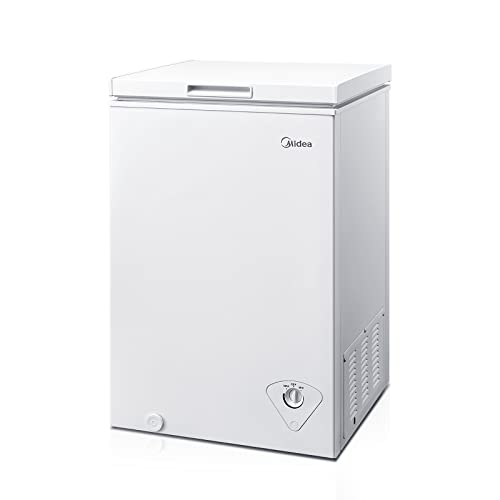
Midea Chest Freezer
The Midea Chest Freezer represents the Midea approach to this category: a large global appliance maker with broad size coverage. Midea brings the scale of one of the world’s largest appliance manufacturers, and in this category that tends to show up as wide size coverage and modern touches filtering down through the range. Buyers who want to fine-tune the size to an exact nook, or who like the idea of a big manufacturer’s parts and support pipeline behind a storage appliance, will find this pick easy to shortlist.
Best for: households whose priorities line up with the Midea approach described above. Not suited for: buyers whose main need falls outside that approach — if your storage pattern, space, or climate demands something different, another pick in this guide will serve you better. As a tier, treat this model as a mid-range option within the chest freezer category, and check the current Amazon listing for the configuration and details that apply when you are ready to buy.

Danby Chest Freezer
The Danby Chest Freezer represents the Danby approach to this category: a compact-appliance specialist with a long track record in smaller formats. Danby has built its name on compact appliances, and that heritage suits smaller chest freezers particularly well: apartments, cabins, offices and tight utility rooms are its home turf. If your constraint is floor space rather than budget, and you want a smaller cabinet from a maker that specialises in exactly that format, this is the pick designed around your problem.
Best for: households whose priorities line up with the Danby approach described above. Not suited for: buyers whose main need falls outside that approach — if your storage pattern, space, or climate demands something different, another pick in this guide will serve you better. As a tier, treat this model as a entry-to-mid-range option within the chest freezer category, and check the current Amazon listing for the configuration and details that apply when you are ready to buy.

Koolatron Chest Freezer
The Koolatron Chest Freezer represents the Koolatron approach to this category: a brand known for compact and niche cooling products. Koolatron is the niche player in this group, a brand many buyers first meet through compact and portable cooling. In a chest freezer context that makes it an interesting alternative for buyers with unusual spaces or secondary storage jobs, and a reminder to compare the whole market rather than only the biggest household names before deciding.
Best for: households whose priorities line up with the Koolatron approach described above. Not suited for: buyers whose main need falls outside that approach — if your storage pattern, space, or climate demands something different, another pick in this guide will serve you better. As a tier, treat this model as a entry-to-mid-range option within the chest freezer category, and check the current Amazon listing for the configuration and details that apply when you are ready to buy.
Who Should Buy It, and Who Should Skip It
Buy a chest freezer if you recognise your household in these lines: you shop in bulk at least monthly; you cook in batches or want to start; you garden, hunt, fish or buy meat in quantity; your refrigerator freezer is a weekly source of frustration; and you have a garage, basement or utility space with a grounded outlet and room for the lid to open. Buy with confidence in the size that matches your habits — most regret in this category is buying too small, then too large, in that order.
Skip it, or at least pause, if you live alone and eat mostly fresh, if your home has no honest place for a wide cabinet with lid clearance, if bending deep into a chest is physically difficult for the person who will use it most, or if you know the organisation system will last a fortnight. In those cases an upright model, covered in upright freezers for small kitchens, or simply a better-organised refrigerator freezer, will serve you better. The buying questions are worked through step by step in how to choose a chest freezer, and the value case is argued in full in is a chest freezer worth it.
Sizing a chest freezer starts with honesty about how you shop and eat, not with the biggest cabinet that fits. A widely used planning rule is to allow roughly one to one and a half cubic feet of freezer space per person for modest overflow storage, and more — sometimes considerably more — for households that buy meat in bulk, receive a share of a farm animal, garden heavily, hunt, fish, or batch-cook for the freezer. Then check the arithmetic against your real habits: a household that buys a few extra bags of vegetables and the occasional tray of chicken needs far less than a household storing half a steer. Physical fit matters just as much: measure the space, then measure the path — doorways, hall turns, stairwell clearances — because a chest freezer is a rigid box that must travel that whole route, and confirm the lid can open fully under your ceiling or shelving. Bigger is not automatically better: an oversized half-empty freezer wastes energy keeping air cold and tempts you to lose food in its depths, while a well-matched size that runs mostly full is efficient and easy to manage.
Setup, Care and Maintenance Essentials
Living with a chest freezer well is mostly an organisation problem, because everything stacks in one deep well and gravity is not your friend. The households that love their chest freezers almost always use containers: removable baskets for the items they grab weekly, sturdy bins or reusable bags that group food by type, and a simple rule that new purchases go to the bottom while older stock rotates to the top. Freeze food flat in sealed bags wherever you can — flat packages stack like books, thaw faster and waste almost no space compared with bulky odd-shaped parcels. Label everything with contents and the month it went in, because frozen food is remarkably anonymous after a few weeks and mystery packages are the ones that eventually get thrown away. A vacuum sealer pairs naturally with a chest freezer here, since well-sealed flat packs resist freezer burn far longer than loose wrapping. Keep a short inventory list on the lid or on your phone; it takes a minute to update and it stops the classic failure of buying a third bag of something already buried at the bottom.
Most chest freezers are manual-defrost appliances, and that is a deliberate trade rather than a defect. Without a defrost heater cycling on and off, a manual-defrost chest freezer holds a steadier, colder temperature and tends to be gentler on food over long storage, which is one reason chest freezers are favoured for bulk meat and long-haul storage. The cost is an occasional defrosting session: frost builds slowly on the interior walls, and when it grows thick enough to steal meaningful space or stop the lid sealing cleanly, you empty the freezer into coolers or insulated boxes, unplug it, let the ice melt away, wipe the interior dry, and restart it before reloading. Never hack at frost with a knife or metal scraper, which can puncture a line and end the appliance’s life in one slip; warm towels and patience do the job safely. For most households this is a once-or-twice-a-year chore measured in part of an afternoon, and planning it for a low-stock week makes it painless.
Freezing is a pause button, not a steriliser, and honest food safety starts there. Freezing food does not kill most bacteria; it simply stops them multiplying while the food stays properly frozen. That means food that was questionable going in is still questionable coming out, and the clock on safe eating effectively resumes when the food thaws. Keep the freezer cold enough that food stays frozen solid — the widely used guidance is zero degrees Fahrenheit or below — and use a simple appliance thermometer if your model has no display, because dials drift and settings are not temperatures. Thaw food safely: in the refrigerator overnight, under cold running water in a sealed bag, or in the microwave when you will cook it straight away. Never thaw perishable food on the counter at room temperature, and never refreeze raw meat that has fully thawed and sat out. When in doubt about how long something has been frozen or how it was handled, throw it out; no saved portion is worth a bout of food poisoning.
A chest freezer deserves one safety conversation before any other, and it concerns children. A chest freezer is a heavy, insulated box with a lid that closes from the top, and a curious child who climbs inside can become trapped, because the lid is difficult or impossible to push open from within and the sealed interior holds very little air. Never let children climb into, play in, or hide inside a chest freezer, not even for a moment and not even with the lid open while you turn your back. Treat the freezer the way you treat a pool: an appliance that is simply not a play space, ever. If your model offers a lid lock, use it consistently, and keep the key somewhere children cannot reach. When you retire an old freezer, the same hazard follows it to the curb: before any old freezer or refrigerator leaves your control, remove the door or lid entirely, or securely disable the latch, following standard safe-disposal practice, so no child can ever be trapped inside a discarded unit. An empty old freezer with its lid still attached is one of the most dangerous objects a household can set out, and taking two minutes to remove the lid removes the hazard completely.
The garage is where many chest freezers live, and it asks more of the appliance than a climate-controlled room does. Summer heat makes the compressor work harder, winter cold in unheated spaces can confuse basic thermostats on models not designed for it, and dust, humidity and the occasional bump from a car or a bike all take their toll. Models marketed as garage ready are built and tested to keep working across a wider range of ambient temperatures, which is exactly the failure mode that catches ordinary freezers in cold snaps, when a too-cold garage can make a standard unit stop cooling properly. If your freezer will live in a garage, a basement with big seasonal swings, or an outbuilding, treat garage readiness as a real feature worth prioritising rather than a marketing extra. Wherever it sits, keep the freezer level, out of direct sun, clear of stored clutter that blocks airflow, and on a surface that can tolerate the weight of a fully loaded cabinet, which is considerable.
Final Verdict
A chest freezer is not a glamorous appliance, and this review’s honest conclusion is that its virtues are the unglamorous ones: space, steadiness, simplicity and savings that compound quietly every week you shop with it in mind. It asks for floor space, a defrost now and then, and a labelling habit, and in return it changes a household’s relationship with food — buying well becomes easy, waste drops, and the question of what is for dinner gains a well-stocked answer. If your household fits the profile above, it is one of the easiest appliance recommendations in the kitchen. Compare the wider field in chest freezer reviews and the structured picks in our chest freezer buying guide before you decide.
Going Deeper: Ownership Skills That Decide Satisfaction
Temperature Discipline: Trust, but Verify
Temperature discipline is the quiet skill of freezer ownership. Put a simple appliance thermometer in the well and read it weekly for the first month, then whenever you load a large shop or finish a defrost. You are learning your own freezer’s personality: how far the control must sit to hold a true freezing temperature in your room’s conditions, how long recovery takes after a big load, and whether the corners differ from the centre. Once you know that personality, the dial stops being a guess and the food inside stops being a gamble. If the reading ever drifts upward without explanation — a heavy load, a hot room, a long browse with the lid up — find the cause before you trust the contents, and remember that food which has fully thawed and warmed belongs in the bin, not back in the cold.
Freezing Flat: the Technique That Changes Everything
Freezing flat is the single technique that most improves life with this format. Soups, sauces, minced meat, marinades and blanched vegetables all go into sturdy sealed bags, the air pressed out, the bag laid flat to freeze on a tray or the freezer floor. Frozen flat, a bag is a tile: it stacks in neat piles, files upright like a book once solid, thaws in a fraction of the time of a lump, and wastes almost no space. A freezer full of tiles is a freezer you can read at a glance, and reading the freezer at a glance is what turns rotation from a chore into a habit. Keep one tray or flat board as the freezing station, move tiles to their category zone once solid, and the system maintains itself.
The Power-Cut Playbook
Every freezer owner should have an outage playbook before they need one. Rule one: do not open the lid — a closed, reasonably full freezer holds safe temperatures far longer than intuition suggests, and every look inside spends that reserve. Rule two: group food together and cover the cabinet with blankets for extra insulation if an outage stretches, keeping vents clear of fabric while it runs again afterwards. Rule three: when power returns, judge food by temperature and condition, not by hope — perishables that fully thawed and warmed are discarded, food still icy or properly cold can be cooked or refrozen according to its type. Rule four: afterwards, note what the freezer taught you; a mostly full cabinet and a household that kept the lid shut will have very little to throw away.
Small Habits, Large Returns
Labelling: Thirty Seconds That Save Meals
Labelling is a thirty-second habit that decides whether frozen food becomes meals or mysteries. Every package gets three facts: what it is, the portion, and the month it went in. Masking tape and a marker beat every app for speed at the freezer side, though the inventory note can live wherever you like. Be specific in the way your future tired self needs: not ‘sauce’ but which sauce and how many it feeds. Frozen food is astonishingly anonymous — identical pale blocks of soup, stock, sauce and smoothie base have humbled every household that skipped the label — and the cost of the habit is so small that refusing it is the most expensive economy in this entire subject.
Systems in Practice
The Inventory Habit
An inventory sounds like administration and behaves like money. The simplest version is a notebook or phone note with three columns — what went in, when, and roughly how much — crossed off as things are eaten. The freezer-specific magic is in the eating order it creates: meals get planned from the oldest stock, the bottom layer stops being a surprise, and shopping lists write themselves from the gaps. Households that keep even a rough inventory report the same two discoveries: they waste almost nothing, and they stop buying duplicates of food they already own. Update it when you load and when you cook; thirty seconds each way is the whole cost.
Zoning the Well Like a Warehouse
Zone the well the way a warehouse zones its floor. The baskets are the fast-moving shelf: bread, vegetables in use, the open bags, this week’s proteins. Below them, arrange the well in rough territories — raw meat in one area, prepared meals in another, produce and baking in a third — using bins or sturdy bags as the walls the cabinet does not provide. Keep the oldest stock toward the top of each territory and load new purchases beneath it, so rotation happens by gravity rather than by willpower. Zones feel like over-engineering for exactly one week; by the second month they are the reason you can find anything in under a minute with the lid up and the cold staying where it belongs.
Storing Meat to a Standard
Storing meat well is where a freezer earns its reputation. Portion bulk purchases into meal sizes before freezing, because thawing a family pack to use a third of it wastes the rest’s quality. Wrap tightly with air expelled — vacuum sealing is the benchmark — and freeze portions flat so they stack and thaw evenly. Keep raw meat grouped and contained so nothing can drip onto other food as it freezes or during a thaw mishap, and observe the ordinary hygiene of the kitchen: clean hands and boards, prompt freezing, safe thawing in the refrigerator. Label with the cut and the date; ‘beef, mystery cut’ is a label that helps no one in four months’ time.
What Careful Checking Reveals About a Chest Freezer
A careful review of a chest freezer is less about first impressions and more about repeatable checks anyone can run at home. This section sets out the hands-on routine that separates a good example from a disappointing one: what to inspect on arrival, what to test in the first week, and which small observations predict how it will behave a year from now.
Our checking routine for a chest freezer starts before first use, at the unboxing. Inspect seams, edges, moving parts and connections, then confirm the basics the listing promised, especially the footprint, lid clearance and the path through doorways the freezer must travel on delivery day. A model such as GE Garage Ready Chest Freezer should arrive matching its description in every checkable detail; small mismatches here, a substituted accessory or a vague specification, are the earliest warning that a listing deserves scepticism.
In the first week, test the job the chest freezer exists for, namely bulk buying, batch cooking and seasonal food storage, under ordinary conditions rather than a staged best case. Note effort, noise, stability and how much clean-up follows, and repeat the same task twice more, because first attempts flatter some designs and unfairly punish others while technique is still new. Compatibility shows up here as well: garage or basement temperatures, outlet access and whether the lid can open fully under low ceilings. Anything that needs a workaround in week one will need it forever.
The longer signals are about decline. Watch for the category failure mode, since frost building faster than expected because the lid seal is dirty or the freezer is opened in long browsing sessions. Check how realistic the upkeep feels in practice, because defrosting on a planned day, wiping the seal and keeping an inventory list so food is not buried and forgotten. And deliberately run the edge case, a power cut, when a full, unopened freezer protects food far longer than a half-empty one that keeps being checked, while you can still exchange the product easily. A chest freezer that passes the arrival inspection, the repeated ordinary task and the edge case has earned a confident verdict; one that needs excuses in any of the three has told you what ownership will feel like.
A Final Decision Checklist
- On arrival, inspect and record: confirm the footprint, lid clearance and the path through doorways the freezer must travel on delivery day against the listing description.
- In the first task, test the real job, bulk buying, batch cooking and seasonal food storage, under ordinary conditions, twice.
- Note any workaround needed, since garage or basement temperatures, outlet access and whether the lid can open fully under low ceilings should hold without one.
- Watch early for the known weak point, because frost building faster than expected because the lid seal is dirty or the freezer is opened in long browsing sessions.
- Log the upkeep as you actually do it, because defrosting on a planned day, wiping the seal and keeping an inventory list so food is not buried and forgotten.
- Run the edge case inside the return window: a power cut, when a full, unopened freezer protects food far longer than a half-empty one that keeps being checked.
- Keep packaging and paperwork until the first full week of testing has passed.
- Photograph the setup once it works well, so later checks compare like with like.
- Test seasonal differences, since heat, guests and holiday loads test a chest freezer differently from ordinary weeks.
- Measure and record the upkeep into an existing routine, because defrosting on a planned day only happens reliably when it rides on a habit.
- Inspect compatibility once more before ordering parts or accessories, remembering that garage or basement temperatures.
- Inspect the storage spot honestly: if putting it away is awkward, the chest freezer will slowly stop being used.
Frequently Asked Questions
How cold should a chest freezer be?
Keep food frozen solid at zero degrees Fahrenheit or below, which is the widely used food-safety guidance for home freezers. If your model has no temperature display, an inexpensive appliance thermometer left inside gives you the truth at a glance. Check it after loading a big shop, after a defrost, and whenever food feels softer than it should, because dial settings are positions, not temperatures.
How often does a chest freezer need defrosting?
For most households, once or twice a year is typical, but the real trigger is the frost itself: when the build-up is thick enough to steal noticeable space, stop the lid sealing cleanly, or make baskets sit unevenly, it is time. Plan the job for a low-stock week, move food to coolers, unplug, let the ice melt without scraping at it with metal tools, dry the interior thoroughly, and restart the freezer before reloading it.
Can a chest freezer live in an unheated garage?
Yes, with a condition: in garages that get properly cold, choose a model designed and rated for garage use, because a standard freezer’s thermostat can behave badly when the room is colder than the setting it expects. In mild climates a standard model in a shaded, ventilated garage spot is usually fine. Either way, keep it level, out of direct sun, clear of clutter that blocks airflow, and plugged directly into a grounded outlet.
What should never go in a chest freezer?
Skip anything carbonated in sealed cans or bottles, which can burst as it expands; glass containers filled to the brim, which can crack; and foods whose texture freezing ruins for your purposes, such as salad leaves, raw eggs in their shells, and soft cheeses you plan to serve fresh. Also never store dry ice loosely in a sealed chest freezer or use the freezer as a step, a seat, or — critically — a hiding place for children during games.
How long will food keep in a chest freezer?
Freezing keeps food safe for very long periods when it stays frozen solid, but quality is the real limit: texture, flavour and moisture slowly decline, and fatty foods decline fastest. Well-wrapped portions eaten in rotation over the following months will taste as they should; the same food found after a very long burial usually disappoints rather than endangers. Labels with dates, and eating in the order food went in, are what turn long storage into good meals instead of archaeology.
Is a chest freezer expensive to run?
It is a compressor appliance running around the clock, so it is not free, but the design is inherently efficient: thick insulation, a top-opening lid that keeps cold air pooled inside, and no frost-free heating cycles. A mostly full freezer also runs more efficiently than a mostly empty one, because the frozen food itself holds the cold. Choosing the size you will actually keep full is the single biggest running-cost decision you control.
Related Guides
Keep researching with these guides: chest freezer reviews: the wider field compared; the chest freezer buying guide; how to choose a chest freezer step by step; chest freezer vs upright freezer; the best upright freezers; vacuum sealer deals worth checking.

