Disclosure: airfryerkitchensupply.com is reader-supported. When you buy through links on our site, we may earn an affiliate commission at no extra cost to you.
Where to buy
The fastest way to compare the best workbench chairs in this guide is on Amazon, where each verified listing shows its current options and availability. Every chair and stool below was verified — most of them in a fresh verification run for this guide — and each is described only with what its listing title actually states: capacity, height range, seat material and features. Where a listing does not state a detail, the spec box in its review says “Not stated” rather than guessing. Use the Check on Amazon links beside each pick to reach the exact listing we verified, and check the current price on Amazon there, since we never print static prices that can go stale.
Key Takeaways
- A workbench chair is not an office chair: bench height runs higher, so match the stool’s seat height range to your bench top before anything else.
- Capacity is stated on the best listings — the verified picks here carry stated capacities from 300 to 330 pounds — treat a missing capacity as a question to answer on the listing, not a detail to assume.
- Backrest or backless is the big fork: backrests suit long assembly and inspection sessions; backless stools win for constant on-off work and tight shops.
- Wheels and swivel earn their keep at a bench, letting you roll along a long workpiece instead of standing and re-sitting all day.
- PVC and PU leather seats wipe clean of grease, glue and dust; fabric seats do not belong in a workshop.
Shopping for the best workbench chairs starts with a measurement most buyers skip: the height of the bench itself. A standard workbench top sits around 34 to 36 inches high, well above desk height, so an ordinary office chair leaves you hunched below your work or perched with your feet dangling. Workbench seating — shop stools, drafting-height chairs and mechanic’s stools — is built taller, usually with an adjustable range, a foot ring or footrest to support your legs, and a seat covering that tolerates a workshop: PVC, PU leather or faux leather that wipes clean instead of absorbing oil and dust. The other difference is movement. Bench work is mobile work. You slide from the vise to the parts tray to the far end of a glue-up, which is why swivel and casters, luxury features in an office, are core features here.
The six picks below were verified against Amazon’s catalog for this guide, and they cover the real shapes of bench seating: a padded backrest shop stool as the all-rounder, a name-brand hydraulic stool with a precisely stated height range, a drafting chair with a full backrest for long seated sessions, a thick-cushioned drafting stool, a rolling mechanic’s stool with built-in tool trays, and a backless two-pack for shops that seat more than one person. Every capacity and dimension quoted comes straight from the verified listing title. If a specification you need — say, the exact seat diameter — is not stated there, the review tells you it is not stated, and the buying guide explains how to check it on the listing before you order.
In this guide
Quick Picks
- Best Overall: FreekyFit Shop Stool with Backrest — a padded, height-adjustable workbench stool with a 300 lb stated capacity and 360° swivel PVC seat. Check the current price on Amazon
- Best Heavy-Duty Hydraulic: WORKPRO Heavy Duty Adjustable Hydraulic Shop Stool — 29 in to 33.86 in height range and a 330-pound stated capacity from a tools-first brand. Check the current price on Amazon
- Best Full Backrest: Brick Attic Drafting Chair with Backrest — PU leather swivel stool with an adjustable foot rest and wheels, shaped for longer seated work. Check the current price on Amazon
- Best Drafting Height: SUPERJARE Drafting Chair with Backrest — a rolling stool with adjustable foot rest and a thick seat cushion for bench and counter work. Check the current price on Amazon
- Best with Tool Storage: BestGlory Rolling Shop Stool with Wheels — a mechanic’s stool with backrest and a double storage tray that keeps tools under the seat. Check the current price on Amazon
- Best Backless Pair: TRINITY Heavy Duty 30 Inch Backless Swivel Bar Stool, Set of 2 — chrome-finish, faux leather stools the listing places in garages and workshops. Check the current price on Amazon
How These Picks Were Chosen
We verified candidates in a single fresh run for this guide, searching the exact language buyers use — workbench chair, shop stool with backrest — and then re-confirming each chosen listing. To be linked here, a seat had to be genuinely intended for bench-height work: a shop stool, drafting chair or mechanic’s stool, not a dining chair or a standard office chair wearing workshop language. We then checked what each listing title states about the things that decide a bench seat: height or height range, weight capacity, seat material, backrest, swivel, wheels and foot support. Listings that stated a capacity earned trust over listings that hid it; where capacity is not stated, the review flags it plainly.
The final six were picked for coverage across real workshop habits. Some people sit for two hours wiring a control panel and need a backrest and a foot ring. Some hop on and off a stool forty times an hour and need backless simplicity and a seat that spins out of the way. Mechanics need a tray; multi-bench shops need two stools, not one precious chair. We also applied the workshop-materials rule throughout: every pick’s seat is a wipe-clean surface — PVC, PU leather or faux leather as stated in its listing — because a workbench chair upholstered like a sofa is a chair that will look ruined by spring. Prices are never printed; the budget discussion in the buying guide works in tiers, and the listing itself is where you check the current price on Amazon.
The 6 Best Workbench Chairs

FreekyFit Shop Stool with Backrest — Best Overall
The FreekyFit is the stool that fits the widest range of benches and bodies, which is what “best overall” has to mean in a workshop. Its verified listing describes a mechanic and garage stool for the workshop: height adjustable, padded, with a backrest, a stated 300 lb capacity, a 360° swivel and a PVC seat, in black. Each of those details answers a real bench problem. The backrest covers long sessions — assembly, soldering, inspection — where a backless stool slowly folds you in half. The PVC seat is the correct workshop surface: sawdust brushes off, grease wipes off, and nothing absorbs into foam through a torn fabric cover, because there is no fabric. The stated capacity, printed right in the title, is the kind of honesty we reward; you do not have to dig through a description to learn whether the stool is built for you.
Strengths
- Stated 300 lb capacity and 360° swivel in the listing title — no spec hunting required.
- Padded PVC seat wipes clean of workshop grime and resists tearing better than thin vinyl.
- Backrest plus height adjustment covers both long seated tasks and quick perch-and-work jobs.
Trade-offs
- The listing title does not state the exact height range, so confirm the range on the listing against your bench height before ordering.
- A backrest stool takes more floor space than a backless stool in a tight shop.
- No tool tray or storage is stated; mechanics who want under-seat storage should look at the BestGlory.
| Spec | Verified from listing title |
|---|---|
| Capacity | 300 lbs |
| Seat | Padded PVC, 360° swivel |
| Backrest | Yes |
| Height adjustment | Adjustable (range not stated) |
| Wheels | Not stated |
| Color | Black |
In practice, this is the stool for a general-purpose bench where the work changes daily: woodworking on Monday, small-engine repair on Wednesday, electronics on Friday. The swivel lets you turn from bench to tool chest without standing; the backrest makes the second hour of a wiring job materially less tiring than the second hour on a backless perch. If your bench is unusually tall — some stand at 38 inches or more — do the one check the title leaves open and confirm the seat’s top height on the listing page; your thighs should sit roughly level or slightly above your knees with your feet supported, a point the buying guide below covers in detail.
Best for: most home workshops wanting one padded, backrest shop stool that suits mixed bench work. / Not suited for: buyers who need a stated tool tray, or a verified extra-tall height range without checking the listing.
Check the current price on Amazon

WORKPRO Heavy Duty Adjustable Hydraulic Shop Stool — Best Heavy-Duty Hydraulic
WORKPRO sells tools, and its shop stool reads like it was specced by people who publish numbers: the verified listing states a hydraulic height range of 29 inches to 33.86 inches and a 330-pound capacity, in black. That height range is the headline. A seat that tops out near 34 inches pairs correctly with standard 34–36 inch benches, putting your elbows at bench level instead of below it, and the hydraulic lift means adjustment is a lever pull rather than a spin-and-pray threaded post. The 330-pound stated capacity is the highest among the backless and compact picks here, and it signals a frame and lift cylinder built with margin — the quality that decides whether a shop stool still glides in year five.
Strengths
- Precisely stated height range (29 in to 33.86 in) — the easiest bench-matching math in this guide.
- 330-pound stated capacity, the strongest figure among the compact stools here.
- Hydraulic adjustment is fast and repeatable when several people share one bench.
Trade-offs
- No backrest is stated; long seated sessions will tire your back sooner than on the FreekyFit or Brick Attic.
- The listing title does not state the seat material, so check the listing if wipe-clean surfacing is a must for your shop.
- Hydraulic lifts are a wear component; treat the capacity limit as a real limit, not a suggestion.
| Spec | Verified from listing title |
|---|---|
| Height range | 29 in to 33.86 in, hydraulic |
| Capacity | 330 lb |
| Backrest | Not stated |
| Seat material | Not stated |
| Color | Black |
Choose the WORKPRO when the bench is shared — a household shop, a maker space corner, a garage where a teenager and a parent both work — because hydraulic height adjustment is the difference between a stool everyone sets correctly and a stool everyone leaves at the wrong height. It is also the natural pick for heavier users who have learned to read capacity figures first and styling second. Pair it with a bench at standard height and it disappears into the work, which is the highest compliment shop furniture can earn.
Best for: shared benches, heavier users, and anyone who wants a stated height range and capacity from a tool brand. / Not suited for: long-session workers who need a backrest, or buyers who require a stated seat material upfront.
Check the current price on Amazon

Brick Attic Drafting Chair with Backrest — Best Full Backrest
Some bench work is really desk work at bench height: programming, design, inspection under a lamp, long electronics sessions. The Brick Attic drafting chair is shaped for exactly that. Its verified listing describes a drafting chair with a backrest, an adjustable foot rest, a rolling design with wheels, a PU leather swivel seat, and a stated use list that runs from office and studio to lab, counter, salon, home work and shop. The drafting format — taller lift, foot rest to keep your legs supported at height, full backrest — is the most chair-like option in this guide, and for sessions measured in hours rather than minutes, that format wins.
Strengths
- Full backrest plus adjustable foot rest: the most supportive long-session setup here.
- PU leather seat wipes clean, unlike the fabric drafting chairs sold for offices.
- Wheels and swivel suit long benches where you travel along the work.
Trade-offs
- The listing title does not state a weight capacity or a height range; verify both on the listing for your body and bench.
- A wheeled chair on a smooth shop floor can drift when you push against the bench; technique and floor surface matter.
- Its studio-and-office styling is less at home in a gritty metal shop than the pure stools.
| Spec | Verified from listing title |
|---|---|
| Backrest | Yes, drafting-chair style |
| Foot support | Adjustable foot rest |
| Seat | PU leather, swivel |
| Wheels | Yes, rolling |
| Capacity | Not stated |
| Height range | Not stated |
The honest framing: this is the pick for the bench that doubles as a workstation — the electronics bench, the design-and-prototype bench, the jeweler’s or modeler’s bench — where you sit down and stay sat. The foot rest is not a detail; at drafting height, unsupported feet dangle, circulation suffers and you start shifting every few minutes, which quietly ruins fine work. If your shop time is mostly standing with short seated intervals, the simpler stools serve you better and cost you less floor space. If your shop time is a chair with occasional standing, start here.
Best for: long seated bench sessions — electronics, inspection, design and studio work at bench height. / Not suited for: buyers who need a stated capacity in the title, or mostly-standing work with quick sits.
Check the current price on Amazon
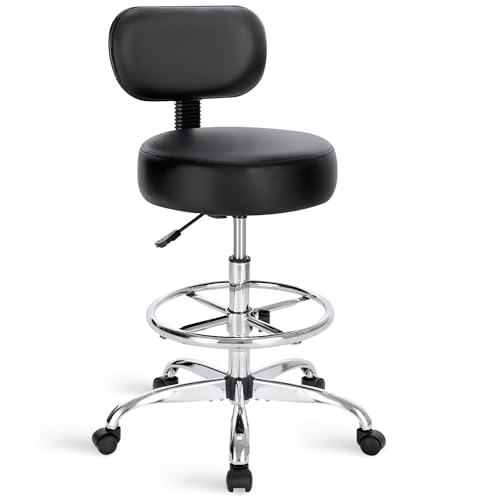
SUPERJARE Drafting Chair with Backrest — Best Drafting Height
The SUPERJARE takes the drafting format and emphasizes the seat itself: its verified listing highlights a thick seat cushion, an adjustable foot rest, a backrest and a rolling design, and it names its territory plainly — multi-purpose shop stool and drafting stool for the home bar, kitchen counter and bench-height work generally. The thick cushion is the differentiator worth pausing on. Thin stool pads are fine for ten minutes; across a long afternoon of assembly, seat padding thickness is the difference between finishing the job and finishing it standing up because sitting became the uncomfortable option.
Strengths
- Thick seat cushion, stated in the listing — the comfort feature long sessions actually feel.
- Backrest and adjustable foot rest complete the drafting-height ergonomic trio.
- Rolling, swiveling format travels along counters and benches.
Trade-offs
- Capacity and exact height range are not stated in the title; check the listing page before ordering.
- Thick cushions compress over years of use; it is a wear item in a way a hard stool seat is not.
- Less purely “shop” in intent than the mechanic stools — no tray, no stated heavy-duty framing.
| Spec | Verified from listing title |
|---|---|
| Seat | Thick seat cushion |
| Backrest | Yes |
| Foot support | Adjustable foot rest |
| Wheels | Yes, rolling |
| Capacity | Not stated |
| Height range | Not stated |
Put the SUPERJARE where the bench meets the household: the craft bench, the kitchen-counter worktop that hosts homework and laptop repairs alike, the studio desk at standing height. It is the friendliest-looking pick here and the one a family is least likely to banish to the garage. Workshop purists who need stated capacities and trays have better options above and below; comfort-first sitters who work at height have found their chair.
Best for: comfort-first users at drafting-height benches and counters who sit for long stretches. / Not suited for: buyers who require stated capacity figures, or mechanics wanting tool storage.
Check the current price on Amazon

BestGlory Rolling Shop Stool with Wheels — Best with Tool Storage
Mechanics lose more time to walking for tools than to almost anything else, and the BestGlory attacks that problem directly: its verified listing describes a rolling shop stool with wheels, adjustable height, a heavy-duty build, a backrest, and a double storage tray — two trays riding under the seat, sized for the sockets, drivers and parts that migrate across a garage floor during any real job. The listing places it across workshop, kitchen and salon use, in blue. A double tray matters more than it sounds: one tray for the tools of the current job, one for the fasteners and parts coming off the machine, kept separate instead of mingled in a single bin.
Strengths
- Double storage tray stated in the listing — the only pick here that carries your tools with you.
- Backrest plus wheels plus height adjustment: the full mechanic’s stool checklist.
- Heavy-duty positioning in the listing suits garage and workshop duty.
Trade-offs
- The listing title does not state a numeric capacity or seat material; verify on the listing page.
- Trays add width at knee height; in a very tight bay, a plain stool threads gaps more easily.
- Rolling stools and sloped or debris-covered floors are a poor mix; sweep the bay first.
| Spec | Verified from listing title |
|---|---|
| Storage | Double storage tray |
| Backrest | Yes |
| Wheels | Yes, rolling |
| Height adjustment | Adjustable (range not stated) |
| Capacity | Not stated |
| Color | Blue |
If your bench work is actually vehicle work — brakes, oil, under-dash wiring — this is the pick shaped like your day: sit low-ish, roll the length of the car, keep the 10mm socket where you left it. The backrest earns its place during the diagnostic pauses, and the trays turn the stool into a small mobile workstation. Buyers at a fixed woodworking bench will use the trays less; buyers under a car will wonder how they worked without them.
Best for: mechanics and garage workers who roll along a job and want tools and parts riding with them. / Not suited for: fixed-bench users who do not need storage, or anyone requiring a stated numeric capacity upfront.
Check the current price on Amazon

TRINITY Heavy Duty 30 Inch Backless Swivel Bar Stool, Set of 2 — Best Backless Pair
Sometimes the right answer is two simple stools. The TRINITY listing describes a set of two heavy-duty 30-inch backless swivel stools with a chrome finish and faux leather seats, and it names the rooms itself: kitchen counter, island, bar, garage and workshop. Thirty inches is counter-and-bench perch height — tall enough to work at a standard bench while half-seated, which is how a great deal of shop work actually happens: leaning in, standing up, leaning in again. Backless is a feature here, not an omission. Nothing catches on a passing workpiece, nothing blocks you sliding off sideways, and two stools mean a second pair of hands — a helper, a student, a spouse — gets a seat at the bench too.
Strengths
- Two stools in one purchase — the only pick that seats a helper as well as the owner.
- Backless 30-inch perch height suits constant on-off bench work and tight shops.
- Faux leather seats and chrome finish wipe down easily and shrug off shop dust.
Trade-offs
- No backrest and no stated height adjustment: the perch is fixed at 30 inches, so measure your bench first.
- Capacity is not stated in the title; check the listing if that figure is decisive for you.
- Swivel without wheels means you lift rather than roll to move along the bench.
| Spec | Verified from listing title |
|---|---|
| Quantity | Set of 2 |
| Seat height | 30 in |
| Backrest | None (backless) |
| Seat | Faux leather, swivel |
| Finish | Chrome |
| Capacity | Not stated |
These stools suit the social workshop and the teaching bench, and they double gracefully at a kitchen island when the shop work is done — the listing itself names both lives. They are also the budget-logical way to furnish a long bench with seating at two stations. What they will not do is support a two-hour seated session in comfort; that is the drafting chairs’ job, and pretending otherwise is how backs get sore.
Best for: shops that seat two, perch-style bench work, and bench-plus-island double duty. / Not suited for: long seated sessions, or benches much taller than standard where a fixed 30-inch seat falls short.
Check the current price on Amazon
Workbench Chair Types Compared: Stools, Drafting Chairs and Mechanic’s Seats
The six picks sort into three families, and understanding the families prevents the most common cross-shopping error in this category: comparing a drafting chair and a mechanic’s stool as if they were rivals, when they are answers to different days. Shop stools — the FreekyFit and the WORKPRO — are the generalists: compact, backrest or backless, built around a lift and a wipe-clean seat. They fit the bench where tasks change hourly, and their footprint suits shops where floor space is measured in sacrificed square feet. If a shop could only own one seat, it would be a shop stool, which is why the Best Overall badge lives in this family.
Drafting chairs — the Brick Attic and the SUPERJARE — are the specialists of duration. Their defining parts are the tall lift, the full backrest and the foot rest, and their natural habitat is the bench where a person sits down at nine and stands up at noon: electronics assembly, inspection, design work, repair diagnosis. They borrow their ergonomics from the office world but keep the workshop’s wipe-clean surfaces. The trade they offer is explicit: more support and more presence, in exchange for more floor space and a less purely industrial build. Buyers who sit briefly and move constantly will find them cumbersome; buyers who sit long will find stools cruel. Neither is wrong — the work decides.
Mechanic’s seats — the BestGlory, with the TRINITY pair as the fixed-station alternative — are the specialists of movement and company. The mechanic’s stool assumes the work is spread across a floor: a vehicle, a machine, a long project on stands. Wheels and trays are its thesis. The TRINITY stools serve the other social pattern: fixed stations at a bench, where two people work side by side and seating is infrastructure, like lighting. Notice that no family wins the guide, because no family should: the honest question is never “which type is best” but “which of my hours does this seat have to survive.”
Matching Seat Height to Common Bench Setups
Numbers end arguments, so here are the setups this guide’s readers actually run. A woodworking bench at 34 to 36 inches pairs with a perch or stool seat in the mid-to-high twenties for standing-lean work, and with an adjustable drafting or shop stool — set so the forearms rest flat — for seated joinery and finishing. The WORKPRO’s stated 29 to 33.86 inch range was plainly designed against this bench height. An electronics or assembly bench at 30 to 32 inches sits lower and forgives more: the FreekyFit at a moderate setting, or either drafting chair, keeps elbows level without shrugging. A garage workbench at counter height, 36 inches, used mostly standing, wants the TRINITY’s 30-inch perch for the lean-and-check moments, not a chair you sink into.
Two adjustments matter after height. The first is foot support: at any seat above roughly 24 inches, your feet should rest on a ring, a rest or a rail — the drafting picks state theirs — because dangling feet pull the pelvis forward and undo the backrest’s good work within the hour. The second is knee clearance under the bench: a stool that parks fully under the bench top when not in use returns the walkway to the shop, and backless and compact designs win that parking test. Measure both — bench height and under-bench depth — before ordering, and the chair that arrives will feel less like a gamble and more like a fitting.
Comparison Table
| Pick | Badge | Key spec | Best for |
|---|---|---|---|
| FreekyFit Shop Stool with Backrest | Best Overall | 300 lb stated capacity, padded PVC seat, 360° swivel | Mixed bench work, one-stool shops |
| WORKPRO Hydraulic Shop Stool | Best Heavy-Duty Hydraulic | 29–33.86 in hydraulic range, 330 lb capacity | Shared benches, heavier users |
| Brick Attic Drafting Chair | Best Full Backrest | PU leather, adjustable foot rest, wheels | Long seated bench sessions |
| SUPERJARE Drafting Chair | Best Drafting Height | Thick cushion, backrest, foot rest, rolling | Comfort-first counter and bench work |
| BestGlory Rolling Shop Stool | Best with Tool Storage | Double storage tray, backrest, wheels | Mechanics and garage work |
| TRINITY Backless Stool, Set of 2 | Best Backless Pair | 30 in fixed height, faux leather, chrome | Two stations, perch-style work |
How to Choose a Workbench Chair
Measure first, shop second. Stand at your bench and measure the top height; then apply the seated-work rule: for sustained work with your forearms on the bench, the seat should sit roughly 10 to 12 inches below the bench top, with your feet fully supported — on the floor for lower seats, on a foot ring or footrest for drafting heights. That single calculation explains most workbench-chair disappointment: a 24-inch counter stool under a 36-inch bench strands you a foot below your work, shoulders shrugged all day. The WORKPRO’s stated 29 to 33.86 inch range exists precisely because bench seating lives higher than buyers expect.
Next, decide how you actually sit. Time yourself honestly across a week of shop work. If your sessions are long and seated — assembly, wiring, inspection, finishing — a backrest and foot support stop being luxuries; the FreekyFit, Brick Attic and SUPERJARE are built for you. If you are up and down constantly — fitting, fetching, clamping, checking — a backless perch like the TRINITY pair keeps out of your way and lets you mount from any side. Mechanics live a third pattern: seated, but moving horizontally, which is what wheels and the BestGlory’s trays are for. Buy for the pattern you have, not the one in the listing photo.
Then read capacities and materials like an engineer. A stated capacity in the title — 300 lbs on the FreekyFit, 330 on the WORKPRO — is information; a missing capacity is homework, and the reviews above flag exactly which picks leave it unstated. Leave yourself margin: a stool used at its limit by a user who also leans, twists and occasionally half-stands on the foot ring ages faster than one with headroom. For materials, the workshop rule is absolute: wipe-clean seats only. PVC, PU leather and faux leather — the surfaces stated across these picks — release grease and glue; fabric and open foam drink them in permanently. Finally, mind the floor: casters roll beautifully on sealed concrete and can skate on dusty or sloped floors, so match the stool’s mobility to the surface it will actually live on.
How to Set Up and Maintain a Workbench Chair
Assembly on shop stools is usually a short job — base, lift, seat, backrest — but two steps deserve care. First, seat the gas lift fully into the base before attaching the seat; a half-seated lift is the hidden cause of most “my stool slowly sinks” complaints. Second, tighten every fastener, then re-tighten them all after your first week of use, because new hardware settles. Set the height with your bench, not by feel alone: sit, place your forearms flat on the bench top, and adjust until your shoulders stay relaxed and your elbows bend at roughly a right angle, with feet supported flat or resting on the foot ring without dangling.
Maintenance is light but real. Wipe PVC and leather-look seats with a damp cloth weekly in a dusty shop; gritty dust left on a seat grinds into the surface every time you swivel. Check caster wheels monthly for wound-up hair, string and wire offcuts — shop floors generate all three, and a seized caster turns a rolling stool into a tipping hazard. Keep hydraulic lifts honest by never standing on the seat, and store stools out from under the bench’s drip line if you finish or glue overhead. A stool that gets these five minutes a month will outlast several that do not.
What to Check on the Listing Before You Order
Because several picks in this guide honestly leave a spec unstated in their titles, here is the two-minute listing routine that closes every gap. Find the full specifications or product-details section and confirm, in order: the seat height range (not just “adjustable”), the weight capacity, the seat dimensions, and whether the wheels — if any — are included and what floor they suit. Check the assembly description so the stool’s arrival matches your tools and patience. Read the brand’s own answers in the questions section for the two facts titles omit most: the exact top height at full extension, and whether the lift is replaceable. Then look at the size of the thing in your space, not the catalog’s: a drafting chair’s footprint under a bench in a one-car garage is a real measurement, and the time to take it is before the box arrives. Every pick in this guide survived API verification; this routine is how a verified pick becomes the right verified pick for your bench, your body and your floor.
Common Buying Mistakes
The classic mistake is buying a desk chair for a bench: standard office chairs top out too low, and their fabric upholstery and plastic arms are wrong for a shop in every way. The second mistake is ignoring the capacity line — or its absence — and discovering the mismatch through a failing lift cylinder. The third is choosing wheels for a sloped garage floor, then chasing the stool downhill all afternoon. The fourth is buying a backless stool for two-hour seated sessions because it looked tidier, and paying for it in back fatigue. And the fifth is forgetting the foot question entirely: at bench height, dangling feet quietly wreck posture no matter how good the backrest is, which is why the drafting picks here all state a foot rest or ring.
Final Recommendation
Start with the FreekyFit Shop Stool with Backrest if you want one stool that does almost everything: stated capacity, cleanable padded seat, backrest, swivel. Choose the WORKPRO Hydraulic when the bench is shared or the user is heavier, and its precise height range and 330 lb capacity matter. For long seated sessions, the Brick Attic Drafting Chair and the thick-cushioned SUPERJARE are the comfort picks; for garage work that moves, the BestGlory and its double tray are purpose-built; and for two stations on a sensible budget, the TRINITY pair is the pragmatic buy. Whichever you pick, measure your bench first — that one number decides more satisfaction than any feature list. For related seating research, see Best Posture Chairs For Desk, Best Chairs To Support Posture, Best Ergonomic Chairs For Posture, Best Inexpensive Work Desk Chairs For Posture and Best Office Chairs For Back And Posture.
Workshop Seating Safety and Ergonomics Notes
A workbench chair lives closer to hazards than any other seat you own, so a short safety discipline belongs in this guide. Never stand on a shop stool or drafting chair to reach a shelf: they are seats with lifts and casters, not ladders, and every workshop’s worst falls start exactly there. Keep rolling stools out of the arc of power-tool work where a drifting seat can move you toward a blade; when a task involves force — pressing, hammering, breaking a fastener loose — plant your feet on the floor and let the stool be furniture, not a participant. Mind the foot ring with rotating machinery nearby: loose clothing, laces and cords belong nowhere near either, and a stool’s ring is one more snag point to keep clear.
Ergonomics in a workshop is mostly the management of variety. Even the best-matched bench chair should not hold you for four unbroken hours; the healthiest shop rhythm alternates sitting, standing and walking in blocks the work itself usually provides — cutting standing, assembly seated, finishing wherever the light is. Use the chair to make the seated blocks genuinely restful for your back: feet supported, forearms level, the work brought to you rather than your spine brought to the work. A stool set correctly disappears; a stool set carelessly taxes every hour it touches. The picks in this guide all adjust or perch at bench-correct heights precisely so that the disappearing act is available — the rest is the five minutes of setup in the how-to section, which we commend to you as the best-value five minutes in the whole purchase.
Workbench Chairs for Specific Trades
Woodworkers sit in bursts — planing standing, joinery and finishing seated — and their enemy is dust in every mechanism. The wipe-clean stools (FreekyFit, WORKPRO) suit them, and the backless TRINITY perch matches the rhythm of a bench where nobody sits for long. Electricians and electronics technicians sit in marathons at benches covered in small, losable parts; they are the drafting chairs’ natural owners, with the foot rest and backrest earning their floor space across a four-hour board-level session, and they should keep rolling chairs’ casters clean of wire offcuts, which the maintenance section flags for a reason. Mechanics live horizontally, and the BestGlory’s trays and wheels were quite obviously designed by someone who has searched a garage floor for a dropped socket at midnight.
The crossover trades named in these listings — salon, tattoo, studio and lab work — share the workshop’s real requirements: height, wipe-clean surfaces, and hours of seated precision. A tattoo artist and a jeweler need the same thing from a seat, which is why the Brick Attic’s listing names shop and salon in one breath. The lesson generalizes: shop by your hours and your mess, not by the trade printed on the box. A seat that matches your sitting pattern and wipes clean of your particular grime is the right workbench chair, whatever the catalog calls it.
Frequently Asked Questions
What height should a workbench chair be?
For sustained seated work, aim for a seat roughly 10 to 12 inches below the bench top, with your feet fully supported. For a standard 34–36 inch bench, that means seat heights around 24–30 inches for perch-style work and drafting-height adjustable stools — like the WORKPRO’s stated 29 to 33.86 inch range — for higher benches or users who sit taller. Measure your own bench; catalog heights assume a standard that your shop may not follow.
Is a backrest worth it on a shop stool?
If your seated sessions run past half an hour, yes. Assembly, wiring, inspection and finishing all happen in long sits, and a backrest measurably reduces the slump-and-ache cycle. If your work is constant motion — fit, fetch, clamp, check — a backless stool stays out of your way and mounts from any direction. Many shops end up with one of each, which is exactly why this guide includes both.
What weight capacity should I look for?
Look for a stated figure and leave margin above the user’s weight, because shop sitting involves leaning, twisting and shifting loads. The verified picks here state 300 lbs (FreekyFit) and 330 lbs (WORKPRO). Where a listing does not state capacity — flagged in each review above — treat finding it on the listing page as a required step before ordering, not an optional one.
Are wheels safe on a workshop stool?
On a flat, swept floor, yes, and they transform bench work by letting you roll along a long workpiece. On sloped, oily or debris-covered floors, wheels can skate when you push off the bench. Sweep the work area, and if your floor slopes noticeably toward a drain — common in garages — consider a non-rolling stool or locking casters, and never stand on any stool, wheeled or not.
What seat material is best for a workshop?
A wipe-clean one: PVC, PU leather or faux leather, as stated on the picks in this guide. Workshops produce grease, glue, solvents and abrasive dust, all of which fabric absorbs and holds. A smooth seat wipes back to clean in seconds, resists tearing on tool-belt hardware, and does not harbor the smell of the shop. Save upholstered comfort for the office.
Can I use a drafting chair at a normal desk too?
Drafting chairs are built tall, so at a standard 29–30 inch desk they usually sit too high unless their range adjusts low enough — and their foot ring becomes essential rather than optional. The Brick Attic and SUPERJARE picks are happiest at benches, counters and standing desks. If you need one chair for both a bench and a standard desk, check the listing’s full height range and confirm the low end genuinely reaches desk-chair territory before buying.


