Disclosure: airfryerkitchensupply.com is reader-supported. When you buy through links on our site, we may earn an affiliate commission at no extra cost to you.
Where to buy
Each heater below was confirmed on Amazon before receiving a link, and Amazon is where you can check the current price on Amazon for the exact configuration you need. The shortlist: the Cadet Com-Pak Twin Electric Wall Heater (4000W, 240V) for in-wall residential heating, the InoKraft 5000W Electric Garage Heater (240V) for garages and workshops, the COMFORT ZONE 5000-Watt Fan-Forced Ceiling Mount Garage Heater for ceiling-mounted value, the Stelpro Sonoma Wall Fan Heater (ASO2002WCW) for quiet living-space heat, the Cadet Energy Plus Electric Wall Heater for digital thermostat control, and the HICFM Electric Fan Wall Heater (240V, 4000W) for high output in a wall format.
The best wall mounted 240 volt fan forced heater for your space depends on a distinction listings rarely make clear: there are two families of machines hiding under this search. The first is the in-wall residential heater — a fan and element inside a wall can, flush with the drywall, thermostat-controlled, built to heat bedrooms, living rooms, and bathrooms for decades. The second is the surface or ceiling-mounted shop heater — a steel box with a powerful fan, hung in a garage or workshop, built to take the chill off a workspace fast. Both are wall mounted, both run on 240 volts, and both are fan forced, but they solve different problems and fail in different ways when misapplied: the shop heater is too loud and too industrial for a bedroom, and the in-wall unit is too gentle for a drafty three-car garage. This guide covers both families honestly, with three picks each, and explains the wattage, mounting, thermostat, and noise decisions that should drive your choice.
A note on expectations before the reviews, because this search attracts two kinds of disappointment that are both avoidable. The first is expecting a fan-forced heater to be silent; moving air makes sound, and the realistic goal is sound appropriate to the room — unobtrusive in a shop, gentle in a living room, minimal in a bedroom — which is why this guide badges a specific quiet pick rather than pretending all six are equal. The second is expecting any single wall or ceiling unit to defeat bad insulation. A 5000-watt heater in a leaky garage is a treadmill: it runs constantly and the room stays mediocre. The same heater after a weekend of sealing and insulating feels twice as powerful, because it is finally heating a room instead of the outdoors. Read the picks below with your room’s envelope in mind and you will choose correctly the first time.
In this guide
Quick Picks
- Best Overall In-Wall — Cadet Com-Pak Twin (4000W, 240V): The large-room version of the classic Com-Pak, thermostat included, for serious residential wall heat. Check the current price on Amazon
- Best for Garages — InoKraft 5000W Garage Heater: A 240V ceiling-mount fan-forced heater with remote, digital thermostat, 24-hour timer, and overheat protection. Check the current price on Amazon
- Best Ceiling-Mount Value — COMFORT ZONE 5000W Fan-Forced Heater: Three heat settings (3,000 / 4,000 / 5,000W) in a hardwired 240V ceiling-mount unit for workshops. Check the current price on Amazon
- Best Quiet — Stelpro Sonoma Wall Fan Heater (2000W, 240V): A quiet fan-forced wall heater for up to 200 sq ft, recessed or surface mounted, designed for living spaces. Check the current price on Amazon
- Best Digital Control — Cadet Energy Plus (1600W, 240V): An in-wall heater with a digital thermostat for precise, efficient room control. Check the current price on Amazon
- Best High-Output Wall Unit — HICFM Electric Fan Wall Heater (4000W): A dual-voltage fan wall heater delivering 4000W at 240V with an enclosed motor and built-in thermostat. Check the current price on Amazon
How These Picks Were Chosen
Every heater here was verified: brand and model searched, the returned listing title matched against the heater described — wattage, voltage, mounting style, thermostat configuration — and only then linked. In this category, verification protects you from a real and common trap: the same product family sold in plug-in 120-volt and hardwired 240-volt versions with nearly identical names and photos. Every pick in this guide is the hardwired 240-volt version, confirmed from its Amazon title.
Selection balanced the two families deliberately. For in-wall residential units, we weighted thermostat quality, noise discipline, and the manufacturer’s track record, because these heaters live in bedrooms and living rooms for decades. For garage and workshop units, we weighted raw output, heat settings, mounting flexibility, and controls you can operate with cold hands — remotes and big settings beat fiddly dials in a shop. Across both families we required fan-forced delivery (the search’s defining feature), 240-volt hardwired operation, and ratings stated plainly in the listing rather than implied. We also favored heaters whose output suits a definable space: each review names the room size and use the heater genuinely fits, instead of repeating the fantasy that one box heats any space. Price was excluded from scoring; tiers are described in words, and you can check price on Amazon when you are ready to buy.
One standing safety note: all six picks are hardwired appliances. They need a dedicated 240-volt circuit sized to their draw, correct wire gauge, and installation that follows the manufacturer’s clearances and your local code. Several are sold for ceiling mounting in garages, where mounting height and clearance from combustibles matter as much as the electrical work. If any part of that is outside your experience, a licensed electrician is not an upsell — it is the correct way to install these.
The 6 Best Wall Mounted 240 Volt Fan Forced Heaters

Cadet Com-Pak Twin Electric Wall Heater (4000W, 240V) — Best Overall In-Wall
When a room is too large for a standard wall heater, the Com-Pak Twin is Cadet’s answer: two heating chambers in one wide wall unit, 4000 watts at 240 volts, with a built-in thermostat, aimed squarely at large rooms. It keeps everything that makes the Com-Pak line the residential default — complete unit, known install pattern, deep parts ecosystem — and doubles the output for open living spaces, great rooms, basements, and additions where a single standard heater would run constantly and still lose. The fan-forced delivery matters at this scale: without a fan, 4000 watts of convection would stratify at the ceiling of a big room, while the Twin pushes warm air out into the living space where people are.
Strengths
- 4000W of in-wall, thermostat-controlled heat for large residential rooms.
- Complete Com-Pak unit from the most established name in wall heat.
- Flush in-wall installation keeps the room’s look clean, unlike surface shop heaters.
Trade-offs
- Requires a wide wall can and a circuit sized for a serious continuous load.
- Two fans’ worth of airflow is audible in quiet rooms, though normal for the class.
- Oversized for bedrooms and small rooms, where it will short-cycle; the smaller picks fit better.
Key specs (from verified listing): 4000W, 240V, built-in thermostat, in-wall fan-forced, large room.
The Twin is the pick for the classic hard case: a big, cold, residential room on 240-volt service — the finished basement, the over-garage bonus room, the open-plan living area in an older home with no ductwork. Installed correctly and controlled by its thermostat, it behaves like a permanent heating system rather than an appliance, which is exactly the expectation at this size. Pair it with good insulation and it will hold a large room evenly through real winter.
Best for: large living rooms, basements, and additions on 240V service. / Not suited for: small bedrooms, or circuits that cannot support a 4000W continuous load. Check the current price on Amazon

InoKraft 5000W Electric Garage Heater (240V) — Best for Garages
The InoKraft is built for the way garages are actually used: cold when you walk in, warm needed quickly, controls operated with gloves or cold fingers. It is a 5000-watt, 240-volt, hardwired ceiling-mount fan-forced heater with a remote control, digital thermostat, 24-hour timer, and overheat protection. The remote is not a gimmick in this context — a heater mounted high in a garage should be adjustable from the workbench, and the timer means the space can be warm when the Saturday project starts instead of an hour after. Ceiling mounting keeps the heater out of the way of vehicles, tools, and the occasional swinging ladder.
Strengths
- 5000W fan-forced output sized for real garage and workshop warm-ups.
- Remote control and digital thermostat suit a high-mounted unit.
- 24-hour timer and overheat protection built in.
Trade-offs
- Hardwired ceiling installation is a bigger job than a plug-in space heater — plan for it.
- Fan noise is shop-appropriate, not living-room appropriate.
- A very large or uninsulated garage in a cold climate may still need insulation first or a second unit.
Key specs (from verified listing): 5000W, 240V, ceiling-mount, hardwired, remote control, digital thermostat, 24-hour timer, overheat protection.
Judge this heater by the garage standard: how fast a cold workspace becomes a comfortable one, and how little thought it demands afterward. The InoKraft’s combination of output, remote, and timer is exactly that standard. It is also the right shape of purchase for home gyms in garages, workshop sheds on 240V service, and anyone whose winter hobbies live outside the house’s heated envelope.
Best for: garages, workshops, and garage gyms on 240V service. / Not suited for: bedrooms or living rooms, or anyone unwilling to hardwire. Check the current price on Amazon

COMFORT ZONE 5000-Watt Fan-Forced Ceiling Mount Garage Heater — Best Ceiling-Mount Value
Comfort Zone’s ceiling-mount unit is the straightforward value play in the shop family: 5000 watts at 240 volts, hardwired, with three heat settings — 3,000, 4,000, and 5,000 watts — so you can match output to the day instead of running full power to take off a mild chill. The stepped settings are the feature to appreciate: shoulder-season mornings need a fraction of January’s output, and a heater that can step down runs more comfortably and cycles less. The black steel format is unapologetically commercial, which in a workshop is a compliment.
Strengths
- Three heat settings (3,000/4,000/5,000W) for output matched to conditions.
- Full 5000W ceiling-mount fan-forced heat at a value tier.
- Hardwired 240V installation: no plug, no cord, permanent and tidy.
Trade-offs
- Controls are on the unit rather than remote-first; mounting height makes adjustments a step-stool affair.
- Industrial looks and shop-level fan noise.
- Ceiling mounting requires the joists, clearances, and wiring to suit — verify before ordering.
Key specs (from verified listing): 5000W max, 240V hardwired, fan-forced ceiling mount, 3 heat settings (3,000/4,000/5,000W), black.
The Comfort Zone is for the buyer who wants the garage warm without paying for connected features: set the output step for the season and let it work. Its value case strengthens in larger shops, where the difference between its price tier and premium alternatives can instead fund the insulation that makes any heater perform better. A heater plus insulation beats a fancier heater alone, every winter, in every climate.
Best for: value-focused garage and workshop heating with flexible output. / Not suited for: living spaces, or buyers who want remote and smart controls. Check the current price on Amazon

Stelpro Sonoma Wall Fan Heater (ASO2002WCW) — Best Quiet
Stelpro, a Canadian maker that thinks about heating the way Canadians must, designed the Sonoma for living spaces: a 2000-watt, 240-volt wall fan heater rated for up to 200 square feet, with quiet fan-forced delivery, in a format that mounts recessed or surface on the wall. The recessed-or-surface flexibility is genuinely useful — recessed where the wall allows for a flush finish, surface-mounted where opening the wall is not an option, such as in finished basements or rental-adjacent renovations. It is sold without a thermostat, so plan on a wall thermostat, which for a living-space heater is arguably the better control arrangement anyway.
Strengths
- Quiet fan-forced design intended for occupied living spaces, up to 200 sq ft.
- Recessed or surface mounting adapts to the wall you actually have.
- Specialist heating manufacturer with a strong cold-climate reputation.
Trade-offs
- No thermostat included — a wall thermostat is a required additional purchase.
- 2000W suits one medium room, not open-plan spaces.
- Premium positioning within its size class.
Key specs (from verified listing): 2000W, 240V, heats up to 200 sq ft, quiet fan-forced, hardwired, recessed or surface mount, wall thermostat sold separately (Model: ASO2002WCW).
The Sonoma is the pick when the room is a bedroom, nursery-adjacent space, home office, or reading room — anywhere fan noise competes with sleep, calls, or concentration. Paired with a good programmable wall thermostat, it becomes a small, silent heating system for one room, which is a more sophisticated outcome than a louder heater with a built-in dial. Cold-climate buyers in particular should note the maker: Stelpro’s home market does not forgive underbuilt heaters.
Best for: quiet rooms up to about 200 sq ft — bedrooms, offices, nurseries. / Not suited for: large rooms, or buyers who want an all-in-one box with thermostat included. Check the current price on Amazon
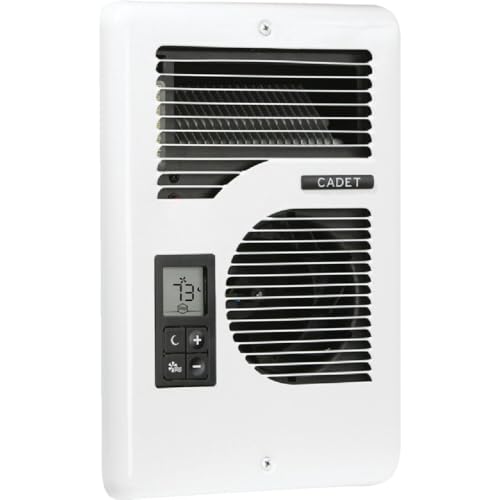
Cadet Energy Plus Electric Wall Heater — Best Digital Control
The Energy Plus is Cadet’s control-focused in-wall heater: 1600 watts at 240 volts with a digital thermostat built in. The digital control is the story — precise setpoints and steadier temperature holding than a mechanical dial delivers, which translates directly into comfort and into not paying to overheat a room past its target. At 1600W it is sized for a single medium room: a bedroom, office, or den where the heater is the primary source and control quality matters more than raw output. It is the thinking person’s Com-Pak: same trusted family, smarter brain.
Strengths
- Digital thermostat for precise, efficient temperature control.
- 1600W output well matched to a single medium room.
- Cadet in-wall format with the line’s install and parts familiarity.
Trade-offs
- Not a large-room heater; open spaces need the Com-Pak Twin.
- Digital controls are a feature to learn, unlike a simple dial.
- Built-in thermostat senses at the heater, as with all in-unit controls.
Key specs (from verified listing): 1600W, 240V, digital thermostat, in-wall fan-forced.
Choose the Energy Plus when the room is occupied on a schedule — a home office that should be warm at 8 a.m. and setback at 6 p.m., a bedroom that should cool slightly overnight. Precise control is where electric heat stops being a blunt expense and becomes a managed one, and this is the most manageable in-wall pick in the guide. For a single well-insulated room, it is arguably the most satisfying heater here to live with day to day.
Best for: medium rooms where precise control and efficiency matter — offices, bedrooms, dens. / Not suited for: large or open rooms needing 3000W or more. Check the current price on Amazon

HICFM Electric Fan Wall Heater — Best High-Output Wall Unit
The HICFM is the output maximalist’s wall unit: a fan wall heater with an enclosed motor, delivering 4000 watts and 13,650 BTU at 240 volts (and 3000W at 208V, for buildings on that service), with a built-in thermostat and a specified installation opening of 14 5/8 by 18 1/2 inches. The enclosed motor is a thoughtful detail for dusty environments, where an open motor inhales the room. The listing’s explicit install dimensions deserve credit too — knowing the required opening before you cut drywall is the difference between a smooth install and a patch job.
Strengths
- 4000W / 13,650 BTU at 240V in a wall format — output matching the Com-Pak Twin class.
- Dual-voltage 240/208V rating adds flexibility across buildings.
- Enclosed motor and built-in thermostat; install dimensions stated up front.
Trade-offs
- A newer, less established name than Cadet, Stelpro, or Comfort Zone in North American wall heat.
- High output demands the circuit and clearances to match; verify both.
- Like all high-output fan units, it is audible at full power.
Key specs (from verified listing): 240V 4000W / 13,650 BTU (208V 3000W / 10,236 BTU), enclosed motor, built-in thermostat, install hole 14 5/8″L × 18 1/2″H.
The HICFM earns its slot for buyers whose room needs Twin-class output but whose wall, budget, or building voltage argues for an alternative — including the unusual case of a space that might move between 240V and 208V service in a renovation. Weigh the brand-history trade-off honestly: the established names carry decades of parts support, while the HICFM counters with specification transparency and dual-voltage flexibility. For a workshop-adjacent room, mudroom, or large bathroom, its output-per-wall-opening is hard to argue with.
Best for: large single rooms needing maximum wall-unit output, and dual-voltage flexibility. / Not suited for: buyers who prioritize decades-long brand parts support above all. Check the current price on Amazon
Comparison Table
| Pick | Badge | Key spec | Best for |
|---|---|---|---|
| Cadet Com-Pak Twin | Best Overall In-Wall | 4000W, 240V, built-in thermostat, in-wall | Large residential rooms |
| InoKraft 5000W Garage Heater | Best for Garages | 5000W, 240V, ceiling mount, remote + timer | Garages and workshops |
| COMFORT ZONE 5000W | Best Ceiling-Mount Value | 5000W max, 3 heat settings, ceiling mount | Value shop heating |
| Stelpro Sonoma ASO2002WCW | Best Quiet | 2000W, 240V, quiet, recessed or surface | Bedrooms and offices |
| Cadet Energy Plus | Best Digital Control | 1600W, 240V, digital thermostat, in-wall | Precise single-room control |
| HICFM Fan Wall Heater | Best High-Output Wall Unit | 4000W at 240V, dual voltage, enclosed motor | Maximum wall output |
How to Choose a Wall Mounted 240 Volt Fan Forced Heater
The first decision is family: in-wall residential or mounted shop heater. In-wall units disappear into the room, run quietly enough for daily living, and are controlled like a heating system, with the thermostat as part of how the room lives. Shop units hang from a ceiling or high wall bracket, move a lot of air, and are controlled like equipment, with output first and refinement second. Choosing the family first eliminates half the confusion in this category, because nearly every disappointment comes from crossing the streams — a shop heater droning in a bedroom, an in-wall unit struggling in a leaky garage.
Second, size by honest arithmetic. The planning rule is roughly 10 watts per square foot for an insulated space with standard ceilings, more for poor insulation, tall ceilings, or cold climates. At 240 volts the nameplate wattage is the real wattage — unlike 208-volt service, there is no derating discount to apply — so a 200-square-foot bedroom wants about 2000W (the Sonoma’s class), a 400-square-foot great room wants the Com-Pak Twin’s or HICFM’s 4000W, and a two-car garage of 450–550 square feet is 5000W territory (InoKraft, Comfort Zone), with insulation deciding whether that feels generous or barely adequate. Garages deserve a special note: an uninsulated garage door can leak more heat than the walls combined, so the smartest garage-heating dollar is often spent on door insulation and weatherstripping before the heater is upsized.
Third, decide the thermostat arrangement before ordering. Built-in thermostats (Com-Pak Twin, Energy Plus, HICFM) simplify everything and suit single-room systems. A separate wall thermostat (required by the Sonoma) senses temperature where people sit and suits living spaces best. Shop heaters split by philosophy: the InoKraft’s remote and digital control suit high mounting and scheduled use, while the Comfort Zone’s stepped settings suit set-and-forget seasonal adjustment. Fourth, respect the circuit: a 5000W heater at 240V draws about 21 amps continuously, which means a properly rated breaker and wire gauge with code-required headroom — confirm your panel can carry it before the heater is on your doorstep. Finally, plan the mounting itself: in-wall cans need a stud bay and clearances; ceiling units need joist support, mounting height, and clearance from stored items and vehicles; surface units need a wall that can take the weight and the heat.
Noise: The Specification Nobody Prints
Fan-forced heaters make sound, and the honest differences between picks are about where that sound is acceptable. Shop heaters optimize for airflow, not acoustics: expect a clear fan presence that disappears under tools, music, and work, and would be intrusive under a conversation or a sleeping child. Residential in-wall units are engineered down from there, with the Stelpro Sonoma explicitly designed for quiet in occupied rooms. Two practical points follow. First, mount and maintenance change noise: a heater screwed to a resonant hollow wall or choked with dust is louder than the same unit clean and solidly mounted, so installation quality is an acoustic feature. Second, fan noise at startup in a cold room is the worst case — as the room warms and the thermostat cycles the unit at partial duty, the perceived noise drops. Judge a heater’s sound after a week of normal cycling, not in its first cold hour, and if the room is a bedroom for a light sleeper, let the Sonoma’s quiet-first design or a baseboard alternative win the argument early rather than after installation.
One more acoustic reality: fan-forced heaters sound loudest in an empty, cold, hard-surfaced room — which is exactly the room you test them in on installation day. Add furniture, rugs, occupants, and a warmed room where the unit cycles at partial duty, and the same heater recedes into the background. This is why experienced installers tell clients to live with a heater for a week before judging it, and why the genuine exception to that patience is the bedroom of a light sleeper, where the correct move is choosing the quiet-designed unit in the first place. If you are furnishing a nursery, a recording-adjacent home office, or a reading room, treat noise as a first-order specification, equal to wattage; if you are heating a workshop, treat it as a footnote and spend your attention on output and controls instead.
How to Install and Set Up a 240V Fan-Forced Heater
Treat this as orientation for a job that must follow the manufacturer’s instructions and local code, with a licensed electrician wherever required or prudent — for most households, that means hiring one for the circuit work at minimum. The professional sequence runs: confirm the panel and circuit can carry the heater’s continuous load with code headroom; run the correct gauge cable to the heater location; for in-wall units, fit the wall can between studs at the specified height with specified clearances, then connect, ground, and fit the heater and grill; for ceiling units, anchor the bracket into structure — never drywall alone — at a height and position that respects clearance from vehicles, storage, and combustibles, angled so discharge air sweeps the occupied zone rather than a wall; connect the thermostat arrangement chosen; restore power and test through full cycles at each heat setting, confirming the thermostat or remote controls output as expected and that overheat protection is undisturbed. Setup afterward is behavioral: set realistic temperatures, use timers and setbacks for garages and offices instead of holding full heat around the clock, keep intakes and discharges unobstructed, and vacuum grills and accessible interiors with power off a few times each season. A fan-forced heater’s worst enemy is dust; its best friend is a five-minute cleaning habit.
Common Buying Mistakes
The classic mistake is family confusion — buying a shop heater for a bedroom or an in-wall unit for a garage, then discovering the mismatch on the first cold night. Second is ignoring the circuit: ordering a 5000W heater for a panel with no capacity for a new 240V circuit of the required size, which turns a product purchase into an electrical project nobody budgeted for. Third is skipping the thermostat plan, discovering at installation that the chosen unit needs a wall thermostat nobody bought. Fourth is mounting by convenience instead of by airflow — a heater tucked behind a door or above a tall cabinet heats the wrong air. Fifth is sizing a garage by square footage alone while ignoring the uninsulated door and slab, then blaming the heater. Sixth is treating “240 volt” as a detail rather than the defining spec, and ending up with a visually identical 120-volt plug-in version that delivers a fraction of the heat. Verify the version, the circuit, the thermostat, and the mounting before ordering, and this category becomes one of the most satisfying purchases in home heating.
Final Recommendation
For a large residential room, buy the Cadet Com-Pak Twin; for a quiet bedroom or office, the Stelpro Sonoma with a good wall thermostat; for precise single-room control, the Cadet Energy Plus. For garages, the InoKraft 5000W if you want remote and timer convenience, the COMFORT ZONE 5000W if you want stepped-output value, and the HICFM when you need maximum output in a wall opening. If your building turns out to be 208 volts instead, start with our guide to Best Wall Heaters 208 Volt; for the laundry end of voltage-specific buying, see Best Washer Dryer Combo 110 Volt; and for whole-house furnace homes, Best Washable Furnace Filter For Smokers covers the filtration side.
In-Wall vs. Ceiling vs. Surface Mounting: Which Fits Your Room?
Mounting style is a decision about the room, not the heater. In-wall mounting, used by the Cadet and HICFM picks, gives the cleanest result: the heater sits inside a can between studs, only the grill shows, and floor space stays completely free. It is the right choice for finished living spaces and permanent installations, at the cost of opening the wall and committing to the location. Ceiling mounting, used by the InoKraft and Comfort Zone, is the garage’s natural answer: heat is delivered from above, out of harm’s way, sweeping down across vehicles and workbenches, and the floor and walls stay clear for storage and equipment. Its costs are installation effort — structure, height, wiring — and controls that must be reachable, which is why remote control matters so much in that family. Surface mounting, offered by the Stelpro Sonoma as an alternative to recessed fitting, splits the difference: the heater sits proud of the wall on a surface box, avoiding drywall surgery while keeping a tidy, intentional look. Surface mounting is the renovator’s friend and the renter-adjacent compromise, and in finished basements or panelled rooms it is often the only sane route. Decide by asking what the wall can give you and how permanent the installation should be; the heater choice usually resolves itself once the mounting is honest.
Clearances discipline all three styles. Fan-forced heaters move hot air and need their discharge path respected: furniture, drapes, stored boxes, and parked vehicles must stay out of the manufacturer’s stated clearance zones, not as a legalism but because blocked airflow makes heaters cycle on their high-limit protection, heat badly, and age fast. When you walk the room planning the install, plan the clearance zone as part of the furniture layout, and the heater will perform as rated for its whole life.
The Garage Heating Playbook
Because two of the six picks exist for garages, the garage deserves its own strategy section. Start with the envelope: seal the door perimeter, consider an insulated door or an insulation kit for the existing one, and seal the obvious penetrations. In many garages this unglamorous work is worth a thousand watts of heater. Next, accept the garage’s two heating modes and equip for both: maintenance mode, where the space is kept just warm enough to protect paint, batteries, and plumbing, and working mode, where it needs to be genuinely comfortable for hours. A heater with stepped output or a thermostat with setback handles both modes without waste; a single-speed heater forces you to choose. Position the heater so its discharge crosses the work area rather than the door, and mount it high enough that its airflow is not blocked by the vehicle that lives there. Finally, think about what the heat is for: a workshop used daily deserves the InoKraft’s timer-and-remote convenience so the space is warm on arrival; a garage used for occasional projects is fine with the Comfort Zone’s manual stepped control, turned on when the project starts. Match the control philosophy to the routine and the heater disappears into the background of the hobby it enables — which is the highest compliment shop equipment can earn.
Maintenance and Service Life
Fan-forced heaters ask little and repay it for a long time. The core routine is dust control: with power off, vacuum the grill, intake, and accessible interior a few times each heating season, more often in workshops where the air carries sawdust and grit. Dust is the category’s universal enemy — it insulates elements, loads fan motors, adds noise, and produces the burnt smell that alarms owners every autumn. Beyond cleaning, listen once in a while: a fan that develops a new rattle or a heater that begins cycling rapidly is reporting a problem while it is still small. Check mountings annually for tightness, especially ceiling units, and confirm that clearance zones have not been colonized by storage. In-wall residential units from established lines routinely serve for decades under this minimal regime; shop units in dusty environments live shorter but still long lives when cleaned. The economics follow: in this category, the difference between a fifteen-year heater and a five-year heater is rarely the purchase — it is the vacuum.
Budget Tiers: Where the Money Goes in This Category
Without printing prices, the tiers in this category buy identifiable things. The value tier — the Comfort Zone’s territory — buys output and simplicity: maximum watts per dollar, stepped manual control, commercial build, and no money spent on electronics you may not need. It is the right tier for shops and for buyers who would rather fund insulation with the savings. The mid tier buys refinement in the residential family: quieter fans, better thermostats, cleaner industrial design, and the Stelpro’s mounting flexibility. This is where most living-space buyers should land, because noise and control quality are felt every day while raw wattage differences are felt only on the coldest mornings. The premium tier buys control intelligence and ecosystem depth: the Energy Plus’s digital precision, Cadet’s decades of parts availability behind the Com-Pak Twin, remote-and-timer convenience in the InoKraft. Premium money is justified when the heater is a primary heat source used daily for years — the amortized cost of better control across a decade of winters is small — and wasted when the heater warms a space used twice a month. One cross-tier warning: installation cost is part of the real price, and it is roughly constant across tiers. A value heater plus an electrician can cost more installed than a premium heater plus the same electrician, so compare installed totals, not box prices, when the budget is tight.
Replacement and Retrofit Scenarios
Many buyers arrive here mid-project rather than from a blank wall, so it is worth mapping the common scenarios to the picks. Scenario one: an old in-wall heater has failed in a large living room and the can is an unknown brand. The clean move is a complete new unit — the Com-Pak Twin if the room is large, the Energy Plus if it is medium — rather than hunting for a compatible interior for an unidentified can. Scenario two: a garage has a 240-volt circuit already roughed in from an old welder outlet’s era, and the owner wants heat for winter projects. That is the InoKraft or Comfort Zone scenario, with the choice turning on whether remote-and-timer convenience or stepped-output value matters more. Scenario three: a finished basement is being converted to a bedroom or office and opening walls is undesirable. The Stelpro Sonoma’s surface-mount option exists precisely for this retrofit, paired with a wall thermostat mounted where the occupant will actually sit. Scenario four: a big bathroom or mudroom needs fast, powerful heat on a schedule. The HICFM’s output and built-in thermostat suit it, provided the install dimensions fit the available stud bay — measure before ordering, using the dimensions the listing states. Scenario five: a rental or multi-unit building standardizing replacements. Cadet’s Com-Pak ecosystem is the landlord’s friend — one install pattern, one parts shelf, predictable behavior across units. Naming your scenario first is the fastest filter in this guide: most readers can delete four of the six picks the moment they do.
Frequently Asked Questions
What size 240V fan-forced heater do I need?
Plan on roughly 10 watts per square foot for insulated spaces — about 2000W for 200 sq ft, 4000W for 400 sq ft, and 5000W for a typical two-car garage — then add capacity for poor insulation, high ceilings, or severe climates. At 240V, the rated wattage is the delivered wattage, which makes the arithmetic refreshingly honest compared with derated 208-volt installations. When your calculation lands between two sizes, choose based on the room’s duty: a continuously occupied room is happier with the larger unit cycling gently, while an intermittently used space can let a smaller unit run longer.
Can I plug a 240V heater into a regular outlet?
No. Every pick in this guide is hardwired to a dedicated 240-volt circuit installed to code. That permanence is the point: it delivers two to three times the heat of a plug-in 120V heater, safely and without tying up an outlet or relying on a cord. If hardwiring is impossible in your situation, the honest alternatives are a plug-in 120V heater with realistic expectations, or a different heating strategy entirely — not an adapter or a workaround, neither of which belongs anywhere near a heater of this class.
Are these heaters expensive to run?
Electric resistance heat costs the same per unit of heat across all models, so running cost is about wattage, hours, and zoning. A 5000W garage heater run only during weekend projects costs little; the same heater holding a garage at room temperature all winter costs a great deal. Timers, setbacks, and insulation are the real cost controls, and they are all cheaper than the electricity they save — which is why this guide keeps returning to the envelope and the thermostat rather than pretending one heater is magically more efficient than another at turning watts into warmth.
Do I need a separate thermostat?
The Com-Pak Twin, Energy Plus, and HICFM include thermostats; the Stelpro Sonoma requires a wall thermostat, sold separately — factor that into its true installed cost when comparing. Garage units build control into the unit or remote. Confirm your pick’s arrangement before ordering so installation day has no surprises, and if you are adding a wall thermostat, choose a line-voltage model rated for the heater’s full amperage, not a low-voltage furnace thermostat.
How loud is a fan-forced wall heater?
Shop units are clearly audible and designed for workspaces, where their sound sits under normal activity. Residential in-wall units are much quieter, and the Stelpro Sonoma is designed specifically for quiet in occupied rooms. Dust buildup and loose mounting make any unit louder, so clean, solid installation is part of the noise specification. As a practical test, if you would not want a bathroom exhaust fan’s level of sound in the room, you do not want a shop heater in it — choose from the residential family instead.
Can one of these heaters heat a whole house?
These are zone heaters, designed for one room or one workspace each. Whole-house electric heating is normally done with multiple wall units on separate thermostats — a legitimate and often comfortable strategy, because each room gets its own temperature and schedule — rather than with a single large unit trying to push air through doorways, around corners, and up stairs it was never designed to reach.
What is the difference between a wall heater and a ceiling-mount garage heater?
Both are fan-forced and hardwired, but they are optimized differently in almost every respect that matters day to day. An in-wall residential heater is built for quiet, even, thermostat-managed heat in a finished room, flush with the wall. A ceiling-mount garage heater is built for maximum airflow and fast warm-up in a workspace, mounted high and out of the way, with noise and appearance traded away for output and durability. Choosing between them is really choosing which room’s standards the heater must meet.