Disclosure: airfryerkitchensupply.com is reader-supported. When you buy through links on our site, we may earn an affiliate commission at no extra cost to you.
Where to buy
This guide is split honestly in two. The first three picks are genuine vintage consoles that trade only on the used and dealer market, so they carry no links — buying routes are explained in their reviews. The last three are current, verified analog mixers that carry the vintage design philosophy — discrete-feeling preamps, real EQ, no menus — into a box you can buy new today with a warranty, and those carry links confirmed against their Amazon listing.
- Soundcraft GB8 32-channel Analog Mixer (Best Modern Descendant — Large Format) — check price on Amazon
- Mackie Onyx16 (Best Modern Descendant — Studio Workhorse) — check price on Amazon
- Soundcraft Signature 22MTK (Best Modern Descendant — Character and Multitrack) — check price on Amazon
The best vintage analog mixers are not really a product category any more; they are a philosophy with a second-hand market attached. The philosophy says a mixer should be a physical instrument — one knob per function, transformers and discrete circuits where they matter, EQ you play rather than program — and that a mix should be performed, not recalled. The market says the original instruments of that philosophy, the great British and American consoles of the 1970s and 80s, now trade like classic cars: by condition, provenance and the name of the last technician to sign the service log.
This guide serves both halves of that reality. It profiles the three vintage consoles that define the category for working studios — and explains how to buy them without buying their problems. Then it does something most vintage guides refuse to do: it admits that for many buyers the right answer is a modern analog desk built in the vintage spirit, serviced by a warranty instead of a prayer, and it recommends three verified examples. Neither half is a compromise. They are different answers for different studios, and the buying guide below will tell you which studio you are.
One rule governs everything that follows: in vintage analog, condition is the specification. Two consoles with the same badge are different products, and the reviews are written accordingly.
In this guide
Quick Picks
Three originals worth the hunt, three descendants worth the warranty — badges state plainly which is which.
- Neve 8024 Console — Best Vintage Console — no link. The archetype: a 1970s Neve whose channel sound — transformer weight, famously musical EQ — is the reference the word ‘vintage analog’ points at. — sold through used and specialist channels; see the buying notes in its review below
- Trident A-Range Console — Best Vintage Character — no link. The cult favourite: fewer built than its rivals, an EQ section engineers describe in superlatives, and a sound with genuine swagger. — sold through used and specialist channels; see the buying notes in its review below
- API 1604 Console — Best American Vintage — no link. The American answer: punchy, forward, transformer-driven channels from the maker whose lunchbox modules now dominate modern studios. — sold through used and specialist channels; see the buying notes in its review below
- Soundcraft GB8 32-channel Analog Mixer — Best Modern Descendant — Large Format. A current 32-channel analog desk in the classic British live/studio tradition — real faders, real EQ, no menus, verified and buyable new. — Check on Amazon
- Mackie Onyx16 — Best Modern Descendant — Studio Workhorse. Sixteen channels of Mackie’s premium analog line with multitrack USB — the vintage control surface married to the modern recording workflow. — Check on Amazon
- Soundcraft Signature 22MTK — Best Modern Descendant — Character and Multitrack. Twenty-two channels, multitrack recording and Lexicon effects in an analog desk whose voicing tips its hat to the British classics. — Check on Amazon
How These Picks Were Chosen
Vintage selections were made on three grounds: documented recording history, a surviving service ecosystem, and a sonic identity distinct enough to justify vintage ownership’s costs. Consoles that are merely old — and the world is full of tired live desks wearing the word vintage as a sales costume — were excluded. A true vintage analog pick must offer something a clean modern desk cannot: a transformer sound, an EQ curve with a famous name, a summing character engineers still describe with adjectives.
Modern descendants were held to the mirror-image test: they had to be genuinely analog in signal path and control philosophy — no menu-diving, no recall theatre — from makers with a legitimate claim on the tradition, and they had to verify like every linked product on this site. The result is a guide that respects the past without lying about the present: if you buy an original, you will know what it costs to keep; if you buy a descendant, you will know exactly which vintage virtues it keeps and which it politely declines.
The 6 Best Vintage Analog Mixers
Neve 8024 Console — Best Vintage Console — no link
If one console explains why vintage analog mixers command devotion, it is the Neve 8024 and its close family. Built around transformer-coupled channels and the EQ that launched a thousand imitations, the 8024’s sound is the sound of the 1970s rock record: low end with physical mass, midrange that pushes a vocal forward without harshness, and a summing behaviour that glues a mix while you are still raising the faders. Studios do not buy these desks for nostalgia. They buy them because a mix started on one is already halfway to sounding like a record.
Ownership is a facilities decision. These consoles live in the care of a small priesthood of technicians, consume power and cooling like the era that built them, and reward owners who budget service as a line item rather than an emergency. Channels are often harvested into racked pairs — a legitimate, more accessible way to own the genuine channel sound without adopting the whole desk, and for many studios the smartest entry into real Neve iron. Judge any example by its service documentation and its iron, in that order, and let the famous badge come third.
Strengths
- The reference vintage console sound: transformer weight and musical EQ
- Mixes glue quickly; vocals and drums gain presence almost automatically
- Channel strips hold value and can be racked as pairs
Trade-offs
- Facility-scale ownership: power, cooling, service and space
- Condition and provenance dominate pricing; expert inspection essential
- Full consoles surface rarely and sell to a waiting list, not a shopper
This pick is written unlinked: there is no verified new-retail listing to link, so judge it on the used-market and dealer guidance in this guide rather than on a buy button.
Best for: established studios building identity around a genuine classic desk / Not suited for: project studios without service budget or space
Trident A-Range Console — Best Vintage Character — no link
The A-Range is the connoisseur’s counter-argument to Neve orthodoxy. Built in small numbers, it pairs a distinctive channel design with an EQ section so admired that its curves are still name-checked by engineers who have never touched the real desk. Where the Neve sound is weight, the A-Range sound is attitude: present, slightly forward, with a top end that flatters rock guitars and voices that need to cut without turning brittle. Original desks are genuinely scarce, and that scarcity is part of both the price and the point.
Scarcity cuts the buyer both ways. The service ecosystem is smaller, parts knowledge is concentrated in fewer heads, and a tired A-Range is a longer road back than a tired rival. The channel-strip route exists here too and is often the rational purchase. Buy an A-Range because its specific character is the one your records are missing — not as a generic vintage trophy — and secure your technician before you secure the desk, because with this console the order of those two purchases decides whether you own an instrument or an heirloom-in-waiting.
Strengths
- EQ section with a legendary, mix-forward character
- Rarity gives the desk genuine studio identity and client pull
- Rock and vocal work benefits from its forward, flattering voicing
Trade-offs
- Smallest service ecosystem of the three vintage picks
- Scarcity inflates prices and slows every transaction
- Full desks are rare enough that patience is part of the budget
This pick is written unlinked: there is no verified new-retail listing to link, so judge it on the used-market and dealer guidance in this guide rather than on a buy button.
Best for: studios wanting a distinctive, characterful vintage centrepiece / Not suited for: buyers who need quick purchase and easy service
API 1604 Console — Best American Vintage — no link
API’s 1604 brings the American branch of the vintage family: a compact console built around the company’s transformer-coupled, discrete-op-amp channels, delivering the punch and forward midrange that became the sound of American rock and, later, of countless drum buses. It matters to modern buyers for a practical reason the British desks cannot match — its channel philosophy survives, supported and manufactured, in API’s current module ecosystem, so the vintage desk and the modern rack speak the same language.
That continuity softens vintage ownership’s sharpest edges: knowledge is current, the sonic references are everywhere, and channel-level solutions exist at many scales. The desk itself remains a serious used-market purchase, judged on condition and service like its peers. For a studio whose records lean on drums, guitars and presence, the 1604 is the vintage console most aligned with how modern hybrid studios actually work — a classic that never fully left the building.
Strengths
- Punchy, forward American console sound, definitive on drums and guitars
- Philosophy continues in current API modules — unmatched knowledge base
- Compact footprint by vintage console standards
Trade-offs
- Still a used-market, condition-first purchase at serious money
- Vintage examples vary; documented service history is essential
- Character is assertive — subtle, neutral work is not its brief
This pick is written unlinked: there is no verified new-retail listing to link, so judge it on the used-market and dealer guidance in this guide rather than on a buy button.
Best for: hybrid studios wanting vintage punch with modern support / Not suited for: buyers seeking a neutral, invisible mixer

Soundcraft GB8 32-channel Analog Mixer — Best Modern Descendant — Large Format
The GB8 is what the vintage philosophy looks like with a warranty. Soundcraft’s GB series was designed in the tradition of the great British analog desks — a proper channel strip per input, a musical EQ section, generous bussing and a layout a guest engineer can read at a glance — and the 32-channel frame gives a studio or venue genuine large-format mixing without a single screen between you and the music. For tracking bands, mixing live-to-two-track or running a rehearsal-complex flagship, it is the vintage workflow at full scale.
It declines, politely, the vintage burdens: no recap roulette, no transformer lottery, parts and support from a living manufacturer. What it cannot give you is forty years of patina or the exact iron of a 1974 channel — and it does not pretend to. Studios buy the GB8 when the performance of mixing matters more than the provenance of the mixer, and on those terms it is the strongest large-format analog value in this guide.
Strengths
- True large-format analog mixing with one-knob-per-function control
- British desk tradition from a manufacturer that helped define it
- New purchase: warranty, parts and support instead of restoration roulette
Trade-offs
- Large, heavy frame needs a permanent home and real space
- No vintage transformer patina — it is a descendant, not an original
- Overkill for small project rooms
| Detail | What to know |
|---|---|
| Format | 32-channel analog mixer (per Amazon listing title) |
Check on Amazon — check the current price on Amazon before you decide, because bundle contents and included accessories change between listings.
Best for: studios and venues wanting large-format analog without vintage risk / Not suited for: small rooms or buyers chasing genuine 1970s iron

Mackie Onyx16 — Best Modern Descendant — Studio Workhorse
The Onyx16 answers the question hybrid studios actually ask: can an analog desk be the centre of a computer studio without adapters and apologies? Its premium analog channels feed multitrack USB recording, so the performance of a mix — faders ridden by hand, EQ turned by ear — can be captured, revisited and combined with DAW work rather than replaced by it. The Onyx preamps carry the line’s reputation for clean gain with a little character, and the build is the solid, road-aware Mackie manner.
As a vintage descendant its claim is workflow, not cosmetics: hands-on analog mixing, immediate control, no menu between intention and sound. It will not saturate like a driven 1970s channel and does not claim to. For the project studio that records real bands and mixes with its hands, it is the most complete modern answer in this guide — the desk the vintage masters would probably have specified, had USB existed to specify it with.
Strengths
- Analog mixing surface with multitrack USB for hybrid workflows
- Premium Onyx preamps with clean gain and mild character
- Solid build suited to studio and small live duties alike
Trade-offs
- Analog character is polite beside genuine vintage iron
- Sixteen channels caps large ensemble work
- USB workflow ties part of its value to computer setup
| Detail | What to know |
|---|---|
| Format | 16-channel premium analog mixer with multi-track USB (per Amazon listing title) |
Check on Amazon — check the current price on Amazon before you decide, because bundle contents and included accessories change between listings.
Best for: hybrid project studios recording bands and mixing hands-on / Not suited for: purists wanting transformer saturation from the desk itself
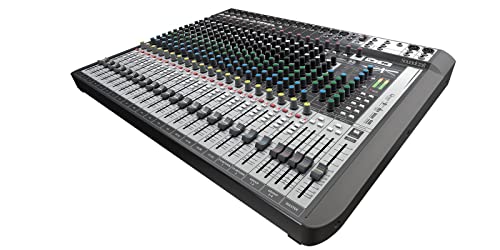
Soundcraft Signature 22MTK — Best Modern Descendant — Character and Multitrack
The Signature 22MTK is the descendant for buyers who want their modern desk to have a point of view. Soundcraft voices the Signature line with its British heritage audible — preamps with a little warmth, EQ that invites broad, musical strokes — then adds the two things vintage desks never had: multitrack USB recording of the whole band, and onboard Lexicon effects, a name with its own vintage pedigree in reverb and delay. The result is a desk that behaves like a classic and files like a modern one.
It suits the studio that demos, rehearses and records in the same room, and the live act that wants its shows captured multitrack for later mixing. Its trade-offs are the honest modern ones: effects are convenient rather than definitive, and the analog warmth is a voicing, not transformer saturation. Within those truths, it is the most characterful verified desk in this guide and the easiest to recommend to a buyer torn between eras.
Strengths
- British-voiced analog channels with multitrack USB recording
- Onboard Lexicon effects with genuine heritage
- Generous 22-channel count for bands and small venues
Trade-offs
- Warmth is a voicing, not vintage transformer saturation
- Onboard effects are convenient, not studio-definitive
- Larger frame than small project rooms expect
| Detail | What to know |
|---|---|
| Format | 22-channel multitrack analog mixer with Lexicon effects (per Amazon listing title) |
Check on Amazon — check the current price on Amazon before you decide, because bundle contents and included accessories change between listings.
Best for: bands and studios wanting character plus multitrack capture / Not suited for: buyers needing genuine vintage iron or minimal footprint
Comparison Table
| Pick | Badge | Key spec | Best for |
|---|---|---|---|
| Neve 8024 Console | Best Vintage Console — no link | 1970s British console, transformer channels | established studios building identity around a genuine classic desk |
| Trident A-Range Console | Best Vintage Character — no link | 1970s British console, small production run | studios wanting a distinctive, characterful vintage centrepiece |
| API 1604 Console | Best American Vintage — no link | American console, discrete transformer channels | hybrid studios wanting vintage punch with modern support |
| Soundcraft GB8 32-channel Analog Mixer | Best Modern Descendant — Large Format | 32-channel analog desk | studios and venues wanting large-format analog without vintage risk |
| Mackie Onyx16 | Best Modern Descendant — Studio Workhorse | 16-channel analog + multitrack USB | hybrid project studios recording bands and mixing hands-on |
| Soundcraft Signature 22MTK | Best Modern Descendant — Character and Multitrack | 22-channel analog multitrack, Lexicon FX | bands and studios wanting character plus multitrack capture |
Vintage Original or Modern Descendant: The Honest Decision
Decide by calendar before you decide by sound. A vintage original asks for a service relationship, a contingency budget and tolerance for the day a channel goes quiet before a session. Studios with paying clients, a technician on call and a room whose identity is part of the product absorb those costs as overhead and gain a sound and a story no new desk ships with. Studios where the mixer must simply work every morning — schools, houses of worship, rehearsal businesses, most project rooms — should buy the descendant and spend the difference on microphones, which will improve their recordings more than patina ever could.
Decide by role, too. A vintage desk used as a colour path — tracking through its channels, summing stems through its bus — earns its keep in defined hours and rests in between. A vintage desk asked to be the room’s only mixer, carrying talkback, monitoring, headphone mixes and recall, is being asked to do a modern desk’s job with a classic car’s maintenance schedule. The happiest vintage owners in the business are the ones who gave their classics a role with edges. The unhappiest bought a headline and discovered a lifestyle.
Finally, decide by exit. Modern descendants depreciate predictably and sell easily. Vintage originals hold or grow value only when condition is documented and maintained — which loops back to the service budget. None of this diminishes the originals. It simply prices their magic honestly, which is the only basis on which magic should ever be bought.
Inspecting a Vintage Console: A Buyer’s Walk-Through
Start cold and stay an hour. Power the desk from silence and listen as it warms: hum that fades is character, hum that grows is a bill. Work every channel the same way — same input, same level — and note which channels are quieter, duller or noisier than their neighbours, because channel consistency is the difference between a mixer and a collection of antiques sharing a frame. Exercise every pot and switch; crackle that clears with exercise is maintenance, crackle that stays is repair. Faders should feel like instruments, not like drawers full of gravel.
Ask for the paper: service logs, recap records, the name of the last technician, and photographs of the inside if a sale is remote. In vintage analog, documentation is not bureaucracy — it is the product. A desk with ten years of signed service history is worth a firm premium over an identical badge with a shrug, and the premium is the cheapest money in the whole transaction. Finish with the iron question: what is original, what has been substituted, and does the seller say it plainly? The desks worth buying come from sellers who answer that question like it is normal — because in this market, it is.
How to Integrate a Vintage or Analog Desk Into a Modern Studio
Give the desk a defined job first: tracking front end, summing destination, live hub, or all three in a small room — and wire it for that job through a patchbay, so changing its role is a patch cord, not a re-cabling weekend. Match levels deliberately: vintage and heritage-voiced desks expect period operating levels, and a modern interface driving them at maximum digital output will make honest analog sound harsh and blame the wrong suspect. Calibrate with test tones once, write the settings down, and your future self will thank you at every session.
For vintage originals, add the rituals: warm-up time in the session plan, a channel log that travels with the desk, spares and a technician relationship established before the first fault, and a clean, stable power feed. For modern descendants, the equivalent ritual is firmware and driver hygiene for the USB side and a saved template session in your DAW that matches the desk’s channel order, so multitrack capture is one click rather than a setup ceremony.
Above all, mix on it. The entire point of this category — original or descendant — is the performed mix: faders under fingers, EQ by ear, decisions committed. Studios that adopt the desk as an instrument get the sound they paid for. Studios that use it as a very handsome input selector mostly get the handsome part.
Common Buying Mistakes
Buying the badge, not the condition. In vintage analog the badge is the beginning of the conversation. Service history, channel consistency and original iron are the conversation.
Skipping the service budget. A vintage desk bought with the last of the money is a desk one fault away from silence. The contingency fund is part of the purchase.
Expecting recall-era convenience. No total recall, no presets, no apologies. If your workflow needs instant reset, buy the modern descendant and love it honestly.
Driving vintage inputs with modern levels. Half the ‘harsh vintage desk’ stories are gain-staging errors. Calibrate once, properly, and judge again.
Calling every old desk ‘vintage’. Age is not pedigree. Tired live desks from the wrong lineage are just old, and priced accordingly by everyone except their sellers.
Ignoring the room it must live in. Power, cooling, space and a tech’s travel distance are ownership costs. Measure the door before the desk measures you.
Final Recommendation
If your studio can keep a classic, the Neve 8024 is the reference, the Trident A-Range the character choice, and the API 1604 the American path with the warmest modern support. If your studio needs the philosophy without the priesthood, the Soundcraft GB8 scales it, the Mackie Onyx16 hybridises it, and the Signature 22MTK gives it a voice and a multitrack memory. There is no wrong door here — only the wrong match between a desk’s demands and a studio’s reality.
Choose that match honestly, and analog mixing — vintage or descendant — will repay you every session, in the oldest currency there is: decisions you can hear.
Keep exploring the cluster: Best Analog Mixers Best Ampex Mixers Best Vintage Mixers Best Analog Mixers For Studios Best Vintage Ampex Mixers
What Vintage Analog Actually Does to a Mix
The vintage analog claim is often marketed and rarely explained, so here is the explanation a buyer deserves. A classic console’s channels pass audio through transformers and discrete circuits that saturate gradually, and its summing bus combines signals in a way that slightly compresses and harmonically enriches the whole. EQ sections on the great desks were voiced as musical instruments — broad, confident curves that encourage the engineer to commit. The cumulative effect, across twenty channels of a real mix, is the quality called glue and weight: not louder, not brighter, but more singular, as if the band had been recorded in one room on one day — which, in the era these desks ruled, it usually had been.
The modern descendant desks in this guide reproduce the workflow of that era faithfully and its sonics partially. Their EQ is voiced in the tradition, their headroom is honest, and a performed mix on one has the decisiveness that mouse-mixed music often lacks. What they do not reproduce is the accumulated harmonic behaviour of period iron driven at period levels — a real difference, audible on drums and voices, and the entire rational basis for vintage ownership’s costs.
The sophisticated position, held by most engineers who own both, is that the two are complements staged across a career and a room. Track through vintage channels where colour matters most, mix with modern reliability where the calendar matters most, and let each technology cover the other’s honest weaknesses. Buyers who frame the purchase that way rarely regret either half of it.
The Used Console Market: Dealers, Auctions and Studio Sales
Vintage consoles reach buyers through three doors, each with its own risk shape. Specialist dealers charge the most and earn it: the desk has usually been serviced, measured and honestly described, and the dealer answers the phone afterwards. Studio decommissioning sales offer the best stories and often the best value — a desk that worked last month in a known room — but the buyer inherits the logistics of extraction, transport and recommissioning, which are neither trivial nor cheap for a large-format console. Auctions offer the widest price variance in both directions and the least recourse; they reward experts and tax everyone else precisely in proportion to their optimism.
Transport deserves its own sentence, because more vintage consoles are damaged between studios than in them. A large desk travels crated, insured and handled by people who move pianos and printing presses, not by the cheapest van available. Budget the move as part of the purchase, photograph everything before it moves, and have your technician scheduled at the destination, because recommissioning — power, grounding, channel verification — is a professional task, not an unboxing.
Finally, the market’s social layer matters: the vintage console world is small, and a buyer’s reputation for seriousness — funds ready, technician engaged, decisions made promptly — is what causes the good desks to be offered to them first. In this market, being easy to sell to is a genuine competitive advantage, and it costs nothing but preparation.
Racked Channels and Lunchboxes: The Middle Path
Between buying a whole vintage console and buying a modern desk lies the path most working studios actually take: genuine vintage channels, racked. When large consoles are retired, their channel strips are commonly harvested, given power supplies and input/output connections, and mounted in racks as self-contained preamp-and-EQ units. A pair of channels from a great desk delivers its essential sound — the transformer, the EQ curve, the saturation behaviour — for tracking and overdubs, at a fraction of the console’s cost, space and maintenance, and with the freedom to patch them exactly where colour is wanted.
The API tradition extends this idea into an ecosystem: the module format that began in consoles became a standard, so vintage and current modules interoperate in powered racks, and a studio can grow its collection channel by channel as budgets and tastes evolve. For buyers whose vintage desire is really about sound on their key sources — lead vocal, kick and snare, bass, the mix bus in pairs — the racked path is not a compromise. It is the precision instrument version of the same idea.
Judgement still applies: racked channels vary in workmanship, power supplies matter to noise, and originality of the strip itself is the value, so buy racked units from rackers with names and warranties. Do that, and the middle path routinely produces the happiest vintage owners in the business — all of the sound, a tithe of the burden, and a studio that still works on the days the colour is resting.
Analogue Summing: Why the Bus Matters as Much as the Channels
Discussions of vintage consoles fixate on channels — the preamp, the EQ, the transformer with the famous part number — but engineers who mix on these desks will tell you the bus is half the sound. Analog summing combines signals in continuous circuitry, where each channel’s contribution interacts subtly with the whole: peaks soften into each other, low frequencies from separate sources cohere, and the stereo image acquires the slight, pleasing density that mixers describe as the record ‘arriving’ before processing begins. It is not louder or cleaner. It is more singular, and on music recorded from real sources in real rooms, singular is often exactly what was missing.
Modern descendants and hybrid workflows chase the same effect at different scales: a summing path for stems, a console’s bus for the full mix, or channels tracked with colour and summed clean. The buyer’s takeaway is to audition a desk the way it will be used — with a real multitrack mix spread across it, not with one microphone and a voice — because a console can flatter a single channel and still disappoint as a summing destination, or vice versa. The desks in this guide earned their places on the full-mix evidence, which is the only evidence that pays rent.
Power, Cooling and the Room a Vintage Console Requires
A large vintage console is an electrical citizen with appetites. Its power supply — often a separate, heavy unit — wants clean, stable mains and a circuit that does not share its life with a refrigerator’s moods. Its channels dissipate heat continuously, which the room must remove or the console will age its own capacitors at an accelerated rate while warming the engineer’s afternoons. Studios planning a vintage centrepiece should budget the electrician and the air conditioning conversation into the purchase, because a desk installed on marginal power in a hot room will present its complaints as intermittent faults — the most expensive kind to chase.
Space planning is the quieter half: service access behind and beneath the desk, cable runs that do not require moving the console to change, and a floor that accepts the weight without argument. None of this is glamorous, and all of it is the difference between a console that is an instrument and one that is an installation problem with faders. The modern descendants in this guide were designed for rooms as they are; the originals were designed for rooms built around them. Buy accordingly, with the tape measure given the same respect as the audition.
Learning to Mix on Faders: The Skill the Desk Teaches
An analog desk — vintage or descendant — is a teaching machine for the skill modern production most neglects: the performed mix. With no automation to hide behind, the engineer learns to arrange a mix with balance and EQ decisions made in real time, to ride a vocal against a band the way a musician plays an instrument, and to commit. Commitment is the curriculum. A mix that must be decided teaches judgement in a way that a mix postponed through forty saved versions never quite does, and engineers formed on desks carry that decisiveness into every tool they touch afterwards.
The practice is learnable in weeks and deepened for years: start with balance alone, faders only, no EQ, until the mix stands; add EQ as sculpture rather than repair; learn the desk’s EQ by mixing the same song three ways and listening to what the curves invite. Studios that adopt an analog centre report the same side effect — sessions get faster, because decisions get made in the room, by listening, at the speed of music. That speed, more than any transformer, may be the vintage era’s most valuable export.
resale and Longevity: Thinking in Decades
Consoles are among the longest-lived purchases a studio makes, and the vintage question is really a longevity question asked twice. The originals have already proven their decades; their continued value depends on the owner’s maintenance discipline, because a documented, serviced classic is an appreciating asset while an identical neglected one is a restoration project with a famous name. The descendants depreciate like professional equipment — predictably, and softened by the fact that a working analog desk always finds a second home in rehearsal rooms, venues and schools.
The practical advice is to buy the desk your next ten years can keep. A studio that will fund service owns the original happily and may never lose money on it. A studio that will not should buy the descendant, use it without anxiety for a decade, and sell it to a happy second owner. Both are respectable outcomes. The only disreputable one is the neglected classic — a piece of recording history slowly expiring for want of a budget line — and it is entirely avoidable at the moment of purchase, which is now.
The Engineer’s Hands: Ergonomics of the Great Desks
Spend a day mixing on a great analog desk and a specification no brochure prints becomes obvious: the ergonomics of confidence. Knobs are sized for fingers, not for tweezers; EQ sections are laid out so the hand learns the geography and the eyes can stay on the musicians; faders travel with a resistance that makes a half-decibel adjustment a physical act rather than a hope. These desks were designed when the engineer was the automation, and every control assumes a human hand working at the speed of a performance.
Modern descendants inherit this unevenly, which is why the guide’s picks favour makers with genuine desk heritage — their layouts feel remembered rather than invented. The buyer auditioning any analog desk, original or descendant, should perform the blind test: eyes up, find the vocal channel’s EQ, make a change, find it again. A desk your hands can learn in an afternoon will teach you mixing; a desk they cannot will teach you its manual, which is a different and lesser education.
Ergonomics is also stamina. Long sessions on a well-laid-out desk leave the engineer listening; long sessions fighting a cramped or illogical surface leave the engineer tired in ways that masquerade as taste — mixes get safer as hands get sore. The great desks’ physical generosity is not luxury. It is session endurance, engineered in aluminium and spacing, and it is part of what their prices were always buying.
Documentation and the Desk’s Second Life
Every vintage console carries two histories: the music it made and the paper it kept. The paper — service logs, modification records, the names of technicians and the dates of capacitor renewals — is what separates a desk with a future from a desk with a past. Buyers should treat complete documentation as a feature on the level of the EQ section, because it converts unknown risks into scheduled maintenance, and sellers should understand that their record-keeping is quite literally money, recoverable at sale.
Owners of modern descendants start this story at page one: keep the purchase records, log any service, photograph the studio’s standard settings, and file the manual where a successor can find it. A desk’s second life — in a school, a rehearsal complex, a younger engineer’s first real room — begins with the first owner’s habits, and the analog desks in this guide are built to have second lives measured in decades.
There is a stewardship ethic here that the vintage market understands instinctively: these instruments outlive their owners’ tenures, and each keeper’s job is to hand the desk on in better documented, better serviced condition than they received it. Buyers who adopt that ethic find the market treats them as members. The desks, in their aluminium way, seem to know the difference too.
Analogue Character, Honestly Measured: A Word on Blind Tests
Sooner or later every analog discussion meets the blind test, and intellectual honesty requires this guide to meet it too. In controlled comparisons, listeners — including experienced ones — are less reliable at identifying analog summing, transformer colour or tube warmth than the forums suggest, particularly at matched levels in dense mixes. The differences are real, measurable and audible on the right material; they are also smaller, at the margin, than the differences made by microphone placement, performance and the decision to commit to a mix.
None of that empties the vintage case; it relocates it to firmer ground. The strongest reasons to own analog iron are workflow and response: a desk changes how the engineer works — faster decisions, performed balances, EQ played rather than programmed — and the equipment’s gentle nonlinearities forgive and flatter real sources in real time. Studios do not keep these desks because a spectrometer told them to. They keep them because sessions go better in their presence, and ‘better’ includes the humans.
Buy on that basis and you will never be disappointed by a blind test. The desk is an instrument and a working method that happens to have a sound, not a sound that happens to have knobs. Judged as the former, the great analog mixers — originals and descendants alike — pass every test that matters, including the ones conducted with eyes closed and levels matched.
Frequently Asked Questions
Are vintage analog mixers better than modern ones?
Different, not simply better. Originals offer transformer colour, famous EQ and summing character, at the cost of maintenance and variability. Modern descendants offer the workflow and much of the voicing with reliability and warranty. The right choice depends on your service budget and your calendar.
Why do some picks have no buy link?
The three original consoles trade only on the used and dealer market; there is no new-retail listing to verify. The three modern descendants are current products and are linked only after API verification, per this site’s rule.
What does it cost to maintain a vintage console?
Budget for an initial professional service, periodic channel and power-supply attention, and a contingency for faults. Exact figures depend on the desk’s condition at purchase — which is why documented service history commands a premium.
Can I own the vintage sound without a whole console?
Yes. Channel strips from the classic desks are commonly racked in pairs, giving you genuine vintage channels for tracking and overdubs without adopting a full console’s footprint and upkeep.
Is a modern analog desk a good first mixer?
Often the best first mixer: you learn real signal flow and performed mixing on a desk that simply works, and the multitrack models in this guide grow with a project studio for years.
What should I inspect on a used vintage desk?
Channel consistency over an hour’s warm operation, hum behaviour, pot and switch condition, originality of transformers, and written service history. Bring or consult a technician before money moves.


