Disclosure: airfryerkitchensupply.com is reader-supported. When you buy through links on our site, we may earn an affiliate commission at no extra cost to you.
Where to buy
Every vanity in this guide to the best value bathroom vanities was verified against a live Amazon listing before it earned a link. “Value” in this category is a trap word, so define it before you shop: a value vanity is not the cheapest cabinet with a sink on top — it is the one whose total cost of ownership stays low, meaning the cabinet survives humidity, the hardware does not loosen in a year, the sink does not stain or craze, and the installation does not require a second vanity’s worth of plumber time. Before ordering, confirm whether the faucet and drain are included (on value vanities they usually are not), measure your rough-in plumbing height against the cabinet’s interior, and check price on Amazon.
LIKIMIO 30″ Bathroom Vanity with Sink · Yaheetech 24″ Bathroom Vanity with Sink · Vabches 30 Inch Fluted Bathroom Vanity with Sink · eclife 30″ Floating Bathroom Vanity with Sink Combo · DELUXE LIVING 36 Inch Modern Bathroom Vanity with Sink · 24 Inches Modern MDF Bathroom Vanity with Sink
What “Value” Actually Means in a Bathroom Vanity
The best value bathroom vanities sit in the most contested corner of bathroom remodeling: too expensive to treat as disposable, too affordable to assume quality. The market splits into three honest tiers. At the bottom are flat-pack MDF cabinets with resin sinks — light, cheap, easy to install, and honest about what they are if you keep water off the cabinet edges. In the middle are engineered-wood and plywood cabinets with ceramic or stone-resin sinks, soft-close hardware, and finishes meant to survive a steamy family bathroom; this is where value actually lives, because the jump in durability per dollar is largest here. At the top of the value segment are solid-wood-framed vanities with quartz or marble tops, which cost more up front but can outlast two budget cabinets. This guide concentrates on the first two tiers and one step into the third, because that is where the search’s promise — a bathroom that looks and works far better than its budget — is actually kept.
Two warnings before the picks. First, the photograph always shows the vanity in a finished bathroom with a faucet, mirror, and lighting that are not in the box; budget for the faucet and drain separately unless the listing explicitly includes them. Second, width is destiny: a vanity that is two inches too wide for your alcove is worth nothing, and a 24-inch vanity in a bathroom that fits 36 inches wastes storage you will miss every day. Measure the space, the door swing, and the plumbing position first — the picks below span 24 to 36 inches precisely because value starts with fit.
There is also a timing truth to this segment: value vanities are at their best when bought as part of a planned, cosmetic renovation — new vanity, new faucet, fresh paint, new mirror — where the room transforms for the price of one major fixture. They are at their worst as an emergency purchase after the old cabinet collapses, because emergency buyers cannot wait for the right width, cannot compare sink materials, and end up paying the urgency tax on the exact product where patience pays most. If your current vanity is dying, let this guide be the homework you do before it becomes urgent: measure now, choose now, and order when the old cabinet gives you a reason rather than a crisis. The picks below are organized so that decision takes minutes when the moment comes — overall value first, then the specialists by size, mount, and look.
In this guide
Quick Picks
Best Overall Value: LIKIMIO 30″ Bathroom Vanity with Sink, White — 30 in freestanding, integrated ceramic sink, 2 soft-close doors. Check the current price on Amazon.
Best for Small Bathrooms: Yaheetech 24″ Bathroom Vanity with Sink, White — 24 in freestanding, ceramic basin, 2 doors + 1 drawer, soft-close. Check the current price on Amazon.
Best Floating Design: Vabches 30 Inch Fluted Bathroom Vanity with Sink — 30 in wall-mounted, fluted front, 4 drawers. Check the current price on Amazon.
Best Modern Look: eclife 30″ Floating Bathroom Vanity with Sink Combo — 30 in wall-mounted, 2 fluted drawers, undermount black sink. Check the current price on Amazon.
Best Mid-Size Value: DELUXE LIVING 36 Inch Modern Bathroom Vanity with Sink, Grey — 36 in freestanding, integral SMC sink, soft-close doors and drawers, adjustable feet. Check the current price on Amazon.
Best Budget Floating Pick: 24 Inches Modern MDF Bathroom Vanity with Sink, Floating — 24 in wall-mounted, double drawers, black handles, resin sink. Check the current price on Amazon.
How These Picks Were Chosen
We scored vanities the way a value buyer experiences them over five years, not the way a showroom presents them in five minutes. Sink material came first: vitreous ceramic and quality stone-resin resist staining and clean easily, while thin resin sinks are the first thing to look tired. Cabinet construction came second — plywood and solid framing where the budget allowed, and where MDF was unavoidable, sealed finishes and designs that keep standing water away from raw edges. Hardware came third: soft-close hinges and drawer slides are the daily-use difference between a vanity that feels cheap and one that does not, and they appear surprisingly low in this segment when you know where to look. Fourth, installation reality: freestanding cabinets forgive uneven floors and DIY plumbing; floating cabinets demand solid wall anchoring but give back floor visibility and easier cleaning. Fifth, storage honesty — drawers with plumbing cutouts versus doors with dead space behind them. Finally, every pick had to be confirmed as a current Amazon listing; unverifiable models were excluded rather than guessed at.
The 6 Best Value Bathroom Vanities
LIKIMIO 30″ Bathroom Vanity with Sink, White — Best Overall Value
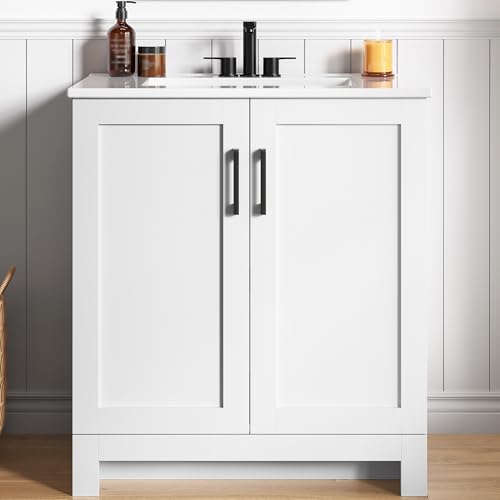
The LIKIMIO earns the top spot by refusing to be interesting in the wrong places. Thirty inches is the sweet-spot width for a single-sink bathroom — wide enough for real counter space on both sides of the basin, narrow enough for the average full bath — and this cabinet pairs it with an integrated ceramic sink, the material you want at this budget, and two soft-close doors, the hardware you want at any budget. It stands on the floor rather than hanging on the wall, which keeps installation in DIY territory and tolerates the imperfect floors of real houses. For a first renovation, a rental upgrade, or a family bathroom that needs to stop being an embarrassment, this is the balanced buy.
Strengths
- Integrated ceramic sink — the durable, easy-clean choice at this tier
- Soft-close doors, the feature that makes a vanity feel non-cheap daily
- Freestanding install forgives uneven floors and DIY plumbing
Trade-offs
- Doors rather than drawers — storage is a single open volume behind them
- White finish shows every splash and hair in a busy family bath
- Faucet and drain not included — budget for them separately
The deeper story is total cost. A vanity like this arrives, assembles or unboxes, connects to standard plumbing, and then asks nothing of you for years except wiping the ceramic and keeping the cabinet front dry. Compare that with the true cost of the cheapest flat-pack alternatives — replaced hinges, swollen edges, a stained sink — and the value argument makes itself. The open cabinet interior is the one compromise: add a small organizer bin or a U-shaped shelf around the trap and the space works far better than it first appears. If your bathroom fits 30 inches and your priority is a vanity that simply does its job well for years, start and very possibly finish here.
Best for: best overall value at an honest total cost / Not suited for: bathrooms whose width or plumbing position does not match this cabinet. Check on Amazon — check price on Amazon.

Yaheetech 24″ Bathroom Vanity with Sink, White — Best for Small Bathrooms
Twenty-four inches is the width of powder rooms, half baths, small rentals, and the second bathrooms of older homes — and it is the width where cheap vanities usually disgrace themselves, because everything gets miniaturized except the compromises. The Yaheetech avoids the worst of it: a real ceramic basin rather than a plastic-feeling resin one, two doors plus a drawer so there is at least one place for small items that is not the counter, and soft-close hardware on both. It is a freestanding cabinet, so it installs like furniture and can even move with a renter who is allowed to swap fixtures.
Strengths
- Real ceramic basin at a width where resin is the norm
- Doors plus a drawer — rare small-item storage at 24 inches
- Soft-close hardware throughout, unusual at this size and tier
Trade-offs
- Counter space is minimal — a soap dispenser is a spatial negotiation
- MDF construction demands discipline about standing water
- Faucet and drain are separate purchases
Judge a 24-inch vanity by what it makes possible rather than what it holds. In a powder room it turns a pedestal-sink afterthought into a bathroom with somewhere to put spare towels, cleaning supplies, and a guest’s dignity. The drawer is the quiet hero: toothpaste, a hairbrush, and the small clutter of daily life disappear, and the tiny counter stays clear, which is what makes a small bathroom feel designed rather than cramped. Keep a hand towel discipline — dry the counter after use — and an MDF cabinet at this size will serve for years. For small bathrooms this is the value pick because it spends its limited budget on the sink and hardware, where you feel it, instead of on styling you cannot.
Best for: best for small bathrooms at an honest total cost / Not suited for: bathrooms whose width or plumbing position does not match this cabinet. Check on Amazon — check price on Amazon.

Vabches 30 Inch Fluted Bathroom Vanity with Sink — Best Floating Design
Floating vanities earn their premium in two currencies: the floor underneath stays visible, which makes a small bathroom read larger, and cleaning under the cabinet becomes a mop pass instead of a hands-and-knees job. The Vabches spends its budget on the two things floating buyers actually want — a fluted front that gives the cabinet a designed, furniture-like face, and four drawers, because drawers are the storage form that works in a bathroom and doors mostly pretend to. At 30 inches with a sink included, it is the value route into the floating look without stepping up to custom cabinetry money.
Strengths
- Four drawers — the most usable storage layout in this guide
- Fluted front reads as designed furniture, not a budget box
- Floating mount frees the floor and speeds cleaning
Trade-offs
- Wall anchoring must hit studs or proper blocking — no shortcuts
- Floating cabinets expose plumbing; neat pipework matters visually
- Drawer cutouts for plumbing reduce the deepest storage
The honest cost of floating is installation seriousness. A loaded 30-inch vanity hangs its entire weight — cabinet, sink, water, and everything in the drawers — on the wall fixings, so this is a studs-and-level job, ideally with a second pair of hands. In return you get the bathroom that photographs like a renovation rather than a replacement. The fluted texture also hides the fingerprints and water spots that plague flat white fronts, a practical detail disguised as a style choice. Choose the Vabches when the bathroom is small, the floor deserves showing, and you are willing to install once and install properly.
Best for: best floating design at an honest total cost / Not suited for: bathrooms whose width or plumbing position does not match this cabinet. Check on Amazon — check price on Amazon.
eclife 30″ Floating Bathroom Vanity with Sink Combo — Best Modern Look
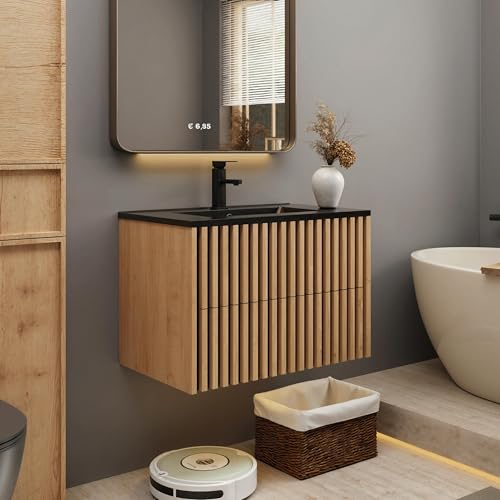
Where the Vabches is tailored, the eclife is sharp: clean lines, fluted drawer fronts again — the texture is having a well-earned moment — and a black undermount sink that makes the whole piece read modern rather than merely new. Two drawers at 30 inches is fewer than the Vabches’ four, but they are wide, full-extension-feeling spaces that suit couples sharing one sink and a pile of daily kit. The black basin is the talking point: it hides water spots and toothpaste evidence better than white, and it anchors a monochrome or high-contrast scheme in a way a white sink never will.
Strengths
- Black undermount sink hides daily evidence and anchors modern schemes
- Two wide drawers suit shared single-sink routines
- Floating mount and fluted fronts deliver the current look honestly
Trade-offs
- Black shows limescale in hard-water areas — wipe-down discipline required
- Two drawers is less granular storage than four
- Modern styling will date faster than the classics on this list
Value here is about cost per compliment as much as cost per year: this is the pick for a guest bathroom or an Airbnb-style refresh where the room has to impress on arrival and the budget has to survive contact with reality. The black sink is a genuine functional trade, not pure styling — brilliant in soft-water areas, a commitment in hard-water ones, so know your water before you fall for the photograph. Installation carries the same floating-cabinet rules: studs, level, two people. Get those right and the eclife delivers the boutique-hotel gesture at a thoroughly non-boutique total.
Best for: best modern look at an honest total cost / Not suited for: bathrooms whose width or plumbing position does not match this cabinet. Check on Amazon — check price on Amazon.

DELUXE LIVING 36 Inch Modern Bathroom Vanity with Sink, Grey — Best Mid-Size Value
Thirty-six inches is where a single-sink vanity stops feeling like a compromise: two people can stand at it in sequence without choreography, the counter holds actual objects, and the cabinet swallows towels and supplies in bulk. The DELUXE LIVING in grey pairs that width with an integral SMC (sheet-molding-compound) sink top — a smooth, stain-resistant surface with the basin molded in, so there is no caulk line where a separate sink meets a counter — plus soft-close doors and drawers and adjustable feet, the unglamorous feature that makes a freestanding cabinet sit level and silent on an imperfect floor.
Strengths
- Integral SMC top — no sink-to-counter seam to trap grime
- Soft-close doors and drawers plus adjustable leveling feet
- Grey finish hides the daily evidence white cannot
Trade-offs
- 36 inches needs a genuinely mid-size bathroom — measure twice
- Heavier and a two-person carry to install
- Grey limits you to cooler-toned schemes unless you embrace contrast
This is the value pick for the family bathroom that does real work: school mornings, shared routines, a decade of service expected. The integral top deserves emphasis, because the seam between a drop-in sink and a laminate counter is where value vanities go to die — water creeps in, the edge swells, and the cabinet follows. Molding the whole top as one piece deletes that failure mode at the drawing board. Adjustable feet sound minor until you have shimmed a rocking cabinet on a sloped old floor; here the fix is built in. If your bathroom fits 36 inches and the budget fits one honest step up from the floor of the market, this is where the step lands.
Best for: best mid-size value at an honest total cost / Not suited for: bathrooms whose width or plumbing position does not match this cabinet. Check on Amazon — check price on Amazon.
24 Inches Modern MDF Bathroom Vanity with Sink, Floating — Best Budget Floating Pick
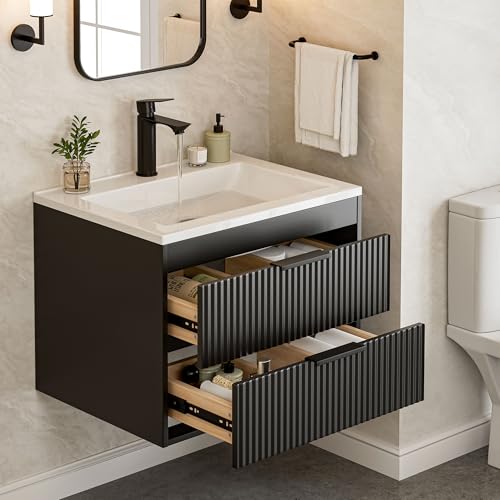
The second 24-inch pick takes the opposite route from the Yaheetech: wall-mounted instead of freestanding, resin sink instead of ceramic, and a low, wide double-drawer layout with black handles that reads Scandinavian and deliberate. The resin sink is the honest compromise — it keeps the price and the hanging weight down, and at 24 inches in a powder room or a rental refresh, where the vanity’s job is mostly to look intentional and hold a drawer of supplies, that compromise is defensible. What you get in return is the floating look at the smallest size and the gentlest total in this guide.
Strengths
- Floating look at 24 inches and the lightest install weight here
- Double drawers beat a door cabinet for small-item storage
- Black-handle styling looks designed rather than discounted
Trade-offs
- Resin sink will not age as gracefully as ceramic
- MDF plus wall-mount demands both dry counters and solid anchoring
- Minimal counter — a powder-room piece, not a family workhorse
Place this vanity where its compromises do not matter and its virtues do: the half bath guests use, the rental you are refreshing between tenants, the tiny ensuite where a floating cabinet returns precious visual floor. In those rooms the resin sink sees hand-washing rather than a decade of family warfare, and the drawers hold exactly what such rooms need. Value is contextual, always: the cheapest pick on this list is the smartest buy in the rooms it was designed for, and a false economy in the rooms it was not, and the discipline of matching pick to room is worth more than any single feature in any single cabinet here. The Final Recommendation below draws that line explicitly.
Best for: best budget floating pick at an honest total cost / Not suited for: bathrooms whose width or plumbing position does not match this cabinet. Check on Amazon — check price on Amazon.
Comparison Table
| Pick | Badge | Key spec | Best for |
|---|---|---|---|
| LIKIMIO 30″ Bathroom Vanity with Sink | Best Overall Value | 30 in freestanding, integrated ceramic sink, 2 soft-close doors | Best Overall Value |
| Yaheetech 24″ Bathroom Vanity with Sink | Best for Small Bathrooms | 24 in freestanding, ceramic basin, 2 doors + 1 drawer, soft-close | Best for Small Bathrooms |
| Vabches 30 Inch Fluted Bathroom Vanity with Sink | Best Floating Design | 30 in wall-mounted, fluted front, 4 drawers | Best Floating Design |
| eclife 30″ Floating Bathroom Vanity with Sink Combo | Best Modern Look | 30 in wall-mounted, 2 fluted drawers, undermount black sink | Best Modern Look |
| DELUXE LIVING 36 Inch Modern Bathroom Vanity with Sink | Best Mid-Size Value | 36 in freestanding, integral SMC sink, soft-close doors and drawers, adjustable feet | Best Mid-Size Value |
| 24 Inches Modern MDF Bathroom Vanity with Sink | Best Budget Floating Pick | 24 in wall-mounted, double drawers, black handles, resin sink | Best Budget Floating Pick |
How to Choose a Value Bathroom Vanity Without Buying Twice
Measure three things, in this order. The alcove or wall width, minus a finger’s width of honesty; the depth, remembering that a standard vanity is about 21 inches deep and a door or drawer must clear it; and the plumbing — the height of the drain stub-out and the spread of the supply lines, because drawers and shelves collide with traps in ways that only become obvious with the cabinet in the room. Photograph the plumbing before you order and compare it with the cabinet’s interior diagram on the listing.
Spend on the sink before the styling. You touch the sink every day and the fluting only with your eyes. Ceramic first, quality stone-resin or SMC second, thin resin only where the duty is light. A value vanity with a good sink and a plain front will satisfy for a decade; the reverse pairing satisfies for a season.
Drawers beat doors for daily storage. A door cabinet is a cave: things at the back are things you have lost. Drawers with U-shaped plumbing cutouts keep daily items visible and reachable. If you choose doors for budget reasons, plan a bin or shelf insert from day one rather than discovering the cave problem in month two.
Decide freestanding versus floating by your walls and floors, not by fashion. Freestanding forgives sloped floors, weak walls, and solo installation. Floating demands studs or blocking and rewards you with visual space and easy floor cleaning. Old plaster walls and rental rules point one way; new stud walls and small bathrooms point the other. Both are legitimate — the mistake is choosing against your house.
Price the whole job. Faucet, drain assembly, supply lines, a mirror, and possibly a backsplash are rarely in the box. A vanity that looks 20 percent cheaper can cost the same installed if its rival includes more hardware. Read the “what’s included” list literally, photograph your existing plumbing before you order so the comparison is in front of you rather than in your memory, and let the installed total — not the cabinet price, and not the styled photograph of someone else’s finished bathroom — make the value judgment.
How to Install a Value Vanity So It Lasts
Start dry and level. Set a freestanding cabinet in place, level it on its adjustable feet or shims, and only then mark plumbing holes; for a floating cabinet, find and mark the studs first and confirm the mounting rail height against your sink rim target — around 32 to 36 inches is the comfortable modern range, matched to the household. Connect the faucet and drain to the sink before the cabinet goes against the wall whenever the design allows; working in the open beats working blind inside a cabinet. Use new supply lines and a fresh trap rather than reusing the old ones — they are the cheapest insurance in the whole job. Seal the junction between the vanity top and the wall with a bead of sanitary silicone, and seal any raw cut edges you made for plumbing with silicone or varnish, because unsealed MDF edges near water are where budget cabinets begin to swell. Finally, run the taps, fill and drain the basin twice, and check every joint with a dry hand and a flashlight before you put a single bottle inside.
DIY or Plumber? Drawing the Line Honestly
A like-for-like vanity swap — same width, same plumbing positions, sound shut-off valves — is one of the most satisfying DIY jobs in the house: an afternoon, basic tools, and no permits in most jurisdictions. The line to professional help sits in three places. First, the shut-off valves: if they are corroded, seized, or absent, the job now starts with the house’s main valve and a plumbing repair, and that is a plumber’s hour well bought. Second, moving the drain or supplies — even a few inches — converts a swap into pipework, and pipework inside a wall is where DIY confidence goes to be educated. Third, floating cabinets in old walls: if you cannot find studs where the cabinet needs them, or the wall is lath and plaster of unknown integrity, have the anchoring assessed rather than discovered by gravity. Everything else — leveling, sealing, connecting a faucet and trap in the open, caulking the backsplash line — is patient-person work, and doing it yourself is part of how the value segment keeps its promise. Budget the plumber for the jobs on their side of the line and the arithmetic of this entire guide still holds.
Common Buying Mistakes
Buying the width in the photograph. Listings show several sizes; the price that caught your eye belongs to one of them. Confirm the exact width of the variant in your cart against your measured alcove.
Assuming the faucet is included. On value vanities it usually is not, and neither is the drain. Discovering that at installation time costs a weekend.
Ignoring the plumbing collision. Deep drawers and low shelves meet traps and supply lines. Compare the interior diagram with your stub-out heights before ordering, not after delivery.
Floating a cabinet on drywall anchors. A loaded vanity is heavy and gets leaned on. Studs or proper blocking are not optional, and a vanity that pulls away from the wall costs more than the installation you saved.
Letting water sit on MDF. Engineered cabinets survive bathrooms by shedding water, not absorbing it. Wipe the counter, seal cut edges, and keep the sink overflow honest — the discipline is the durability.
Final Recommendation
For the typical full bathroom, the LIKIMIO 30-inch is the value center of this guide: ceramic sink, soft-close doors, freestanding forgiveness, and nothing in the design that will embarrass you in five years. Small bathrooms and powder rooms should take the Yaheetech 24-inch for its ceramic basin and drawer, unless the floating look is the point of the renovation — then the 24-inch floating pick serves light-duty rooms, and the Vabches 30-inch, with its four drawers, serves full ones. Choose the eclife when the room needs to impress and your water is soft, and step up to the DELUXE LIVING 36-inch when two people share the morning and the bathroom honestly fits it. In every case, price the faucet and drain into the decision, anchor and seal like you mean it, and the value segment will do what it promises: a bathroom that feels renovated, at a total that still feels sensible, with hardware and a sink that will still be earning that verdict years after the paint color has been changed twice.
Related guides in this series: Best 18 Inch Bathroom Vanities · Best Bathroom Double Vanities · Best Value Bathroom Vanities · Best Sinks Faucets For Small Bathroom · Best Bathtubs For Old Homes
Cabinet Materials, Honestly Compared
The cabinet box decides how a value vanity ages, and the three constructions in this segment age very differently. MDF — medium-density fiberboard — is the budget material: flat, stable, takes a smooth painted or laminated finish beautifully, and is genuinely fine in a bathroom as long as its sealed surfaces stay sealed. Its weakness is singular and well known: water that reaches a raw edge or a chipped corner wicks in and swells the board, and the damage does not reverse. MDF vanities therefore reward tidy households and punish splashy ones, and their low price is partly a payment for your future discipline. Plywood, especially with a hardwood veneer or painted finish, tolerates humidity and the occasional leak far better, resists screw pull-out at hinges, and is the construction to seek when the budget stretches — it is the quiet dividing line between the disposable end of this market and the durable end. Solid wood framing, found at the top of the value segment, adds repairability: a door can be re-hung, a finish can be renewed, and the cabinet can plausibly outlive the bathroom around it.
Two construction details matter as much as the headline material. The first is the finish inside the cabinet, not just outside: an interior that is sealed or laminated shrugs off the drips from stored bottles and the condensation of plumbing, while a raw interior absorbs both. The second is the back panel — or its absence. Open-back designs install easily around plumbing and ventilate the cabinet, which is good; fully closed backs look tidier and must be cut for pipes, which creates the raw edges that need sealing. None of this is visible in listing photographs, which is why the reviews above call out construction wherever the listing states it, and why the honest verdict for the MDF picks is always paired with the wipe-down discipline that makes them last.
Sink Materials, Honestly Compared
Vitreous ceramic is the benchmark the others are measured against: fired, glazed, hard, and essentially indifferent to toothpaste, hair dye, and a decade of cleaning. It chips if you drop something heavy and hard into it, and otherwise asks nothing. It is also heavy, which is one reason the smallest floating cabinets avoid it. Stone-resin and SMC tops — the DELUXE LIVING’s integral top is the example here — mold the basin and counter as one seamless piece, deleting the caulk seam that fails on assembled tops; they feel warm rather than cold, resist staining well, and can be lightly refinished if they dull. Their weakness is heat and harsh abrasives over years, a fair trade for the seam they remove. Basic resin and gel-coat sinks, found on the lightest budget picks, start life looking identical to the better materials and age fastest: they dull, they take stains, and they are the component most likely to make a five-year-old vanity look tired while its cabinet is still sound. That is precisely why this guide restricts resin-sink picks to powder rooms and light duty, and says so in plain language — a resin sink in a gentle room is a rational economy; the same sink under a family of five is a scheduled replacement.
Matching the Vanity to the Room: Powder Room, Family Bath, Rental
The powder room is the value segment’s happiest hunting ground. Duty is light, guests judge the room in ninety seconds, and storage needs are a spare roll and a hand towel. A 24-inch cabinet with a drawer — or the floating 24 for the look — transforms the room for the smallest total in this guide, and material compromises that would fail elsewhere are safe here. The family bathroom is the opposite brief: maximum storage, maximum durability, hardware that survives being slammed by people who are late for school. Spend on the sink and the soft-close hardware, choose doors or drawers by how your household actually stores things, and take grey or textured fronts over flat white if your family’s evidence bothers you. The rental sits between the two: durability matters because tenants will not baby anything, but so does reversibility — a freestanding cabinet that can be uninstalled cleanly beats a floating one anchored into unknown walls, and ceramic beats resin because you will not be there to enforce the wipe-down rule. The same six picks serve all three rooms; the Final Recommendation maps them, and the mapping — not the ranking — is the part of this guide to follow most closely.
Storage Layouts That Actually Work in a Small Cabinet
A vanity’s storage is won or lost in the first week, when you decide what lives where — and most people lose it by treating the cabinet as a cupboard rather than a system. The trap and supply lines occupy the center of every vanity, so the usable volume is really two side columns and whatever the drawers give you. In a door cabinet, fit a U-shaped or stepped organizer that wraps the trap, put daily items in the front third where your hand lands without looking, and exile bulk — spare towels, cleaning bottles, back-stock toilet paper — to the back and sides. In drawer vanities, reserve the top drawer for the morning routine only; the moment it accepts overflow, it becomes a junk drawer with a sink on top. Hair dryers and styling tools deserve a heat-safe home of their own, ideally a drawer or a door-mounted holder, because they are the items most often left on the counter to make a small bathroom look cluttered.
Counter discipline completes the system. A value vanity’s counter is small by definition, so adopt a rule of three: no more than three objects live on it permanently — typically soap, a toothbrush holder, and one more. Everything else earns a place inside or leaves the room. It sounds austere, and it is the entire difference between a 24-inch vanity that feels like a boutique powder room and one that feels like a storage accident. The vanities in this guide were chosen partly for how well they support that discipline — drawers where drawers matter, doors with interiors that accept organizers, and counters sized honestly for the rule of three.
The Hidden Costs of a “Cheap” Vanity: Delivery, Disposal, and the Second Trip
Value math that stops at the cabinet price is how a bargain becomes a saga, so run the full ledger before you order. Delivery first: a vanity is furniture, and furniture arrives by freight or oversized parcel, sometimes to the curb rather than the door. Confirm the delivery terms on the listing, plan a second pair of hands for anything 30 inches and up, and inspect the box before the driver leaves — a cracked ceramic sink discovered after installation begins is a project-stopper, while the same crack reported at delivery is a replacement. Keep every piece of the packaging, including the corner protectors and the sink crate, until the vanity is installed and plumbed; returns of installed cabinetry are misery you can schedule out of your life with a week of patience.
Disposal second: the old vanity has to go somewhere. A cabinet and ceramic top are bulky waste that many municipal pickups will not take curbside, and a cast-iron or stone top adds genuine weight. Price a bulk pickup or a trip to the transfer station into the project, or time the swap to a renovation skip if one is on site. Third, the second trip: every vanity project contains one — the trap that does not align, the supply line an inch short, the drill bit you do not own. The experienced move is to buy the consumables generously in advance (trap kit, two lengths of supply line, silicone, shims, wall anchors rated for the load) and return the unopened surplus; the inexperienced move is discovering each item separately at 7 p.m. on a Sunday. None of these costs is large. Together they are routinely the difference between the vanity that was “great value” and the identical vanity that “ended up costing a fortune” — the product was the same; the ledger was not.
Frequently Asked Questions
What is a realistic budget for a value bathroom vanity?
Value in this category means the segment below custom and big-brand flagship lines: flat-pack and mid-tier cabinets with sinks included, where the real decision is materials rather than brand. Judge by installed total — cabinet, faucet, drain, and supplies — rather than the cabinet price alone, and check price on Amazon for the current figure on any pick here.
Is MDF acceptable in a bathroom vanity?
Yes, with conditions. Sealed, well-finished MDF in a ventilated bathroom that gets wiped down will serve for years; raw or damaged edges near water will swell. Plywood and solid wood tolerate abuse better and cost more. The picks here flag which construction each cabinet uses so the trade is explicit.
Does a value vanity come with a faucet?
Usually not. Most listings in this segment include the cabinet and sink only. Confirm the included-items list on the listing, and budget for a faucet, drain assembly, and fresh supply lines as part of the real total.
Floating or freestanding — which is better value?
Freestanding is cheaper and easier to install correctly, and forgives old floors and walls. Floating costs more effort in anchoring and rewards small bathrooms with visual space and easy cleaning. Value depends on your house: the wrong mount for your walls is the expensive one.
What width vanity does a small bathroom need?
Powder rooms and tight full baths usually land at 24 inches; a standard single bathroom is happiest at 30; 36 inches suits shared mornings where the room allows it. Measure the alcove and door swing first — the correct width is the one that fits with clearance, not the largest that can be forced in.
How long should a value vanity last?
A ceramic-sink cabinet with soft-close hardware, installed level and sealed, should give a decade of ordinary service. Resin sinks and unsealed MDF shorten that horizon, which is why this guide reserves those picks for light-duty rooms and says so in their verdicts.
Can I replace just the sink top on an existing cabinet?
Sometimes — vanity tops are sold separately in standard widths, and a sound cabinet with a tired top is exactly the case for one. Measure the cabinet’s outside width and depth, confirm the new top’s overhang, and check that the faucet drilling matches your faucet or your plans. If the cabinet itself is swollen, rocking, or hinge-torn, a new top is money on a failing base; replace the whole vanity instead.
