Disclosure: airfryerkitchensupply.com is reader-supported. When you buy through links on our site, we may earn an affiliate commission at no extra cost to you.
Where to buy
Every machine below was verified before earning a link, and every anti-clog claim in the reviews traces to the listing itself. Prices are never printed — check the current figure once you have matched a machine to your home’s hair and dust load.
- Tineco A30S Cordless Vacuum — Check the current price on Amazon
- Levoit Cordless Vacuum Cleaner (LVAC-200) — Check the current price on Amazon
- Roborock Q7 L5 Robot Vacuum and Mop — Check the current price on Amazon
- Shark Navigator Zero-M Pet Pro (ZU62) — Check the current price on Amazon
- BISSELL PowerClean FurFinder (4282K) — Check the current price on Amazon
- Tineco Pure ONE S15 Essentials — Check the current price on Amazon
The best vacuums that dont clog are not the ones with the biggest motors; they are the ones designed around the three places vacuums actually block. First, the brush roll, where hair winds itself into a felted sleeve until the brush stalls. Second, the filter, where fine dust builds an invisible blanket that strangles suction weeks before any visible blockage. Third, the bin and airway, where debris packs into corners and elbows until the machine gives up mid-room. This guide ranks six verified machines by how their listings answer those three failure points — anti-tangle and self-cleaning brushrolls, cyclonic separation that keeps dust off filters, and bins with honest capacity. Every claim was cross-checked against the Amazon catalogue.
One honesty note before the picks: no vacuum is clog-proof. Anti-clog design stretches maintenance intervals from days to weeks; it does not abolish maintenance. The how-to section in this guide is the other half of the promise — the five-minute routine that keeps an anti-clog machine honest for years.
Key Takeaways
- Vacuums clog in three places: the brush roll (hair), the filter (fine dust) and the bin/airway (packed debris). Judge every machine against all three.
- Anti-tangle and self-cleaning brushrolls are the headline fix for pet and long human hair.
- Cyclonic separation protects the filter — the invisible clog that fades suction long before anything visibly blocks.
- Bigger bins clog later; daily robot runs clog least, because debris never accumulates into a load.
- Anti-clog design buys longer intervals, not exemption: a five-minute monthly routine keeps the promise, and a two-thirds-full bin emptied today prevents the packed-bin clog that would have arrived next week.
- Know your home’s signature debris — litter, needles, long hair, craft dust — because each one clogs in its own place and on its own schedule.
In this guide
Quick Picks
Two Tineco sticks with different depths of anti-clog engineering, a lightweight Levoit, an anti-tangle robot, a self-cleaning Shark upright and a corded Bissell. Match the machine to where your current vacuum blocks.
Tineco A30S Cordless Vacuum — Best Overall Anti-Clog Stick. A cordless stick built around clog prevention on three fronts: a ZeroTangle brush for hair, PureCyclone separation to keep debris off the filter, and a larger 1L dustbin — with 200AW suction and up to 60 minutes of runtime as listed. Check price on Amazon.
Levoit Cordless Vacuum Cleaner (LVAC-200) — Best Lightweight Anti-Tangle. A lightweight rechargeable stick whose listing leads with anti-tangle pet-hair performance, up to 50 minutes of runtime and a 180-degree lay-flat design for reaching under furniture without stirring up blockages. Check price on Amazon.
Roborock Q7 L5 Robot Vacuum and Mop — Best Robot Anti-Tangle. A robot with a dual anti-tangle system and 8,000Pa suction as listed, plus LiDAR navigation and multi-level mapping — daily automated cleaning that stops hair clogs at the brush before they start. Check price on Amazon.
Shark Navigator Zero-M Pet Pro (ZU62) — Best Self-Cleaning Brushroll Upright. A corded upright whose Zero-M brushroll is described as self-cleaning — engineered to strip hair from itself as it works, in a pet-focused Navigator platform. Check price on Amazon.
BISSELL PowerClean FurFinder (4282K) — Best Corded Stick for Pet Hair. A corded stick with a tangle-free brush for pet hair pickup as listed, HEPA filtration as listed, a 30-foot cord, self-standing design and bright headlights — unlimited runtime with the clog points engineered down. Check price on Amazon.
Tineco Pure ONE S15 Essentials — Best Smart-Sensing Stick. A cordless stick with an anti-tangle brush and LED headlights as listed, from Tineco’s Pure ONE line — the second anti-tangle stick here, with its own take on keeping the brush clear and the path lit. Check price on Amazon.
How These Picks Were Chosen
Selection began in Amazon listing data cache with a hard filter: a machine’s listing had to state an anti-clog feature — an anti-tangle or self-cleaning brush, cyclonic separation, or a capacity designed against packing. Powerful machines with no stated anti-clog design were excluded, however impressive, because this search is a design brief, not a suction contest. The survivors were organised across the formats real homes use: cordless sticks, a corded stick, an upright and a robot, so that the answer exists for every household shape.
Two transparency notes. The Shark ZU62’s cache record carries no recorded verification date — it is marked “not recorded” — and its listing is brief; its review claims the self-cleaning brushroll the listing states and flags the rest. And two picks share the Tineco brand because that brand’s listings state anti-tangle engineering most consistently in the verified catalogue; the S15’s review explains why it earns an independent place rather than serving as padding. Where a listing omits a figure — a runtime, a bin size — the spec box omits it too.
The 6 Best Vacuums That Don’t Clog
Each review names the clog points the machine addresses, three strengths, three trade-offs, the specifications exactly as listed, and a verdict. If a number is not in the listing, it is not in the review.

Tineco A30S Cordless Vacuum — Best Overall Anti-Clog Stick
Clogging is not one failure; it is three — hair wrapping the brush until it stalls, fine dust blinding the filter until suction fades, and a bin so small it packs solid by the second room. The Tineco A30S is the only pick here whose listing attacks all three by name: a ZeroTangle brush, PureCyclone technology that separates debris from the airflow before it reaches the filter, and a larger 1L dustbin. Around that anti-clog core sit the numbers that make it a complete stick vacuum: 200AW suction and up to 60 minutes of runtime as listed, positioned for pet hair, carpet and hard floor.
Who it suits: pet households and mixed-floor homes wanting one cordless machine whose maintenance intervals are measured in weeks, not days. Who it does not suit: anyone who never empties bins until the machine begs — a 1L bin delays clogging, it does not abolish housekeeping — or buyers wanting a self-emptying dock, which this model does not list.
Strengths
- ZeroTangle brush addresses the hair-wrap clog at its source
- PureCyclone separation keeps dust off the filter, holding suction longer between cleans
- 1L larger dustbin means fewer packed-bin clogs and fewer emptying interruptions
Trade-offs
- Cordless runtime is finite — large homes may need a mid-clean recharge plan
- Anti-tangle systems still need an occasional check; hair finds a way eventually
- No self-empty dock listed, so emptying remains a manual job
Key specs (as listed)
- Suction as listed: 200AW
- Runtime as listed: up to 60 minutes
- Dustbin as listed: 1L
- Brush/tech as listed: ZeroTangle brush, PureCyclone
The PureCyclone point deserves emphasis, because filter-blinding is the clog nobody sees. A vacuum can have a clear brush and an empty bin and still clean badly because its filter is wearing a felt jacket of fine dust — suction fades, pickup fades, and the owner concludes the motor is dying. Cyclonic separation that spins debris out of the airflow before the filter is the engineering answer, and pairing it with a tangle-resistant brush and a bin with genuine capacity is what a complete anti-clog design looks like. The A30S is therefore the guide’s overall pick not because it tops any single number, but because it is the only machine here that treats clogging as the system problem it actually is.
Best for: Pet homes wanting the most complete anti-clog system in one stick / Not suited for: Dock seekers or owners who never empty bins
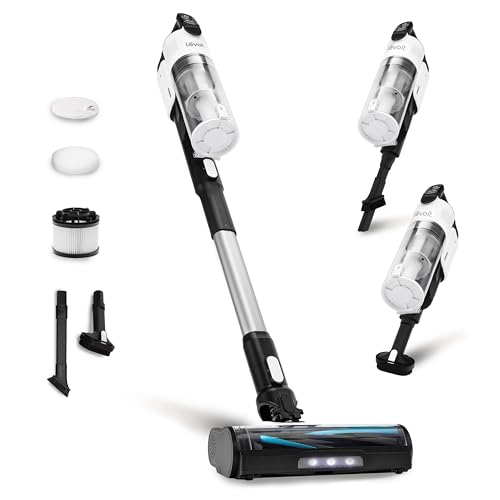
Levoit Cordless Vacuum Cleaner (LVAC-200) — Best Lightweight Anti-Tangle
The Levoit LVAC-200 makes its anti-clog case simply: an anti-tangle design for pet hair, stated at the front of its listing, in a lightweight rechargeable stick that runs up to 50 minutes and lies flat at 180 degrees to slide under furniture. That lay-flat party trick matters to this search more than it first appears — the debris that clogs vacuums concentrates exactly where uprights cannot reach, under sofas and beds, in the form of hair tumbleweeds and dust drifts that arrive at the brush in one overwhelming clump. A stick that cleans those zones weekly meets them while they are still small.
Who it suits: flat-dwellers, pet owners in smaller homes, and anyone who wants anti-tangle performance without a heavy machine. Who it does not suit: large homes needing the A30S’s bigger bin and longer runtime, or deep-pile carpet specialists — this is a versatile hard-floor-and-carpet stick, not a carpet monster.
Strengths
- Anti-tangle design for pet hair stated in the listing
- 180-degree lay-flat reach keeps under-furniture debris from becoming clog-sized
- Lightweight build encourages the frequent light cleans that prevent clogs forming
Trade-offs
- Smaller format means a smaller bin than the A30S — empty it more often
- Up to 50 minutes is a ceiling, not a guarantee, on high power
- Versatile rather than specialised: deep-pile owners should look at carpet-first machines
Key specs (as listed)
- Runtime as listed: up to 50 minutes
- Design as listed: anti-tangle for pet hair; 180 lay-flat
- Format: lightweight cordless stick, rechargeable
- Model as listed: LVAC-200
There is a behavioural truth in this pick: the vacuum that gets used is the vacuum that prevents clogs. A heavy, corded machine comes out weekly and meets a week’s accumulation at once — the exact conditions for a packed bin and a wrapped brush. A light stick that lives within reach comes out for five minutes after the dog shakes, after the litter scatters, after the hallway grit arrives — and debris that is removed in teaspoons never becomes the tablespoon that chokes a machine. The LVAC-200’s anti-tangle head handles the hair; its weight and lay-flat reach handle the human. For smaller homes with pets, that combination is worth more than raw specification, and it is why this lighter machine outranks heavier rivals for its audience.
Best for: Smaller pet homes wanting light, frequent, tangle-resistant cleaning / Not suited for: Large homes or deep-pile carpet specialists

Roborock Q7 L5 Robot Vacuum and Mop — Best Robot Anti-Tangle
Robots clog differently: not in dramatic blockages, but in the slow hair-winding of a small brush roll that nobody inspects because nobody pushes the machine. The Roborock Q7 L5 answers with a dual anti-tangle system stated in its listing, alongside 8,000Pa suction, LiDAR navigation, multi-level mapping and self-charging, in a vacuum-and-mop combo upgraded from the Q5 Pro. A robot’s deeper anti-clog virtue is frequency: a machine that cleans daily never meets a week’s hair at once, and its bin, though small, is emptied as a rhythm rather than as an emergency.
Who it suits: pet households wanting hair handled daily without lifting a finger, and multi-level homes the mapping can learn. Who it does not suit: anyone expecting a robot to replace deep cleaning — stairs, upholstery and edges still belong to a stick or upright — or buyers who will not maintain a robot at all; anti-tangle reduces brush care, it does not delete it.
Strengths
- Dual anti-tangle system as listed targets the robot’s classic hair-wrap failure
- Daily automated runs prevent debris accumulating into clog-sized loads
- LiDAR navigation and multi-level mapping cover homes methodically, including under furniture
Trade-offs
- Small robot bin fills fast in shedding season — the rhythm only works if you keep it
- Mop combo adds its own maintenance (pads, water) beyond vacuuming
- No self-empty dock in this listing, unlike some rivals
Key specs (as listed)
- Suction as listed: 8,000Pa
- Brush system as listed: dual anti-tangle
- Navigation as listed: LiDAR, multi-level mapping
- Format: robot vacuum and mop combo, self-charging
Judge a robot on this search by what happens in month three. In week one, every robot delights. By month three, the hair of a shedding pet has wound the brushes of lesser machines into felted rollers, suction has faded, and the robot pushes dirt around a home it used to clean. A dual anti-tangle design is aimed precisely at that month-three wall, and daily scheduling is the second wall-defence: hair removed in daily grams never becomes the weekly kilogram that defeats brushes and bins. Keep your side of the small bargain — empty the bin on rhythm, glance at the brushes monthly — and the Q7 L5 is the closest thing in this guide to a clog problem that simply stops occurring.
Best for: Pet households wanting daily automated anti-tangle cleaning / Not suited for: Anyone expecting a robot to be their only vacuum

Shark Navigator Zero-M Pet Pro (ZU62) — Best Self-Cleaning Brushroll Upright
Shark’s Zero-M idea is the most direct answer to brush-wrap ever put in an upright: a brushroll described as self-cleaning, designed to remove hair from itself during operation rather than storing it for your scissors. The ZU62 Navigator Zero-M Pet Pro wraps that brushroll in Shark’s upright platform, in a pewter grey finish, aimed squarely at pet homes — the homes where brush-wrap is not an occasional annoyance but a weekly ritual with scissors and regret.
Who it suits: heavy-shedding households, long-hair households (human hair wraps as enthusiastically as pet hair), and corded-upright loyalists who want unlimited runtime. Who it does not suit: cordless converts, or anyone wanting the specification depth of the newer sticks — this listing is comparatively brief, and its review claims the self-cleaning brushroll and the platform, not invented numbers.
Strengths
- Self-cleaning Zero-M brushroll as listed attacks hair-wrap continuously, not at maintenance time
- Corded upright: no runtime ceiling for whole-house sessions
- Pet Pro positioning matches the heaviest hair loads in real homes
Trade-offs
- Listing is brief — detailed specs are not stated, so check the listing for capacities before buying
- Upright format is heavier to carry between floors than the sticks
- Self-cleaning reduces brush maintenance; filters and bins still need their routine
Key specs (as listed)
- Brushroll as listed: Zero-M self-cleaning
- Format: corded upright
- Positioning as listed: Pet Pro
- Colour as listed: Pewter Grey Metallic
A sourcing note in the open, because this guide makes them: the catalogue record for the ZU62 does not carry a recorded verification date in the cache — it is listed there as “not recorded” — and its listing text is short. What is stated is the thing that matters for this search: the Zero-M self-cleaning brushroll. That mechanism is the pick. Every other anti-tangle design in this guide resists hair wrapping; a self-cleaning brushroll actively removes hair during the clean, which is why generations of pet owners have sought the platform out. If your current upright’s brush needs scissor surgery monthly, this is the upright designed to retire your scissors — with the honest caveat that bins and filters keep their normal maintenance rights.
Best for: Heavy-shedding and long-hair households loyal to corded uprights / Not suited for: Cordless seekers or spec-sheet-first shoppers

BISSELL PowerClean FurFinder (4282K) — Best Corded Stick for Pet Hair
The FurFinder occupies the sensible middle of this guide: a corded stick — so runtime never ends a session halfway through a shedding emergency — with a tangle-free brush for pet hair pickup stated in its listing, HEPA filtration as listed, a 30-foot power cord, a self-standing design and bright headlights. The headlights are an anti-clog feature in disguise: debris you can see is debris you vacuum in teaspoons, and the shadowed zones under furniture edges are where hair accumulates into brush-stalling drifts.
Who it suits: pet owners who distrust batteries, smaller homes where a 30-foot cord reaches everywhere, and anyone who wants a stick that stands in the corner ready rather than charging in a dock. Who it does not suit: large multi-floor homes where a cord becomes a leash, or buyers wanting cyclonic spec depth — the listing sells tangle-free pet performance, not engineering poetry.
Strengths
- Tangle-free brush for pet hair pickup as listed
- Corded with a 30-foot reach: no runtime ceiling, ever
- Self-standing design and headlights suit ready-in-the-corner, see-the-debris cleaning
Trade-offs
- Cord management is the eternal corded tax
- HEPA wording is as listed — the guide repeats the listing’s term without embellishment
- Stick format bins are modest; shedding season means frequent emptying
Key specs (as listed)
- Brush as listed: tangle-free, for pet hair pickup
- Filtration as listed: HEPA
- Cord as listed: 30-foot
- Design as listed: self-standing, headlights; model 4282K
There is an underrated anti-clog argument for corded sticks: they are always ready at full power. A cordless stick with a fading battery loses suction as it fades, and fading suction is how debris gets left half-lifted in the hose path — the seed of the next blockage. The FurFinder’s cord removes that failure mode entirely, and its self-standing body removes the other great stick annoyance, the slow slide down the wall. Add the tangle-free brush and the headlights that expose the hair drifts, and you have the guide’s most straightforward machine: plug in, see everything, wrap nothing. For a one-pet, one-floor home, straightforward is a compliment of the highest order.
Best for: Battery sceptics and smaller pet homes wanting corded reliability / Not suited for: Large multi-floor homes or cordless devotees

Tineco Pure ONE S15 Essentials — Best Smart-Sensing Stick
The Pure ONE S15 Essentials closes the list with the same anti-clog headline as its A30S sibling — an anti-tangle brush, stated in the listing — in a rechargeable cordless stick with LED headlights, positioned for hard floor, pet hair and home cleaning. Two Tinecos in one guide is a fair reflection of the verified catalogue: few brands put anti-tangle engineering at the front of as many listings. The S15’s pitch is the essentials version of the idea — the brush that resists wrapping, the lights that reveal the hair, the stick format that invites frequent use.
Who it suits: buyers who want anti-tangle performance in a mainstream cordless stick and value the headlight-guided, little-and-often cleaning style. Who it does not suit: shoppers wanting the A30S’s stated big-bin and cyclone specification depth — within this brand’s own line, that model is the anti-clog maximalist; the S15 is the streamlined one.
Strengths
- Anti-tangle brush stated in the listing — the search’s core feature
- LED headlights expose hair drifts before they become brush loads
- Cordless stick format suits the frequent light cleans that prevent clogs
Trade-offs
- Listing does not state bin capacity or runtime figures — check the listing if those numbers decide for you
- Shares its brand with the A30S; the differences are specification depth, not philosophy
- Anti-tangle is resistance, not immunity — periodic brush checks still apply
Key specs (as listed)
- Brush as listed: anti-tangle
- Lights as listed: LED headlights
- Format: cordless stick, rechargeable
- Positioning as listed: hard floor, pet hair, home cleaning
Why include two sticks from one brand in a six-pick guide? Because the honest alternative — padding the list with a machine whose listing makes no anti-clog claim at all — would betray the keyword. The S15 earns its independent place on the strength of its stated anti-tangle brush and its particular balance: lighter on specification theatre, strong on the daily reality of pet hair on hard floors, which is where most hair-clogging begins. Choose between the siblings by appetite: the A30S if you want every anti-clog system named and stacked, the S15 if you want the essential one — a brush that resists the wrap — in a simpler package. Either way, the maintenance covenant in the guide below applies: anti-tangle buys you intervals, not exemptions.
Best for: Mainstream cordless buyers wanting stated anti-tangle performance / Not suited for: Spec-maximalists (the A30S is that pick)
Comparison Table
| Pick | Badge | Key spec | Best for |
|---|---|---|---|
| Tineco A30S Cordless Vacuum | Best Overall Anti-Clog Stick | 200AW, 1L bin, ZeroTangle + PureCyclone as listed | Pet homes wanting the most complete anti-clog system in one stick |
| Levoit Cordless Vacuum Cleaner (LVAC-200) | Best Lightweight Anti-Tangle | Anti-tangle stick, up to 50 min, 180 lay-flat | Smaller pet homes wanting light, frequent, tangle-resistant cleaning |
| Roborock Q7 L5 Robot Vacuum and Mop | Best Robot Anti-Tangle | Robot, 8,000Pa, dual anti-tangle, LiDAR as listed | Pet households wanting daily automated anti-tangle cleaning |
| Shark Navigator Zero-M Pet Pro (ZU62) | Best Self-Cleaning Brushroll Upright | Upright, Zero-M self-cleaning brushroll as listed | Heavy-shedding and long-hair households loyal to corded uprights |
| BISSELL PowerClean FurFinder (4282K) | Best Corded Stick for Pet Hair | Corded stick, tangle-free brush, HEPA as listed, 30 ft cord | Battery sceptics and smaller pet homes wanting corded reliability |
| Tineco Pure ONE S15 Essentials | Best Smart-Sensing Stick | Cordless stick, anti-tangle brush, LED headlights | Mainstream cordless buyers wanting stated anti-tangle performance |
Read the table by your failure mode. Brush wrapped in hair: the Shark’s self-cleaning roll, the Roborock’s dual anti-tangle, or any of the anti-tangle sticks. Suction fading mysteriously: the A30S’s cyclonic separation is the only design here aimed squarely at the filter. Bin packing solid: the A30S’s 1L bin, or the robot’s daily rhythm that never lets a load form.
Format is the second read. The corded Bissell never fades and never charges; the sticks trade cords for freedom and finite runtime; the robot trades deep-clean power for daily prevention. Clogging is a system problem, and this table is six different systems for solving it — choose the one whose maintenance rhythm matches the rhythm you will actually keep.
How to Choose a Vacuum That Won’t Clog: The Three Failure Points
Failure point one: the brush roll. Hair — pet hair, long human hair, thread — winds around a spinning brush until friction and felt do the rest. The design answers are anti-tangle brush geometries, which comb hair toward the suction path instead of letting it wind, and self-cleaning brushrolls, which strip hair during operation. If your current vacuum needs scissors monthly, this failure point is yours, and it should headline your shortlist.
Failure point two: the filter. Fine dust — the grey powder from carpets, litter, plaster, life — coats filters molecule by molecule. Suction fades so gradually that owners blame motors and batteries. The design answers are cyclonic separation that removes debris from the airflow before the filter, and filters that are washable or cheaply replaceable on a sane schedule. If your vacuum cleans worse each month and recovers after a filter wash, this is your failure point.
Failure point three: the bin and airway. Small bins pack; sharp airway elbows catch; hose bends collect. The design answers are capacity, smooth air paths and — in the robot’s case — a cleaning frequency that never lets debris accumulate. If your machine blocks mid-clean on visible debris, this is your failure point. Diagnose honestly, then buy the design that answers your diagnosis; a machine that solves someone else’s clog will leave yours untouched.
Hair: The Number One Clog, and How Anti-Tangle Design Defeats It
Hair defeats brushes by length and patience. A single long hair, caught at one end, wraps once; the next revolution wraps it again and traps its neighbours; within a session the brush wears a sleeve, within a month the sleeve is felt. Short pet hair wraps less elegantly but packs into brush ends and bearings, which is why pet homes clog at the brush housing even when the roll itself looks clear. Anti-tangle designs interrupt the first wrap: comb-like guides and shaped brush surfaces move hair into the suction stream before the second revolution can lock it.
Self-cleaning brushrolls go further, actively cutting or stripping accumulated hair into the bin as they turn — maintenance performed by the machine, during the clean, instead of by you, after it, with scissors, on the kitchen floor. Neither technology repeals physics: brush ends and bearings still collect their toll, and the monthly two-minute check in our how-to remains part of ownership. But the difference between a brush that needs attention monthly and one that needs surgery weekly is the difference between a vacuum you keep and a vacuum you curse — and in shedding season, it is the whole ballgame.
Bins, Filters and Air Paths: The Invisible Half of Clogging
The visible clog gets the attention; the invisible half does the damage. Consider the filter’s slow blinding: a vacuum can pass every visual inspection — brush clear, bin empty, hose open — and still clean at half strength because its filter is wearing dust like a jumper. Owners respond by pressing harder, passing more, and concluding the machine is old. It is not old; it is suffocating politely. Cyclonic systems exist to delay exactly this, spinning the dust load out of the air before the filter sees it, and washable filters exist to reverse it in minutes under a tap.
Air paths hide the second invisible clog: the partial blockage. A wad of fluff at a hose elbow does not stop a vacuum; it taxes it, session after session, until a genuinely large object arrives and completes the seal. This is why the how-to below includes a quarterly air-path check — a broom handle’s worth of attention that finds the wad while it is still a tax rather than a shutdown. Buy for the visible features, by all means; but maintain for the invisible ones, because they are where suction goes to die quietly.
Robots and the Frequency Defence: Why Daily Cleaning Barely Clogs
Every other machine in this guide fights clogging with design; the robot fights it with arithmetic. A stick or upright meets its debris in weekly loads — seven days of hair, grit and dust arriving at the brush in one session. A robot on a daily schedule meets one day of it. The brush never faces a felt-worthy quantity, the bin never packs because it is emptied as rhythm, and the filter blinds at a seventh of the rate. Frequency is not a workaround; it is a legitimate anti-clog strategy, and for pet hair — which arrives daily and wraps eagerly — it is arguably the strongest one.
The defence has conditions. The robot’s small bin must actually be emptied on its rhythm, or frequency collapses into a small machine meeting a big load — the worst of both worlds. Its brushes, anti-tangle or not, still want a monthly glance. And a robot does not abolish the need for a second machine: stairs, upholstery, car interiors and the weekly deep clean belong to sticks and uprights. The honest household architecture for a heavy-shedding home is a robot preventing daily accumulation plus a stick or upright for everything else — which is why this guide happily recommends both in the same breath.
Know Your Debris: Litter, Cereal, Needles and Other Specialist Clogs
Different debris clogs differently, and homes tend to specialise. Cat litter is dense, abrasive and relentless: it packs bins by weight long before they look full, and its dust is a champion filter-blinder. Litter households should empty by weight-feel, not by sight, and treat filter care as a weekly rhythm in the litter zone. Kitchen debris — cereal, rice, crumbs, the occasional dried pea with ambitions — clogs at the floorhead neck, where chunky pieces bridge across the opening and form a dam that finer dirt then completes. A quick shake of the head mid-clean clears bridges before they set.
Pine needles and garden debris, seasonal but vicious, align themselves across airways like logs in a river, and each needle that lodges sideways collects ten more. After tree season or a mudroom incident, check the air path before blaming the machine. Craft and renovation dust — glitter, sawdust, plaster — are filter events: fine, voluminous and exactly sized to blind. A renovation weekend deserves a filter wash afterwards as surely as it deserves a shower for the renovator. And long hair in bathrooms behaves differently from pet hair in halls: it arrives wet-adjacent, mats eagerly, and wraps brush ends in dense ropes — the monthly brush check matters most in the rooms with the longest hair. Read your home’s debris like a local weather report, and the anti-clog routine stops being generic advice and becomes a forecast you can act on.
How to Keep Any Vacuum Clog-Free: The Five-Minute Routine
Step 1 — Empty the bin at two-thirds, not at the line. The max line is a cliff edge, not a target. Debris packed to the line has already begun compressing into the cyclone and filter. Two-thirds emptying is the cheapest anti-clog habit in existence.
Step 2 — Give the brush a monthly two minutes. Even anti-tangle brushes collect end-wrap and bearing floss. Pop the brush out per the manual, clear the ends, check the bearings spin freely, and reseat it. Self-cleaning rolls need the same glance, less often.
Step 3 — Wash or replace filters on the maker’s schedule. A washable filter wants a rinse, a full dry — a full day, not an hour — and a dry return. A damp filter installed is a clog installed. Keep a spare if your machine’s life allows no drying days.
Step 4 — Check the air path quarterly. Detach the hose and look through it against the light; drop a coin through — it should fall clean. Check elbows and the floorhead neck, where partial blockages live.
Step 5 — Feed the machine sensibly. Pick up the coin, the hair tie, the sock and the toy mouse by hand. Vacuums are for debris fields, not obstacle courses, and most dramatic blockages began life as one object that should never have been asked of the hose.
Step 6 — For robots: keep the rhythm. Bin on schedule, brushes monthly, wheels and sensors wiped. A robot’s anti-clog defence is frequency, and frequency is a habit, not a feature.
Problem: suction faded but nothing is visibly blocked → that is the filter’s signature; wash or replace it before suspecting the motor. Problem: the brush stalls on carpet → check for end-wrap and a packed brush housing before assuming a belt or motor fault. Problem: it blocks in the same place repeatedly → a partial obstruction is living at that elbow; clear the air path fully, not just the visible end.
Common Buying Mistakes
Mistake 1: Emptying the bin only when the machine stops. By then, debris has been packing into the separation system for sessions. Two-thirds is the habit; the line is the limit.
Mistake 2: Never washing the filter because it “looks fine”. Filter blinding is invisible by definition. The schedule, not the eyeball, decides — and a spare filter makes the drying day painless.
Mistake 3: Reinstalling a damp filter. A wet filter in a running vacuum cakes dust into concrete. Dry means a full day of air, not a towel-pat and optimism.
Mistake 4: Vacuuming the un-vacuumable. Coins, ties, toys, screws and socklets are the leading cause of dramatic blockages. A ten-second pickup pass before cleaning prevents the hour with the unbent coat hanger.
Mistake 5: Ignoring the brush ends. The roll can look clean while its bearings strangle on floss. The monthly two-minute check exists for exactly the part you cannot see while the brush is installed.
Mistake 6: Believing “anti-clog” means “no maintenance”. It means longer intervals and gentler failures. Owners who treat it as exemption eventually meet the same clog, larger and later, with interest.
Final Recommendation
For the most complete anti-clog system in one machine, take the Tineco A30S — brush, cyclone and bin all addressed by name. For smaller pet homes, the Levoit LVAC-200 pairs anti-tangle with a weight that invites daily use, and the Tineco Pure ONE S15 covers the same ground in a streamlined package. Let the Roborock Q7 L5 prevent the problem daily, keep the Shark Zero-M for corded whole-house power with a self-cleaning roll, and trust the Bissell FurFinder when you want corded simplicity that never fades. Then keep the five-minute routine — because the best anti-clog machine in the world is still a partnership between good design and an owner who empties the bin at two-thirds.
Related reading from the same programme:
Best Shark Vacuums With Zero M Best Vacuums For Hair Pick Up Best Vacuums For Heavy Dog Hair Best Lightweight Bagless Upright Vacuums Best Robot Vacuums For Dog Hair
Frequently Asked Questions
Can a vacuum really be clog-proof?
No — and distrust any listing that implies otherwise. Anti-tangle brushes, cyclonic separation and bigger bins stretch maintenance intervals from days to weeks and turn dramatic blockages into rare events, but filters still blind slowly and bins still fill. Anti-clog is a maintenance rhythm, not an exemption from one.
Why does my vacuum lose suction when nothing is blocked?
The filter is the usual suspect. Fine dust coats it invisibly until airflow strangles — the machine sounds fine and cleans badly. Wash or replace the filter on schedule and suction returns. Cyclonic designs like the A30S’s exist specifically to slow this blinding down.
Are anti-tangle brushes worth it for pet hair?
Yes — hair wrap is the most common clog in pet homes, and anti-tangle geometries interrupt the wrap before it felts. Self-cleaning brushrolls go further by stripping hair during the clean. You will still check brush ends monthly; you will stop doing scissor surgery weekly.
Do robot vacuums clog less than sticks?
In practice, often — because they clean daily, debris never accumulates into a clog-sized load, and their anti-tangle systems face grams instead of weeks of hair. The condition is rhythm: empty the small bin on schedule, or the advantage collapses.
How often should I empty the bin to prevent clogs?
At two-thirds full, not at the max line. Past two-thirds, debris compresses into the separation system and filter, which is where packing clogs begin. It is the simplest habit in this guide and the one with the highest return. Judge by weight as well as by sight in litter households: dense debris can pack a bin solid while it still looks half empty through the plastic, and the machine will tell you the truth through fading suction long before your eyes see the problem — believe the machine, empty the bin, and let the filter check follow if suction does not fully return.
Corded or cordless for avoiding clogs?
Both can be engineered against clogging. Corded machines never fade mid-clean — and fading suction leaves debris half-lifted in the air path — while cordless sticks invite the frequent light cleaning that prevents loads forming. Choose by your home’s size and your habits; maintain either by the routine in this guide.
My vacuum keeps clogging in the hose. What am I doing wrong?
Usually nothing dramatic — hose clogs are cumulative. A partial wad forms at a bend, taxes suction for weeks, and then one larger object completes the seal and the machine stops as if by surprise. Clear the hose fully (detach it, look through it against the light, drop a coin through), then look at what your home feeds it: litter dams at the floorhead neck, needles bridge in bends, and chunky kitchen debris bridges at openings. The ten-second hand-pickup of large objects before cleaning, plus a quarterly air-path check, prevents nearly every hose clog this guide’s readers will ever meet — and if yours keeps recurring in the same spot after a full clear, inspect that bend for a rough edge or a trapped staple that is catching fibres and starting each new wad.


