Disclosure: airfryerkitchensupply.com is reader-supported. When you buy through links on our site, we may earn an affiliate commission at no extra cost to you.
Where to buy
Every pick in this guide to the best vacuums for single man households is sold on Amazon, and every link below points to a listing confirmed before we wrote a word. Most single guys in apartments should start with the iRobot Roomba 105 Vac or the Lefant M210 if the budget is tight. Want mopping handled too? Look at the Roborock Q7 L5. Prefer to vacuum yourself, fast? The Dyson V8 Plus is the stick to buy, the Eureka Blaze is the dorm-cheap option, and the BLACK+DECKER dustbuster AdvancedClean handles the daily crumbs. Prices move constantly, so check the current price on Amazon rather than trusting numbers in any guide.
The best vacuums for single man households are not simply smaller versions of family vacuums. A one-person home has a different dirt profile: less total mess, but mess that sits longer because nobody else is going to clean it; smaller floor plans where a full-size upright is overkill and storage is a real constraint; and a strong preference — let’s be honest — for machines that do the work themselves or make a five-minute cleanup genuinely take five minutes. The winning formula is automation for the baseline, plus a fast grab-and-go tool for spills, plus nothing that demands a maintenance ritual you will abandon by month two.
That is why this guide is built around three robot vacuums, one premium cordless stick, one ultra-cheap corded stick, and one handheld. The robots keep floors at a baseline of clean while you do nothing, which is the single biggest quality-of-life upgrade for a solo household. The sticks handle what robots cannot: stairs, upholstery, the car, and the deep clean before guests arrive. The handheld lives on its charging station and eats the coffee grounds, cereal, and entryway grit that make up ninety percent of daily messes. Buy any two of these three categories and a one-man apartment basically cleans itself.
A note on expectations: no vacuum in this guide will rescue a floor that is covered in clutter. Robot vacuums need a reasonably clear floor and five minutes of prep — chairs up or pushed in, cables lifted, socks off the floor. In exchange they vacuum while you are at work. Cordless sticks trade runtime for freedom: forty minutes is plenty for an apartment, marginal for a large house. Everything below is matched to solo living in apartments and modest homes, and we say plainly where each machine’s limits sit.
There is one more solo-living factor that rarely appears in vacuum guides: accountability. In a shared home, someone notices the gritty floor. In a one-man home, the floor can drift for weeks because the only witness is the person tolerating it, and standards slide quietly until a guest announcement triggers a panic clean. The system in this guide is designed against that drift. Automation holds the baseline without willpower, the handheld removes the excuse for spot messes, and the stick makes the occasional deep clean short enough that it actually happens. Judge every pick below by that standard — not by whether it can clean, since all of them can, but by whether it makes cleaning happen in a home with exactly one person’s motivation available.
In this guide
Quick Picks
- Best Overall Robot: iRobot Roomba 105 Vac — LiDAR navigation, strong suction, cleans in neat rows.
- Best Budget Robot: Lefant M210 — slim, quiet, 120-minute runtime, app and voice control at a budget tier.
- Best Vacuum and Mop Combo: Roborock Q7 L5 — vacuums and mops with LiDAR mapping and anti-tangle brushes.
- Best Cordless Stick: Dyson V8 Plus — up to 40 minutes, converts to a handheld, detangling cleaner head.
- Best Ultra-Budget: Eureka Blaze 3-in-1 — featherweight corded stick built for dorms and small apartments.
- Best Handheld: BLACK+DECKER dustbuster AdvancedClean — cordless, rotating nozzle, lives on its charging station ready to grab.
How These Picks Were Chosen
We searched Amazon’s catalog for vacuums suited to one-person homes, then applied filters a family guide would not. Complete machines only — no replacement batteries, filters, or accessory kits masquerading as products. Size and storage mattered: everything here fits a closet or a corner. Runtime and automation mattered: robots needed at least roughly two hours of runtime or smart navigation to compensate, and sticks needed enough battery for a whole apartment on one charge. Maintenance burden mattered most of all: bagless designs, washable or long-life filters, and dustbins you can empty in ten seconds over a trash can.
We deliberately mixed price tiers because “single man” covers a student in a studio and a professional in a two-bedroom. The Eureka Blaze proves the floor of the market is genuinely usable; the Dyson V8 Plus shows what the premium tier buys in suction and build; the three robots span budget to full-featured. What we excluded matters too: full-size uprights (storage hogs with power a small home cannot use), canister vacuums (a two-piece dance in tight rooms), wet-dry shop vacuums (garage tools, not apartment tools), and any robot without self-charging, because a robot that dies mid-room and stays there is furniture, not help.
Every specification printed below — suction figures, runtimes, navigation types — comes from the product’s own confirmed listing title. Where a listing does not state a figure, we do not print one. And in line with our standing rules, we print no fixed prices and no star ratings or review counts; check the current price on Amazon for the number that is actually true today.
The 6 Best Vacuums for a Single Man

iRobot Roomba 105 Vac — Best Overall Robot
The Roomba 105 Vac is the robot most solo households should buy. Its listing confirms the two features that separate modern robots from the bump-and-pray generation: LiDAR navigation, so it maps your rooms and cleans in neat, efficient rows instead of ricocheting, and strong suction rated at 7,000 Pa in the listing — serious power for a robot, enough for apartment carpet as well as hard floors. It comes with a charging base and returns to it on its own.
Strengths
- LiDAR navigation cleans in neat rows and learns your floor plan.
- 7,000 Pa suction per the listing — strong for a robot vacuum.
- Multi-surface cleaning handles the hard floor / rug mix of typical apartments.
Trade-offs
- Vacuum only — no mopping function.
- This configuration uses a standard charging base, not a self-empty dock, so you empty the bin yourself.
- Like every robot, it needs a clutter-free floor to do its best work.
| Specifications (as confirmed by the listing) | |
|---|---|
| Type | Robot vacuum with charging base |
| Suction | 7,000 Pa |
| Navigation | LiDAR, cleans in neat rows |
| Surfaces | Multi-surface (hard floor and carpet) |
The Roomba proposition for a single guy is schedule-and-forget: set it to run while you are at work or the gym, and come home to floors that never get visibly dirty in the first place. That baseline effect is the real product — crumbs never accumulate into a weekend project, and the apartment never crosses the line from lived-in to neglected. The 105’s LiDAR mapping makes it efficient enough for a two or three-bedroom place, and iRobot’s long presence in the category means parts and support are easy to find. Empty the small bin a couple of times a week — ten seconds, over the trash — and brush the rollers monthly, and this is close to zero-effort floor care.
Best for: apartments and small homes wanting set-and-forget daily vacuuming. / Not suited for: anyone who also wants mopping, or homes with heavy clutter.
Check the current price on Amazon
Lefant M210 — Best Budget Robot
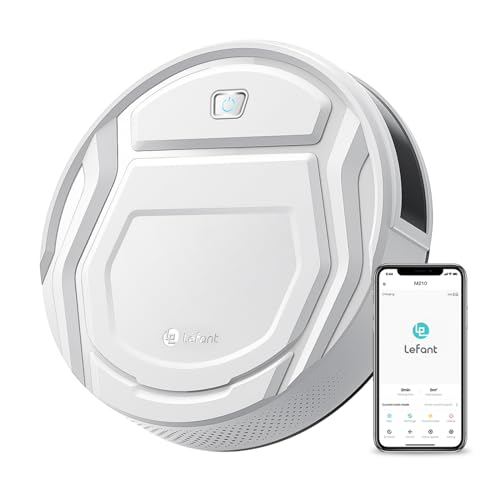
The Lefant M210 proves a robot vacuum does not need a premium budget. Its listing confirms a 120-minute runtime, a slim low-noise body that slides under sofas and beds, automatic self-charging, and Wi-Fi, app, and Alexa control. For a studio or one-bedroom, that is the complete checklist: it cleans everywhere, quietly, for two hours, then goes home to charge.
Strengths
- 120-minute runtime covers small and medium apartments easily.
- Slim body reaches under furniture where dust actually accumulates.
- App and voice control plus self-charging — full automation at a budget tier.
Trade-offs
- No LiDAR mapping; navigation is less methodical than the Roomba’s.
- Suction figure is not stated in the listing, so we make no power claim beyond its hard-floor and pet-hair positioning.
- Budget robots have smaller bins — empty it more often.
| Specifications (as confirmed by the listing) | |
|---|---|
| Type | Robot vacuum, self-charging |
| Runtime | 120 minutes |
| Control | Wi-Fi / app / Alexa |
| Positioning | Pet hair, hard floors, daily cleaning |
The honest way to frame the M210: it trades navigation intelligence for price, and in a small apartment that trade is nearly free. A robot that bumps around a 500-square-foot studio still covers every reachable inch within its two-hour runtime — the inefficiency only shows in larger, complicated floor plans. Its low noise matters more than people expect, too: you can run it while working from home without a headache. If your place is small and your budget is real, this is the robot that gets you the automated baseline for the least money, and the money saved can fund the handheld below. One more practical point in its favor: because it is slim and comparatively simple, it tolerates the realities of a first apartment — thresholds, rug edges, chair legs everywhere — with the patience of a machine that has nowhere else to be. Set it loose daily, empty its bin when you take out the trash, and it will quietly prevent the slow grit buildup that makes small homes feel dingy long before they look dirty.
Best for: studios and one-bedrooms, first robot buyers, tight budgets. / Not suited for: large multi-room homes needing mapped, room-by-room cleaning.
Check the current price on Amazon

Roborock Q7 L5 — Best Vacuum and Mop Combo
The Roborock Q7 L5 adds the second half of floor care: it vacuums and mops in the same run. The listing confirms 8,000 Pa suction, a dual anti-tangle system — a real quality-of-life feature if you have long hair or a partner or pet who sheds it — LiDAR navigation with multi-level mapping, and self-charging. For hard-floor apartments, which describes most modern rentals, this is the closest thing to a complete floor staff in one machine.
Strengths
- Vacuums and mops in one pass — hard floors get fully finished, not just vacuumed.
- 8,000 Pa suction and dual anti-tangle brushes per the listing.
- LiDAR multi-level mapping suits multi-room and multi-floor homes.
Trade-offs
- Robot mopping is maintenance mopping — it keeps floors fresh but does not scrub dried-on spills like a manual mop.
- Mop pads need rinsing after use; that is a small but real chore.
- Premium tier compared with vacuum-only robots.
| Specifications (as confirmed by the listing) | |
|---|---|
| Type | Robot vacuum and mop combo, self-charging |
| Suction | 8,000 Pa |
| Navigation | LiDAR, multi-level mapping |
| Brushes | Dual anti-tangle system |
Kitchen and entryway floors are where solo apartments quietly get gross — cooking splatter, tracked-in grit, bathroom overspray. A vacuum-only robot leaves that film untouched, which is why hard-floor homes benefit disproportionately from the combo. Run the Q7 L5 twice a week and the floors stay at a standard that makes the monthly manual mop genuinely optional rather than overdue. The anti-tangle design deserves its bullet: wrapped hair around a brush roll is the number one maintenance annoyance of robot ownership, and a system designed to prevent it saves real minutes every month.
Best for: hard-floor apartments and anyone who wants vacuuming and mopping automated together. / Not suited for: wall-to-wall carpet homes, where the mop adds little.
Check the current price on Amazon

Dyson V8 Plus — Best Cordless Stick
Robots cannot do stairs, sofas, or the inside of a car, and they cannot do a fast pre-guest deep clean on demand. The Dyson V8 Plus is the manual half of the system: a cordless stick with up to 40 minutes of runtime, 115 AW of suction per the listing, a detangling cleaner head for carpet and hard floors, and one-click conversion to a handheld for upholstery and crumbs.
Strengths
- Up to 40 minutes cordless — a full apartment clean on one charge.
- Converts to a handheld, replacing a separate dustbuster for most jobs.
- Detangling head handles carpet and hard floors without hair wrap drama.
Trade-offs
- Premium tier pricing — you pay for suction, build, and the brand’s support network.
- 40 minutes is a ceiling on the higher modes; big homes will want a second battery or a robot partner.
- Trigger-style operation means your hand works the whole clean — no set-and-forget here.
| Specifications (as confirmed by the listing) | |
|---|---|
| Type | Cordless stick vacuum, converts to handheld |
| Suction | 115 AW |
| Runtime | Up to 40 minutes, 2 power modes |
| Surfaces | Hard floors and carpets, detangling head |
If you buy exactly one vacuum and no robot, buy this class of machine — and the V8 Plus is its benchmark. It hangs on a wall dock in a closet, grabs in two seconds, and covers the jobs robots miss: the couch after a movie night, the car footwells, the stairs, the bathroom floor around the sink where robots fear to tread. Solo households generate less dirt but also have less cleaning labor to spread around; a stick this capable compresses the weekly clean into fifteen genuinely sufficient minutes. Pair it with any robot above and your floors are, functionally, handled.
Best for: one-vacuum households, stairs and cars, fast deep cleans. / Not suited for: buyers who want fully hands-off cleaning, or very large homes on one battery.
Check the current price on Amazon

Eureka Blaze 3-in-1 — Best Ultra-Budget
The Eureka Blaze is the vacuum of first apartments and dorm rooms everywhere: a featherweight, corded 3-in-1 stick that converts between stick, handheld, and stair configurations, costs less than a night out, and asks nothing of you but an outlet. Its listing confirms the positioning honestly — a small vacuum for home and dorm use — and within that brief it is genuinely good.
Strengths
- Featherweight and compact — hangs in a closet or stands in a corner.
- 3-in-1 conversion covers floors, stairs, and spot handheld jobs.
- Corded power means unlimited runtime and no battery to degrade.
Trade-offs
- The cord limits range and adds a small hassle to every clean.
- Suction is modest — fine for hard floors and low rugs, not a deep carpet cleaner.
- Small dust cup fills fast; empty it every clean or two.
| Specifications (as confirmed by the listing) | |
|---|---|
| Type | Corded stick vacuum, 3-in-1 |
| Weight class | Featherweight |
| Positioning | Small homes and dorms |
| Color | Blue |
The Blaze’s role in this guide is to kill the excuse. At its tier, “I don’t have a vacuum” stops being a budget statement and becomes a choice. For a student, a first-job renter, or a guy furnishing a place from zero, it covers the essential eighty percent: hard floors, entryway grit, bathroom tile, the rug by the couch. It will not deep-clean plush carpet and it will not impress anyone, and none of that matters at its price. Many owners later upgrade to a robot and keep the Blaze for stairs and quick jobs — a career path few appliances manage.
Best for: dorms, first apartments, and the tightest budgets. / Not suited for: thick carpet, large homes, or anyone who hates cords.
Check the current price on Amazon

BLACK+DECKER dustbuster AdvancedClean — Best Handheld
The dustbuster is the original handheld, and the AdvancedClean version earns its place in a solo home: cordless, with a rotating nozzle and crevice tool for edges and corners, and a charging station that keeps it parked, charged, and grabbable. This is the vacuum you will use most often, in the smallest doses — thirty seconds at a time, five times a week.
Strengths
- Lives on its charging station — always charged, always within reach.
- Rotating nozzle and crevice tool reach the edges full-size vacuums miss.
- Cordless freedom for kitchen crumbs, car seats, and entryway grit.
Trade-offs
- A spot tool, not a floor vacuum — it complements a robot or stick rather than replacing one.
- Small dust cup suits small messes; big spills will need repeat emptying.
- Battery is internal; long-term life depends on keeping it on the charger as designed.
| Specifications (as confirmed by the listing) | |
|---|---|
| Type | Cordless handheld vacuum |
| Tools | Crevice tool, rotating nozzle |
| Charging | Charging station included |
Think about where a single guy’s messes actually happen: coffee grounds around the machine, cereal under the table edge, soil by the door, crumbs in the couch seams, litter or grit in the car. None of those justify hauling out a full vacuum, and all of them sit there looking sloppy until the weekly clean — unless a charged handheld is sitting ten steps away. The dustbuster’s entire value is friction removal: grab, ten seconds, done, back on the charger. Paired with a robot handling the open floor, it completes the lowest-effort cleaning system a solo household can run.
Best for: daily spot messes in kitchen, entryway, couch, and car. / Not suited for: whole-floor cleaning or large debris jobs.
Check the current price on Amazon
Matching the Vacuum to Your Floor Plan
Studio and one-bedroom apartments (under roughly 700 square feet). Everything in this guide works here, which is a pleasant problem. A robot with 120 minutes of runtime, like the Lefant M210, can clean the entire space several times over on one charge, so navigation sophistication barely matters — persistence wins. A handheld plus any stick also covers the whole brief. The real constraint in small spaces is storage: measure your closet before buying anything with a dock, and favor machines that hang on a wall or stand in a corner without a footprint of accessories.
Two and three-bedroom apartments (roughly 700–1,400 square feet). This is where mapping starts to pay. A LiDAR robot like the Roomba 105 or Roborock Q7 L5 cleans room by room in straight lines, finishes faster, and can be sent to the kitchen alone after a cooking disaster. Runtime stops being the binding constraint — most robots recharge and resume — but bin size becomes one: check the bin before the weekend, because a full bin on Saturday means a robot pushing dust around decoratively. A cordless stick needs the full 40-minute class of runtime here, which is exactly the Dyson V8 Plus’s territory.
Houses, townhouses, and stairs. Robots become per-floor employees — one per level, or carried between them, using multi-level mapping like the Roborock’s to keep the plans separate. Stairs themselves belong to the stick and handheld exclusively. If you have a car in the equation, the stick’s handheld mode or the dustbuster earns its keep weekly. Larger homes are also where a self-empty dock graduates from luxury to sanity, simply because the bin fills faster across more floor.
Roommates, partners, and pets — the “single man” home that is not. Solo on the lease does not always mean solo in the home. A dog multiplies hair and grit by an order of magnitude and argues for anti-tangle brushes and more frequent robot runs; the Lefant and Roborock both position for pet hair in their listings. A partner who sheds long hair makes the same argument. Guests argue for the stick’s fast pre-arrival deep clean. Buy for the home you actually live in, not the tidy fiction of the keyword.
Noise, Neighbors, and Other Apartment Realities
Apartment living adds constraints no specification sheet mentions. Thin walls and downstairs neighbors turn a loud vacuum at 7 a.m. into a social problem, which is one reason the Lefant M210’s low-noise positioning matters and why scheduling robots for mid-day, when you are out and neighbors are too, is the considerate default. Hard floors transmit impact noise — a robot bumping chair legs at midnight announces itself through the building — so use the app’s scheduling and do-not-disturb hours rather than running overnight cycles in a studio where the robot sleeps three meters from your head.
Storage is the other silent constraint. A vacuum you must assemble from a closet pile is a vacuum you will use less; the picks in this guide were chosen partly because each has a simple resting state — robot on its base in a corner, stick on a wall dock, handheld on its charging station, Blaze standing in a closet corner. If you take one practical step after buying, make it this: give the machine a permanent, plugged-in home that takes under five seconds to grab and return. Convenience compounds; friction does too.
Finally, a word on rental reality: most landlords care about floors at move-out, and gritty hard floors scratch. The cheapest insurance for your deposit is a robot or stick used little and often, because the damage is done by grit ground under shoes over months, not by any single spill. A solo renter running a budget robot three times a week will hand back better floors than a homeowner with a premium vacuum used monthly. Frequency is the whole game, and automation is how a busy single guy wins it.
Comparison Table
| Pick | Badge | Key spec | Best for |
|---|---|---|---|
| iRobot Roomba 105 Vac | Best Overall Robot | 7,000 Pa, LiDAR navigation | Set-and-forget daily cleaning |
| Lefant M210 | Best Budget Robot | 120-min runtime, slim, app control | Studios and one-bedrooms |
| Roborock Q7 L5 | Best Vacuum and Mop Combo | 8,000 Pa, LiDAR, anti-tangle | Hard-floor apartments |
| Dyson V8 Plus | Best Cordless Stick | 115 AW, up to 40 min, converts to handheld | One-vacuum households |
| Eureka Blaze 3-in-1 | Best Ultra-Budget | Featherweight corded 3-in-1 | Dorms and first apartments |
| BLACK+DECKER dustbuster AdvancedClean | Best Handheld | Cordless, rotating nozzle, charging station | Daily spot messes |
Robot, Stick, or Handheld: How to Choose for a One-Person Home
Start with the honest question: will you actually vacuum? If the truthful answer is “only when it looks bad,” buy a robot first. A robot’s mediocre daily clean beats a great stick vacuum’s monthly clean by an enormous margin, because floors are won or lost on frequency. The Roomba 105 and Roborock Q7 L5 add mapped, methodical cleaning; the Lefant M210 covers small spaces by persistence. Any of them converts vacuuming from a chore you schedule into a background process you forget.
Add a stick when your home has levels, stairs, or a car. Robots cannot climb, cannot clean a sofa, and cannot detail a car interior. A cordless stick like the Dyson V8 Plus covers all three and doubles as a handheld. In a one-floor apartment with no car, the stick is optional; in a townhouse or a house with stairs, it is essential. Judge sticks on runtime against your floor area — forty minutes covers most apartments with time to spare — and on whether the cleaner head handles both your hard floors and your rugs without swapping attachments mid-clean.
The handheld is the highest-frequency tool you will own. Solo messes are small and constant. A charged dustbuster on its station removes the activation energy from cleaning them, and that behavioral effect — messes handled in the moment — is what keeps a solo home looking kept between real cleans. If budget forces a sequence, the order for most single guys is: robot first, handheld second, stick third. Reverse the order only if you genuinely enjoy vacuuming, in which case the Dyson alone will serve you well.
Match suction claims to surfaces, not ego. Robots quote suction in pascals (Pa), Dyson quotes air watts (AW) — the numbers are not comparable across types, and bigger is not automatically better on hard floors, where airflow and brush design do the work. What matters: enough power to lift grit from your carpet’s pile, a brush that does not wrap itself in hair, and a bin you can empty without a dust cloud in your face. Every pick here clears those bars for apartment-scale homes; the premium tiers buy navigation, runtime, and build quality more than raw cleaning.
Budget in tiers, honestly. The ultra-budget tier (the Blaze) covers hard floors and small spaces adequately. The mid tier (Lefant, dustbuster) buys automation and convenience that change daily life. The premium tier (Roomba, Roborock, Dyson) buys mapping intelligence, stronger suction, and machines that last longer between replacements. A single guy outfitting from zero does well to buy one premium anchor — robot or stick — and fill the other roles from the value tier, rather than buying three mid-tier machines. And whichever tier you start in, keep the receipt mindset simple: a vacuum that gets used three times a week at any price cleans better than a flagship that waits in a closet for a motivation that never arrives.
How to Set Up a Cleaning Routine That Actually Sticks
The machine is half the system; the routine is the other half. Here is the lowest-effort routine that keeps a one-person home genuinely clean. Step one: robot-proof the floor once — lift charging cables into a cable box or along the wall, pick a home for shoes and bags that is not the middle of the room, and move anything the robot will push around into a basket. This is a one-time, twenty-minute investment that pays off on every run. Step two: schedule the robot for when you are out — workdays or gym time — three to five runs a week for a solo home. Floors cleaned that often never build the grit layer that makes cleaning feel like a project.
Step three: give the handheld a permanent home on its charging station in or near the kitchen, where most spot messes happen, and adopt the ten-second rule — any mess smaller than a dustpan gets handled the moment it happens. Step four: once a week, run the stick (or walk the robot’s missed edges) for ten minutes: bathroom floor, around the toilet and sink, the entryway, under the couch edge. Step five: once a month, spend five minutes on maintenance — empty and wipe the robot’s bin, check the brush roll for wrapped hair, tap the filter clean, and wipe the robot’s sensors with a dry cloth. That is the entire system: roughly fifteen minutes of human effort a week, most of it in ten-second bursts, for floors that always look handled.
Understanding Suction Numbers Without Getting Fooled
Vacuum marketing runs on incomparable numbers, so here is the decoder. Robot vacuums quote pascals (Pa): the Roomba 105 lists 7,000 Pa and the Roborock Q7 L5 lists 8,000 Pa. Within the robot category, higher Pa generally means stronger pickup on carpet, but the numbers are measured at the fan, not at your floor, and brush design, sealing, and airflow decide how much of that power becomes cleaning. Treat Pa as a rough tier marker among robots, nothing more. Dyson quotes air watts (AW) — 115 AW for the V8 Plus — a measure that combines suction and airflow at the cleaner head and is more meaningful for stick performance, but it cannot be converted into Pa or compared against robot figures. Anyone who tells you a 8,000 Pa robot “beats” a 115 AW stick, or the reverse, is comparing a temperature to a weight.
What actually predicts cleaning in an apartment: on hard floors, almost everything here is sufficient, because grit and crumbs need airflow more than raw suction; on low and medium carpet, the ranked order follows the tiers in this guide; on deep-pile carpet, only the stick on its higher mode truly gets down into the pile, which is why carpet-heavy homes should weight the Dyson more heavily and treat the robot as a surface maintainer. Runtime claims deserve the same skepticism: the Lefant’s 120 minutes and the Dyson’s up-to-40 are best-case figures on standard settings, and both shrink on max power. Buy for your typical mode, not the brochure mode, and every pick in this guide has headroom for a solo home’s real workload.
What These Machines Still Cannot Do
Honesty about limits saves returns. Robot vacuums cannot climb stairs, open doors, move the laundry basket, or vacuum the top of anything. They clean under furniture only where their height fits, and dark carpets can confuse cliff sensors on some models into treating the rug as a staircase to avoid. Their mopping, where offered, is a damp wipe that maintains a clean floor — dried pasta sauce still wants a human with a mop and opinions. Cordless sticks cannot run forever: the headline runtime is measured on the gentlest mode, and max suction cuts it dramatically, so a big home on boost mode is a two-charge job. Handhelds are spot tools with small cups and modest suction; asking one to clean a whole room is asking for frustration. None of this diminishes the picks — it defines the system. Robot for the baseline, stick for the vertical world and deep cleans, handheld for the daily ten seconds. Each covers the others’ blind spots, which is why this guide recommends combinations instead of crowning a single winner and pretending the question is closed.
There is also a longevity reality worth planning around. Batteries are the wear item in every cordless machine here: treated well — kept charged, not stored dead, not baked in a hot garage — they serve for years, and treated badly they fade early. Robots add brush rolls and filters to the wear list; sticks add filters and the occasional belt-free but not maintenance-free cleaner head. None of it is expensive or difficult, but the guy who budgets five minutes a month, as in the routine above, will get double the service life of the guy who runs everything until it clogs. Buy the machine whose maintenance you will actually perform.
Two cheap accessories complete the system. A small caddy or basket that corrals cables, remotes, and the stuff that migrates to the floor gives the robot a clear run and gives clutter a legal home. And a simple door mat inside the entry — the grit trap — cuts the dirt entering the home at the source, which every vacuum in this guide will silently thank you for. Neither costs much, both are sold everywhere, and together they do more for a solo home’s baseline cleanliness than upgrading one tier of vacuum ever will. Buy the machine first, but do not skip the five-minute environment fixes that let the machine succeed.
Common Buying Mistakes
- Buying a full-size upright for an apartment. It will clean beautifully and live as an obstacle in your one closet. Power you cannot store is power you will stop using.
- Expecting a robot to handle clutter. Robots vacuum floors, not floors-plus-laundry-plus-cables. Five minutes of prep is part of the deal; skip it and you will blame the robot.
- Buying a stick with too little runtime. Measure your home honestly. A 20-minute stick in a three-bedroom house means cleaning in two sessions and hating both.
- Ignoring the hair problem. If you or your guests have long hair, brush-roll tangles become your weekly chore unless you choose anti-tangle designs like the Roborock’s or the Dyson’s detangling head.
- Skipping the handheld because it seems minor. Daily messes are where solo homes look dirty. The cheapest pick in this guide may change your home’s appearance more than the most expensive.
- Forgetting consumables. Filters and mop pads need periodic replacement. Factor that small ongoing cost into any robot or stick purchase rather than being surprised by it.
Final Recommendation
If you buy one thing, buy the Roomba 105 Vac — mapped, strong, and forgettable in the best way. On a budget, the Lefant M210 delivers the same automated baseline for a small home at a value tier. Hard-floor homes should stretch to the Roborock Q7 L5 and let mopping be automated too. Add the dustbuster AdvancedClean for daily messes and either the Dyson V8 Plus or the bargain Eureka Blaze for stairs, upholstery, and deep cleans, and a one-man home effectively cleans itself. Start with whichever single machine removes the most friction from your current routine, live with it for a month, and let your actual habits — not a shopping list — tell you which second machine, if any, is worth adding.
Shopping for the rest of the home? Compare your options in Best Battery Powered Vacuums, Best All Around Vacuums, Best Affordable Upright Bagless Vacuums, and Best Bagged Vacuums For Allergies — each guide applies the same verified-listing, no-invented-specs standard as this one does throughout.
Frequently Asked Questions
Is a robot vacuum worth it for a small apartment?
Yes — arguably more than for a big house. In a small space a robot covers everything quickly, runs often, and keeps the floor at a constant baseline of clean for zero ongoing effort. The Lefant M210 exists precisely for this case: two hours of runtime in a studio is total coverage many times over.
Can one vacuum do everything in a one-person home?
A good cordless stick like the Dyson V8 Plus comes closest, since it converts to a handheld and covers floors, stairs, upholstery, and cars. What it cannot do is work while you are out. If you want automation and versatility, the realistic answer is a robot plus a stick or handheld.
How often should a single guy vacuum?
With a robot, three to five scheduled runs a week keeps a solo home at baseline because one person generates dirt slowly but steadily. Manually, one proper clean a week plus spot-cleaning messes as they happen achieves the same standard — the robot simply removes the willpower from the equation.
Do robot vacuums work on carpet and hard floors?
The robots in this guide are all positioned for multi-surface or hard-floor-plus-rug homes. The Roomba 105 lists multi-surface cleaning, the Lefant targets hard floors and pet hair, and the Roborock adds mopping for hard floors. Deep-pile carpet is where robots struggle most; low and medium pile is fine.
What maintenance does a robot vacuum actually need?
About five minutes a month: empty the bin (more often in small-bin models), pull wrapped hair off the brush roll unless your model has an anti-tangle design, tap or rinse the filter as directed, and wipe the cliff and charging sensors. Skip it and performance fades gradually rather than failing — which is exactly why people forget.
How long should a vacuum last in a one-person home?
Solo use is gentle use. A robot or cordless stick from this guide, maintained on the five-minutes-a-month routine described above, should serve for years; the battery is the most likely first wear item, and keeping the machine charged and stored indoors at room temperature is the main thing under your control. Budget machines like the Blaze often surprise owners with their longevity precisely because a corded motor has no battery to fade — what usually ends their service is a clog or a crack from rough handling, both preventable.
Is a bagless vacuum better than a bagged one for a single guy?
For most solo homes, yes: every pick in this guide is bagless, because a one-person household fills bins slowly, bags become an annoying recurring purchase and storage item, and emptying a bagless bin over the trash takes ten seconds. The honest exception is allergy management — a sealed bag traps dust better at emptying time, which is why our related guide to bagged vacuums for allergies exists. If emptying a bin makes you sneeze, that trade is worth making; otherwise bagless is the low-friction default.
Should I get a vacuum with a self-empty dock?
It is a convenience upgrade, not a necessity. A dock stretches bin-emptying from every few runs to every few weeks and seals dust away, which matters if you have allergies or a large, shedding household. For a solo apartment, the standard charging base on picks like the Roomba 105 keeps the price lower and the chore is ten seconds — most single guys are fine without the dock.


