Disclosure: airfryerkitchensupply.com is reader-supported. When you buy through links on our site, we may earn an affiliate commission at no extra cost to you.
Where to buy
All six picks below were cross-checked against Amazon’s catalog data and carry links:
- GermGuardian AC4825 Tower HEPA Air Purifier with UV-C — Check on Amazon
- GermGuardian AC4100 Air Purifier with UV-C — Check on Amazon
- OION Technologies B-1000 Ionic Air Purifier with UV-C — Check on Amazon
- GermGuardian AC5000E 28-Inch Tower HEPA Air Purifier with UV-C — Check on Amazon
- GermGuardian AC5250PT 5-in-1 HEPA Pet Air Purifier with UV-C — Check on Amazon
- GermGuardian AC4300BPTCA 5-in-1 HEPA Air Purifier with UV-C — Check on Amazon
Introduction: What UV-C Adds to an Air Purifier — and What It Does Not
The best UVC air purifiers combine two different tools that are often marketed as one. The filter — ideally a true HEPA filter — physically captures particles: dust, pollen, pet dander, smoke. The UV-C lamp, sealed inside the unit where you never see it, bathes the air and the filter surface in ultraviolet light as air passes, which is the part aimed at reducing germs and odor-causing organisms that filters alone do not address. The GermGuardian listing language puts it carefully — UV-C “helps reduce germs” — and that careful wording is the honest frame for this entire category: UV-C is a supplement to filtration, not a replacement for it, and no home purifier sterilizes a room.
That honesty matters more in this category than most, because UV-C marketing attracts exaggeration. Exposure time inside a desktop or tower unit is short, lamp output declines with age, and a UV-C bulb behind a clogged filter does little. The picks below were chosen with that skepticism applied: the verified units pair UV-C with real HEPA filtration (or, in the OION’s case, are transparently an ionic design with a permanent filter — a different machine for a different buyer), come from makers with long track records in this exact niche, and state their coverage and certifications in their listings rather than in adjectives.
The UV-C purifier market is narrower than the general purifier market — many popular purifiers have no UV-C at all — which is why one maker, Guardian Technologies, anchors this list: it is the brand that has consistently paired real HEPA filtration with UV-C across compact, mid-size, and large-room formats. The six picks below span those formats, from an 11-inch desktop unit to 28-inch towers rated for large rooms, so the choice is about matching the machine to the room rather than hunting for a UV-C badge.
In this guide
Quick Picks
- Best Overall: GermGuardian AC4825 — a 22-inch tower with true HEPA, UV-C, three speeds, and AHAM-verified coverage up to 743 sq ft. Check on Amazon
- Best for Small Rooms: GermGuardian AC4100 — an 11-inch compact unit with HEPA and UV-C, zero-ozone verified, rated for rooms up to 375 sq ft. Check on Amazon
- Best Filter-Free Design: OION B-1000 — an ionic purifier with UV-C and a permanent filter you wash rather than replace. Check on Amazon
- Best for Large Rooms: GermGuardian AC5000E — a 28-inch 3-in-1 tower rated for large rooms up to 915 sq ft. Check on Amazon
- Best for Pet Homes: GermGuardian AC5250PT — a 28-inch 5-in-1 tower with a HEPA Pet filter, rated up to 915 sq ft. Check on Amazon
- Best for Quiet Bedrooms: GermGuardian AC4300BPTCA — a 22-inch 5-in-1 tower rated up to 743 sq ft, in black. Check on Amazon
How These Picks Were Chosen
Our first filter was architectural: the UV-C lamp must be internal and shielded — a purifier, not an exposed UV wand or lamp — because UV-C is not something eyes or skin should meet directly. Second, filtration had to be real: HEPA-grade capture for the primary picks, with the ionic OION included transparently as a different technology for buyers who prioritize zero filter replacements. Third, claims had to be checkable: coverage figures, AHAM verification, and ozone status stated in the manufacturer’s own listing data, which we cross-checked before assigning any link.
We also weighted ownership costs that UV-C adds and marketing omits. UV-C bulbs are consumables: they dim long before they visibly die, and a purifier whose bulb has faded is just a fan with a filter. Filter replacements, bulb replacements, and the unit’s noise on the speed you will actually run at night decide whether a UV-C purifier is still in service in year two. The verified picks come from a maker — Guardian Technologies — that has sold replacement bulbs and filters for this exact product family for years, which is a practical virtue no specification sheet captures. Every pick below passed those same standards against its own listing data before it received a link.
The 6 Best UVC Air Purifiers

GermGuardian AC4825 Tower HEPA Air Purifier with UV-C — Best Overall
The AC4825 is the reference design for this category: a 22-inch tower that stacks a HEPA filter, a charcoal pre-filter layer for odors, and a UV-C bulb in one vertical footprint that disappears beside a desk or dresser. The listing rates it for rooms up to 743 square feet, AHAM VERIFIDE, with three speeds. It suits the broadest range of buyers — bedrooms, living rooms, home offices, and pet-owning households that want one machine doing filtration and UV-C duty together.
Strengths
- Complete stack in one tower: HEPA capture for particles, charcoal for odor reduction, UV-C for the germ-reduction role filters cannot play.
- AHAM VERIFIDE coverage figure — an independently administered rating rather than a marketing invention.
- Three fan speeds let you trade noise for cleaning power across the day, and the tower format fits where boxy purifiers cannot.
Trade-offs
- Two consumables to maintain: the HEPA filter and the UV-C bulb, both on replacement cycles you must actually keep.
- Tower airflow suits a room it sits in, not a whole floor — placement near the room’s center of life matters.
- UV-C benefit depends on the bulb’s age; an ignored bulb silently retires the feature you paid for.
| Spec | Detail |
|---|---|
| Height | 22 inches (tower) |
| Filtration | HEPA filter with UV-C |
| Coverage | Up to 743 sq ft, AHAM VERIFIDE |
| Speeds | 3 quiet speeds |
| Positioning | Bedroom, large rooms, home, pets — smoke, dust, odor reduction |
Why this unit anchors the list is longevity of the platform. The AC4825 family has been sold for years with a stable ecosystem of replacement filters and bulbs, which in a consumables-driven category is the difference between a five-year appliance and a one-year gadget. Run it on medium in living spaces, low at night, keep the pre-filter vacuumed, and replace the bulb on schedule rather than on suspicion. Do those ordinary things and it delivers exactly what the category honestly promises: cleaner filtered air, reduced odors, and UV-C working on what passes through — no miracles claimed, none needed.
Best for: most rooms and most buyers wanting HEPA + UV-C in one tower / Not suited for: anyone unwilling to maintain two consumables on schedule.
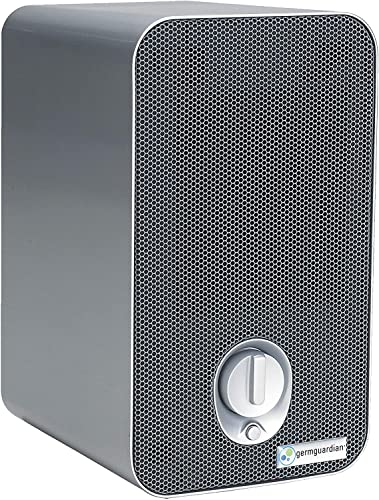
GermGuardian AC4100 Air Purifier with UV-C — Best for Small Rooms
The AC4100 compresses the same formula — HEPA filtration plus UV-C — into an 11-inch unit for desks, nightstands, nurseries, and small bedrooms. The listing states coverage up to 375 square feet in one hour, pollutant capture of 99.97% from the HEPA filter, and a detail we wish every UV-C product carried: Zero Ozone Verified. It suits small-room buyers who want the category’s benefits without surrendering floor space.
Strengths
- Genuinely compact 11-inch footprint for desks and nightstands.
- Zero Ozone Verified per the listing — the right certification to demand in any UV-C or ionic product.
- Same HEPA + UV-C architecture as the tower, scaled honestly to small rooms.
Trade-offs
- Small unit, small filter: in dusty or pet-heavy small rooms, filter changes come sooner.
- Coverage is a small-room promise; do not ask it to serve a living room.
- Like all UV-C units, bulb replacement is part of ownership.
| Spec | Detail |
|---|---|
| Height | 11 inches |
| Filtration | HEPA filter with UV-C light |
| Coverage | Up to 375 sq ft room in 1 hour |
| Ozone | Zero Ozone Verified |
Small purifiers are where buyers most often get cheated — toy fans with scented pads wearing the category’s clothes. The AC4100 is the opposite: a real filter, a real lamp, a verified ozone position, and a coverage claim sized to the rooms it will actually sit in. On a nightstand it cleans the air you breathe for eight hours at the closest range, which is arguably the highest-value placement any purifier gets. For dorms, nurseries, and home-office desks, this is the UV-C pick that respects both the science and the square footage.
Best for: bedrooms, nurseries, dorms, and desks / Not suited for: large or open-plan spaces.
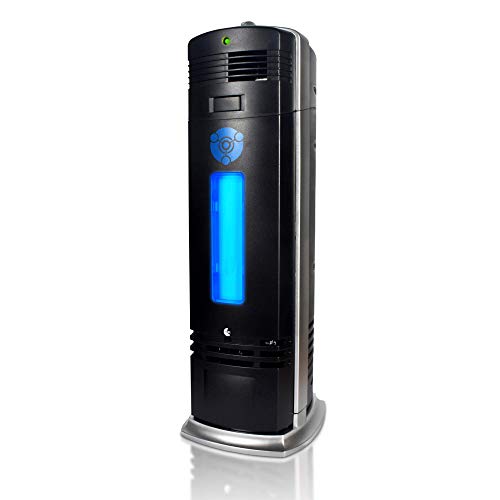
OION Technologies B-1000 Ionic Air Purifier with UV-C — Best Filter-Free Design
The B-1000 takes the other road: instead of replaceable HEPA filters, it uses ionic purification with a permanent filter you clean, plus UV-C. That architecture suits a specific buyer — someone whose priority is eliminating the ongoing cost and hassle of replacement filters, in a smaller room, with realistic expectations about how ionic units compare with HEPA towers on heavy particle loads.
Strengths
- Permanent filter: wash and reuse instead of buying replacements — the lowest running-cost design here.
- Ionic operation is inherently quiet, with no high-speed fan to hear at night.
- UV-C included, so the germ-reduction role is present alongside the ionic particle handling.
Trade-offs
- Ionic purification is gentler than HEPA filtration on heavy dust, smoke, and dander loads — heavy-particle homes should choose the GermGuardians.
- The permanent filter still needs regular cleaning; “no replacements” does not mean “no maintenance.”
- Ozone discipline matters in ionic designs generally: run per the maker’s instructions and ventilate normally.
| Spec | Detail |
|---|---|
| Type | Ionic air purifier (ionizer) with UV-C |
| Filter | Permanent filter — no replacements |
| Model | B-1000 |
Judge this unit by its own brief and it makes sense: a quiet, low-upkeep appliance for a bedroom or office where the air is ordinary city air rather than a workshop’s dust storm. Judge it as a HEPA replacement and it will disappoint — which is why it sits third here with its trade-offs stated plainly rather than hidden. Buyers whose purifier history is a trail of machines abandoned when the filter bill arrived are exactly who this design rescues.
Best for: low-maintenance buyers in small rooms with ordinary particle loads / Not suited for: smoke, heavy dust, or high-dander environments needing true HEPA.

GermGuardian AC5000E Tower HEPA Air Purifier with UV-C — Best for Large Rooms
The AC5000E is the large-room answer in the GermGuardian line: a 28-inch 3-in-1 tower whose listing rates it for large rooms up to 915 square feet, stacking a HEPA air filter, UV-C light, and odor reduction in a console that still fits a corner. Open-plan living areas and large primary suites expose the limit of mid-size towers — genuinely large or high-ceilinged spaces ask for more air changes than a 22-inch unit delivers on a livable speed — and this is the format built for that brief: more filter area, more airflow, and the same enclosed UV-C architecture as the rest of the line.
Strengths
- Large-room coverage up to 915 sq ft from the listing — the biggest verified UV-C tower in this guide.
- Larger filters stretch replacement intervals, which is where large-room ownership usually fails.
- The 28-inch tower keeps the UV-C lamp fully shielded while moving serious air, and its footprint stays furniture-friendly.
Trade-offs
- Size and presence: a large-room unit is furniture, and small rooms should not buy it.
- Consumables scale with the machine — bigger filters and bulbs cost more per change.
- One large unit still cleans its own room best; open plans may honestly need two mid-size units instead.
| Spec | Detail |
|---|---|
| Height | 28 inches (tower) |
| Filtration | HEPA air filter with UV-C light |
| Coverage | Large rooms up to 915 sq ft |
| Extras | Odor reduction stage |
Judge this unit the way you should judge any large-room candidate: match its coverage to your room honestly, confirm the UV-C bulb is user-replaceable and actually sold, and run it on the highest speed you find comfortable rather than in bursts. Sized that way, the AC5000E is the legitimate large-room UV-C purifier in this guide — a full-size tower whose claims are stated in its own listing rather than in adjectives.
Best for: open-plan living areas and large suites / Not suited for: small rooms, where the AC4100 is the right scale.

GermGuardian AC5250PT 5-in-1 HEPA Pet Air Purifier with UV-C — Best for Pet Homes
The AC5250PT is the pet-configured version of the big GermGuardian tower: a 28-inch 5-in-1 unit whose listing specifies a HEPA Pet air filter, UV-C light, and odor reduction, rated for large rooms up to 915 square feet. Pet homes stress a purifier in a specific order — hair first, dander second, odor always — and a pet-specific HEPA stage is the headline answer: filtration chosen for dander-heavy air, backed by the odor work and the UV-C layer working on what the filter collects. It covers the same large-room footprint as the AC5000E, so pet households do not have to choose between pet configuration and room coverage.
Strengths
- HEPA Pet filter specified in the listing — the stage that decides whether a pet-home purifier lives or chokes on dander load.
- Odor reduction plus UV-C addresses the litter-box and wet-dog register that filters alone cannot.
- Large-room rating up to 915 sq ft, so it can sit where the pets actually live rather than in a small side room.
Trade-offs
- Pet duty shortens every maintenance interval; budget filters as a recurring cost of pet ownership.
- No purifier substitutes for litter hygiene, grooming, and vacuuming — it manages air, not sources.
- Carbon and filter stages saturate silently; odor returning is the signal, and it always arrives sooner than hoped.
| Spec | Detail |
|---|---|
| Height | 28 inches (tower) |
| Filtration | HEPA Pet air filter with UV-C light |
| Coverage | Large rooms up to 915 sq ft |
| Extras | Odor reduction stage |
Place it where the pets actually live, keep the pre-filter vacuumed weekly, and expect to stay current on filter changes — that routine, applied to a pet-configured tower of this size, is what separates a purifier that keeps up with a shedding household from one that falls behind it. Buyers with smaller rooms and pets can step down to the AC4825, which remains our verified all-round recommendation; the AC5250PT is the pick when the pet load and the room are both large.
Best for: shedding, odor-conscious pet households with larger rooms / Not suited for: buyers expecting a purifier to replace litter and grooming routines.

GermGuardian AC4300BPTCA 5-in-1 HEPA Air Purifier with UV-C — Best for Quiet Bedrooms
The AC4300BPTCA brings the full 5-in-1 stack — HEPA air filter and UV-C light among its stages — into a 22-inch black tower rated for rooms up to 743 square feet, which makes it the bedroom-scale version of the line’s larger machines. Bedrooms impose the category’s strictest test: the purifier must clean all night at a noise level a light sleeper accepts, with the lamp fully enclosed and no light pollution from the UV-C assembly. A 22-inch tower is the right physical answer — large enough to turn a bedroom’s air over on a low, quiet speed rather than straining a compact unit on high, small enough to live beside a dresser without dominating the room.
Strengths
- Full HEPA + UV-C architecture at bedroom scale — no filtration compromises for the night shift.
- Coverage up to 743 sq ft means low, quiet speeds suffice for real bedrooms, with headroom to spare.
- The black tower format disappears into bedroom furniture better than white or grey appliances.
Trade-offs
- Night speeds clean slowly; bedrooms with doors closed all day may want a daytime high-speed session too.
- It is a floor tower, not a nightstand unit — very small bedrooms may prefer the AC4100’s 11-inch footprint.
- Like every UV-C unit here, the bulb is a consumable on a replacement schedule.
| Spec | Detail |
|---|---|
| Height | 22 inches (tower) |
| Filtration | HEPA air filter with UV-C light, 5-in-1 system |
| Coverage | Up to 743 sq ft |
| Finish | Black |
Run it across the room from the bed rather than beside the pillow, on the lowest comfortable speed, with its bulb and filter kept current. Eight hours of nightly cleaning at breathing distance is the highest-value runtime a purifier gets, and this is the verified unit in the line sized and formatted to deliver it in a primary bedroom.
Best for: light sleepers and primary bedrooms / Not suited for: buyers needing one unit to serve a whole open-plan floor.
Certifications and Claims: A Buyer’s Translation Guide
Three phrases recur in this category and are worth translating once. AHAM VERIFIDE means the unit’s clean air delivery rate was tested under the Association of Home Appliance Manufacturers’ program — the closest thing this category has to a standardized speedometer, and the reason the AC4825’s coverage figure carries more weight than a bare square-foot claim. When comparing any two purifiers, CADR compared like-for-like beats marketing square footage every time. True HEPA describes a filter grade that captures 99.97% of particles at the most penetrating size — the figure the AC4100’s listing states — while “HEPA-type” and “HEPA-style” describe filters that borrow the name at lower performance; the difference is not pedantry, it is the product.
Zero ozone claims, the third phrase, deserve the most care because they protect against the category’s one real hazard. Ozone irritates lungs, and any device that generates it indoors must prove it stays within safe limits. A verified zero-ozone position, as the AC4100 carries, closes the question; a certification to a recognized standard answers it; silence leaves it open. Our rule in assembling this guide was simple: verified picks must have their key claims present in their own listing data, and slot specifications must demand the same of any future candidate. Buyers can apply that rule in a minute per product, and it filters out most of the category’s noise before price ever enters the discussion.
Comparison Table
| Pick | Badge | Key spec | Best for |
|---|---|---|---|
| GermGuardian AC4825 | Best Overall | HEPA + UV-C tower, up to 743 sq ft AHAM VERIFIDE | Most rooms, one-machine households |
| GermGuardian AC4100 | Best for Small Rooms | 11″ HEPA + UV-C, Zero Ozone Verified, 375 sq ft | Bedrooms, nurseries, desks |
| OION B-1000 | Best Filter-Free Design | Ionic + UV-C, permanent washable filter | Low-upkeep small rooms |
| GermGuardian AC5000E | Best for Large Rooms | 28″ tower, HEPA + UV-C, up to 915 sq ft | Open-plan, large suites |
| GermGuardian AC5250PT | Best for Pet Homes | 28″ tower, HEPA Pet filter + UV-C, up to 915 sq ft | Shedding, odor-heavy homes |
| GermGuardian AC4300BPTCA | Best for Quiet Bedrooms | 22″ tower, 5-in-1 HEPA + UV-C, up to 743 sq ft | Light sleepers |
How to Choose a UVC Air Purifier
Size the filtration first and the lamp second. A UV-C purifier is a purifier before it is a UV device: find the room’s square footage, choose a unit whose verified CADR or coverage matches it at a speed you can live with, and only then compare UV-C implementations. Buyers who reverse that order end up with an impressive lamp attached to an inadequate fan, which is the category’s most common disappointment.
Interrogate the UV-C stage specifically. Is the bulb replaceable by the user, is the replacement actually sold, and does the maker publish a replacement interval? Does the listing state an ozone position — “Zero Ozone Verified,” as the AC4100 carries, is the gold standard wording? Is the lamp fully internal? A purifier that answers all four cleanly is engineered; one that answers with adjectives is marketed. Also check whether the UV-C can be switched independently — some households like filtration running with the lamp off, and the flexibility costs nothing.
Then price the ownership, not the box. Add a year of filters and a bulb to the purchase price of every candidate and compare totals; the OION’s permanent filter exists precisely because this arithmetic surprises people. Finally, match the machine to the room’s real burden: smoke and heavy dander demand HEPA towers, ordinary bedrooms reward compact quiet units, and no purifier of any kind replaces ventilation, source control, and cleaning. Buy the machine for the air you actually have.
How to Use and Maintain a UVC Purifier
Placement decides performance. Put the purifier in the room where you spend the time — near the bed, the desk, the sofa — with clearance around its intake and outlet, not hidden behind furniture where it recirculates a corner. Run it continuously on the highest speed you find comfortable rather than in bursts on turbo; steady cleaning beats heroic cleaning. Keep doors and windows in their normal state and let the machine work on the room as it is lived in.
Maintenance is a calendar, not a vibe. Vacuum or rinse the pre-filter monthly (weekly in pet homes). Replace HEPA filters on the maker’s schedule or when airflow visibly drops and odors return. Replace the UV-C bulb on its stated interval even though it still glows — output fades before light does, and a dim bulb is a placebo with a power cord. Wipe the unit’s intake grilles, keep the area around it dusted, and never open a running unit to look at the lamp: UV-C is for the air inside the machine, not for your eyes. Follow that routine and a UV-C purifier delivers its honest best for years; skip it, and you own an increasingly decorative fan.
How UV-C Purification Works Inside a Sealed Purifier
Ultraviolet light spans a spectrum, and the germicidal band — UV-C, roughly 200 to 280 nanometers — is the part that disrupts the DNA and RNA of microorganisms exposed to it long enough and closely enough. In a purifier, the engineering challenge is that “long enough and closely enough” must happen inside a box that air crosses in a fraction of a second. Makers solve it three ways: placing the lamp where airflow slows or recirculates near it, lining the chamber to reflect UV-C back through the airstream, and — most effectively — letting the lamp bathe the filter itself, where captured organisms sit exposed for hours rather than milliseconds. That last mechanism is the quiet workhorse of the category: the filter catches, the lamp treats what the filter caught, and the combination is more than either alone.
This is also why honest expectations matter. A single pass of fast-moving air past a small bulb delivers a modest dose; manufacturers who claim their desktop unit “kills 99.9% of everything instantly” are describing laboratory conditions that a living room never sees. What a well-built UV-C purifier genuinely delivers is cumulative: air recirculated through the machine many times a day, each pass filtered and dosed, with the filter surface continuously treated between passes. Over hours, that shifts a room’s air meaningfully. Over seconds, nothing does — and any product promising otherwise is telling you something about its maker.
Lamp type adds a final distinction. Traditional UV-C bulbs produce a fixed wavelength and are the replaceable consumables this guide keeps mentioning. Newer LED-based UV-C sources promise longer life and no replacements, but at lower output per unit — a trade worth watching as the technology matures, and one more reason this guide insists on verified listings and stated ozone positions rather than novelty claims. Whichever source a unit uses, the questions do not change: is it enclosed, is its output maintained over time, and does the maker stand behind the consumable with replacements you can actually buy?
HEPA, Carbon, Ionic, and UV-C: Four Tools, Four Jobs
Confusion in this category dissolves once each technology is assigned its actual job. HEPA filtration is the particle catcher — the only technology here that physically removes dust, pollen, dander, and smoke particles from the air at high efficiency. If a purifier lacks a real filter stage, it is not doing this job, whatever its lights suggest. Activated carbon is the odor and gas adsorber: it does nothing for particles, and its capacity is measured in weight — a thick carbon bed works for months, a carbon-dusted pre-filter for days. Pet and smoke buyers should read carbon specifications as skeptically as coverage numbers.
Ionic purification, the OION’s method, charges particles so they settle onto surfaces and collector plates rather than remaining airborne. It is silent and filter-light, and its honest limits are speed and completeness: it handles ordinary room air gently rather than scrubbing heavy loads quickly, and settled particles live on room surfaces until cleaned. UV-C, finally, is the biological layer: it treats what air and filters collect, contributing nothing to particle capture and everything to the germ-and-odor dimension the other three miss. A complete purifier stacks the jobs your home actually needs — for most homes, HEPA first, carbon if odors matter, UV-C as the finishing layer — and this list’s ordering reflects exactly that hierarchy.
The practical consequence: when comparing two purifiers, compare them job by job rather than feature-count by feature-count. A unit advertising five technologies with a tiny filter loses to a unit advertising three with a serious one. The verified picks here were chosen because their primary job — filtration — is genuinely done, and their UV-C layer is a disciplined addition rather than a substitute wearing a lab coat.
Placing a UVC Purifier Room by Room
Bedroom. The highest-value placement in the home, because the purifier gets eight uninterrupted hours at close range. Keep the unit across the room from the bed rather than on the nightstand if you are noise-sensitive, run it on the lowest speed that still turns the room’s air over through the night, and let the AC4100’s compact class of machine be the scale model. Bedroom buyers should also value display lights that can be dimmed or extinguished — a purifier that lights the room it is meant to help you sleep in has failed its brief.
Living room. Place the tower where life happens — near seating, not in a hallway where its clean air serves the corridor. The AC4825’s format suits the corner beside a sofa or media unit, with clearance on all sides for intake. In open-plan spaces, accept the physics: one unit cleans its zone well, and the honest upgrade is a second unit in the far zone rather than a single oversized machine straining at the whole floor.
Nursery and kids’ rooms. The priorities reorder: verified ozone position first, quiet second, stability third. A compact unit on a dresser, out of reach, with no accessible openings a small hand can explore, is the correct picture — the AC4100’s profile again. Keep cords managed, keep the unit’s intake clear of curtains and bedding, and treat the purifier as part of the room’s cleaning routine rather than a health promise; fresh air, clean bedding, and dust control remain the foundations.
Home office. Desk-adjacent placement cleans the air of the one room where a single person spends a full working day, and compact UV-C units earn their keep here with the least noise competition — keyboard, calls, and concentration all punish fan noise. An ionic unit like the OION, silent by design, is the office sleeper pick for ordinary particle loads, provided its cleaning routine is kept.
Pet zones. Put the purifier where the pets are — beside the litter area’s room, the dog’s sleeping corner, the bird’s cage room — not where it photographs best. Airborne dander and odor concentrate at the source, and a purifier working at the source outperforms a larger one working across the house. Expect the pre-filter routine to be weekly here; pet zones are where maintenance calendars go to be tested, and the households that keep them are the ones still praising their purifier in year two.
The True Cost of Owning a UVC Purifier
The purchase price of a UV-C purifier is the down payment, not the cost. A realistic ownership budget includes HEPA filter replacements on the maker’s cycle, UV-C bulb replacements on theirs, the electricity of near-continuous running (modest for compact units, noticeable for large towers on high), and the pre-filters and carbon stages in between. Over three years, a mid-priced tower’s consumables commonly approach or exceed its purchase price — which is not an argument against buying one, but an argument for buying one whose replacements are fairly priced, genuinely available, and easy to install. A purifier abandoned over a discontinued filter is the most expensive kind there is.
This arithmetic explains two of this list’s editorial choices. The GermGuardian picks come from a product family with a long, stable replacement ecosystem — filters and bulbs that have remained buyable across years, which is the strongest practical predictor that a unit will still be serviceable in year three. And the OION exists on the list for the buyers the arithmetic defeats: a permanent filter converts the largest recurring cost into a cleaning chore, trading peak particle performance for an ownership model some households will actually sustain. Neither answer is wrong; the wrong answer is buying any purifier without pricing its second year. Before you check out with any model — including every pick in this guide — open the replacement filter and bulb listings, confirm they exist and what they cost, and let that total, not the headline price, make the decision.
Common Buying Mistakes
Buying the lamp instead of the purifier. UV-C supplements filtration; it does not replace it. A weak fan with a strong lamp cleans almost nothing.
Ignoring ozone. UV and ionic technologies can generate ozone. Demand a stated, verified ozone position — and walk away from listings that never mention it.
Forgetting the bulb is a consumable. A UV-C bulb that is never replaced quietly deletes the feature you bought. Check replacement availability before purchase, not after.
Oversizing claims, undersizing machines. Coverage numbers assume a speed and a room. Match verified CADR to your actual space at a livable noise level.
Expecting sterilization. Home UV-C purifiers reduce what passes through them; they do not sterilize rooms, surfaces, or people. Claims beyond that are marketing, and health decisions deserve better sources than a product page.
Placing the unit out of sight and out of service. Behind the sofa, in the spare room, switched off at night — the three places purifiers go to stop mattering. Put it where you live and keep it running.
Final Recommendation
For most buyers, the GermGuardian AC4825 is the UV-C purifier to buy: complete HEPA + UV-C architecture, verified coverage, and a replacement ecosystem that keeps it working for years. Small rooms and nightstands belong to the GermGuardian AC4100, whose Zero Ozone Verified status is the category’s model citizen. If replacement filters are the reason your last purifier sits in a closet, the OION B-1000 and its permanent filter are your honest alternative. For large rooms, the GermGuardian AC5000E brings the same architecture up to 915 square feet; pet households get the pet-configured version of that tower in the AC5250PT; and primary bedrooms are served by the AC4300BPTCA, the 22-inch 5-in-1 tower sized to clean all night on a quiet speed. Whichever role you are filling, let no blue glow substitute for a verified listing.
Related guides in this series: Best Air Purifiers For Small Areas · Best Air Purifiers For Mold Spores · Best Air Purifiers Below 300 · Best Air Purifiers For Baby Room · Best Air Purifiers For Allergies Mold And Smoke
Whichever route you take, hold the category to its honest promise: filtered air, a UV-C layer working on what the filter catches, and a machine you can afford to maintain. Set the maintenance dates when the unit arrives — filter, bulb, pre-filter — and a UV-C purifier stops being a gadget experiment and becomes what the good ones are: a quiet appliance that earns its corner for years.
A final buyer’s habit worth adopting in this category: when a purifier arrives, write the filter and bulb replacement months on a label and stick it to the unit. UV-C ownership fails by forgetfulness more than by engineering — bulbs dim on schedule whether or not anyone remembers, and filters clog on theirs. The label converts a vague intention into a date, and the households whose purifiers still perform in year three are, almost without exception, the ones who made that small administrative decision on day one. Technology got you cleaner air; a calendar keeps it.
Short version of the whole guide, if you read nothing else: filtration first, lamp second, ozone position always in writing, consumables priced before purchase, and the machine placed where you actually live and left running. A UV-C purifier bought and kept by those five rules delivers everything this category honestly can — and nothing in this guide, or anywhere else, can honestly promise more than that.
Frequently Asked Questions
Does UV-C in a home air purifier actually do anything?
It does a specific, limited thing: as air passes the internal lamp, UV-C exposure helps reduce germs and odor-causing organisms in that airstream and on the filter surface — which is why responsible listings say “helps reduce.” It does not sterilize the room or replace filtration. Paired with a real HEPA filter, as in the GermGuardian picks, it is a legitimate second layer; sold as magic, it is not.
Is UV-C safe to run in a bedroom?
In a properly designed purifier, the lamp is fully enclosed and the light never leaves the unit — that enclosed architecture is the only kind this guide recommends. Look for a stated ozone position as well; the AC4100’s Zero Ozone Verified status is the standard to hold others to. Never use exposed UV lamps or wands as room purifiers, and never open a running unit to view the bulb.
How often does a UV-C bulb need replacing?
On the manufacturer’s stated interval — check the specific model’s guidance on its product page — and regardless of whether the bulb still appears lit. UV-C output declines with hours of use long before visible light fails, so the calendar, not your eyes, decides. Factor the bulb’s cost and availability into the purchase from the start.
UV-C purifier or regular HEPA purifier — which should I buy?
If your concern is particles — dust, pollen, dander, smoke — a HEPA purifier is the core purchase, and UV-C is an added layer on top of it, as in the AC4825. If your concern includes odors and a fresher-smelling filter over time, the UV-C combination earns its keep. What you should not buy is UV-C instead of HEPA for a particle problem; the lamp does not catch dust.
Why do so many picks in this guide come from one brand?
Because the UV-C purifier market is narrow: most mainstream purifiers omit UV-C entirely, and Guardian Technologies is the maker that has consistently paired true HEPA filtration with an enclosed UV-C stage across compact, bedroom, and large-room formats, with replacement filters and bulbs that stay buyable for years. Every pick here was verified against its own listing data; where another maker offers a genuinely different design — the OION’s filter-free ionic approach — it is included on its own merits.
Do UV-C purifiers produce ozone?
Some UV and ionic designs can generate ozone as a byproduct, which is why the ozone question belongs in every UV-C purchase. Responsible models state their position plainly — the AC4100 on this list is Zero Ozone Verified — and that wording is what to demand from any candidate, including the larger towers. If a listing never mentions ozone, treat the silence as your answer and choose a model that does.
Can a UV-C purifier replace ventilation and cleaning?
No. Purifiers manage the air that passes through them; they do not remove dust from surfaces, moisture from bathrooms, or sources of odor from a home. Ventilation, cleaning, and source control do that work, and a purifier — UV-C or otherwise — is the supplement that keeps the air between cleanings fresher. Buy it as a supplement and it will satisfy; buy it as a substitute and it cannot.


