Disclosure: airfryerkitchensupply.com is reader-supported. When you buy through links on our site, we may earn an affiliate commission at no extra cost to you.
Where to buy
Every pick on this shortlist of the best unconventional chairs is sold through Amazon, and each one was confirmed against Amazon’s own product data before it earned a link here. Start with the DRAGONN by VIVO Ergonomic Kneeling Chair if you want the most desk-ready unconventional seat, the GIANTEX Folding Floor Chair if your seating happens at floor level, or the Y-STOP Hammock Chair if the whole point is to get off the ground in a completely different way. Check the current price on Amazon for each pick before you order, and confirm the color and configuration shown on the listing match the one described here.
Unconventional chairs are a category where the photo can mislead you. A kneeling chair, a wobble stool, a floor chair, a bean bag, a hanging swing chair and a saddle stool all solve the sitting problem by ignoring the standard four-legs-and-a-backrest formula, and each one asks something different from your room, your body and your habits. If you are shopping for the best unconventional chairs, the honest first step is deciding which kind of different you actually want, because these six designs share almost nothing except the fact that none of them looks like a normal chair. This guide walks through six verified designs, explains what each one does well, where each one falls short, and how to choose between them without guessing.
A quick note on how this list was built: every product below was matched to a live Amazon listing through the retailer’s own catalog data, and the descriptions stick to what those listings actually state — the shape, the structure and the features named in the product title. Where a listing does not state a material, a dimension or a weight limit, this guide says so rather than filling the gap with a guess. Unconventional seating attracts a lot of marketing language, and the most useful thing a buying guide can do is separate the physical design, which you can verify, from the comfort promises, which only your own trial period can settle.
In this guide
Quick Picks
- Best Overall — DRAGONN by VIVO Ergonomic Kneeling Chair: an adjustable kneeling stool with an angled seat, thick moulded foam cushions and brake casters, in black. It replaces the chair back with a shin-supported kneeling posture. Check the current price on Amazon
- Best for Standing Desks — Ergooffile Adjustable Standing Desk Chair: a wobble stool built as a leaning perch seat for adults, with 360-degree swivel and an adjustable height for sit-stand desks, in black. Check the current price on Amazon
- Best Floor Chair — GIANTEX Folding Floor Chair: a padded floor chair with back support and 14 adjustable positions that also folds flat and can recline toward a sleeper position, in grey. Check the current price on Amazon
- Best Bean Bag — MAXYOYO Bean Bag Chair: a 3-foot bean bag sofa with supportive foam filling, a side pocket and a washable cover, in pink. It arrives as a complete filled chair, not a cover. Check the current price on Amazon
- Best Hanging Chair — Y-STOP Hammock Chair: a macrame hanging rope swing rated by its listing to a maximum of 500 lbs, with two cushions included, a storage pocket and a hardware kit, in beige. Check the current price on Amazon
- Best Saddle Stool — Antlu Saddle Stool Rolling Chair: a backless saddle-shaped rolling stool with hydraulic height adjustment and wheels, in black, aimed at work settings from salons to drafting tables. Check the current price on Amazon
How These Picks Were Chosen
Six different ways of sitting anchor this list, one per design family, so the comparison stays useful instead of turning into six versions of the same product. The families chosen are the ones buyers actually search for when they go looking beyond a standard chair: kneeling chairs, wobble stools, floor chairs, bean bags, hanging chairs and saddle stools. Within each family, the pick had to be a complete, ready-to-use seat sold as a single product — not a replacement cover, not a cushion insert, not a repair part and not an accessory that needs another chair to work. Listings that were only a variant of another pick, such as the same floor chair or hammock chair listed again in a second color or under a near-identical listing, were deduplicated so each of the six slots is a genuinely different product.
Each pick was verified against Amazon’s catalog data: the product title returned by the catalog is the source for every structural claim in the reviews below, including adjustment ranges described in words, included parts such as cushions and hardware kits, and the one stated weight capacity on this list. Anything the catalog title does not state — frame materials on most picks, exact seat dimensions, foam densities — is flagged as not stated rather than invented. That discipline matters more in this category than most, because unconventional chairs are often sold with lifestyle photography and very thin specifications.
Finally, the health framing is deliberately modest. Several of these designs are marketed with posture language. This guide describes what the shapes do mechanically — a kneeling chair tilts the pelvis by supporting the shins, a wobble stool keeps the sitter making small balancing movements, a saddle stool spreads the legs around a narrow seat — and treats comfort as a personal, trial-based judgment. Nothing here is presented as a treatment or a fix for any medical condition, and anyone choosing seating because of an existing condition should treat these as comfort products to test during the return window, not as therapy equipment.
The 6 Best Unconventional Chairs
DRAGONN by VIVO Ergonomic Kneeling Chair — Best Overall
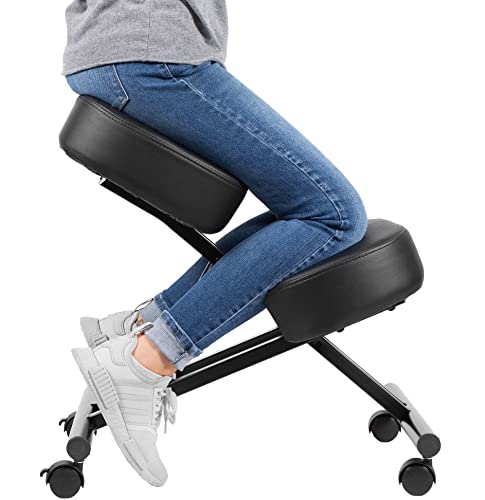
The kneeling chair is the original unconventional desk seat, and the DRAGONN by VIVO version, model DN-CH-K01B, is the most complete expression of the idea on this list. Instead of a backrest, it gives you an angled seat paired with a padded kneeling platform, so part of your weight rests on your shins and knees rather than entirely on your sitting bones. The listing states thick, comfortable moulded foam cushions, an adjustable build, and brake casters — the brake detail matters, because a kneeling chair you cannot lock in place will creep across a hard floor every time you shift. It suits desk workers who want to change how they sit for part of the day, people furnishing a small home office where a full task chair dominates the room, and anyone curious about kneeling posture who wants a purpose-built product rather than improvising with cushions on the floor. It does not suit anyone who needs back support while seated, anyone who gets in and out of their chair dozens of times an hour, or anyone whose knees cannot tolerate sustained contact pressure — the design is honest about what it is, and the trial period is your friend.
Strengths
- The angled seat and kneeling platform are a genuinely different sitting geometry from a standard chair, not a styling exercise.
- Brake casters address the design’s most obvious practical flaw, unwanted rolling on hard floors.
- Moulded foam cushions are shaped for the seat and knee pad rather than being flat slabs of padding.
Trade-offs
- There is no backrest at all, so leaning back to think is simply not an option.
- Getting in and out takes more effort than sliding off a normal chair, which matters during busy workdays.
- The listing does not state a weight capacity or frame material, so heavier users have nothing verified to go on.
Using a kneeling chair well is a habit change as much as a purchase. Most people do best alternating it with a conventional chair in the first weeks, building up kneeling time while their shins and knees adapt to carrying part of the load. The adjustable build lets you tune the seat angle and height to your desk, and that tuning is worth doing slowly: a small change in seat height shifts how much weight lands on the knee pad. Position the chair so your forearms rest naturally at desk height without shrugging, lock the brake casters before you settle in, and keep a footrest-free patch of floor in front of you, since your feet tuck behind and below the seat rather than flat in front. As a piece of furniture it reads as a compact black stool on casters, which makes it one of the easier unconventional designs to live with visually in a shared room.
Best for: desk workers who want a genuinely different sitting posture for part of the day / Not suited for: anyone who needs back support or gets up and down constantly. Check the current price on Amazon

Ergooffile Adjustable Standing Desk Chair — Best for Standing Desks
The Ergooffile is a wobble stool designed as a leaning perch for sit-stand desks. The listing describes an active sitting wobble stool with a 360-degree swivel, an adjustable height and a perch-style seat for adults, finished in black. The unconventional idea here is instability on purpose: the rounded base lets the stool tilt and rock in any direction, so instead of parking your weight in a fixed position you perch, lean and make constant small adjustments. It suits standing-desk users who want a middle option between standing and fully sitting, people who fidget their way through the workday anyway, and small workspaces where a perch takes up a fraction of a task chair’s footprint. It does not suit anyone who wants to relax into a seat at the end of a task, anyone who needs armrests or a backrest, or shared-desk environments where a wobbling seat would distract the neighbors. Think of it as equipment for people who already stand most of the day and want occasional relief without committing to a full sit.
Strengths
- The perch format pairs naturally with height-adjustable desks, covering the gap between standing and sitting.
- 360-degree swivel and a tilting base make position changes constant and effortless.
- The footprint is tiny compared with any chair that has a back and arms.
Trade-offs
- A perch is not a resting seat; long, settled work sessions belong in a real chair.
- The listing does not state the exact height range, base material or weight capacity.
- Active sitting is a love-it-or-hate-it sensation, and there is no way to know which camp you are in without trying it.
The right way to use a wobble perch is to treat it as a third posture. Stand for a while, perch for a while, and keep a normal chair nearby for calls or reading that ask you to be still. Set the height so your weight is split between your feet and the seat rather than dumped fully onto either; if your feet go numb, the seat is too high and you are sliding, and if your legs feel fully unloaded, it is too low and you are simply sitting on a stool that moves. The black finish and plain silhouette keep it visually quiet in an office. Because the base is designed to move, hard floors give the smoothest wobble, while thick carpet will damp the motion and can make the stool feel reluctant rather than responsive — worth knowing before you blame the product for a soft floor.
Best for: standing-desk users who want a perch between standing and sitting / Not suited for: anyone who wants a restful seat with back or arm support. Check the current price on Amazon

GIANTEX Folding Floor Chair — Best Floor Chair
The GIANTEX floor chair removes the legs entirely. Its listing states a padded floor chair with back support and 14 adjustable positions, able to fold for storage and recline toward a flat sleeper position, in grey. You sit on the floor with a real backrest behind you, and the ratcheting back clicks through angles from upright — for gaming, reading or eating at a low table — down toward flat for stretching out. It suits people who genuinely live at floor level: low-table dining, meditation corners, console gaming in front of a TV, kids’ rooms and guest spaces where a folding seat that disappears into a closet beats a permanent chair. It also works as occasional extra seating that stores flat. It does not suit anyone who finds getting down to and up from the floor difficult, anyone who needs seat height for a standard table, or anyone expecting the support of a framed chair; a floor chair’s backrest is padded and adjustable, but it is still anchored by your own weight on the seat pad.
Strengths
- Fourteen stated back positions cover upright sitting through near-flat reclining in one product.
- It folds, so the chair can live in a closet or under a bed between uses.
- A backrest at floor level is the whole point of the design, and this one is padded rather than a bare frame.
Trade-offs
- Floor sitting is a physical commitment; rising from floor level is the deal-breaker for many adults.
- The listing does not state dimensions, weight capacity or the internal frame material.
- Near-identical GIANTEX floor chair listings exist, so confirm you are ordering the 14-position grey version described here.
Getting the most from a floor chair is about placement. Put it on a rug or mat rather than bare hardwood, both for your comfort and to keep the base from sliding when you lean back. Work through the backrest angles deliberately: fully upright for a low table, a few clicks back for gaming with a controller, deeper recline for reading, and flat only when you actually want a padded sleeper surface. Because it folds, it is the one pick on this list that can serve a studio apartment as everyday seating and then vanish when guests need floor space. The grey upholstery is a sensible, low-drama choice for a product that will spend its life at ankle height being stepped around. If your household mixes floor-sitters and chair-sitters, a pair of these around a low table solves the mismatch better than forcing everyone onto stools of different heights.
Best for: floor-level living, gaming and low-table dining with real back support / Not suited for: anyone who struggles to get up from the floor or needs standard seat height. Check the current price on Amazon
MAXYOYO Bean Bag Chair — Best Bean Bag
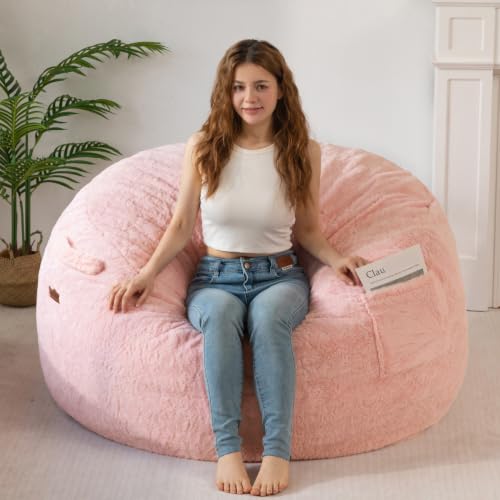
The bean bag is the unconventional chair most people have already tried, usually in its disappointing form: a half-empty sack that swallows you and offers nothing back. The MAXYOYO listing describes something more deliberate — a bean bag sofa with supportive foam filling rather than loose beads, a side pocket, and a washable cover, in a 3-foot size and pink finish. Foam filling matters because it holds a shape: the chair behaves more like a soft, low lounge seat you sit in rather than a pile you sink through. It suits reading corners, teen rooms, casual TV spaces and anyone whose ideal chair has no hard edges at all. The side pocket is a small, real convenience for a remote or a paperback. It does not suit anyone who needs firm support to stand back up — a low, soft seat is the hardest kind to rise from — or anyone furnishing a formal room, or households where a pink 3-foot floor cushion cannot earn its floor space. Note the size honestly: 3 feet is a one-person lounge chair, not a loveseat.
Strengths
- Foam filling gives the seat a held shape that loose bead filling does not.
- The washable cover answers the bean bag category’s oldest problem, the un-cleanable exterior.
- A side pocket keeps small essentials with the chair instead of lost inside it.
Trade-offs
- Low and soft means hard to get out of, especially for anyone with limited mobility.
- The listing states the 3-foot size but not a weight capacity.
- This pick is the pink version; check the listing for other colors rather than assuming they match this configuration.
Living with a foam bean bag is mostly about fluffing and placement. Foam-filled chairs compress in shipping and need time and a few good shakes to reach full shape, so judge the seat after it has expanded, not in the first hour. Rotate and pat the filling back toward the backrest area weekly if it starts to feel like a nest with no back. Place it where its low profile is an advantage — in front of a low bookshelf, in a window corner, at the foot of a bed — rather than in a traffic path where a soft 3-foot lump becomes an obstacle. The washable cover makes it the most pet- and kid-tolerant pick in this guide, provided the household accepts that a bean bag is shared territory by design. For movie nights it pairs well with the floor chair above: two different kinds of low seating that store in completely different ways.
Best for: casual lounge corners that need a soft, shaped, washable seat / Not suited for: anyone who needs firm support or an easy rise. Check the current price on Amazon

Y-STOP Hammock Chair — Best Hanging Chair
The Y-STOP hammock chair is the only pick here that leaves the floor entirely. The listing describes a macrame hanging rope swing with two cushions included, a side pocket, a hardware kit in the box, a beige finish, and a stated maximum capacity of 500 lbs — the only weight limit actually stated among these six listings, and one this guide reports as the seller’s figure rather than an independently tested result. You sit in a suspended fabric seat that swings gently and wraps around you, which is a completely different sensation from any framed chair: part seat, part porch swing, part reading nest. It suits porches, patios, sturdy indoor beams and anyone whose relaxation ideal involves motion. The included hardware kit and cushions make it a complete package rather than a fabric shell that needs extras. It does not suit renters who cannot drill into a joist or use a stand, small rooms where a swinging arc would hit furniture, or anyone who wants a seat that stays exactly where it is put. Installation is part of the product here, and it deserves respect: the chair is only as safe as the anchor point above it.
Strengths
- A suspended seat is the most genuinely unconventional sitting experience on this list.
- Two cushions and a hardware kit are included, so the box contains the complete setup.
- The listing states a 500 lb maximum capacity, giving buyers a concrete figure the other picks do not offer.
Trade-offs
- It needs a trustworthy overhead anchor or a separate stand, which is a real installation project.
- The swing arc needs clear floor space in every direction, more than the chair itself occupies.
- Macrame cotton-style rope seating belongs under cover outdoors; it is not a leave-it-in-the-rain product category.
Plan the installation before the chair arrives. Find a ceiling joist or beam with a stud finder, never anchor into drywall or a decorative beam, and follow the hardware kit instructions for the mounting type you choose. If your space cannot take an anchor, a hammock chair stand is the alternative — but note that a stand is a separate purchase and is not part of this listing. Hang the chair so the seat clears the floor with room to swing without striking walls, then test the anchor with gradual weight before the first full sit. Once installed, the pocket keeps a book or phone with you, which matters because getting out of a hammock chair to fetch things is its own small workout. Check rope and hardware periodically for wear; a hanging chair asks for the same respect as any suspended load, and a two-minute inspection each season is cheap insurance.
Best for: porches and reading corners where a gentle swing is the whole point / Not suited for: rooms without a safe anchor point or clearance to swing. Check the current price on Amazon

Antlu Saddle Stool Rolling Chair — Best Saddle Stool
The saddle stool borrows its shape from horse tack: a narrow, contoured seat that you straddle rather than sit on top of. The Antlu listing describes a rolling saddle stool with hydraulic height adjustment and wheels, sold without a backrest, in black, and aimed at work settings the title names directly — medical and massage practices, salons, kitchens, spas and drafting. The unconventional element is the straddle posture itself: your legs angle down on either side of the seat, which opens the hips and puts you in a half-standing working stance that rolls easily around a workstation. It suits professionals who work seated but mobile — stylists, tattoo artists, estheticians, technicians — and home users with a workbench or drafting table who want the same rolling perch. It does not suit anyone who wants to lounge, anyone who needs back support during long stationary tasks, or anyone who finds a narrow contoured seat uncomfortable in the first sitting; saddle seats divide opinion immediately, and the first ten minutes usually tell you your camp.
Strengths
- The straddle seat and rolling base are built for moving around a workstation while seated.
- Hydraulic height adjustment lets one stool serve counters, tables and treatment beds of different heights.
- The backless design cannot tempt you into slumping against a backrest mid-task — it keeps the working posture the design intends.
Trade-offs
- No backrest means no rest; this is a working seat only.
- The listing does not state a weight capacity or the seat covering’s exact material specification beyond the product name.
- Saddle comfort is intensely personal, and the shape cannot be adjusted away if your body dislikes it.
Set a saddle stool up like a tool, not like furniture. Adjust the hydraulic lift so your feet rest flat with your knees angled downward, and position your workstation so the rolling range of the stool covers everything you reach for during a task — the design pays off when you stop standing up for supplies. On hard floors the wheels roll freely, which is the point, but it also means the stool will drift on any slope; work on level ground. Because the seat is narrow, clothing matters more than with a normal chair: stiff seams and thick belts make themselves known quickly. For home users, the same stool that serves a salon works at a craft bench, a kitchen counter used as a prep station, or a garage workbench, and its small footprint tucks under the counter when the job is done. Of the six picks, this is the one most clearly bought for work rather than relaxation, and it should be judged that way.
Best for: mobile seated work at salons, benches and drafting tables / Not suited for: relaxing, reading or any task where you want to lean back. Check the current price on Amazon
Comparison Table
| Pick | Badge | Key spec (as listed) | Best for |
|---|---|---|---|
| DRAGONN by VIVO Ergonomic Kneeling Chair | Best Overall | Angled seat, moulded foam cushions, brake casters, adjustable | Desk work in a kneeling posture |
| Ergooffile Adjustable Standing Desk Chair | Best for Standing Desks | Wobble perch seat, 360-degree swivel, adjustable height | Perching at a sit-stand desk |
| GIANTEX Folding Floor Chair | Best Floor Chair | 14 adjustable back positions, padded, folds flat | Floor-level gaming, dining and lounging |
| MAXYOYO Bean Bag Chair | Best Bean Bag | Foam filling, washable cover, side pocket, 3 ft | Soft lounge corners and reading nooks |
| Y-STOP Hammock Chair | Best Hanging Chair | Macrame rope swing, 2 cushions, hardware kit, stated 500 lb max | Porch swinging and reading nests |
| Antlu Saddle Stool Rolling Chair | Best Saddle Stool | Saddle seat, hydraulic lift, wheels, no backrest | Mobile seated work |
How to Choose the Best Unconventional Chairs for Your Space
Start with the job, not the shape. Unconventional chairs fail most often when they are bought as sculptures and then asked to do eight hours of desk work, or bought as desk tools and then expected to host a relaxed evening. Write down the primary use in one sentence — desk work, standing-desk perching, floor gaming, porch reading, salon work — and let that sentence eliminate most of this list immediately. The kneeling chair and the wobble stool are desk-adjacent tools. The floor chair and the bean bag are lounge furniture that happen to be seats. The hammock chair is relaxation equipment. The saddle stool is a workstation tool. Crossing those categories is where disappointment lives.
Next, audit your space honestly. The hammock chair needs a structural anchor and a clear swing arc. The floor chair needs floor space and users who can rise from the floor. The bean bag needs a permanent footprint because it never folds away. The kneeling chair, wobble stool and saddle stool all roll, which means they need hard or low-pile flooring to behave as designed, and they will wander on slopes. Measure the space the chair will actually occupy in use — including the swing arc, the kneeling chair’s tucked-back feet and the floor chair’s reclined length — rather than the compact dimensions in a product photo.
Then think about your body as it is, not as a product page imagines it. Every design here moves load somewhere unusual: shins and knees on the kneeling chair, feet and core on the wobble perch, hips on the saddle, the whole body into soft foam on the bean bag. Any of those can feel wonderful or awful depending on the person, which is why the return window is part of the purchase decision. Buy from a listing with a workable return policy, keep the packaging until you have lived with the chair for at least a week, and alternate with a conventional chair while you adapt. Comfort claims in this category are personal by nature; treat the first fortnight as a trial, because it is one.
What Each Design Actually Changes About Sitting
It helps to understand the mechanics, because the mechanics predict who will love each chair. A standard chair supports you at the seat and back and asks almost nothing of your legs. A kneeling chair removes the back and tilts the seat forward, transferring part of your weight to a shin pad; your trunk stays active because nothing holds it up. A wobble stool removes stability instead, so your feet and trunk make constant small corrections. A saddle stool removes width, spreading your legs so your pelvis sits more like it does standing. A floor chair removes height, putting you at ground level with back support borrowed from your own seated weight. A bean bag removes structure, letting the filling shape itself to you. A hammock chair removes the floor’s support altogether and replaces it with suspension and motion. None of these is automatically better. Each trades one kind of effort for another, and the right trade is the one whose effort you barely notice and whose relief you feel immediately.
How to Set Up and Adapt to an Unconventional Chair
Whatever you choose, give the setup a deliberate first session rather than dropping the chair into your routine. First, assemble or install it completely before judging it: hang the hammock chair from its anchor and test the mount gradually, expand the bean bag fully before deciding it is too flat, and set the kneeling chair’s and saddle stool’s heights before your first work session. Second, tune the geometry in small steps — one notch of height or angle at a time — and work at each setting for at least an hour before changing it, because bodies adapt slowly and first impressions in the first five minutes mislead. Third, alternate: use the new chair for part of the day and your old chair for the rest during the first two weeks, extending the new chair’s share only while it stays comfortable. Fourth, place the chair where its design works — the wobble stool on hard floor, the floor chair on a rug, the hammock where its arc is clear. Fifth, at the end of two weeks, make the keep-or-return decision on evidence: if you reach for the unconventional chair voluntarily, it has earned its place; if you have been avoiding it, no amount of adjustment will fix a fundamental mismatch, and the return window is there to be used.
Unconventional Chairs in Small Spaces
Small rooms are where unconventional seating quietly outperforms the standard chair, provided you match the design to the constraint. A studio apartment that cannot spare the visual bulk of a task chair can use a kneeling chair or a wobble stool at a compact desk, and both roll into a corner when the desk becomes a dining table. The floor chair is the small-space champion for lounging: it delivers a backed seat for movie night and then folds flat behind a door or under a bed, which no armchair can do. The bean bag is the opposite strategy — it never stores away, but in a room with no space for both a sofa and a chair, a 3-foot foam bean bag can be the lounge seat, full stop. The saddle stool tucks completely under a counter, making it a real option for kitchen workspaces and craft corners in tight homes. Only the hammock chair is a poor small-space bet despite its tiny seat, because its swing arc claims a circle of empty room that small spaces rarely have. The lesson is that footprint on paper and footprint in use are different numbers, and unconventional designs win when you compare the second one.
Care, Cleaning and Making One Last
Each design has its own maintenance rhythm, and none of them is onerous if you start early. Upholstered picks — the kneeling chair’s moulded cushions, the floor chair’s padding — benefit from a quick vacuum with an upholstery attachment and prompt attention to spills, because foam under fabric holds moisture. The MAXYOYO bean bag has the easiest story: its cover is stated as washable, so follow the cover’s care instructions and let it dry fully before refilling the room with it. Rope and macrame seating like the Y-STOP hammock chair should be kept dry, brought under cover in wet weather, and inspected along the rope and at the hardware for fraying or corrosion; a hanging chair’s maintenance is a safety habit, not a cosmetic one. Rolling picks — kneeling chair, wobble stool and saddle stool — need their casters and wheels cleared of hair and grit, which is the difference between a smooth roll and a grinding one, and the saddle stool’s hydraulic lift should be cycled through its range occasionally to keep the action smooth. Finally, tighten what can loosen: floor chair hinges, caster stems and hammock hardware all repay a seasonal check with years of quieter service.
Common Buying Mistakes
The first mistake is buying an unconventional chair as a statement piece and expecting conventional comfort. These designs are functional experiments; the ones that work, work because the function fits your day. The second mistake is ignoring the exit: kneeling chairs, floor chairs and bean bags all demand more from your legs when you stand up, and that cost is paid every single time you leave the seat. The third mistake is skipping the specifications that are not stated. When a listing omits a weight capacity or a material, that absence is information — it means you cannot verify the chair suits you on that point, and you should weigh it accordingly. The fourth mistake is installing a hanging chair into anything that is not structural. Drywall, decorative beams and undersized hardware are not anchor points, and no cushion package makes them so. The fifth mistake is ordering a near-duplicate listing by accident; several of these product families have multiple similar listings, so confirm the exact model name and configuration on the checkout page. The sixth mistake is judging any of these chairs in the first ten minutes. Foam needs to expand, bodies need to adapt, and heights need tuning — decide at the end of the trial, not the start.
Final Recommendation
For most buyers curious about unconventional seating, start with the DRAGONN by VIVO kneeling chair: it is the most versatile experiment here, desk-ready out of the box, and easy to alternate with a normal chair. Standing-desk users should go straight to the Ergooffile wobble perch. Floor-level households get the most from the GIANTEX floor chair, lounge spaces from the MAXYOYO bean bag, porches from the Y-STOP hammock chair, and mobile workers from the Antlu saddle stool. If your curiosity extends to neighboring categories, compare these picks with Best Durable Bean Bag Chairs For Adults for heavier-duty soft seating, Best Comfortable Floor Chairs With Backs for more floor-level options, and Best Chairs Affordable if the budget matters more than the novelty. Event-style seating lives in a different guide entirely: see Best Event Folding Chairs. Whichever design you choose, buy it as a trial, tune it patiently, and let two weeks of real use make the final call.
Why the Trial Period Matters More Here Than Anywhere Else
With a conventional chair, an experienced buyer can predict comfort from a photograph and a seat height. With unconventional chairs that prediction fails, because the sensation of kneeling, perching, straddling, sinking or swinging cannot be extrapolated from sitting in a normal chair — your body has no reference for it. That is why this guide keeps returning to the trial: order one design, live with it properly for a fortnight, and keep the second candidate in mind rather than buying two experiments at once. It is also why the verified facts in each review are structural — what the seat is, what adjusts, what is included — rather than comfort verdicts stated as fact. Structure is what a listing can prove. Comfort is what your two weeks will prove, and an honest guide should never confuse the two. If the trial fails, return the chair without resentment: a mismatch between a body and an unusual design is information, not a mistake, and it points directly at which of the other five designs deserves the next trial.
Frequently Asked Questions
Are unconventional chairs actually comfortable for long workdays?
Some are, for some people, with adaptation. Kneeling chairs and saddle stools are used for full workdays by people who have adjusted to them, but both reward alternating with a conventional chair at first. Wobble perches are better treated as part-day seating. Judge comfort after two weeks of gradual use, not after the first sitting.
What is the difference between a kneeling chair and a saddle stool?
A kneeling chair supports part of your weight on a padded platform under your shins, with an angled seat and no backrest. A saddle stool is a narrow straddle seat on a rolling base with height adjustment, keeping your feet on the floor. Kneeling suits stationary desk work; saddle stools suit moving around a workstation.
Can a hammock chair be installed indoors?
Yes, provided it hangs from a structural ceiling joist or beam using suitable hardware, or from a purpose-built stand. Never anchor a hanging chair to drywall or decorative trim. The Y-STOP listing includes a hardware kit, but the anchor point itself must be verified in your home before anyone sits down.
Is a floor chair a good gaming chair?
For console gaming in front of a TV, yes — that is one of its best uses, because the screen is usually at a height that suits floor seating and the adjustable backrest supports long sessions. For desk-based PC gaming it is the wrong tool, since the desk height assumes a standard chair.
How long does a foam bean bag chair take to reach full size?
Foam-filled chairs are compressed for shipping and expand over the first day or two. Help the process by shaking and fluffing the filling once the chair is unboxed, and wait until it has fully expanded before judging the seat height or firmness.
Which unconventional chair takes up the least space?
The wobble stool and the saddle stool have the smallest working footprints, and the floor chair stores flattest because it folds. The bean bag takes the most permanent floor space, and the hammock chair needs the most total room once its swing arc is counted.


