Disclosure: airfryerkitchensupply.com is reader-supported. When you buy through links on our site, we may earn an affiliate commission at no extra cost to you.
Where to buy
An honest note before the links: every product linked below was confirmed against Amazon’s catalog through our verification process before it earned its place. Three of the six picks are verified listings. The other three — the organic cotton, waffle-weave and microfiber types — are presented as unlinked guidance describing exactly what to buy (the material, size and format our research supports), because repeated catalog searches found no bidet towel listing that honestly states those materials: the organic results were bath towel sets and baby wipes, and the waffle and microfiber results were kitchen and detailing cloths. Rather than relabel the wrong product, those slots describe the type so you can choose a listing yourself with the checks in each review.
- Crafty Cloth Butt Cloths — Viscose from Bamboo Washcloths, 4-Pack — check price on Amazon
- FuWeave Reusable Bidet Towels — Flannel Cotton, 60 Pack (Wilderness) — check price on Amazon
- Organic Cotton Bidet Towels — check price on Amazon (listed by type; see the review below)
- Waffle-Weave Cotton Bidet Towels — check price on Amazon (listed by type; see the review below)
- Microfiber Bidet Towels — check price on Amazon (listed by type; see the review below)
- May Bright Reusable Bidet Towels with Washable Canvas Bag — 15 Pack, 2-Ply — check price on Amazon
If you are new to the whole idea, read the introduction first: a bidet towel is a specific tool with a specific job, and five minutes of understanding will make the shopping — slot-based or otherwise — much more accurate.
What a bidet towel is, and why bidet owners buy them
The best towels for bidet use solve the one problem a bidet creates: after the water has done its work, you need to dry off, and the options are toilet paper (which defeats much of the bidet’s purpose and can leave lint behind), a regular bath towel (too big, too shared, and not designed for the job), or a dedicated bidet towel — a small, personal, washable towel sized and built for patting dry. Bidet towels are the reusable answer a growing number of bidet owners land on: softer than paper, cheaper over time, kinder to plumbing and septic systems than “flushable” wipes (which should never be flushed, whatever the packet says), and hygienic when they are used personally and laundered properly — the two disciplines this guide will keep returning to.
Size and material decide everything here. A bidet towel is small — think hand-towel-to-washcloth territory, large enough to pat dry comfortably, small enough to launder in bulk and store in a basket by the toilet. Materials split into families with real consequences: bamboo-derived fabrics are the softness-and-absorbency leaders and the market’s default recommendation; cotton flannel is the durable, budget, unpaper-towel-style workhorse; organic cotton serves buyers avoiding synthetics and conventional cotton alike; waffle-weave cotton dries fastest between uses; and microfiber absorbs aggressively at the lowest cost, with some care caveats. The six slots below map to those families and to the complete-system option (towels plus their own storage bag), because the system — where clean towels live, where used ones wait for laundry — is half the product.
Hygiene framing, stated once and plainly: bidet towels are personal items, one per person, used for drying after washing — which is why they stay sanitary with ordinary hot laundering. Households that share a bathroom assign colors per person. Anyone for whom that discipline sounds unworkable should honestly choose a different drying method, and this guide’s FAQ addresses the hygiene questions directly rather than waving at them.
In this guide
Quick Picks
Best Overall — Crafty Cloth Butt Cloths — Viscose from Bamboo Washcloths, 4-Pack. The softness benchmark: washcloths made of viscose from bamboo, made for separate sensitive-area cleansing — the default recommendation for most bidet owners. Check on Amazon
Best Everyday Value — FuWeave Reusable Bidet Towels — Flannel Cotton, 60 Pack (Wilderness). The unpaper-style workhorse: a deep 60-pack of flannel cotton bidet towels on a roll, durable squares that launder hard and improve with washing. Check on Amazon
Best Natural Fiber — Organic Cotton Bidet Towels (by type). For buyers who want the reusable habit without conventional cotton or synthetics — presented by type, with the certification caveat explained in the review, because no organic bidet towel listing could be confirmed.
Best Quick-Dry — Waffle-Weave Cotton Bidet Towels (by type). The waffle structure dries fastest between uses — the type for humid bathrooms and single-towel rotations, presented by type because no waffle-weave bidet towel listing could be confirmed.
Best Absorbency per Towel — Microfiber Bidet Towels (by type). Maximum water uptake in the smallest towel, with the microfiber care rules stated honestly in the review — presented by type, because the microfiber listings verified in this category are kitchen and detailing cloths, not bidet towels.
Best Complete System — May Bright Reusable Bidet Towels with Washable Canvas Bag — 15 Pack, 2-Ply. Towels plus the storage answer — a washable canvas bag and a dispensing roll — for households setting up from zero. Check on Amazon
How These Picks Were Chosen
Our method verifies every product against Amazon’s catalog data before inclusion, and bidet towels were searched across several rounds — by material (bamboo, flannel, organic cotton, waffle, microfiber) and by system format (sets with bags). Three slots matched real listings whose titles state the material and format plainly, and those carry the links. Three did not: organic searches returned bath towel sets and baby wipes, waffle and microfiber searches returned kitchen, barista and detailing cloths — neighboring products that this guide will not relabel as bidet towels. Per our standing rules, those three slots are not linked, with no invented brands, no invented ASINs and no purchase links, describing the product archetypes our category research supports. The sourcing notes published with this article document the searches in full.
The archetypes themselves were chosen on the criteria that matter for this product: drying performance (absorbency against skin, not against a countertop); softness, because the towel’s job is personal; size discipline (personal towels, not bath towels cut down); laundry behavior (hot-wash tolerance, durability across hundreds of cycles, drying speed between uses); and system fit — how the towels are stored clean and held used. We deliberately excluded three things searches in this category surface: full-size bath towels marketed with the word bidet attached, disposable products (the opposite of this category’s purpose), and any listing making hygiene or health claims beyond ordinary cleanliness — bidet towels are a comfort and sustainability product, and this guide treats them as exactly that.
The 6 Best Towels for Bidet Use

Crafty Cloth Butt Cloths — Viscose from Bamboo Washcloths, 4-Pack — Best Overall
The bamboo slot is the default recommendation for a reason that anyone who has used both will confirm: bamboo-derived fabric — usually a rayon-from-bamboo terry or fleece — is noticeably softer against skin than cotton at the same weight, and it absorbs eagerly. For a towel whose entire job is a gentle pat-dry, softness is not a luxury feature; it is the feature, the difference between a habit that sticks and a basket of towels that quietly goes unused while the toilet paper comes back. Look for a multi-pack of personal-size towels with finished, serged or hemmed edges — edge finishing is what separates towels that survive two hundred washes from towels that fray into strings by month two.
Strengths
- Softest hand-feel of the material families — the comfort benchmark for a personal towel.
- High absorbency in a small towel; a single towel handles the job with margin.
- Packs of many towels make the one-per-person, wash-weekly system practical.
Trade-offs
- Bamboo-derived fabrics ask for gentler washing than cotton flannel — skip the hottest cycles and harsh softeners.
- “Bamboo” on a label almost always means rayon made from bamboo, not raw bamboo fiber — buy it for the feel, which is real, not for a fiber story that is not.
- Slower to dry on the line than waffle cotton; tumble or ventilate well.
What to look for (spec guidance)
- Material: bamboo-derived terry or fleece, stated on the listing
- Format: multi-pack, personal/hand size
- Edges: serged or hemmed, not raw-cut
- Care: machine washable, moderate heat
This is the slot to fill first if you are setting up a bidet towel system from zero and want the version most likely to convert a skeptical household. Softness is the conversion tool; everything else about the system can be ordinary. The verified pick above is exactly this material story told honestly: washcloths made of viscose from bamboo, made for separate sensitive-area cleansing, in a 4-pack — so buy several packs to reach the rotation depth this guide recommends below.
Best for: most bidet owners, and households converting from paper for the first time. / Not suited for: buyers who insist on the harshest hot-wash laundry routine.
Crafty Cloth Butt Cloths (Viscose from Bamboo): Check on Amazon — check the current price on Amazon.

FuWeave Reusable Bidet Towels — Flannel Cotton, 60 Pack (Wilderness) — Best Everyday Value
Cotton flannel bidet towels are the reusable-towel world’s workhorse — the same cloth family sold as “unpaper towels” for kitchens, sized down for the bathroom. Flannel’s virtues are durability and trajectory: it starts merely fine and gets softer and more absorbent across its first dozen washes as the fibers open up, and it tolerates hot water, strong detergent, and general laundry abuse that bamboo asks you to moderate. For families, for guest bathrooms, and for anyone whose laundry philosophy is “everything on hot,” flannel is the honest answer, and its low cost per towel makes the deep bench — twenty or more towels in rotation — painless.
Strengths
- Toughest laundry tolerance in the guide — hot washes welcome.
- Improves with washing: softer and thirstier over the first weeks.
- Lowest cost per towel makes large rotations and family sets practical.
Trade-offs
- Less plush than bamboo from day one; the softness arrives gradually.
- Plain flannel can look utilitarian — this is equipment, not decor.
- Single-layer flannel is thinner than terry styles; some users prefer a double-layer version.
What to look for (spec guidance)
- Material: 100% cotton flannel, ideally double-layer or ply-backed
- Format: multi-pack squares, personal size
- Edges: serged to survive hot washing
- Care: hot wash tolerant
Buy the flannel slot if your household runs on durability and your laundry runs hot. The verified pick above is the deep-rotation version of it: sixty flannel cotton bidet towels at 12 x 4.3 inches, supplied on a cardboard roll in the Wilderness pattern — the whole bench in one purchase. It is the pick that will still be in service, softer than ever, when fancier towels have retired.
Best for: families, hot-wash households, and budget-first setups. / Not suited for: buyers who want maximum plushness immediately.
FuWeave Reusable Bidet Towels (Flannel Cotton, 60 Pack): Check on Amazon — check the current price on Amazon.
Organic Cotton Bidet Towels — Best Natural Fiber (By Type)
The organic cotton slot serves buyers whose reusable habit is part of a wider preference for certified natural materials. One certification distinction matters here and is often blurred in listings: GOTS certification concerns organic fiber and the chain of custody — it is the organic claim. OEKO-TEX certification, by contrast, tests the finished product for harmful substances; it is a safety-testing claim, not an organic one. A towel can carry either, both, or neither, and honest listings say which. We flag the distinction because this category’s shoppers care about it more than most, and because conflating the two is the most common labeling sleight in natural textiles.
Strengths
- Natural fiber with a verifiable certification path — check which certification a listing actually claims.
- Cotton’s familiar laundry behavior: hot-wash tolerant, durable, and quick to soften.
- No synthetic fibers in the bathroom system, for buyers who count that.
Trade-offs
- Certified organic lines sit at the premium position of this category.
- Cotton absorbs well but releases water less eagerly than bamboo blends; line-drying takes longer than waffle weave.
- Certification claims vary by listing — read for the specific standard named, not the word “natural.”
What to look for (spec guidance)
- Material: organic cotton, with the certification named explicitly (GOTS = organic)
- Format: multi-pack, personal size, finished edges
- Care: machine washable, hot tolerant
Choose the organic slot if material provenance is a genuine priority and you are willing to verify the certification language on whichever listing fills it. The towel underneath the label is a good cotton towel; the label, when it is the right one, is the added value you are paying for.
Best for: natural-fiber households that verify certifications. / Not suited for: buyers who want the softest feel or the lowest cost per towel.
Check price on Amazon by searching the product type and configuration described above; this pick is presented without a direct link because no organic cotton bidet towel listing could be confirmed at research time.
Waffle-Weave Cotton Bidet Towels — Best Quick-Dry (By Type)
Waffle weave is the engineer’s answer to the bidet towel’s quiet problem: between uses and between washes, towels in a humid bathroom need to dry, and a towel that stays damp is a towel that smells. The waffle structure — a grid of recessed squares — exposes far more surface area than flat terry, so it dries noticeably faster hanging on a hook, and it packs flatter in the drawer or basket. The trade is plushness: waffle cotton feels crisp and textured rather than cloud-soft, and its absorbency per towel is a step below bamboo terry, though entirely sufficient for the pat-dry job the towel actually does.
Strengths
- Fastest drying construction here — the humid-bathroom and small-rotation champion.
- Woven structure is durable and sheds almost nothing into the wash.
- Packs flat; a week’s rotation fits a small basket.
Trade-offs
- Crisp, textured hand-feel — the least plush option in the guide.
- Absorbency per towel is adequate rather than luxurious; heavy users may prefer terry.
- Waffle can snag on rough hooks or latches; hang it kindly.
What to look for (spec guidance)
- Material: cotton waffle weave, stated
- Format: personal/hand size multi-pack
- Edges: hemmed (waffle frays at raw edges)
Buy the waffle slot if your bathroom is humid, your ventilation is poor, or your rotation is small enough that each towel must dry fully between turns. It is the practical pick that solves the problem nobody mentions in the product photos.
Best for: humid bathrooms, small rotations, and travel bidet kits. / Not suited for: buyers who prioritize plush softness above all.
Check price on Amazon by searching the product type and configuration described above; this pick is presented without a direct link because no waffle-weave bidet towel listing could be confirmed at research time.
Microfiber Bidet Towels — Best Absorbency per Towel (By Type)
Microfiber is the absorbency maximalist’s slot: split microfiber can hold several times its weight in water, so the smallest, thinnest towel in this guide can out-drink towels twice its size. That makes microfiber bidet towels the pick for users who want one small towel to do the whole job with certainty, and for travel kits where bulk is the enemy. The caveats are real and we state them as part of the recommendation: microfiber’s hand-feel divides people — it can feel grabby against skin rather than soft — it should be washed without fabric softener, which coats its fibers and kills the absorbency that is its whole point, and it is a synthetic, which natural-fiber households will count against it.
Strengths
- Highest absorbency per gram and per towel in the guide.
- Thin and compact — the travel and small-bathroom choice.
- Dries quickly for a synthetic, and is inexpensive to stock deeply.
Trade-offs
- Grabby hand-feel is a genuine dislike for some users; sample one before stocking twenty.
- Fabric softener ruins its absorbency — laundry discipline required.
- Synthetic fiber, with the microplastic-shedding consideration that entails in washing.
What to look for (spec guidance)
- Material: split microfiber, stated GSM or plushness description
- Format: small multi-pack, finished edges
- Care: no fabric softener; wash separately from cotton lint sources
Choose microfiber if performance per towel is your metric and the hand-feel suits you. It is the engineer’s other answer — waffle for drying speed, microfiber for uptake — and the two slots bracket the practical end of this guide.
Best for: maximum absorbency, travel kits, and compact storage. / Not suited for: softness-first users or natural-fiber households.
Check price on Amazon by searching the product type and configuration described above; this pick is presented without a direct link because no microfiber bidet towel listing could be confirmed at research time.
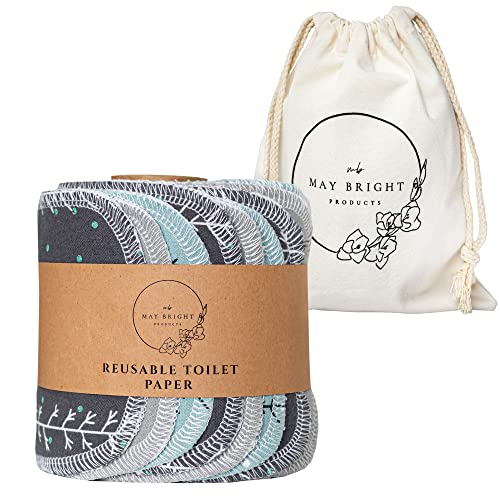
May Bright Reusable Bidet Towels with Washable Canvas Bag — 15 Pack, 2-Ply — Best Complete System
The final slot is the system around the towels, sold as a set: a stock of bidet towels plus their storage. The verified pick above bundles fifteen 2-ply reusable bidet towels with a washable canvas bag and a durable cardboard roll the towels dispense from — clean storage and dispensing solved in the box. Pair it with any lidded container you already own for used towels awaiting laundry. This is the pick we recommend to households starting from zero, because the number-one reason bidet towel systems fail is not the towels — it is the missing logistics. Clean towels in a drawer across the room and used towels with nowhere dignified to go will kill the habit in a week; a set that solves storage on day one keeps it alive.
Strengths
- Solves the whole workflow — clean storage, used storage, and towel stock — in one purchase.
- The washable canvas bag keeps the towel stock contained, portable and off the counter.
- The fastest route from “we bought a bidet” to a working daily system.
Trade-offs
- You accept the set’s towel choice rather than hand-picking your material family.
- Takes a small footprint of bathroom floor or counter space permanently.
- The canvas bag is a storage bag, not a waterproof wet bag — used towels still need a lidded container or a lined bag you supply.
What to look for (spec guidance)
- Contents: 15 two-ply towels, a washable canvas storage bag, and a durable cardboard dispensing roll
- Bag: washable canvas — storage, not waterproofing; add your own lidded bin for used towels
- Towels: one of the material families covered in this guide
Buy the system slot if your household is new to bidet towels and you want the habit to survive its first week: the May Bright set above arrives with its towels, bag and roll ready to place by the toilet. Experienced users with storage already solved should spend the same money deepening the towel stock in their preferred material instead.
Best for: new bidet households setting up the complete routine. / Not suited for: existing users who already have storage and a preferred material.
May Bright Reusable Bidet Towels with Canvas Bag: Check on Amazon — check the current price on Amazon.
Comparison Table
| Pick | Badge | Key spec | Best for | Link |
|---|---|---|---|---|
| Crafty Cloth Butt Cloths — Viscose from Bamboo Washcloths, 4-Pack | Best Overall | Viscose from bamboo, 4-pack | Most bidet owners | Check on Amazon |
| FuWeave Reusable Bidet Towels — Flannel Cotton, 60 Pack (Wilderness) | Best Everyday Value | Cotton flannel, 60 pack, 12 x 4.3 in | Families, hot laundry | Check on Amazon |
| Organic Cotton Bidet Towels (by type) | Best Natural Fiber | Organic cotton, certification to verify | Natural-fiber households | Listed by type — see review |
| Waffle-Weave Cotton Bidet Towels (by type) | Best Quick-Dry | Cotton waffle weave | Humid bathrooms | Listed by type — see review |
| Microfiber Bidet Towels (by type) | Best Absorbency per Towel | Split microfiber, compact | Travel, small spaces | Listed by type — see review |
| May Bright Reusable Bidet Towels with Washable Canvas Bag — 15 Pack, 2-Ply | Best Complete System | 2-ply towels + canvas bag + roll | New bidet households | Check on Amazon |
How to Choose Towels for Bidet Use
Choose the material by your laundry, not your ideals. Hot-wash households belong in cotton flannel or cotton waffle. Gentle-cycle households can enjoy bamboo’s softness. Everyone should sample microfiber’s hand-feel before committing. The towel you launder correctly beats the theoretically better towel you launder wrong.
Buy depth, not a pair. A bidet towel system runs on rotation: enough towels that laundry day is weekly, not daily. For one person that usually means at least a dozen; for a family, a dozen per person is not extravagant at flannel prices. Shoppers building the wider bathroom linen closet can compare Best High Quality Towels and Best Japanese Hand Towels for adjacent categories chosen with the same care.
Assign colors per person. The one-person-one-towel discipline is what makes the system hygienic and effortless: each household member has a color, towels are personal, and the laundry treats them like underwear — hot, thorough, and unshared. Any set you buy should offer enough colors or patterns to run this system.
Solve storage before the towels arrive. Clean towels within arm’s reach of the toilet, used towels into a lined bag or lidded bin. If you cannot picture both locations in your bathroom, buy the system set — or solve storage first and towels second. Related small-towel thinking lives in Best Inexpensive Bamboo Bath Towels for the bamboo-curious, and absorbency benchmarks in Best Kitchen Towels Absorbent translate surprisingly well to judging towel thirst.
Read certifications like a skeptic. GOTS means organic. OEKO-TEX means tested for harmful substances. “Bamboo” means rayon from bamboo. None of these is a scam and none of them means the others — buy the specific claim you actually value.
How to Use and Launder Bidet Towels Hygienically
The routine is simple and is the whole hygiene story. Use your own towel, for drying after the bidet wash, then place it in the used-towel bag or bin — never back on the clean stack. Launder on a warm-to-hot cycle with detergent (cotton families take full hot; bamboo prefers the gentler end), dry thoroughly — a fully dry towel is a hygienic towel — and return the stack to its clean storage. Wash the wet bag itself with the load. Replace the household’s stock gradually as towels thin or lose absorbency, demoting veterans to cleaning duty.
Two habits protect the system: keep bidet towels a separate, recognizable set so they never migrate into face-towel duty, and keep the used-towel container closed and washed, since it is the one part of the system that handles the pre-wash interval. Guests get their own towel, visibly fresh, or the honest alternative of paper for guests — most households run exactly that hybrid without a second thought.
Finally, give the system a two-week settling period before judging it. The first days feel like a routine you are performing; by the second week the reach, the pat, the bag, and the laundry rhythm have become invisible, and the household’s paper consumption tells the real story in the trash bin. Nearly every abandoned bidet-towel setup we have heard of died in week one from missing storage or shallow stock — the two failures this guide’s system slot and depth rule exist to prevent — rather than from any flaw in the towels themselves.
Bidet Towels, Family Cloth, and Unpaper: Sorting Out the Vocabulary
Searches in this space collide with two neighboring terms, and knowing the difference sharpens your shopping. “Family cloth” is the broad reusable-cloth movement’s name for washable cloth used in place of toilet paper entirely — a wider commitment than this guide assumes. A bidet towel, by contrast, has the narrower job of drying after a water wash, which is why its hygiene model is simpler and why bidet owners adopt it more easily: the cloth meets washed skin, not the alternative. “Unpaper towels” are the kitchen branch of the same idea — reusable cloths replacing paper towels — and their flannel construction is literally the same cloth family as our flannel slot, which is why kitchen unpaper products sometimes appear in bidet searches and can even serve in a pinch, sized and edged as they are.
The practical takeaway: if you own a bidet, shop the bidet-towel brief — personal size, soft, absorbent, hot-launderable — and do not let the wider family-cloth world’s debates about a bigger commitment talk you out of a smaller, easier one. If you do not own a bidet, this category is not your product; a bidet attachment plus towels is the system, and the towels alone solve nothing.
Setting Up in a Small Bathroom
Small bathrooms are where bidet towel systems go to be abandoned, so the setup deserves its own honest section. The constraints are real: no floor space for a bin, no counter for a basket, guests sharing the same few square feet. The solutions are vertical and modest. Clean towels live in a small hanging basket, a rolled stack in an over-tank tray, or a wall-mounted holder within reach of the toilet — the reach is the non-negotiable part. Used towels go into a slim hanging wet bag on the back of the door or a hook, which takes no floor at all and closes away from sight. Rotation depth shrinks to fit: eight to ten towels per person instead of twenty, with laundry twice a week, is a fair trade in a small space — and it is exactly the scenario where the quick-drying waffle slot earns its place, because a small rotation lives or dies on drying speed.
Renters have one extra consideration: nothing in this setup needs to be permanent. Baskets hang, bags hook, bins sit. The whole system can move out in a single box, which makes it one of the few bathroom upgrades that asks nothing of a landlord.
The Running-Cost Picture, in Honest Qualitative Terms
Per this site’s standing rule we do not print product prices — check Amazon at purchase time on the linked picks above — but the shape of the economics deserves a plain description, because it is the reason many households adopt bidet towels in the first place. The setup cost is a one-time purchase of towel stock plus storage; the running cost is a marginal addition to laundry you already do, since a week’s bidet towels are a fraction of one load. Against that sits the eliminated purchase: the toilet paper a bidet household otherwise buys for drying, plus the wipes some households buy on top. For most households the towel system pays for itself in a matter of months and then simply keeps not costing money, while the towels themselves — flannel and cotton especially — last for years of weekly washing. The honest caveats: households with coin laundry pay per load and should run the numbers with their own rates, and premium organic or bamboo stocks take longer to amortize than flannel. The direction of the math, though, is not in serious doubt, which is why the category keeps growing.
Travel, Portable Bidets, and Taking the Habit on the Road
A portable bidet — a squeeze bottle or travel unit — creates the same drying need away from home, and the towel answer scales down gracefully: two or three small towels in a zip pouch, with a mini wet bag for the return trip. This is the microfiber type’s home turf, and the waffle type’s close second, because both dry fast in a hotel bathroom and pack to nothing. Travelers who run this kit report the same conversion story as home users: the habit, once comfortable, feels incomplete without its towel. The hygiene discipline travels unchanged — personal towels, sealed away used, hot laundry on return — and the whole kit weighs less than the paper products it replaces in the bag.
Finishes That Matter: Terry, Fleece, and Flannel Surfaces
Within each material family, the surface finish changes the experience enough to shop by it. Terry — tiny loops across the surface — is the classic towel finish and the absorbency benchmark in natural fibers: the loops present enormous surface area to water. A bamboo or cotton terry bidet towel is the plush, thirsty default most people picture. Fleece finishes, common in bamboo-derived fabrics, shear those loops into a smooth, dense nap: slightly less thirsty than terry, noticeably softer and less textured against skin, and quicker to release water in the wash. Flannel is a woven finish rather than a loop at all — a brushed plain weave, thin and smooth, whose absorbency comes from the cotton itself and improves as washing opens the fibers. None of the three is “best” in isolation: terry for maximum uptake, fleece for maximum softness, flannel for maximum durability and laundry tolerance. The slots in this guide map onto that triangle, and a household that cannot decide can legitimately run two finishes — terry for home, flannel for the laundry-proof guest set — without any inconsistency.
Edge finishing deserves the same attention, because it is where cheap towels die. A serged edge — dense overlock stitching — survives hundreds of hot washes. A hemmed edge is nearly as good and lies flatter. A raw or pinked edge is a countdown timer. When a listing’s photos let you see the edge, judge the towel by it before you judge it by its fluff: fluff is marketing, edges are engineering.
Troubleshooting the First Month
Problem: the towels feel less absorbent than expected. New towels often carry factory finishes that resist water. Wash them two or three times before judging, keep fabric softener out of every load, and remember that flannel in particular is a slow starter that improves for weeks.
Problem: the system keeps running out of clean towels. The rotation is too shallow for your laundry interval. Add towels before you add laundry days — depth is cheaper than frequency, in money and in willpower.
Problem: a household member refuses to convert. Do not force the system. Keep paper available without commentary, make the towels the softest slot (bamboo), and let convenience and curiosity work. Most holdouts convert when they see the system running smoothly rather than being argued into it.
Problem: towels come out of the wash dingy. Wash hotter (for the cotton families), use adequate detergent, and do not overload the machine — towels need room to rinse. Persistent dinginess in bamboo usually means the load is too gentle for the soil; a periodic hotter wash, within the maker’s guidance, resets it.
Problem: the wet bag smells when opened. It is doing containment, not magic: shorten the interval, wash the bag with every load, and let it air dry fully inside-out between uses. A second bag in rotation ends the problem permanently.
Matching the Setup to Your Household
Solo households have the easiest version of this system: one color, one dozen towels, one small wet bag, laundry weekly. Start with the bamboo slot for the best first impression, or flannel if your laundry runs hot, and resist overbuilding — a solo system should fit in one small basket with room to spare.
Couples add exactly one discipline: two colors, strictly kept. Everything else scales trivially. The couples’ failure mode is not hygiene but towel drift — colors mixing until neither partner trusts the stack — so keep the color rule cheerfully and absolutely.
Families with children should weight durability and depth above softness: flannel in quantity, a lidded bin a child cannot baptize toys in, and towels treated as the household utility they are. Kids accept the system as normal remarkably fast when it is simply how the bathroom works; assign each child their color and let ownership do the teaching.
Households with elderly members or sensitive skin should weight softness and simplicity: the bamboo slot’s gentle hand, a storage position that requires no bending or reaching, and a routine simple enough to run identically every day. Nothing in this category involves medication or treatment, and we make no such claims — this is about a softer, simpler drying habit, chosen on comfort grounds alone.
Eco-committed households will already have the laundry discipline this system wants; their decision is the material one — organic cotton for the certified natural path, or bamboo-derived fabric with clear eyes about what “bamboo” means on a label, as the organic slot’s review explains.
Common Buying Mistakes
Buying two beautiful towels instead of twenty working ones. Rotation depth is the system. A pair of luxury towels and a daily laundry burden is a failed setup wearing nice clothes.
Sharing towels between people. The entire hygiene model is personal towels, personally colored, hot laundered. Sharing breaks the model; colors fix it.
Using fabric softener on everything. Softener coats absorbent fibers — microfiber most of all, but terry too — and quietly converts thirsty towels into water-resistant ones. Skip it for this load.
No plan for used towels. A pile on the floor is how systems die. Wet bag or lidded bin, decided before the towels arrive.
Confusing certifications. Paying an organic premium for an OEKO-TEX-tested conventional towel — or vice versa — is a reading failure, not a product failure. The reviews above flag the distinction; use it.
Final Recommendation
Start with the bamboo pick — the Crafty Cloth Butt Cloths — Viscose from Bamboo Washcloths, 4-Pack — for softness-led conversion (Check on Amazon), or the cotton flannel pick, the FuWeave Reusable Bidet Towels — Flannel Cotton, 60 Pack (Wilderness), if your laundry runs hot and your household runs large (Check on Amazon). Natural-fiber households should shop the organic cotton type, verifying the certification named on any listing they choose; humid bathrooms should shop the waffle type by the checks in its review; performance-per-towel shoppers should sample the microfiber type before deepening it; and brand-new bidet households should buy the complete system pick — the May Bright Reusable Bidet Towels with Washable Canvas Bag — 15 Pack, 2-Ply (Check on Amazon) — and let its storage design carry the habit through its first month.
Frequently Asked Questions
Are bidet towels hygienic?
Yes, under the system this guide describes: the towel dries skin that the bidet has just washed, it is personal to one user, and it is hot-laundered and fully dried between rotations. That is the same hygiene model as a personal hand towel, applied consistently — the discipline is the product as much as the cloth is.
How many bidet towels do I need?
Enough for your laundry interval plus a buffer: most single users land around a dozen, and families scale per person with colors assigned. If you are doing laundry more often than weekly because the basket ran dry, the answer is more towels, not more washing.
Can I just use washcloths or cut-up towels instead?
You can, and many households start exactly there to test the habit. Dedicated bidet towels win on size consistency, edge finishing that survives constant washing, and being a recognizable set that never migrates to face duty. Test with washcloths; commit with a real set.
How do bidet towels compare with toilet paper environmentally?
They trade paper consumption for laundry water and energy. With full loads, efficient machines, and long towel life, most households come out ahead on waste and cost — and unambiguously ahead on plumbing, since nothing is flushed. We present the trade honestly rather than as a free lunch.
What about guests?
Most households keep it simple: a small stack of clearly fresh guest towels by the toilet, or paper available for guests who prefer it. Your system should never require a guest to guess — hospitality is a feature of the setup, not an afterthought.
Should I buy a bidet towel set or assemble my own?
Buy the set if you are starting from zero and storage is unsolved — its value is the workflow, not the cloth. Assemble your own if you already have a storage answer and a material preference, because then the set’s towels are a compromise you do not need. The two paths converge within a month: set owners start deepening their favorite material, and self-assemblers end up buying a wet bag that looks exactly like the one in the set.
Do bidet towels smell between washes?
Not when the system is run properly: towels go into a closable wet bag or lidded bin, laundry is weekly or better, and towels are dried completely before returning to service. Odor is a logistics failure, not a product property — it appears when used towels sit open and damp, which is precisely what the storage half of this guide exists to prevent.
What is the difference between a bidet towel and a washcloth?
Mostly intent and company: a bidet towel is a washcloth-class cloth bought as a dedicated, color-coded set with finished edges chosen for hundreds of hot washes, stored in a system by the toilet. The cloth itself may be identical — which is why testing the habit with spare washcloths is legitimate. The set is what turns a cloth into a system, and the system is what makes the habit permanent.
How long do bidet towels last?
Judged by absorbency and edges rather than the calendar: a cotton flannel or terry towel in weekly rotation typically serves for years before it thins, and bamboo asks for gentler handling in exchange for its softness. Retire towels when they stop absorbing eagerly or when edges fray past tidiness — demote them to cleaning rags, where their second life is long and useful.
What size should a bidet towel be?
Personal-towel size: large enough to pat dry comfortably in one or two passes, small enough to launder in bulk and store by the dozen in a small basket. In practice that means the washcloth-to-hand-towel range. Anything bath-towel sized defeats the storage and laundry logic that makes the system work, and anything much smaller turns the job into a two-towel affair.
Can bidet towels go in the same load as regular laundry?
Yes — they are ordinary laundry, washed hot with detergent like underwear or hand towels. Households that prefer separation can run them with the towel load; the only hard rules are adequate heat, real detergent, and complete drying. Microfiber is the exception to mixed loads: wash it away from cotton, whose lint it collects, and never with fabric softener.
Why not flushable wipes instead?
Because “flushable” wipes are a leading cause of household and municipal clogs — they do not break down like toilet paper, whatever the packaging implies. A bidet plus a washable towel achieves the same clean with nothing entering the pipes but water.


