Disclosure: airfryerkitchensupply.com is reader-supported. When you buy through links on our site, we may earn an affiliate commission at no extra cost to you.
Where to buy
Every verified pick below links to its Amazon listing, where sizing, colour and availability change often, so confirm the details on the listing before ordering:
- SITAILE Toddler Slippers (Truck design) — check price on Amazon
- OWIF Toddler Slippers with Non-slip Sole (unisex) — check price on Amazon
- Fadezar Toddler Bunny Slipper (Pink, 8-9 Toddler) — check price on Amazon
- OWIF Toddler Dinosaur Slippers (Green) — check price on Amazon
- JOINFREE Toddler Slippers Boots with Hook and Loop — check price on Amazon
- Hstyle Baby Walking Sock Shoes (Grey, 12-18 Month) — check price on Amazon
Parents searching for the best toddler slippers with grip are usually solving a specific moment: a newly walking child, a hard kitchen floor, and a pair of socks that turned the hallway into a skating rink. The fix is a slipper whose sole is built to bite the floor — and the honest way to shop for one is to read the sole claim in the listing title itself. Every pick in this roundup has a title that states its grip outright: non-slip sole, anti-slip soft sole, non-slip rubber sole, or grips named directly. If a toddler slipper’s title does not say it grips, we did not include it, however cute the design.
Two cautions belong at the top. First, grip is not magic: any sole slips on a wet, soapy bathroom floor, and toddlers should wear slippers while awake and supervised, on dry indoor floors, which is the job these products are made for. Second, sizing in toddler footwear is unforgiving — a slipper a size too big trips a child more surely than socks ever did, so every pick below notes its stated sizing and you should measure your child’s foot against the listing’s size chart rather than trusting age labels alone.
All six picks were verified. Titles, sole claims and size labels below come from those verified listings. There are no prices and no ratings in this article — check the current price on Amazon on the listing, and use the listing’s own size chart at the same visit.
In this guide
Quick Picks
- SITAILE Toddler Slippers (Truck design) — Best Overall: The title says it twice — non-slip sole and with grips — on a plush-lined memory foam slipper with a child-friendly truck design. Check on Amazon
- OWIF Toddler Slippers with Non-slip Sole (unisex) — Best Everyday Value: A warm, soft indoor bedroom slipper for boys and girls with the non-slip sole stated plainly in the title. Check on Amazon
- Fadezar Toddler Bunny Slipper (Pink, 8-9 Toddler) — Best for Girls: A bunny slipper with a non-slip rubber sole and half-cover heel, sized explicitly at 8-9 toddler in the title. Check on Amazon
- OWIF Toddler Dinosaur Slippers (Green) — Best Character Pick: A fuzzy green dinosaur slipper — non slip, warm and soft — built for winter indoor floors. Check on Amazon
- JOINFREE Toddler Slippers Boots with Hook and Loop — Best Stay-On Fit: An adjustable hook-and-loop sock slipper boot, non-slip and machine washable, in a stated 5-6 size — the stay-on champion. Check on Amazon
- Hstyle Baby Walking Sock Shoes (Grey, 12-18 Month) — Best for First Walkers: A soft rubber sole, non-slip, lightweight walking sock shoe sized 12-18 months — built for the very first steps stage. Check on Amazon
How These Picks Were Chosen
We required three things. First, the product had to be a slipper — grip socks appeared repeatedly in search results and were excluded, because a sock is not a slipper and parents type this query want a shoe-like sole. Second, the listing title had to state the grip feature explicitly: non-slip, anti-slip or grips. Third, the title had to place the product in toddler or little-kid sizing; big-kid-only slippers were set aside. Within those rules we spread the picks across the shapes toddlers actually wear — plush character slippers, sock-style boot slippers with hook-and-loop straps, and clog-style slippers — and across warm lined designs for winter floors and lighter builds for year-round use.
We make no medical or developmental claims for any pick. A grippy slipper helps a child keep footing on smooth floors; it does not teach walking, correct gait or replace supervision, and nothing in the verified titles claims otherwise.
The 6 Best Toddler Slippers with Grip

1. SITAILE Toddler Slippers (Truck design) — Best Overall
The SITAILE slipper earns the top slot because its verified title makes the grip promise in two ways at once: a non-slip sole and grips, on a slipper that is also plush lined with a memory foam footbed for cold floors. The truck design matters more than decoration usually does — a toddler who loves the slippers is a toddler who keeps them on, and a grip sole only works while it is on the child’s foot. This is a winter-weight indoor slipper for bedroom and home use, aimed at boys and girls in the little-kid range.
Strengths
- Grip stated twice in the title: non-slip sole and grips
- Soft plush lining and memory foam footbed for cold hard floors
- Truck design gives reluctant toddlers a reason to keep them on
Trade-offs
- Warm plush build will be too hot for summer use
- Character design may not suit parents wanting a plain slipper
- Check the listing’s size chart carefully — plush lining takes up interior room
Key specs (from the listing title):
- Sole (as titled): Non-slip sole, with grips
- Lining: Soft plush
- Footbed: Memory foam
- Use: Indoor, winter
In daily life this is the slipper that lives by the bedroom door from October to March. The memory foam footbed cushions the thin fat pads of toddler feet on hard floors, the plush lining keeps toes warm on cold mornings, and the grip sole does its work on the kitchen tiles and hallway laminate where toddlers actually fall. Buy it for the season it is built for, measure for the plush lining when you size it, and expect the truck design to do quiet behavioural work every single morning.
Best for: toddlers on cold hard floors in winter who need a stated grip sole / Not suited for: warm homes or summer use, where the plush lining will overheat small feet
Check the current price on Amazon

2. OWIF Toddler Slippers with Non-slip Sole (unisex) — Best Everyday Value
This OWIF model is the straightforward everyday option: a cute, warm, soft indoor bedroom slipper for boys and girls whose title states the essential feature without fuss — a non-slip sole. It suits the largest number of households because it makes no narrow promise beyond warm feet and a gripping sole for indoor floors. For parents buying a first pair of grip slippers and unsure which special features matter, this is the low-risk starting point against which fancier options should have to justify themselves.
Strengths
- Non-slip sole stated plainly in the title
- Warm, soft build for indoor bedroom and living-room floors
- Unisex positioning for boys and girls simplifies handing down between siblings
Trade-offs
- Title does not specify lining or footbed materials — check the listing for detail
- Indoor positioning; not the pick for outdoor doorstep trips
- Cute styling varies by listing variant — confirm the design at checkout
Key specs (from the listing title):
- Sole (as titled): Non-slip sole
- Build: Warm, soft
- Use: Indoor bedroom shoes
- Fit: Boys and girls, little kids
The virtue here is absence of surprises. It is warm where toddlers need warmth, soft where they need softness, and grippy where the search demands grip, and it does not ask parents to decode a specialist feature list. Hand-me-down practicality is a genuine plus in toddler gear, which is outgrown in months: a unisex indoor slipper passes between siblings without negotiation. Pair it with careful sizing — measure the foot, consult the chart — and it will do the everyday job quietly well.
Best for: parents wanting a simple, warm first pair of grip slippers / Not suited for: outdoor use or children who need a strap to keep slippers on
Check the current price on Amazon

3. Fadezar Toddler Bunny Slipper (Pink, 8-9 Toddler) — Best for Girls
The Fadezar bunny slipper is unusually specific in its title, and the specifics are useful: a non-slip rubber sole — rubber being the classic grip material on smooth floors — a half cover heel that helps the slipper stay on without a full closed back, cosy plush construction, and an explicit size, 8-9 toddler, printed right in the title. It is an autumn and winter indoor slipper in pink bunny styling that the title notes is unisex despite the colour. Parents who know their child is in the stated size can order with more confidence than most toddler listings allow.
Strengths
- Non-slip rubber sole stated in the title
- Half cover heel helps the slipper stay on active toddlers
- Size stated in the title itself: 8-9 toddler
Trade-offs
- The verified listing is one size — other sizes sit under separate listings, so search carefully
- Pink bunny styling will not suit every child
- Plush autumn-winter build is too warm for summer
Key specs (from the listing title):
- Sole (as titled): Non-slip rubber sole
- Heel: Half cover heel
- Size (as titled): 8-9 Toddler
- Season: Autumn and winter
Rubber soles deserve their reputation: on laminate, tile and varnished wood, a rubber grip sole is the most predictable performer, and pairing it with a half-cover heel addresses the second toddler problem — slippers that walk off the foot. The bunny styling, like the truck design on the SITAILE, is functional in disguise: it makes the slipper an object the child asks for. If your toddler is in or near the stated size, this is one of the most completely specified picks in the roundup.
Best for: toddlers in the 8-9 size range who kick slippers off / Not suited for: children outside the stated size, or summer use
Check the current price on Amazon
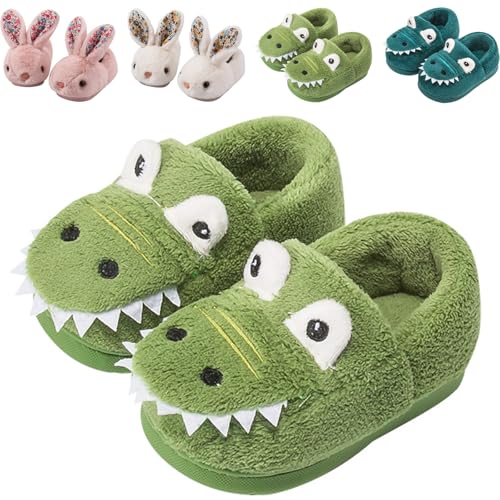
4. OWIF Toddler Dinosaur Slippers (Green) — Best Character Pick
The second OWIF entry earns its own slot on character strength: a green dinosaur slipper whose title states non slip performance alongside warm, soft, fuzzy winter construction for indoor bedroom use. Dinosaur styling is the toddler equivalent of a favourite toy, and for the large population of children in a dinosaur phase, these are the slippers most likely to be worn rather than carried, hidden or thrown. The grip claim is stated in the title as required by our method, and the winter fuzzy build suits cold floors.
Strengths
- Non slip performance stated in the title
- Warm, soft, fuzzy winter build for cold indoor floors
- Dinosaur design in green — high wear-compliance for dinosaur-phase toddlers
Trade-offs
- Fuzzy winter construction is seasonal, not year-round
- Character styling is a strong taste statement some families will skip
- Title gives no strap or heel detail — check the listing if staying-on is a concern
Key specs (from the listing title):
- Sole (as titled): Non slip
- Build: Warm, soft, fuzzy
- Use: Winter indoor bedroom
- Colour: Green
Treat this pick as a behaviour tool as much as footwear. The best grip sole in the world does nothing in the toy box, and character slippers get worn. On specification it matches the brief — stated non-slip sole, warm fuzzy winter build, indoor bedroom positioning — and the dinosaur design does the rest. Buy it for winter, size it by measurement, and let the roaring do the persuading at getting-dressed time.
Best for: dinosaur-loving toddlers in winter / Not suited for: summer use or families wanting plain, hand-me-down-neutral slippers
Check the current price on Amazon

5. JOINFREE Toddler Slippers Boots with Hook and Loop — Best Stay-On Fit
The JOINFREE pick solves the staying-on problem mechanically: a boot-style sock slipper with a hook and loop strap the parent adjusts, rather than relying on elastic and hope. Its title states non-slip performance, indoor and outdoor walking-shoe positioning, machine washability — a genuinely valuable feature in toddler gear — and a stated size of 5-6 in beige. The barefoot-style flexible format suits early walkers whose parents want floor grip without a stiff shoe, and the strap makes it the pick for children who remove every other slipper within minutes.
Strengths
- Hook and loop adjustment keeps the slipper on determined removers
- Non-slip sole stated in the title; positioned as an indoor-outdoor walking shoe
- Machine washable — rare and valuable in toddler footwear
Trade-offs
- Sock-slipper format offers less structure than a moulded-sole slipper
- The verified listing is beige in size 5-6; other sizes and colours are separate listings
- Barefoot-style flexibility will not suit parents wanting a firm supportive sole
Key specs (from the listing title):
- Sole (as titled): Non-slip
- Closure: Hook and loop, adjustable
- Care: Machine washable
- Size (as titled): 5-6
Every parent of a toddler knows the removal artist: shoes, socks and slippers come off in the car seat, the pram and the hallway. A strap changes the game because the fit is set by the adult, and the hook-and-loop closure also lets you fine-tune for thick winter socks or bare feet. Add machine washability — toddler slippers meet every floor and most puddles of spilled milk — and this is the practical engineer’s pick of the roundup, in a flexible barefoot format that lets small feet feel the floor they are gripping.
Best for: toddlers who remove slippers, and early walkers needing adjustable fit / Not suited for: parents wanting a structured, firm-soled slipper
Check the current price on Amazon

6. Hstyle Baby Walking Sock Shoes (Grey, 12-18 Month) — Best for First Walkers
The youngest pick in the roundup is aimed squarely at the first-walker window: the Hstyle sock shoe in grey for 12-18 months, with a non-slip soft rubber sole and lightweight construction stated in the title. At this age the requirement is minimal interference — a flexible sole that grips smooth floors while letting the foot flex naturally as the child learns balance. The sock format goes on like the socks the child already accepts, and the stated age sizing in the title makes the target wearer unambiguous.
Strengths
- Soft rubber sole, non-slip, stated in the title
- Lightweight sock format suits the 12-18 month first-walker stage
- Age sizing printed in the title: 12-18 months
Trade-offs
- The youngest sizing in the roundup — older toddlers need the other picks
- Sock format has minimal structure by design
- Gift positioning aside, always size by foot measurement, not age alone
Key specs (from the listing title):
- Sole (as titled): Non-slip, soft rubber sole
- Size (as titled): 12-18 months
- Build: Lightweight sock shoe
- Colour: Grey
First walkers fall for structural reasons — they are learning — but slippery socks add avoidable falls on hard floors, and that is precisely the gap this product fills. The soft rubber sole grips where cotton slides, the sock upper avoids the battle of a stiff shoe on a curling infant foot, and the light weight means the child is learning to walk in something close to bare feet, just with traction. Use it on dry indoor floors, awake and supervised, and graduate to the strapped or moulded picks as the child grows and speeds up.
Best for: first walkers aged around 12-18 months on smooth indoor floors / Not suited for: older, faster toddlers who need a more structured slipper
Check the current price on Amazon
Comparison Table
| Pick | Badge | Key spec | Best for |
|---|---|---|---|
| SITAILE Toddler Slippers (Truck design) | Best Overall | See key specs below | toddlers on cold hard floors in winter who need a stated grip sole |
| OWIF Toddler Slippers with Non-slip Sole (unisex) | Best Everyday Value | See key specs below | parents wanting a simple, warm first pair of grip slippers |
| Fadezar Toddler Bunny Slipper (Pink, 8-9 Toddler) | Best for Girls | See key specs below | toddlers in the 8-9 size range who kick slippers off |
| OWIF Toddler Dinosaur Slippers (Green) | Best Character Pick | See key specs below | dinosaur-loving toddlers in winter |
| JOINFREE Toddler Slippers Boots with Hook and Loop | Best Stay-On Fit | See key specs below | toddlers who remove slippers, and early walkers needing adjustable fit |
| Hstyle Baby Walking Sock Shoes (Grey, 12-18 Month) | Best for First Walkers | See key specs below | first walkers aged around 12-18 months on smooth indoor floors |
How to Choose the Best Toddler Slippers with Grip
Read the sole claim first and require it in writing. In this category the listing title is where honest sellers state the grip: non-slip sole, anti-slip, grips, rubber sole. A slipper that merely looks textured in a photograph has made you no promise at all. Rubber soles are the traditional grip standard on tile and laminate; moulded synthetic soles with stated non-slip design are the common alternative. Either is acceptable when the claim is stated — what matters is that the seller commits to it.
Sizing: Measure the Foot, Not the Birthday
Toddler sizes turn over every few months and vary between brands, so measure your child’s foot in centimetres, standing if they will stand, and match it to the listing’s size chart with a small allowance for socks and growth — but only a small one. An oversized grip slipper is a trip hazard with good marketing. Where a title states the size outright, as two of our picks do, treat that as the listing’s identity and search for the sibling listing in your child’s size rather than ordering the wrong size because it was the one you found first.
Staying On: Straps, Heels and Sock Formats
Grip only works on feet that are wearing the slipper. For removal artists, a hook-and-loop strap is the reliable answer. A half-cover heel is the middle path — easier on, harder to kick off than a pure slide. Sock-format slippers suit the youngest walkers, who accept them as socks. Match the retention system to your child’s demonstrated behaviour, not to the child you wish you had.
Grip Slippers and Floor Types
Not all hard floors are equal. Glossy ceramic tile and polished laminate are the most slippery surfaces in most homes and the ones where a stated grip sole earns its keep most visibly. Matte wood and textured vinyl are kinder, and carpet needs no grip at all — though toddlers cross every surface in the house in a single lap, so the sole must handle the worst floor on the route, not the average one. Wet floors defeat every product in this roundup: bathroom and kitchen spills should be wiped up rather than relied on slippers to survive, and grip slippers are indoor dry-floor equipment, full stop.
Warmth, Season and Rotation
Most grip slippers for toddlers are built warm — plush, fleece and fuzzy linings dominate the verified listings — because cold floors are half the reason parents buy them. That creates a summer gap: a toddler in July needs the grip without the insulation. If your home has hard floors year-round, plan on two pairs: a warm lined pair for winter and the lightest stated-grip pair you can find for summer, accepting slimmer choice in the warm months. Rotation also doubles working life, since toddler slippers are washed often and outgrown fast; a spare pair means never sending a child onto the tiles in plain socks while the grip pair is in the laundry — which, given machine-washable options like the JOINFREE pick, is a routine event worth planning around.
Grip Slippers Through the Walking Stages
The right grip slipper changes as walking develops, and buying ahead of the stage is as unhelpful as buying behind it. In the cruising stage, when a baby walks holding furniture, the sock-format picks rule: minimal interference, grip where palms-and-knees life meets the floor. In the early independent stage, the requirement shifts to a sole that survives speed — toddlers do not walk so much as fall forward repeatedly and catch themselves, and the sole must grip at the catch, mid-stride, dozens of times an hour. That is the stage the moulded and rubber soles in this roundup serve. By the confident-runner stage, the questions become staying-on and durability: straps, heels and soles that tolerate a child who now treats the house as a circuit. Match the pick to the stage you are in, not the photograph you like, and re-match it every few months — toddlerhood’s only constant is that last month’s right answer is this month’s small shoe.
The Sock Drawer Problem: Rotation and Washing
Toddler slippers live a filthier life than any other footwear in the house. They meet every floor, every spill, every toilet-training accident’s outer edge. A single pair, however grippy, spends a third of its life in the wash or drying — during which the child is on the tiles in socks, re-creating the problem the slippers solved. Two pairs in rotation is the practical minimum for a hard-floored home, and it changes the buying maths in a useful direction: the second pair can be the budget or character pair, the dinosaur or the truck, because the primary pair carries the specification burden. Wash both pairs on the same rhythm, dry them fully — a damp plush lining is a smell with ambitions — and inspect the soles while you handle them, since the wash is the natural moment to spot grip patterns wearing smooth.
Grandparents’ Houses and Other People’s Floors
A final scenario worth planning for: the floors your child walks most may not be yours. Grandparents’ houses, with their polished wood, loose rugs and stone kitchens, are statistically where many toddlers spend their longest floor hours — and where the slipper left at home does no good at all. A dedicated pair that lives at the grandparents’ house is one of the cheapest safety purchases in this whole category, and the character picks earn their keep there too, becoming part of the ritual of arrival. The same logic covers nursery and childminder settings that permit indoor shoes: send the grippy pair, labelled, and ask for it back at weekends for washing. Grip is a property of a place as much as a product — the sole only works on the floor it is standing on, so put the soles where the floors are.
What Grip Actually Is: Tread, Material and Contact
Grip is not one thing, and understanding its three ingredients helps you read listings like an engineer instead of a hopeful parent. The first ingredient is material: rubber grips hard floors by deforming microscopically into the surface’s texture, which is why rubber soles recur in this roundup’s titles. The second is tread pattern: channels and studs give water and dust somewhere to go, preserving contact on imperfectly clean floors — a smooth sole on a crumb-dusted kitchen floor is skating on ball-bearings. The third is contact area and flexibility: a sole that bends with the foot keeps more of itself on the floor through a stride than a rigid plate that touches at heel and toe only. When a title states a non-slip rubber sole, it is claiming the first ingredient outright and implying the others; when it states grips, it is usually describing tread. Either claim, stated, is a claim you can hold the seller to — which remains the whole method of this article. What no ingredient survives is a wet, soapy floor, and the supervision rule outranks every sole ever moulded.
When Slippers Are Not the Answer
Honesty about a category includes its boundaries. Grip slippers are indoor, dry-floor, awake-and-supervised equipment. They are not the answer for the garden, the pool surround, the scooter, or the climbing frame, and they are not a substitute for a properly fitted shoe when a child is walking outdoors or for long distances. They are also not the answer when the real problem is the floor itself: a loose rug on polished wood defeats every sole in this roundup by simply moving, and the correct purchase there is a rug grip or the rug’s removal. Finally, a child who is falling far more than peers at the same stage deserves a conversation with a health professional rather than a footwear upgrade — slippers solve slippery floors, and falls with another cause deserve another kind of attention. Knowing what a product cannot do is part of buying it well, and in a children’s category it is the part that matters most.
Reading a Toddler Slipper Listing in Sixty Seconds
A parent reading a listing in the aisle of a busy day needs a drill, and here it is. First, find the sole claim in the title — non-slip, anti-slip, grips, rubber sole — and if it is absent, close the tab; the photograph is not a promise. Second, confirm the product is a slipper and not a grip sock wearing slipper language, because the two share searches and differ in durability, structure and price. Third, find the size stated in the title or the size chart, convert your child’s measured foot length, and check the allowance the chart recommends. Fourth, decide the staying-on system against your child’s known behaviour: strap for removers, heel for kickers, sock format for the youngest. Fifth, check the care line — machine washable is a genuine feature in this category, worth real money across a winter of spills. Sixty seconds, five checks, and you have replicated the method that built this roundup. The drill generalises to every toddler purchase, which is why it is worth learning here, on the slippers.
Shoes, Slippers and the Barefoot Question
Parents sometimes ask whether toddlers should simply go barefoot indoors, and the honest answer is: on warm, clean, grippy floors, barefoot is a fine and natural default that no product in this article claims to improve on. The grip slipper’s case begins where those conditions end — cold floors that make bare feet miserable, hard floors where a fall lands worse, polished surfaces where skin itself slides when slightly damp, and households where the floor is shared with outdoor shoes, dogs and the day’s deliveries. In other words, the slipper is not competing with the foot; it is competing with the sock, and against the sock it wins on grip, warmth and cushioning simultaneously. Buy it for the floors and the season that need it, skip it for the carpeted summer flat that does not, and let the child’s own comfort arbitrate the borderline days. A category that knows its boundaries is a category you can trust inside them.
The Hallway Test, the Playground Standard and Other Home Checks
Beyond the fit checks in this article’s how-to section, three home standards separate a good purchase from a returned one. The hallway test you already know: your smoothest floor, a walking toddler, and your eyes on the soles rather than the smile. The playground standard is the comparison every parent makes instinctively — the slipper should grip at least as reassuringly as the child’s outdoor shoe grips pavement, because indoor speeds on hard floors reach outdoor energy with harder landings. And the midnight standard is the one nobody lists: the slipper a half-asleep parent can identify, orient and fasten in the dark during a 3 a.m. resettling is the slipper that gets used at 3 a.m., while the fiddly one stays in the drawer and the socks go back on. Judge a candidate against all three before the returns window closes. A pair that passes the hallway, matches the playground and survives the midnight has earned its place by the bedroom door, and the brand on the box will have long stopped mattering to anyone in the house.
Siblings, Hand-Me-Downs and the Honest Second Life
Toddler gear’s economics run on succession, and grip slippers are no exception — but their second life needs one check the first life did not. A handed-down pair arrives with its grip partly spent by an unknown number of hallway miles, so inspect the sole as you would a tyre on a used car: tread visible and textured, or a kind decline and a new pair for the new walker. Elastic and straps tire too, and a strap that no longer holds has quietly converted a stay-on slipper into a kick-off one. Where the pair passes, the hand-me-down is the greenest and cheapest pick in this entire article, and the character designs — sized out of long before they are worn out — get the second childhood they were styled for. Where it fails, it fails on safety’s doorstep, and the correct sentiment is gratitude for its service rather than a second tour of duty. Buy the new pair, pass the old one to the dressing-up box, and let dinosaurs retire to ceremonial duties.
A Word on Floors: Rugs, Thresholds and Transitions
The last variable in the grip equation is the route, not the room. Toddlers travel, and their routes cross the transitions where floors change character: the rug’s edge that lifts a toe, the threshold bar between kitchen tile and hallway wood, the bath mat that slides on the very floor it protects. A grip sole handles the surfaces; the transitions demand a household audit. Tape or grip the rug edges on the toddler routes, check that bath mats have their own grip backing intact, and clear the thresholds of the toy traffic that accumulates exactly where feet are busiest. None of this diminishes the slipper — it completes it, because a safety system is the product plus the place. Walk your child’s route once at their height and you will see the house as the soles do: a sequence of surfaces and edges, each asking its own question. The slippers in this roundup answer the surfaces. The audit answers the edges, and together they are the closest thing to a finished job that toddler-proofing ever offers.
Reading Reviews From Other Parents Without Being Misled
Since this article prints no ratings of its own — a programme rule, because fixed numbers go stale — a note on reading other parents’ experiences elsewhere is in order. Weight the reviews that describe a floor like yours, a child of your child’s stage, and a problem like the one you are solving; a five-line account of a strapped slipper surviving a removal artist is worth more to the parent of a removal artist than any aggregate score. Discount the reviews that complain a plush winter slipper was warm in summer, or that a child outgrew a size — those are the category working as described. And treat sizing complaints as data rather than verdicts: a pattern of size-up advice on one model is the crowd correcting the size chart in public, which is exactly the intelligence this article’s measuring drill exists to gather for your own child’s foot. Read for situations, not scores, and the experience of thousands of hallways becomes usable evidence.
One Last Thing: The Slipper by the Door
Every system in this article converges on a single humble image: the right pair, in the right size, sitting by the door where the floors begin. Not in the wardrobe, not in the wash basket, not at the grandparents’ house — by the door, every morning, where a toddler’s day actually starts. Build that one habit and the grip, the sizing, the straps and the soles all get their chance to work; neglect it and the finest specification in this roundup is a theory. Put the pair by the door tonight, and the article has done its job.
And Finally: Buy Two, Wash One, Keep the Hallway Safe
If this long article must shrink to an instruction, it is this: measure the foot, choose the stated grip, pick the staying-on system your child cannot defeat, and buy the second pair while the first is still new enough to match. Everything else — the characters, the colours, the morning negotiations — is the pleasant surface of a simple safety system doing quiet work on cold floors. The toddlers will not remember the slippers. They will simply have fallen less, on the days when falling was the curriculum, and that is the entire ambition of the category, honestly bought and honestly worn.
How to Fit and Use Toddler Grip Slippers Safely
Fit them at the end of the day, when feet are at their largest, with the socks the child will actually wear. The heel should sit in the heel cup or against the strap without the toes pressing the front; check with the child standing, since feet spread under weight. Fasten straps snugly enough that the slipper does not rotate on the foot — a twisted sole grips in the wrong direction. Then do the hallway test: walk the child across your smoothest floor and watch for sliding, tripping on the toe, or the slipper walking off. Any of the three means resize or change format before regular use.
In use, keep the routine simple: slippers on for indoor floor time, off for naps and sleep, and always on dry floors with an adult around, as with any toddler footwear. Wash machine-washable pairs as directed and air-dry plush pairs fully — a damp lining is a smell and a hygiene problem — and inspect soles monthly. Grip patterns wear smooth with use, and a worn-smooth grip slipper has quietly become the sock you bought it to replace.
Common Buying Mistakes
The biggest mistake is buying grip socks when you wanted slippers, or the reverse — they appear in the same searches and are different products with different durability. Second is sizing by age label alone; brands differ, and a too-big grip slipper trips more children than socks ever slipped. Third is trusting a photograph of a textured sole without a stated non-slip claim in the title. Fourth is expecting any sole to handle wet bathroom floors. And fifth is forgetting the removal problem: the finest grip sole is useless in the toy box, so for children who strip footwear, buy the strap first and the styling second.
Final Recommendation
For most families the SITAILE is the complete answer — grip stated twice in the title, plush warmth and a design toddlers keep on. First walkers should start with the Hstyle soft rubber sole sock shoe, and removal artists with the strapped, washable JOINFREE. The Fadezar earns its place for its rubber sole and half-cover heel in its stated size, the dinosaur OWIF for dinosaur-phase compliance, and the unisex OWIF as the hand-me-down-friendly everyday pair. Continue your search with Best Baby Walking Slippers, Best Baby Slippers With Velcro and Best Boy’s Slippers.
Frequently Asked Questions
Do grip slippers really stop toddlers slipping?
They reduce slipping on dry smooth floors substantially compared with socks, because the sole is designed and stated to grip. They do not make any floor slip-proof — wet tiles defeat every sole here — so treat them as traction help, not protection, and keep floors dry.
What is the difference between grip slippers and grip socks?
Grip socks are socks with grip patterns — lighter, cheaper and less durable. Grip slippers have a constructed sole, usually rubber or moulded synthetic, with more cushioning and structure. They appear in the same searches, so check which product a listing actually is before ordering.
How should toddler slippers fit?
Snug at the heel with a small allowance at the toes, fitted standing with normal socks. Measure the foot and use the listing’s size chart. A slipper that is too big is a trip hazard; one that is too small will be rejected and outgrown in weeks.
Can toddlers wear grip slippers outdoors?
Most picks here are positioned for indoor use. One pick, the JOINFREE, is titled as an indoor-outdoor walking shoe. For regular outdoor play, a proper toddler shoe protects better; slippers are for floors, doorsteps and quick trips at most.
How do I know when grip slippers need replacing?
When the sole’s grip pattern has worn smooth, when the child outgrows the size, or when straps and elastic stop holding the slipper on. Check soles monthly — wear is gradual and easy to miss until the first slide reminds you.
Are character designs just decoration?
Partly — but decoration drives whether a toddler wears the slipper at all. A grip sole in the toy box grips nothing, so a truck or dinosaur design that a child asks for is doing real functional work.


