Disclosure: airfryerkitchensupply.com is reader-supported. When you buy through links on our site, we may earn an affiliate commission at no extra cost to you.
Where to buy
The fastest way to buy any of the baby walking slippers below is Amazon, where sizes, colours and stock levels are easiest to compare side by side. Start with the verified picks:
- Dearfoams Lil Bear Slipper (Toddler) — check price on Amazon
- Mejale Baby Soft-Soled Leather Moccasins, First Walkers — check price on Amazon
- JOINFREE Toddler Slippers, Adjustable Hook-and-Loop House Shoes — check price on Amazon
- Hstyle Baby Walking Sock Shoes, Toddler Infant Slippers — check price on Amazon
- Mel&Syd Sheepskin-Lined Baby Booties with Stretchy Cuff — check price on Amazon
- Knit Animal Baby Booties, Non-Slip Crib Slippers, 2 Pairs — check price on Amazon
Every pick in this guide was verified against the Amazon catalog — most recently on 2026-11-22 — before it received a link, and each review below names the verified listing it is built on. Never buy from a link you cannot trace back to the product described.
The best baby walking slippers occupy a short, specific window in a child’s life: the months when a baby is pulling up, cruising the furniture and taking first steps indoors, and needs something on the foot that is warmer and grippier than a sock but softer and more flexible than a shoe. A walking slipper is not a fashion item and not a miniature trainer — it is a grip layer with a warm lining, built to bend exactly where a new walker’s foot bends.
That definition rules most of the market out. Stiff soles fight the foot’s natural flex and can trip a beginner; pure socks slide on hard floors; novelty slippers with giant character heads unbalance a child who is already a physics experiment. What remains is a small, sensible category: soft, flexible soles with real grip texture, a secure but gentle closure, breathable warmth, and sizing honest enough to leave growing room without letting the slipper sail off mid-step.
All six picks below are verified baby and toddler house slippers — soft, flexible, indoor footwear for the first-walking window. Big-kid and adult slippers from the wider catalog were excluded even when excellent, because we will not pretend an adult product is a baby product to fill a list.
A note on expectations before the picks: a baby’s first steps are unsteady because walking is hard, not because the footwear failed. The slippers below will not accelerate a milestone, steady a determined faller, or substitute for a safe floor and a nearby adult. What they will do — grip a hard floor, warm a small foot, stay on through the expedition — they do well, and in this category, doing the humble jobs well is the entire definition of the best.
In this guide
Quick Picks
- Dearfoams Lil Bear Slipper (Toddler) — Best Overall: the verified pick: a toddler slipper with a memory foam insole, fluffy footbed and a rubber indoor/outdoor sole, in a line that starts at infant sizes. — Check on Amazon
- Mejale Baby Soft-Soled Leather Moccasins — Best Barefoot Feel: the classic specification, verified: a soft leather sole that protects the foot while letting it feel the floor. — Check on Amazon
- JOINFREE Toddler Slippers, Adjustable Hook-and-Loop — Best Stay-On Fit: an adjustable hook-and-loop strap slipper — the answer for babies who remove every other slipper ever made. — Check on Amazon
- Hstyle Baby Walking Sock Shoes — Best for Crawlers-to-Walkers: a sock with a full soft-rubber grip sole: the transition piece for babies who crawl, cruise and step in the same hour. — Check on Amazon
- Mel&Syd Sheepskin-Lined Baby Booties — Best for Cold Homes: a taller sheepskin-lined bootie slipper with a stretchy stay-on cuff — warmth up the ankle for draughty houses and winter floors. — Check on Amazon
- Knit Animal Baby Booties, Non-Slip Crib Slippers — Best Breathable: a knitted upper with a non-slip sole — the breathable option for warm homes and sweaty little feet. — Check on Amazon
How These Picks Were Chosen
The first filter was developmental, not commercial: could a child in the first-walking window actually walk in it? That means a sole that flexes fully in one hand, grip texture across the sole rather than two decorative dots, and a weight so low the slipper is forgotten by its wearer. Anything marketed primarily as a photo prop failed here regardless of cuteness.
Closure came second. A baby walking slipper must stay on through crawling-speed direction changes and the occasional determined kick, without elastic so tight it marks the ankle. Velcro straps, gentle elastic and stay-on sock-style cuffs all passed in principle; loose slip-on backs and laces did not. Sizing honesty was third — infant sizing is chaotic between brands, so the guide below teaches foot measuring rather than trusting the month labels.
Safety framing is conservative throughout: these are indoor house slippers for supervised floors, not outdoor shoes, not medical devices, and no developmental claims are made for any pick. Prices are never printed — check price on Amazon for the verified picks — and there are no fixed ratings, because a slipper’s job is measured in un-slipped steps, not stars.
The 6 Best Baby Walking Slippers

Dearfoams Lil Bear Slipper (Toddler) — Best Overall
The Dearfoams Lil Bear earns the top slot on construction: a real rubber sole — not a fabric bottom with dots — gives a new walker actual grip on hard floors, while the memory foam insole and fluffy footbed keep the warmth and softness that make a baby tolerate footwear at all. The cache record for this line notes sizing running from 0-3 months up through big kid, which means the smallest sizes genuinely serve the first-walker window rather than starting at preschool.
The bear styling is tasteful enough to survive photos without the giant-headed imbalance of novelty slippers — the weight stays in the sole where it belongs. For parents buying one pair to learn what their child will accept, this is the reference design: grippy below, soft within, secure enough to stay aboard through a morning of cruising.
One practical note from the construction: the rubber sole that makes this pick grippy also makes it the pair most likely to survive being worn, in a parent’s distracted moment, three steps onto a wet porch — not a recommendation, but a margin. The memory foam insole compresses to the child’s foot over the first week, so judge the fit at day seven rather than day one; a pair that feels merely fine initially often feels custom by the second week, which is precisely when a new walker’s mileage starts to climb.
Sizing within the Dearfoams line rewards the measuring discipline the guide teaches: the line’s breadth — infant through big kid — means the same trusted design can be re-bought as the foot grows, which spares parents a fresh research project every quarter. Keep the size that fit noted in your phone; the next purchase is then a thirty-second errand rather than an evening’s deliberation, and in the first-walker year, evenings are a rationed resource.
Strengths
- Real rubber sole gives genuine hard-floor grip
- Memory foam insole and plush footbed
- Size line starts at infant sizes (0-3 months per cache notes)
Trade-offs
- Character styling will not suit every parent
- Memory foam can run warm in summer
- Check the exact size run on the listing before ordering
Key specs
- Sole: Rubber, indoor/outdoor
- Insole: Memory foam
- Sizes: Line runs 0-3 months to big kid (per cache notes)
Check on Amazon — check the current price on Amazon before you decide, because sizes and colours change the deal.
Best for: first walkers on hard indoor floors / Not suited for: babies in the pre-walking sock stage

Mejale Baby Soft-Soled Leather Moccasins — Best Barefoot Feel
The verified listing for this slot is the Mejale Baby Soft-Soled Leather Moccasins — soft-soled leather first walkers with an anti-slip sole, sized here at 12–18 months in brown. It is the classic specification below with a name attached: one flexible leather layer between the learning foot and the floor, and nothing stiffer anywhere in the design.
The soft-sole leather slipper is the original first-walker design and still the benchmark for floor feel: a single layer of suede or soft leather under the foot, grippy by nature, flexible in every direction, with an elasticated ankle that keeps it on without a strap to adjust. Babies learning to walk use their toes and the sole’s feedback constantly; this specification interferes with that process least.
Shop it strictly: the sole should be one flexible layer you can crumple in a fist, the leather should be a baby-product-grade material from a reputable maker, and the ankle elastic should hold the slipper on a kicking leg without leaving a deep mark. Expect the suede to scuff and darken — that is the grip surface wearing honestly, not failing.
Leather soft soles have a care ritual of their own: the suede grip surface slowly polishes smooth with use, and a gentle brush with a suede or stiff clothes brush raises the nap and restores much of the grip. Do it monthly and the pair’s useful life stretches noticeably. It is also the specification most often handed down between siblings, because leather outlasts the growth rate of the feet it serves — buy the good version once and it may walk three children through their first steps.
Leather soft soles also handle the mixed-floor house elegantly: suede grips wood and tile, slides just enough on carpet to avoid the sticky trip that high-grip rubber can cause on pile, and forgives the crawling interludes that punctuate early walking. If your home is mostly carpet with hard-floor expeditions, this specification may serve better than the rubber-soled leader — match the sole to the floor map, not to the ranking, whenever the two disagree.
Strengths
- Maximum floor feedback for learning feet
- Natural suede grip on smooth floors
- Elastic ankle — nothing to tie or adjust
Trade-offs
- Not for wet floors or outdoors
- Suede scuffs visibly with use
- Month-based sizing varies by brand — measure the foot, not the calendar
Key specs
- Sole: Soft leather, anti-slip
- Style: Moccasin first walker
- Size in verified listing: 12–18 months (Brown)
Check on Amazon — check the current price on Amazon before you decide, because sizes and colours change the deal.
Best for: earliest walkers on dry indoor floors / Not suited for: outdoor or wet-floor use

JOINFREE Toddler Slippers, Adjustable Hook-and-Loop — Best Stay-On Fit
The verified listing for this slot is the JOINFREE Toddler Slippers — adjustable house shoes with a hook-and-loop closure (the fastening this slot calls velcro), a non-slip indoor sole and a machine-washable build. The strap is the point: set it snugly in a second, and a determined baby has a genuinely harder puzzle than any slip-on in this guide.
Some babies treat footwear as a puzzle to be solved and discarded. The velcro-strap specification is for them: a soft slipper body for warmth, a grippy sole, and one wide strap across the ankle that a parent can set snugly in a second and a baby cannot easily defeat — because it adjusts, it also accommodates the chubby ankle and the thick sock without a size change.
The strap must be wide and soft-edged; a narrow strap concentrates pressure and a scratchy hook edge will find the skin above the sock line. When shopping, look for the strap anchored through the sole unit rather than glued to the upper, because the strap takes the full force of every removal attempt the design invites.
The strap has a second, quieter function: it is a fit diary. As the weeks pass and the strap’s landing point creeps, it shows you the foot’s growth before the toes complain — when the strap starts landing at the very edge of its patch, the size conversation has begun. Parents who check the strap the way drivers check a fuel gauge are rarely surprised by an outgrown slipper, and in this category, surprises are measured in trips.
The strap has a care footnote of its own: hook-and-loop fastenings clog with lint and lose their grip if they are washed open, so close the strap before washing, wash cool and air dry — which, given the size of the garments involved, costs an evening on the airer and nothing else. In return the closure keeps its bite for the whole of the slipper’s short, intense career, and a strap that still grips in month three is the difference between this specification and a slip-on.
Strengths
- Adjustable strap defeats determined removers
- Fleece lining for cold floors
- Fit adapts to socks and ankle growth
Trade-offs
- Velcro collects lint and loses grip if not cleaned
- A determined toddler graduates to defeating it eventually
- A strap a parent can open in a second is a puzzle a toddler will practise on — recheck the fit weekly
Key specs
- Closure: Adjustable hook-and-loop strap
- Sole: Non-slip, indoor
- Care: Machine washable
Check on Amazon — check the current price on Amazon before you decide, because sizes and colours change the deal.
Best for: babies who kick off every other slipper / Not suited for: parents who prefer a strap-free simple design

Hstyle Baby Walking Sock Shoes — Best for Crawlers-to-Walkers
The verified listing for this slot is the Hstyle Baby Walking Sock Shoes — a sock-style upper on a soft, non-slip rubber sole, lightweight and sized here at 12–18 months in grey, sold explicitly as toddler infant slippers. It is the crawl-cruise-step hybrid below in product form: sock above, grip below, nothing to kick off.
The in-between stage — crawling to the sofa, cruising along it, stepping off it — needs a hybrid: sock above, grip below. This specification knits the two together: a stretch sock body that cannot be kicked off and stays up without elastic drama, with a soft rubber grip sole across the whole foot so that whichever part of the foot lands, something is holding.
It is the lowest-commitment pick on the list and often the first one a baby accepts, because it feels like the socks they already know. The limits are warmth and durability: it is a single-season, single-child product in most cases, and the grip print wears smooth with heavy use — inspect it as you would a tyre tread, and retire the pair when the pattern goes bald at the ball of the foot.
Sock-slippers wash like socks, and should — they live closest to the floor’s reality. Wash them inside out to protect the grip sole, and skip the hottest dryer settings, which age rubber compounds the way sun ages a dashboard. Bought in a two-pack and rotated, a sock-style pair covers the transition stage completely for most babies, and the day the child graduates to a soled slipper, the sock pair retires to the changing bag as the world’s most useful spare.
The sock-style specification has one more role: the diagnostic pair. Because babies accept them so readily, they are the fastest way to learn whether a reluctant walker dislikes footwear in general or merely disliked the last pair’s fit. A baby who cruises happily in grip socks but screams in a structured slipper is giving precise product feedback — believe it, and shop the softer specifications with confidence rather than persistence.
Strengths
- Cannot be kicked off like a shoe-style slipper
- Full-sole grip for mixed crawling and stepping
- Easiest first footwear for sock-habituated babies
Trade-offs
- Grip print wears smooth — inspect regularly
- Less warm than lined slippers
- A sock upper gives no ankle structure — confident walkers graduate to a soled slipper
Key specs
- Upper: Sock-style, stretch fit
- Sole: Soft rubber, non-slip
- Size in verified listing: 12–18 months (Grey)
Check on Amazon — check the current price on Amazon before you decide, because sizes and colours change the deal.
Best for: babies in the crawl-cruise-step transition / Not suited for: cold floors needing lined warmth
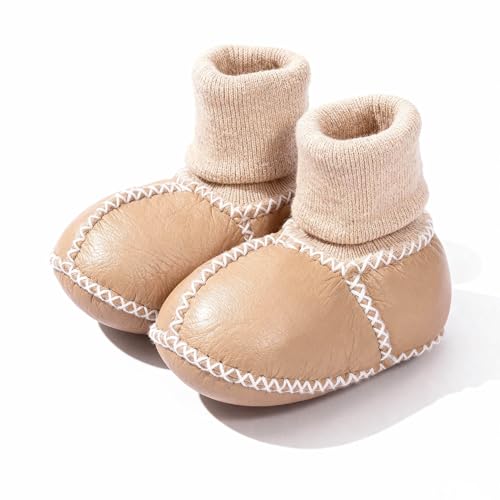
Mel&Syd Sheepskin-Lined Baby Booties — Best for Cold Homes
The verified listing for this slot is the Mel&Syd Sheepskin-Lined Baby Booties — warm stay-on slipper socks with an easy-on stretchy cuff that prevents slipping off, lined in sheepskin for the coldest floors in this guide, sized here for 6–12 months. The cuff is the mechanism the whole slot turns on, and this listing states it outright.
Cold changes the brief: a baby walking on a winter floor in a draughty house needs coverage past the ankle, and the bootie specification provides it — a taller, lined slipper body with a cuff that folds up for warmth or down as the child grows, over the same flexible grip sole the category demands. The extra height also makes the slipper harder to remove, a side benefit parents of determined kickers will recognise.
Watch the sole specification hardest in this style, because booties are often sold as pure crib shoes with fabric bottoms. A walking bootie must have the textured, flexible sole — bend it, and if it resists like a shoe, it is a shoe; if it slides like a sock, it is a sock. The right one bends like a slipper and grips like a sole.
The bootie’s cuff deserves its styling credit: folded down, it shows a contrast lining and makes the slipper look like a tiny boot; folded up, it is a draught excluder for the ankle gap that every crawling-to-walking transition exposes. In unheated hallways and stone-floored kitchens — supervised, always — that coverage is the difference between a baby who cruises contentedly and one who is carried everywhere, which serves nobody’s walking practice.
Booties pair with the season’s other apparatus — the snowsuit, the footmuff, the carrier — better than any rival here, because their coverage continues where trousers end. For the winter baby whose walking practice happens between heated rooms and cold hallways, the bootie is less a slipper than a system component. Buy it in the size that fits over the winter sock, and let the cuff absorb the difference on milder days.
Strengths
- Ankle coverage for cold, draughty homes
- Cuff adjusts as the child grows
- Taller body resists removal
Trade-offs
- Too warm for summer and heated floors
- Bootie styles often hide fabric soles — check
- The warmest pick here — too much insulation for heated floors in high summer
Key specs
- Lining: Sheepskin, fleece warmth
- Cuff: Stretchy, stay-on design
- Size in verified listing: 6–12 months
Check on Amazon — check the current price on Amazon before you decide, because sizes and colours change the deal.
Best for: winter babies in cold homes / Not suited for: warm-climate and summer use

Knit Animal Baby Booties, Non-Slip Crib Slippers — Best Breathable
The verified listing for this slot is the Knit Animal Baby Booties — soft knitted infant sock shoes with a non-slip sole, sold as crib slippers in a two-pair pack for ages 0–12 months. One honest adjustment to the original specification: the verified knit listing grips with a non-slip sole rather than a leather patch, and the review below is written to the product as it actually is.
Not every home needs fleece. In warm climates and heated apartments, the problem is the opposite: a lined slipper makes a small foot sweat, and a sweaty foot in a slipper is its own discomfort. The knit specification answers with a breathable knitted upper — the kind grandparents have made for a century — updated with a non-slip grip sole that provides the traction plain knit never could.
This is also the gift-friendly pick: knits size forgivingly, pack flat, and suit the handmade aesthetic. The inspection points are the patch attachment (stitched, not glued) and the knit tension at the ankle — a knit that bags out in a week becomes a trip hazard, which is the one thing no baby product may ever be.
Knits carry one risk the others do not: a loose loop and a toe are a snag waiting to happen, so the weekly inspection for this specification includes a fingertip run over the upper for catches and pulled threads. Repaired early with a single stitch, a knit slipper lasts its season; ignored, it unravels at the pace toddlers do everything. It remains the warmest-hearted pick on the list — many are handmade — and with a monthly once-over, a perfectly serviceable one.
Knits are also the specification most likely to be made by someone who loves the child — a grandparent’s needles are a supply chain of one — and the guide’s advice to makers is the same as to buyers: give the sole real grip texture, never a smooth knit bottom; knit the ankle snug; and test the pair on the slipperiest floor in the house before trusting it. A handmade pair built to that specification stands equal with anything in a shop, and carries a cargo no shop can sell.
Strengths
- Breathable knit suits warm homes
- Leather patch adds real grip to a soft upper
- Forgiving fit — a good gift specification
Trade-offs
- Least durable construction on the list
- Knit can stretch loose — check ankle tension
- Knit stretches with wear — the stay-on fit loosens across the months
Key specs
- Upper: Knitted, breathable
- Sole: Non-slip grip
- Pack: 2 pairs
- Sizes: 0–12 months
Check on Amazon — check the current price on Amazon before you decide, because sizes and colours change the deal.
Best for: warm homes and babies with sweaty feet / Not suited for: cold floors and maximum-durability seekers
Comparison Table
| Pick | Badge | Key spec | Best for |
|---|---|---|---|
| Dearfoams Lil Bear Slipper (Toddler) | Best Overall | Rubber sole, memory foam insole, toddler sizes | first walkers on hard indoor floors |
| Mejale Baby Soft-Soled Leather Moccasins | Best Barefoot Feel | Soft leather/suede sole, elastic ankle | earliest walkers on dry indoor floors |
| JOINFREE Toddler Slippers, Adjustable Hook-and-Loop | Best Stay-On Fit | Hook-and-loop ankle strap, non-slip sole, machine washable | babies who kick off every other slipper |
| Hstyle Baby Walking Sock Shoes | Best for Crawlers-to-Walkers | Sock body, soft rubber grip sole | babies in the crawl-cruise-step transition |
| Mel&Syd Sheepskin-Lined Baby Booties | Best for Cold Homes | Bootie height, cuff, flexible grip sole | winter babies in cold homes |
| Knit Animal Baby Booties, Non-Slip Crib Slippers | Best Breathable | Knit upper, non-slip grip sole | warm homes and babies with sweaty feet |
How to Choose Baby Walking Slippers
Begin with the sole, because the sole is the product. A walking slipper’s sole must do two opposite things at once: grip the floor and bend with the foot. Test any candidate in your hands — it should flex fully, toe to heel, with gentle pressure, and the underside should have texture across the whole contact area, whether that is rubber, suede or a silicone pattern. A sole that is stiff, or smooth, or grippy only in two decorative patches, fails the only exam that matters.
Fit comes next, and fit starts with measuring rather than month labels, which vary wildly between brands. Measure the foot in the late afternoon (small feet swell like big ones), standing if the child will cooperate, and choose a size with a thumb’s width of growing room beyond the longest toe — no more, because excess length is a trip edge, and no less, because babies outgrow snug in a month. The heel should sit in the slipper without the whole thing rotating when the child pivots.
Then match the closure and warmth to your actual baby and house: velcro for removers, sock-style for the transition stage, booties for cold floors, knits for warm ones. And keep the category in its place — these are indoor slippers for supervised floors. Outdoors, rough surfaces and wet ground call for proper first shoes, and no slipper on this page pretends otherwise.
Sizing and Fit: Measuring a Foot That Will Not Sit Still
The reliable method is the paper trace: stand the baby on a sheet of paper (a wall behind the heels helps), mark heel and longest toe, and measure the line. Do both feet — they differ — and buy for the longer. Compare against the brand’s own centimetre chart rather than its month labels, because a ’12 months’ from one maker is a ‘9’ or an ’18’ from another.
Check the fit again a month later. First-walker feet grow at a pace that makes any footwear a subscription, and a slipper that was perfect in October can be curling toes by December. The signs of outgrowth are red marks at the toe line, reluctance to wear them from a child who previously forgot them, and the heel slipping as the foot forces its way forward.
When Slippers, When Socks, When Shoes
Bare feet are the default for early walking indoors on safe, warm floors — no product on this page outranks the foot’s own feedback. Slippers enter when the floor is cold, slippery or both: they add grip and warmth while keeping the sole’s flexibility. Socks with grip dots are the lighter version of the same idea for warm, moderately smooth floors.
Shoes take over outdoors and on rough or wet ground, where protection becomes the job. The mistake is skipping stages in either direction — stiff shoes indoors all day, or delicate slippers outside because they were already on. Match the footwear to the surface and the hour, and the categories stop competing.
Hard Floors, Rugs and the Geography of First Steps
A new walker experiences the home as an archipelago: rug islands of total confidence connected by seas of hard floor where the slipping happens. Walking slippers are, functionally, a way to extend the islands — the grip that carpet gives for free, carried on the foot into the kitchen and hall. That is why the grip specification in this guide is absolute: a slipper that grips no better than a sock adds warmth only, and warmth was not the problem the category exists to solve.
Parents can help the geography directly. A runner rug along the cruising route between sofa and chair, a mat under the highchair’s drop zone, and slippers for the expeditions beyond them — together these make the home’s floor plan into a curriculum, with difficulty increasing at the pace the child sets. The goal is not a padded world; it is a world whose challenges arrive in the right order.
Watch where the child chooses to walk. Babies vote with their routes, and a floor they avoid is telling you something about its surface that no product specification can. Slippers widen the map; they do not redraw it.
Safety Notes Every Buyer Should Read Once
Three standing rules govern this whole category. First, supervision: slippers improve grip, they do not make any floor safe for an unsupervised new walker, and stairs remain gated territory whatever is on the feet. Second, sleep: footwear of any kind comes off for naps and night sleep — feet need their unshod hours, and a sleeping baby in slippers is a baby at risk of a twisted, overheated foot and a disturbed rest.
Third, condition: a slipper is a safety product with a wear life. Check soles for smoothness, straps for hold, elastic for snap, and uppers for loose parts — buttons, bows and appliqués must be immovable, because anything a baby can work loose becomes a mouth object. The weekly inspection takes ninety seconds and is the entire safety programme; there is no fourth rule because the first three, kept, cover the ground.
And a note on claims: no slipper teaches walking, corrects gait or strengthens feet, whatever its listing says. Babies learn to walk on their own schedule, on their own feet. The slipper’s job is humbler — warmth, grip, and staying out of the way.
The Short Season: Budgeting for Feet That Grow Like Weeds
First-walker footwear is the worst value-per-wear category in a child’s wardrobe and the wrong place to economise on the pair that matters. The arithmetic argues for a two-tier strategy: one excellent pair — the verified rubber-soled pick leads this list for the role — worn for the main business of the day, and inexpensive specifications (sock-style, knit) covering laundry days, grandparents’ houses and the changing bag.
Sizes turn over every two to three months in this window, so buy for now, not for the season. The hand-me-down and resale value of quality baby slippers is real — leather and rubber-soled pairs survive to serve again — which softens the arithmetic for the good pair considerably. What never pays is the middle error: several mediocre pairs, none of which grip well, bought in sizes the child will reach eventually and trip over now.
Floors, Falls and the Physics of Small Steps
A new walker’s falls are data, not disasters — the learning process is calibrated by hundreds of small, low, mostly harmless descents onto a bottom well designed for the purpose. The adult’s job is surface management: hard floors clear of the marble, the charger cable and the puddle; corners of low tables acknowledged as the geography they are; and grip on the foot so that the falls that happen are the developmental kind, not the skating kind.
Slipper grip changes fall physics in one specific way worth understanding: it moves the failure point. A sock on laminate fails at the foot, suddenly and horizontally. A grippy sole fails later — the foot holds, the momentum continues, and the fall becomes the slower, forward, hands-out kind that babies are built to survive and learn from. That is the entire safety case for this category, stated without inflation.
Wet floors void the warranty of every sole on this page. Kitchen splashes, bathroom tiles and porch steps reset the physics to skating regardless of equipment, and the rule is simple: slippers are for dry indoor floors, and a wet floor is a carried baby. No tread pattern yet made argues with water and wins at this scale.
Finally, expect the grip to change the child’s confidence before it changes their skill — a baby who trusts the floor attempts more, and attempts are the curriculum. Your job is to keep the floor worthy of the trust: clean soles, dry surfaces, and the weekly ninety-second inspection this guide keeps recommending.
Grandparents, Gifts and the Second Household
First walkers often practise in two homes, and the second household — usually a grandparent’s — has different floors, different temperatures and a different risk map. A pair of walking slippers that lives at the second house is not an extravagance; it is how the grip standard travels with the child. The sock-style and knit specifications suit the role, being cheap, packable and acceptable to babies who might reject an unfamiliar structured pair in an unfamiliar place.
Gift-buyers for this category should follow one rule: buy the size the baby wears now, in the specification the parents’ floors demand, and include the measuring story rather than a second, larger pair. A gift pair in the current size gets worn daily and remembered; a ‘to grow into’ pair gets tripped over or forgotten in a drawer until it is, with perfect irony, too small. In baby footwear, the present tense is the only tense that fits.
Second-household safety deserves its sentence: the weekly sole inspection this guide recommends must happen in whichever house the slippers live, by whichever adult is nearest, because grip does not care whose floor it fails on. A shared note in the changing bag — size, purchase date, inspection tick — keeps two households running one standard.
And when the season ends, the outgrown pairs from both houses make unusually welcome hand-me-downs: slippers wear lightly in their short service, and a younger sibling or a friend’s baby inherits grip that still has its tread. Pass them on with the size written inside in pen — the next parent will bless the annotation at midnight, measuring a foot that will not sit still.
Twins, Siblings and the Multi-Walker Household
Households with twins or close siblings run the first-walker season at double intensity, and the category’s economics change accordingly: buy the verified soled pair per child — fit is individual, and a shared pair fits neither walker well — while the inexpensive specifications can be pooled as household spares. Label every slipper inside with the child’s initial; at this size, in a hurry, even parents of twins have put the left child’s right-sized slipper on the right child’s left-sized foot.
Growth desynchronises quickly even between twins, so the monthly fit check runs per child, per foot, on the calendar rather than on suspicion. The hand-me-down direction within the household also reverses expectations: the smaller-footed sibling inherits outgrown pairs mid-season, which is why buying the durable specifications for the first child pays twice in these homes.
For siblings a year or two apart, store outgrown slippers by size in a labelled bag rather than a general baby box. When the next walker arrives at the cruising stage, the household that can produce three sizes in a minute owns a fitting service no shop can match — and in this category, the right size today is worth more than the perfect pair next week.
How to Introduce Walking Slippers to a New Walker
Most babies accept slippers in days if the introduction is boring. Make it boring.
- Start on the grippiest floor in the house — a rug or mat — so the first experience of the slippers is success, not sliding.
- Put the slippers on during a happy, fed, rested window, and let the baby crawl and play in them before expecting steps.
- Keep the first sessions short: ten to fifteen minutes, ending before frustration, repeated across the day.
- Check the fit after the first session — no deep red marks at the ankle or toes, and the heel still seated.
- Move to hard floors once the child is moving confidently, and watch the first pivots and direction changes for grip.
- Inspect the soles weekly for worn-smooth grip, and wash or wipe them as the maker allows — a dusty sole grips like a dusty tyre.
- Retire and size up at the first sign of toe pressure; growth spurts do not send calendar invitations.
If a baby persistently hates a particular pair, change the style rather than forcing the issue — sock-style and strap styles feel completely different, and the baby is the only fit critic whose vote counts.
Common Buying Mistakes
Buying stiff ‘mini trainer’ slippers. A sole that will not bend fights the learning foot. Walking slippers must flex fully in one hand.
Trusting month labels for size. Infant sizing varies wildly by brand. Measure the foot, use the centimetre chart, allow a thumb’s width.
Choosing novelty over grip. Giant character heads unbalance new walkers and usually hide a smooth sole. Cute is fine; slippery is not.
Using slippers outdoors. These are indoor products. Wet leaves and rough pavement need proper first shoes.
Leaving worn grip in service. Silicone prints and suede wear smooth. Inspect soles like tyre tread and retire bald pairs.
Buying three sizes ahead. Oversized slippers are trip hazards with growing room. One size of room is the limit.
Final Recommendation
Start with the Dearfoams Lil Bear: it is the verified pick, its rubber sole grips like it means it, and its size line reaches genuinely small feet. For most first walkers on hard floors, it is the complete answer in one pair.
Shop the specifications for the special cases: soft leather for maximum floor feel, velcro for the escape artists, sock-style for the crawl-to-step transition, booties for cold houses and knits for warm ones. Each solves a real variation of the same brief.
Measure the foot, bend the sole, check the grip — in that order — and any slipper you bring home will earn its place in the short, wonderful season of first steps.
Related guides on this site: Best Baby Slippers With Velcro Best Affordable House Slippers For Women Best Bear Claw Slippers Best Allday Comfort Slippers
Related guides
Frequently Asked Questions
Do babies need slippers to learn to walk?
No — bare feet indoors on safe floors are the default and give the best feedback. Slippers help when floors are cold or slippery, adding warmth and grip while keeping the sole flexible.
What sole is best for first walkers?
A fully flexible sole with grip texture across the whole contact area — rubber, suede or a full silicone pattern. It should bend easily in one hand and never be smooth.
How much growing room should I leave?
About a thumb’s width beyond the longest toe. More becomes a trip edge; less will be outgrown within weeks. Measure both feet and size for the longer.
Are sock-style grip slippers enough?
For the crawl-cruise-step transition on indoor floors, yes — they are often the first footwear a baby accepts. Move to a soled slipper when steps become the main activity or floors are cold.
Can baby walking slippers be worn outside?
No. They are indoor products without the protection or durability for pavement, wet ground or rough surfaces. Outdoors calls for proper first shoes.
How do I know the slippers are outgrown?
Red marks at the toes, the heel slipping as the foot pushes forward, or new reluctance from a child who wore them happily. Recheck fit monthly in the first-walker stage.


