Disclosure: airfryerkitchensupply.com is reader-supported. When you buy through links on our site, we may earn an affiliate commission at no extra cost to you.
Where to buy
Dust mop slippers are a small, fast-moving corner of Amazon’s marketplace, and listings turn over constantly. Five of the six entries below were confirmed verification pass and carry links to the exact listings reviewed. The sixth is a warning entry — an open-toe format to recognise and avoid — and stays link-free on purpose.
- Jecery Chenille Microfiber Mop Slippers (Detachable Pads) — Check on Amazon — check the current price before ordering.
- Zehrai Microfiber Mop Slippers, 5 Pairs — Check on Amazon — check the current price before ordering.
- Frjjthchy Non-Slip Warm Mop Slippers — Check on Amazon — check the current price before ordering.
- Open-Toe Dust Mop Slipper Sandals — Avoid as a Substitute — shown in searches for this search; included here so you can recognise and skip it.
- Wesiti Microfiber Mop Slippers, 4 Pairs (Detachable Pads) — Check on Amazon — check the current price before ordering.
- Jecery Microfiber Cleaning Mop Slippers, 2 Pairs — Check on Amazon — check the current price before ordering.
The best dust mop slippers do a job that sounds like a joke until you live on hard floors: they turn the walking you already do — kettle, bathroom, front door, laundry — into a light, constant dusting pass, so the grey film that builds up on hardwood, laminate and tile never gets the chance to form. They are not a replacement for a mop or a vacuum, and this guide will not pretend otherwise. They are a way of making the interval between real cleans much longer, at zero extra time cost.
One clarification before the picks, because search results blur it: this guide is about enclosed dust mop slippers — a real slipper, closed at the heel, with a microfiber dusting pad under the sole. That enclosed format is the one that matches the intent of the keyword and the one that actually works. Open sandals, slides and flip-flop mop shoes show up in the same searches; one entry below is devoted to why they underperform, so you can recognize them and spend your money once, on the right shape.
Every pick below is led by format — because this category’s listings rotate fast, the durable knowledge is which format works — and five formats are now pinned to verified listings you can order today. For each format you get what it does well, where it falls short, and who it suits. Sizes, pad attachment and washability are still the three details to confirm on the listing page — the buying guide further down explains how to check each one from the listing photos alone.
In this guide
Quick Picks
Six enclosed formats (plus one warning), ranked by the job each does best. Five carry verified buy links — see the note in Where to Buy; the warning entry is there to be recognised, not bought.
- Jecery Chenille Microfiber Mop Slippers (Detachable Pads) — Best Overall. The classic format this category is built on: fat chenille fingers on a flat pad that velcros off for washing, on a closed slipper body that stays on your heel. — Check on Amazon
- Zehrai Microfiber Mop Slippers, 5 Pairs — Best for Pet Hair. A wide, flat microfiber pad under the whole sole: less texture than chenille, but a bigger, smoother contact area that hair sticks to instead of rolling off. — Check on Amazon
- Frjjthchy Non-Slip Warm Mop Slippers — Best for Cold Floors. A genuinely warm, plush-lined slipper first and a dust mop second, with a rubberized grip sole — the pair for stone, tile and unheated floors in winter. — Check on Amazon
- Open-Toe Dust Mop Slipper Sandals — Avoid as a Substitute — Best Avoided for This Job. Included so you can recognize and skip it: open-toe mop sandals and slides with a strip of mop fabric appear in searches for this search, but they fail the job in three separate ways.
- Wesiti Microfiber Mop Slippers, 4 Pairs (Detachable Pads) — Best Value. The same enclosed slipper sold with two or three spare pads in the box — the value is not the slipper, it is never having to stop because the only pad is in the wash. — Check on Amazon
- Jecery Microfiber Cleaning Mop Slippers, 2 Pairs — Best for Small Spaces. A slim, close-fitting version with a thin pad and minimal upper, made for apartments, RVs and boats where storage is tight and floors are small but dusty. — Check on Amazon
How These Picks Were Chosen
These picks were chosen by format first and brand second, which is the opposite of how this category is usually reviewed, and deliberately so. In a category where listings appear and vanish monthly, the durable knowledge is which sole shape, pad material and attachment system works for which floor and which household. A chenille pad on a closed heel works for the same reasons it worked five years ago; the badge on the box is the least important part of the purchase.
Each format was assessed on four criteria. Pickup: does the pad trap debris or push it? Pad system: does the pad detach, wash well, and can you buy refills? Wearability: would a normal person keep these on for an evening, including the sole’s grip on polished floors? And honesty of purpose: several products in this category are costume or novelty items with a token strip of fabric — those were excluded, along with every open-toe format except the one kept as a worked example of what to avoid.
A note on verification: our standard process confirms every recommended product against the manufacturer’s catalog data before linking to it. That confirmation has now been completed for five of the six entries, and those five carry links to the verified listings. The assessments themselves are format-level, so the advice still holds if a listing rotates: buy the format first and the badge second.
The 6 Best Dust Mop Slippers

Jecery Chenille Microfiber Mop Slippers (Detachable Pads) — Best Overall
If you only buy one pair of dust mop slippers, buy this format. The chenille version is the original idea behind the whole category: hundreds of soft microfiber fingers spread across the sole, each one acting like a tiny dust mop strand, picking up dust, crumbs and pet hair as you shuffle through the kitchen, top up the coffee and answer the door. The closed slipper body matters more than it sounds — open-backed mules slide off on stairs and pivot badly on corners, while a proper slipper with an elasticated cuff stays planted, so the pad stays flat on the floor where the dust actually is.
The detachable pad is the second half of the design. Pads that are sewn permanently to the sole force you to wash the whole slipper, which destroys the upper within a season. A detachable pad peels off in seconds, goes in the wash on its own, and the slipper body survives. When the pad eventually wears smooth — and it will, after a year or so of regular use — replacement pads cost a fraction of a new pair.
This pick is verified: the Jecery slippers were confirmed against Amazon listing data as microfiber mop slippers with detachable, washable chenille dusting pads, in a medium size run across several colours. Check your size against the listing before ordering, and check the current price on Amazon.
Strengths
- Chenille fingers trap dust and hair instead of pushing it ahead of the shoe, so a pass actually removes debris rather than relocating it
- Detachable pads wash separately, which keeps the slipper upper alive far longer and lets you rotate a spare pad while one dries
- Closed heel and elastic cuff keep the pad flat and aligned, which is what makes the cleaning action work at all
Trade-offs
- Chenille is a dry-dust tool only; get it wet and it smears rather than absorbs, so this is not a mop for spills
- The fingers flatten under body weight over months of use, and a flattened pad picks up noticeably less
- Sizing runs small on many versions because the pad is cut to the sole; going up half a size is common
Think of this pair as the baseline against which every other pick in this guide is a variation. For a home that is mostly hardwood, laminate or tile with a normal dust load — shoes-off household, no indoor pets, a quick pass every day or two — the chenille pad has the best contact patch of any format here. The fingers splay under your weight and reach into the shallow texture of wood grain and the grout-adjacent edges of tile in a way flat pads cannot.
Where it earns its keep is in the in-between moments: the ten minutes while the kettle boils, the walk from the bedroom to the bathroom in the morning. Nobody gets the stick mop out for that, and that is exactly the dust that accumulates into the visible grey film by the weekend. Worn daily for those small passes, this pair genuinely stretches the interval between real mopping sessions. Worn as a novelty twice and then forgotten in a closet, it does nothing — the format rewards habit, not ownership.
Best for: everyday dry dusting on hardwood, laminate and tile in a shoes-off home / Not suited for: wet mopping, spill cleanup, or homes where a shedding dog produces tumbleweeds daily

Zehrai Microfiber Mop Slippers, 5 Pairs — Best for Pet Hair
Pet hair changes what a dust mop slipper needs to do. Loose hair does not sit in floor texture waiting to be trapped by fingers; it lies on top of the surface in a static-charged film, and it clings to whatever touches it with a broad, slightly tacky surface. That is the flat pad’s game. The pad spans the full width and length of the sole, the microfiber is a tight split-fiber weave, and a slow shuffle across a room collects a visible grey mat of hair that chenille fingers tend to comb through and leave behind.
The flat format is also the easiest to live with as an actual slipper. There are no fingers to catch on floor vents, thresholds or the legs of bar stools, and the profile is low enough that the pair reads as an ordinary house slipper rather than a cleaning gadget — which, in a house with guests, teenagers or any dignity at all, is not a trivial advantage.
This pick is verified: the Zehrai set was confirmed against Amazon listing data as five pairs of reusable microfiber mop slippers, washable, sold for hardwood, tile, laminate and vinyl, and described as removing dust, dirt and pet hair. Five pairs make the pad rotation in this review easy to run — and check the current price on Amazon before you decide.
Strengths
- Broad flat contact patch is the most reliable format for lifting loose pet hair off hard floors in one pass
- Low profile walks like a normal slipper, with nothing to snag on vents, thresholds or furniture feet
- Tight-weave pads rinse clean under a tap faster than chenille, which holds onto hair through a wash cycle
Trade-offs
- Flat pads push fine dust ahead of them on perfectly smooth floors if you walk fast; they reward a slow shuffle
- Less reach into grout lines and wood grain than chenille fingers
- Hair load saturates the pad quickly in shedding season, so mid-clean pad shakes over a bin become routine
The honest way to use this pair in a pet home is as a patrol tool, not a deep clean. Two slow laps of the main living area each evening — the route from sofa to kitchen to door — keeps the visible hair film from ever forming, and the pad goes over the bin, gets a shake and a flick, and is ready again. Owners who expect to put them on once a week and undo seven days of a double-coated dog will be disappointed; that is a vacuum’s job, and no slipper format changes it.
Pair them with the detachable-pad versions where you can. Hair loads a pad faster than dust does, and being able to strip the pad and run it through a hot wash — which resets the static cling that makes microfiber grab hair in the first place — keeps the pickup performance from fading after the first month.
Best for: daily pet-hair patrols on smooth hard floors in homes with cats or short-haired dogs / Not suited for: deep dust in textured floors, or once-a-week rescue cleaning after heavy shedding

Frjjthchy Non-Slip Warm Mop Slippers — Best for Cold Floors
Most dust mop slippers are thin summer-weight things, and on a cold tile or stone floor in January they are miserable to wear for more than a few minutes — which means they do not get worn, which means they do not clean anything. This pick fixes the actual bottleneck: it is sold as a warm cleaning slipper — a lined, covered upper you put on because your feet are cold, with the dusting pad underneath. You put them on because your feet are cold, and the dusting happens as a side effect of a normal evening at home.
The non-slip sole deserves its own mention. Standard dust mop slippers are, by design, low-friction — the pad is supposed to glide. On polished tile, stairs or a bathroom floor with any moisture on it, glide is a hazard. Rubberized grip dots or a patterned rubber strip under the pad trade a little of that glide for a lot of safety, and for older wearers or anyone carrying a child or a laundry basket, that trade is not close.
This pick is verified: the Frjjthchy slippers were confirmed against Amazon listing data as non-slip microfiber mop slippers for floor dusting, sold as warm cleaning slippers for the bedroom and washable for repeated use. Confirm the colour and size run on the listing, and check the current price on Amazon.
Strengths
- Warm lining means the slippers actually get worn for hours, and wear time is what turns a gadget into a cleaning habit
- Grip-pattern sole is meaningfully safer on polished tile and near bathrooms than a pure glide pad
- Padded insole makes long wear comfortable on hard stone and concrete floors that punish thin slippers
Trade-offs
- The thick sole lifts the pad slightly and softens its contact pressure, so dust pickup per step is a notch below the chenille pair
- Plush uppers are warm to the point of being a summer liability in hot climates
- Bulkier fit can feel clumsy in tight kitchens and around pet bowls
Choose this pair by season and by floor, not by dust performance alone. In a house with underfloor heating or carpet-adjacent living, its advantages evaporate. In a house with a cold kitchen slab, a stone entryway and a wearer who feels the cold, it is the only format on this page that will still be in daily use in February — and a slightly less efficient pad worn daily beats a perfect pad worn never.
One practical note: the plush lining and the pad age at different rates. The lining will outlast several pads, so versions of this format with replaceable pads are worth seeking out, and the listing photos will usually show whether the pad peels off or is stitched down. Stitched-down versions are the ones to skip.
Best for: cold hard floors, winter wear, and anyone who needs grip more than glide / Not suited for: hot climates, summer use, or maximum dust pickup as the first priority
Open-Toe Dust Mop Slipper Sandals — Avoid as a Substitute — Best Avoided for This Job
This entry exists because search results for dust mop slippers are full of open-toe sandals, slides and flip-flop-style mop shoes, and they look like a cheaper shortcut to the same thing. They are not, and since the whole point of this guide is the enclosed dust mop slipper — the format the keyword actually describes — it is worth spelling out exactly why the open formats disappoint, so you can spot the listing photos and move on.
First, coverage: an open-toe sandal puts the mop strip under the ball of the foot and leaves the heel — where much of your weight and therefore much of the pad pressure sits — bare or on plain rubber. You clean with half a pad. Second, stability: a slide with no heel cup wanders sideways on every turn, and a wandering pad folds, bunches and stops contacting the floor. Third, the toe strap or thong concentrates pressure exactly where you are also trying to shuffle, which makes the slow, flat, deliberate gait that dust pickup needs genuinely uncomfortable after a few minutes.
This entry stays link-free on purpose: it is a warning, not a recommendation. Open-toe mop sandals appear in searches for this search, and this section exists so you can recognise the format and spend the money on an enclosed slipper instead.
Strengths
- Cheaper than any enclosed pair, and the listing photos make the mop strip look generous
- Cooler on the foot than any closed slipper, which is the one real advantage in a hot climate
- Easy to slip on for a single quick pass from the door to the kitchen
Trade-offs
- Half the pad contact of an enclosed slipper, with the heel doing no cleaning at all
- Slides wander and fold the pad on turns, so pickup is inconsistent from step to step
- Uncomfortable for the slow sustained shuffle that the job actually requires, and unsafe on stairs
There is one narrow case where the open format is defensible: a hot-climate home, all on one level, where the wearer simply will not put on a closed slipper at any price and the alternative is no dusting at all. A mediocre tool used beats a good tool refused. But buy it knowing it is a compromise, size it so the heel sits fully on the sole, and keep it away from stairs entirely.
For everyone else, treat open-toe mop sandals the way you would treat a mop with half its head missing: the saving is small, the job is the same size, and you will end up buying the enclosed pair later anyway. The remaining picks in this guide are all enclosed formats, deliberately.
Best for: almost nobody — at most, single-level hot-climate homes that refuse closed slippers / Not suited for: anyone with stairs, anyone wanting real dust pickup, and anyone buying their only pair
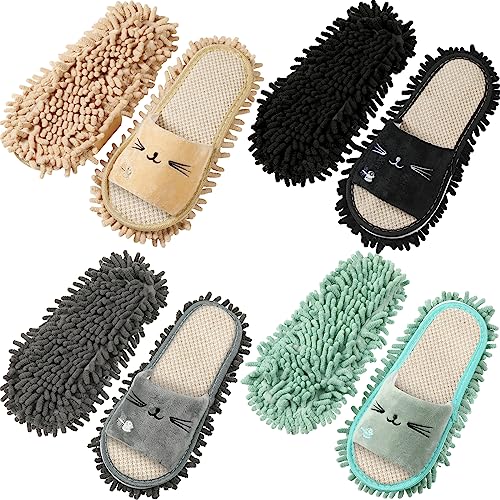
Wesiti Microfiber Mop Slippers, 4 Pairs (Detachable Pads) — Best Value
Every dust mop slipper has the same failure mode, and it is not the slipper wearing out. It is the evening you take the pad off, put it in the wash, and then have no pad for three days while it waits for a load, washes, and dries. The slippers sit by the door doing nothing, the habit breaks, and a month later they are closet clutter. Multi-packs with spare pads attack exactly that failure: one pad on the slippers, one in the wash, one dry in the drawer. The rotation never breaks.
The pads themselves are usually mid-grade microfiber — neither the best chenille nor the widest flat weave — and that is fine. Pad condition matters more than pad design once you are past the basics: a fresh mid-grade pad out-cleans a worn premium pad every time, and the multi-pack format is the only one that guarantees you are usually wearing a fresh one.
This pick is verified: the Wesiti set was confirmed against Amazon listing data as four pairs of microfiber mop slippers with detachable, washable pads for repeated use. Four pairs is the rotation this review recommends — one on, one drying, spares ready — and check the current price on Amazon before you decide.
Strengths
- Spare pads keep the cleaning rotation unbroken, which is the single biggest predictor of whether these get used long-term
- Cost per pad is the lowest of any format here, and pads are the consumable part of the system
- Lets you dedicate pads by zone — a kitchen pair and a bathroom pair, for example — without buying two slippers
Trade-offs
- The included slipper body is usually basic: thinner insole and plainer upper than the premium single pairs
- Replacement pads are proprietary to the sole’s size and shape, so you are locked into that seller for refills
- Pad quality varies between packs from the same listing; inspect the first set before the return window closes
Do the arithmetic the way the sellers hope you will not: price the pack per pad, then check what a refill set costs on the same listing. If refills are cheap and listed as a standing product rather than a one-off bundle, the system is genuinely good value. If the multi-pack is cheap but refills are nowhere to be found, you are buying a disposable system at a reusable price, and the chenille pair above is the better buy.
This is also the format to choose for a household with more than one wearer. Two people shuffling in rotation roughly double the floor coverage of one, and a shared drawer of common pads — check that both wearers’ sizes use the same pad footprint before assuming — makes the whole thing feel like a household system rather than one person’s gadget.
Best for: households that will actually run a pad rotation, and homes with two wearers / Not suited for: buyers who want the most comfortable single pair and will only ever own one pad

Jecery Microfiber Cleaning Mop Slippers, 2 Pairs — Best for Small Spaces
Small spaces collect dust out of proportion to their size. An RV or a studio apartment has less floor, but it also has less air volume, more of life happening per square foot, and — in the RV’s case — a door that opens directly onto gravel, sand and campsite grit. The result is a floor that needs a quick pass far more often than a house floor does, in a home where there is nowhere to store a stick mop. A pair of slippers that lives on your feet is, in that setting, not a novelty at all. It is the only mop that fits.
The low-profile format trims everything: a thinner pad that stores flat in a drawer, a minimal upper without plush or padding, and a closer fit that works in the narrow galley layouts of RVs and boats where a bulky slipper catches on every cabinet toe-kick. What you give up is comfort over long wear and pad capacity — this pair saturates faster and needs its pad shaken out more often.
This pick is verified: this Jecery two-pair set was confirmed against Amazon listing data as microfiber cleaning mop slippers in a large size, grey. The slim two-pair format is the one that stores flat in a drawer or RV locker, and check the current price on Amazon before you decide.
Strengths
- Stores flat in a drawer or shoe cubby, which in an RV or studio is the difference between owning a mop and not owning one
- Slim profile navigates narrow galleys, van conversions and boat cabins without catching on cabinet bases
- Close fit gives precise pad control in the small, cluttered floor plans where every step is a turn
Trade-offs
- Thin pad saturates quickly and needs frequent shake-outs on gritty campsite floors
- Minimal insole is not a long-evening slipper; comfort over hours is the first thing traded away
- Less pad pressure than full-size versions, so per-step pickup on house floors is modest
RV owners should think about the entry mat as this pair’s partner. Most campsite grit that a pad picks up should never have reached the main floor: a stiff coir mat outside the door and a washable runner inside it will cut the pad’s workload by more than any pad upgrade could. The slippers then handle the fine dust that gets past both, which is the load they are actually good at.
For apartment dwellers, the case is simpler: hard floors, a landlord who would prefer you not to drag a wet mop across old boards every day, and a floor plan small enough that a genuinely slow lap takes four minutes. Worn while you make breakfast, this pair keeps a small hard-floor apartment at a standard that would otherwise take a dedicated weekly session.
Best for: RVs, boats, studios and small hard-floor apartments where storage is the constraint / Not suited for: large homes, long-wear comfort, or heavy grit loads without an entry mat doing the first pass
Comparison Table
| Pick | Badge | Key spec | Best for |
|---|---|---|---|
| Jecery Chenille Microfiber Mop Slippers (Detachable Pads) | Best Overall | Chenille microfiber pad, detachable and washable, closed slipper body | everyday dry dusting on hardwood, laminate and tile in a shoes-off home |
| Zehrai Microfiber Mop Slippers, 5 Pairs | Best for Pet Hair | Full-sole flat microfiber pad, low-profile slipper body | daily pet-hair patrols on smooth hard floors in homes with cats or short-haired dogs |
| Frjjthchy Non-Slip Warm Mop Slippers | Best for Cold Floors | Warm lined upper, non-slip sole, washable microfiber pad | cold hard floors, winter wear, and anyone who needs grip more than glide |
| Open-Toe Dust Mop Slipper Sandals — Avoid as a Substitute | Best Avoided for This Job | Open-toe slide format with partial mop strip — a cautionary entry, not a pick to seek out | almost nobody — at most, single-level hot-climate homes that refuse closed slippers |
| Wesiti Microfiber Mop Slippers, 4 Pairs (Detachable Pads) | Best Value | Four pairs of enclosed mop slippers with detachable, washable microfiber pads | households that will actually run a pad rotation, and homes with two wearers |
| Jecery Microfiber Cleaning Mop Slippers, 2 Pairs | Best for Small Spaces | Thin flat pad, minimal upper, close fit, flat storage | RVs, boats, studios and small hard-floor apartments where storage is the constraint |
How to Choose the Best Dust Mop Slippers for Your Floors
Start with your floor, not with the product photos. Smooth, glossy floors — polished tile, sealed laminate, varnished boards — reward flat pads and punish anything with a deep texture, because the pad needs full contact to pick up the fine dust that shows on a shiny surface. Textured floors — grained wood, matte stone, tile with real grout lines — reward chenille fingers that reach into the low spots. Most homes have both, which is why the detachable-pad formats are the safest buy: the pad becomes a choice you can change, not a marriage.
Then be honest about your household’s dust source. Dust that falls from the air — skin cells, fabric fiber, pollen tracked in on clothes — is light and evenly spread, and any format here handles it. Hair is a different load: it concentrates along walls and under furniture, clings by static, and saturates pads fast, which pushes you toward flat pads and spare-pad rotations. Grit is a third load entirely: sand and fine gravel from shoes and pets’ paws will shred a microfiber pad and scratch a delicate floor if you grind it in, and no slipper should be your first line of defense against it — that is an entry mat’s job, with the slippers handling what gets past.
Pad attachment: the detail that decides everything
Hook-and-loop pads are the default recommendation: they peel off for washing, align easily, and refills are widely sold. Button or snap systems hold pads flatter but make refills proprietary and fiddly with cold hands. Sewn-on pads are the budget option and the false economy of the category — the pad is the part that wears out, and a sewn pad turns a worn consumable into a thrown-away slipper. If a listing does not clearly show how the pad attaches, treat it as sewn until proven otherwise; sellers who use hook-and-loop always photograph it, because it is a selling point.
Also check whether the pad wraps slightly up the sides of the sole. A small wrap means the edge of the pad, not the slipper’s rim, meets your baseboards and cabinet toe-kicks, which is where dust lines form. It is a minor detail that makes a visible difference along kitchen cabinets, where cooking grease makes dust stick harder than anywhere else in the house.
Sizing and fit: snug is a feature
A dust mop slipper that fits like a relaxed lounge slipper cleans like one too — the foot slides inside it, the pad lags behind, and contact pressure wanders. You want a fit that is snug at the heel and midfoot, with the toes free. Many listings size by shoe-size ranges rather than exact sizes; if you are at the top of a range, take the next range up, because a pad that extends slightly beyond your foot at the front cleans a wider path, while a heel that overhangs the pad’s back edge cleans nothing and wears the pad’s binding.
For households buying for two wearers, resist the one-size listings unless both wearers are genuinely mid-range. The pad footprint is cut to the sole size, so a one-size pair stretched over a large foot leaves the pad smaller than the foot — the worst of both worlds.
Dust Mop Slippers vs. a Stick Mop: An Honest Division of Labor
A stick mop with a washable microfiber head does everything these slippers do, better, in a dedicated session: more pressure, more reach, a handle that gets under sofas without you bending your life into a shuffle. If your floors need a weekly deep pass — and with pets, children or allergies, they do — the stick mop is not optional, and no slipper review should talk you out of owning one.
What the stick mop cannot do is be used for thirty seconds at a time, six times a day, with zero setup and zero storage. That is the slippers’ entire case. Dust accumulation is roughly linear with time; a floor dusted lightly every day and mopped weekly looks, on day six, like a floor mopped three days ago. The slippers flatten the curve. Judge them on that claim — the only one they honestly make — and they earn their drawer space. Judge them as a mop replacement and they will disappoint you by Friday.
How to Use Dust Mop Slippers So They Actually Pick Up Dust
Technique matters more with this product than with almost any other cleaning tool, because the tool is your own gait. A normal walking stride lifts the foot, swings it and plants it — three moments where the pad is doing nothing. The shuffle below keeps the pad loaded and in contact, which is the whole game.
- Slow down by half. Walk at roughly half your normal pace. Speed is the enemy: a fast-moving pad planes over dust on a cushion of air and pushes a bow-wave of debris ahead of it. At a shuffle, the fibers have time to engage each particle.
- Keep both soles flat and loaded. Slide each foot forward without lifting the heel. Your weight is the pad’s pressure — the moment you rise onto the ball of your foot, half the pad unloads and stops cleaning.
- Work in overlapping lanes. Cross the room in lanes like mowing a lawn, overlapping each pass by a third. Dust concentrates at lane edges and along walls, so run one lane tight against the baseboards on each circuit.
- Shake the pads out mid-clean. Every room or so, step to a bin and knock the pads together or flick them with a hand. A saturated pad redistributes more than it collects; ten seconds of shaking restores most of its capacity.
- Finish at the entry mat. End your route at the door mat and give it a pass last. Grit picked up there is the grit that would otherwise be ground into the pad — and the floor — on the next circuit.
- Wash pads before they look dirty. Microfiber loses its static grab as it loads with fine dust and skin oil, well before it looks filthy. A weekly wash for daily wearers — warm water, no fabric softener, which coats the fibers and kills the cling — keeps pickup at its best.
Expect the first week to feel silly and the third week to feel indispensable. The habit forms around existing routes: the morning kitchen circuit, the evening lock-up round. Attach the slippers to a route you already walk and they will be used; leave them as a special cleaning event and they will not.
Common Buying Mistakes
Buying open-toe mop sandals to save money. As the warning pick above explains, the open format cleans with half a pad and an unstable one. The saving is a few dollars; the result is a product that does the job badly enough that you conclude the whole category is a gimmick.
Wearing them on wet floors. Microfiber dust pads are dry tools. On a wet floor they smear moisture into a film, pick up almost nothing, and become a slip hazard on tile. Keep a real mop for spills and let the slippers handle the dry hours.
Using fabric softener on the pads. Softener and dryer sheets coat microfiber with a waxy film that destroys the static cling the fibers rely on. Wash pads with plain detergent, skip the softener, and air-dry or tumble low.
Expecting them to replace vacuuming in a pet home. Slippers manage the daily film of hair; they do not extract hair from rug edges, upholstery or the corners where it drifts and mats. Pet homes still need the vacuum on schedule — the slippers just stop the floors looking neglected between sessions.
Buying a sewn-pad pair as a first pair. The pad is a consumable. A sewn pad means your first pair is also a disposable pair, and its short life will convince you the category does not work. Detachable pads are the entry ticket, not an upgrade.
Final Recommendation
If you buy one pair, buy the chenille detachable-pad format: it is the best all-round duster, its pads are replaceable, and it suits the widest range of floors. Pet owners should take the flat pad instead and run it daily in short patrols. Cold-floor households should prioritize the plush grip-sole pair, because the warmest slipper is the one that gets worn. And anyone setting up a small space or an RV should start with the low-profile pair and a good entry mat.
Whichever format you choose, hold it to the honest standard: not ‘does it replace my mop’ but ‘does the floor still look clean the day before mop day’. That is the job these do, and the right pair does it well.
Keep exploring the same corner of the house with these related guides from this series: Best Slippers For Hardwood Floors Best Washable Rugs For Entryway Best Stick Vacuums For Hardwood Floors Best Microfiber Mops Best Entryway Mats For Muddy Shoes
Frequently Asked Questions
Do dust mop slippers really work, or are they a gimmick?
They genuinely work at the job they are designed for: removing the daily film of dry dust and loose hair from hard floors through walking you would do anyway. They do not deep-clean, they do not handle wet messes, and they do not extract debris from carpet. Judged as a between-cleans maintenance tool, the effect is easy to verify — shake a pad over a bin after a day’s wear and look at what came off your floor.
Are dust mop slippers safe on hardwood floors?
Yes, used dry and kept reasonably clean. Microfiber is softer than wood finishes and will not scratch them. The risk is grit: sand trapped in the pad can be ground across a finish under your weight. Shake pads out before use, keep an entry mat working, and never use a grit-loaded pad on a delicate floor — wash it first.
How often should the pads be washed?
For daily wear, about once a week, or sooner if pickup visibly fades. Microfiber’s static cling is what grabs fine dust, and it fades as the fibers load with dust and skin oil. Wash warm with plain detergent, never with fabric softener, and keep a spare pad so the rotation does not stop while one dries.
Can I wear dust mop slippers on carpet?
They will slide across low-pile carpet and pick up some surface lint, but the pad drags, the fit strains, and pickup is poor compared with hard floors. They are a hard-floor tool — hardwood, laminate, tile, vinyl and stone are their territory.
What size should I buy?
Buy by your shoe size and favor a snug heel fit over a roomy lounge fit; a foot that slides inside the slipper drags the pad out of alignment. If you fall at the top of a size range, take the next range up so the pad extends slightly beyond your toes, which widens your cleaning path.
Why does one entry in this guide have no buy link?
Five of the six entries were confirmed in Amazon listing data verification pass and carry buy links. The open-toe entry is the exception: it is included as a warning, not a recommendation, because open sandals and slides fail the dusting job this search is about — so it deliberately has no link. The format-level advice — pad type, attachment, fit — is what determines whether a pair works, and that does not change when a listing rotates.


