Disclosure: airfryerkitchensupply.com is reader-supported. When you buy through links on our site, we may earn an affiliate commission at no extra cost to you.
Where to buy
The fastest way to compare the best toddler chairs to eat at kitchen island in this guide is on Amazon, where each verified listing shows its current options, sizes and availability. Use the Check on Amazon links beside each pick below to go straight to the exact listing we verified. Island seating fails or succeeds on measurements, so every pick below is verified through Amazon record with its stated limits reported exactly as listed.
Key Takeaways
- Measure the island first: hook-on chairs need a clampable overhang inside the stated thickness range, and a waterfall edge rules the format out completely.
- Counter height changes everything — a booster only works at an island if the counter stool it straps to is heavy and stable.
- Backless stools are poor booster hosts: the straps need a chair back to grip, and the whole stack must pass a push test.
- If the island cannot take a hook-on or a booster safely, a freestanding chair pulled up to the island is the honest answer, not a forced fit.
Best Toddler Chairs to Eat at a Kitchen Island: Measure First, Buy Second
The best toddler chairs to eat at kitchen island height are decided by your island, not by a ranking. Islands break the usual rules: the counter is higher than a dining table, the edge may be a waterfall slab with nothing to clamp, and the seating is usually a backless or low-back stool rather than a dining chair. A chair that is perfect at a table can be unusable — or unsafe — at an island.
So this guide works in measurement order. First, what your island’s edge allows: a hook-on chair needs a horizontal overhang within the clamp’s stated thickness range. Second, what your stools allow: a booster needs a stable stool with a back for its straps. Third, the fallback that always works: a freestanding convertible chair with the height range to reach a counter. The six verified picks below cover all three routes.
Every pick is a complete chair or booster verified through Amazon record, and every stated limit is quoted from its own listing. Where a listing does not state a figure, we say so. Do not transfer numbers between models — at counter height, with a longer fall and harder floor around most islands, the stated limits deserve more respect, not less.
In this guide
Quick Picks

1. guzzie+Guss Perch Hook-On High Chair (Forest Green) — Best Hook-On for Island Overhangs
A clip-on chair listed from 4 months up, positioned for tables, restaurants and travel — at an island with a proper overhang it puts the toddler at counter height with no stool involved at all.
Strengths
- Clip-on format removes the stool from the equation entirely — the island edge does the work
- Listed for 4M+, the widest starting guidance among these picks
- Portable positioning suits islands that double as the home’s eating and working surface
Trade-offs
- The verified listing does not state a weight limit or clamp thickness range in its title — both must be confirmed on the listing before island use
- Waterfall-edge islands and very thick stone overhangs are outside what any clamp should be asked to grip
- No tray: the counter surface becomes the plate’s home, crumbs and all
| Detail (from verified listing) | What it says |
|---|---|
| Type | Hook-on / clip-on table chair |
| Age guidance | 4M+ (per listing) |
| Colour | Forest Green (per listing) |
| Stated weight limit | Not stated in verified listing title |
Best for: islands with a clean, standard overhang and parents who confirm the full listing specs / Not suited for: waterfall-edge or extra-thick stone islands
Check the current price on Amazon

2. Toogel Hook-On High Chair (Grey) — Best Documented Hook-On Specs
The Toogel states its window plainly — 6 to 36 months — and adds a non-slip clamp, safety harness, anti-tear washable fabric and a carrying bag: the most completely described hook-on in this set.
Strengths
- Stated age window of 6–36 months in the listing itself
- Non-slip clamp and safety harness named in the verified listing
- Anti-tear, washable fabric and a carrying bag included
Trade-offs
- ‘Fits most tables’ is a claim to verify against your island’s actual overhang thickness, not a guarantee
- BPA-free refers to the materials the listing applies it to — it does not change the clamp measurements you must check
- Foldable travel designs trade some rigidity for portability; the push test decides
| Detail (from verified listing) | What it says |
|---|---|
| Type | Hook-on travel clip seat |
| Age window | 6–36 months (per listing) |
| Clamp | Non-slip clamp (per listing) |
| Fabric | Anti-tear, washable (per listing) |
| Extras | Safety harness; carrying bag included |
Best for: island owners who want the specifications stated up front / Not suited for: islands whose overhang falls outside the clamp’s fit
Check the current price on Amazon

3. Dreambaby Dining Booster Seat — Best Booster with Storage
A booster with a three-point harness, built-in storage and a shoulder strap for carrying — at an island it straps to a suitable counter chair and then carries away to a cupboard when the island turns back into a workspace.
Strengths
- Three-point harness named in the verified listing
- Built-in storage plus a shoulder strap — designed to be moved and put away daily
- Booster format works at the island without depending on the counter’s edge at all
Trade-offs
- Needs a counter-height chair with a back for the straps; a backless stool is not a safe host
- Built-in storage adds bulk compared with the slimmest boosters
- No tray in the verified listing, so the counter is the eating surface
| Detail (from verified listing) | What it says |
|---|---|
| Type | Booster seat / portable high chair |
| Harness | Three-point harness (per listing) |
| Extras | Built-in storage; shoulder strap |
| Tray | Not stated in verified listing |
Best for: islands with backed counter chairs and no room to leave a chair set up / Not suited for: backless-stool islands
Check the current price on Amazon

4. Dream On Me Munch N Go Booster Seat — Best Height-Adjustable Booster
Four adjustable heights in a lightweight booster listed for 6–36 months, with a 3-point harness and 3-in-1 feeding, floor and table use — height adjustment is exactly what counter-height seating demands.
Strengths
- Adjustable 4 heights — the feature that lets one booster fit both table and counter setups
- Stated window of 6–36 months with a 3-point safety harness
- 3-in-1 feeding, floor and table use stretches its value beyond the island
Trade-offs
- Height adjustment helps only if the host chair is suitable — it cannot stabilise a backless or wobbly stool
- Lightweight portability means checking strap tension after every move between heights and chairs
- The verified listing does not name a tray, so plan on counter-level eating
| Detail (from verified listing) | What it says |
|---|---|
| Type | Booster seat, 3-in-1 |
| Heights | Adjustable, 4 heights (per listing) |
| Age window | 6–36 months (per listing) |
| Harness | 3-point safety harness (per listing) |
Best for: families splitting meals between a dining table and the island / Not suited for: islands with only backless stools
Check the current price on Amazon

5. SMZCTYI Toddler Booster Seat for Dining Table — Best Cushion-Style Booster
A cushion-style booster with a removable PU washable cushion, double safe straps and a non-slip bottom — the simplest lift in the guide, and the easiest to wipe down after island meals.
Strengths
- PU washable cushion: the easiest surface in this guide to keep clean
- Double safe straps plus a non-slip bottom address both attachment and sliding
- Removable cushion design travels and stores with almost no footprint
Trade-offs
- A cushion booster lifts less than framed boosters — check the child’s eye level against your counter before relying on it at the island
- No harness is named in the verified listing; the straps secure the cushion, so this suits older, steadier toddlers
- Minimal structure means minimal side support for younger toddlers
| Detail (from verified listing) | What it says |
|---|---|
| Type | Cushion booster seat |
| Cushion | Removable, PU washable (per listing) |
| Straps | Double safe straps (per listing) |
| Base | Non-slip bottom (per listing) |
Best for: older toddlers who need a modest lift and the easiest cleanup / Not suited for: young toddlers who still need a harness and side support
Check the current price on Amazon
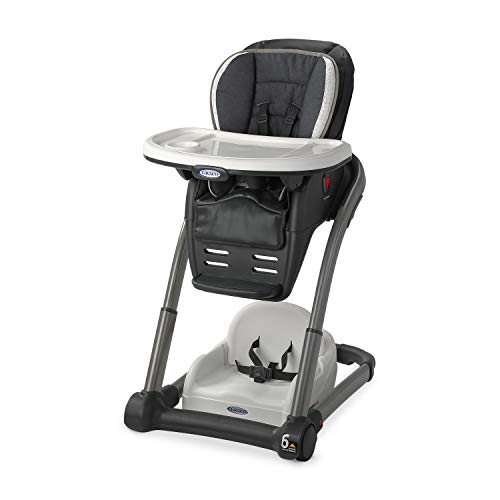
6. Graco Blossom 6-in-1 Convertible High Chair (Redmond) — Best Freestanding Island Solution
The fallback that always works: a freestanding 6-in-1 convertible high chair that stands beside the island on its own legs, independent of overhangs, stools and strap geometry.
Strengths
- Freestanding: no clamp, no host chair, no compatibility gamble with your island
- 6-in-1 convertible design is built to change modes as the child grows
- A full high chair gives the most complete seating structure of any pick here
Trade-offs
- The largest footprint in the guide — it needs floor space beside the island permanently
- The verified listing title is brief; mode-by-mode specifications should be confirmed on the listing
- A freestanding chair at an island still needs the child positioned so feet cannot push off the island base
| Detail (from verified listing) | What it says |
|---|---|
| Type | Convertible high chair, 6-in-1 |
| Colour | Redmond (per listing) |
| Modes | 6 modes (per listing) |
| Detailed specs | Confirm on listing — title is brief |
Best for: islands with waterfall edges, backless stools, or no clampable overhang / Not suited for: kitchens with no spare floor space at the island
Check the current price on Amazon
How These Picks Were Chosen
These picks were verified against Amazon record, and the selection was driven by island compatibility rather than general popularity. Each pick represents a distinct route to counter height — clamp the overhang, boost a backed counter chair, cushion a modest lift, or stand freely beside the island — because the correct route is a property of your kitchen’s measurements, not of the chairs.
Two honesty rules shaped the list. First, unstated figures are reported as unstated: the guzzie+Guss listing does not give a weight limit or clamp range in its verified title, and we flag that rather than borrowing the Toogel’s or any other model’s numbers. Second, no pick is presented as fitting furniture it cannot fit. A booster on a backless stool and a clamp on a waterfall edge are not ‘probably fine’ — they are the two pairings this guide exists to prevent. Measure, match the route to the measurement, and then choose within the route.
The 6 Best Toddler Chairs to Eat at a Kitchen Island, Reviewed
guzzie+Guss Perch Hook-On High Chair (Forest Green) — Best Hook-On for Island Overhangs
The guzzie+Guss Perch approaches the island problem from the right direction: if the island has a usable overhang, the chair hangs from the counter itself and the question of which stool to sacrifice never arises. It is listed for boys and girls from 4 months, the earliest starting guidance in this guide, and its travel positioning — restaurants, picnics, camping — reflects how light and movable the format is.
The honesty paragraph matters here: the verified listing title does not state a weight limit or a clamp thickness range. At a dining table that would be an inconvenience; at an island it is a stop sign until resolved. Read the full listing, find both figures, and measure your overhang — including any support corbels or apron beneath it — before this chair goes anywhere near the counter.
If the numbers check out, the daily experience is the hook-on experience at its best: toddler at counter height, feet clear of the stools, nothing on the floor. If they do not, the boosters and the Graco below exist precisely for your island.
Strengths
- Clip-on format removes the stool from the equation entirely — the island edge does the work
- Listed for 4M+, the widest starting guidance among these picks
- Portable positioning suits islands that double as the home’s eating and working surface
Trade-offs
- The verified listing does not state a weight limit or clamp thickness range in its title — both must be confirmed on the listing before island use
- Waterfall-edge islands and very thick stone overhangs are outside what any clamp should be asked to grip
- No tray: the counter surface becomes the plate’s home, crumbs and all
Best for: islands with a clean, standard overhang and parents who confirm the full listing specs / Not suited for: waterfall-edge or extra-thick stone islands
Toogel Hook-On High Chair (Grey) — Best Documented Hook-On Specs
What sets the Toogel apart is not a feature — it is that the listing actually tells you things. A stated window of 6 to 36 months, a non-slip clamp, a safety harness, anti-tear washable fabric and a carrying bag are all in the verified title. For island buying, where compatibility is a measurement rather than a hope, that completeness is worth real money.
The one phrase to handle carefully is ‘fits most tables’. Most is not all, and islands are where ‘most’ goes to be tested: thick quartz overhangs, decorative edge profiles and underside supports all shrink the clampable zone. Measure the overhang’s thickness and the clear depth underneath, then compare with the full listing’s figures before ordering.
In use it folds, travels and washes — the three verbs island seating needs, because an island chair gets moved constantly between meals, homework and food prep. If your overhang measures up, this is the hook-on we would start with.
Strengths
- Stated age window of 6–36 months in the listing itself
- Non-slip clamp and safety harness named in the verified listing
- Anti-tear, washable fabric and a carrying bag included
Trade-offs
- ‘Fits most tables’ is a claim to verify against your island’s actual overhang thickness, not a guarantee
- BPA-free refers to the materials the listing applies it to — it does not change the clamp measurements you must check
- Foldable travel designs trade some rigidity for portability; the push test decides
Best for: island owners who want the specifications stated up front / Not suited for: islands whose overhang falls outside the clamp’s fit
Dreambaby Dining Booster Seat — Best Booster with Storage
Islands earn their keep by changing jobs through the day, and the Dreambaby booster is built for that rhythm. The three-point harness handles the child; the built-in storage handles the bib-and-wipes problem; the shoulder strap handles the twice-daily carry between cupboard and island. It is the booster as a piece of household logistics, not just a seat.
The condition is the host. At an island, the booster straps to a counter-height chair, and that chair must have a back for the straps and enough weight and stability to pass a firm push test with the booster attached. Backless stools — the default island seating in many kitchens — fail this requirement, and no booster listing can fix that. If your island stools are backless, your routes are a hook-on or the freestanding Graco below.
Choose the Dreambaby when the island has proper backed chairs and the seat must disappear between meals. The storage compartment sounds like a gimmick until the first week of not hunting for a bib at breakfast.
Strengths
- Three-point harness named in the verified listing
- Built-in storage plus a shoulder strap — designed to be moved and put away daily
- Booster format works at the island without depending on the counter’s edge at all
Trade-offs
- Needs a counter-height chair with a back for the straps; a backless stool is not a safe host
- Built-in storage adds bulk compared with the slimmest boosters
- No tray in the verified listing, so the counter is the eating surface
Best for: islands with backed counter chairs and no room to leave a chair set up / Not suited for: backless-stool islands
Dream On Me Munch N Go Booster Seat — Best Height-Adjustable Booster
Counter height is the island problem in one phrase: a booster that lifts a toddler correctly at a 75 cm dining table may leave them chin-to-counter at a 90 cm island. The Munch N Go’s four adjustable heights are the direct answer — set the lift for the surface in front of the child, at the island or at the table, with the same seat.
The rest of the listing supports the plan: a stated 6–36 month window, a 3-point safety harness, and 3-in-1 positioning as a feeding, floor and table seat in a lightweight portable design. The floor-seat mode earns its keep during the island’s other life — the toddler sits safely at floor level nearby while the counter is a workspace, rather than the booster living permanently on a stool.
The condition repeats because it is the whole game at islands: the host chair must be a proper, backed, stable counter chair, and the straps must be re-tensioned every time the booster moves. Do that, and this is the most adaptable booster in the guide.
Strengths
- Adjustable 4 heights — the feature that lets one booster fit both table and counter setups
- Stated window of 6–36 months with a 3-point safety harness
- 3-in-1 feeding, floor and table use stretches its value beyond the island
Trade-offs
- Height adjustment helps only if the host chair is suitable — it cannot stabilise a backless or wobbly stool
- Lightweight portability means checking strap tension after every move between heights and chairs
- The verified listing does not name a tray, so plan on counter-level eating
Best for: families splitting meals between a dining table and the island / Not suited for: islands with only backless stools
SMZCTYI Toddler Booster Seat for Dining Table — Best Cushion-Style Booster
The SMZCTYI is the minimalist end of the booster idea: a removable cushion with double safe straps and a non-slip bottom that lifts the toddler and then gets out of the way. The PU washable surface is its headline — of every pick in this guide, this is the one that shrugs off island eating, where the chair sits amid food prep, coffee and homework debris.
Read its limits as carefully as its strengths. The verified listing names straps that secure the cushion; it does not name a child harness, and the lift from a cushion is modest. At a dining table that suits an older toddler who sits steadily. At a taller island counter, measure the result: the child’s chin and elbows relative to the counter decide whether a cushion lift is enough, and no listing adjective can answer that for your kitchen.
For the right child — older, steady, nearly tall enough — it is the least intrusive island solution here, and the one most likely to be wiped, strapped and forgotten about, which is what mature toddler gear should do.
Strengths
- PU washable cushion: the easiest surface in this guide to keep clean
- Double safe straps plus a non-slip bottom address both attachment and sliding
- Removable cushion design travels and stores with almost no footprint
Trade-offs
- A cushion booster lifts less than framed boosters — check the child’s eye level against your counter before relying on it at the island
- No harness is named in the verified listing; the straps secure the cushion, so this suits older, steadier toddlers
- Minimal structure means minimal side support for younger toddlers
Best for: older toddlers who need a modest lift and the easiest cleanup / Not suited for: young toddlers who still need a harness and side support
Graco Blossom 6-in-1 Convertible High Chair (Redmond) — Best Freestanding Island Solution
Every island guide needs the pick for the islands that defeat the clever solutions. Waterfall edge? No clamp will hold it. Backless stools? No booster should sit on them. Thick stone overhang with corbels underneath? The clampable zone is an illusion. For all of those kitchens, the Graco Blossom’s answer is to ignore the island entirely and stand on its own legs beside it.
The 6-in-1 convertible design is the long-game play: a full high chair now, converting through modes as the child grows, rather than a single-purpose seat with a short window. The verified listing title is brief — ‘Graco Blossom 6 in 1 Convertible High Chair, Redmond’ — so confirm the mode details and limits on the listing itself; we report only what the listing states, and it states the format and the colourway.
Position it thoughtfully: close enough for the child to reach the counter, far enough that feet cannot brace against the island’s base and push. With that one habit, the freestanding chair is the zero-compatibility-risk route to island meals, and for many islands it is simply the right one.
Strengths
- Freestanding: no clamp, no host chair, no compatibility gamble with your island
- 6-in-1 convertible design is built to change modes as the child grows
- A full high chair gives the most complete seating structure of any pick here
Trade-offs
- The largest footprint in the guide — it needs floor space beside the island permanently
- The verified listing title is brief; mode-by-mode specifications should be confirmed on the listing
- A freestanding chair at an island still needs the child positioned so feet cannot push off the island base
Best for: islands with waterfall edges, backless stools, or no clampable overhang / Not suited for: kitchens with no spare floor space at the island
Comparison Table
| Pick | Badge | Key detail | Best for |
|---|---|---|---|
| guzzie+Guss Perch Hook-On High Chair (Forest Green) — check price on Amazon | Best Hook-On for Island Overhangs | Clip-on chair listed 4M+; limits not stated in title | islands with a clean, standard overhang and parents who confirm the full listing specs |
| Toogel Hook-On High Chair (Grey) — check price on Amazon | Best Documented Hook-On Specs | 6–36 months, non-slip clamp, washable anti-tear fabric | island owners who want the specifications stated up front |
| Dreambaby Dining Booster Seat — check price on Amazon | Best Booster with Storage | 3-point harness booster with storage and carry strap | islands with backed counter chairs and no room to leave a chair set up |
| Dream On Me Munch N Go Booster Seat — check price on Amazon | Best Height-Adjustable Booster | 4-height booster, 6–36 months, 3-point harness | families splitting meals between a dining table and the island |
| SMZCTYI Toddler Booster Seat for Dining Table — check price on Amazon | Best Cushion-Style Booster | PU washable cushion booster, double straps, non-slip | older toddlers who need a modest lift and the easiest cleanup |
| Graco Blossom 6-in-1 Convertible High Chair (Redmond) — check price on Amazon | Best Freestanding Island Solution | Freestanding 6-in-1 convertible high chair | islands with waterfall edges, backless stools, or no clampable overhang |
How to Choose the Best Toddler Chairs to Eat at a Kitchen Island
Measure the island before anything else
Three measurements decide your route. First, the overhang: its thickness, and the clear, flat depth underneath it, free of corbels, aprons and drawer boxes. Hook-on listings state a thickness range; your overhang must sit inside it with room for the clamp body. Second, the counter height: standard islands are taller than dining tables, which is why booster lift — ideally adjustable, like the Munch N Go’s four heights — must be checked against the child’s seated eye and elbow level. Third, the edge profile: a waterfall edge, where the counter material runs vertically to the floor, offers nothing to clamp and ends the hook-on conversation immediately.
Write the numbers down and shop with them open beside the listings. Island compatibility is binary — a clamp fits or it does not, a stool is stable or it is not — and binary questions deserve measured answers, not hopeful ones.
The stool problem: boosters need the right host
Most island seating is a stool, and most stools are backless — which makes them unsuitable booster hosts, because booster straps are designed to wrap a chair back and the combined stack must resist a toddler’s sideways lean and foot-push. A backed counter chair that is heavy, wide-based and passes a push test with the booster strapped on is the minimum host. If pushing the empty, strapped booster sideways produces any slide or tip tendency, the pairing fails and the route changes.
Also count your seating. A booster borrows a stool full-time. Islands often have exactly enough stools for the household; borrowing one for a year of toddler meals is a real cost, and it is the practical reason many island families end at the hook-on or freestanding routes.
Falls, floors and the push-off problem
Counter height means a longer fall, and island floors are usually hard — stone, tile or timber rather than carpet. That combination raises the value of boring virtues: a harness that is actually fastened at every meal, straps re-tensioned after every move, and positioning that denies the child a foot-brace. Toddlers push off vertical surfaces with their feet; at an island, keep the chair far enough from the island’s base panels and stool rungs that pushing cannot rock the seat.
Supervision is the other half. An island is a workspace full of hot pans, knives and coffee; the feeding chair places the toddler inside that workspace at counter level. Stay present, keep the counter zone in front of the child clear of anything that should not be grabbed, and treat the chair as attended equipment at all times.
When the freestanding chair is the right answer
There is a point in many island kitchens where the honest recommendation is to stop adapting and stand a real chair beside the island. Waterfall edges, backless stools, thick corbelled overhangs, or simply no stool to spare — each independently justifies the freestanding route, and the Graco Blossom’s 6-in-1 design repays the floor space by converting as the child grows. The footprint objection is real but often overstated: a hook-on chair’s stools and a booster’s borrowed chair also consume the room, just less visibly.
Judge the routes by total disruption. If the island’s seating and surface stay fully usable and the only cost is a square of floor, the freestanding chair is frequently the cheapest solution in the currency that matters — daily friction.
How to Set Up Toddler Seating at a Kitchen Island, Step by Step
Work through these steps in order for whichever route your measurements selected. The attachment and push-test steps are not optional at counter height.
- Measure and record. Overhang thickness and clear depth, counter height, edge profile. Compare against the listing’s stated figures before the chair comes out of the box.
- Choose the route the measurements allow. Clampable overhang → hook-on. Backed, stable counter chair → booster. Neither → freestanding chair beside the island.
- Prepare the surface. Clear the clamp or eating zone; remove anything within toddler reach that belongs to the island’s working life — pans, knives, hot drinks.
- Attach fully. Tighten hook-on clamps evenly, or cinch booster straps around the host chair’s back and under its seat, exactly as the listing directs.
- Push-test the empty setup. Push and pull firmly in every direction, including sideways. Any slide, lift or tip tendency means re-attach or change route — never ‘watch it’.
- Set height and harness. Adjust booster height so the child’s elbows clear the counter comfortably; fasten and snug the harness or safety straps.
- Position against push-off. Place the chair so the child’s feet cannot brace against the island base, stool rungs or cabinet doors.
- Supervise and reset. Stay present for the whole meal. Afterwards, if the seat moves or stores away, repeat the attach and push-test steps at the next meal — every time.
The routine feels heavy for the first week and automatic by the second. What it buys is that the setup you verified on day one is the setup your child actually eats in on day ninety, at the height where that consistency matters most.
Island Geometry: The Three Measurements That Decide Everything
Start with the overhang, because it is the measurement most often taken wrongly. The number that matters is not the countertop’s total thickness at its decorative edge but the thickness of the flat, grip-able slab the clamp will actually close on, measured where the clamp will sit. Bullnose and ogee edges present a rounded profile whose effective grip thickness is less than the slab’s full depth, and some clamps will not seat securely on them at all. Underneath, run your hand along the underside: corbels, support brackets, apron rails and drawer boxes all occupy the space the clamp body and the chair’s arms need. A beautiful overhang with a corbel every forty centimetres may offer no single clampable bay wide enough for a chair. Measure the clear bay, not the island’s brochure length.
The second measurement is seated height, and it is the child’s, not the furniture’s. What you need is the distance from the seat the child will occupy to the counter’s underside and top, compared against the child’s torso. Too low and the child eats at chin height, reaching up and tiring quickly; too high and thighs press against the counter’s underside. Adjustable boosters exist because this window is narrow and children grow through it. The practical test is a stack of books on the intended chair: sit the child on the stack at the island, add or remove a book, and find the height where elbows rest naturally at counter level with feet supported or dangling freely without bracing. That book-stack height, compared with a booster’s stated lift range, is a more reliable purchase guide than any age label.
The third measurement is the one nobody takes: the clear floor and the swing of life around the island. A freestanding chair needs its square of floor permanently, in a kitchen where floor squares are contested by stools, bins and the cook’s own movement. A hook-on needs the stools in front of it to be movable, because the child must be lifted in from the side. A booster needs its host chair to be pull-out-able without dragging the whole arrangement. Walk the choreography before you buy: where do you stand, where does the child enter, where does the food travel from stove to counter? The right island chair is the one whose choreography has no awkward step, and that is a property of your kitchen’s geometry, not of the chair’s reviews.
Common Buying Mistakes
Clamping a waterfall or corbelled edge
A waterfall edge gives a clamp nothing horizontal to grip, and corbels or aprons under an overhang shrink the gripping zone to a fraction of what the clamp needs. Both look fine in a photo and fail the push test in person. If the edge is not clean, flat and inside the stated thickness range, the hook-on route is closed.
Strapping a booster to a backless stool
This is the most common island mistake. Booster straps are designed around a chair back; on a backless stool they grip a seat edge, and the tall, narrow stack that results is exactly what a leaning toddler tips. Backed counter chair, or a different route — there is no safe improvisation between those options.
Assuming dining-table gear transfers to counter height
Lift, fall distance and foot-brace geometry all change at an island. A booster that positioned a child perfectly at the table can leave them low at the counter, and a chair that was stable at table height gains leverage against it. Re-measure and re-test at the island rather than trusting the dining-room result.
Leaving the island set up as a workspace around the child
The chair puts the toddler at the level of chopping boards, hot trays and coffee cups. Clear the child’s reach zone before every meal, every time. Most island incidents are reach incidents, not chair failures.
Before you order: a five-minute checklist
Write down the three numbers — overhang thickness and clear depth, counter height, edge profile — and keep them open while you shop; every compatibility claim you read should be checked against your numbers, not against the phrase ‘fits most’. Sit your child on a stack of books at the island to find the seated height the booster must deliver. Push-test your intended host stool sideways, empty, and imagine it taller and top-heavier with a booster and a toddler aboard; if the empty stool already feels lively, it is not a host. Decide where the setup lives between meals, because an island chair with no home becomes an island obstacle. And agree the supervision rule with everyone who will feed the child there: harness on, reach zone cleared, adult present — the chair’s specification assumes all three.
Final Recommendation
Start with your island’s measurements and let them choose the route. A clean overhang makes the Toogel the best-documented hook-on and the guzzie+Guss Perch the early-starting alternative — once its full listing specifications are confirmed. Backed counter chairs make the Dreambaby and the height-adjustable Dream On Me the boosters to compare, with the SMZCTYI cushion as the older toddler’s minimal lift. And if the island defeats both routes, the Graco Blossom standing beside it is not a compromise; it is the correct answer.
Whichever route you take, the push test on day one and a clear reach zone at every meal are the two habits that make island eating ordinary instead of eventful — which is exactly what family meals at the island are supposed to be.
Related guides in this series: Best Toddler Chairs For Eating Best Booster Chairs For Toddlers Best High Chairs And Booster Seats Best High Chairs That Attach To A Chair Best High Chairs For Traveling Best Slim High Chairs
Frequently Asked Questions
Can a hook-on chair be used on a kitchen island?
Yes, if the island has a horizontal overhang whose thickness falls inside the clamp’s stated range, with clear flat space underneath for the clamp body. It cannot be used on a waterfall edge, and thick stone overhangs with corbels often leave too little gripping depth. Measure the overhang, compare it with the full listing’s figures, and push-test the empty chair before the first meal.
Why can’t a booster go on a backless island stool?
Booster straps are designed to wrap a chair back, and the booster-plus-stool stack must resist a toddler leaning and pushing with their feet. A backless stool gives the straps nothing proper to grip and produces a tall, narrow, tippy stack. Use a backed, stable counter chair, a hook-on chair on a suitable overhang, or a freestanding chair instead.
How high does a booster need to lift a toddler at an island?
Enough that the child’s elbows rest comfortably at counter level and their chin clears the edge without straining — check with the child seated, not by arithmetic. Counters are taller than dining tables, which is why an adjustable-height booster like the Dream On Me Munch N Go, with four heights, is easier to fit to an island than a fixed-lift design.
Is a freestanding high chair safe beside an island?
Yes, with one positioning rule: place it close enough for the child to reach the counter, but so their feet cannot brace against the island’s base and push the chair backwards. Keep the harness fastened, supervise the meal, and clear the counter zone within the child’s reach of hot or sharp items.
What if my island overhang is very thick stone?
Then most hook-on clamps are out — their stated thickness ranges top out well below a chunky stone edge, and forcing a clamp is not an option. Your routes are a booster on a backed counter chair or a freestanding chair. This is a common outcome with statement islands, and it is a measurement result, not a product failure.
Can the same chair serve both our table and our island?
A booster is the natural double-duty pick, because it moves between a dining chair and a backed counter chair — an adjustable-height model handles the level difference best. A hook-on can also move, provided both surfaces have clampable edges inside its stated range. Re-attach and push-test at each location, every time it moves.


