Disclosure: airfryerkitchensupply.com is reader-supported. When you buy through links on our site, we may earn an affiliate commission at no extra cost to you.
Where to buy
Start with the shortlist for best ti chopsticks below, then use this section to buy the right one. ‘Ti’ in these listings means titanium, and the word to hunt for beyond it is ‘pure’ — the best sets state a purity figure or come from known titanium makers, while cheaper listings may be titanium-plated or titanium-colored steel. Every pick below was verified with titanium stated in the returned title, several with the purity or maker confirmed. Check price on Amazon at the exact model, because titanium pricing varies more between makers than almost any kitchen category.
- Snow Peak Titanium Chopsticks — Best Overall: Check the current price on Amazon
- Keith Ti5633 Pure Titanium Solid Square Chopsticks — Best Solid Square: Check the current price on Amazon
- Thous Winds Titanium Chopsticks, Foldable — Best for Backpacking: Check the current price on Amazon
- Youda 99.8% Pure Titanium Chopsticks, 1 Pair with Case — Best Purity-Stated Value: Check the current price on Amazon
- Youda 99.8% Pure Titanium Chopsticks, 2 Pairs — Best for Couples: Check the current price on Amazon
- SANTTA Titanium Chopsticks with Travel Case — Best Travel Case Pick: Check the current price on Amazon
First, the translation the keyword needs: ‘ti’ is titanium, and the best ti chopsticks are exactly that — chopsticks milled or formed from titanium metal. This is not a marketing finish. Titanium is the material outdoor and travel gear settled on for cutlery decades ago because it combines properties no other chopstick material offers together: it never rusts or corrodes, it does not react with acidic food or absorb flavors, it is remarkably light for a solid metal, and it is strong enough that a thin stick stays straight for a lifetime of daily use.
The category needs honest framing, because titanium chopsticks are a premium niche. You pay more per pair than for excellent stainless steel, and what the money buys is specific: zero maintenance forever, the lightest solid-metal feel, and a tool that travels — most sets here include cases or fold — as happily as it sits at a home table. If your chopsticks live in a dishwasher and serve a family of five, stainless five-packs are the rational buy, and this guide says so. If you want one pair, yours, for years, titanium is the terminus.
The six picks below were all verified with titanium confirmed in the listing title: a Japanese outdoor legend, a solid square connoisseur pair, a folding backpacking design, two purity-stated everyday sets and a cased travel pair. The guide after the reviews covers purity claims, solid versus hollow construction, and how to tell real titanium listings from plated imitations.
In this guide
Quick Picks
Snow Peak Titanium Chopsticks — Best Overall. Snow Peak is the name that legitimized titanium tableware, and its listing states the essentials: ultralight at 22 grams, a carrying case included, and heat-reducing behavior at the tips. — Check price on Amazon
Keith Ti5633 Pure Titanium Solid Square Chopsticks — Best Solid Square. Keith mills the Ti5633 from solid pure titanium into a square profile and ships it in an aluminum case — the heaviest-duty, grippiest interpretation of titanium in this guide. — Check price on Amazon
Thous Winds Titanium Chopsticks, Foldable — Best for Backpacking. A folding titanium pair at a full 9-inch eating length per the verified listing, with a storage bag — pack size halves, function does not. — Check price on Amazon
Youda 99.8% Pure Titanium Chopsticks, 1 Pair with Case — Best Purity-Stated Value. Youda states the number most listings avoid — 99.8% pure titanium, in the verified title — in an ultralight single pair with a black carrying case for home, camp and travel. — Check price on Amazon
Youda 99.8% Pure Titanium Chopsticks, 2 Pairs — Best for Couples. The same 99.8% purity-stated titanium as its sibling listing, in a two-pair pack — because the person across the table will steal yours otherwise. — Check price on Amazon
SANTTA Titanium Chopsticks with Travel Case — Best Travel Case Pick. An ultralight titanium pair whose verified listing leads with its travel case — a green-cased single pair built for camping kits and daily carry. — Check price on Amazon
How These Picks Were Chosen
Verification for this guide had two layers. First, Amazon listing data had to return the listing with titanium in its title, matched maker-and-model before any ASIN was assigned. Second, we favored listings that substantiate the claim — a stated purity figure, a known titanium specialist maker (Snow Peak, Keith), or a design (folding, cased) that only makes sense in real titanium. Listings that said merely ‘titanium color’ were excluded.
Scoring weighted construction honesty (solid versus hollow, stated purity), weight and balance, grip treatment — titanium is smooth, so profile and texture matter — and the travel-versus-table brief each set was built for. A backpacking pair and a home pair are both in this guide, judged against their own purposes.
The 6 Best Ti (Titanium) Chopsticks

Snow Peak Titanium Chopsticks — Best Overall
Buy this pair if you want the reference standard. Snow Peak’s Japanese outdoor heritage means the proportions, finish and case are resolved by decades of iteration, and 22 grams — the weight is stated in the verified listing — is light enough to disappear in a lunch bag or pack while feeling unmistakably premium at the table. It serves campers and daily home users with equal conviction, which is rare in a crossover product.
Strengths
- 22 grams ultralight, weight stated in the listing
- Carrying case included; Snow Peak titanium heritage
- Heat-reducing design for hot food and travel cooking
Trade-offs
- Premium tier for one pair
- Smooth titanium needs a day or two of grip adjustment
- One pair — a personal tool, not table service
| Specification | Detail |
|---|---|
| Maker | Snow Peak |
| Weight | 22 grams (per Amazon title) |
| Case | Included |
| Use | Camping, travel, hiking, home (per Amazon title) |
Some products define their category so completely that alternatives are measured against them; Snow Peak’s titanium chopsticks are that product outdoors. The 22-gram figure matters because it is achieved without hollowing the experience away — the sticks feel machined, not stamped. At home they are simply the best-balanced titanium pair here; on the trail they are the pair every ultralight kitchen eventually converges on. If the budget reaches, this is the buy-once answer.
Best for: one-pair buyers, campers and daily users wanting the standard / Not suited for: equipping a family table
Check on Amazon — check price on Amazon before ordering, because configurations and included accessories change between listings.

Keith Ti5633 Pure Titanium Solid Square Chopsticks — Best Solid Square
Choose the Keith if smooth round titanium sounds slippery, because the square profile is titanium’s grip answer: flat faces index in the fingers, resist rotation on heavy pieces and never roll off the table. ‘Solid’ in the listing is the other key word — no hollow core, no flex, a planted feel closer to fine wooden sticks than to featherweight travel gear. The aluminum case suits commuters and travelers who carry their pair daily.
Strengths
- Solid pure titanium — maximum durability and heft for the material
- Square profile solves titanium’s smoothness
- Aluminum case included for daily carry
Trade-offs
- Heavier than hollow titanium — a preference, not a flaw
- Premium single-pair tier
- Square feel takes a few meals to become invisible
| Specification | Detail |
|---|---|
| Model | Ti5633 |
| Material | Pure titanium, solid |
| Profile | Square |
| Case | Gray aluminum (per Amazon title) |
Keith is the other titanium specialist in this guide, and the Ti5633 is its argument that titanium need not mean ultralight minimalism. The solid square body gives the sticks presence — you feel a tool, not a whisper — while the material keeps every titanium virtue: no corrosion, no flavors, no maintenance. Buyers who tried hollow titanium and found it insubstantial will recognize this as the corrective. It is also, not incidentally, the finest travel pair here for people who eat at desks and in transit daily.
Best for: users wanting solid, grippy titanium for daily carry / Not suited for: ultralight purists counting grams
Check on Amazon — check price on Amazon before ordering, because configurations and included accessories change between listings.

Thous Winds Titanium Chopsticks, Foldable — Best for Backpacking
Backpackers and bikepackers are the buyers: the fold puts a real 9-inch pair into a cook kit’s smallest pocket, and titanium keeps the weight near the floor while surviving pack abuse that snaps wooden sticks. The listing also claims home use, and the pair does serve at a table — but the folding joint is a feature you pay for in money and a little rigidity, so home-only buyers should take a fixed pair instead.
Strengths
- Folds for true packability at full 9-inch length
- Ultralight titanium; storage bag included
- Survives pack life that breaks wood and bamboo
Trade-offs
- Folding joint is one moving part to keep clean
- Slightly less rigid than fixed sticks under heavy pieces
- Travel-first design, priced accordingly
| Specification | Detail |
|---|---|
| Length | 9 inches (per Amazon title) |
| Design | Foldable |
| Bag | Storage bag included |
| Use | Camping, backpacking, travel, home |
Folding chopsticks live or die on the joint: sloppy joints wobble, and wobble is fatal to confidence with food. Thous Winds builds for the outdoor market where this design is mature, and the result is a pair that assembles into a genuinely usable 9-inch tool rather than a novelty. For weight-and-space counters it is the only logical titanium form; for everyone else it is a delightful second pair that turns any bag into a kitchen.
Best for: backpackers and minimal travel kits / Not suited for: home-only buyers (choose fixed)
Check on Amazon — check price on Amazon before ordering, because configurations and included accessories change between listings.
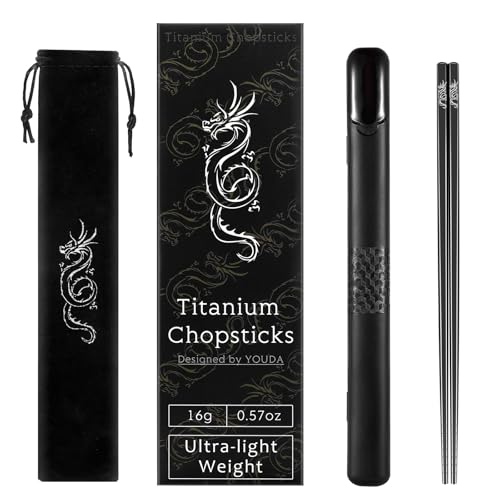
Youda 99.8% Pure Titanium Chopsticks, 1 Pair with Case — Best Purity-Stated Value
Buyers who comparison-shop materials will appreciate a maker that prints its purity. This pair is the straightforward titanium proposition: ultralight, cased, reusable across home and travel, without a heritage brand premium. It suits the commuter who eats at a desk daily, the traveler who refuses hotel disposables, and the home user who wants a personal pair that never enters the family rotation’s arguments.
Strengths
- 99.8% purity stated in the listing
- Ultralight with a carrying case included
- One honest pair for home, camp and travel
Trade-offs
- Lesser-known maker than Snow Peak or Keith
- Single pair pricing still sits in the titanium tier
- Smooth finish — grip purists should look at the square Keith
| Specification | Detail |
|---|---|
| Purity | 99.8% pure titanium (per Amazon title) |
| Pairs | 1 |
| Case | Black carrying case |
| Design | Ultralight |
Purity claims are where titanium listings earn or lose trust, and a stated 99.8% figure is the kind of specificity that separates material sellers from finish sellers. Youda’s pair is the value expression of real titanium: the case, the lightness and the metal are all present, and the premium paid goes to material rather than brand. For a first titanium pair — the one that decides whether you are a titanium person — this is the lowest-risk way to find out.
Best for: first titanium buyers and daily commuters / Not suited for: brand-heritage collectors
Check on Amazon — check price on Amazon before ordering, because configurations and included accessories change between listings.

Youda 99.8% Pure Titanium Chopsticks, 2 Pairs — Best for Couples
Couples are the obvious buyers, and so are solo users who want a home pair and a bag pair without maintaining two different tools. Two matched pairs also solve the guest problem at a small table: a visitor gets real titanium rather than the emergency disposables. The listing keeps the ultralight, reusable, travel-ready brief of the single-pair version.
Strengths
- Two matched pairs of 99.8% pure titanium
- Covers a couple, or home-plus-bag for one user
- Same ultralight reusable design as the single pair
Trade-offs
- Two pairs still will not serve a family table
- Case inclusion differs from the single-pair listing — check the listing contents
- Titanium tier pricing, doubled
| Specification | Detail |
|---|---|
| Purity | 99.8% pure titanium (per Amazon title) |
| Pairs | 2 |
| Design | Ultralight, reusable |
| Use | Camping, home, travel |
Titanium buying has a social arithmetic: one pair creates a hierarchy at the table, two pairs end it. This pack is priced and built for that reality. It is also the pragmatic solo choice — a pair lives in the kitchen, a pair lives in the work bag, and neither is ever in the wrong place. Against buying two singles from the heritage brands, the value case is strong; against stainless family sets, it serves a different, more personal brief.
Best for: couples and home-plus-travel solo users / Not suited for: families of four or more
Check on Amazon — check price on Amazon before ordering, because configurations and included accessories change between listings.

SANTTA Titanium Chopsticks with Travel Case — Best Travel Case Pick
Choose the SANTTA if the case is the point: a distinctively colored case is easier to spot in a pack, a drawer or a wash bag than black or gray, and the listing is explicit that the pair is an ultralight camping-and-carry tool. Office lunch carriers and students get the same benefit — a personal pair that is visibly, hygienically their own, in a case that announces itself.
Strengths
- Distinctive green travel case — easy to find in a kit
- Ultralight titanium pair for camping and carry
- Personal-pair hygiene for office and school lunches
Trade-offs
- Single pair, travel-first positioning
- Case color is a taste commitment
- Less home-table presence than the heritage pairs
| Specification | Detail |
|---|---|
| Pairs | 1 |
| Case | Green travel case (per Amazon title) |
| Design | Ultralight |
| Use | Camping and travel |
Not every pick needs to out-engineer Snow Peak; some win on the small correct decision. A bright case sounds trivial until you have dug through a dark pack or a shared office drawer for a black tube. SANTTA’s pair is competent titanium in the ultralight class with the most findable packaging in this guide, and for the carry-every-day user, findability is a daily feature, not a footnote.
Best for: campers and daily carriers who lose black cases / Not suited for: formal home table service
Check on Amazon — check price on Amazon before ordering, because configurations and included accessories change between listings.
Comparison Table
| Pick | Badge | Key spec | Best for |
|---|---|---|---|
| Snow Peak Titanium Chopsticks | Best Overall | 22 g, cased, Snow Peak | one-pair buyers, campers and daily users wanting the standard |
| Keith Ti5633 Pure Titanium Solid Square Chopsticks | Best Solid Square | Solid titanium, square, cased | users wanting solid, grippy titanium for daily carry |
| Thous Winds Titanium Chopsticks, Foldable | Best for Backpacking | Foldable, 9in, bagged | backpackers and minimal travel kits |
| Youda 99.8% Pure Titanium Chopsticks, 1 Pair with Case | Best Purity-Stated Value | 99.8% Ti, cased, ultralight | first titanium buyers and daily commuters |
| Youda 99.8% Pure Titanium Chopsticks, 2 Pairs | Best for Couples | 99.8% Ti, 2 pairs | couples and home-plus-travel solo users |
| SANTTA Titanium Chopsticks with Travel Case | Best Travel Case Pick | Titanium, green case | campers and daily carriers who lose black cases |
How to Choose the Best Ti Chopsticks: Purity, Solid vs Hollow
Read listings like a materials buyer. Real titanium sets say titanium plainly, and the trustworthy ones add evidence: a purity percentage (Youda’s stated 99.8%), a specialist maker (Snow Peak, Keith), or a weight figure only titanium achieves at that strength. ‘Titanium-plated’, ‘titanium finish’ and ‘titanium color’ describe coatings on other metals — they shave cost and every titanium virtue with it. When a listing will not say which it is, it is the coating.
Construction is the second decision. Solid titanium (the Keith) feels planted and is effectively indestructible, at the material’s full weight. Hollow or thin-wall titanium (the Snow Peak at a stated 22 grams) reaches the ultralight figures travelers want, with a livelier, lighter hand feel. Neither is better; they are the same metal tuned for a table or for a trail.
Why Titanium at All? The Material Case, Honestly
Titanium’s virtues compound quietly. It cannot rust, so a pair left wet in a camp kit is fine. It is chemically inert against food acids, so flavors do not carry between meals and the metal does not pit in the dishwasher. It is light enough that a solid pair surprises people who pick it up expecting steel. And it is strong enough that thin, elegant sticks do not bend in a drawer or a pack.
The honest costs: price per pair, a smooth surface that asks for profile or texture help (square, like the Keith, or a day of adjustment), and a metallic feel some diners simply prefer less than wood. Titanium is the answer to maintenance and longevity questions, not to every question.
Titanium vs Stainless Steel Chopsticks
Stainless wins on price per pair and family economics — five good pairs cost what one titanium pair can. Titanium wins on weight, absolute corrosion immunity and travel abuse, and it never develops the dishwasher haze lesser steels can. In the hand, solid titanium feels warmer and less dense than solid steel; hollow steel can match titanium’s lightness but not its indifference to salt water and acids. Most households that own both settle into a pattern: steel serves the table, titanium serves the person. The two guides in this cluster are written to be read together for exactly that decision.
Solid, Hollow and Folding: Titanium Construction Compared
Solid titanium is the connoisseur construction: a stick milled or drawn from the metal through its whole cross-section, like the Keith Ti5633. The result is the densest titanium feel — still lighter than solid steel — with zero flex and a surface that can be squared, textured or polished at will. Solid pairs are the ones owners describe as permanent, and they are priced as the last pair you buy.
Hollow and thin-wall construction is the travel engineer’s answer: Snow Peak’s stated 22 grams is achievable because the stick does not need to be solid to be rigid at eating loads. The feel is livelier and lighter, the pack weight nearly vanishes, and the trade is a slight springiness under the heaviest pieces that solid sticks do not show. Neither construction is a compromise of the other; they are tunings for a table or a trail.
Folding construction adds a joint, and the joint is the product. A good folding pair — the Thous Winds in this guide — locks into a full-length stick with no play at the hinge; a bad one wobbles and teaches its owner to hate the concept. Judge folders by their maker’s outdoor pedigree, because the hinge is an engineering problem that kitchen brands dabbling in travel gear often solve badly.
Titanium in the Field: Why Outdoor Kitchens Standardized on It
Backpacking cutlery went titanium for reasons that compound. Weight is the famous one — a full titanium kit can weigh less than a single steel spoon — but durability is the decisive one: titanium does not rust in a wet stuff sack, does not bend in a packed bear canister, and does not flavor the next meal with the last one. Chopsticks benefit doubly because their long thin form is exactly where lesser materials fail: wood snaps, plastic warps near stoves, steel weighs.
The trail use case also explains this category’s design language — cases, bags, folding forms, heat-reducing lengths. These are not decorations; they are answers to a kit that is packed, soaked, frozen and cooked over, daily, for months. Home buyers benefit from the over-engineering every time a titanium pair survives a garbage disposal encounter or a decade of dishwasher cycles without a mark.
There is also a hygiene argument that matters more each year: a personal titanium pair in its case is a known-clean utensil in a world of shared drawers, office kitchens and travel uncertainty. Many owners in this category bought their pair for exactly that reason and discovered the material’s other virtues afterward.
Is Titanium Worth It? A Decision Framework
Run three questions. First: is this a personal pair or table service? Titanium’s economics work per-person — one or two pairs for committed users — and collapse at family scale, where stainless serves five for the price of one titanium pair. Second: will the pair travel, commute or live in a bag? Titanium’s virtues are disproportionately travel virtues; a pair that never leaves a drawer still wins on maintenance, but by a smaller margin. Third: do you keep tools for decades or refresh them for pleasure? Titanium is a permanence purchase; buyers who enjoy rotating new wooden sets yearly are paying for the opposite pleasure.
If your answers are personal, mobile and permanent, titanium is not a splurge — it is the fitted material, and the only remaining choice is construction: solid square for the hand, ultralight for the pack, folding for the pocket. If your answers run the other way, the stainless guide in this cluster will serve you better and this guide is content to have talked you out of the wrong purchase.
One last consideration is gifting. A cased titanium pair is a genuinely significant gift for a hiker, a commuter or a chopstick devotee — an object with a story, a material with a reputation, and a daily use that reminds the recipient of the giver. Few kitchen gifts at any tier land as personally as the right pair of sticks.
Titanium Chopstick Myths, Corrected
Myth one: titanium chopsticks are a coating. That describes the cheap listings this guide excluded, not the category. Real titanium sticks are the metal throughout — which is why specialist makers state purity and why a stated weight like 22 grams is possible at full strength. The correction matters because buyers burned by a flaking ‘titanium finish’ often dismiss the genuine material for the imitation’s failure.
Myth two: lighter is always better. Ultralight is a travel virtue and a table preference, not a universal good. Diners who grew up on substantial wooden or steel sticks often find a 22-gram pair insubstantial for a month, and the solid Keith exists because that preference is legitimate. Titanium’s range — solid to hollow to folding — is the material being honest about different hands.
Myth three: titanium is indestructible, so any pair will do. The metal is extraordinarily durable; the designs are not equally so. A folding joint, a thin wall, a case hinge — these are engineering, and engineering quality varies by maker. Buy the metal from makers who stake their name on it, and the myth becomes close enough to true for a lifetime of dinners.
Titanium for People Who Eat Away From Home
The office drawer is titanium’s natural habitat. A cased pair lives there permanently, ends the disposable-utensil negotiation at every desk lunch, and washes in the office sink in seconds. Workers who eat at their desks four days a week will use a personal pair more in a year than a family set is used in five — the highest-frequency chopstick ownership there is, and the easiest purchase in this guide to justify by cost per use.
Students and travelers extend the same logic. A pair in a backpack turns any takeaway into proper equipment, survives being sat on, frozen in a car and washed in a hostel sink, and weighs less than the sauce packets it travels with. For gap years, field work and long assignments abroad, titanium is frequently the single utensil that makes the whole trip — small enough to forget, present every time it is needed.
There is a sustainability dividend that owners mention unprompted: a carried pair quietly deletes hundreds of disposable sets a year from one person’s footprint. It is rarely the reason for the purchase and often becomes the reason for the second pair — the one that lives in the car, the gym bag or the partner’s drawer.
Matching a Titanium Pair to Your Hand and Cuisine
Length follows cuisine as it does in every material: shorter for Japanese precision, mid-lengths for Korean and mixed dining, and the standard 9-inch travel pairs in this guide split the difference for general use. Titanium adds one variable — because the metal is light, a slightly longer pair costs almost nothing in fatigue, so travelers can size up for versatility where wood would punish the choice.
Grip preference is the second match. Smooth round titanium rewards a confident, relaxed hold and punishes a squeeze — the stick is meant to float. Square titanium, the Keith’s proposition, rewards the deliberate grip and gives feedback at every lift. Neither is the correct titanium; they are two schools, and a buyer’s wooden history predicts their school better than any review can: lacquered-stick users go smooth, raw-wood users go square.
Finally, match the case to the life. Hard aluminum cases survive packs and toolboxes; soft bags suit lunch totes and drawers; bright colors suit anyone who has ever lost a black tube in a dark bag — which, owners report, is everyone eventually. The pair is the product, but the case is the habit, and habits are what get carried.
Titanium Chopsticks as an Heirloom Object
Most kitchen tools are consumables wearing durable costumes: coatings fade, hinges loosen, plastics embrittle. A solid titanium chopstick is one of the few genuine exceptions — an object whose service life is measured in generations rather than warranty periods. It will not rust in a century of dishwashers, will not stain in a decade of curries, and will not bend in a lifetime of drawers. Owners of the heritage pairs in this guide are, in a literal sense, buying for whoever inherits their kitchen.
That permanence changes the buying emotion. A titanium pair is not compared against other chopsticks; it is compared against the watches, knives and pens people buy once and keep — the small pantheon of personal tools. This is why the category’s buyers obsess over balance, profile and case: an object you will hold at ten thousand meals should be chosen the way you choose anything that permanent, by how it feels in the hand on an ordinary Tuesday.
It is also why titanium pairs make unusually meaningful gifts at life’s thresholds — the graduation, the first apartment, the wedding, the retirement trip. The giver is not giving cutlery; they are giving a daily ritual upgraded for decades, in a material that will outlast the occasion’s photographs. If this guide has a single sentiment to leave with a reader, it is that some kitchen purchases are allowed to be significant, and a pair of titanium chopsticks, chosen well, is one of them.
The First Week With Titanium: What New Owners Notice
Day one is the weight — or its absence. A titanium pair lifted from its case registers as almost a trick, and the first meal usually involves one experimental lift of something too heavy, undertaken to test whether the sticks are serious. They are. By day two the surprise inverts: it is the old steel and wooden pairs that feel oddly cumbersome, the way a heavy pen feels after a week with a light one. The hand recalibrates faster than the mind expects.
Midweek, owners notice the silence of maintenance. The pair has been washed four ways — dishwasher, sink, a rinse and a wipe — and looks identical after each, and the small background anxiety that attends wooden tools (dry them, oil them, do not leave them soaking) is simply absent. This is the virtue that converts skeptics, because it compounds: a tool that asks nothing is a tool that is always ready, and readiness is what gets a personal pair carried, used and carried again.
By the end of the first week the case has found its station — the drawer slot, the bag pocket, the desk’s top tray — and the pair has begun its real career as a personal instrument rather than a purchase. Owners report the same milestone in different words: they reached for it without deciding to. That is the test every tool in this guide is ultimately taking, and titanium — light, indifferent, permanent — passes it at a rate few kitchen objects match. If your first week runs this course, you did not buy chopsticks. You adopted the last pair you will need.
Titanium Chopsticks and Food: Taste, Temperature and Table Feel
Titanium’s chemical indifference has a taste consequence owners notice within the first week: the sticks contribute nothing. Steel can carry a faint metallic note with acidic foods for sensitive palates, wood carries the memory of a thousand previous meals in its grain, and plastic carries its own quiet flavor. Titanium, the material surgical implants are made from precisely because bodies ignore it, is ignored by food the same way. A tomato tastes like a tomato; a pickle tastes like a pickle. For diners who have always faintly tasted their utensils, the absence is startling.
Temperature behavior flatters the table too. Titanium’s modest heat conduction means the held section stays neutral in hot dishes, and the tip does not carry the wok’s threat that steel can. In iced dishes the sticks do not sweat or chill the fingers. The material simply refuses to participate thermally, which leaves the food as the only temperature event of the meal — a neutrality that feels, after a week, like good manners.
Table feel completes the case. Titanium’s surface, whether polished or matte, has a dry, precise quality distinct from steel’s slickness and wood’s warmth — closer to fine ceramic than to either. It is the feel the square Keith exploits with its milled faces and the feel Snow Peak’s finish has refined for decades. Diners divide on whether they prefer it, but nobody mistakes it: like the material’s weight and its silence in the dishwasher, the feel announces that this is not the ordinary tool. For an object used three times a day, that distinctness is either the point or the problem — and this guide’s six picks exist so that either answer can be bought correctly.
Titanium Chopsticks for Special Diets, Allergies and Sensitive Settings
One underreported constituency for titanium is diners managing material sensitivities. Nickel sensitivity is the common example in cutlery: some stainless grades contain nickel as part of their recipe, and while food-contact reactions are uncommon, diners who react to nickel in jewelry sometimes prefer to remove the question from their table entirely. Titanium’s implant-grade biocompatibility makes it the default answer in that conversation — the same property that lets it live in a human body lets it serve any human’s dinner without negotiation. Buyers in this situation should still confirm their own medical guidance, but the material’s reputation in medicine is precisely why it appears in this guide without a caution section.
The same logic serves households managing strict flavor separation — religious, dietary or simply fastidious — where a utensil that cannot absorb or carry flavors between meals is more than a convenience. Titanium washes to a genuinely neutral state with nothing but soap and water, which is one reason it anchors field kits, hospital-adjacent travel and the bags of diners whose requirements travel with them. It is a niche within a niche, and for the people in it, there is no second material to consider.
In One Sentence, For the Decided and the Undecided
If you will use one pair for years, carry it beyond your kitchen, and value a tool that asks nothing and gives back its quality at every meal, titanium is worth its premium — and if any of those three conditions fails, the stainless sets in this cluster will make you happier for less, which is not a lesser outcome but the same outcome reached honestly.
How to Care for Titanium Chopsticks (Almost Nothing, Done Right)
Titanium’s care routine is famously close to zero, but ‘close to’ is not ‘equal to’ — four small habits keep a pair perfect:
- Wash any way you like — dishwasher, camp stream with a drop of soap, office sink. The metal is indifferent; dried food is the only enemy.
- Dry the pair before casing it after travel, not for the titanium’s sake but for the case’s — trapped moisture smells, even when it cannot rust.
- Keep folding models’ joints clean: rinse the hinge area after saucy meals so the fold stays smooth for years.
- Store cased or in a tray rather than loose against steel cutlery if you care about the surface finish staying unmarked.
- Never use the pair as a pry, a skewer over open flame beyond brief food contact, or a camp tool substitute — titanium is strong, not magical.
- If water spots appear after hard-water washing, a vinegar wipe restores the finish in seconds.
That is the entire manual. A material whose care section fits in six short steps is making its own argument — the time other chopsticks spend being maintained, titanium spends being used.
Common Buying Mistakes
Buying ‘titanium color’ steel at a titanium price. The words plated, finish and color change the product entirely. If purity or a specialist maker is not stated, assume a coating and price it as steel.
Expecting titanium to grip like wood. Polished titanium is smooth. Choose a square or textured design, or allow a few meals of adjustment, instead of declaring the material slippery on day one.
Buying ultralight for a user who loves heft. A 22-gram pair delights travelers and disappoints diners who equate weight with quality. The solid Keith exists for the second group — match the construction to the hand.
Equipping a whole family in titanium by default. Five titanium pairs is a serious outlay solving problems a family table may not have. Stainless serves families; titanium serves individuals and travelers. Spend where the virtue is used.
Losing the case and blaming the pair. Half of titanium’s travel value lives in its case. The bright-cased SANTTA in this guide exists because black cases vanish into packs — choose findability deliberately.
Final Recommendation
Buy the Snow Peak if you want the reference pair, the Keith Ti5633 if you want solid square permanence, and the Thous Winds folder if a pack is where your meals happen. Youda’s purity-stated pairs are the value route into real titanium — one pair with its case, or two pairs for a couple — and the SANTTA’s green case is the daily carrier’s quiet winner. Every pick states titanium in its verified listing; when you check price on Amazon, confirm the listing still says pure or solid titanium rather than a plated variant, because this category’s lookalikes are one click apart.
Keep researching the cluster: Best Stainless Steel Chopsticks Best Square Chopsticks To Buy Best Ti Chopsticks Best Purple Cookware Sets Best Personal Air Fryers
Frequently Asked Questions
What does ‘ti’ mean in ti chopsticks?
Ti is the chemical symbol for titanium. ‘Best ti chopsticks’ means best titanium chopsticks — solid or hollow metal sticks made from titanium, not a brand name or a style.
Are titanium chopsticks really pure titanium?
The trustworthy listings say so with evidence: Youda states 99.8% purity in its listing title, and makers like Snow Peak and Keith build their lines on real titanium. Listings saying ‘titanium color’ or ‘plated’ are other metals with a finish — this guide excluded them.
Do titanium chopsticks get hot in hot pot or soup?
Titanium conducts heat less eagerly than steel, and Snow Peak’s listing even describes a heat-reducing design. Tips warm in hot liquid, but the held section stays comfortable in normal dining.
Are titanium chopsticks worth the money over stainless?
For one personal pair used daily or traveled with, yes — you are buying decades of zero maintenance and the lightest solid-metal feel. For equipping a family table, stainless delivers most of the function at a fraction of the outlay.
Can titanium chopsticks go in the dishwasher?
Yes, indefinitely. Titanium does not rust, pit or react with detergents. Dry before casing a travel pair so the case stays fresh.
Why are titanium chopsticks so light?
Titanium has an exceptional strength-to-weight ratio, so a stick can be thin and still rigid. Snow Peak’s pair states 22 grams in its listing — light enough for ultralight travel kits while feeling machined and substantial.


