Disclosure: airfryerkitchensupply.com is reader-supported. When you buy through links on our site, we may earn an affiliate commission at no extra cost to you.
Where to buy
Start with the shortlist for best square chopsticks to buy below, then use this section to buy the right one. Square chopsticks are a niche inside a niche, so listings mix true square profiles with round sticks wearing optimistic titles. Every pick below was chosen because the verified listing title itself says square — profile, material and pair count confirmed before any link was assigned. Check price on Amazon at the exact listing, because the same storefront often sells round and square variants side by side.
- Keith Ti5633 Pure Titanium Solid Square Chopsticks — Best Overall: Check the current price on Amazon
- 316 Stainless Steel Square Chopsticks, 5 Pairs — Best for Families: Check the current price on Amazon
- Stainless Steel Square Chopsticks, Fu Silver, 5 Pairs — Best Lightweight Steel: Check the current price on Amazon
- LIXTONGR Dragon & Phoenix Beech Wood Square Chopsticks, 2 Pairs — Best Wooden Gift Set: Check the current price on Amazon
- Natural Black Ebony Wood Chopsticks, Square Handles, 5 Pairs — Best Premium Wood: Check the current price on Amazon
- Restaurantware Natural Bamboo Square Chopsticks, 100 Ct — Best Bulk / Restaurant Buy: Check the current price on Amazon
Searching for the best square chopsticks to buy starts with a grip problem. Round chopsticks roll — off the plate, off the rest, in the drawer — and they rotate between the fingers when you pick up something heavy or slippery. A square profile fixes all three behaviors at once: flat faces sit still on the table, resist rolling in storage, and give your fingers purchase that a polished round stick cannot. That is why square and squared-tip designs are traditional in much of Japan and why restaurant buyers specify them.
The square market is smaller than the round one, which makes verification matter. Plenty of listings use ‘square’ loosely for sticks that are square only at the top third, and some are disposable restaurant stock being sold to homes. This guide is strict: every pick below has the word square in its Amazon listing data-verified listing title, and the six span the real materials of the category — titanium, two stainless steels, beech wood, ebony and bulk bamboo — so the profile stays constant while you choose the material that fits your table.
One expectation to set honestly: square sticks feel different for the first few meals. The edges register in the fingers where round sticks disappear, and most users convert within a week and then find round sticks oddly slippery. The reviews and guide below cover lengths, edge sharpness and which square material suits beginners, daily family use, gifts and restaurants.
In this guide
Quick Picks
Keith Ti5633 Pure Titanium Solid Square Chopsticks — Best Overall. Solid pure titanium milled into a true square profile, with an aluminum carry case in the verified listing — the buy-once square stick, light in the hand and effectively immortal. — Check price on Amazon
316 Stainless Steel Square Chopsticks, 5 Pairs — Best for Families. Five pairs of 316-grade stainless in a square profile at 9.45 inches, laser-engraved and dishwasher safe per the verified listing — the family workhorse of this guide. — Check price on Amazon
Stainless Steel Square Chopsticks, Fu Silver, 5 Pairs — Best Lightweight Steel. A lightweight square stainless five-pack with non-slip shaping and a Fu-character silver design per the verified listing — the lighter, more decorative steel option. — Check price on Amazon
LIXTONGR Dragon & Phoenix Beech Wood Square Chopsticks, 2 Pairs — Best Wooden Gift Set. Beech wood with an explicitly stated square profile and textured grip in the verified listing, presented as a two-pair gift set with matching rests, a travel pouch and a gift box. — Check price on Amazon
Natural Black Ebony Wood Chopsticks, Square Handles, 5 Pairs — Best Premium Wood. Dense African black ebony with square handles and a matte finish made without lacquer, wax or varnish per the verified listing — five pairs in a box set, the connoisseur’s wooden option. — Check price on Amazon
Restaurantware Natural Bamboo Square Chopsticks, 100 Ct — Best Bulk / Restaurant Buy. One hundred paper-banded, 9.5-inch square bamboo sticks per the verified listing — the disposable square standard for restaurants, parties and events. — Check price on Amazon
How These Picks Were Chosen
The rule for this guide was textual and strict: Amazon listing data had to return a listing whose title states a square profile, matched brand-and-model before any ASIN was used. That filter removed several popular sets whose photos looked square but whose listings never claimed it — they were excluded rather than assumed.
Within the verified square field we scored grip (edge definition and tip texture), material durability, length against cuisine norms, dishwasher tolerance, and value shape — a gift pair, a family five-pack and a restaurant hundred-count are different products solving different problems, and each is judged against its own job.
The 6 Best Square Chopsticks to Buy

Keith Ti5633 Pure Titanium Solid Square Chopsticks — Best Overall
Buy the Keith if you want one pair for years: titanium does not rust, stain, absorb flavors or react with acidic food, and the solid square body gives the profile’s full grip benefit with crisp edges. The included case makes it a travel and lunch-bag pair as much as a home pair. It suits committed chopstick users who are done replacing wooden sets.
Strengths
- Pure solid titanium — no coating to wear, no rust ever
- True square profile with an aluminum travel case
- Light in hand despite the solid construction
Trade-offs
- Premium tier for a single pair
- Metal feel and sound on ceramic bowls divides users
- One pair — not a family solution
| Specification | Detail |
|---|---|
| Model | Ti5633 |
| Material | Pure titanium, solid |
| Profile | Square |
| Case | Gray aluminum (per Amazon title) |
Titanium is the connoisseur material for chopsticks because it removes every maintenance variable: no oiling like wood, no hollow lightness like cheap steel, no coating anxiety. The square milling is the point of this guide in its purest form — four flat faces that lock between the fingers and rest motionless on the table. Keith is a known outdoor-cutlery maker, and the Ti5633’s case signals its second life as a travel pair. For a single buyer choosing a lifetime stick, this is the terminus of the search.
Best for: committed users wanting one lifetime pair / Not suited for: families equipping a whole table
Check on Amazon — check price on Amazon before ordering, because configurations and included accessories change between listings.
316 Stainless Steel Square Chopsticks, 5 Pairs — Best for Families
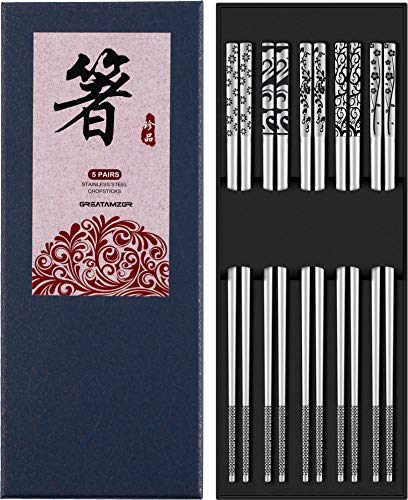
Families should start here. The listing confirms the practical stack: 316 stainless (a step above the common 18/8 grade), a square non-slip profile, laser engraving that adds fingertip texture, Korean length at 9.45 inches, and five pairs in a gift-set box. Everything goes in the dishwasher and nothing needs oiling, drying rituals or replacement cycles.
Strengths
- 316 stainless — the higher corrosion-resistant grade
- Five pairs, square and laser-engraved for grip
- Dishwasher safe; 9.45-inch Korean length
Trade-offs
- Steel conducts heat from hot pots — care at the wok
- Metal on ceramic is audible at a quiet table
- Engraving pattern may not suit minimal tastes
| Specification | Detail |
|---|---|
| Material | 316 stainless steel |
| Pairs | 5 |
| Length | 9.45 inches |
| Profile | Square, laser engraved (per Amazon title) |
This is the set that converts a household. The square profile plus engraving solves the slipperiness that makes beginners abandon metal chopsticks, while 316 steel shrugs off the dishwasher, tomato sauces and years of daily service. Five matching pairs end the mixed-drawer era. If the guide’s question is ‘what square chopsticks should a family actually buy,’ this listing is the answer with the fewest caveats.
Best for: families wanting dishwasher-proof square sets / Not suited for: hot-pot cooking at the stove (heat conduction)
Check on Amazon — check price on Amazon before ordering, because configurations and included accessories change between listings.

Stainless Steel Square Chopsticks, Fu Silver, 5 Pairs — Best Lightweight Steel
Choose this set if the 316 set above sounds heavy or plain. The listing emphasizes lightweight construction, which suits smaller hands, older users and anyone who finds solid-feeling metal sticks tiring over a long meal. The Fu motif makes the set giftable for Lunar New Year and housewarmings in a way plain steel is not, while the square non-slip profile keeps the function honest.
Strengths
- Lightweight build — easier over long meals
- Square non-slip profile, dishwasher safe
- Decorative Fu silver design suits gifting
Trade-offs
- Lighter sticks feel less substantial to titanium/wood fans
- Decorative finish needs gentler handling to stay smart
- Steel heat conduction at the stove still applies
| Specification | Detail |
|---|---|
| Material | Stainless steel |
| Pairs | 5 |
| Profile | Square, lightweight |
| Design | Fu silver (per Amazon title) |
Weight is an underrated chopstick specification: a stick is lifted hundreds of times in a meal, and grams compound. This set trades the planted feel of heavier steel for ease, and decorates the trade with a culturally apt motif. As a gift it lands better than the utilitarian sets; as a daily driver it suits lighter grips and noodle-and-rice cuisines. Buyers who squeeze hard and cook at the stove should take the 316 set instead.
Best for: lighter grips and gift-giving / Not suited for: heavy-handed cooks at a hot wok
Check on Amazon — check price on Amazon before ordering, because configurations and included accessories change between listings.

LIXTONGR Dragon & Phoenix Beech Wood Square Chopsticks, 2 Pairs — Best Wooden Gift Set
This is the presenter’s pick: couples, newlyweds (the dragon-and-phoenix pairing is a traditional couples motif) and anyone who wants square sticks in warm wood rather than metal. The listing confirms the details that make it a set rather than a pair — rests for both settings, a pouch, natural grain, and a textured grip zone that adds purchase to the square profile’s natural advantage.
Strengths
- Square profile with textured grip in natural beech
- Complete presentation: rests, pouch and gift box
- Warm, quiet wood feel on ceramic
Trade-offs
- Wood needs hand washing and drying to last
- Only two pairs — a couples set, not a family set
- Motif styling will not suit every table
| Specification | Detail |
|---|---|
| Material | Beech wood |
| Pairs | 2 |
| Length | 9 inches |
| Extras | 2 rests, travel pouch, gift box (per Amazon title) |
Wooden square sticks are the traditional form, and beech is a sensible timber for it — fine-grained, hard enough to hold an edge, and light. LIXTONGR’s execution leans into ceremony: the rests and box make the unboxing match the table. Care is the honest cost: hand wash, dry standing, and the set will serve for years; dishwash it and no wooden stick survives the year. For a couple’s table or a meaningful gift, that ritual is part of the appeal.
Best for: couples and gift buyers wanting wood / Not suited for: dishwasher-only households
Check on Amazon — check price on Amazon before ordering, because configurations and included accessories change between listings.

Natural Black Ebony Wood Chopsticks, Square Handles, 5 Pairs — Best Premium Wood
Wood lovers who find beech too light should come here. Ebony is famously dense, so these sticks have a planted, weighty feel closer to metal than to bamboo, and the listing’s no-lacquer matte finish means the grip is the wood itself. The square handles deliver the anti-roll, anti-rotate benefit while the eating ends keep a classic profile — a hybrid for users who want square control without square tips.
Strengths
- Dense ebony — substantial, balanced feel
- Square handles; matte finish with no lacquer or wax
- Five pairs in a presentation box set
Trade-offs
- Premium wood tier; ebony asks hand care
- Square handles only — tips are classic profile
- Heavier sticks divide users with lighter grips
| Specification | Detail |
|---|---|
| Material | African black ebony |
| Pairs | 5 |
| Finish | Matte, no lacquer/wax/varnish (per Amazon title) |
| Profile | Square handles |
This set is honest about being a hybrid, and the hybrid makes sense: rotation happens at the fingers, rolling happens at the handle end on the table — square exactly where both problems live. The ebony’s density gives the sticks an heirloom gravity, and the unfinished matte surface grips better than any lacquered stick in a drawer. It is the pick for a household that serves in wood, cares for it properly, and wants five matched pairs rather than one special pair.
Best for: wood connoisseurs and formal tables / Not suited for: dishwasher households or light-grip users
Check on Amazon — check price on Amazon before ordering, because configurations and included accessories change between listings.

Restaurantware Natural Bamboo Square Chopsticks, 100 Ct — Best Bulk / Restaurant Buy
Events and eateries are the buyers here: a wedding with a noodle bar, a pop-up, a restaurant that wants the square profile’s no-roll behavior in a disposable. Bamboo disposables avoid the splintery worst of cheap wooden throwaways, the paper band keeps pairs together and presentable, and the square profile keeps sticks on plates instead of the floor — a small mercy multiplied by a hundred covers.
Strengths
- 100-count bulk with paper bands
- Square profile — no rolling off plates at events
- 9.5-inch full-service length
Trade-offs
- Disposable — a per-event cost, not an heirloom
- Bamboo disposables vary slightly pair to pair
- Not the eco choice versus reusables for home use
| Specification | Detail |
|---|---|
| Material | Natural bamboo |
| Count | 100 |
| Length | 9.5 inches |
| Profile | Square (per Amazon title) |
Disposable chopsticks are judged on consistency and splinters, and square bamboo from a restaurant-supply brand is the reliable end of that market. For a home, this box is the party drawer solved for years — guests get fresh pairs, the good sets stay un-lost. For a small restaurant, the square profile genuinely reduces floor losses and table complaints. It is not competing with the titanium pair above; it is feeding a crowd, which is its own category of best.
Best for: restaurants, parties and event hosts / Not suited for: daily home use (choose reusable)
Check on Amazon — check price on Amazon before ordering, because configurations and included accessories change between listings.
Comparison Table
| Pick | Badge | Key spec | Best for |
|---|---|---|---|
| Keith Ti5633 Pure Titanium Solid Square Chopsticks | Best Overall | Solid titanium, square, cased | committed users wanting one lifetime pair |
| 316 Stainless Steel Square Chopsticks, 5 Pairs | Best for Families | 316 steel, 5 pairs, 9.45in | families wanting dishwasher-proof square sets |
| Stainless Steel Square Chopsticks, Fu Silver, 5 Pairs | Best Lightweight Steel | Lightweight square steel, 5 pairs | lighter grips and gift-giving |
| LIXTONGR Dragon & Phoenix Beech Wood Square Chopsticks, 2 Pairs | Best Wooden Gift Set | Beech, square, gift boxed | couples and gift buyers wanting wood |
| Natural Black Ebony Wood Chopsticks, Square Handles, 5 Pairs | Best Premium Wood | Ebony, square handles, 5 pairs | wood connoisseurs and formal tables |
| Restaurantware Natural Bamboo Square Chopsticks, 100 Ct | Best Bulk / Restaurant Buy | Bamboo, 100 ct, 9.5in | restaurants, parties and event hosts |
How to Choose the Best Square Chopsticks to Buy
Choose material by care tolerance first, because the profile is constant across this guide. Dishwasher households get steel or titanium and never think again. Wood households accept hand washing and drying in exchange for warmth, quiet and grip. Events get bamboo disposables and no washing at all. Anyone who tells you one material is simply best is selling their preference, not your fit.
Length follows cuisine: Japanese styles run shorter (around 9 inches, like the LIXTONGR set) for precise work over small dishes; Korean lengths sit near 9.4–9.5 inches in flatter profiles; Chinese styles run longer for shared dishes and hot pots. Square sticks read slightly larger in the hand than round sticks of the same nominal size, so if you are between sizes, the shorter option usually feels right sooner.
Finally, judge the edge. A square stick should have defined but not sharp edges — crisp enough to resist rotation, smooth enough to disappear during a meal. Listings that mention textured or engraved grip zones are solving the slippery end of the problem; plain polished square steel can still skate on oily noodles, which is why the engraved 316 set ranks so high for families.
Square vs Round Chopsticks: What Actually Changes
Three things change, all mechanical. Rolling stops: a square stick placed on a plate, rest or counter stays where it is put, which sounds trivial until you have chased round sticks across a table service. Rotation stops: the flat faces index against your fingers, so the stick’s orientation stays fixed while lifting — heavy pieces like a glazed rib or a whole dumpling twist less and drop less. And tip alignment is easier to learn, because the fingers get tactile feedback about where the tips point.
What does not change: the fundamental technique, the cuisines, or the learning curve’s first day. Beginners often find square sticks easier for exactly the feedback reason, which is why several training designs quietly use squared profiles. If round sticks have always felt fiddly, the profile — not your hands — may be the problem.
Care Rules by Material
Titanium and stainless want nothing: dishwash, dry, done — which is why they anchor the family and lifetime ends of this guide. Keep steel away from prolonged soaking in salty water anyway, and never use steel sticks as wok tools over open flame unless the listing intends it; conducted heat is the one real steel hazard.
Wood wants a ritual: wash promptly by hand, dry standing with air around the sticks, and store them unbundled. Ebony and beech both reward this with years of service and punish the dishwasher with cracks within months. Bamboo disposables want nothing either — their whole virtue is that care is someone else’s problem — but store the box dry so the paper bands and sticks stay crisp.
Square Chopsticks by Cuisine: Japanese, Korean and Chinese Norms
Japanese dining favors shorter sticks — around 9 inches — because meals arrive as many small dishes close to the diner, and lacquered and wooden squares are traditional forms. The LIXTONGR beech set in this guide sits squarely in that tradition, rests and all. Precision is the Japanese brief: picking a single edamame, separating fish flakes, placing food as much as lifting it. Shorter square sticks give the fingertips leverage for that work.
Korean dining runs slightly longer and flatter, in metal, because the table centers on shared grills, soups and kimchi — slippery, hot and communal. The 316 stainless square set’s 9.45 inches is the Korean proportion, and its profile is a squared cousin of the classic Korean flat stick. Chinese dining runs longest at the table, for shared dishes reached across a lazy Susan and for hot pot, where length is safety; square wooden and bamboo forms are common in restaurant service, which is the world the Restaurantware hundred-count serves.
The practical lesson is to buy your cuisine’s proportion rather than a generic ‘chopsticks’ length. A household eating mostly Japanese home cooking in a Korean-length steel set will adapt, but the tool will never disappear into the hand the way the right length does. Square profile is constant across all three traditions; length is where the fit lives.
Grip Science: Why Edges Beat Polish
A chopstick is held by friction and opposed by food weight, and everything about a square profile raises the friction budget. Flat faces present more contact area to the fingers than a round stick’s tangent line, so the same grip force holds more securely. The edges index the stick’s rotation, which means the brain spends less effort tracking tip orientation — the subtle reason beginners improve faster on square sticks and heavy pieces stop twisting mid-lift.
Surface treatment multiplies the profile’s advantage. Laser engraving and textured zones, like those on the steel sets in this guide, add micro-edges exactly where fingertips and food make contact. Mirror-polished round sticks sit at the opposite extreme: minimum contact, minimum texture, maximum reliance on grip strength. That is why polished round metal is the hardest configuration sold and why this guide’s picks all carry at least one grip feature — profile, engraving, texture or wood’s natural tooth.
There is a fatigue consequence too. When friction does the holding, the hand can relax; over a long meal — a hot pot session, a noodle course, a celebration dinner — relaxed hands outlast strong ones. Square sticks are, in this precise sense, the ergonomic choice, and users with arthritis or reduced grip strength often find them the difference between using chopsticks and avoiding them.
Building a Square Chopstick Drawer: A Sensible Collection
Most households do not need one perfect set; they need a small system. The sensible drawer holds a daily family set (the 316 stainless five-pack is this guide’s candidate), one elevated set for guests and occasions (ebony or beech), and a cooking pair kept at the stove. That three-part system covers every meal a home serves, and each part is bought once and kept for years.
Add a bulk disposable box only if you host — parties, clubs, events — where guest count exceeds your reusable sets or hygiene favors fresh pairs. The Restaurantware bamboo hundred-count lives in the pantry, not the daily drawer, and a single box can cover years of gatherings. Resist the fourth category, the novelty pair, unless it will genuinely be used; drawers fill with souvenirs while the daily set does all the work.
Label by household reality: in homes where sticks wander — lunch bags, desks, cars — a cased personal pair like the titanium Keith keeps one good tool accounted for while the family set stays home. The drawer system works when every pair has a station; chopsticks fail households by migration, not by breakage.
Square Chopsticks for Beginners and Children
Beginners fail at chopsticks for mechanical reasons that square profiles directly address. The upper stick rotates, the tips cross or splay, and slippery food escapes at the last inch. A square stick’s faces give the fingers a reference the brain can use without looking, the rotation problem halves, and early successes arrive sooner — which matters, because beginners quit tools, not techniques, and they quit in the first three meals.
Children benefit for the same reasons at smaller scale. Training chopsticks with connectors teach the motion, but a child graduating to real sticks often does better on a shorter square pair than on the family’s round ones: the grip feedback substitutes for the connector they have outgrown. Households teaching children should size down in length as well as choosing the profile — control comes from proportion first.
Adults returning to chopsticks after years of fork-first eating are the third beginner class, and pride is their obstacle. A square set quietly lowers the difficulty without announcing itself as a training tool — it looks like a preference, not a remedial aid. Many a household’s square conversion began with one adult’s dignity-preserving purchase and ended with the whole drawer changed over.
Square Profiles in Restaurants and Hospitality
Restaurants choose square disposables and reusables for operational reasons that translate directly to home hosting. Sticks that do not roll do not end up on floors, under tables or in the aisle where staff step on them. Sticks that index in the fingers make guests — many of them occasional users — more competent, which means fewer dropped items, fewer replacement pairs requested, and a table that feels considered rather than equipped.
The hospitality signal matters too. A square wooden pair with rests, like the LIXTONGR presentation in this guide, tells a guest the host thought about the meal’s mechanics, not just its menu. In Japanese hospitality culture the chopstick rest and the stick’s placement are part of the welcome; a square pair that sits still on its rest is performing that welcome correctly without the host saying a word.
Home hosts can borrow the whole playbook cheaply: a bulk square bamboo box for big gatherings, a beech or ebony set for the dinners that matter, and rests at every setting where the table is dressed. The cost is trivial against the food budget of a single dinner party, and the competence it lends guests is the difference between a meal people navigate and a meal people enjoy.
Testing a Pair Before You Commit to a Set
A chopstick reveals itself in three lifts. Lift something heavy and smooth — a glazed meatball, a whole mushroom — and feel whether the stick rotates in your fingers as the load comes up. Lift something small and round — a pea, a grape — and judge the tips’ alignment and closure. Then set the sticks down on the plate’s edge and see whether they stay: the rest test, the one square sticks were born to pass.
If you are buying in a store, run the three lifts with the actual pair; online, read the listing for the features that predict them — profile stated, grip treatment named, length matched to your cuisine — which is the standard every pick in this guide was held to. Weight is the fourth test, done by time rather than by lift: hold the pair in eating position for a full minute and notice your hand. The pair that disappears is the pair you will use for a decade.
Buy one pair before a set whenever the material or profile is new to you. A single Keith, a single beech pair, a week of dinners — the experiment costs little and the information is total. Households convert drawer by drawer, not by decree, and the pair that wins the trial earns the set purchase that follows.
A Short History of the Square Stick
Chopsticks began as cooking tools in ancient China — long implements for retrieving food from hot oil and communal pots — and migrated to the table over centuries, differentiating as they traveled. Japan shortened them for a cuisine of small, precise dishes served close to the diner, and developed the lacquered wooden forms, often squared or faceted, that suit fish and delicate presentation. Korea flattened them in metal for a table of grills, soups and fermented vegetables. The square profile is not a modern grip gimmick; it is one of the tradition’s own answers, refined in wood long before it was milled in titanium.
The restaurant world standardized the squared disposable for brutally practical reasons — rolling sticks are lost sticks, and lost sticks are a cost line — and home diners inherited the benefit without noticing. When a guest at a good restaurant finds the sticks easy, part of that ease is a profile chosen by an industry that cannot afford for its tools to fail strangers. Home buyers choosing square are, knowingly or not, adopting the professionals’ specification.
What has changed in the modern era is material range. The profile that began in bamboo and wood now exists in 316 steel, ebony and solid titanium, at every station from a hundred-count party box to a cased lifetime pair. The guide you have just read is essentially that range organized: one ancient, correct idea about how a stick should sit in a hand, executed in every material a modern table might ask for.
Square Chopsticks at the Table: Settings, Rests and Etiquette
A square stick’s stillness makes it a natural citizen of the formal table, where chopstick etiquette is largely the art of keeping the tools graceful and at rest. The rules that matter across Japanese, Korean and Chinese tables share a core: sticks rest on their rest or across the bowl’s rim when not in use, never stand upright in rice, never point, spear or shovel, and never pass food stick-to-stick. Square sticks perform the resting parts of that etiquette effortlessly, which is one unglamorous reason they dominate restaurant service, where a hundred strangers’ manners must be gently engineered by the tools themselves.
The rest deserves its own attention because square sticks and rests are designed for each other. A rest cradles the tips — the part that enters food and mouths — off the table surface, which is hygiene expressed as courtesy. Sets like the LIXTONGR in this guide, which include matched rests, understand that the stick is only half the instrument. Households adopting square sticks for daily use often find that adding rests changes the whole table’s behavior: sticks stop migrating, cloths stay cleaner, and the meal acquires a rhythm of use and rest that round sticks on bare tables never quite achieve.
Placement at the setting carries meaning too. In Japanese settings sticks rest horizontally before the diner, tips on the rest, pointing left for right-handed use; Korean settings pair the sticks with the spoon on the right of the rice bowl; Chinese settings rest them on the rest or the plate’s edge between courses. A square stick honors each convention by simply staying where it is placed — a small fidelity that hosts notice and guests feel without naming.
None of this requires ceremony at a family weeknight table. It requires only the awareness that the square profile’s virtues — stillness, index, control — are the same virtues table manners were built from. Buy the profile for your grip and you receive the etiquette as a dividend; buy rests for the set you choose and the dividend compounds at every meal, whether the meal is a Tuesday noodle bowl or the dinner where you are trying, quietly, to impress.
Square Chopsticks for Hot Pot, Noodles and Shared Dishes
Hot pot is the square stick’s examination hall: broth at a rolling boil, slippery ingredients, shared space, and a premium on sticks that stay where they are put between retrievals. Eating-length square sticks in steel or wood perform beautifully at the table side of the pot — the profile keeps its orientation while fishing, and the stick rests on the bowl’s rim without rolling into the soup, a small mercy repeated fifty times in a meal. What they should not do is live in the pot itself; communal cooking sticks and long kitchen chopsticks are the pot’s proper tools, and every diner’s personal pair stays personal.
Noodle dishes reward the profile differently. Ramen, pho and noodle soups ask the stick to lift a heavy, lubricated load repeatedly without rotation — exactly the square stick’s mechanical advantage — while the spoon handles the broth. Beginners who struggle with noodles on round sticks often find the dish suddenly manageable on square ones, not because their technique changed but because the tool stopped adding its own rotation to the food’s slipperiness. It is the single meal where a doubter should test the profile first.
Shared-plate dining — the lazy-Susan table — is where length and profile combine: reach matters, rotation control matters more as the load travels farther, and the stick that stays composed at full extension is the one that delivers the dumpling intact. Square sticks in the longer Chinese proportions are the traditional answer, and the restaurant world’s preference for squared service sticks is this meal, industrialized. Equip the table you actually host, in the proportions of the meals you actually serve, and the profile will justify itself without a word of theory.
A Note on Price Tiers in Square Chopsticks
Square sticks span an unusual price range for such a simple object — from a hundred-count bamboo box whose per-pair cost is trivial, to a solid titanium pair at the premium end — and the tiers buy different things rather than different amounts of the same thing. The disposable tier buys hygiene and convenience for crowds. The family steel tier buys a decade of daily service. The wooden gift tier buys presentation and ritual. The titanium tier buys permanence and travel-worthiness. Confusion arises only when a buyer expects one tier to perform another tier’s job: disposables judged as heirlooms, or a gift pair judged as family equipment. Read each pick in this guide against its own tier’s promise, and every one of them is honestly priced for the work it does. The square profile is the constant; what your money actually selects is the material, the making and the meaning the pair will carry at your table.
How to Hold and Get Used to Square Chopsticks
Switching profiles takes most people two or three meals. This sequence shortens the adjustment:
- Rest the lower stick on the base of your thumb and ring finger as usual — the square face will sit flatter and steadier than a round stick does.
- Hold the upper stick like a pencil, and notice the flat faces indexing against your fingertips; that feedback is the feature, not a fault.
- Start with large, grippy foods — roasted vegetables, meatballs, thick noodles — where the anti-rotation benefit is obvious.
- Practice lifting something smooth (a cherry tomato, a grape) once the basics feel calm; square tips align more predictably than round ones.
- Set the sticks down between bites and enjoy the point of the design: they stay exactly where you put them.
- After a week, try a round pair again — most switchers find the old profile suddenly feels vague, which confirms the adjustment is complete.
If edges feel too present after a week of daily use, the size is more likely wrong than the profile: try a half-inch shorter or a slimmer stick before abandoning square. Hands adapt to profiles quickly; they do not adapt to levers that are the wrong length.
Common Buying Mistakes
Buying ‘square’ from a photo. Listings photograph round sticks at angles that look squared. If the title and description never state a square profile, assume round — every pick in this guide states it in the verified title.
Dishwashing wooden square sticks. The edges that make wood square are exactly what dishwasher heat and water swell and crack first. Hand wash or choose steel.
Using metal chopsticks as cooking tongs over flame. Steel and titanium conduct heat along the stick. Eating length is not cooking length — long cooking chopsticks are a separate tool.
Ordering one gift pair for a family table. A single beautiful pair among mismatched sticks serves nobody. Match the purchase shape to the table: five-pair sets exist for families, two-pair sets for couples.
Judging by the first meal. Square feels foreign for two or three meals by design — the edges are information your fingers have not learned to read yet. Decide after a week of real use.
Final Recommendation
One pair for life: the Keith titanium. A family set that ends drawer chaos: the 316 stainless five-pack, or its lighter Fu-decorated sibling for gentler grips and gifts. Wood lovers choose between LIXTONGR’s beech couples set and the ebony five-pair box, and hosts and restaurants take the Restaurantware bamboo hundred-count. Every pick states its square profile in the verified listing — when you check price on Amazon, confirm you are on the square variant, because these storefronts sell round versions one click away.
Keep researching the cluster: Best Stainless Steel Chopsticks Best Ti Chopsticks Best Square Chopsticks To Buy Best Purple Cookware Sets Best Oven Air Fryers
Frequently Asked Questions
Are square chopsticks easier for beginners?
Usually, yes. The flat faces give fingers tactile feedback and stop the stick rotating while lifting, which removes two of the beginner’s main frustrations. Technique is otherwise identical to round sticks.
Do square chopsticks damage bowls or plates?
No more than round ones of the same material. Wood and bamboo square sticks are gentle; metal sticks of any profile can mark delicate glazes if used roughly.
What length of square chopsticks should I buy?
Around 9 inches suits Japanese-style dining and smaller hands; 9.4–9.5 inches suits Korean and general family use; longer sticks are for cooking and shared hot-pot serving, not personal eating.
Can square wooden chopsticks go in the dishwasher?
They should not. Dishwasher heat and prolonged water swell and crack the squared edges first. Hand wash and dry standing — or choose the steel and titanium sets in this guide.
Are titanium square chopsticks worth it?
For a single daily user, yes: titanium never rusts or stains, needs no care ritual, and a solid square pair like the Keith Ti5633 is effectively a lifetime purchase. For equipping a family, steel five-packs are the economical route.
Why do restaurants use square disposable chopsticks?
They do not roll off plates and tables, which cuts floor losses and guest annoyance, and the profile feels more substantial than round disposables. The Restaurantware bamboo set in this guide is that restaurant standard.


