Disclosure: airfryerkitchensupply.com is reader-supported. When you buy through links on our site, we may earn an affiliate commission at no extra cost to you.
Where to buy
All six pots in this guide are sold on Amazon and were verified against Amazon’s own catalogue data before writing, so the material, capacity and construction named in each review match the listing you will land on. If you want one safe first purchase, start with the Thermos TTE-700 BW Vacuum Insulated Teapot if you brew mainly for yourself or one other person, or the GiNT 51oz Thermal Carafe with Infuser if the pot has to serve a table. The full shortlist is the CGHWBEA 34oz Thermal Tea Pot, the Teabloom Insulated Teapot, the WALDWERK Double Wall Stainless Steel Teapot and the suyika Tetsubin Cast Iron Teapot. Check the current price on Amazon as you compare them, and check price on Amazon again at checkout, because colours and finishes rotate in and out of stock.
Introduction
The best tea pots to keep tea hot solve a problem that ordinary teapots quietly create: tea is brewed at its best temperature and then starts losing that temperature from the moment the water leaves the kettle. A thin glass pot on a cold counter can turn a carefully brewed second cup lukewarm while you are still finishing the first, and reheating brewed tea in a microwave is a poor rescue, because it dulls delicate flavours and can push tannins forward. A pot designed to hold heat changes the whole rhythm of tea drinking. You brew once, properly, and the pot looks after the temperature while you work, read, talk or simply take your time.
There are three honest ways a teapot keeps tea hot, and this guide is organised around them rather than around looks. The first is vacuum insulation: two walls with the air removed from between them, the same principle as a good travel flask, which slows heat loss through the wall of the pot itself. The second is double-wall construction without a full vacuum, in glass or stainless steel, where a trapped layer of air does a more modest but still useful insulating job while keeping the outside of the pot comfortable to handle. The third is thermal mass: a heavy cast iron tetsubin absorbs heat from the brew and gives it back slowly, so the pot itself becomes part of the warming system. Each approach has a different feel, a different weight in the hand and a different set of compromises, and pretending they are interchangeable is how buyers end up disappointed.
One distinction matters before anything else, because the cast iron section depends on it. A tetsubin is, strictly, a cast iron kettle made for boiling water over a heat source. Many of the enamel-lined cast iron pots sold for tea today are really brewing pots in the tetsubin shape: they are made to receive hot water and steep leaf, not to sit on a burner boiling water for the tea. The suyika pick in this guide is listed by its maker as stovetop safe with an enameled interior, and we describe it exactly that way, but the general rule stands for the whole category: check what a specific cast iron pot is actually built to do before you put it over direct heat, and never assume a brewing pot and a boiling kettle are the same tool.
We verified every pick in this guide against Amazon’s catalogue data, matching brand, model, material and capacity to real listings. All six passed, so all six carry links. We do not print prices or fixed ratings anywhere in this guide, because both change constantly; each pick is positioned by tier instead, and you can check price on Amazon for the current figure. What we judged is what actually decides whether a heat-holding pot earns its place: how the insulation or mass is built, whether the lid seals well enough to matter, whether loose leaf is handled by a proper infuser or filter, how the pot pours, and whether the stated capacity is a usable brewing volume or a brim-full number.
The shortlist covers the main situations. There is a compact vacuum pot for one or two drinkers, a large insulated carafe-style pot with its own infuser for households and offices, a budget vacuum pot in a higher grade of stainless steel, a double-wall glass pot that keeps the visual pleasure of watching leaf unfurl, a double-wall stainless pot with a wooden accent for people who want insulation without a carafe look, and a cast iron tetsubin for drinkers who value the slow, even warmth and ritual of iron. If none of those descriptions sounds like your kitchen, the buying guide further down explains the underlying trade-offs so you can judge any other pot you meet.
In this guide
Quick Picks
- Best Overall: Thermos TTE-700 BW Vacuum Insulated Teapot with Strainer, 23.7 fl oz — a true vacuum-insulated brewing pot from a maker whose name is shorthand for insulation, sized honestly for one to two drinkers, with a built-in strainer for loose leaf.
- Best for Groups and Offices: GiNT 51oz Thermal Carafe with Infuser — the largest pot here at 1.5 litres, with a removable infuser, a wide mouth that is easy to fill and clean, and a leak-proof seal described in its listing.
- Best Budget: CGHWBEA 34oz Thermal Tea Pot, 316 Stainless Steel — double-wall vacuum construction in 316 stainless steel at a budget tier, in a practical size for two to three drinkers.
- Best Double-Wall Glass: Teabloom Insulated Teapot Keeps Tea Hot, 24 oz — double-wall heatproof glass that keeps tea hot while keeping the brew visible, with a stainless steel filter lid for loose leaf.
- Best Double-Wall Stainless Design: WALDWERK Tea Pot with Infuser — double-wall 304 stainless steel with oak wood detailing and a strainer, for buyers who want insulation in a pot that still looks like a teapot.
- Best Cast Iron: suyika Japanese Tetsubin Cast Iron Teapot, 30 oz — enamel-lined cast iron with a stainless steel infuser, listed as stovetop safe, for slow and even warmth in the traditional iron style.
How These Picks Were Chosen
We started from the heat problem, not from a brand list. Every candidate had to offer a real heat-holding mechanism that could be identified in its catalogue data: vacuum insulation, a genuine double wall, or the thermal mass of cast iron. Ordinary single-wall ceramic, glass and stainless pots, however attractive, were set aside for this guide, because a single wall is a heat leak by design. If you want those pots for other reasons, they belong in a general teapot guide, not in one whose entire promise is keeping tea hot.
Brand, model wording, material, capacity and key construction claims in this article come from the returned listing titles, not from memory or from third-party roundups. Where a listing title does not state a detail — a capacity, for example — we do not invent one, and the review says so or leaves the spec box out. Heat-retention performance is described qualitatively for the same reason: unless a maker states a figure in the listing itself, printing a precise number of hours would be inventing data, and a pot that holds tea properly hot for a long, relaxed session does not need a made-up number to recommend it.
We also weighed the brewing side of the pot, because insulation is wasted on tea that was badly brewed in the first place. Loose leaf needs room to expand and a filter fine enough to keep small leaf out of the cup, so infusers and filter lids were scored as part of the pick, not as accessories. Lids matter twice over: a loose lid leaks heat from the top of the pot, which is exactly where heat escapes fastest, and it can also shift during pouring. Spouts were judged on the simple test of whether the design suggests a controlled pour rather than a dribble down the side of the pot and onto the table.
Finally, we spread the six picks across sizes, materials and tiers so that the guide answers different households rather than crowning one pot six ways. Capacities run from a personal 23.7 fluid ounces to a table-serving 1.5 litres. Prices are not printed, in line with our standing rule, but the tiers are real: there is a budget vacuum pot, several mid-range insulated pots, and a cast iron pot whose cost reflects a heavy, traditional material. If your situation is unusual — brewing for one at a desk all day, or serving eight people after dinner — read the pick whose badge matches that job first, then use the comparison table to check you are not over- or under-buying capacity.
The 6 Best Tea Pots to Keep Tea Hot

Thermos TTE-700 BW Vacuum Insulated Teapot with Strainer, 23.7 fl oz — Best Overall
This is the pot we would hand to most people who ask how to keep tea hot without fuss, because it attacks the problem with the strongest tool available: a true vacuum between its walls. Thermos built its reputation on vacuum insulation, and the TTE-700 BW applies that idea to a proper brewing pot rather than a travel flask, complete with a strainer so loose leaf can be brewed in the pot itself. At 23.7 fluid ounces (700 ml) it is honestly sized for one generous drinker or two modest cups, which is exactly the session length where a small pot most often disappoints in ceramic or glass — there simply is not enough tea in a small pot to hold its own temperature for long without help.
Strengths
- True vacuum insulation, the most effective passive way to slow heat loss through the walls of a pot.
- Built-in strainer, so loose leaf brews in the pot and lifts out when the steep is done, preventing over-extraction while the tea stays warm.
- Compact 700 ml size suits desks, breakfast trays and solo rituals where a large carafe would be wasted tea.
Trade-offs
- The capacity that makes it perfect for one or two is too small for a table of guests.
- The brown finish is a single, practical colourway rather than a decorative choice.
- As a vacuum pot it is a brewer and keeper, not a kettle — water is boiled separately, as with most insulated pots.
| Spec | Detail (as listed) |
|---|---|
| Construction | Vacuum insulated teapot with strainer |
| Capacity | 23.7 fl oz (700 ml) |
| Finish | Brown |
The deeper point about a pot this size is behavioural. Small amounts of tea cool fastest, so small-pot drinkers are the people most likely to have given up on a second cup or to have fallen into the habit of brewing one mug at a time with a basket infuser. A vacuum pot restores the pot ritual at a personal scale: brew once in the morning, pour a first cup at full flavour, and come back for the second when you are ready for it rather than when the tea demands it. Pre-warming still helps — rinse the pot with hot water before brewing so the first fill does not spend its heat warming cold walls — but with a vacuum the pre-warm is a refinement, not a rescue mission.
Care is straightforward. The strainer should be emptied and rinsed promptly, because leaf left sitting in a warm, sealed pot will keep flavouring whatever moisture remains and can stain over time. Wash the interior with warm soapy water, avoid abrasive pads on the finish, and let the pot dry with the lid off so no stale tea smell builds up between sessions. Treated that way, a vacuum pot has no fragile parts to baby: no glass to chip and no enamel to crack, just seals and a strainer to keep clean.
Best for: solo drinkers and couples who brew loose leaf and want the second cup as hot as the first. / Not suited for: serving groups, or anyone who wants to watch the leaf through glass.
Check on Amazon — check the current price on Amazon.
GiNT 51oz Thermal Carafe with Infuser — Best for Groups and Offices
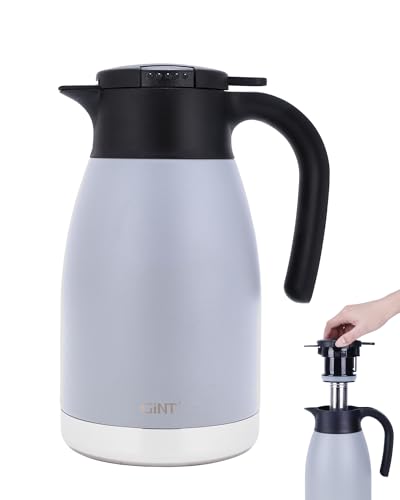
At 51 ounces and 1.5 litres, described in its listing as six to seven cups, the GiNT is the serving pot of this guide: a thermal carafe with a removable infuser, built to brew a full batch and hold it through a meeting, a family breakfast or a long afternoon of guests topping up their cups. The listing highlights a wide mouth, which matters more than it sounds — wide mouths fill without splashing, accept a brush for cleaning, and let you see the inside when you rinse it. It also describes a leak-proof seal and dishwasher-safe construction, both of which suit shared spaces where a pot gets used hard and washed by whoever is nearest the sink.
Strengths
- Largest capacity here at 1.5 litres, so one brew serves a table instead of the pot being refilled mid-conversation.
- Removable infuser means the batch can be brewed in the pot and the leaf lifted out before serving, so the last cup is not stewed.
- Wide mouth and dishwasher-safe billing make it the easiest large pot here to fill, empty and clean.
Trade-offs
- A full 1.5 litres is heavy to lift and pour one-handed, especially for smaller hands.
- Its carafe styling reads as a beverage server rather than a traditional teapot on a formal table.
- For one or two drinkers it is simply too much tea, and a half-filled large pot is a waste of good leaf.
| Spec | Detail (as listed) |
|---|---|
| Construction | Insulated thermal carafe, stainless steel, removable filter/infuser |
| Capacity | 51 oz / 1.5 L (6–7 cups as listed) |
| Features | Wide mouth, leak-proof seal, dishwasher-safe as listed |
Large-batch brewing has one trap that this pot’s infuser directly addresses: if leaf stays in a big pot for the whole serving period, the tea that reaches the last cups has been steeping far longer than the tea in the first cups, and bitterness creeps in even while the temperature holds. Brewing with the infuser in, then removing it at the right moment, separates steeping time from serving time — the single most useful habit for group tea. Brew slightly stronger than you would for a single cup if your drinkers take milk, and keep the lid closed between pours; every opening of a large pot lets out a visible plume of the heat you are trying to keep.
In an office setting, agree on one unglamorous rule: the pot gets rinsed at the end of the day, not left with the dregs until morning. Old tea left in any insulated vessel will season the interior with stale flavour that fresh tea then picks up. A wide mouth makes that rinse a ten-second job rather than a chore, which is precisely why it is worth listing as a strength rather than a footnote.
Best for: families, shared offices, and hosts who brew once for many cups. / Not suited for: solo drinkers, or anyone who wants a delicate traditional teapot silhouette.
Check on Amazon — check the current price on Amazon.

CGHWBEA 34oz Thermal Tea Pot, 316 Stainless Steel — Best Budget
The budget pick earns its place on construction rather than on a famous name. Its listing describes a 34-ounce tea pot in 316 stainless steel with double-wall vacuum construction and hot and cold retention, and that combination is notable at a budget tier, where many cheap insulated pots quietly downgrade materials. The 316 grade is the more corrosion-resistant of the common food-grade stainless steels — the grade also used where salt and acids are a daily fact — so for a vessel that will hold acidic infusions like hibiscus or lemon blends, the material choice is a genuine point in its favour rather than marketing filler. At 34 ounces it sits in the useful middle: a full pot for two, a generous pot for one.
Strengths
- Double-wall vacuum construction at a budget tier, so the heat-keeping mechanism is the real thing, not a thin double skin.
- 316 stainless steel interior-facing material, a step up in corrosion resistance from the more common 304 grade.
- Practical 34 oz size that serves two properly without the weight of a full carafe.
Trade-offs
- An unbranded pot means support and spare parts depend on the seller rather than a long-standing maker.
- The listing describes it as a thermal carafe and tea pot hybrid, so purists may find the styling more flask than teapot.
- No infuser is named in its listing title, so loose-leaf drinkers should plan on a separate strainer or check the listing details before ordering.
| Spec | Detail (as listed) |
|---|---|
| Construction | Double-wall vacuum, 316 stainless steel |
| Capacity | 34 oz |
| Use | Hot and cold retention, as listed |
Budget insulated pots live or die on their lids and seals, because the vacuum wall can be perfect and the pot will still lose heat through a sloppy top. When yours arrives, fill it with hot water, close it, and leave it on the counter for a while, then feel the outside and the lid area. The walls should stay neutral to the touch; warmth creeping through one spot tells you where heat is escaping and whether the seal seats properly. That simple first-day test, which costs nothing, tells you more about a budget vacuum pot than any amount of product copy.
Used with that one check done, this is the sensible way to get vacuum performance without paying for a heritage brand: the physics is the same, the steel grade is arguably better than pots costing more, and the money saved buys a great deal of good loose leaf, which will improve your tea far more than a logo on the pot would.
Best for: value-focused buyers who want real vacuum insulation and a corrosion-resistant steel at a budget tier. / Not suited for: buyers who want a named maker behind the pot, or a guaranteed included infuser.
Check on Amazon — check the current price on Amazon.

Teabloom Insulated Teapot Keeps Tea Hot, 24 oz — Best Double-Wall Glass
Glass is normally the enemy of hot tea: it is thin, it gives heat away freely, and it leaves the pot too hot to touch while the tea inside still manages to cool. Teabloom’s answer is a double wall of heatproof glass, and its listing says the quiet part out loud in its name — this is an insulated teapot that keeps tea hot. The trapped layer between the walls slows heat loss and keeps the outer wall more comfortable in the hand, while preserving the one thing glass drinkers refuse to give up: watching the leaf unfurl and judging the brew by its colour. At 24 ounces it is billed as a tea maker for two, and it filters through a stainless steel filter lid rather than a basket, so the whole interior stays open for the leaf to move.
Strengths
- Double-wall heatproof glass keeps tea hot far better than single-wall glass while keeping the brew fully visible.
- Stainless steel filter lid strains on the pour, leaving the leaf free to expand in the full body of the pot.
- The outer wall stays more comfortable to handle than a single-wall glass pot filled with near-boiling tea.
Trade-offs
- Glass, even heatproof double-wall glass, is the most fragile construction in this guide and will not forgive being dropped or knocked hard.
- Double-wall glass insulates less strongly than a true vacuum in stainless steel, so it suits a sitting rather than an all-day hold.
- The 24 oz size is for two, not for a gathering.
| Spec | Detail (as listed) |
|---|---|
| Construction | Double-wall heatproof glass |
| Capacity | 24 oz, tea maker for two as listed |
| Filter | Stainless steel filter lid for loose leaf |
This is the right pot for teas that are partly a visual pleasure: blooming teas that open in the water, pale green and white teas whose colour tells you the strength, and whole-leaf oolongs that need room to uncurl. A filter lid rather than a tight basket genuinely helps those leaves, because cramped leaf extracts unevenly — the outside over-steeps while the centre of the clump stays dry-ish and underused. Give the pot a gentle swirl midway through the steep if the leaf has settled, and pour steadily so the lid filter can do its work without a rush of leaf pressing against it.
Handle it like the glass it is: warm it before brewing with a rinse of hot water, which both pre-heats the pot for better temperature holding and reduces thermal shock, set it down on a mat or board rather than a cold stone counter, and wash it by hand if you want it to stay crystal clear for years. Those are small rituals, and for the drinkers this pot is aimed at, they are part of the pleasure rather than a burden.
Best for: loose-leaf and blooming-tea drinkers who want heat held and the brew on show. / Not suited for: clumsy or high-traffic kitchens, all-day holding, or group serving.
Check on Amazon — check the current price on Amazon.

WALDWERK Tea Pot with Infuser, Double Wall Stainless Steel — Best Double-Wall Stainless Design
WALDWERK takes the double-wall idea and dresses it as a teapot rather than a carafe: 304 stainless steel inside and out, an oak wood accent that keeps the design warm rather than industrial, an infuser with a strainer for loose tea, and a listing that promises a drip-free pour. That last claim is worth pausing on, because dripping is the daily annoyance of teapot ownership — the spout that leaves a ring on the tablecloth after every cup. Spout geometry is what decides it, and a maker who calls out drip-free pouring in the title is at least designing with the problem in mind. The double wall here is an air-insulated construction rather than a sealed vacuum, so set expectations accordingly: it meaningfully slows cooling and keeps the outside comfortable, sitting between a single-wall steel pot and the vacuum picks in outright holding power.
Strengths
- Double-wall 304 stainless steel that insulates while keeping the outside comfortable to handle.
- Included infuser and strainer set up properly for loose leaf straight out of the box.
- Oak wood detailing and a drip-free pouring claim give it the table presence the carafe-style picks lack.
Trade-offs
- Air-insulated double wall holds heat well but not as strongly as the true vacuum pots in this guide.
- Its listing title does not state a capacity, so confirm the size on the listing before ordering if capacity is decisive for you.
- Wood accents prefer hand washing and a dry storage spot over being left soaking in a sink.
| Spec | Detail (as listed) |
|---|---|
| Construction | Double-wall stainless steel teapot with infuser |
| Material | 304 stainless steel and oak wood, as listed |
| Pour | Described as 100% drip free in its listing |
Choose this pot when the pot itself is part of the serving ritual — when tea is poured at the table in front of people, and a vacuum flask shape would break the mood. It will keep a sitting’s worth of tea properly hot, it will not burn fingers through its wall, and it will look after loose leaf with its own infuser. What it will not do is hold a morning brew at drinking temperature until lunch, and buyers who need that should be honest with themselves and take one of the vacuum picks instead. Matching the insulation strength to the actual length of your tea sessions is the whole game in this category, and this pot is pitched squarely and fairly at the session, not the day.
For care, empty the infuser while it is still warm, rinse the pot, and dry the wood with a cloth rather than leaving it wet on the draining board. Stainless steel interiors can pick up tea staining over months of daily use; a soak with warm water and a little bicarbonate of soda lifts it without scouring, and keeps the steel tasting of nothing but the next brew.
Best for: table service and design-conscious buyers who want insulation in a real teapot shape. / Not suited for: all-day heat holding, or buyers who need a confirmed capacity before they commit.
Check on Amazon — check the current price on Amazon.
suyika Japanese Tetsubin Cast Iron Teapot, 30 oz — Best Cast Iron
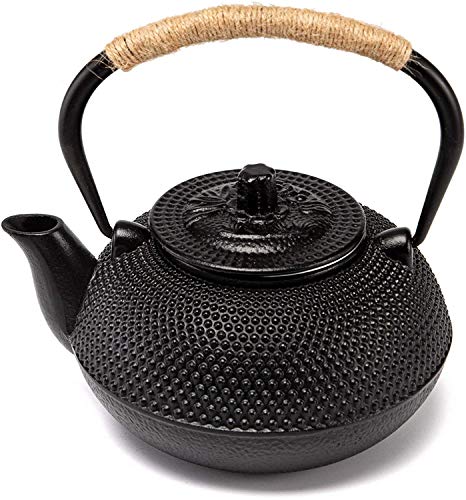
Cast iron keeps tea hot by the opposite strategy to insulation: instead of blocking heat, it stores it. A thick iron wall absorbs heat from the brew until pot and tea reach the same temperature, then gives that heat back slowly as the tea tries to cool, which produces the steady, even warmth that iron devotees describe as a rounder cup. The suyika is a 30 oz (900 ml) tetsubin-style pot with a stainless steel infuser and an enameled interior, and its listing describes it as stovetop safe. The enamel lining is the detail that makes a modern iron pot practical: bare iron can rust and can flavour tea, while an enameled interior keeps the water side clean, neutral and far easier to maintain.
Strengths
- Heavy cast iron thermal mass holds a steady, even temperature through a relaxed sitting.
- Enameled interior protects against rust on the tea side and keeps flavours neutral.
- Stainless steel infuser included, and the 30 oz size serves two to three cups per brew.
Trade-offs
- Iron is heavy, and a full iron pot is a two-handed commitment for some drinkers.
- It must be dried after use; leaving an iron pot wet invites rust on any unenameled surface, including the rim and exterior.
- It is a brewing pot in the tetsubin style, not a substitute for a boiling kettle — boil water separately unless the specific listing guidance for your pot says otherwise.
| Spec | Detail (as listed) |
|---|---|
| Construction | Cast iron tetsubin-style teapot, enameled interior |
| Capacity | 30 oz / 900 ml |
| Infuser | Stainless steel, included; listed as stovetop safe |
That last trade-off deserves a full paragraph, because it is the most common misunderstanding in this whole category. In Japan, a tetsubin is traditionally a kettle: unlined iron, used to boil water, with the water then poured into a separate brewing vessel. The enamel-lined, infuser-fitted iron pots sold widely today borrow the tetsubin shape and mass for brewing, which is a legitimate and enjoyable tool — but it is a different tool. Treat this suyika as a brewer: boil your water in a kettle, warm the iron pot with a rinse of that hot water so the cold iron does not steal the first brew’s heat, then add leaf and water and let the mass of the pot hold the temperature steady. Pre-warming is not optional with iron the way it is with vacuum steel; a cold iron pot is a heat sink, and the first fill will pay for warming it.
After serving, empty the pot, rinse it with plain hot water rather than detergent where the enamel is concerned, and dry it thoroughly — on a warm stovetop for a moment or with a cloth — before putting it away. That dry-before-storage habit is the entire secret of owning iron for decades. Do that, and this is the most characterful pot in the guide: the one guests ask about, and the one whose second cup tastes most like the first.
Best for: traditionalists and slow tea rituals who want even warmth and do not mind the weight or the drying habit. / Not suited for: anyone who wants a featherweight pot, a true boiling kettle, or zero-maintenance ownership.
Check on Amazon — check the current price on Amazon.
Comparison Table
| Pick | Badge | Key spec | Best for |
|---|---|---|---|
| Thermos TTE-700 BW | Best Overall | Vacuum insulated, 23.7 fl oz, strainer | Solo and two-person loose-leaf brewing |
| GiNT 51oz Thermal Carafe | Best for Groups and Offices | Insulated carafe, 1.5 L, removable infuser | Tables, meetings and households |
| CGHWBEA 34oz Thermal Tea Pot | Best Budget | Double-wall vacuum, 316 stainless steel, 34 oz | Value buyers who want real vacuum insulation |
| Teabloom Insulated Teapot | Best Double-Wall Glass | Double-wall heatproof glass, 24 oz, filter lid | Watching loose leaf and blooming tea |
| WALDWERK Tea Pot with Infuser | Best Double-Wall Stainless Design | Double-wall 304 stainless steel, oak wood, infuser | Table service with a traditional shape |
| suyika Tetsubin Cast Iron Teapot | Best Cast Iron | Cast iron, enameled interior, 30 oz, infuser | Slow rituals and even, steady warmth |
Read the table by mechanism first and size second. If your sessions are long, the vacuum rows are your shortlist; if your sessions are social and visual, the glass and double-wall stainless rows fit better; if your sessions are rituals, the iron row is the one you will keep for decades.
How to Choose a Tea Pot That Keeps Tea Hot
Start by timing your own tea drinking honestly. If a pot is normally finished within one sitting at the table, almost any genuine double wall will serve you, and you can choose on looks, pour and capacity. If tea is brewed and then revisited across a working morning, only a true vacuum construction will hold a satisfying temperature for that span without help, and you should shop the vacuum picks first. If your pleasure is the ceremony itself — warming the pot, brewing, pouring slowly — cast iron’s thermal mass — the suyika tetsubin is this guide’s example — matches that rhythm, because the pot participates in the warmth instead of merely resisting its loss.
Understand the three mechanisms as a ladder. A vacuum removes the air between two walls, and since heat crosses a vacuum very poorly by conduction, it is the strongest passive insulation a pot can have; its weakness is that it depends on seals and on the vacuum staying intact. A double wall with trapped air is the middle rung: noticeably better than a single wall, kinder to hands, but not a vacuum’s equal over long periods. Thermal mass is not insulation at all — iron does not stop heat leaving, it soaks heat up and returns it — which is why an iron pot feels warm to the touch while a vacuum pot’s outside stays neutral, and why iron excels over a sitting rather than a day.
Capacity: buy for the session, not the crowd you imagine
Oversized pots are the most common buying error in this category. Tea that sits because the pot was too big is tea that cools and stews, no matter how good the insulation is, and leaf is wasted on water nobody drinks. Work backwards from cups: a personal pot around 700 ml covers one drinker generously; 24 to 34 ounces covers two; and a 1.5-litre carafe like the GiNT 51oz only makes sense when at least four cups will actually be poured. Remember too that stated capacity is usually brim capacity, so your comfortable brewing volume is a little less than the headline number on any pot.
Lids, seals and the heat that escapes upward
Heat leaves a pot fastest from the top, through the lid and the opening, yet lids get the least attention from buyers. Look for a lid that seats positively rather than rattling, a spout that can be covered or that sits low, and on vacuum pots a seal you can inspect and clean. When you pour, pour decisively and close the pot again; the habit of leaving a lid ajar between cups undoes a surprising amount of good insulation. A pot warmer or a fabric cosy can supplement a borderline pot, but treat those as accessories to a sound pot, not as fixes for a bad one.
Infusers, filter lids and leaf room
How a pot handles leaf decides whether hot tea is also good tea. Basket infusers should be deep and fine-meshed, with room for leaf to expand to several times its dry size; cramped baskets under-extract. Filter lids, like the Teabloom insulated pot‘s, free the whole pot for the leaf and strain on the pour, which suits large and blooming leaf but lets fine particles through more easily. Whichever system you choose, the essential feature is removability or separation: the leaf must be able to stop steeping while the tea stays in the pot, or the last cup will always be the bitter one. Bag drinkers can ignore mesh fineness, but not removability — bags left in hot water over-steep just as leaf does.
Budget tiers in this category are best understood by mechanism rather than by brand prestige. The budget tier buys you vacuum or double-wall construction from unbranded makers, with plainer finishes and support that runs through the seller. The mid-range buys named makers, better lids and seals, and finishes you would put in front of guests. Premium money in this guide goes on material and craft — cast iron, higher steel grades, design work — rather than on stronger insulation, because past a true vacuum there is no stronger passive step to buy. Spend first on the mechanism that matches your session length, then on size, and only then on looks.
How to Use a Heat-Holding Teapot for the Best Second Cup
First, warm the pot. Fill it with hot water from the tap or a splash from the kettle, swirl, and discard. This step matters most for cast iron and glass and least for vacuum steel, but it helps every pot in this guide, because heat spent warming cold walls is heat taken from your tea. Second, add your leaf to the infuser or pot — roughly a teaspoon of loose leaf per cup as a starting point, adjusted to the tea — and pour over water at the right temperature for that tea: just off the boil for black teas and tisanes, noticeably cooler for green and white teas, which scald and turn bitter in boiling water.
Third, close the lid immediately and steep for the time your tea asks for, not a minute longer. Fourth, the step most people skip: remove the infuser, or decant, the moment the steep is done, even though the tea is staying in the pot. Separating leaf from liquor is what lets insulation do its job without the flavour deteriorating while you wait. Fifth, keep the lid closed between pours and pour in one steady motion, tilting further as the pot empties rather than shaking the last cup out.
Between sessions, empty the pot the same day, rinse it, and let it dry open. Once in a while, soak a stained steel or glass interior with warm water and bicarbonate of soda, then rinse well. Never plunge a hot glass or iron pot into cold water, never leave an iron pot wet, and never use a scouring pad on enamel or on a polished exterior. Those five brewing steps and three care rules are the entire technique; everything else is preference.
Common Buying Mistakes
The first mistake is buying a beautiful single-wall pot and expecting a cosy or a warmer to make it a heat-holding pot. Accessories help at the margins; they do not change the physics of a thin wall. The second is confusing a brewing pot with a boiling kettle, above all with cast iron: enamel-lined tetsubin-style pots are brewers, and putting the wrong vessel over direct heat can damage enamel and void any maker guidance. Boil water in a kettle, brew in the pot.
The third mistake is chasing capacity you will not use, covered above, and the fourth is ignoring the infuser: a pot with a shallow, coarse basket will make mediocre loose-leaf tea no matter how hot it stays. The fifth is believing precise heat-retention numbers that a listing never stated — if a maker does not publish a figure, treat any exact promise you read elsewhere with suspicion, including ours, which is why this guide describes retention in terms of sittings and sessions. The sixth is leaving tea sitting in the pot overnight and blaming the pot for stale flavour the next day; insulation preserves temperature, not freshness, and yesterday’s tea should be discarded, the pot rinsed, and a fresh brew made.
Final Recommendation
For most buyers, the answer is the Thermos TTE-700 BW: real vacuum insulation, a strainer for loose leaf, and a size that matches how individuals and couples actually drink tea. If the pot must serve a room, take the GiNT 51oz Thermal Carafe with Infuser and remember to lift the infuser out when the steep is done. If the budget is the constraint, the CGHWBEA 34oz in 316 stainless steel delivers genuine vacuum construction for budget-tier money. For leaf you want to watch, choose the Teabloom Insulated Teapot; for a pot that belongs on the table, the WALDWERK double-wall stainless pot; and for the slow ritual, the suyika cast iron tetsubin — warmed first, dried after, and kept for years.
Related reading on this site: Best Ceramic Teapots, Best Glass Teapots, Best Japanese Teapots, Best Large Teapots, Best Loose Leaf Teapots, and Best Electric Teapots.
Frequently Asked Questions
What is the best way to keep tea hot in a teapot?
Choose a pot with a real heat-holding mechanism — vacuum insulation for the longest hold, a double wall for a sitting, or cast iron for even warmth — then pre-warm it, remove the leaf when the steep is done, and keep the lid closed between pours. Those habits matter as much as the pot itself.
Is a tetsubin a kettle or a teapot?
Traditionally a tetsubin is a cast iron kettle for boiling water. Most enamel-lined cast iron pots with infusers sold today are brewing pots in the tetsubin shape: boil water separately in a kettle, then brew in the iron pot, unless the specific listing for your pot states otherwise.
Does a double-wall teapot keep tea as hot as a vacuum teapot?
No. A double wall with trapped air slows heat loss and keeps the outside comfortable, which is plenty for a meal or a sitting, but a sealed vacuum between the walls insulates more strongly and holds temperature over a longer span.
Why does the last cup from my pot taste bitter even though it is still hot?
Because the leaf kept steeping. Heat-holding pots keep tea hot, and hot water keeps extracting, so remove the infuser or decant the tea once the steep is finished. Temperature and steeping are separate problems, and a good pot lets you solve both.
Can I put an insulated or cast iron teapot on the stove?
Only if that specific pot’s listing says it is stovetop safe, and even then gently. Vacuum and double-wall pots are generally brewers, not kettles. The suyika in this guide is listed as stovetop safe, but the safe default for the whole category is to boil water in a kettle and brew in the pot.
How do I stop a stainless steel teapot tasting stale?
Empty and rinse it the same day, dry it with the lid off, and soak away built-up tea staining occasionally with warm water and bicarbonate of soda. Stale flavour in steel almost always comes from old residue, not from the steel itself.
