Disclosure: airfryerkitchensupply.com is reader-supported. When you buy through links on our site, we may earn an affiliate commission at no extra cost to you.
Where to buy
Every vacuum in this guide to the best tangle brush robotic vacuums is sold through Amazon, and that is where we recommend buying: robot vacuum listings change dock configurations and model suffixes constantly, and Amazon’s pages let you confirm whether you are getting the self-empty dock version or the vacuum alone before you pay. Start with the roborock Q10 S5+ as the most complete anti-tangle package, the roborock Q7 M5+ if pet hair is your battlefield, the roborock Q7 L5 for the same dual anti-tangle system without the dock, the ILIFE V10 for dual anti-tangle on a budget, the ILIFE V2 if you want the brushless tangle-free suction design, and the ILIFE V2 Pro for the slimmest profile here. Check the current price on Amazon for the configuration you choose; we never print static prices, because robot vacuum pricing is among the most volatile in home tech.
Introduction: the hair-wrap problem, and the two ways engineers solve it
Anyone who has owned a robot vacuum and a long-haired human — or a shedding dog — knows the ritual: flip the robot over, again, and cut a matted sleeve of hair off the main brush with scissors, wondering why a smart machine needs this much surgery. Hair wrap is the number one maintenance burden of robot vacuums, and the search for the best tangle brush robotic vacuums is really a search for the machines that finally engineered around it. This guide covers both genuine solutions, and it is worth understanding them before the picks, because they work differently and suit different homes.
Solution one is the anti-tangle brush system: the robot keeps a main brush — which it needs for carpet agitation — but the brush and its housing are redesigned so hair migrates to the ends, gets chopped or combed by built-in mechanisms, or is shaped so it cannot wind tightly. Roborock’s “Dual Anti-Tangle System,” which appears across our top picks, is the current flagship expression of this approach. Solution two is more radical: delete the brush. ILIFE’s tangle-free suction models use a brushless suction inlet, so there is physically nothing for hair to wrap around. The trade is carpet deep-cleaning — a brush agitates carpet pile in a way suction alone cannot — against genuinely zero brush maintenance.
Every pick below was verified against Amazon’s own catalog data, with the anti-tangle claim read directly from the listing: “Dual Anti-Tangle System,” “Tangle-Free Suction,” or “Dual Anti-Tangle Design.” We did not credit anti-tangle status to any vacuum whose listing does not claim it, however good the vacuum otherwise is — several excellent robots were excluded from this guide on exactly that ground, and we name the reasoning in our exclusions section. Six vacuums, two philosophies, one promise: no scissors ritual.
In this guide
Quick Picks
| Pick | Badge | Why it is here |
|---|---|---|
| roborock Q10 S5+ | Best Overall | 10,000Pa, dual anti-tangle, 70-day self-empty dock, sonic mopping |
| roborock Q7 M5+ | Best for Pet Hair | Dual anti-tangle system built for pet hair and carpet, 7-9 weeks self-empty |
| roborock Q7 L5 | Best Dock-Free Roborock | 8,000Pa and dual anti-tangle with LiDAR, without paying for a dock |
| ILIFE V10 | Best Budget Anti-Tangle | 5000Pa with dual anti-tangle design at a budget tier |
| ILIFE V2 | Best Brushless Design | Tangle-free suction inlet — no main brush for hair to wrap, at all |
| ILIFE V2 Pro | Best Slim | 2.99-inch body, tangle-free suction, 150-minute runtime |
Short on time? Pet hair on carpet means the Q7 M5+; hard floors and zero maintenance tolerance mean the ILIFE V2; the best single answer for most homes is the Q10 S5+. An honesty note that applies to the whole table: verified anti-tangle robots concentrate in two brands — roborock and ILIFE — because they are the makers whose listings actually claim and specify anti-tangle systems. We present that concentration openly rather than padding the guide with vacuums that merely have brushes.
How These Picks Were Chosen
Verification came first, as always: every candidate was cross-checked against Amazon’s catalog data, and the anti-tangle claim had to be explicit in the listing — a named system (“Dual Anti-Tangle System,” “Dual Anti-Tangle Design”) or a brushless design described as “Tangle-Free Suction.” Vacuums with conventional brushes and no anti-tangle claim were excluded regardless of suction numbers or navigation quality; that screen removed several famous models, and it is the screen that makes this guide different from a generic robot vacuum roundup.
From the qualifying pool we judged: suction as stated in the listing (the roborock picks state 8,000–10,000Pa; the ILIFE picks state 5,000Pa or describe suction without a figure, and we report exactly that); navigation (LiDAR on the roborock line versus gyroscope navigation on the ILIFE picks — a real capability gap we weigh honestly); self-empty docks and their stated capacities in days or weeks; runtime where stated; and body height for under-furniture reach. Price played no role in the text — we never print it — but tier did: the guide deliberately spans flagship dock systems down to budget brushless models so the anti-tangle benefit is available at every spend level.
One more methodological note: suction figures in pascals are manufacturer-stated and not independently standardized across brands, so we treat them as within-brand comparisons rather than laboratory truth. A 10,000Pa roborock and a 5,000Pa ILIFE differ meaningfully; whether the real-world gap is exactly two-to-one, no honest guide can claim. The same discipline applies to dock-day ratings and runtime minutes throughout this guide: they are the makers’ stated figures, useful for comparing models within a line, and we present them as claims verified to exist in the listings — not as laboratory measurements we performed. That discipline is slower than copying a spec sheet, and it is the entire reason this guide can be trusted where faster roundups cannot.
The 6 Best Tangle Brush Robotic Vacuums

1. roborock Q10 S5+ — Best Overall
The roborock Q10 S5+ is the most complete expression of the anti-tangle idea in this guide: a robot vacuum and mop with 10,000Pa suction, a dual anti-tangle design, obstacle avoidance, sonic mopping, auto mop lift, and a self-empty dock rated by the listing at 70 days. The package logic is coherent — anti-tangle brushes reduce your weekly maintenance, the dock reduces your monthly maintenance, and auto mop lift means the mop raises on carpet instead of dampening it. It is the robot for people who want to think about vacuuming roughly four times a year.
Strengths
- Dual anti-tangle design plus a 70-day self-empty dock — minimal touch ownership
- 10,000Pa stated suction, the joint-highest in this guide
- Sonic mopping with auto mop lift for mixed carpet and hard-floor homes
Trade-offs
- Flagship tier — the dock system is the most expensive direction here
- Mopping adds its own maintenance (pads, water) even as brush maintenance falls
- Obstacle avoidance is good, not magic — cables and small objects still need tidying
Spec snapshot (from the verified listing): robot vacuum and mop; 10,000Pa suction; 70-day self-emptying; obstacle avoidance; sonic mopping; dual anti-tangle design; auto mop lift; black. (Listing notes it as upgraded from the Q8 Max+.)
Who should buy it: mixed-floor homes with shedding pets or long-haired humans, where the owner wants the full automation stack. If your current robot ownership experience is a liturgy of brush-cutting and bin-emptying, the Q10 S5+ is the systematic answer to both complaints at once. A note on its lineage, since the listing states it: the Q10 S5+ is positioned as the upgrade of the Q8 Max+, and owners of that earlier robot will find the anti-tangle system and dock capacity are the substantive steps forward — the rest is refinement. New buyers can ignore the genealogy; what matters is that the current model’s claims, as verified, are the strongest in this guide. Judge it on the 70-day dock, the dual anti-tangle design, and the mop lift, not on its family tree.
Best for: mixed floors, pets, and set-and-forget ownership / Not suited for: budget shoppers or hard-floor-only minimalists
Check the current price on Amazon

2. roborock Q7 M5+ — Best for Pet Hair
The roborock Q7 M5+ is the pet-hair specialist: 10,000Pa suction, a dual anti-tangle system that its listing explicitly aims “for Pet Hair & Carpet,” PreciSense LiDAR navigation, app control, and a self-empty dock rated at up to 7-9 weeks. The pet-hair aim matters because pet hair is the hardest wrap case — long, fine, and produced in industrial quantities — and a system designed against it, on a robot that also agitates carpet with a real brush, is the correct tool for carpeted pet homes.
Strengths
- Anti-tangle system explicitly designed for pet hair and carpet
- 10,000Pa stated suction with LiDAR navigation
- Self-empty dock stretches emptying intervals to 7-9 weeks per the listing
Trade-offs
- Dock tier pricing, though below the Q10 flagship
- Mop function is standard wiping, not the Q10’s sonic system
- Pet homes still need filter and side-brush attention — anti-tangle solves the main brush, not all maintenance
Spec snapshot (from the verified listing): robot vacuum and mop; up to 7-9 weeks self-empty; 10,000Pa; dual anti-tangle system for pet hair & carpet; PreciSense LiDAR navigation; app control; black. (Upgraded from Q5 Max+.)
Who should buy it: dog and cat households with carpet, full stop. If your floors are mostly hard, the brushless ILIFE models below compete hard for your money; if carpet and pet hair define your cleaning problem, this is the pick the guide was built to find. Shedding season is its proving ground: the weeks when a conventional robot would be flipped over twice for brush surgery are the weeks the M5+ simply runs, empties itself, and runs again. Owners consistently underestimate how much of pet-robot dissatisfaction is maintenance dread rather than cleaning performance — this model is engineered against the dread, and that is a more valuable spec than another thousand pascals.
Best for: carpeted pet homes / Not suited for: hard-floor-only homes, where brushless designs shine
Check the current price on Amazon

3. roborock Q7 L5 — Best Dock-Free Roborock
The roborock Q7 L5 keeps the important half of the flagship formula — 8,000Pa suction, the dual anti-tangle system, LiDAR navigation with multi-level mapping — and drops the dock, for buyers who would rather empty a dustbin than pay for a tower. It is a vacuum and mop combo that self-charges and maps properly, positioned by its listing as upgraded from the Q5 Pro. For apartments and smaller homes, where a dock is furniture you do not have room for, this is the rational roborock.
Strengths
- Dual anti-tangle system and LiDAR mapping without dock pricing
- 8,000Pa stated suction handles pet hair and carpet respectably
- Multi-level mapping suits multi-floor homes
Trade-offs
- No self-empty dock — you empty the bin yourself, on a pet-home rhythm
- Suction and features sit a step below the M5+ and Q10
- Mopping is the standard drag-mop style
Spec snapshot (from the verified listing): robot vacuum and mop combo; 8,000Pa suction; dual anti-tangle system; LiDAR navigation; multi-level mapping; self-charging; black. (Upgraded from Q5 Pro.)
Who should buy it: apartment dwellers and smaller homes that want genuine anti-tangle engineering and real mapping at a mid tier. It is also the pick for buyers who distrust dock consumables and recurring bag costs on principle. Renters should weigh one more L5 virtue: it asks nothing of the home. No tower to place, no bags to stock, no landlord questions — the robot and its small charging base are the entire installation, and they leave with you. In a category that increasingly sells furniture-sized infrastructure, the L5’s restraint is a genuine product position, and for the growing share of households that move every few years, it may be the deciding one.
Best for: apartments and dock-skeptics who still want LiDAR / Not suited for: large pet homes wanting weeks between emptying
Check the current price on Amazon

4. ILIFE V10 — Best Budget Anti-Tangle
The ILIFE V10 brings the anti-tangle brush philosophy down to a budget tier: 5000Pa stated suction, a dual anti-tangle design, gyroscope navigation, 120 minutes of runtime, remote control, self-charging, and a slim body, positioned for hard floor, pet hair, and carpet. ILIFE built its name on exactly this value formula, and the V10 is its anti-tangle chapter — you give up LiDAR mapping and dock options, and in exchange the scissors ritual ends at a fraction of flagship money.
Strengths
- Dual anti-tangle design at a budget tier — the guide’s cheapest brush-system answer
- 5000Pa stated suction is strong for the class
- 120-minute runtime covers most apartments and mid-size homes per charge
Trade-offs
- Gyroscope navigation is less methodical than LiDAR — expect bump-pattern coverage
- No self-empty dock option; manual bin emptying
- App ecosystem is thinner than roborock’s; remote control is the primary interface story
Spec snapshot (from the verified listing): robot vacuum cleaner; 5000Pa suction; gyro navigation; 120 mins runtime; dual anti-tangle design; remote control; self-charging; slim; gray.
Who should buy it: first-time robot buyers whose hair problem is real but whose budget is not flagship-shaped, and hard-floor homes where navigation sophistication matters less than daily hair pickup. It is the honest entry point to anti-tangle ownership. One more consideration for V10 shoppers: because it keeps a real brush, it is the only budget pick here that can credibly serve a carpeted bedroom or a rug-heavy living room. Budget guides usually force a choice between anti-tangle and carpet competence; the V10’s dual anti-tangle design at this tier is precisely the refusal of that choice, and it is why the V10, rather than a second brushless model, holds the budget brush slot.
Best for: budget anti-tangle entry, hard floors and mixed small homes / Not suited for: large homes needing precise mapping
Check the current price on Amazon
5. ILIFE V2 — Best Brushless Design
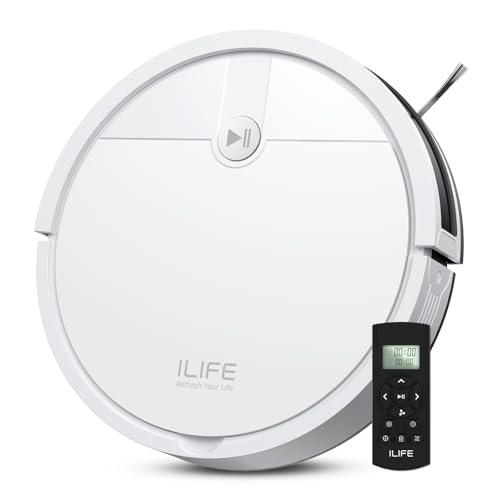
The ILIFE V2 is the purest answer to hair wrap in this entire guide: tangle-free suction. There is no main brush roll. The suction inlet draws hair and debris directly into the bin, so the scissors ritual is not reduced — it is abolished, because there is nothing cylindrical for hair to wind around. The listing adds the practical details: 120 minutes runtime, remote control, scheduling, a slim body, self-charging, in white, and positioned as ideal for pet hair — the exact use case where brushlessness pays.
Strengths
- Brushless tangle-free suction: zero main-brush hair wrap, by design
- Simple, proven platform with scheduling and remote control
- Slim body reaches under furniture that taller LiDAR robots cannot
Trade-offs
- No brush means weaker carpet agitation — deep carpet is not its home
- Basic navigation; no mapping smarts
- Suction figure not stated in the listing title — we report that honestly rather than guessing
Spec snapshot (from the verified listing): robot vacuum cleaner; tangle-free suction; 120 mins runtime; remote control; schedule; slim; self-charging; white.
Who should buy it: hard-floor homes — wood, tile, laminate, low rugs — with shedding pets or long hair, where the owner’s top priority is never touching the underside of a robot again. On hard floors, the brush you are giving up was doing little anyway; here, brushlessness is nearly free. There is also a noise and simplicity dividend worth naming: a brushless robot has one less rotating assembly to wear, rattle, or demand a replacement part two years in, and its underside can be wiped clean in seconds. For owners whose previous robot died of accumulated brush-compartment neglect, the V2’s emptiness underneath is not a missing feature — it is the feature.
Best for: hard floors and zero-maintenance purists / Not suited for: deep carpet, where a brush earns its keep
Check the current price on Amazon

6. ILIFE V2 Pro — Best Slim
The ILIFE V2 Pro refines the brushless formula: gyroscope navigation, a longer 150-minute runtime, tangle-free suction with self-charging, a 300ml dustbin, and a 2.99-inch slim design — the lowest profile in this guide. That height is the headline for real homes: standard robot bodies with LiDAR turrets often cannot pass under sofas and bed frames, and the V2 Pro’s sub-3-inch body cleans the dust-and-hair reservoirs everyone else drives around.
Strengths
- 2.99-inch profile reaches under low furniture other robots skip
- Tangle-free suction — the brushless zero-wrap design
- 150-minute runtime, the longest stated among our ILIFE picks
Trade-offs
- 300ml dustbin is small; pet homes will empty it often
- Gyroscope navigation, not LiDAR mapping
- Brushless limits deep-carpet performance, as with the V2
Spec snapshot (from the verified listing): robot vacuum cleaner; gyroscope navigation; 150-min runtime; tangle-free suction and self-charging; 2.99-in slim design; 300ml dustbin; for pet hair and hard floors.
Who should buy it: homes with low-clearance furniture and hard floors, where the dirtiest square footage hides under the sofa. Between the V2 and V2 Pro, choose the Pro for the runtime and the profile; choose the V2 for simplicity and its slightly larger platform history. A measuring homework assignment before ordering either: slide a book under your lowest sofa and bed frame and note the clearance honestly. If your lowest furniture sits at three inches, the V2 Pro is not a compromise pick at all — it is the only robot in this guide that will ever clean where your dog’s hair actually retires, and that fact outweighs every spec it concedes to the flagship models.
Best for: low furniture and hard floors / Not suited for: carpet-heavy homes or big-bin needs
Check the current price on Amazon
Comparison Table
| Pick | Badge | Key spec | Best for |
|---|---|---|---|
| roborock Q10 S5+ | Best Overall | 10,000Pa, dual anti-tangle, 70-day self-empty | Set-and-forget mixed homes |
| roborock Q7 M5+ | Best for Pet Hair | 10,000Pa, anti-tangle for pet hair & carpet, LiDAR | Carpeted pet homes |
| roborock Q7 L5 | Best Dock-Free Roborock | 8,000Pa, dual anti-tangle, LiDAR | Apartments, mid budgets |
| ILIFE V10 | Best Budget Anti-Tangle | 5000Pa, dual anti-tangle design | Budget brush-system buyers |
| ILIFE V2 | Best Brushless Design | Tangle-free suction inlet, no main brush | Hard floors, zero brush maintenance |
| ILIFE V2 Pro | Best Slim | 2.99-in body, tangle-free suction, 150 min | Low furniture, hard floors |
How to Choose a Tangle-Free Robot Vacuum
Decide your philosophy first, because it determines everything downstream. If your home has real carpet — medium pile or better, in rooms that matter — you need a brush for agitation, and your anti-tangle answer is a brush-system robot: the roborock dual anti-tangle line, or the ILIFE V10 at a budget. If your home is hard floors with rugs, the brush is mostly ceremonial, and brushless tangle-free suction (ILIFE V2 and V2 Pro) removes the hair problem at its root with no moving part to maintain. Mixed homes should weight by where the hair lands: hair on carpet argues brush system; hair on hard floors argues brushless.
Second, be honest about hair volume and type. A single short-haired cat is a light load that any pick here handles. Two large shedding dogs, or long human hair past shoulder length, is the heavy league — that is where self-empty docks stop being luxury, because the bin fills with hair fast, and where the Q7 M5+ and Q10 S5+ earn their tiers. Match the dock decision to your hair production, not your aspirations.
Third, navigation is the quiet divider. LiDAR robots (all three roborocks) map your home, clean in efficient rows, remember rooms, and support no-go zones — genuinely better in large or complex layouts. Gyroscope and random-navigation robots (the ILIFE picks) clean by pattern and persistence: they get there, eventually, and in small simple spaces the difference is minor. Buy navigation for your floor plan’s complexity, not for spec-sheet pride. A useful test: if you can describe your cleaning area as “three squarish rooms, few obstacles,” gyroscope navigation will satisfy you and the savings are real. If your description involves hallways, islands, chair-leg forests, and rooms you want cleaned on different schedules, LiDAR is not a luxury — it is the difference between a robot and a random guest.
Fourth, clearance. Measure the gap under your sofa and bed. If it is under about 3.2 inches, turret-topped LiDAR robots are locked out of the dirtiest territory in the house, and the V2 Pro’s 2.99-inch body becomes the smartest pick in the guide regardless of its simpler navigation. Spec sheets do not clean under sofas; profiles do.
Fifth, total maintenance honesty. Anti-tangle systems end the scissors ritual; they do not end maintenance. Filters need tapping and replacing, side brushes wear, mops need washing, docks need bags or emptying. The right expectation: these six robots reduce upkeep from a weekly chore to a monthly few minutes. Any listing promising a maintenance-free robot is selling you a story this guide will not repeat.
How to Set Up Your Anti-Tangle Robot for Hair Success
Setup decides whether the anti-tangle system gets a fair fight. First, do a manual deep clean before the robot’s first run — a robot maintains cleanliness, it does not excavate a month’s backlog, and a first run through heavy hair can overwhelm any system. Second, declutter the floor’s hair traps: charging cables, rug tassels, and shoelaces are the enemies of every robot, anti-tangle or not. Third, run the robot frequently — daily or every other day in shedding season. Anti-tangle systems handle steady hair flow gracefully; a week’s accumulation arriving at once is how even good systems get tested past their design. Fourth, place the dock on hard floor with clear approach space, and if you bought a self-empty model, calendar the bag or bin check monthly rather than waiting for the robot to complain. Fifth, keep the small habits: tap the filter weekly, glance at the brush ends monthly — on anti-tangle models this is a glance, not a surgery — and wipe the sensors when you empty the bin. Ten minutes a month is the real maintenance contract of this category, and it is a contract worth signing. The owners who keep that contract are the ones still praising their robots in year three. Compare it honestly with the conventional contract — scissors, a flipped robot, and a felted hair sleeve every week or two — and the reason this category exists stops being a marketing story and becomes a calendar: the anti-tangle robot gives you back small pieces of your month, every month, for years. That, more than any suction figure, is what the six picks above are selling.
How Anti-Tangle Systems Actually Work
Understanding the mechanisms helps you read listings skeptically, so here is the engineering in plain language. A conventional robot brush is a rotating cylinder with bristles and rubber fins. Hair picked up by the brush slides along the cylinder as it rotates — and because the cylinder’s ends are capped by bearings and housings, the hair collects, winds, and felts into a sleeve. Every anti-tangle design attacks one of the steps in that chain.
The first attack is geometry: brushes shaped or segmented so hair keeps migrating toward the ends instead of settling mid-roller, where end caps are designed to receive it without winding — the hair arrives loose in a chamber rather than tight on a shaft. The second attack is active removal: small blades or combs positioned at the brush that sever or strip hair as it accumulates, so wrap never builds past a few strands. Roborock’s dual anti-tangle approach, as its name suggests, defends at two points in the path — the main brush system and the side brush, which is the unsung second wrap site most owners discover a month in. When a listing says “dual,” that two-front defense is what it should mean, and it is why we weighted the roborock system highly for pet homes, where side brushes sweep hair constantly.
The third attack is deletion: ILIFE’s tangle-free suction removes the cylinder entirely. A suction inlet has edges and a filter, but nothing rotates and nothing winds. Hair goes from floor to bin in one airflow. The engineering cost is real — a brush also flicks debris out of carpet pile and grout lines, and suction alone persuades less — which is why the brushless design’s natural habitat is hard flooring, and why honest guides keep repeating that sentence.
A buyer’s translation: when a listing claims anti-tangle, look for which attack it is describing. A named system with a mechanism story (dual, comb, blade, channel) is a claim with content. A bare adjective — “anti-tangle brush!” with no system name and no design description — is a hope. All six picks in this guide carry the named, describable kind.
Know Your Hair: Matching the Robot to the Actual Enemy
Long human hair. The champion wrapper: lengths over eight inches wind into perfect sleeves on conventional brushes. Every pick here was chosen with this case in view. Heavy long-hair households (several long-haired people) should lean to the dock models, because the bin fills with hair faster than intuition suggests.
Short pet hair. Wraps less but infiltrates more — it works into filters and brush bearings. Anti-tangle brushes handle it easily; the maintenance story shifts to filter discipline. Any pick serves; buy by floor type.
Long pet hair and double coats. The volume case. Shedding season turns a robot into a hair logistics operation, and this is where self-empty docks and 10,000Pa-class suction stop being spec-sheet jewelry. The Q7 M5+ was picked for exactly this household.
Fine, flyaway hair on hard floors. The brushless case. Suction inlets inhale fine hair from smooth surfaces completely, and there is no brush to redistribute it. ILIFE V2 and V2 Pro territory — with the bonus that fine hair’s favorite hiding place, under low furniture, is the V2 Pro’s specialty.
Mixed hair plus grit. Homes near beaches, gardens, or workshops add sand and grit to the hair load. Brush systems with docks handle the volume best, and filters need the most attention here — grit is what actually wears a robot down over years.
The Self-Empty Dock Question, Priced in Honesty
Two of our picks carry docks rated in weeks — the Q10 S5+ at 70 days and the Q7 M5+ at up to 7-9 weeks — and the ratings deserve translation. Those figures assume average debris loads; a heavy-shedding household will fill a dock faster, because hair is bulky even when it is light. Treat the numbers as “many weeks, plausibly months for light homes” rather than calendar promises. What a dock really buys is the removal of the most frequent touch in robot ownership, and it buys it at three costs: the purchase premium, the floor space of a small tower, and, on bagged systems, an ongoing bag cost that bagless docks avoid. Our dock-free picks — the Q7 L5 and all three ILIFE models — are not lesser robots for lacking towers; they are robots whose owners accepted a weekly bin ritual in exchange for money and space. Neither choice is the smart one universally. The honest question is how many minutes a month your household will actually spend emptying a small bin without resentment — answer that truthfully and the dock decision makes itself.
Troubleshooting Anti-Tangle Robots
Problem: hair is still collecting at the brush ends. On brush-system models, some end accumulation is the design working — the system channels hair to the ends for easy removal. Pull it off at the monthly check; if it is winding tightly mid-brush instead, check for a damaged comb or blade element and clean the brush housing channel.
Problem: the robot leaves hair lines along carpet edges. That is the side brush flicking hair faster than the inlet can take it, usually at full speed on deep pile. Slow the robot’s pace in the app if supported, run the room twice, and check that the side brush is not splayed with age — it is a wear part.
Problem: suction seems weaker after a month. Almost always the filter, loaded with the fine fraction of pet hair and dander. Tap it out; if performance does not return, replace it. Hair households consume filters faster than the generic schedule in the manual.
Problem: brushless model struggles on a new rug. You have found the brushless boundary — pile too deep for suction alone. Move that rug’s deep cleaning to a weekly pass with an upright, and let the robot maintain the rest. Or accept it as the signal to switch that room’s robot to a brush-system model.
Problem: the dock is not emptying fully. Hair mats can bridge in the bin outlet, especially long hair. Clear the bin’s exit port manually once, then shorten your run interval — smaller, more frequent loads empty cleaner than one packed bin.
What We Excluded, and Why
Our verified cache held several excellent robot vacuums that this guide deliberately left out, and the reasons define the guide’s integrity. Premium robots from Shark and iRobot appeared in our verification pool with strong suction and navigation — but their listings in our pass did not carry an explicit anti-tangle system claim for the main brush, and this search’s promise is anti-tangle, so they were excluded rather than assumed. One self-emptying eufy model with hair-detangling technology was excluded because the verified listing is a Renewed (refurbished) unit, and this guide recommends new products unless a renewed status can be presented with full clarity at every mention — simpler to exclude. A Lefant model with strong pet-hair positioning lacked a named anti-tangle system in its listing. The pattern is the point: this is a mechanism guide, not a brand pageant, and six robots whose listings actually claim and describe anti-tangle engineering beat ten robots where the claim would be our invention.
Common Buying Mistakes
Assuming every robot brush is anti-tangle. Most are not. If the listing does not name an anti-tangle system or a tangle-free suction design, assume a conventional brush and a future with scissors.
Buying brushless for deep carpet. Tangle-free suction is brilliant on hard floors and weak at carpet agitation. Match the philosophy to your floors, not to your hatred of brush cleaning.
Chasing pascal numbers across brands. Suction figures are maker-stated and not standardized. Compare within a brand; across brands, weigh navigation, brush system, and dock instead.
Ignoring body height. A robot that cannot fit under your sofa cannot clean under it. Measure the clearance; the V2 Pro exists because 2.99 inches matters.
Skipping runs in shedding season. Hair systems are designed for flow, not floods. Frequent short runs beat weekly marathons for anti-tangle health.
Forgetting the rest of the maintenance. Filters, side brushes, and mop pads still exist. Anti-tangle removes the worst chore, not every chore.
Runtime, Bin Size, and the Arithmetic of Hair
Specifications interact in hair-heavy homes in ways spec sheets never explain, so here is the arithmetic. Runtime figures in this guide — 120 minutes for the ILIFE V2 and V10, 150 for the V2 Pro — describe how long the robot can run, not how much it can hold. Hair is bulky: a shedding dog can fill a small dustbin with visually impressive, featherweight hair in a single run, long before the battery is tired. That is why bin capacity and dock capacity outrank runtime for pet households, and why the V2 Pro’s 300ml bin is its honest limitation despite its excellent runtime. Conversely, in a low-hair apartment, runtime and navigation rule, because the bin never becomes the constraint.
Coverage follows from the same math. A LiDAR robot cleans a large home methodically in one outing and returns to exactly where it left off after recharging; a gyroscope robot covers by persistence and may need the run repeated in complex layouts. Neither is a defect — they are different contracts. What hair changes is the emptying cadence layered on top: plan your ownership around the hair your household actually produces, measured in bins per week, and the right model from this guide usually selects itself. The owners who end up disappointed with anti-tangle robots are rarely disappointed in the brush; they are disappointed that nobody told them the bin, the filter, and the dock were part of the same system.
Final Recommendation
Most homes should buy the roborock Q10 S5+: dual anti-tangle, a 70-day dock, and the strongest all-round spec here. Carpeted pet homes can save a step with the Q7 M5+, and apartment buyers with the dock-free Q7 L5. On a budget, the ILIFE V10 keeps the brush-system faith cheaply, while hard-floor homes should seriously consider going brushless with the ILIFE V2 or the slimmer V2 Pro. Keep reading in this cluster: Best Robot Vacuums For Dog Hair, Best Robot Vacuums For Bare Floors, Best Robot Vacuums Under $300, and Best Shark Robot Vacuums.
Frequently Asked Questions
Do anti-tangle brushes really eliminate hair wrap?
They reduce it dramatically — hair is combed, cut, or channeled away instead of winding into a solid sleeve. “Eliminate” is too strong a word for any brush system; expect a monthly glance rather than a weekly cutting session. Only the brushless tangle-free suction designs truly have nothing to wrap.
Is a brushless robot vacuum worse for carpet?
For surface debris on low carpet, it performs respectably. For deep-cleaning medium or plush carpet, a brush’s agitation matters and brushless models cannot match it. That is why our guide splits by floor type instead of crowning one philosophy for everyone.
How often do I still need to maintain an anti-tangle robot?
Roughly monthly minutes: empty the bin (or check the dock bag), tap or replace the filter, glance at the brush ends and side brush, wash mop pads if equipped. Compare that with the conventional ritual of cutting hair off a brush every week or two, and the category’s value is obvious.
What does Pa mean in robot vacuum listings?
Pascals measure suction pressure as stated by the manufacturer. Higher generally means stronger pickup within the same brand’s lineup, but there is no cross-brand laboratory standard, so treat the figures as orientation rather than verdicts — and weigh brush design and navigation alongside them.
Can these robots handle long human hair as well as pet hair?
Yes — long human hair is actually the classic wrap case, because its length winds beautifully around conventional brushes. Anti-tangle systems and brushless inlets were designed against exactly this enemy. Households with long hair and no pets are first-class citizens of this guide.
Will an anti-tangle robot damage delicate rugs or tassels?
Any robot can catch a tassel or a loose fringe, anti-tangle or not — the mechanism protects the brush from hair, not the rug from the robot. Keep fringe and tassels out of the cleaning area, use no-go zones on mapping models, and lift delicate rugs for robot runs. This is a floor-prep rule for the whole category.
How long do anti-tangle brushes last before replacement?
Brush rolls are wear parts on every robot; expect to inspect them at the monthly check and replace on the maker’s schedule or when bristles and fins visibly deform. The anti-tangle advantage is not that the brush lasts forever — it is that its life is spent cleaning instead of wearing a hair sleeve. Brushless models skip this consumable entirely, one more point in their maintenance column.
Are anti-tangle robots good for allergy households?
They help indirectly: a robot you actually run daily — because maintenance no longer punishes you — keeps hair and its dander load from accumulating in the first place. The dock models help further by sealing collected debris away between runs. But a robot vacuum is a cleaning appliance, not a medical device, and no pick here should be bought as a health treatment; buy it because frequent, low-effort cleaning is genuinely useful housekeeping.
Do I need a self-empty dock?
Only if your hair volume fills a bin quickly or you know you will not empty it. Heavy-shedding homes gain the most; a single person in a hard-floor apartment may find a dock-free model like the Q7 L5 or the ILIFE picks perfectly sufficient. It is a convenience tier, not a cleaning-quality tier.


