Disclosure: airfryerkitchensupply.com is reader-supported. When you buy through links on our site, we may earn an affiliate commission at no extra cost to you.
Where to buy
Nursery chairs are bought tired, often at the end of a long day of registry decisions, and “small” is the word that matters most in this search: the chair has to fit a compact nursery and still rock, glide or recline through months of night feeds. Where a listing states a certification, we name it precisely and explain what it actually certifies; where a listing does not state dimensions, we do not invent them — measure your room and check the product page figures before ordering.
Korser Recliner Chair 360 Swivel Rocker (Small, for Small Spaces) — Check the current price on Amazon
Korser Recliner Chair Swivel Rocking (Chenille, Beige) — Small Nursery Chair Recliner — Check the current price on Amazon
Davinci Juno Swivel Glider (Vanilla) — Check the current price on Amazon
Storkcraft Premium Hoop Glider & Ottoman (Natural/Beige) — Check the current price on Amazon
Angel Line Elsa Upholstered Swivel Glider with Bonus Storage Ottoman (Cream) — Check the current price on Amazon
CANMOV Swivel Rocker Recliner Chair / Nursery Glider Chair (White) — Check the current price on Amazon
The best small nursery chairs earn their place twice: once in the floor plan, where every inch is already promised to a crib, a dresser and a changing setup, and once at 3 a.m., where the chair either supports a feeding parent comfortably or becomes an expensive laundry stand. Small nurseries punish standard recliners, which is why this guide focuses on chairs whose listings position them for small spaces or compact nursery use — swivel rockers and gliders with modest footprints rather than oversized living-room recliners that happen to rock.
The six verified picks split into two families. Three are compact swivel rocker recliners — the Korser small-space models and the CANMOV — that recline for contact naps and double as living-room seating later. Three are classic nursery gliders — the Davinci Juno, the Storkcraft Hoop with ottoman, and the Angel Line Elsa with storage ottoman — built around smooth gliding motion, which many parents prefer to rocking for soothing a baby without jarring starts.
A safety framing that applies to every pick: a nursery chair is adult furniture for feeding and holding a baby while you are awake and seated. It is not a sleep surface for a baby, and no chair makes unsupervised or sleeping-while-holding safe. Buy the chair for your comfort during feeds; follow safe-sleep guidance for everything else.
In this guide
Quick Picks
Short on floor space above all? Start with the two Korser models explicitly listed for small spaces. Prefer gliding over reclining? The Davinci, Storkcraft and Angel Line are your three. Want a recliner that later moves to the living room? Korser or CANMOV.
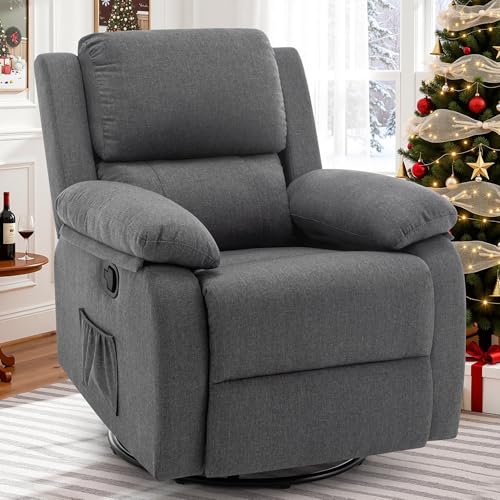
Korser Recliner Chair 360 Swivel Rocker (Small, for Small Spaces) — Best Overall for Small Spaces
A 360° swivel rocker recliner whose listing leads with small-space positioning — glide, swivel and recline in a footprint meant for compact rooms.

Korser Recliner Chair Swivel Rocking (Chenille, Beige) — Small Nursery Chair Recliner — Best for Small Nurseries in Chenille
A swivel rocking recliner whose listing names it a small nursery chair outright, in beige chenille with modern-designed armrests.

Davinci Juno Swivel Glider (Vanilla) — Best Certified Glider
A dedicated nursery glider with GREENGUARD Gold, FSC and CertiPUR-US certifications stated in its listing, a 360° swivel and a metal base.

Storkcraft Premium Hoop Glider & Ottoman (Natural/Beige) — Best Classic Glider and Ottoman
The traditional hoop-base glider with a matching ottoman, solid wood craftsmanship and GREENGUARD Gold certification per its listing.

Angel Line Elsa Upholstered Swivel Glider with Bonus Storage Ottoman (Cream) — Best Storage Ottoman Bundle
An upholstered swivel glider with a bonus storage ottoman — the ottoman hides the burp cloths, spare blankets and 3 a.m. supplies.

CANMOV Swivel Rocker Recliner Chair / Nursery Glider Chair (White) — Best White Recliner Option
A manual swivel rocker recliner positioned as a nursery glider chair, in white — swivel, rock and recline for rooms planned around a bright palette.
How These Picks Were Chosen
Verification used the standard method: Amazon listing data search, title match, ASIN from the listing response. All six picks are complete chairs — no slipcovers, replacement cushions or ottoman-only listings, several of which surfaced in the same searches. Each pick’s listing positions it for nursery use, small spaces, or both; two Korser models state “small” positioning in their titles outright, which is why they lead the guide.
Certifications are stated exactly as the listings give them, because this category attracts vague green language. GREENGUARD Gold — claimed by the Davinci Juno and the Storkcraft — certifies low chemical emissions from the product; it is not an organic certification. CertiPUR-US, also on the Juno listing, certifies the foam’s content and emissions standards. FSC on the same listing concerns certified wood sourcing. We repeat each claim only where the title makes it and explain it in those terms.
We excluded the larger power recliners and massage models that appeared in the same cache results: a chair with heating, massage and a wide power frame is a fine living-room recliner, but it fails this search’s first word — small.
The 6 Best Small Nursery Chairs
Korser Recliner Chair 360 Swivel Rocker (Small, for Small Spaces) — Best Overall for Small Spaces
This Korser leads the guide because its listing says the quiet part out loud: it is a small rocking recliner designed for small spaces. In a compact nursery, the 360° swivel is not a luxury — it is how you reach the side table, the door and the crib without standing up while holding a baby, and it lets a chair wedged into a corner still function. The recline adds the second shift of the chair’s life: upright for feeds, leaned back for the long contact-nap holds, then years of ordinary living-room service after the nursery phase ends.
As a manual recliner, it skips motors, cords and remotes — fewer things to fail, and nothing to plug in within a baby’s future crawling range. The honest limits are the generic ones for value-tier recliners: fabric upholstery will need spot-cleaning discipline with milk involved, and the listing title does not state dimensions, so verify the product-page measurements against your floor plan before ordering. For the small-nursery brief as stated, it is the most direct answer here.
Strengths
- Listing explicitly positions it for small spaces
- Swivel, rock and recline in one compact chair
- Manual mechanism — no cords or motors
Trade-offs
- Dimensions not stated in the verified title — check the product page
- Fabric upholstery needs prompt spot-cleaning
- Value-tier build versus premium glider brands
| Detail (from the verified listing title) | Value |
|---|---|
| Motion | 360° swivel, rocking, reclining (per listing title) |
| Positioning | “Small Rocking Recliner for Small Spaces” |
| Upholstery | Fabric |
| Type | Manual recliner |
Best for: compact nurseries needing one chair that does everything / Not suited for: buyers who want a traditional glide-only motion
Korser Recliner Chair Swivel Rocking (Chenille, Beige) — Small Nursery Chair Recliner — Best for Small Nurseries in Chenille
If the first Korser is the small-space generalist, this one is the nursery-specific sibling: its listing title calls it a small nursery chair recliner directly. The chenille upholstery is the tactile difference — chenille has a soft, slightly textured hand that reads warmer and more “nursery” than flat woven fabric, and in beige it disappears politely into the neutral palettes most small nurseries use to feel bigger. Swivel, rocking and reclining are all present, so the functional story matches the lead pick.
Two Korser models in one guide is deliberate, not lazy: they are distinct listings with distinct positioning — one for small spaces generally, one for small nurseries specifically — and small-room shoppers benefit from the closer comparison. Chenille’s trade-off is care: its pile can crush and shade with heavy use, and it wants gentler cleaning than performance fabrics. If your nursery plan already leans beige and soft, this is the version tuned for it.
Strengths
- Listing names it a small nursery chair
- Chenille feels soft and suits neutral nurseries
- Full swivel-rock-recline motion set
Trade-offs
- Chenille pile can crush and needs gentle care
- Beige shows milk and mess more than dark colors
- Same value-tier caveats as its sibling
| Detail (from the verified listing title) | Value |
|---|---|
| Motion | Swivel, rocking, reclining (per listing title) |
| Positioning | “Small Nursery Chair Recliner” |
| Upholstery | Chenille, beige |
| Details named in title | Modern-designed armrests |
Best for: beige, soft-textured nursery schemes in small rooms / Not suited for: households wanting the most stain-forgiving fabric
Davinci Juno Swivel Glider (Vanilla) — Best Certified Glider
The Juno is the pick for parents who read certification lines, and its listing gives them real ones to read. GREENGUARD Gold means the chair has been tested for low chemical emissions — relevant in a small, closed nursery where a baby breathes for hours; it does not mean the chair is organic, and we will not blur that line. CertiPUR-US certifies the foam inside. FSC concerns the wood sourcing. Together they make this the most credentialed listing in the guide, from a brand (DaVinci) that builds nursery furniture specifically rather than adapting living-room chairs.
Functionally it is a glider, not a recliner: the smooth forward-back glide soothes without the tipping sensation of rocking, the swivel handles reach, and the metal base keeps the mechanism compact and stable. The trade is the recline you give up — if long reclined holds are your plan, the Korser models serve better. If a calm glide, a compact swivel base and verified low-emission credentials top your list, the Juno is the specialist’s choice.
Strengths
- GREENGUARD Gold low-emissions certification per listing
- Dedicated nursery brand and glider design
- Metal base keeps footprint tidy and stable
Trade-offs
- Glides and swivels but does not recline
- Vanilla upholstery shows nursery messes
- Certification-tier pricing (check price on Amazon)
| Detail (from the verified listing title) | Value |
|---|---|
| Motion | Glide with 360° swivel (per listing title) |
| Certifications per title | GREENGUARD Gold; FSC; CertiPUR-US foam |
| Base | Metal |
| Color in verified listing | Vanilla |
Best for: parents prioritizing low-emission certified materials / Not suited for: parents who want to recline for long holds
Storkcraft Premium Hoop Glider & Ottoman (Natural/Beige) — Best Classic Glider and Ottoman
The hoop glider is the design most people picture when they hear “nursery chair,” and the Storkcraft Premium Hoop is its certified, solid-wood representative here. The matching ottoman matters more than newcomers expect: during long feeds, feet up changes your posture completely, and a gliding ottoman keeps the motion synchronized instead of planting your feet on a static block while the chair moves. The listing states GREENGUARD Gold certification — low chemical emissions, stated exactly — and solid wood craftsmanship in the frame.
The footprint question deserves honesty: a chair plus ottoman takes more floor than a compact recliner, ottoman included in the plan or it becomes an obstacle. In a truly tiny nursery, measure for both pieces or choose a swivel recliner instead. The natural/beige palette suits the classic nursery look, and the hoop base’s glide is gentle and quiet. For traditionalists with the floor space for the ottoman, this is the heritage pick.
Strengths
- Matching gliding ottoman transforms long feeds
- GREENGUARD Gold certification per listing
- Solid wood frame in a classic design
Trade-offs
- Ottoman adds real footprint in small rooms
- No swivel or recline
- Traditional styling may not suit modern nurseries
| Detail (from the verified listing title) | Value |
|---|---|
| Motion | Glide (chair and ottoman set) |
| Certification per title | GREENGUARD Gold |
| Construction | Solid wood craftsmanship |
| Extras | Matching ottoman; storage mentioned in title |
| Colors in verified listing | Natural/Beige |
Best for: classic nurseries with room for chair plus ottoman / Not suited for: the very smallest nurseries counting every inch
Angel Line Elsa Upholstered Swivel Glider with Bonus Storage Ottoman (Cream) — Best Storage Ottoman Bundle
The Elsa’s distinguishing idea is storage exactly where you need it. A nursery chair accumulates a small economy of objects — burp cloths, a water bottle, nipple cream, a phone charger, the spare pacifier — and in a small nursery there is no side table to spare. A storage ottoman swallows that clutter at your feet while still doing the ottoman’s main job during feeds. The chair itself glides and swivels 360° on a metal base, the compact, stable arrangement that suits tight rooms.
Cream upholstery is the honest caveat: it is the prettiest and the least forgiving color in a room defined by milk. If your household discipline runs to immediate spot-cleaning, enjoy it; if not, the darker Korser fabric may age more gracefully in your home. As a bundle — glider, swivel, storage ottoman — the Elsa answers the small-nursery brief with organization rather than just dimensions, which is a genuinely different and useful angle.
Strengths
- Storage ottoman solves small-nursery clutter
- Glide plus 360° swivel on a compact metal base
- Bundle value in a single purchase
Trade-offs
- Cream fabric is high-maintenance with babies
- Ottoman still adds footprint
- No recline function
| Detail (from the verified listing title) | Value |
|---|---|
| Motion | Glide with 360° swivel (per listing title) |
| Base | Metal |
| Extras | Bonus storage ottoman |
| Color in verified listing | Cream |
Best for: small nurseries with no room for a side table / Not suited for: mess-prone households wanting dark upholstery
CANMOV Swivel Rocker Recliner Chair / Nursery Glider Chair (White) — Best White Recliner Option
The CANMOV covers the shopper the beige and gray picks leave behind: the nursery planned in white. Its listing positions it as a nursery glider chair while the mechanism is a manual swivel rocker recliner — so you get the recline the pure gliders lack, plus swivel for reach and rocking for soothing, in the bright colorway that small rooms often use to feel larger. Manual operation keeps it cord-free and simple.
White upholstery in a nursery is a decision to make with open eyes: it will record every spill until your cleaning routine proves otherwise, and this guide will not pretend otherwise. What you get in exchange is the recliner feature set in the color the other recliner picks do not offer. If your room plan is white and bright and you accept the upkeep, the CANMOV is the only pick here that completes the picture.
Strengths
- Recline plus swivel plus rock in one chair
- White colorway suits bright, small-room palettes
- Manual mechanism — nothing to plug in
Trade-offs
- White is the least forgiving nursery color
- Fewer listing details stated than premium brands
- No ottoman included
| Detail (from the verified listing title) | Value |
|---|---|
| Motion | Swivel, rocking, reclining (per listing title) |
| Type | Manual reclining chair |
| Positioning | Nursery glider chair |
| Color in verified listing | White |
Best for: white-themed nurseries wanting a recliner / Not suited for: anyone who dreads visible stains
Comparison Table
| Pick | Badge | Key spec | Best for |
|---|---|---|---|
| Korser Recliner Chair 360 Swivel Rocker (Small, for Small Spaces) | Best Overall for Small Spaces | 360° swivel rocker recliner, small-space design | compact nurseries needing one chair that does everything |
| Korser Recliner Chair Swivel Rocking (Chenille, Beige) — Small Nursery Chair Recliner | Best for Small Nurseries in Chenille | Small nursery recliner, chenille beige | beige, soft-textured nursery schemes in small rooms |
| Davinci Juno Swivel Glider (Vanilla) | Best Certified Glider | GREENGUARD Gold certified glider, metal base | parents prioritizing low-emission certified materials |
| Storkcraft Premium Hoop Glider & Ottoman (Natural/Beige) | Best Classic Glider and Ottoman | Hoop glider + ottoman, GREENGUARD Gold | classic nurseries with room for chair plus ottoman |
| Angel Line Elsa Upholstered Swivel Glider with Bonus Storage Ottoman (Cream) | Best Storage Ottoman Bundle | Swivel glider + storage ottoman | small nurseries with no room for a side table |
| CANMOV Swivel Rocker Recliner Chair / Nursery Glider Chair (White) | Best White Recliner Option | Manual swivel rocker recliner, white | white-themed nurseries wanting a recliner |
How to Choose the Best Small Nursery Chairs
Measure before you fall in love. The chair’s footprint is only the start: a recliner needs clearance behind it to recline and in front for the footrest; a glider needs its glide path; an ottoman needs its own square of floor. In a small nursery, lay painter’s tape on the floor in the chair’s full working outline — not its parked outline — and live with the tape for a day. More nursery chairs are returned over working clearance than over comfort.
Choose motion by soothing style. Gliding is smooth, linear and quiet — many babies settle best to it, and it is gentle on a recovering parent’s body. Rocking has more amplitude and a traditional feel. Reclining is about the parent: long holds, contact naps while you stay awake, and a second life as a reading chair. Swivel, present in most picks here, is the small-room superpower — it turns a corner placement into a functional one.
Then weigh upholstery like a realist. You will clean milk from this chair at 3 a.m. with one hand. Darker colors and textured weaves forgive; cream and white demand immediacy. Neither choice is wrong, but choose the one your actual household will maintain, because a stained chair in a small room is impossible to ignore.
Nursery Chair Safety and Honest Expectations
A nursery chair is for holding your baby while you are awake. The dangerous pattern is the exhausted parent falling asleep holding a baby in a recliner or glider — soft seating and sleep do not mix for infants. Use the chair for feeds and cuddles; when you feel yourself drifting, put the baby down on a flat, clear sleep surface on their back and rest yourself. No chair feature — recline angle, rocking, padding — changes that guidance, and any marketing implying a chair is a safe sleep spot for a baby should be ignored.
Check stability with your real body and a realistic load: sit, shift, lean to reach. A compact chair should feel planted, with no tippy arc at the end of the glide or rock. Keep the chair’s mechanism maintained — a glider that develops a squeak or a catch at month three will wake the baby it is meant to soothe, and most catches are a loose bolt away from fixed.
Certifications deserve one calm paragraph. GREENGUARD Gold, claimed by two picks here, tests products for low chemical emissions — a sensible thing to want in a small nursery. It does not mean organic, non-toxic in an absolute sense, or safer in any mechanical way. CertiPUR-US concerns foam standards; FSC concerns wood sourcing. Buy them for what they are, not for a halo.
How to Set Up a Small Nursery Chair Corner
In a small nursery, placement is half the product. A well-placed mid chair beats a premium chair wedged wrong.
- Tape the chair’s full working footprint — reclined or gliding — on the floor and confirm doors, drawers and the crib rail all clear it.
- Angle the chair toward the room, not flat against a wall, if it swivels: the angle gives you reach in both directions without moving the base.
- Put the things you need within seated arm’s reach: a small surface or storage ottoman for water, cloths and your phone, so you never twist while holding the baby.
- Check the light: you want a dim, warm light you can reach from the chair for night feeds that does not blast the baby awake.
- Sit in the chair and rehearse the motions — swivel to the crib side, recline, return upright — before the baby arrives, and tighten any assembly bolts after the first week of use.
- Add a washable throw over the upholstery’s splash zone; it is easier to launder a throw at 3 a.m. than to shampoo a chair.
Revisit the setup after the first fortnight. Real feeding patterns reveal reach problems no plan predicts, and in a small room, moving a chair six inches can fix a month of annoyance.
Common Buying Mistakes
Measuring the parked chair, not the working chair
Recliners grow backwards and forwards in use; gliders travel. If the tape test uses only the parked footprint, the first recline will hit the wall or the crib.
Falling asleep holding the baby in the chair
The most serious mistake on this list. Chairs are for awake holding; a sleeping baby belongs on a flat, clear surface on their back, every time.
Buying white or cream without a cleaning plan
Beautiful in photos, relentless in practice. If you choose light upholstery, commit to the throw cover and the spot-clean routine from day one.
Assuming GREENGUARD means organic
It certifies low chemical emissions — valuable, and different. Read certifications for exactly what they test.
Skipping the ottoman footprint
A glider-and-ottoman set is two pieces of furniture. In the smallest nurseries, a swivel recliner with no ottoman is often the truer “small” choice.
Final Recommendation
Start with the Korser small-space swivel rocker recliner if your room is genuinely tight — it is the pick whose listing is built around your constraint, with the chenille Korser as its nursery-styled sibling and the white CANMOV for bright palettes. If you prefer gliding to reclining, the Davinci Juno brings the strongest certification list, the Storkcraft Hoop brings the classic ottoman pairing, and the Angel Line Elsa turns its ottoman into storage.
Whichever chair you choose, tape its working footprint before it ships and plan the corner around one-handed, half-asleep use. In a small nursery, the right chair is the one that fits the room and the routine — in that order.
Related guides on this site: Best Nursery Chairs For Short Moms Best Locking Glider Chairs Best Looking Glider Chairs Best Chairs Ayla Swivel Glider Best Upholstered Swivel Glider Chairs With Prices Best Nursery Area Rugs
Key Takeaways
- Measure the working footprint — reclined, gliding, ottoman included — not the parked chair.
- Swivel is the small-room feature that makes corner placement work.
- GREENGUARD Gold certifies low chemical emissions; it does not mean organic.
- A nursery chair is for awake holding only — babies sleep on flat, clear surfaces on their backs.
- Choose upholstery color for the cleaning routine you will actually keep.
Fabric and Cleaning: Planning for Milk, Medicine and Midnight
Every nursery chair will be baptized in milk. The only choice is whether cleaning it is a two-minute wipe or a Saturday project, and that choice is made at purchase, in the upholstery. Performance-woven fabrics shed liquid briefly and spot-clean well; chenille and sherpa-style piles feel wonderful and hold spills in their texture; smooth weaves in dark colors are the pragmatist’s trifecta. The listings in this guide name their upholstery where the title states it — chenille on one Korser, fabric on others — and where a title is silent, treat cleanability as unverified and check the product page.
Build the cleaning system when you build the corner. A washable throw over the splash zone is the highest-value accessory in the nursery: it intercepts ninety percent of incidents and launders in minutes. Keep a small caddy — cloths, a gentle upholstery cleaner the fabric tolerates, a spare throw — within reach of the chair, because the parent holding a freshly fed baby cannot go hunting through cupboards one-handed.
Smell management is the long game. Milk worked into foam is forever; milk caught on a throw is a laundry cycle. Chairs with removable, washable covers — where offered — deserve a premium for exactly this reason, and any chair’s first month should include a fabric-protection decision made with the maker’s guidance, not a generic spray chosen at random.
Beyond the Nursery: The Second Life of a Small Chair
A nursery chair is a two-to-four-year assignment inside a piece of furniture that should last a decade, so its second life deserves a thought at purchase. This is where the two families in this guide diverge. The swivel rocker recliners — the Korsers and the CANMOV — walk straight into a living room, reading corner or bedroom and keep working; nothing about them announces their first career. If your budget is significant, that continuity is real value: one purchase, two rooms, ten years.
Classic gliders have a second life too, but a narrower one: they suit quiet corners, bedrooms and grandparents’ houses, and their nursery styling is more legible. The ottoman pairs — Storkcraft and Angel Line — redeploy as footstools anywhere, and the Angel Line’s storage ottoman may honestly out-serve the chair in its second act, swallowing blankets and remotes in a living room for years.
The practical advice: if the chair will migrate, choose its color for the destination room, not only the nursery. A beige recliner bought for a beige living room’s future is a smarter purchase than a nursery-perfect shade that clashes with everywhere it goes next. Small chairs get moved; plan the move at the checkout.
Which Chair for Which Nursery
Tightest rooms, full motion: the Korser small-space recliner. Soft beige nursery styling: the Korser chenille. Certified low-emission glide: the Davinci Juno. Classic glider with ottoman: the Storkcraft Hoop. Storage in place of a side table: the Angel Line Elsa. White palette with recline: the CANMOV.
Layout Patterns for Genuinely Small Nurseries
Three layout patterns cover most small nurseries, and the chair choice follows from the pattern. The corner pattern puts crib along one wall and the chair in the diagonal corner, angled into the room — the pattern where a swivel chair earns its price, because the angle plus swivel gives the seated parent command of the whole room from one planted base. The wall pattern lines everything along a single wall in long, narrow rooms; here a glider’s linear motion beats a recliner, whose backward travel the wall forbids. The alcove pattern uses a closet nook or bay as the feeding station; compact recliners fit alcoves beautifully, provided the recline clearance is measured into the room, not the nook.
In all three patterns, the chair’s working footprint — taped on the floor, per the setup guide — is the document that tells the truth. Small nurseries fail on paper-perfect plans that ignore a recliner’s backward arc or an ottoman’s square. The tape does not care about your optimism, which is its virtue.
Lighting and reach complete the pattern: the chair corner needs a dimmable warm light reachable from the seat, a surface or storage for the feeding kit, and a path to the door that a sleep-deprived parent can walk in the dark without meeting the ottoman. Design the 3 a.m. version of the room; the daylight version will take care of itself.
The Budget Question: Where a Nursery Chair Sits in the Whole Spend
A nursery budget has many claimants, and the chair competes with the crib, the mattress and the car seat — items where safety standards rightly command first money. The chair is a comfort purchase for the parent, and it should be budgeted as one: after the safety-critical items are funded properly, the chair deserves a serious share of what remains, because the parent will spend hundreds of hours in it during the exact months when their own rest is scarcest.
Within the chair budget, spend on the mechanism and the frame before the fabric story. A smooth, quiet glide or recline that survives years of daily cycles is the product; upholstery is its clothing. The picks here span value recliners to certified brand gliders, and the honest difference is mechanism refinement, materials credentials and expected lifespan — not the ability to rock a baby, which every pick possesses.
The second-life math from the earlier section belongs in the budget too: a recliner that serves a decade across two rooms costs less per year than a nursery-only chair replaced at the toddler stage. Run the per-year number, not the sticker number, and the mid-tier picks in this guide usually win the arithmetic.
Grandparents, Partners and the Second Sitter
Nursery chairs are usually bought for one body and used by several, and the mismatch causes real friction. A chair chosen for a shorter mother may strand a taller partner’s head above the backrest; a narrow recliner that hugs one sitter can exclude another entirely. If two adults will share night duty, both should sit-test the finalist — or, failing that, the household should favor the more generous, adjustable end of this guide: recliners with real back height and swivel bases that forgive different reach patterns.
Grandparents are the third sitter nobody plans for, and their needs are specific: a chair that is easy to exit matters more than any other feature, because rising from a deep, low recliner while holding a baby is a genuine physical task. Firmer seats, higher sitting positions and supportive arms — the parts of a chair you push against — deserve weight in any household where grandparents will hold feeds. Rocking and gliding should also be smooth at the start of the stroke; a jerky mechanism startles babies and sitters alike.
None of this requires buying the largest chair — the keyword here is small, and it stays in force. It requires choosing the small chair whose dimensions and mechanism serve the household’s actual roster of sitters, which is a tape-measure-and-conversation exercise, not a bigger budget.
Quietness: The Specification Nobody Lists and Everybody Needs
At 3 a.m., the most important specification of a nursery chair is one no listing in this guide states: how much noise it makes. A glider with a developing squeak, a recliner mechanism with a clunk at the end of its travel, a swivel base that grinds — each can undo twenty minutes of careful soothing in one sound. Since decibel and squeak data do not exist in listings, quietness must be managed by the buyer: choose mechanisms with fewer, simpler moving parts where possible (manual over motorized, glide over complex recline linkages), and maintain what you buy.
Maintenance is mostly one habit: re-tighten. Assembly bolts on nursery chairs work loose under thousands of rocking cycles, and the first symptom is usually sound — a click, a creak — weeks before anything feels loose. A five-minute bolt check monthly keeps a quiet chair quiet, and catching a loose glide bearing early is the difference between a wrench and a warranty claim.
Placement helps too: a chair on a rug is quieter than a chair on bare floor, where every mechanism sound couples into the boards. In a small nursery that rug needs its own planning — low pile, non-slip, sized to the chair’s footprint — but the acoustic dividend at 3 a.m. repays the effort nightly.
Fabric Colors and Nursery Light: A Small, Practical Aesthetic Guide
Small nurseries amplify every color decision, because there is no distance for a mistake to retreat into. The chair is usually the largest upholstered object in the room, which makes its color the room’s dominant textile note. The verified palette in this guide runs beige, vanilla, cream and white — the light register that makes small rooms feel larger — and the aesthetic advice is less about which light tone than about committing to one: a beige chair, cream bedding and white walls in slightly different temperatures can look accidental, while a disciplined two-tone scheme looks designed at any budget.
Light interacts with the choice practically as well as visually. North-facing and dim nurseries forgive darker fabrics less — they absorb what little light exists — while bright rooms bleach pale fabrics toward glare in photographs and in life. The middle path most small nurseries land on, a warm mid-beige like the Korser chenille, is popular precisely because it splits these failures.
Finally, plan the chair’s color against its second life from the earlier section: the living room it will join in three years has a palette too. A chair bought in the destination room’s family of colors is a chair that gets promoted instead of donated — the most sustainable and economical outcome available, and one decided entirely at this purchase.
Secondhand Nursery Chairs: What to Check Before You Save the Money
Nursery chairs have an active secondhand market, and a used glider from a good maker can be a rational buy — with a checklist, because chairs hide their wear in mechanisms. Sit and move first: glide or rock through the full stroke slowly and listen. Clicks, grinds and catches are bearing or linkage wear announcing itself, and they do not heal. Check the swivel for wobble under load; a base that rocks independently of the chair’s intended motion is a stability question, not a quirk.
Inspect the upholstery like a forensic accountant: nursery chairs carry milk history, and foam that has absorbed spills holds odor that surface cleaning cannot reach. Smell the cushions at close range in a warm room; your nose is the correct instrument and it does not lie. Ask about pets and smoking with the same directness — soft furnishings keep those records permanently.
Finally, price the risk honestly. A used chair at a third of retail with a smooth, silent mechanism and clean cushions is a genuine bargain. A used chair with a noisy glide and a cushion past is a new chair’s price paid in installments of annoyance. The models in this guide give you the reference points — motion types, certifications, constructions — to grade any used candidate against, which is most of what buying secondhand well requires.
A Final Fitting Note: The Two-Minute Showroom Test
If you can sit in a finalist before buying — in a store, at a friend’s house, anywhere — two minutes tells you most of what a specification sheet cannot. Sit down and check three things in order. First, your feet: they should rest flat or on an ottoman without your knees floating, because dangling legs tire a holding parent faster than any other fit flaw. Second, your head: the backrest should meet it when you lean back, since a chair that abandons your head abandons your neck by the second night feed. Third, the exit: stand up slowly, imagining a sleeping baby in your arms, and notice whether the chair helps or hinders. A chair that passes all three in two minutes will pass the hundred nights that follow; a chair that fails one will remind you nightly. Online buyers can run the same test during the return window — which is a good reason to keep the packaging until the verdict is in.
Frequently Asked Questions
What size chair fits a small nursery?
One whose full working footprint — including recline clearance or glide path and any ottoman — fits your taped floor plan with doors and drawers still opening. Listings here do not all state dimensions in their titles, so confirm the product-page measurements for your finalist before ordering.
Glider or rocker recliner for a nursery?
Gliders soothe with a smooth, quiet, linear motion and suit parents who dislike tipping sensations. Rocker recliners add recline for long holds and a second life as living-room seating. Small rooms often favor swivel models of either type.
What does GREENGUARD Gold mean on a nursery chair?
It means the product has been tested and certified for low chemical emissions. It is a meaningful indoor-air credential, especially in a small nursery — but it is not an organic certification and says nothing about mechanical safety.
Do I need an ottoman in a small nursery?
It transforms long feeds by supporting your legs, but it costs floor space. Storage ottomans, like the Angel Line Elsa’s, earn their footprint twice. If space is desperate, a recliner’s built-in footrest replaces the ottoman entirely.
Is it safe to sleep in the nursery chair with my baby?
No. Falling asleep holding a baby in a chair is a recognized risk. Feed and cuddle in the chair while awake; when sleep comes — for either of you — the baby goes onto a flat, clear sleep surface on their back.
When should I buy the nursery chair?
Early enough to assemble, air out and rehearse the setup before the baby arrives — and to re-tighten bolts after the first week of use. Last-minute assembly in an exhausted household is how chairs end up wobbly.


