Disclosure: airfryerkitchensupply.com is reader-supported. When you buy through links on our site, we may earn an affiliate commission at no extra cost to you.
Where to buy
The fastest way to buy any of the best small desktop air purifiers below is Amazon, where stock, colour and size options are widest and returns are straightforward if a pick does not suit your space. Linked picks go straight to the verified product page — check price on Amazon on the listing itself, because options and availability change often.
- Levoit Core Mini-P Small Air Purifier (Best Overall): check price on Amazon
- BLUEAIR Mini Max Air Purifier for Small Spaces (Best for Bedrooms and Dorms): check price on Amazon
- BLUEAIR Blue 511 Compact Air Purifier (Best Compact for a Home Office): check price on Amazon
- BLUEAIR Blue Pure 511i Max (Best Smart Features): check price on Amazon
- Medify MA-14 Air Purifier (Best Value Tabletop): check price on Amazon
- GermGuardian AC4100CA Compact HEPA Air Purifier (Best Compact Tower): check price on Amazon
Shopping for the best small desktop air purifiers starts with a confession the category rarely makes: a desktop purifier cleans a personal zone, not a house. Put one within arm’s reach of your desk or bed and filtered air genuinely changes how that zone feels — less dust settling on the screen, a fresher smell in a closed room, fewer of the particles that make a small space feel stuffy. Expect it to treat a whole open-plan floor and you will call it useless within a week. This guide is written inside that honest frame: comfort and air quality where you sit and sleep, with no medical claims attached.
The six picks below split into two honest groups. True desktop units — the Levoit Core Mini-P, the Medify MA-14 and the slim GermGuardian tower — live on the desk itself and serve the person at it. Compact small-room units from Blueair sit on a dresser or side table and handle a whole small bedroom or office. Both groups earn their place; choosing between them is a question of whether your problem is a desk corner or an entire small room.
Every linked pick was cross-checked against Amazon’s catalogue data for this site before it was included, and ioniser-only gadgets with no real filter were excluded on principle. Prices are not printed because they shift with filter-bundle options — check price on Amazon at the listing, and factor replacement filters into the tier you choose.
In this guide
Quick Picks
- Levoit Core Mini-P Small Air Purifier — Best Overall. A true desktop footprint with a proper filter stack and a fragrance sponge for light scent — the default small purifier for a desk or nightstand. — Check on Amazon
- BLUEAIR Mini Max Air Purifier for Small Spaces — Best for Bedrooms and Dorms. Blueair’s compact HEPASilent unit with an auto sensor and washable pre-filter — set it on a dresser and let it manage itself. — Check on Amazon
- BLUEAIR Blue 511 Compact Air Purifier — Best Compact for a Home Office. A step up in capacity while staying compact, AHAM Verified and Energy Star rated — for a home office that is a real room, not a corner. — Check on Amazon
- BLUEAIR Blue Pure 511i Max — Best Smart Features. The connected version of the compact Blueair formula: app control, auto mode, 360-degree intake and a very quiet night mode. — Check on Amazon
- Medify MA-14 Air Purifier — Best Value Tabletop. A straightforward tabletop HEPA box with honest small-space numbers — the value pick for a desk, nursery shelf or spare room. — Check on Amazon
- GermGuardian AC4100CA Compact HEPA Air Purifier — Best Compact Tower. An 11-inch tower-format purifier with HEPA filtration and a UV-C light stage, sized for a desk corner or bathroom counter zone. — Check on Amazon
How These Picks Were Chosen
Picks were chosen on filtration honesty first: a real, replaceable filter doing the work, with any extra stages — pre-filters, UV-C, electrostatic assist — clearly secondary. Ioniser-only desktop devices were cut, because at desktop distance you want filtration you can verify, not a technology you have to take on faith.
Size truth was the second filter. Each pick’s footprint was judged against real desks and nightstands, and its coverage class against real small rooms, with test-condition headline numbers treated as ceilings rather than promises. AHAM verification, where a pick carries it, counted in its favour because it means the room-size claim was measured by someone other than the seller.
Running cost and noise decided the final order. A desktop purifier runs for thousands of hours beside your head, so quiet low settings and washable pre-filters that extend main-filter life matter more than a dramatic turbo mode you will use twice. One category note: no pick here is presented as a health treatment — these are comfort and air-freshness appliances, and anyone managing a medical condition should follow their clinician’s advice on air cleaning.
The 6 Best Small Desktop Air Purifiers

Levoit Core Mini-P Small Air Purifier — Best Overall
Check the current price on Amazon
This is the pick for a single desk, dorm room or nightstand where the air right around you is what matters. It is genuinely small enough to live on a desktop without crowding a monitor, it runs a real filter rather than an ioniser-only trick, and the fragrance sponge lets you add a light scent if you like that. It suits students, home workers and anyone whose ‘room’ is really a corner of a room. Comfort and air-freshness framing only: a desktop unit freshens the air in your immediate area; it is not a medical device.
Strengths
- True desktop size that fits beside a monitor or on a nightstand
- Real replaceable filter for dust, pollen and pet dander in your near zone
- Fragrance sponge adds optional light scent without sprays
Trade-offs
- Covers a personal zone, not a whole large room
- Filter replacements are an ongoing cost to budget for
- Fragrance feature will not suit scent-sensitive users — simply leave the sponge empty
| Detail | What to know |
|---|---|
| Form factor | Compact desktop unit, Core Mini-P per Amazon listing |
| Targets | Smoke, allergens, pet dander, odour and dust per Amazon listing |
| Extras | Fragrance sponge and filter-cleaner reminder per Amazon listing |
Desktop purifiers succeed or fail on honesty about scale, and this one is honest: it is built to clean the air in the few feet around a desk or bed, and within that zone a real filter makes a visible difference to dust settling on screens and to how stale a small room feels by afternoon. Place it within arm’s reach, not across the room, and it does its job.
The fragrance sponge is a small, sensible extra for shared dorms and home offices that double as guest rooms. Used empty, the unit is simply a quiet filter box; used with a drop of scent, it freshens the near zone without aerosol sprays drifting over your keyboard and coffee.
Best for: students and home workers cleaning the air at one desk or nightstand / Not suited for: anyone expecting whole-house or large-room coverage from a desktop box

BLUEAIR Mini Max Air Purifier for Small Spaces — Best for Bedrooms and Dorms
Check the current price on Amazon
Choose the Mini Max if you want the purifier to make its own decisions: the auto sensor reads the air and adjusts, the washable pre-filter catches the coarse dust and pet hair that would otherwise shorten the main filter’s life, and the compact body sits happily on a dresser or wide shelf. It suits bedrooms and dorms where the unit will run for long, unattended stretches, and owners who prefer washing a pre-filter to buying replacements more often.
Strengths
- Auto sensor adjusts speed without daily attention
- Washable pre-filter reduces how fast the main filter loads up
- HEPASilent approach pairs filtration with low operating noise
Trade-offs
- Sized for small spaces — it will not rescue a big open-plan room
- Auto features add cost over a basic manual desktop unit
- Pre-filter still needs regular washing to stay effective
| Detail | What to know |
|---|---|
| Filtration | HEPASilent filtration per Amazon listing |
| Controls | Auto sensor mode per Amazon listing |
| Maintenance | Washable pre-filter per Amazon listing |
The washable pre-filter is the feature owners underrate at purchase and praise a year later. Desktop and dresser-top purifiers inhale the dustiest air in the room — the layer that settles on furniture — and a washable first stage keeps that load out of the expensive filter behind it. A monthly rinse is a fair trade for longer filter life.
HEPASilent filtration is Blueair’s hybrid approach, combining mechanical filtration with electrostatic charging to move air quietly. For a bedroom, that quietness is not a luxury: a purifier you turn off at night because it hums is a purifier that does nothing for the eight hours you breathe most steadily.
Best for: bedroom and dorm users who want automatic, quiet running / Not suited for: buyers who want the cheapest possible manual unit for a workshop desk

BLUEAIR Blue 511 Compact Air Purifier — Best Compact for a Home Office
Check the current price on Amazon
The Blue 511 is for the home office or bedroom that is a full small room rather than a desk corner. It stays compact enough for a side table or floor corner by the desk, carries AHAM verification for its room-size claims, and keeps the washable pre-filter and quiet HEPASilent running of the smaller Blueair. It suits remote workers who spend ten hours a day in one room and want that room’s air handled properly, within a comfort and freshness frame.
Strengths
- AHAM Verified room-size performance per Amazon listing
- Energy Star rated for all-day running
- Washable pre-filter plus quiet HEPASilent filtration
Trade-offs
- Larger than a true desktop unit — plan side-table or floor space
- Costs more than personal-zone mini purifiers
- Overkill for a single nightstand in a tiny room
| Detail | What to know |
|---|---|
| Coverage class | Small rooms, listed up to 907 ft² under test conditions per Amazon listing |
| Verification | AHAM Verified and Energy Star per Amazon listing |
| Noise character | Quiet operation, listed 24 dB low setting per Amazon listing |
Third-party verification is the dividing line in this category, and AHAM verification means the room-size claim was measured rather than invented. Treat headline coverage numbers carefully across all brands — they assume multiple air changes per hour under test conditions — but a verified number at least gives you a real basis for comparison.
In daily use the 511’s virtue is that it disappears: low noise on its working speeds, a pre-filter you wash rather than replace, and enough capacity that a closed office door does not defeat it by mid-afternoon. That invisibility is what long-term owners actually pay for.
Best for: home workers with a dedicated small office room / Not suited for: desk-corner users with no side surface to spare
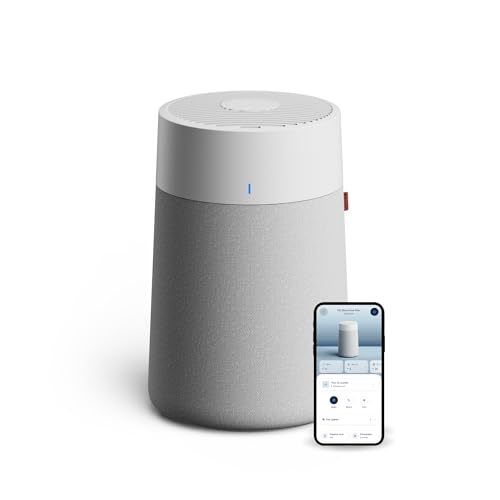
BLUEAIR Blue Pure 511i Max — Best Smart Features
Check the current price on Amazon
Pick the 511i Max if the purifier will live in a bedroom and be controlled from the bed or from another room: WiFi app control, an auto mode that reacts to air changes, and a night mode listed at a whisper level make it the set-and-forget option. The 360-degree intake also frees placement — it does not need its back to a wall gap the way single-direction units do. It suits connected-home households and light sleepers who still want filtration running overnight, framed strictly as comfort and air freshness.
Strengths
- WiFi app control and auto mode for hands-off running
- 360-degree intake makes placement flexible
- Very quiet night mode for bedroom use
Trade-offs
- Smart features raise the price over the manual 511
- App setup is one more account and connection to manage
- Capacity is still small-room class despite the ‘Max’ name
| Detail | What to know |
|---|---|
| Intake | 360-degree air intake per Amazon listing |
| Controls | WiFi app and auto mode per Amazon listing |
| Night mode | Listed 19 dB night mode per Amazon listing |
Placement freedom sounds minor until you live with a purifier: single-intake units lose performance pushed against a wall or tucked in a corner, which is exactly where small rooms force you to put them. A 360-degree intake keeps the 511i Max effective in the corner it will actually occupy.
The app is genuinely useful in one specific way — scheduling. Run the unit harder in the hour before bed or while you are out, then let night mode carry the quiet hours. That pattern gets more clean air through the room than a constant medium setting, without asking you to touch the unit daily.
Best for: bedrooms and connected homes wanting scheduled, quiet filtration / Not suited for: buyers who avoid apps and want two buttons and nothing else

Medify MA-14 Air Purifier — Best Value Tabletop
Check the current price on Amazon
The MA-14 is the no-drama option: a compact HEPA unit sized for small spaces, with filtration aimed at the usual household mix of smoke, odours, pollen and pet dander. It suits a nursery shelf, a spare-room desk or a first purifier for someone who wants to test whether filtered air improves how a small room feels before spending more. Keep expectations at the small-room scale and it delivers exactly what the class promises — fresher, less dusty air in its zone.
Strengths
- Compact tabletop size suits shelves and desks
- HEPA filtration for the standard household particle mix
- Simple operation without apps or accounts
Trade-offs
- Small-space capacity — not for open-plan areas
- Fewer automation features than the Blueair picks
- Replacement filters are a recurring cost, as with all HEPA units
| Detail | What to know |
|---|---|
| Coverage class | Listed 470 ft² per hour under test conditions per Amazon listing |
| Filtration | HEPA filter, removal to 0.3 microns per Amazon listing |
| Targets | Smoke, odours, pollen and pets per Amazon listing |
Value tabletop purifiers are where inflated claims usually live, so judge the MA-14 the way you should judge all of them: by filter type and by whether the stated coverage fits your room with margin. A small bedroom or office sits comfortably inside its class; a double-height living room does not, and no desktop unit at any price changes that.
Its simplicity is a feature for shared spaces — a nursery, a guest room, an elderly relative’s sitting room — where the user should be able to switch it on and trust it, without pairing a phone first.
Best for: first-time buyers and simple small-room setups / Not suited for: large rooms or users wanting app scheduling
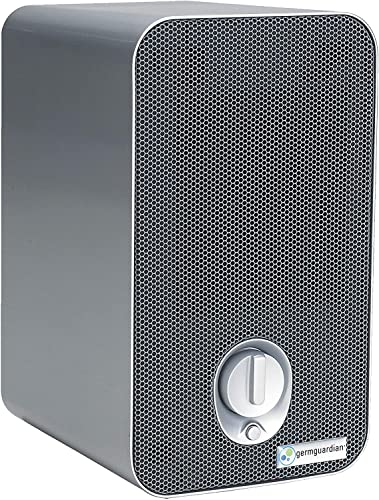
GermGuardian AC4100CA Compact HEPA Air Purifier — Best Compact Tower
Check the current price on Amazon
The GermGuardian’s tall, narrow 11-inch footprint is its argument: it stands where squat boxes cannot — between a monitor and a wall, on a crowded desk, beside a bathroom sink. The filter stack pairs HEPA filtration with a UV-C light stage, and the model is listed as zero-ozone verified, which matters for a unit that will run close to where you sit and breathe for hours. It suits crowded desks and small bathrooms where floor and surface space are both contested.
Strengths
- Slim 11-inch tower footprint fits tight desk corners
- HEPA filter plus UV-C light stage
- Zero ozone verified per Amazon listing — important for a near-zone unit
Trade-offs
- Tower format cleans a personal zone, not a whole floor
- UV-C bulb and filter are both consumables over time
- Small rooms only — listed coverage is modest and should be respected
| Detail | What to know |
|---|---|
| Height | 11 in tower format per Amazon listing |
| Filtration | HEPA filter with UV-C light stage per Amazon listing |
| Coverage class | Listed up to 375 sq ft in 1 hr under test conditions per Amazon listing |
Near-zone placement cuts both ways: a purifier beside your chair delivers its cleanest air to you, but any emissions from the device itself also reach you first. That is why the zero-ozone verification on this model matters more than it would on a unit across the room, and why ioniser-only desktop gadgets without such verification were excluded from this guide entirely.
The tower shape also suits rental desks and dorms where nothing can be wall-mounted and surface space is measured in centimetres. If your desk is already full, measure the gap you actually have — this is one of the few purifiers that fits a gap rather than demanding a clearing.
Best for: crowded desks and small bathrooms needing a slim footprint / Not suited for: anyone wanting to treat a whole open-plan living space
Comparison Table
| Pick | Badge | Key spec | Best for |
|---|---|---|---|
| Levoit Core Mini-P Small Air Purifier | Best Overall | Compact desktop filter unit with fragrance sponge | students and home workers cleaning the air at one desk or nightstand |
| BLUEAIR Mini Max Air Purifier for Small Spaces | Best for Bedrooms and Dorms | HEPASilent, auto sensor, washable pre-filter | bedroom and dorm users who want automatic, quiet running |
| BLUEAIR Blue 511 Compact Air Purifier | Best Compact for a Home Office | AHAM Verified compact, washable pre-filter | home workers with a dedicated small office room |
| BLUEAIR Blue Pure 511i Max | Best Smart Features | Smart compact, 360° intake, app control | bedrooms and connected homes wanting scheduled, quiet filtration |
| Medify MA-14 Air Purifier | Best Value Tabletop | Tabletop HEPA, small-space class | first-time buyers and simple small-room setups |
| GermGuardian AC4100CA Compact HEPA Air Purifier | Best Compact Tower | 11-inch tower, HEPA + UV-C, zero ozone verified | crowded desks and small bathrooms needing a slim footprint |
Short on time? Start with the Best Overall pick, then use the table to check whether a specialist badge matches your actual room, routine or household better before you check price on Amazon.
How to Choose the Best Small Desktop Air Purifiers
Decide your zone first. If the problem is the air at one desk or one side of a bed, a true desktop unit is enough and a bigger purifier is wasted money and surface. If the problem is a whole small bedroom or office — dust on every surface, a room that smells closed by morning — step up to the compact small-room class and place it on furniture, not the floor in a corner.
Then read coverage claims like an engineer. Headline figures assume several air changes per hour in a sealed test room; your real room has a door gap, soft furnishings and a window. A sensible rule is to choose a unit whose listed coverage comfortably exceeds your room’s size, so its quiet middle speeds — the ones you will actually tolerate all day — still move enough air.
Finally, price the filters, not just the box. Every HEPA-class unit here consumes replacement filters, and over three years the filters can cost more than the purifier. Washable pre-filters, filter-life indicators and widely stocked replacement filters are the features that decide whether a cheap purifier stays cheap.
Desktop vs Small-Room Purifiers: Which Class Do You Need?
Desktop units win on proximity: the cleanest air a purifier makes is the air nearest its outlet, and a unit on your desk delivers that air to your breathing zone before it mixes with the room. For a home worker in a shared house, that personal bubble is often all they wanted. Desktop units lose on total volume — they cannot keep a whole room’s dust down, and shelves across the room will still gather it.
Small-room compacts win on coverage and lose on footprint and price. They need a dresser, side table or a deliberate floor corner, and they cost more to buy and to feed with filters. The deciding question is simple: when you picture the problem, is it ‘my desk area feels dusty and stale’ or ‘this whole room does’? Answer that honestly and the class chooses itself.
Filters, Pre-Filters and What Actually Gets Removed
A HEPA-class filter captures the fine particles that dominate indoor dust: pollen, pet dander, mould spores and the fine fraction of household dust. Activated carbon stages, where fitted, work on odours and some gases — the stale cooking smell in a studio flat, for instance — but carbon saturates and needs replacing on schedule to keep working. Pre-filters catch hair and coarse dust and exist to protect the expensive stages behind them.
What no purifier in this class does is sterilise a room or substitute for ventilation. Opening a window still beats any box for carbon dioxide build-up, and source control — dusting, washing bedding, keeping a pet’s bed clean — multiplies what a small purifier can achieve. Treat the purifier as one layer in a cleaner-air routine, not the whole routine, and it will not disappoint you.
Placement and Noise: Getting Real Performance at a Desk
Place a desktop purifier within about a metre of where you sit or sleep, with its intake unobstructed — not behind a monitor, not inside a shelf cubby. Small units have modest airflow, and every obstacle between the intake and the room’s air costs performance you cannot spare at this size. On a nightstand, keep it below pillow height so the outlet air does not blow directly across your face all night.
Noise ratings are quoted at the lowest speed, which moves the least air. The useful question is how the middle speed sounds, because that is the speed that will run for eight hours. In practice, the hybrid-filtration Blueair models and the Levoit mini are designed around that middle-speed reality, while the cheapest boxes often achieve their quiet figure by barely moving air at all.
How to Set Up and Maintain a Small Desktop Air Purifier
A small purifier needs ten minutes of setup and two minutes a month to keep performing like it did on day one.
- Unpack the unit and remove the filter from its protective plastic bag inside the housing — the single most common setup mistake is running a new purifier with the filter still sealed.
- Place it on the desk or nightstand within about a metre of your chair or pillow, intake facing the room, with clear space around it.
- Run it on its highest speed for the first hour to clear the accumulated dust in the zone, then settle to the middle or auto setting for daily use.
- Vacuum or wash the pre-filter (if washable) every few weeks — a clogged pre-filter starves the main filter and raises noise.
- Wipe the exterior and intake grille monthly; desktop units inhale the dustiest air layer in the room.
- Replace the main filter on the indicator or schedule, and write the date on the new filter so the next change is never a guess.
If the air from the outlet starts to smell stale, the carbon stage or filter is saturated — that smell is the unit telling you the consumable is done, and no amount of external cleaning fixes it. Replace the filter and the smell goes with it.
Running Costs and Filter Economics Over Three Years
A desktop purifier’s purchase price is the down payment; filters are the mortgage. Before choosing a tier, add three years of replacement filters at your expected running hours to the box price of each candidate and compare those totals — the ranking of this guide’s picks changes less than you might fear, because the washable pre-filters on the Blueair models slow main-filter consumption, but the exercise routinely exposes bargain units whose filters cost flagship money.
Running hours are the lever you control. A unit on auto or scheduled modes — hard before bed, gentle overnight, off in an empty house — can halve filter consumption against a unit left on turbo around the clock, while delivering clean air at the moments the room is actually occupied. The smart pick in this guide exists largely to automate that pattern; the manual picks reward an owner who builds the habit.
Electricity is the smallest cost and still worth a line: compact purifiers draw modest power, and an Energy Star rated model like the Blue 511 keeps all-day running to a minor line in a household bill. The expensive purifier is never the one on the meter — it is the one whose filter you cannot find in stock when the indicator lights.
Desktop Purifiers in Shared and Sensitive Spaces
Shared offices and dorms add a social dimension: a purifier is also a noise source and an air-movement source in someone else’s space. The courteous pattern is the quiet middle speed, placement that does not blow across a neighbour’s desk, and fragrance features — like the Levoit pick’s sponge — left empty unless the room’s other occupants have agreed. Air you have cleaned is a gift; scent you have chosen for everyone is an imposition.
For nurseries and the rooms of elderly relatives, simplicity outranks features: a unit with one obvious control, no app pairing, and a filter that a visiting family member can change without instructions. The Medify and GermGuardian picks fit that brief. In those rooms, also secure the unit against curious hands — stable placement, cable tidied, intake out of reach of small fingers exploring.
A final shared-space note: a purifier is not a substitute for dealing with a pollution source. A smoky room, a mouldy corner or a litter tray in the corner needs the source addressed; the purifier then maintains the improvement. Used as the second step rather than the only step, these small units perform noticeably better — and so does the room.
Buying Scenarios: Dorm, Home Office, Bedroom and Nursery
The dorm room is a personal-zone problem in a shared space: one desk, one bed, air that belongs to two people. The Levoit Core Mini-P fits it exactly — small, quiet, cheap to feed with filters on a student budget, and courteous to a roommate on its middle speeds. The fragrance sponge stays empty unless both occupants agree; dorm harmony outranks scent.
The full-time home office is a whole-room problem wearing a desk’s clothes: eight to ten hours of occupancy, a door that closes, dust that settles on equipment daily. That is Blue 511 or 511i Max territory, placed on a side surface, scheduled around working hours. Buying a mini for this room is the category’s most common false economy — it will run at maximum, loudly, and still lose to the room’s volume.
The bedroom and nursery reward quiet and automation over capacity: the Mini Max’s auto sensor and washable pre-filter suit a room where the purifier must manage itself at 3 a.m. without waking anyone. In every scenario the pattern repeats — zone first, class second, model third — and buyers who follow it rarely return a purifier.
What to Check on the Listing Before You Buy a Desktop Purifier
Filter type, stated plainly: a named HEPA-class filter with replaceable cartridges you can actually find for sale. Search the replacement filter’s availability before buying the unit — a purifier whose filters are out of stock everywhere is already obsolete. Second, the coverage basis: an AHAM-verified figure outranks an unqualified headline number every time, and both should be compared against your room with margin.
Third, noise at the speed you will use, not the minimum: look for figures at medium settings in reviews and specifications, because that is the eight-hour reality. Fourth, dimensions against your actual desk gap, measured, not imagined — the GermGuardian’s slim tower exists because this check fails so often. Fifth, the control style you will genuinely use: app, auto sensor or one honest dial.
A purifier that passes those five checks, in the right class for your zone, is very unlikely to disappoint. The disappointments in this category are almost never bad machines — they are good machines bought for the wrong room at the wrong scale.
Living With a Desktop Purifier: The First Month, Honestly
The first change owners notice is not in the air but on the surfaces: a desk that needed dusting every second day stretches to twice a week, and a monitor screen stays readable longer between wipes. That visible dust reduction is the honest, measurable promise of a personal-zone purifier — the particles it captures were previously landing on your desk and, some of them, in your breathing zone on the way down.
The second change is olfactory and subtler: a small closed room that used to smell stale by mid-afternoon — the accumulated signature of occupancy, cooking drift and a pet’s bed — simply smells like less. Not fragranced, not clinical, just less present. Owners consistently describe this as the benefit they would not give back, and it is why the guide frames these machines as comfort appliances: the improvement is in how a room feels to live in, stated no more grandly than that.
The third lesson is about the owner’s own behaviour. A purifier with an auto mode or a schedule gets forgotten, which is praise; a purifier that needs daily decisions gets switched off during a busy week and never switched back on. This is why automation features, dismissed as gadgets in the showroom, dominate the one-month reviews — and why the buying guide ranks your likely habits alongside the hardware. The best purifier is the one still running in month six.
By the end of the month the filter question arrives for the first time — a pre-filter to rinse, a reminder light, the first look at replacement prices — and owners who did the three-year arithmetic at purchase feel smug while others feel ambushed. Nothing in this category is expensive to run; it is only ever surprising, and surprise is a choice made at purchase. Do the arithmetic, place the unit close, keep the pre-filter clean, and a desktop purifier settles into the background of a room exactly as good appliances should.
Value, Longevity and the Cost of Breathing Easier at Your Desk
Price a desktop purifier across three years of filters, as the running-cost section insists, and the category’s value order becomes stable: the honest units cluster together, and the outliers are the ones with orphan filters. Longevity follows the same logic — a purifier is a fan and a filter housing, mechanically simple, so its lifespan is set by whether filters remain available and whether the pre-filter was kept clean enough to protect the motor from a dust-loaded life.
There is a placement dividend to count as well. A purifier correctly sized and positioned delivers its benefit at the hours a room is occupied, which is when benefit exists. An oversized unit cleaning an empty room beautifully is not better value than a right-sized unit cleaning an occupied desk; it is merely a larger electricity and filter bill wearing a specification sheet. Right-sizing is the value skill in this category, and it is free.
Buy once, in the right class, with filters you have already priced and a spare already in the cupboard, and a desktop purifier becomes the dullest appliance in the room — which, for a machine whose entire job is the air you stop noticing, is the highest available praise.
Common Buying Mistakes
Running a new purifier with the filter still bagged
Manufacturers ship filters sealed in plastic inside the unit. Skip that setup step and the purifier moves almost no clean air while appearing to work — check inside the housing before the first run.
Expecting a desktop unit to clean a whole floor
A personal-zone purifier placed in a large open-plan space will always disappoint. Match the class to the zone: desktop for a desk, compact small-room for a bedroom, and a full-size unit for open-plan areas.
Hiding the purifier behind a monitor or in a cubby
Blocked intakes strangle small units. A desktop purifier needs open air around it; if there is no clear spot on the desk, a slim tower format fits gaps that boxes cannot.
Ignoring filter replacement costs
The purchase price is the smaller half of ownership. Check what replacement filters cost and how often they change before choosing a tier — a bargain unit with expensive, obscure filters is not a bargain.
Buying ioniser-only gadgets for a desk
At breathing distance, verified filtration is the responsible choice. Every pick in this guide uses a real filter; treat filterless desktop ‘purifiers’ with no verification as desk ornaments.
Final Recommendation
For a single desk or nightstand, start with the Levoit Core Mini-P — it is the honest desktop default. Bedrooms and dorms that want automation should take the BLUEAIR Mini Max, a full small office the Blue 511, and anyone wanting app scheduling and the quietest nights the 511i Max. The Medify MA-14 is the value tabletop, and the GermGuardian tower owns the crowded-desk niche.
Whichever class you choose, unbag the filter, place the unit close, and keep the pre-filter clean. A small purifier used that way earns its desk space every day — as a comfort and freshness appliance, which is exactly what it is built to be.
Best Air Purifiers Best Air Purifiers For Bedroom Best Air Purifiers For Pets Best Air Purifiers For Dust Best Small Air Purifiers Best Air Purifiers For Office
Frequently Asked Questions
How much of a room can a desktop air purifier actually clean?
Realistically, a personal zone: the few feet around a desk or bed, which is where its cleanest air lands before mixing. Compact small-room models in this guide extend that to a whole small bedroom or office. No desktop unit treats a large open-plan space, whatever the headline coverage number implies.
Are desktop air purifiers noisy?
On low and middle settings, the picks here are designed to run beside a working or sleeping person — hybrid-filtration models are especially quiet. Turbo speeds are louder on every model and are meant for short clearing bursts, not all-day use.
How often do the filters need replacing?
It depends on hours run and how dusty the room is, but plan on the main filter being a recurring consumable, with washable pre-filters rinsed every few weeks to extend its life. Write the install date on each new filter so replacement is scheduled, not guessed.
Do these purifiers help with allergies or asthma?
They filter airborne particles such as pollen and dander out of the air in their zone, which many people find makes a room feel fresher and less dusty. They are comfort appliances, not medical treatments — anyone managing a health condition should follow their clinician’s advice about air cleaning.
Is UV-C or ionisation better than a HEPA filter?
They do different jobs. A HEPA-class filter physically captures particles and is the verified core of every pick here. UV-C is a supplementary stage in one pick, and ioniser-only devices were excluded from this guide because filtration at desk distance should be verifiable.
Where exactly should I put a desktop purifier?
Within about a metre of where you sit or sleep, intake facing open room air, not behind a monitor or inside a shelf. On a nightstand, position it so outlet air does not blow straight across your face through the night.
Can a desktop purifier replace opening windows?
No — purifiers filter particles but do not refresh carbon dioxide or bring in oxygen. Ventilation and filtration do different jobs; a stuffy room needs a window opened, and a dusty room needs the filter. The most comfortable small rooms use both.
How close is too close for a desktop purifier?
On the desk beside you is the intended distance — that proximity is the point of the format. Keep the intake unobstructed and avoid aiming the outlet directly at your face for hours; a slight angle gives you the cleaned air without the draught.
Can I run a desktop purifier all night?
Yes — that is what night and low modes are for, and the bedroom picks here are designed around quiet overnight running. Place the unit so its outlet does not blow directly across your face, keep the pre-filter clean so the quiet speeds stay effective, and let auto or scheduled modes do the thinking.
Do I need a purifier if I already open windows daily?
They solve different problems: windows refresh air and clear stuffiness, purifiers remove particles between ventilations. A room can be freshly aired and still dusty. If your complaint is dust, pollen or pet dander settling in a closed room, the purifier adds something the window cannot.
What size filter stock should I keep at home?
One spare main filter is the sensible household stock: it turns a replacement reminder from a week of degraded air into a five-minute swap, and it protects you against the stock gaps that strand owners of less common models. Buy the spare when you buy the unit, while you know the exact model number.

