Disclosure: airfryerkitchensupply.com is reader-supported. When you buy through links on our site, we may earn an affiliate commission at no extra cost to you.
Where to Buy
All six purifiers below are sold on Amazon, and every linked model here was confirmed against the airfry the Amazon catalogue before it earned a link, so the name on this page matches the name on the listing. Smoke is the hardest everyday job you can give a small purifier, because it is really two jobs at once: fine particles that a HEPA-grade filter can trap, and odour gases that only a meaningful bed of activated carbon can adsorb. Listings blur that distinction constantly, so use the links to check the current price on Amazon and, just as importantly, to check what replacement filters cost and how much carbon the unit actually carries.
- LEVOIT Core Mini-P Air Purifier — check price on Amazon
- LEVOIT Core 200S-P Smart Air Purifier — check price on Amazon
- LEVOIT Core 300-P Air Purifier — check price on Amazon
- LEVOIT Core 300S-P Smart Air Purifier — check price on Amazon
- WINIX A230 Air Purifier — check price on Amazon
- GermGuardian AC4825 Tower Air Purifier — check price on Amazon
If you are shopping for the best small air purifiers for indoor smoke, start with an honest expectation: a compact purifier can make a bedroom, home office or small living room noticeably fresher and can cut the lingering haze and stale smell after cigarettes, cigars, incense, a wood stove or a kitchen mishap, but it works on the air in one room, with the door mostly closed, over time. It is an air-quality and comfort tool. Nothing in this guide is a health claim, and no purifier is a substitute for smoking outdoors or for ventilation when you can open a window.
The small-purifier shelf splits into three camps. True-HEPA compacts from LEVOIT and WINIX pair a real particle filter with a carbon layer and publish room-size guidance you can sanity-check. Tower designs like the GermGuardian stretch a slimmer footprint over a taller filter stack. And a long tail of no-name desktop boxes offer a fragrance sponge and a fan, which is not the same thing as smoke filtration. The six picks below are the small machines we would actually shortlist for smoke, ordered from the tiniest bedside unit to the strongest compact in the group, with the carbon question answered honestly for each one.
In this guide
Quick Picks
- LEVOIT Core Mini-P Air Purifier — Best for a Bedside Table: The smallest verified pick here: a genuinely tiny bedroom and dorm unit with an aroma sponge, best for one person sleeping next to a faint, occasional smoke smell rather than a heavy smoking room. Check on Amazon
- LEVOIT Core 200S-P Smart Air Purifier — Best Smart Pick for Small Rooms: A step up in filter size with app and voice control and an AHAM-verified rating, for a bedroom or office where you want the purifier to react on its own and run quietly all night. Check on Amazon
- LEVOIT Core 300-P Air Purifier — Best Overall Small Purifier: The benchmark compact: a cylindrical 3-stage filter, quiet sleep mode and AHAM-verified claims, sized for a real bedroom and strong enough to be the default recommendation for smoke in one room. Check on Amazon
- LEVOIT Core 300S-P Smart Air Purifier — Best for App Control and Schedules: The Core 300 platform with WiFi, Alexa control and a quiet 24dB-class sleep mode added, for households that will actually use schedules and remote boosts. Check on Amazon
- WINIX A230 Air Purifier — Best Carbon Filtration in a Small Unit: A compact tower with a true HEPA filter, a separate carbon filter and an air-quality monitor with auto mode — the strongest smoke-and-odour package here that still counts as small. Check on Amazon
- GermGuardian AC4825 Tower Air Purifier — Best Slim Tower for Tight Corners: A long-running 22-inch tower design with HEPA filtration and a slim footprint that tucks beside a desk or sofa, suited to steady background cleaning in one room. Check on Amazon
How These Picks Were Chosen
We chose these picks by matching verified listings to the way smoke actually behaves indoors. First, filtration type: every linked pick uses a HEPA-grade particle filter, because smoke particles are fine and a washable mesh alone will not catch them. Second, carbon: we favoured models whose filter stack includes activated carbon in some real quantity, and we say plainly where the carbon layer is thin and the unit is therefore better on particles than on odour. Third, honest room sizing: we used the coverage figures in the verified Amazon titles as a ceiling, not a promise, and we recommend sizing for the room you will actually close the door on.
We also weighed filter replacement cost and availability, noise on the sleep setting, and whether the controls make sense at 2 a.m. when a room still smells of smoke. Models were excluded if the listing could not be confirmed through the API, if the filter was a proprietary oddity with no replacement path, or if the marketing leaned on medical promises we will not repeat. Air purifiers in this guide are framed strictly around comfort and everyday air quality: fresher-smelling rooms, less visible haze, less dust settling on furniture.
The 6 Best Small Air Purifiers for Indoor Smoke

LEVOIT Core Mini-P Air Purifier — Best for a Bedside Table
The Core Mini-P is the purifier you buy when the problem is modest and the space is tight: a single bedroom where smoke drifts in from another room or through a window, a dorm room, a small study where incense is burned. Its footprint is closer to a water bottle than to an appliance, it runs from a simple dial-free control scheme, and the verified listing confirms it is positioned exactly for bedrooms, dorms and pet corners, filtering smoke and everyday allergens as a small unit can.
Strengths
- Truly compact: fits a crowded nightstand or desk corner
- Fragrance sponge lets you add a drop of aroma oil for stale-smell masking
- Simple, quiet running suits overnight use in a small bedroom
Trade-offs
- Carbon capacity is minimal, so heavy smoke odour overwhelms it
- Covers a small personal zone, not a living room
- Filter is small, so in smoky homes it loads up faster than larger filters
| Detail | What to know |
|---|---|
| Format | Compact desktop / bedside unit |
| Filter type | 3-stage filter with fragrance sponge (per listing) |
| Room fit | Single small bedroom or dorm room |
Be realistic about what the Mini-P can do and it earns its place. Run it on the higher setting for an hour after the smoke source is gone, then drop it to its quiet setting overnight, and a lightly affected bedroom smells neutral by morning. Ask it to clear a room where someone smokes every evening and you will be disappointed: the particle filter will catch a share of the haze, but the odour load is beyond a filter this size. Think of it as personal-zone air freshening with real filtration, priced and sized accordingly, and check the cost of its small replacement filters before you commit, because on a unit this inexpensive the filter is a meaningful share of the running cost.
Best for: One sleeper in a small bedroom with light, occasional smoke drift / Not suited for: Rooms where smoking happens daily indoors
Check on Amazon — check the current price on Amazon before ordering, and confirm size, colour and configuration on the listing.

LEVOIT Core 200S-P Smart Air Purifier — Best Smart Pick for Small Rooms
The Core 200S-P is where the small-purifier category starts to feel like a real appliance rather than an accessory. The verified listing confirms the essentials: a 3-in-1 filter with a HEPA sleep mode, AHAM verification behind its room-size claims, and smart control through an app or voice assistant. For smoke, that smart layer matters more than it sounds: you can run the unit hard from your phone while the room is empty, schedule it around the hours a household member smokes on a nearby balcony, and let it idle almost silently once the air is clear.
Strengths
- AHAM-verified performance claims you can compare like-for-like
- App and voice control make high-speed clearing easy to trigger remotely
- Quiet sleep mode suits light sleepers
Trade-offs
- Carbon is one layer of a combined filter, so odour removal is moderate, not heavy-duty
- Smart features are wasted if you simply want a dial
- Replacement combined filters cost more than the Mini’s
| Detail | What to know |
|---|---|
| Format | Compact smart purifier |
| Filter type | 3-in-1 combined filter, HEPA sleep mode |
| Verification | AHAM VERIFIDE (per listing) |
In a bedroom or small office with intermittent smoke — a partner who smokes outside but brings the smell back in on clothes, a neighbour’s wood stove on still evenings — the 200S-P is the sweet spot of this list. Its particle filtration is genuinely effective at this size, and the automation means it actually gets used at the right moments, which is half the battle with any purifier. Its limit is the same as every combined-filter compact: the carbon is a layer, not a bed, so persistent heavy odour needs the bigger carbon carriers further down this page. Buy it for convenience and verified particle performance, not as an odour-erasing machine.
Best for: Bedrooms and offices wanting set-and-forget smart control / Not suited for: Heavy daily indoor smoking
Check on Amazon — check the current price on Amazon before ordering, and confirm size, colour and configuration on the listing.

LEVOIT Core 300-P Air Purifier — Best Overall Small Purifier
The Core 300-P has become the default small purifier recommendation for a reason: the format works. Air enters through a cylindrical combined filter, so the unit pulls from every direction on a side table or floor corner, and the verified listing confirms the claims that matter here — HEPA filtration with a quiet sleep mode, AHAM verification, and explicit positioning for smoke and pet odour in bedrooms. It is still a small machine, but it is a small machine with a filter big enough to matter.
Strengths
- Cylindrical filter pulls air from all sides; flexible placement
- Quiet sleep mode with the display able to dim for bedrooms
- Huge installed base means replacement filters are easy to find
Trade-offs
- Combined filter’s carbon layer is modest for severe odour
- Round footprint needs a clear patch of floor or table
- No air-quality sensor on this version, so speeds are manual
| Detail | What to know |
|---|---|
| Format | Cylindrical compact purifier |
| Filter type | 3-stage combined filter with HEPA sleep mode |
| Coverage note | Listing cites up to 1,073 ft² (manufacturer figure; size down for smoke) |
For indoor smoke, treat the headline coverage as a best-case for dust in ideal conditions and plan on this unit serving one bedroom or a small living room well. Run it at its highest speed for the first hour after smoking has happened nearby, then let the sleep setting maintain the room overnight; that pattern clears visible haze and takes the edge off stale odour in a way guests notice. The honest weakness is carbon quantity: a cigar evening or daily indoor cigarettes will saturate the carbon layer weeks before the particle filter is spent, and the smell will return while the air still looks clear. If odour is your main complaint and smoke is frequent, step up to the WINIX A230 below; if smoke is occasional, this is the balanced buy.
Best for: Most bedrooms and small living rooms with occasional-to-regular smoke / Not suited for: Dedicated smoking rooms needing heavy carbon
Check on Amazon — check the current price on Amazon before ordering, and confirm size, colour and configuration on the listing.
LEVOIT Core 300S-P Smart Air Purifier — Best for App Control and Schedules
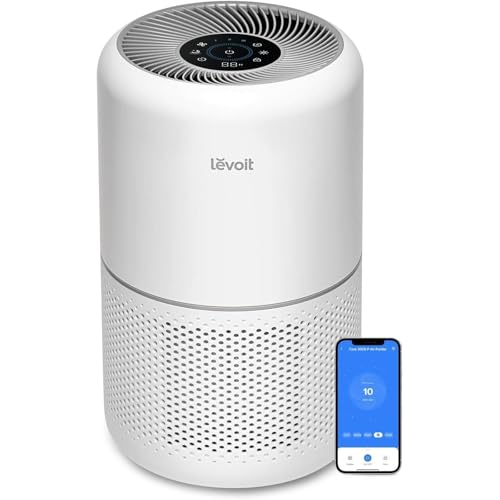
Take the Core 300 formula and add the two things connected households ask for: WiFi with Alexa control, and the ability to check and change the purifier from another room. The verified listing for the Core 300S-P confirms smart WiFi, AHAM verification, a HEPA sleep mode and a very quiet low setting, with smoke named among its target pollutants. In a smoke context, the killer feature is the schedule: the purifier can run a clearing cycle in the hour before you come home and drop to a whisper by bedtime without you touching it.
Strengths
- WiFi and Alexa control with scheduling for automatic clearing cycles
- Same proven cylindrical filter platform as the Core 300-P
- Very quiet sleep setting for bedrooms
Trade-offs
- Costs more than the non-smart 300-P for identical filtration hardware class
- App setup is one more account and password in the house
- Carbon layer is still a combined-filter layer, not a deep bed
| Detail | What to know |
|---|---|
| Format | Smart cylindrical compact purifier |
| Filter type | HEPA filter with sleep mode (per listing) |
| Control | WiFi app and Alexa voice control |
Choose the 300S-P over the 300-P only if the smart layer will change how the machine gets used — and for smoke, it often does. A purifier that is off, or idling on its lowest speed because nobody remembered to boost it, does nothing for the smell in the cushions. One that runs a timed high-speed cycle after the household’s smoking hours, every day, quietly keeps on top of the problem. Filtration-wise it inherits the platform’s strengths and its one weakness: particles are handled well, odour is managed rather than conquered. Pair it with the filter-change reminder in the app and you also solve the most common reason small purifiers stop working — a filter nobody replaced.
Best for: Connected homes that will use schedules and remote boost / Not suited for: Buyers who want a simple dial and no app
Check on Amazon — check the current price on Amazon before ordering, and confirm size, colour and configuration on the listing.
WINIX A230 Air Purifier — Best Carbon Filtration in a Small Unit
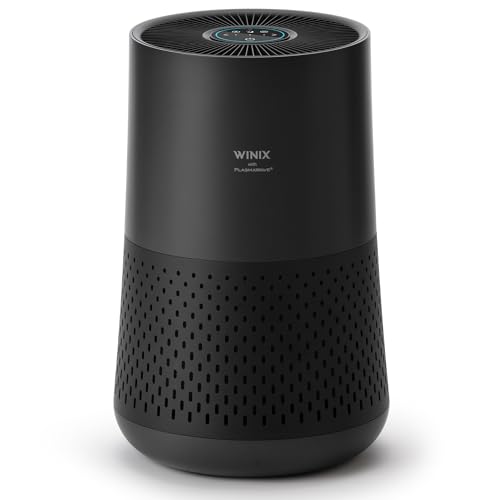
The WINIX A230 is the pick for readers whose complaint is smell as much as haze. Its verified listing spells out the stack: true HEPA for particles, a dedicated carbon filter for odours, and an air-quality monitor driving an auto mode. That separation matters. A dedicated carbon stage carries more adsorbent than the carbon dusting inside a combined filter, so it keeps working on smoke odour for longer before it saturates, and when it does, you replace the carbon stage on its own schedule rather than throwing away a whole combined filter.
Strengths
- Dedicated carbon filter: the best odour handling in this small group
- Air-quality monitor with auto mode reacts to smoke events on its own
- True HEPA particle stage with a washable pre-filter for ash and dust
Trade-offs
- Tower footprint is larger than the LEVOIT compacts
- Two filter types to track and replace on different schedules
- Auto mode can hunt up and down audibly when smoke drifts in waves
| Detail | What to know |
|---|---|
| Format | Compact tower purifier |
| Filter type | True HEPA + dedicated carbon filter |
| Extras | Air quality monitor; auto mode |
Placement and patience get the best from the A230. Put it in the room where smoke actually lingers, a metre or so from walls so the intake breathes, and let auto mode do its work: it will spin up when smoke arrives and settle back when the air clears, which is exactly the duty cycle a smoking-adjacent household needs. In our judgement this is the strongest small answer to cigarette and wood-smoke smell short of moving to a full-size machine, and its per-filter replacement model can work out fairer over years of ownership. It is not the prettiest or the smallest unit here, and if your smoke problem is light, it is more machine than you need — but if odour is the complaint you lead with, start here.
Best for: Rooms where smoke odour, not just haze, is the main problem / Not suited for: Tiny nightstands or buyers wanting the smallest possible box
Check on Amazon — check the current price on Amazon before ordering, and confirm size, colour and configuration on the listing.

GermGuardian AC4825 Tower Air Purifier — Best Slim Tower for Tight Corners
The GermGuardian AC4825 has been on the market for years, which in this category is a feature: filters are everywhere, the controls are three speeds and a button, and the tall, narrow tower slips into the gap beside a desk or behind a door where a cylindrical purifier will not go. The verified listing confirms a HEPA tower positioned for smoke, dust and odour reduction with three quiet speeds. For a home office where someone vapes or where smoke seeps from a shared hallway, that set-and-forget simplicity is the appeal.
Strengths
- Slim tower footprint fits corners and beside furniture
- Dead-simple controls; no app, no account, nothing to configure
- Long product history means filters are widely stocked
Trade-offs
- Carbon is a thin pre-filter layer, so odour work is light
- No sensor or auto mode; speeds are entirely manual
- Tower intake needs clearance behind it to breathe properly
| Detail | What to know |
|---|---|
| Format | 22-inch tower purifier |
| Filter type | HEPA filter with carbon pre-filter (per listing) |
| Speeds | 3 quiet speeds |
The AC4825 is a background worker. Set it on its middle speed in the room that needs steady help, leave it running through the day, and it will keep visible dust and light smoke haze down and take a modest edge off odour. It will not win a fight against a room used for smoking every night — its carbon layer is simply too thin — and it asks you to remember filter changes yourself. But for the renter who wants a slim, proven, inexpensive-to-run tower and whose smoke exposure is drift and occasional guests rather than a daily habit, it remains a sensible, honest buy.
Best for: Offices and rentals wanting a slim, simple, proven tower / Not suited for: Heavy smoke odour or buyers wanting auto sensing
Check on Amazon — check the current price on Amazon before ordering, and confirm size, colour and configuration on the listing.
Comparison Table
| Pick | Badge | Key spec | Best for |
|---|---|---|---|
| LEVOIT Core Mini-P Air Purifier | Best for a Bedside Table | Smallest footprint; fragrance sponge | One sleeper in a small bedroom with light, occasional smoke drift |
| LEVOIT Core 200S-P Smart Air Purifier | Best Smart Pick for Small Rooms | Smart control; AHAM verified; 3-in-1 filter | Bedrooms and offices wanting set-and-forget smart control |
| LEVOIT Core 300-P Air Purifier | Best Overall Small Purifier | Cylindrical 3-stage filter; AHAM verified | Most bedrooms and small living rooms with occasional-to-regular smoke |
| LEVOIT Core 300S-P Smart Air Purifier | Best for App Control and Schedules | WiFi + Alexa; scheduled clearing cycles | Connected homes that will use schedules and remote boost |
| WINIX A230 Air Purifier | Best Carbon Filtration in a Small Unit | Separate carbon filter; AQI monitor; auto mode | Rooms where smoke odour, not just haze, is the main problem |
| GermGuardian AC4825 Tower Air Purifier | Best Slim Tower for Tight Corners | 22in slim tower; 3 speeds; HEPA | Offices and rentals wanting a slim, simple, proven tower |
Read the table as a shortlist, not a ranking: the right row is the one whose key spec matches the problem you described at the start, and the full reviews above explain where each pick gives ground as well as where it wins.
How to Choose a Small Air Purifier for Indoor Smoke
The single most useful question is: particles or odour? Smoke haze — the visible cloud and the fine ash that settles as dust — is a particle problem, and any true-HEPA or HEPA-grade filter handles it in proportion to how much air the fan moves. Smoke smell is a gas problem. HEPA media does nothing for gases at all; only activated carbon adsorbs them, and the amount of carbon decides how long the effect lasts. A combined filter with a carbon layer will freshen a room for weeks; a dedicated carbon stage works for months; a fragrance sponge merely covers the smell while it lasts. Match the machine to the problem you actually have, and be suspicious of any small purifier that promises to erase heavy smoke odour entirely.
Size the purifier to the room with the door closed, and size down from headline claims. Manufacturer coverage figures assume ideal conditions and a pollutant load lighter than smoke. For smoke duty, take the verified coverage figure in a listing and plan on the unit serving roughly half to two-thirds of it well. A bedroom of 120–200 square feet is the natural home of every pick in this guide. If your smoke-affected space is an open-plan living area, one small purifier will improve the corner it sits in and disappoint you about the rest; two small units at opposite ends, or one full-size machine, is the honest answer.
Finally, price the filters before the machine. A purifier is a subscription you pay in replacement filters, and smoke loads filters faster than dust does — carbon saturates and HEPA media clogs with tarry particles sooner in a smoky home. Check what a year of filters costs for any model you shortlist, whether genuine filters are easy to find, and whether the unit tells you when a change is due. A slightly dearer machine with cheap, available filters is usually the cheaper three-year ownership story.
Carbon, HEPA and the Things That Do Not Filter Smoke
Three technologies in listings deserve a plain explanation. HEPA-grade filtration is the particle workhorse: a dense fibre mat that traps fine particles, including the bulk of smoke particulate, as air passes through. It is genuinely effective and it is the floor of what you should accept for smoke. Activated carbon is the odour workhorse: a porous material whose surface adsorbs gas molecules. Its capacity is finite and roughly proportional to its weight, which is why thin carbon layers disappoint and dedicated carbon filters satisfy. When carbon saturates, odour passes straight through again — the filter has not failed, it is full.
Then there are the extras. UV-C lamps inside small purifiers act on air that passes very close to the bulb very briefly; treat them as a minor bonus, never a reason to buy. Ionisers can make particles settle out of the air faster, but settled is not captured — the residue lands on walls and furniture — and some designs produce ozone, which you do not want added to a room you are trying to freshen. Fragrance sponges mask; they do not remove. None of these extras substitutes for the two-stage basics: enough HEPA media and enough carbon, moved by a fan strong enough for the room.
A word on expectations and framing. This guide treats purifiers as comfort appliances: they reduce haze, stale smell and settling dust so a room feels and smells fresher. We make no claims about health outcomes, and a purifier does not make indoor smoking safe or neutralise second-hand smoke for other people in the home. Source control — smoking outside, ventilating when weather allows — always beats filtration, and the best purifier is the one backing up those habits, not replacing them.
Running Costs, Noise and Life With a Small Purifier
The purchase price of a small purifier is the smaller half of its cost. Filters are the recurring half, and smoke shortens filter life in two ways at once: tarry particles load the HEPA media, and odour gases fill the carbon. Before you settle on a model, price a full year of filters at the rate a smoky home will actually consume them — often one and a half to two times the dust-only schedule — and check whether the filters are stocked by more than one seller. The LEVOIT Core platform scores well here because its installed base is huge; the WINIX asks you to track two filter types but lets you replace the carbon stage on its own rhythm, which can work out fairer when odour, not dust, is what exhausts your filters.
Noise decides whether a purifier gets used at night, and night is when a bedroom purifier earns its keep. Every pick here has a sleep or low setting designed to sit under the level that disturbs most sleepers, and the smart LEVOIT models quote figures in the mid-20dB range on their lowest settings. What the numbers hide is character: a smooth fan hum disappears into background noise, while a unit that hunts between speeds, clicks, or lights the room with a bright display will be switched off by someone in the household within a week. If you are a light sleeper, favour the models with dimmable displays and a genuinely steady low speed, and plan the loud clearing cycle for when the room is empty.
Day to day, the routine that works is boring: pre-filter vacuumed monthly, clearing cycle after smoke, quiet maintenance running otherwise, filters changed when odour returns rather than when a calendar says so. Households that adopt that rhythm report the same thing — the purifier fades into the background and the room simply stops smelling of smoke. Households that buy a purifier as a one-off fix, run it for a weekend and then forget it behind the sofa, conclude that purifiers do not work. The machine is rarely the difference; the routine is.
Smoke From Neighbours, Balconies and Shared Walls
A large share of readers shopping this search do not smoke themselves: the smoke arrives from a neighbour’s balcony, a shared hallway, or the flat below, and it arrives on the neighbour’s schedule, not yours. That changes which pick suits you. Reaction speed matters more than raw power, because the intrusion is a wave that peaks and passes. The WINIX A230’s air-quality monitor and auto mode were built for exactly this pattern — it senses the wave, spins up, and settles again without you getting up. The smart LEVOIT models answer the same problem with schedules, if the intrusions are predictable, and with a phone-triggered boost when they are not.
Placement also changes. Put the purifier near the entry point — the window, door or vent the smoke drifts through — rather than beside your bed, so it intercepts the wave before it spreads across the room and into the soft furnishings. Keep that window closed during the intrusion if you can; a purifier fighting an open window onto a smoky balcony is fighting the outdoors. And manage expectations about fabric: if smoke has been drifting in for months, the curtains and sofa already hold it, and the first weeks of purifier use will feel underwhelming until those fabrics are washed or aired. The purifier stops the problem getting worse from day one, which is the part fully in your control.
What About Candle, Incense and Kitchen Smoke?
Not all indoor smoke arrives from cigarettes, and the lighter sources are where a small purifier shines brightest. Incense and candle smoke are intense but brief and localised: a compact unit on a clearing cycle in the same room will pull the haze down quickly and stop the smell settling into curtains, which is precisely the pattern the Core 300-P and Core 200S-P handle well. Kitchen smoke — the seared steak, the forgotten toast, the wok that got away from you — is also a short, sharp event, but it carries grease particles that load a pre-filter fast, so if your purifier lives near a kitchen, add pre-filter cleaning to your monthly routine and expect the main filter to age faster than the schedule in the manual.
Cooking smoke also tests placement differently: the purifier belongs just outside the kitchen’s main airflow, close enough to catch the drift into the living room, far enough that it is not inhaling the full greasy plume from the hob. Households that burn incense daily should treat that as a genuine smoke habit for filter-planning purposes — the particle load is real even when the ritual is short — and should favour the models with cheap, plentiful filters. The GermGuardian tower, with its simple three-speed running and widely stocked filters, quietly suits that pattern of frequent small events in one fixed room.
The through-line for every smoke source is the same: brief events reward a machine that is already in the room, already plugged in, and easy to boost; chronic sources reward carbon capacity and filter economics. Identify which pattern is yours before you buy, and the shortlist in this guide narrows itself.
Buying Second-Hand or Choosing Between Two Finalists?
Small purifiers appear constantly on resale listings, and a used unit can be a rational buy if you price it as a fan and a housing: assume the fitted filter is finished, especially for smoke, and add a new filter set to the true cost before comparing with a new machine. Check that the model still has filters in production — a discontinued purifier with no filter supply is worth very little however clean it looks — and run it on every speed before paying, listening for bearing rattle that no filter change will fix. If two finalists from this guide are within a small price gap after filters are counted, choose the one with the better carbon story for smoke; particle performance at this level is broadly comparable, and carbon is where ownership satisfaction is decided.
How to Set Up and Run a Small Purifier for Smoke
Setup is five minutes of placement and a habit of running the machine at the right times. The steps below are written for the picks in this guide but apply to any small purifier.
- Unbox and remove the plastic wrap from the filter before first use — the most common reason a new purifier ‘does nothing’ is a filter still sealed in its bag inside the machine.
- Place the unit in the room where smoke lingers, on a hard floor or sturdy table, with clear space around the intake and outlet; a metre from walls and soft furnishings is a good target, and never inside a cupboard or behind curtains.
- Put it between the smoke source and where people sit or sleep where you can: near a door that smoke drifts through, or beside the chair area rather than in the far corner.
- After a smoke event, run the highest speed for 30–60 minutes with the room door closed; this clearing cycle does more than a full day of idling on low.
- Once the air looks and smells clear, drop to the quiet or sleep setting to maintain the room overnight or through the working day.
- Vacuum or rinse the washable pre-filter (where fitted) every few weeks in a smoky home; a clogged pre-filter starves the main filter and raises noise.
- Replace filters on the maker’s schedule or sooner if odour returns quickly after a clearing cycle — that is the signature of saturated carbon, not a broken machine.
Keep a simple log for the first month: when smoke happened, how long you ran the clearing cycle, and when the room smelled neutral again. That log tells you whether the unit is sized right for your room far better than any coverage figure, and it tells you when filters are tiring before guests notice.
Common Buying Mistakes
- Buying for the whole flat. A small purifier cleans the room it is in. Expecting one compact unit to handle an open-plan space guarantees disappointment; close doors and treat each room as its own problem.
- Ignoring carbon and buying on HEPA alone. HEPA clears haze while the smell sails through untouched. If odour is your complaint, carbon quantity is the spec that decides satisfaction.
- Leaving the filter wrapped. New filters ship sealed in plastic inside the unit. Run a wrapped filter and you get fan noise and zero filtration — check before first use, every time.
- Running only the quiet setting. Sleep speeds move little air. They maintain clean air well but cannot clear a smoky room; use a timed high-speed cycle after smoke, then step down.
- Never replacing the carbon. Saturated carbon silently stops working on odour while the machine sounds fine. Odour returning fast after a clearing cycle is your replacement signal.
- Placing it behind furniture. Blocked intakes strangle airflow. A purifier squeezed behind a sofa is furniture decoration, not filtration.
Final Recommendation
For most readers the LEVOIT Core 300-P is the right default: verified, quiet, sensibly filtered and easy to live with in a bedroom. If smell is the headline problem, the WINIX A230’s dedicated carbon filter makes it the strongest small choice here, and its auto mode suits households where smoke arrives unpredictably. The Core 300S-P earns its premium only if you will use schedules and remote boosts — for smoke duty, many households genuinely will. On a nightstand with only light drift to handle, the Core Mini-P is honestly sized; the Core 200S-P adds smart control to that smaller-room brief, and the GermGuardian AC4825 remains the slim, simple tower for a corner that fits nothing else.
Whichever you choose, pair it with the habits that make filtration work: door closed, a clearing cycle after smoke, filters replaced on time. That combination is what turns a small purifier from a hopeful purchase into a room that reliably smells like nobody smoked near it.
One last sizing reminder: measure your room, choose for the room with the door closed, and let the first month of use — not the box — tell you whether you sized it right.
Related guides on this site: Best Air Purifiers For Smokers Best Air Purifiers For Smoke Best Small Air Purifiers Best Air Purifiers For Apartments Best Quiet Air Purifiers For Bedrooms
Frequently Asked Questions
Can a small air purifier remove cigarette smoke smell completely?
It can reduce it a lot in one closed room, especially a model with a dedicated carbon filter like the WINIX A230, but ‘completely’ depends on how much smoking happens and how much soft furnishing has absorbed odour over time. Curtains, upholstery and carpets hold smoke smell and re-release it; the purifier handles the air while you gradually clean or air the fabrics. For daily indoor smoking, expect management, not erasure.
How long should I run the purifier after someone smokes?
Run the highest speed for 30–60 minutes with the door closed, then step down to a quiet setting to maintain the room. Light drift may clear faster; a heavy session in a small room can justify a second cycle. If odour is still obvious after two cycles, the carbon is likely saturated or the unit is undersized for the room.
Where is the best place to put a small purifier for smoke?
In the room where the smell lingers, with clear space around its intakes, ideally between the smoke’s entry point and the bed or seating. Floor or a sturdy table both work for the cylindrical models; towers need clearance behind them. Avoid cupboards, curtains and tight corners.
How often do filters need changing in a smoky home?
Faster than the box suggests in a dust-only home. Combined filters in regularly smoky rooms may tire in a few months; dedicated carbon stages last longer but still saturate. The practical signal is odour returning quickly after a clearing cycle. Check replacement filter prices on the listing before buying the machine so the running cost is no surprise.
Is a purifier with a fragrance sponge a good idea for smoke?
The sponge masks smell with scent; it does not remove smoke particles or gases. On the Core Mini-P it is a pleasant extra for a lightly affected bedroom, but it is not filtration. If you dislike added fragrance, run the unit without oil in the sponge — the filter still does its work.
Will a small purifier help with wood stove or fireplace smoke?
Yes, within the same limits: HEPA media catches the fine particles that make rooms hazy and dusty, and carbon takes the edge off the smell. Back-draught puffs when a stove door opens are exactly the short events a clearing cycle handles well. Persistent smoke from a faulty flue is a chimney problem, not a purifier problem — fix the source first.

