Disclosure: airfryerkitchensupply.com is reader-supported. When you buy through links on our site, we may earn an affiliate commission at no extra cost to you.
Where to buy
Shopping for the best small 12 volt cooler? The fastest way to buy any pick in this guide is through Amazon, where stock, delivery and returns are handled in one place. Start with our top recommendation, the SubSun 27 Quart Thermoelectric Electric Cooler and Warmer (Check the current price on Amazon), then compare it against the other five picks below before you decide. Prices move with stock and season, so we never print a fixed price in the article itself — use the check-price links to see the current figure on Amazon.
If you are searching for the best small 12 volt cooler, you are probably trying to solve a very specific problem rather than browse a whole category. A small 12 volt cooler is the broad church of car cooling: at one end, affordable thermoelectric boxes that chill drinks and lunches relative to the weather; at the other, compact compressor fridges that freeze. This search covers both, so this guide separates them honestly instead of letting similar-looking boxes blur together.
Read the picks in two families. The thermoelectric models are lighter, cheaper and simpler, and they warm as well as cool — but they cannot freeze and they fade on very hot days. The compressor models cost more and do everything a household fridge does. Choosing your family first is the whole decision; choosing within it is detail.
This guide narrows the field to six picks that genuinely fit the brief behind the best small 12 volt cooler — not six near-misses padded out to fill a table. Each pick earned its place for a different reason, each one carries an honest limitation, and the buying-guide and hands-on sections further down explain the trade-offs in plain language so you can match a pick to your own setup instead of guessing.
In this guide
Quick Picks
- SubSun 27 Quart Thermoelectric Electric Cooler and Warmer — Best Thermoelectric for Road Trips. The SubSun represents the honest thermoelectric end of this search: a 27-quart cool-and-warm box on 12V or mains that keeps drinks and lunches properly chilled on the road without pretending to be a freezer. Check the current price on Amazon
- TopAutoGear 26.5 Quart Thermoelectric Cooler and Warmer — Best Value Thermoelectric. A second full-size thermoelectric option with the same dual-power, cool-and-warm formula, giving value shoppers a genuine alternative in the 26-quart class. Check the current price on Amazon
- Igloo IE24 Thermoelectric Cooler and Warmer 24L — Best Brand-Name Thermoelectric. Igloo is the cooler name generations already own, and the IE24 is its thermoelectric entry: a 24-litre cool-and-warm box aimed at truckers, RVers and anyone who trusts a brand with a service department. Check the current price on Amazon
- Alpicool C15 Portable Car Freezer 16 Quart — Best Compressor Upgrade. Listed again in this guide because cooler shoppers keep discovering it: the C15 is what to buy when you outgrow thermoelectric limits but still want a small box — a true compressor fridge-freezer in 16 quarts. Check the current price on Amazon
- BougeRV 12V Refrigerator 23 Quart Portable Freezer — Best Compressor for Longer Trips. The larger compressor option in this cooler guide: 23 quarts of true fridge-or-freezer capacity with efficiency modes for owners whose trips run past the weekend. Check the current price on Amazon
- Alpicool 10 Quart Car Refrigerator — Best Personal Compressor Cooler. The smallest compressor box in either of our 12V guides: a personal 10-quart fridge for a cab, a desk-side commute setup, or the drinks unit that frees the main fridge for food. Check the current price on Amazon
How These Picks Were Chosen
We started from the real-world shortlist that buyers of the best small 12 volt cooler actually cross-shop: the established brands in this niche, the current value challengers, and the specialist models that solve one problem unusually well. From that long list we applied four filters. First, the product had to match the core specification in the search itself — voltage, size class and intended use — with no stretching of the definition to make a pick fit. Second, it had to be a product a buyer can actually obtain through normal retail channels today, not a discontinued listing kept alive by third-party markups. Third, the design had to suit the way these products are really used, which for this category means a clear-eyed match between cooling technology and trip type, honest capacity for the people actually being fed, power draw a vehicle system can sustain, and leads, lids and handles that suit the vehicle it will live in. Fourth, we weighed ownership as heavily as first impressions: parts availability, documentation quality, warranty support and how forgiving the product is when something goes wrong six months in.
Products that failed any filter were cut, even when they were heavily marketed. Where a tier of the market turned out to be thin or effectively empty, we say so openly in the relevant review instead of inventing a filler pick. Specifications quoted in the mini spec boxes come from the verified catalog listing for that exact model; where a figure could not be confirmed for a specific pick, we left the box out rather than guess. The result is six picks that divide the market by job, not by marketing label.
The 6 Best Small 12 Volt Coolers

SubSun 27 Quart Thermoelectric Electric Cooler and Warmer — Best Thermoelectric for Road Trips
The SubSun represents the honest thermoelectric end of this search: a 27-quart cool-and-warm box on 12V or mains that keeps drinks and lunches properly chilled on the road without pretending to be a freezer.
Strengths
- Cooling and warming modes cover road-trip food and winter takeaway runs alike
- Dual power suits car days and hotel-room or office nights
- 27 quarts is family day-trip capacity in a liftable box
Trade-offs
- Thermoelectric limits apply: it chills relative to ambient and cannot freeze
- Fan runs whenever it cools — noticeable in a quiet room
- Not for multi-day raw-meat storage in hot weather
Key specs: 27 quart, thermoelectric cooling and warming, 12V DC and 110V AC
Buy the SubSun for what thermoelectric does well: a long drive with sandwiches, drinks and salad that arrive cold, a warm mode that keeps a takeaway respectable on the way home, and a box that then plugs into the wall and serves as a mini fridge wherever you land. Its limits are physics, not flaws — on a hot day it will hold a pleasant chill rather than a fridge’s bite. Owners who respect that distinction rate these boxes highly; owners who expected a freezer write the angry reviews.
Best for: road-trip families wanting chill and warmth / Not suited for: freezer duty or hot-climate multi-day food storage
Check the current price on Amazon
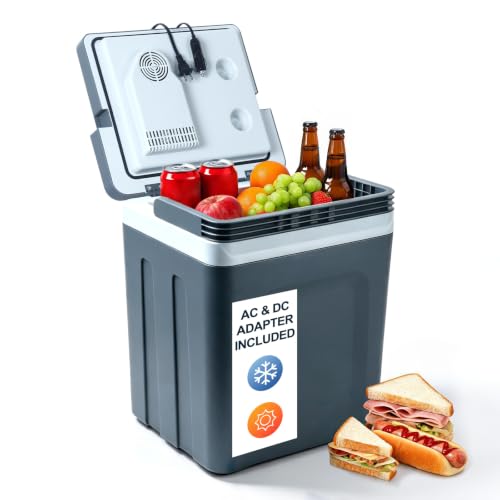
TopAutoGear 26.5 Quart Thermoelectric Cooler and Warmer — Best Value Thermoelectric
A second full-size thermoelectric option with the same dual-power, cool-and-warm formula, giving value shoppers a genuine alternative in the 26-quart class.
Strengths
- Family day-trip capacity at the value end of the market
- AC and DC leads cover car and indoor use
- Warming mode adds year-round usefulness
Trade-offs
- Same thermoelectric ceiling: no freezing, ambient-dependent chilling
- Build and fan refinement match its price tier
- Check lead lengths for your vehicle’s socket position
Key specs: 26.5 quart, thermoelectric, 110V AC and 12V DC
The TopAutoGear competes on straightforward value: the same physics, the same dual-power convenience, a family-size box. It suits buyers who have understood the thermoelectric bargain — chilled, not frozen — and would rather spend the savings on the trip itself. As with its rival above, it will be loved for road-trip duty and misjudged only by buyers who needed the compressor page of this site instead.
Best for: value shoppers who understand thermoelectric limits / Not suited for: anyone needing guaranteed cold in high heat
Check the current price on Amazon

Igloo IE24 Thermoelectric Cooler and Warmer 24L — Best Brand-Name Thermoelectric
Igloo is the cooler name generations already own, and the IE24 is its thermoelectric entry: a 24-litre cool-and-warm box aimed at truckers, RVers and anyone who trusts a brand with a service department.
Strengths
- Igloo’s distribution means accessories and support are easy to find
- Sized for the cab-and-car niche these boxes serve best
- Thermoelectric simplicity: no compressor, no refrigerant, little to break
Trade-offs
- Thermoelectric performance ceiling applies in full
- Capacity is drinks-and-lunch scale, not family grocery scale
- Fan noise is part of the thermoelectric package
Key specs: 24 litre class, thermoelectric, 12V, truck/RV/car/home positioning
Professional drivers are the thermoelectric box’s natural constituency: a working day of cold drinks and a fresh lunch, powered from the cab, week after week, with nothing to defrost and nothing to leak. The IE24 serves that life with a mainstream brand behind it. If your use is measured in shifts and day trips rather than off-grid weeks, this is the dependable, unglamorous answer — and unglamorous dependability is a compliment in a working vehicle.
Best for: drivers and brand-conscious buyers / Not suited for: large families packing big shops
Check the current price on Amazon

Alpicool C15 Portable Car Freezer 16 Quart — Best Compressor Upgrade
Listed again in this guide because cooler shoppers keep discovering it: the C15 is what to buy when you outgrow thermoelectric limits but still want a small box — a true compressor fridge-freezer in 16 quarts.
Strengths
- Real freezing and fridge temperatures, independent of the weather
- Smaller footprint than the thermoelectric family boxes above
- The end of ice, meltwater and ambient-dependent chilling
Trade-offs
- Costs more than thermoelectric boxes of similar size
- 16 quarts is compact — plan packing
- Compressor cycling is audible in a sleeping space
Key specs: 16 quart, compressor fridge-freezer, 12/24V DC
If you read the thermoelectric reviews above and felt the limits bite — hot climates, multi-day trips, food you cannot risk — the C15 is the upgrade that resolves them rather than softening them. It costs more because it contains a refrigerator, not a fan and a plate. Many owners arrive here after one melted thermoelectric summer; buying the C15 first is simply the shortcut version of the same journey.
Best for: buyers who have outgrown thermoelectric boxes / Not suited for: the tightest budgets
Check the current price on Amazon
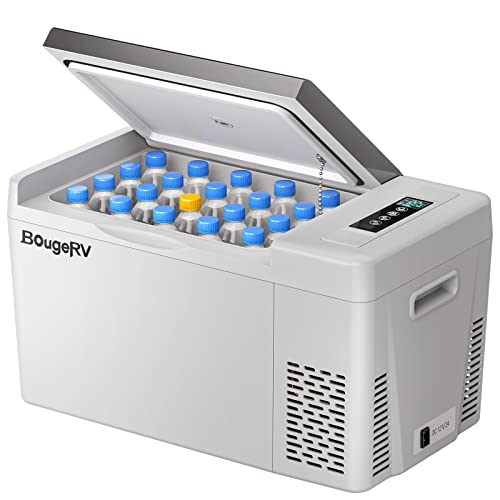
BougeRV 12V Refrigerator 23 Quart Portable Freezer — Best Compressor for Longer Trips
The larger compressor option in this cooler guide: 23 quarts of true fridge-or-freezer capacity with efficiency modes for owners whose trips run past the weekend.
Strengths
- Capacity and compressor performance for multi-day food storage
- ECO mode respects small batteries and power stations
- No ice means all 23 quarts are food space
Trade-offs
- Bigger and heavier than the day-trip boxes
- Overkill for drinks-only duty
- Single zone: one temperature throughout
Key specs: 23 quart, compressor, fridge-or-freezer range per listing title
Choose the BougeRV when the cooler’s job description grows up: three or four days of fresh food, frozen items that must stay frozen, a basecamp powered by a modest solar setup. It is the pick in this guide for people who plan menus rather than pack snacks. The efficiency modes are not decoration — on a small power station they are the difference between a fridge that lasts the trip and one that becomes a heavy box on day three.
Best for: multi-day campers and basecamp cooks / Not suited for: drinks-only day trips
Check the current price on Amazon

Alpicool 10 Quart Car Refrigerator — Best Personal Compressor Cooler
The smallest compressor box in either of our 12V guides: a personal 10-quart fridge for a cab, a desk-side commute setup, or the drinks unit that frees the main fridge for food.
Strengths
- Personal size fits footwells and cabs nothing else reaches
- True compressor temperatures in miniature
- Doubles as a medication or drinks fridge on long drives
Trade-offs
- 10 quarts is a handful of cans and lunch — nothing more
- Highest cost per litre here
- Tall bottles may not stand upright; measure what you carry
Key specs: 10 quart, compressor, AC/DC options
There is a specific joy in a fridge that fits a footwell: cold drinks and a proper lunch on any drive, medication held at temperature without negotiation, a small cold reserve that asks nothing of the main system. The 10-quart Alpicool is a specialist and prices like one. As an only fridge it would frustrate; as the second, personal unit in a vehicle that already has a plan, it is close to perfect.
Best for: personal cab and second-fridge duty / Not suited for: a household’s only travel fridge
Check the current price on Amazon
Comparison Table
| Pick | Badge | Key spec | Best for |
|---|---|---|---|
| SubSun 27 Quart Thermoelectric Electric Cooler and Warmer (Check the current price on Amazon) | Best Thermoelectric for Road Trips | 27 quart, thermoelectric cooling and warming, 12V DC and 110V AC | road-trip families wanting chill and warmth |
| TopAutoGear 26.5 Quart Thermoelectric Cooler and Warmer (Check the current price on Amazon) | Best Value Thermoelectric | 26.5 quart, thermoelectric, 110V AC and 12V DC | value shoppers who understand thermoelectric limits |
| Igloo IE24 Thermoelectric Cooler and Warmer 24L (Check the current price on Amazon) | Best Brand-Name Thermoelectric | 24 litre class, thermoelectric, 12V, truck/RV/car/home positioning | drivers and brand-conscious buyers |
| Alpicool C15 Portable Car Freezer 16 Quart (Check the current price on Amazon) | Best Compressor Upgrade | 16 quart, compressor fridge-freezer, 12/24V DC | buyers who have outgrown thermoelectric boxes |
| BougeRV 12V Refrigerator 23 Quart Portable Freezer (Check the current price on Amazon) | Best Compressor for Longer Trips | 23 quart, compressor, fridge-or-freezer range per listing title | multi-day campers and basecamp cooks |
| Alpicool 10 Quart Car Refrigerator (Check the current price on Amazon) | Best Personal Compressor Cooler | 10 quart, compressor, AC/DC options | personal cab and second-fridge duty |
How to Choose a Small 12 Volt Cooler
The two technologies, priced honestly
Thermoelectric coolers use a Peltier plate and a fan: no refrigerant, no compressor, very little to break, and a cooling ability defined as a margin below the surrounding temperature. In mild weather that margin feels like refrigeration; in a heatwave car it feels like a cool cupboard. They also warm, which no compressor fridge in this guide does, and for takeaway runs and winter work lunches that mode is quietly beloved.
Compressor coolers are refrigerators. They hold set temperatures absolutely, freeze when asked, and sip power once cold. The price difference buys physics, not branding. The honest buying question is therefore not ‘which cooler is best’ but ‘what is the hottest, longest, most food-critical trip this box must survive’ — answer that and the technology chooses itself.
Capacity and the can-count con
Cooler capacities are quoted in quarts, litres and cans, often all three, and none of them describe your actual load. A family’s day-trip reality — drinks, sandwiches, fruit, a salad bowl that refuses to stack — fills a 26-quart box faster than any can count suggests. Pack mentally in meals, not litres: day trip for four, roughly the 25-quart class; a couple’s weekend of fresh food, a 20-plus-quart compressor box where no space is lost to ice.
Shape matters as much as volume. Tall, narrow boxes suit bottles and footwells; wide boxes suit platters and boots. Lids that open against a car’s trim, handles that dig into hands on a long carry, leads that exit toward the socket — these unglamorous details decide whether a cooler is used weekly or abandoned in the garage.
Power etiquette in a vehicle
A thermoelectric box draws steadily whenever it runs, which makes it a poor overnight load on a starter battery; a compressor box cycles and sips, but still needs battery protection respected. The rules are simple: engine running or leisure power for anything sustained, protection cut-offs set conservatively, and never a cooler left running in a parked car on the starter battery ‘just for the afternoon’ in summer — that is the flat-battery story every owner tells once.
Socket quality matters too. Worn cigarette-lighter sockets and thin extension leads cause voltage drop that makes good coolers behave badly. A firm plug, a short lead and, for permanent installs, a proper fused 12V outlet turn mysterious underperformance into the reliability the box was capable of all along.
How to Get the Best From a 12V Cooler
Small habits multiply the performance of either technology far beyond what the spec sheet promises.
- Pre-chill everything: load the cooler with food and drink already cold from the home fridge, and run the cooler itself for an hour before departure when you can.
- Fill the gaps: a full cooler holds temperature better than a half-empty one, so add a frozen bottle of water in spare corners — free ballast and a cold drink later.
- Keep it shaded and ventilated in the vehicle; a cooler baking under a rear window in sun is fighting the car as well as the weather.
- Open it like you mean it: decide what you want, take it, close it. Every long browse is paid for in temperature.
- In camp, move the cooler to shade and off hot ground, and keep thermoelectric fans unobstructed by luggage.
- At home, clean and dry it with the lid ajar so seals and interiors stay fresh for the next trip.
Thermoelectric owners get the most from the warming mode in winter: a hot lunch carried properly warm is the feature compressor owners envy, and it costs nothing to use. Just respect the food-safety basics — warm means properly warm, not lukewarm for hours.
Compressor owners should learn their unit’s battery-protection settings before the first trip rather than during the first flat battery. Ten minutes with the manual in the driveway is the cheapest reliability upgrade in this entire guide.
Common Buying Mistakes
Expecting a thermoelectric box to freeze. It cannot, by design. If freezing matters, buy the compressor picks.
Running any cooler overnight on a starter battery. Use leisure power or switch it off; cold drinks are not worth a jump start.
Buying by can count. Pack by meals and bottle shapes, not marketing arithmetic.
Leaving it in a hot parked car and blaming the cooler. Ambient heat is the opponent; shade and ventilation are your tactics.
Ignoring the lead and socket. Voltage drop from a tired socket imitates a faulty cooler perfectly.
Which Family Are You? A Two-Minute Test
If your trips are day-length, your food is drinks, sandwiches and salads, your climate is mild to warm rather than extreme, and your budget is firm — you are thermoelectric people, and the top three picks will serve you for years. If any answer flips — multi-day trips, raw meat on day three, desert or deep-summer heat, frozen goods — you are compressor people, and the lower three picks are where your money belongs.
The expensive mistake is buying thermoelectric for a compressor life, because the replacement purchase erases the saving. The cheap mistake is buying a compressor for drinks duty, because you will carry weight and cost you never use. This test, answered honestly, is worth more than any single product comparison in the guide.
The Cooler as Camp Furniture: Living With the Box
A travel cooler spends its life being sat on, stood on (do not), used as a table and wedged into Tetris loads. Lid strength, hinge quality and handle comfort are therefore product features, not afterthoughts. When comparing two similar boxes, the one whose lid you would trust as a step and whose handles you would trust on a long carry is usually the one still in service in five years.
Colour is a feature too: a light-coloured box in a sunny boot absorbs less heat than a dark one. It is a small effect, but cooler ownership is a game of small effects stacked in your favour — shade, fullness, pre-chilling, brief openings — and the stack is what people experience as ‘a good cooler’.
Cleaning, Smells and the Forgotten Sandwich
Every cooler eventually hosts a forgotten sandwich, and the recovery ritual is always the same: empty, wash with warm soapy water, rinse, then wipe with a mild bicarbonate solution and dry thoroughly with the lid open. Plastic absorbs odours slowly and releases them slowly, so patience and air do more than perfume.
Prevention is duller and better: a quick wipe after every trip, no food stored in the cooler between trips, and the lid stored ajar. A cooler that lives clean and dry in the garage is ready at a moment’s notice; one that lives sealed and damp is a project before it is an appliance.
Living With a Small 12 volt cooler: the First Season and Beyond
The first month with a small 12 volt cooler teaches you the gap between the brochure and the routine. Controls that seemed fiddly become automatic, the sounds the cooler makes become a background language you read without thinking, and the one specification you obsessed over at purchase time turns out to matter less than the two you barely noticed. This is normal, and it is why this guide weighted ownership factors — support, parts, documentation and forgiveness — as heavily as headline performance when the picks were chosen.
By the end of the first season, patterns settle. You will know the settings you actually use, the accessories that earned their storage space and the ones still in their packaging. You will also know whether your original sizing decision was right: owners of the best small 12 volt cooler who bought for their real pattern rather than their imagined one report the appliance disappearing into their routine, which is the highest praise any product in this category can earn. Owners who bought for an imagined life spend the season working around the mismatch.
Year two and beyond is where the picks in this guide separate from the market’s disposable tier. The established brands publish documentation, stock consumables and answer questions; the products keep performing because their wear items were designed to be serviced rather than sealed away. None of that appears in a first-week review, and all of it decides whether you are still satisfied — or shopping again — three seasons from now.
The Maintenance Rhythm That Actually Works
Every product behind the best small 12 volt cooler has a maintenance rhythm, and the owners who thrive are not the ones with the longest checklist — they are the ones whose short checklist actually happens. Anchor the routine to events that already exist in your life: the start of a trip, the first weekend of the month, the change of a season. A check tied to a calendar abstraction gets skipped; a check tied to packing the vehicle or opening the pool gets done.
Keep the consumables on hand before they are needed. The pattern repeats across this whole category: the part is inexpensive, the shipping delay is the expensive part, and the failure chooses the least convenient weekend of the year. A small spares kit bought calmly in advance — informed by the specific pick you own and its manual — converts most mid-season failures from trip-ending events into twenty-minute interruptions.
Finally, keep a notebook or a notes file. Dates, settings that worked, parts replaced, the dealer’s name, the exact model variant: ownership knowledge compounds, and the owner who can say precisely what was done and when gets better help from every support line, forum and technician they ever call. The notebook is also what turns a future replacement decision from guesswork into arithmetic.
Troubleshooting: Reading Symptoms Before Spending Money
When a small 12 volt cooler misbehaves, work the symptom ladder from the free end upward. First, power and connections: is the supply actually delivering what the product expects, at the plug, under load? A remarkable share of ‘failures’ in every category in this guide are supply problems wearing the product’s clothes. Second, the consumables and the airflow, water flow or signal path — whichever medium the cooler works in — because blockages imitate breakdowns perfectly. Third, settings: a mode changed by a guest, a child or your own elbow can produce symptoms indistinguishable from a fault.
Only after those three should money move. When it does, spend it on diagnosis before parts: a technician’s hour that names the fault is cheaper than a sequence of hopeful components. And use the symptom’s timing as evidence — faults that appear after a move, a storm, a service or a new accessory are usually about that event, not about the product’s age. Tell whoever helps you the whole timeline; it is the most diagnostic information you own.
Know, too, when a symptom is a retirement notice rather than a repair ticket. Every category has a component whose failure, on an old and heavily used example, costs a meaningful fraction of replacement — and whose replacement reveals the next tired component behind it. The picks in this guide were chosen partly for graceful ageing, but no product escapes the arithmetic forever, and recognising the moment keeps money in your pocket.
Who Should Skip This Purchase Entirely
An honest guide to the best small 12 volt cooler should name the buyers it cannot help. Skip this purchase if your real need belongs to the neighbouring category — the guide’s own comparisons point at those neighbours repeatedly, and forcing this product class to do that job produces the disappointed reviews that litter every marketplace. Skip it, too, if the supporting system it depends on — the power supply, the space, the venting, the water, the vehicle — cannot be made right: a good product on a bad foundation performs badly and takes the blame.
Skip it if you are buying for a single event with no life afterwards. Hiring, borrowing or buying the cheapest adequate option serves one-off needs better than a quality purchase that will sit unused, ageing, in a cupboard. And skip it if the honest reason is a sale rather than a need: the discount on the wrong product is the most expensive money in this entire category.
For everyone else — the buyers whose pattern matches what these products genuinely do — the picks above are ordered so that the first one is the default and each subsequent one exists for a named reason. If none of the named reasons is yours, the default is your answer, and the time to stop researching and start using is now.
Resale, Spares and the End of the Story
Products bought well in this category hold a second life. The established brands’ examples sell on used markets because buyers trust the badge and can verify the model — another quiet return on choosing the names in this guide over anonymous alternatives. Keep the manual, the receipt and any spare consumables together; a complete, documented example is worth visibly more than a bare one, and costs you nothing but a drawer.
When the end does come, dispose of the product through the proper channel for its type — several categories in this guide involve materials that local rules govern — and let the replacement decision reuse everything you learned. Your notebook of settings, sizes and mistakes is the real asset you carry into the next purchase; the hardware was always just renting your attention.
That is the perspective this guide was written from: the best small 12 volt cooler is not a trophy purchase but a working part of a vehicle, a home, a pool or a stage. Bought with clear eyes, maintained with a light rhythm and replaced without sentimentality when the arithmetic says so, it is one of the more satisfying corners of ownership — a problem genuinely solved, season after season.
The Cost of Ownership, in Plain Terms
The purchase price of a small 12 volt cooler is the entry fee, not the cost. The real ledger adds the consumables it eats on schedule, the energy it draws across a season, the accessories that turned out to be necessities rather than luxuries, and — the line nobody budgets — the cost of the cheap first purchase replaced early. Worked through honestly, that ledger is why this guide’s ordering puts durable, supported products first: their per-season cost is routinely lower than the bargain alternative’s, even when the till receipt says otherwise.
Energy deserves a specific mention because it is the cost owners feel monthly rather than once. The efficient picks in this guide were not chosen for their green credentials but for their arithmetic: a product that runs every day, or all night, or all season, repays efficiency in the currency of smaller supporting systems — smaller batteries, smaller bills, fewer compromises elsewhere. When you compare two finalists, compare them as systems across a year, not as stickers across a counter.
The final line of the ledger is your own time. Products that need constant adjustment, rescue and research tax the hours they were bought to free. A small 12 volt cooler that simply works — set up once, maintained lightly, understood completely — is worth a premium measured in weekends, and owners consistently undervalue that premium at purchase time and overvalue it ever after.
Accessories: the Short List That Earns Its Keep
Every small 12 volt cooler attracts an ecosystem of accessories, most of which exist because they can, not because they should. The ones that earn their keep share a trait: they remove a recurring friction you have actually felt. Buy accessories in that order — after the friction, not in anticipation of it — and your storage stays as lean as your routine.
The exceptions are protective and consumable items, which should be bought with the product itself: the cover, the filter, the spare, the correct cable or fitting whose absence on the first weekend turns a new purchase into a sculpture. Those are not accessories in the shopping sense; they are the second half of the product, and the listings and manuals of the picks above name them plainly.
Resist, finally, the bundle. Kits that package the essential with the ornamental price the ornamental as if it were essential. Buy the product, live with it for a month, and let your own routine write the accessories list. It will be shorter than the manufacturer’s, cheaper than the bundle, and — uniquely — composed entirely of things you use.
A Seasonal Checklist You Can Actually Finish
Once a season, give the cooler an hour of deliberate attention. Work from outside in: the surfaces and seals the weather touches, the connections that carry power or signal, the consumables whose wear is a schedule rather than a surprise. Clean what the manual says to clean, with what the manual says to use — improvisation with solvents and pressure is how good products acquire cosmetic and functional scars.
Then run the cooler through its full working range, not just the setting you live on. Modes and functions that sit unused for years are the ones that fail silently and announce themselves on the one occasion they are needed. A seasonal full-range run is both a test and a rehearsal: you relearn the controls in calm conditions, and any developing fault appears while there is still time to address it on your schedule rather than its own.
Close the checklist by updating the notebook: what was done, what was noticed, what will be needed next season. Five lines, written once, that convert next year’s checklist from an inspection into a confirmation. Ownership at this level is not a hobby — it is an hour a season — and it is the entire difference between products that age and products that merely get old.
Head to Head: Separating the Picks in This Guide
Readers who reach this section usually have the shortlist down to two, so here is the honest separation. The first pick, the SubSun 27 Quart Thermoelectric Electric Cooler and Warmer, is the default because it balances the most factors for the most buyers; it is the answer when no special circumstance argues otherwise. The moment a special circumstance does argue — a tighter space, a smaller budget, a bigger load, a specific feature — the pick built for that circumstance overtakes it, and each review above names its circumstance in its first paragraph.
Between the remaining picks, the differences are of emphasis rather than quality: one trades capacity for compactness, another trades features for simplicity, another trades brand depth for value. That is deliberate. A guide whose picks are merely ranked from best to worst best serves nobody, because buyers’ constraints differ more than products do. Match the constraint you cannot change — the space, the circuit, the vehicle, the channel count — and the correct pick selects itself.
If you are still torn between two finalists after that, decide on ownership rather than specification: whose documentation is clearer, whose consumables are easier to source where you live, whose support answers in a way you trust. Specifications tie more often than brochures admit; ownership never does.
Cooler, Fridge or Both: How Households End Up Equipped
Many households end up owning both technologies, and far from being duplication it is the mature end-state of this category: the compressor fridge lives in the vehicle or van as the serious food appliance, while the thermoelectric box handles day trips, school runs, the warm-mode takeaway mission and service as a drinks overflow at gatherings. Each does the work it is physically suited to, and neither is asked to impersonate the other.
If you are choosing your first box today, buy for the harder job you genuinely face — that is usually the compressor’s — and let the thermoelectric join later at its lower price if day-trip duty proves frequent. Buying in that order means the expensive purchase is the capable one, and the cheap purchase is the convenient one, which is the correct way round for a household budget.
What you should not do is buy two compromised versions of the same thing: a large thermoelectric hoping it will freeze, or a tiny compressor hoping it will feed six. The two families in this guide are complements, not rivals, and the households happiest with their cooling are the ones who let each family do its own work.
Final Recommendation
Match the technology to the trip first: the SubSun and TopAutoGear serve road-trip families, the Igloo serves drivers who value the brand, and the three compressor Alpicool and BougeRV picks serve everyone whose food, climate or trip length demands real refrigeration. Chosen in the right family, every pick here is the correct cooler for somebody — possibly you.
Related guides on this site: Best Small 12 Volt Compressor Fridge Best 12 Volt Batteries For An Rv Best 12 Volt Rv Refrigerator Best Six Volt Batteries For Rv Best 12 Volt Fan For Rv
Frequently Asked Questions
What is the difference between a 12V cooler and a 12V fridge?
In practice, the cooling technology. Most 12V ‘coolers’ are thermoelectric: they chill relative to ambient and cannot freeze. A 12V fridge has a compressor and holds an exact set temperature, including below freezing. This guide includes both and labels each clearly.
How cold does a thermoelectric cooler get?
A margin below the surrounding temperature rather than a fixed temperature — enough to keep drinks and lunches pleasantly cold in normal conditions, less impressive in a heatwave car. It will not freeze anything, and raw meat for days in hot weather is beyond its brief.
Can I leave a 12V cooler running in a parked car?
Only on a leisure battery or power station sized for it. On the starter battery, even a modest cooler will eventually flatten it; compressor models at least offer battery-protection cut-offs. The safe habit is engine running, leisure power, or off.
What size cooler does a family of four need for day trips?
The 25-27 quart class in this guide is the day-trip sweet spot for drinks and food for four. For multi-day fresh food, look at compressor models of similar or larger size, remembering that none of their volume is lost to ice.
Is the warming mode actually useful?
More than buyers expect: hot lunches for work crews, takeaway kept properly warm on the drive home, and baby bottles or medical supplies kept at temperature. It is the one trick thermoelectric boxes do that compressor fridges do not.
Why does my cooler seem weaker on some days?
Because its opponent changes: ambient heat, sun load through glass, how full it is, how often it is opened and the voltage your socket actually delivers all move real performance. Pre-chilling, shade, fullness and a healthy socket fix most ‘weak cooler’ complaints.