Disclosure: airfryerkitchensupply.com is reader-supported. When you buy through links on our site, we may earn an affiliate commission at no extra cost to you.
Where to buy
No slipper can honestly promise to never smell — what the verified listings below can do is show their working: odor-resistant materials, breathable uppers and machine washable construction, all confirmed in the listing titles pulled. These are the best slippers that won t smell as fast, or as badly, as a sealed synthetic slipper worn barefoot every day.
- Best Overall — Odor-Resistant Japanese Bamboo House Slippers: check price on Amazon
- Best Washable for Women — RockDove Women’s Birdseye Knit Memory Foam Slippers: check price on Amazon
- Best Washable for Men — RockDove Men’s Original Two-Tone Memory Foam Slipper: check price on Amazon
- Best Breathable Clog — Dearfoams Men’s Brendan Breathable Clog Slipper: check price on Amazon
- Best Linen Everyday Pair — EitCaton Unisex Linen House Slippers: check price on Amazon
- Best Minimal Summer Slipper — Japanese Style Linen House Slippers, Open Toe: check price on Amazon
Let us be straight about the best slippers that won t smell: no footwear worn against bare skin stays odor-free forever, and any listing promising permanent freshness is selling you a story. What actually controls slipper odor is mundane and provable — how much air reaches your foot, whether sweat gets absorbed and released or trapped, and whether the whole slipper can go through a wash when it needs one. This guide only picks slippers whose listings state one or more of those mechanisms in plain words.
That filter changed the shape of the shortlist. Sealed faux-fur winter slippers — the ones that feel luxurious in week one — mostly failed it, because a warm, damp, unwashed lining is an odor incubator. What passed: an odor-resistant bamboo design, breathable perforated and knit uppers, open-toe summer styles, and fully machine washable memory foam slippers for men and women. Each pick below states exactly which anti-odor mechanism its listing claims, and the buying guide explains how to keep any pair fresher for longer.
One more honesty note: several well-known slipper listings use the word antimicrobial or similar language that we could not confirm in the verified title, so we do not repeat those claims here. Where a title says breathable, washable or odor-resistant, we say so; where it is silent, the pick had to qualify on another stated mechanism. Your habits matter as much as the slipper — the care section at the end is half the battle.
In this guide
Quick Picks
Six house slippers, each with at least one odor-control mechanism stated in its own verified listing title.
- Best Overall — Odor-Resistant Japanese Bamboo House Slippers: The only pick whose listing says odor-resistant outright — bamboo construction aimed at keeping feet dry and cool, with an easy-clean design. Check on Amazon
- Best Washable for Women — RockDove Women’s Birdseye Knit Memory Foam Slippers: A breathable birdseye knit upper over memory foam, and the whole slipper is machine washable — freshness you can reset in the laundry. Check on Amazon
- Best Washable for Men — RockDove Men’s Original Two-Tone Memory Foam Slipper: The men’s counterpart: slip-on memory foam with a machine washable build and a skin-friendly, lightweight knit — freshness by laundry day. Check on Amazon
- Best Breathable Clog — Dearfoams Men’s Brendan Breathable Clog Slipper: A perforated breathable upper on a wide-width clog — airflow engineered into the design rather than added as an afterthought. Check on Amazon
- Best Linen Everyday Pair — EitCaton Unisex Linen House Slippers: Cotton-linen fabric, breathable and open-toe, with memory foam and machine washable care — natural fibres doing the odor work. Check on Amazon
- Best Minimal Summer Slipper — Japanese Style Linen House Slippers, Open Toe: A minimalist open-toe linen slipper for women and men — breathable, lightweight, anti-skid, and about as airy as a house slipper gets. Check on Amazon
How These Picks Were Chosen
Candidates came from Amazon listing data searches on this site’s Amazon connection for odor, breathable and washable slipper terms. A pick only qualified if its own verified listing title stated at least one concrete odor-control mechanism: odor-resistant material, breathable or perforated construction, open airflow design, or machine washable build. Marketing language we could not confirm in the title — including antimicrobial claims — was not repeated and did not count toward qualification.
Listings pitched primarily with medical language were excluded under this site’s comfort-only rule, as were outdoor sandals and slides that are not house slippers. Size and colour variants of the same model were deduplicated, so the six picks are six genuinely different slippers spanning the four honest strategies: resist, breathe, vent and wash.
The 6 Best slippers that won t smell

Odor-Resistant Japanese Bamboo House Slippers — Best Overall
This is the one listing in the entire search that puts the promise in its name: the verified title describes odor-resistant Japanese bamboo house slippers that keep feet dry and cool for summer, with a non-slip soft sole for tatami and indoor use, and an easy to clean design. Bamboo as a slipper material earns its place here on simple physics — it is a hard, smooth surface that does not hold moisture the way a fabric lining does, and a slipper that stays dry is a slipper where odor struggles to start.
The open summer style matters as much as the material. Air moving across the foot between wears is what resets a slipper, and this design is built for exactly the warm-weather, barefoot-all-day pattern that destroys padded winter slippers. The listing frames it for tatami and indoor floors, with a soft non-slip sole, so it is a quiet, floor-friendly house slipper rather than a dash-to-the-mailbox shoe.
The honest limits: this is a warm-season slipper with minimal cushioning, so anyone wanting plush memory foam support or winter warmth should look at the washable picks below and accept a wash routine as their odor strategy. For the specific job of a house slipper that resists odor by design, nothing else verified came as close to the brief.
A sizing note for the bamboo pick: the verified listing covers a women’s size range in a specific colourway, and Japanese-style house slippers traditionally fit snug and low. If you are between sizes, the larger option is the safer order, and the open design forgives the difference. Treat the first days as a settling period — a hard-surface slipper feels different from the padded pair it replaces, and most wearers adjust within the week and then refuse to go back.
Strengths
- Listing states odor-resistant in the product name itself
- Bamboo surface does not trap moisture like fabric linings
- Easy to clean design, per the listing
Trade-offs
- Warm-season style with minimal cushioning
- Open design offers little winter warmth
- Sole is a soft indoor sole, not a yard shoe
| Detail | What the listing states |
|---|---|
| Odor mechanism | Odor-resistant bamboo (as listed) |
| Style | Open summer house slipper |
| Sole | Non-slip soft sole (as listed) |
| Care | Easy to clean (as listed) |
Best for: warm homes and anyone whose padded slippers always turn / Not suited for: winter warmth or plush cushioned support

RockDove Women’s Birdseye Knit Memory Foam Slippers — Best Washable for Women
For women who want a real cushioned slipper rather than a summer sandal style, this RockDove is the strongest verified answer. Its listing confirms a birdseye knit upper described as breathable, memory foam cushioning, a slip-on open-back shape, non slip sole and — the decisive detail — machine washable construction. Breathability slows odor down day to day; washability is what actually ends it, because a slipper you can launder is a slipper that never has to reach the point of no return.
The open back helps more than it looks: it lets the foot slide in without crushing the heel, and it vents heat every time you kick the slippers off, which is when most drying happens. The two-tone grey and pink colourway on the verified listing is a 7-8 size, and the same model is sold across a size range — treat other size listings as variants of this one chair-equivalent, one product, not separate picks.
Wash them monthly in a normal cold cycle if you wear them barefoot daily, and air-dry rather than tumble-drying to protect the foam. Choose a different pick if you need a closed heel for stairs; the open back that vents so well is also the first thing to slip on a staircase if you rush.
One habit doubles this RockDove’s freshness advantage: wash the pair before the first wear and then on a fixed schedule rather than when they announce themselves. Odor management is a game won early — a slipper washed monthly from new can stay neutral for its whole life, while the same slipper first washed at month four is playing catch-up against odor already set into the foam. Put them in with the towels and the routine costs you nothing.
Strengths
- Machine washable — odor can be fully reset
- Breathable birdseye knit upper stated in the listing
- Memory foam comfort with a non slip sole
Trade-offs
- Open back is less secure on stairs
- Foam needs air-drying after washing
- Knit upper is not a cold-weather insulator
| Detail | What the listing states |
|---|---|
| Odor mechanism | Breathable knit + machine washable |
| Cushioning | Memory foam |
| Style | Slip-on, open back |
| Sole | Non slip (as listed) |
Best for: barefoot daily wearers who will actually wash their slippers / Not suited for: stair-heavy homes wanting a locked-in heel

RockDove Men’s Original Two-Tone Memory Foam Slipper — Best Washable for Men
Men’s slippers are where odor complaints concentrate, because the default men’s design is a closed, padded, rarely washed moccasin. This RockDove attacks the problem the practical way: its verified listing confirms a slip-on memory foam slipper that is machine washable, non-slip, lightweight and skin-friendly, in a dark grey and blue two-tone knit. No exotic material claims — just a slipper built to survive the washing machine, which is the only reset that fully works.
The knit upper breathes better than the solid synthetic uppers common in men’s slippers, and the indoor/outdoor sole means the pair you wear at the desk is the pair that steps out for the paper, so sweat cycles through one washable slipper instead of soaking an unwashable one. The verified listing is the 11-12 size in dark grey/blue; other sizes are variants of the same model.
Set a rhythm: wash every few weeks in warm months, air-dry completely before wearing, and rotate with a second pair if your feet run hot — the bamboo pick above makes an ideal summer rotation partner. Skip this one if you want a structured moccasin look; this is a soft house slipper, styled casually and honestly.
For men comparing this against the closed moccasin style they usually buy, the adjustment is mostly visual: the knit two-tone upper reads as leisure wear rather than footwear. The payoff for that small style concession is a slipper that can be restored to neutral in one wash cycle, indefinitely. Men who rotate two pairs of these — one wearing, one drying — effectively exit the slipper-odor problem altogether, at a total cost below one premium unwashable pair.
Strengths
- Machine washable construction, confirmed in listing
- Breathable knit two-tone upper
- Indoor/outdoor non-slip sole for all-day wear
Trade-offs
- Soft casual styling, not a moccasin look
- Needs a wash routine to deliver its benefit
- Air-drying takes the pair out of rotation for a day
| Detail | What the listing states |
|---|---|
| Odor mechanism | Machine washable + knit upper |
| Cushioning | Memory foam |
| Sole | Non-slip, indoor/outdoor (as listed) |
| Colour verified | Dark grey/blue, size 11-12 |
Best for: men who wear one pair of slippers all day, every day / Not suited for: anyone who will never actually wash them
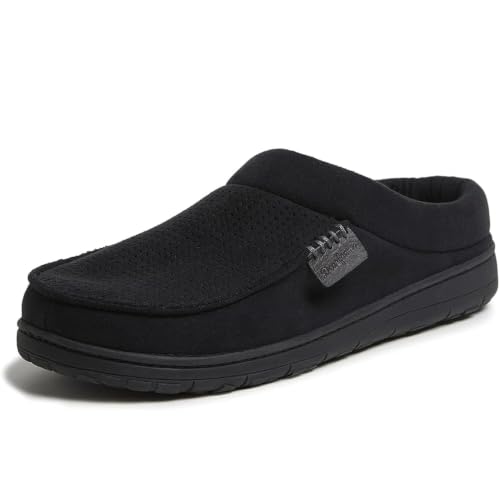
Dearfoams Men’s Brendan Breathable Clog Slipper — Best Breathable Clog
The Brendan takes the other route to a fresher slipper: ventilation. The verified listing describes a men’s indoor/outdoor breathable memory foam clog house shoe with wide widths, in black perforated. Those perforations are the point — a clog already vents at the open heel, and a perforated upper lets heat escape over the top of the foot too, so the inside of the slipper dries between wears instead of staying at foot temperature and humidity all day.
The clog format suits men who dislike the slipper look: it reads as a casual house shoe, slips on hands-free, and the wide-width availability is a genuine comfort feature for broader feet that get squeezed — and sweatier — in standard widths. Memory foam provides the cushioning, per the listing, so this is not a hard garden clog; it is a padded house shoe with holes in the right places.
It is not the pick for cold floors in winter, because the same airflow that keeps it fresh keeps it cool, and the listing does not claim washability, so its odor strategy is drying rather than laundering. Pair it with the washable RockDove above and you have the classic two-pair rotation: one breathes, one washes.
The Brendan’s perforations reward one care habit of their own: shake and tap the pair out weekly, because the same holes that vent heat admit dust and crumbs, and a clog with debris in its perforations breathes at half strength. A rinse and a full air-dry restores it. Wearers in dusty or pet-heavy homes will notice the difference this thirty-second routine makes by the second month.
Strengths
- Perforated breathable upper stated in the listing
- Open clog shape vents at heel and top
- Wide widths available for broader feet
Trade-offs
- Airflow means minimal winter warmth
- Washability not stated on the verified listing
- Clog style is casual, not smart
| Detail | What the listing states |
|---|---|
| Odor mechanism | Breathable perforated upper |
| Cushioning | Memory foam (as listed) |
| Fit | Wide widths (as listed) |
| Style | Clog, indoor/outdoor |
Best for: hot feet and wide feet in milder homes / Not suited for: cold-floor winters or a wash-only strategy

EitCaton Unisex Linen House Slippers — Best Linen Everyday Pair
Linen has been the summer fabric for centuries for a reason: it absorbs moisture and releases it again instead of holding it against the skin. The EitCaton listing confirms a unisex linen house slipper in a cotton fabric described as breathable, in an open-toe style with memory foam, a soft non-slip bottom and machine washable care. That is three odor mechanisms in one modest slipper — absorbent natural fabric, open-toe airflow, and full washability.
The open-toe design makes it a three-season slipper: warm enough with the fabric upper for spring and autumn evenings, airy enough for summer. The verified listing is the navy version sized 9-10 women / 7-8 men, a genuinely unisex cut, which makes it a sensible household spare pair for guests as well as a daily driver. Memory foam in an open-toe slipper is a pleasant surprise at this tier and keeps it comfortable on hard floors.
Natural fabric has one honest weakness: it wears and softens faster than synthetics, and the light construction is a house slipper, not an outdoor shoe despite the listing’s casual-wear framing. Wash it as the listing allows, dry it fully, and it will stay fresher than any sealed slipper you own.
The EitCaton’s unisex cut makes it the natural household utility player: the pair by the door for guests, the spare pair in the linen closet, the travel pair in a suitcase — linen packs flat in a way no foam winter slipper can. Every household role that involves intermittent, shared or travel wear is an odor-risk role, and a washable natural-fibre slipper is precisely the tool for all of them.
Strengths
- Cotton-linen fabric absorbs and releases moisture
- Breathable open-toe design, stated in listing
- Machine washable, with memory foam comfort
Trade-offs
- Natural fabric wears faster than synthetics
- Open toe gives toes no protection or warmth
- Light build is for indoor use
| Detail | What the listing states |
|---|---|
| Odor mechanism | Breathable linen + machine washable |
| Style | Open-toe, unisex |
| Cushioning | Memory foam (as listed) |
| Colour verified | Navy |
Best for: natural-fibre fans and guest-spare duty / Not suited for: heavy outdoor use or winter warmth

Japanese Style Linen House Slippers, Open Toe — Best Minimal Summer Slipper
Sometimes the best anti-odor design is the least slipper at all. This Japanese style linen house slipper’s verified listing describes an open toe, breathable, lightweight indoor home shoe with an anti skid sole, soft and easy to wear, for women and men. With this little material around the foot, there is almost nowhere for moisture to hide: the foot is mostly in open air, the linen footbed wicks what it touches, and the whole thing dries fast after a rinse or a day of wear.
The minimalist shape suits warm homes, tatami and wood floors, and people who find padded slippers sweaty within the hour. It is also the easiest style here to keep clean — a light hand-wash or rinse and an hour of air is a full refresh, no laundry cycle required, though the listing does not make formal wash claims so we describe care conservatively.
The trade is cushioning and warmth: this is a thin, quiet house slipper for warm floors and warm weather. If your floors are cold or you stand for long stretches cooking, the washable memory foam picks above will serve you better. As the summer half of a two-pair rotation, it is close to unbeatable on freshness per effort.
Minimalist slippers like this one have one more freshness advantage that never appears in listings: there is almost nothing to wear out. No foam to pack down, no lining to separate, no plush to mat — the failure mode of a padded slipper simply does not exist here. What you are buying is closer to a washable floor sandal in spirit, and for warm-climate wearers it can be the last style of house slipper they ever need to think about.
Strengths
- Open-toe minimal design — maximum airflow
- Linen construction, breathable per the listing
- Lightweight with an anti skid sole
Trade-offs
- Thin cushioning for long standing
- Little warmth for cold floors
- Formal washability not stated on the listing
| Detail | What the listing states |
|---|---|
| Odor mechanism | Open-toe breathable linen design |
| Style | Open-toe, unisex |
| Sole | Anti skid (as listed) |
| Weight | Lightweight (as listed) |
Best for: warm homes, wood and tatami floors, summer wear / Not suited for: cold floors or long hours standing
Comparison Table
| Pick | Badge | Key spec | Best for |
|---|---|---|---|
| Odor-Resistant Japanese Bamboo House Slippers | Best Overall | Odor-resistant bamboo, open summer style | warm homes and anyone whose padded slippers always turn |
| RockDove Women’s Birdseye Knit Memory Foam Slippers | Best Washable for Women | Breathable knit, memory foam, machine washable | barefoot daily wearers who will actually wash their slippers |
| RockDove Men’s Original Two-Tone Memory Foam Slipper | Best Washable for Men | Memory foam, machine washable, knit upper | men who wear one pair of slippers all day, every day |
| Dearfoams Men’s Brendan Breathable Clog Slipper | Best Breathable Clog | Perforated breathable upper, wide-width clog | hot feet and wide feet in milder homes |
| EitCaton Unisex Linen House Slippers | Best Linen Everyday Pair | Linen cotton, open-toe, machine washable | natural-fibre fans and guest-spare duty |
| Japanese Style Linen House Slippers, Open Toe | Best Minimal Summer Slipper | Open-toe linen, breathable, anti skid sole | warm homes, wood and tatami floors, summer wear |
Why Slippers Smell: The Three Causes You Can Actually Control
Slipper odor is a moisture story before it is anything else. Feet sweat into the lining, the lining stays warm and damp, and odor builds in that trapped moisture. Sealed synthetic linings — the plush faux fur in many winter slippers — are the worst environment: warm, wet and rarely washed. Every effective countermeasure attacks one of three points: keep moisture from accumulating (breathable and open designs), use a surface that does not hold moisture (bamboo and smooth materials), or remove the moisture and what grows in it on a schedule (machine washing).
That is why this guide contains no promise that a slipper will never smell. Even the best design only slows accumulation; washing is the reset. The realistic goal is a slipper that stays fresh for weeks between washes instead of days, and that survives washing when its turn comes. If a listing promises permanent odor elimination with no mechanism stated, treat the promise as decoration.
Breathable vs Washable vs Odor-Resistant: Choosing Your Strategy
Breathable designs — perforated uppers, knit fabrics, open toes — work passively every day and suit people with hot feet in mild or warm homes. Their limit is winter: airflow is the opposite of insulation. Washable designs suit barefoot daily wearers in any season, because the wash resets what breathability only slows; their limit is discipline, since a washable slipper that never gets washed is just a slipper. Odor-resistant materials like the bamboo pick suit people who want the lowest-maintenance option and wear slippers mostly in warm conditions.
The strongest setup, used by people who never seem to have the problem, is a rotation: a breathable summer pair and a washable cushioned pair, each resting and drying while the other works. Two mid-priced pairs rotated will outlast and out-smell — in the good way — one premium pair worn every single day.
Sizing and Fit for Fresher Feet
Fit is an underrated odor factor. A slipper that is too small compresses the foot, reduces airflow and makes feet sweat harder; a slipper far too large makes the foot work and slide, generating friction heat. Aim for a thumb’s width of room, an upper that touches without squeezing, and a heel that stays put without gripping. Wide-width models like the Dearfoams clog exist for a reason — broad feet in standard slippers are a sweat recipe.
Socks change the equation too. A thin sock absorbs the sweat that would otherwise soak the lining, and socks are trivially washable. Barefoot purists should lean hardest into washable picks; sock wearers can prioritise breathability, since the sock is doing the absorption work.
Slipper Odor by Season: Why Summer and Winter Need Different Pairs
The slipper that fails in August is usually innocent in January. Summer odor is a sweat-volume problem: bare feet, warm floors and long wearing hours push moisture into any lining faster than overnight drying can remove it, which is why the open, breathable and bamboo picks exist. Winter odor is a sealing problem: closed plush slippers worn with heating-dried air should dry well, but they are worn for more hours, rarely washed because they are always in use, and their thick linings hold a deep reservoir that a surface sniff underestimates.
The practical conclusion is the two-season wardrobe this guide keeps returning to: an airy pair owning the warm months, a washable cushioned pair owning the cold ones, each resting half the year and being washed at the season change. A slipper that rests for months, fully dry, starts its season reset in a way no continuously worn pair ever does. Buyers who insist on one pair year-round should buy the washable foam picks and accept the laundry discipline as the price of the arrangement.
Households with heated floors should be especially careful with winter pairs: constant gentle warmth feels wonderful and quietly incubates whatever moisture the lining holds. Stand winter slippers on their sides or on a rack overnight rather than flat on the warm floor, and the same heat that dries the top will not be stewing the lining.
What About Odor Sprays, Insoles and Home Remedies?
They have their place — as maintenance, not resurrection. A fabric-safe deodorising spray on a slipper that is merely tired can buy a week; baking-soda-style dry treatments can pull surface odor from a washable pair between cycles. What none of them do is remove the moisture reservoir inside packed foam, which is why remedies disappoint on old slippers and work fine on young ones. The order of operations is always: wash if washable, dry completely, then treat what remains.
Replacement insoles are the one accessory with real leverage, on slippers built to accept them: the insole is where sweat lands first, and a fresh washable insole inside a sound slipper is a legitimate second life. But insoles cannot rescue a slipper whose lining itself has turned — at that point the honest remedy is the one in our care section: retire the pair. Money spent deodorising a finished slipper is money taken from its replacement.
The cheapest remedy of all remains the unglamorous one from the care steps: air, rotation and time. A slipper rested 24 hours between wears accumulates odor at a fraction of the rate of a daily-driven pair, and no product on a shelf outperforms that arithmetic.
Reading Slipper Listings for Odor Claims: A Field Guide
Odor language in listings sorts into three honesty tiers. The top tier states a mechanism — odor-resistant material, breathable construction, machine washable — in the title itself, as every pick in this guide does; you can reason about whether the mechanism suits your life. The middle tier uses freshness adjectives with no mechanism attached; treat those as decoration. The bottom tier promises outcomes — never smells, odor-proof forever — which no slipper can deliver, and which should lower your trust in everything else the listing says.
Apply the same reading to the words around odor: antimicrobial and antibacterial are technical claims that we only repeat when a verified title states them, and even then they describe a treatment of the material, not a lifetime guarantee. Natural-fibre claims deserve a look at the actual fibre — linen and bamboo earn their reputation through moisture behaviour, while a synthetic “bamboo-style” print earns nothing.
Your own evidence outranks all of it. The slippers you have owned tell you which mechanism your feet need: if your pairs die damp, buy breathability; if they die despite drying, buy washability; if they die in summer only, buy the open pair. Listings propose — your laundry basket disposes.
Household Variables: Floors, Heating, Pets and Laundry Access
Two people can own the same slipper and get opposite results, because odor lives in the household as much as in the footwear. Homes with hard floors and underfloor heating dry slippers fast and forgive almost any design; carpeted, cooler homes keep linings damp longer and punish sealed constructions. Pet households add a second moisture and hair load that pushes washability from a preference to a requirement — a slipper that cannot be laundered in a dog household is a slipper on a countdown.
Laundry access is the variable nobody lists: a home with a machine in the kitchen makes the washable strategy nearly free, while a household relying on a weekly launderette trip should weight breathability and rotation more heavily, because the wash cycle that anchors the strategy is genuinely costly in effort. Read this guide’s picks through your own infrastructure, not through an idealised one.
Finally, wearer count matters: a slipper worn by one person dries into one person’s pattern, while shared household slippers — the guest pair, the door pair — accumulate from multiple feet and should always be the washable, natural-fibre kind. Match the mechanism to the household, and the slipper will do the rest.
Travel and Guest Duty: The Slippers Nobody Thinks About
Two slipper roles quietly generate a household’s worst odor outcomes. The travel pair lives in a suitcase between trips — packed damp once, it marinates for a month and emerges as evidence. The rule for travel is absolute: only pack a fully dry pair, favour the linen and bamboo styles that pack flat and dry fast in a hotel room, and unpack the pair to air the day you return, whether or not it was worn.
The guest pair has the opposite problem: many feet, no owner, no routine. A shared pair should be the most washable object in the house — the EitCaton linen or a washable RockDove — laundered between guests the way the guest towels are, without ceremony. Households that treat guest slippers as textiles, on the same cycle as the bedding they accompany, never have the faint embarrassment of offering a visitor a pair with a history.
Both roles reward the same buying instinct that built this guide: choose the mechanism that survives the role’s reality. A suitcase wants dry-and-flat; a guest room wants wash-and-forget. The slippers that fail these jobs are always the plush, sealed, unwashable kind — however lovely they were in the shop.
A Word on Feet Themselves: The Half of the Equation You Own
Every mechanism in this guide manages the slipper; the other half of the system is the foot. Feet dried properly after washing — including between the toes — start each slipper session dry instead of damp, and that single habit delays odor in any pair more than any material upgrade. Rotating socks, when socks are worn, and changing out of work shoes promptly at home both reduce the moisture load a house slipper inherits at the start of its shift.
None of this is medical advice and none of it needs products: it is moisture bookkeeping. The slipper can only release what it receives slowly; a foot that arrives dry and a slipper that rests dry will out-perform, on freshness, a premium pair subjected to the opposite routine. Buy the mechanism, then be the other half of it.
The One-Week Freshness Audit: Testing Your Current Pair
Before replacing anything, audit what you own. Wear your current slippers normally for a week while applying only the free interventions — nightly airing in open room air, no closet storage, a full rest day midweek if you can manage it. At the week’s end, smell the pair cold, first thing, before they are worn: that cold sniff is the honest measurement, because a warm slipper always smells worse than its true state.
If the audit passes — neutral when cold — your problem was routine, not product, and this guide becomes your maintenance manual rather than your shopping list. If it fails, note how it fails: damp at day’s end points to breathability, odor despite dryness points to washability, summer-only failure points to the open pair. Then buy the pick that answers the failure you actually measured.
How to Keep House Slippers Smelling Fresh
The routine below works for every pick in this guide and doubles the useful fresh life of any house slipper.
- Air them out nightly: leave slippers in open air, not in a closed closet or under the bed, so the day’s moisture can actually leave.
- Rotate pairs if you wear slippers all day — 24 hours of rest dries a slipper far better than a night on a warm foot-warmed floor.
- Wash washable models every two to four weeks of daily barefoot wear, cold and gentle, then air-dry completely before wearing; never wear a damp slipper.
- Rinse or wipe down bamboo and linen styles regularly and let them dry in moving air, out of direct harsh sun.
- Tackle early odor promptly with a fabric-safe deodorising routine and a full dry — odor left for a month becomes the slipper’s permanent character.
- Retire honestly: when a wash no longer resets a slipper, the lining has reached the end of its life and replacement is the real fix.
None of this needs specialty products. Air, time, water and a wash cycle are the whole toolkit — the picks above were chosen because their stated construction works with that toolkit instead of against it.
Common Buying Mistakes
Believing a “never smells” promise
No slipper worn on bare feet stays odor-free forever. Buy the mechanism — breathable, washable, resistant — not the slogan, and plan the small routine that keeps the mechanism working.
Wearing one sealed pair every day, all year
A single plush synthetic pair worn daily never fully dries, and undried is unsmelly-proof. Rotation is the cheapest odor technology there is.
Never washing a washable slipper
Machine washable only helps if the machine gets used. Put slippers on the same mental schedule as bedding: regular, unremarkable, done.
Wearing slippers straight from the wash
A damp slipper on a warm foot is an odor incubator with a head start. Air-dry fully — foam models can take a full day — before the next wear.
Buying too small for a “snug” feel
Compression kills airflow and raises sweat. Fresh feet need room; size for comfort, not for a locked-in athletic fit.
Final Recommendation
If you want the closest thing to a set-and-forget answer, the odor-resistant bamboo slipper is the pick — it is the only design here whose listing leads with odor resistance. For cushioned everyday comfort, choose by your strategy: the RockDove pair for women and men if you will wash them, the Dearfoams clog if your feet run hot and wide, and the linen picks if your home is warm and your floors are kind. The two-pair rotation — bamboo or linen for summer, washable foam for winter — is the setup we would buy with our own money.
More slipper reading from the same programme: Best Anti Odor Slippers takes the dedicated anti-odor angle, Best Breathable Slippers Women goes deeper on airflow designs for women, and Best Asian House Slippers covers the minimalist house slipper tradition behind two of these picks.
A final practical word: keep this guide’s mechanism test in your pocket for every future footwear purchase, not just slippers. Shoes, trainers and boots all make freshness claims, and the same three tiers apply — stated mechanism, vague adjective, impossible promise. A buyer who can sort those tiers at a glance will never again pay a premium for a slogan, in this category or any other.
Best Anti Odor Slippers Best Breathable Slippers Women Best Asian House Slippers
Frequently Asked Questions
Can slippers really be odor-proof?
No — and this guide does not claim otherwise. Slippers can be odor-resistant, breathable or washable, which together keep odor away for far longer, but any slipper worn barefoot daily will eventually need a wash or a rest. Buy the mechanism, keep the routine.
How often should I wash house slippers?
For daily barefoot wear, every two to four weeks is a sensible rhythm for machine washable models. Wash sooner if they feel damp at the end of the day or carry any smell when cold — odor noticed cold is odor that has set in.
Are open-toe slippers better for odor?
For warm homes, yes: open toes maximise airflow, which is the passive half of odor control. In cold homes the trade-off flips, and a washable closed slipper that gets laundered regularly will stay fresher than an open slipper worn with cold, sockless feet only in summer.
Does bamboo really help with slipper smell?
The verified listing for our top pick states odor-resistant bamboo construction and an easy-clean design. The logic is sound: a smooth, hard surface holds less moisture than a fabric lining, and moisture is what odor needs. We report the listing’s claim and the mechanism; we do not promise miracles.
Why do my slippers smell even after washing?
Usually because they were worn again before fully drying, or because the odor had months to set into foam that a gentle cycle cannot fully reach. Dry completely — a full day for foam — and wash earlier next time. If a thorough wash and full dry no longer resets them, the lining is spent.
Should I wear socks with slippers to reduce smell?
It genuinely helps: the sock absorbs sweat and is washed far more often than any slipper. If you prefer barefoot wear, lean into the washable and breathable picks and keep the rotation habit.
Do odor-resistant slippers still need washing?
Eventually, yes — resistance slows accumulation, it does not repeal it. The bamboo pick in this guide is also easy to clean by design, and a periodic rinse plus full drying keeps its resistance working at full strength for far longer.
Why do slippers smell worse than shoes?
Because shoes get aired, rotated and worn with socks, while slippers get worn barefoot, daily, and stored warm. The slipper’s job conditions are simply harsher — which is why mechanism-first buying and rotation matter more here than in any other footwear you own.

