Disclosure: airfryerkitchensupply.com is reader-supported. When you buy through links on our site, we may earn an affiliate commission at no extra cost to you.
Where to buy
Every purifier below is sold on Amazon, and the listing is where you confirm the two numbers this category is judged by: the stated noise level on its quiet setting, and the room size it is rated to cover. Read both together — a quiet figure without coverage is meaningless — and check price on Amazon when you order.
- BLUEAIR Blue 311i Max — check price on Amazon
- BLUEAIR Blue 211i Max — check price on Amazon
- LEVOIT Vital 200S-P Smart Air Purifier — check price on Amazon
- BLUEAIR Blue Pure 511 — check price on Amazon
- LEVOIT Smart WiFi Air Purifier (Quiet 24dB Sleep Mode) — check price on Amazon
- Rabbit Air MinusA2 SPA-780N — check price on Amazon
Introduction: “Silent” Is a Trade, and This Guide Prices It Honestly
The best silent air purifiers all make the same bargain, and a good guide should state it before selling you anything: a purifier cleans air by moving it through a filter, moving air takes a fan, and fans make noise — so the quietest setting on every machine here moves the least air. Silence and maximum cleaning speed cannot coexist in one moment. What the best designs do is manage the trade intelligently: filtration that needs less fan pressure (Blueair’s HEPASilent approach), sleep modes tuned for bedrooms, and auto modes that whisper when the air is clean and work harder only when it is not. Bought with that understanding, a quiet purifier is a genuinely life-improving appliance. Bought expecting turbo performance at whisper volume, every machine in this category will disappoint you.
A note on framing, because this site is careful with it: the picks here are comfort appliances. They reduce the dust that settles on your shelves, the odours that linger after cooking, the pet hair floating in a sunbeam, and they make a bedroom feel fresher to sleep in. This guide makes no medical claims for them — no promises about conditions, symptoms or health outcomes — because that is neither what the evidence in a listing supports nor what a buying guide should sell. Judged as comfort and air-quality machines for real rooms, these six are the verified shortlist.
Every pick was confirmed against a live Amazon listing, and the decibel figures quoted are the ones the listings themselves state for their quiet settings. They split into a clear shape: two 23dB Blueair Max models for whole rooms, a 24dB compact Blueair for small rooms, two smart Levoits at 24–27dB for bedrooms and pet homes, and one premium wall-mountable design from Rabbit Air.
In this guide
Quick Picks
Six verified quiet air purifiers, from a compact nursery machine to a large-room flagship. Badges match the reviews below.
- BLUEAIR Blue 311i Max — Best Overall — check price on Amazon
- BLUEAIR Blue 211i Max — Best for Large Rooms — check price on Amazon
- LEVOIT Vital 200S-P Smart Air Purifier — Best for Bedrooms — check price on Amazon
- BLUEAIR Blue Pure 511 — Best Compact — check price on Amazon
- LEVOIT Smart WiFi Air Purifier (Quiet 24dB Sleep Mode) — Best for Pet Households — check price on Amazon
- Rabbit Air MinusA2 SPA-780N — Best Premium — check price on Amazon
How These Picks Were Chosen
The first filter was the listing’s own stated noise figure for its quiet or sleep setting — every pick here states 27dB or below, and most state 23–24dB, which is the range where a purifier genuinely disappears into a bedroom’s background. Machines that were merely “quiet-ish” in marketing language without a stated figure were excluded. The second filter was coverage honesty: each pick’s rated room size is quoted alongside its decibels, because a silent machine that cannot serve your room will be run on a louder speed and serve neither purpose. The third was filtration credibility — HEPA-class filtration, with AHAM verification noted where the listing states it.
We then spread the six across the real decisions: small room versus large, simple controls versus app ecosystems, floor-standing versus wall-mounted, and mainstream tiers versus the premium design pick. Prices are never printed (check price on Amazon; filter replacements are part of ownership on every sealed-filter machine), and no fixed star ratings or review counts appear anywhere, per this site’s standing rules.
The 6 Best Silent Air Purifiers

BLUEAIR Blue 311i Max — Best Overall
The Blue 311i Max is the purifier we would put in most rooms, because it refuses the category’s usual compromise. Most quiet purifiers are quiet because they are small; the 311i Max pairs a 23dB low setting with coverage rated for rooms up to 2,107 square feet, which means the quiet speed is a working speed for a real bedroom or living room rather than a night-light setting that barely stirs the air. Blueair’s HEPASilent approach — combining electrostatic and mechanical filtration — is exactly how it manages that: less fan pressure is needed to move air through the filter, and fan pressure is where purifier noise is born.
Strengths
- The listing’s headline number is the one this search cares about: 23dB on its quiet setting, which is genuinely whisper territory for a full-size purifier
- Coverage up to 2,107 sq ft means the quiet speed still serves a real room, not just the corner it sits in
- Washable pre-filter keeps the consumable cost and hassle down — vacuum or rinse it instead of replacing it
Trade-offs
- Like every purifier here, the quietest speed moves less air than turbo — the trade is physics, and the auto mode exists to manage it for you
- WiFi and app features are only a virtue if you use them; the machine also runs perfectly well from its own controls
- Replacement main filters are an ongoing cost of ownership to plan for, as with all sealed HEPA-class machines
Key specs: HEPASilent filtration; stated quiet level 23dB; coverage up to 2,107 sq ft; WiFi; auto mode; washable pre-filter (per Amazon listing title).
In a bedroom, the lived experience is what matters: on its low setting the 311i Max recedes below the level of normal room tone, the sort of sound your ear stops reporting within minutes. Auto mode handles the rest of life — cooking drift, a dusty day, the dog shaking itself beside the sofa — by speeding up when the sensor sees particles and settling back down when the air clears. That automation is the correct answer to the quiet-versus-effective trade: you should not have to choose a speed and live with it; the machine should be quiet when the air is clean and busy only when it needs to be.
Ownership is straightforward: the washable pre-filter takes the hair and fluff, the main filter is the periodic replacement to budget for qualitatively, and the footprint suits a corner without dominating it. Verified, this is the balanced default for the keyword — quiet first, but not only quiet.
Best for: Most bedrooms and living spaces that want quiet plus coverage / Not suited for: Anyone wanting the absolute smallest footprint
Check on Amazon — check the current price on Amazon and confirm the drain finish and delivery options for your bathroom.

BLUEAIR Blue 211i Max — Best for Large Rooms
Open-plan living is where quiet purifiers usually give up. The room is big, the purifier must move serious air, and serious air has historically meant audible fan noise right where the family sits to read and talk. The Blue 211i Max exists for that room: it carries the same 23dB HEPASilent quiet setting as its smaller sibling while covering spaces up to 3,235 square feet, which makes it one of the very few machines that can serve a combined kitchen-living area without becoming part of the soundscape.
Strengths
- Same 23dB quiet character as the 311i Max, scaled to rooms up to 3,235 sq ft — the rare large-room purifier that does not sound like one
- Auto mode plus WiFi control suits open-plan spaces where the machine sits far from where you sit
- A recognised editor’s-pick lineage in this category per the listing
Trade-offs
- Oversized and over-specified for a small bedroom — buy the 311i or the 511 there and save the difference
- Larger machine, larger replacement filters: the running costs scale with the coverage
- Its quiet speed in a huge room still moves less air than its turbo — large rooms need the auto mode trusted, not overridden
Key specs: HEPASilent filtration; stated quiet level 23dB; coverage up to 3,235 sq ft; WiFi; auto mode (per Amazon listing title).
The way to live with it is to trust the automation. Place it where air circulates freely (the setup section covers placement), leave auto mode on, and let it surge when cooking or a dusty day demands and whisper the rest of the time. Owners who pin a purifier to a fixed medium speed get neither the quiet nor the cleaning; owners who let the sensor drive get both, at different moments, which is the only honest way both exist.
Choose it when the room is genuinely large — a primary suite with a sitting area, an open-plan ground floor, a big family room. In a standard bedroom it is money and footprint spent on coverage you will never use, and the 311i Max will serve you identically at a lower tier. That discipline — matching machine to room — matters more to your satisfaction than any feature list.
Best for: Open-plan living areas and large primary bedrooms / Not suited for: Small bedrooms, where it is more machine than the room needs
Check on Amazon — check the current price on Amazon and confirm the drain finish and delivery options for your bathroom.

LEVOIT Vital 200S-P Smart Air Purifier — Best for Bedrooms
The Vital 200S-P is the bedroom specialist from the other great school of quiet purification. Where Blueair competes on the lowest decibel figure, Levoit competes on the complete night-time experience: a stated 27dB quiet level, a proper air quality monitor with a visible readout, app control for schedules and filter status, and coverage up to 1,875 square feet that lets one machine serve a large primary bedroom and its dressing area without straining.
Strengths
- The listing rates it at 27dB for quiet bedroom use — a touch above the Blueair pair, but with an air quality monitor that shows you what the machine is doing
- Coverage to 1,875 sq ft is generous for a bedroom-focused machine, so the sleep speed still does real work
- Levoit’s app ecosystem is among the easiest to live with for schedules, timers and checking filter life
Trade-offs
- 27dB is quiet, not silent — the most noise-sensitive sleepers should compare the 23–24dB picks first
- Display lights matter in bedrooms; check the listing’s display-off or sleep behaviour if you need true darkness
- Smart features assume a home WiFi network and an app account — friction some households prefer to skip
Key specs: Stated quiet level 27dB; coverage up to 1,875 sq ft; air quality monitor; HEPA sleep mode; smart control (per Amazon listing title).
That monitor deserves more credit than it usually gets. A purifier is an appliance whose work is invisible, and the households that keep using theirs for years are the ones that can see it working — the readout spiking when the door opens on a dusty day, settling as the machine clears the room. It converts faith into feedback. The app’s scheduling is the other quiet feature in disguise: set the machine to run a stronger cycle in the hour before bed, then drop to its sleep level as you get in, and you get a pre-cleaned room at the quietest setting — the correct sequencing trick, built in.
The honest comparison is the decibel line: at 27dB this is a very quiet machine, but the Blueair picks on this list are quieter still on paper. Extremely light sleepers should start there; everyone else may find the Levoit’s visibility and app polish worth more than the last few decibels. Either way, this is a verified, AHAM-rated machine from the category’s mainstream — a safe pair of hands.
Best for: Light sleepers who want app control and an air quality display / Not suited for: Anyone who needs the lowest possible noise floor above all else
Check on Amazon — check the current price on Amazon and confirm the drain finish and delivery options for your bathroom.

BLUEAIR Blue Pure 511 — Best Compact
The Blue Pure 511 is the answer for the rooms the big machines cannot sensibly serve: the nursery, the box-room office, the student dorm, the small bedroom where a full-size purifier would be furniture. Its stated 24dB quiet level is remarkable in a compact body — quieter, on paper, than many machines three times its size — because the HEPASilent approach scales down well and the room it serves is small enough that its low speed is a working speed.
Strengths
- The smallest footprint here, with a stated 24dB quiet level — a compact machine that is quieter than many full-size rivals
- Coverage to 907 sq ft suits nurseries, small bedrooms, studies and dorm rooms exactly
- Washable pre-filter and simple controls make it the low-fuss pick for a child’s room or a guest room
Trade-offs
- Coverage is the ceiling: in a large living room it will run hard, get louder, and still under-serve the space
- Fewer smart features than the Max models — this is the simple, set-and-forget branch of the family
- Compact filters are replaced on the same kind of schedule as big ones; small machine, same consumable reality
Key specs: HEPASilent filtration; stated quiet level 24dB; coverage up to 907 sq ft; washable pre-filter; compact format (per Amazon listing title).
In a nursery or child’s bedroom, the priorities rearrange themselves: you want the machine simple, stable, quiet and out of the way, with a washable pre-filter because household dust and fluff are the daily load. The 511 is exactly that appliance. It is also the natural second purifier for a household that owns a big machine for the living area and discovers, as most do, that the bedroom is where air quality is actually felt — eight hours of breathing one room’s air outweighs an evening in another’s.
Respect its coverage honestly: up to 907 square feet per the listing, and happiest well inside that. Put it in a large open-plan space and it will spend its life on higher, louder speeds doing a mediocre job — the classic misapplication that makes people conclude purifiers do not work. In its proper room, it is the easiest recommendation on this list.
Best for: Nurseries, small bedrooms, home offices and dorms / Not suited for: Large or open-plan rooms, where its coverage runs out
Check on Amazon — check the current price on Amazon and confirm the drain finish and delivery options for your bathroom.
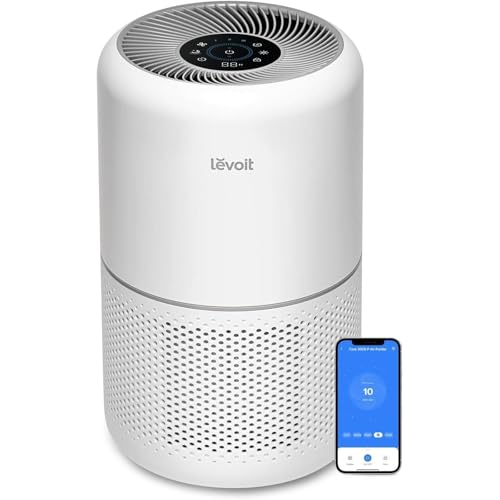
LEVOIT Smart WiFi Air Purifier (Quiet 24dB Sleep Mode) — Best for Pet Households
Pet ownership is the most common real-world reason a purifier gets bought, and the least compatible with noise: the machine needs to work hardest exactly where the animals are, which is usually where the people are trying to sleep. This Levoit’s listing answers with a stated 24dB sleep mode — properly quiet — inside an AHAM-verified HEPA machine with smart controls, which is the complete pet-household specification in one product.
Strengths
- The listing leads with what pet households need: a stated 24dB sleep mode, so the machine can live in the bedroom the dog sleeps in
- HEPA filtration with AHAM verification — the dander and hair load is handled by the pre-filter and main filter working as a system
- Smart WiFi control lets you run a strong cycle while you are out and arrive home to clean, quiet air
Trade-offs
- Pet hair shortens filter life in direct proportion to how furry your household is — budget replacements qualitatively and keep the pre-filter clean
- A purifier manages airborne hair and dander; it does not vacuum the sofa, and expectations should be set accordingly
- App-connected, like the other Levoit here — households avoiding smart appliances should take the Blueair 511 route instead
Key specs: Stated quiet sleep mode 24dB; HEPA filtration; AHAM Verifide; smart WiFi (per Amazon listing title).
The routine that makes it work is unglamorous and worth stating: the pre-filter is your first defence and needs regular vacuuming or washing, because a pre-filter blinded with hair forces the fan to work harder and louder for the same result — noise in an older purifier is often just a dirty filter asking for attention. Run the stronger speeds while the household is out or active, let sleep mode carry the night, and the airborne share of pet life — the floating hair, the dander, the litter dust — drops to a level visitors notice by its absence.
Frame expectations correctly, as this guide does throughout: a purifier improves the air’s comfort — less dust settling, fewer odours lingering, a fresher-feeling room. It is a comfort appliance for the home environment, and judged on that ground, for pet households, this is the pick.
Best for: Pet owners who need hair and dander control that stays quiet overnight / Not suited for: Anyone avoiding app-connected appliances on principle
Check on Amazon — check the current price on Amazon and confirm the drain finish and delivery options for your bathroom.

Rabbit Air MinusA2 SPA-780N — Best Premium
The Rabbit Air MinusA2 is the connoisseur’s answer to this search: a slim, wall-mountable purifier designed from the first sketch for quiet rooms, finished like furniture rather than appliances, and priced accordingly. In its SPA-780N form it adds WiFi to a design that has been the premium benchmark in this category for years, and its ultra-quiet brief is structural — a machine intended to hang in a bedroom or a study cannot afford to announce itself, and this one does not.
Strengths
- Ultra-quiet is the design brief, not a setting: the MinusA2 was built for bedrooms and quiet rooms from the start
- Wall-mountable — the only pick here that can leave the floor entirely, which changes both the look and the airflow of a room
- A long-established premium design with a multi-stage filter array and WiFi control in this N variant
Trade-offs
- Premium tier in every sense, including its replacement filter sets — the most expensive ownership on this list
- Wall mounting needs a suitable wall and a permanent decision about placement; renters should think twice
- Its filtration array targets a broad range of household air concerns, which is more machine than a simple dust problem requires
Key specs: Ultra-quiet design; HEPA filtration; WiFi enabled; wall mountable (per Amazon listing title).
Wall mounting is the feature that reorganises a room. Off the floor, the purifier stops competing with furniture, stops being kicked and vacuumed around, and sits at a height where air circulation is often better. For a primary bedroom designed with intention, or a quiet work room where floor space is planned, that is worth real money. The multi-stage filtration is the other half of the premium story, aimed at households whose air concerns run beyond dust to cooking odours and general household freshness.
The discipline is financial honesty: the purchase tier is premium and the filter sets follow it, so buy this machine because its design and placement solve your room’s problem, not as a default upgrade. If it does solve your problem, it is the most satisfying purifier on this list to live with — silent in the ways that matter, invisible in the ways that count.
Best for: Design-conscious rooms and anyone wanting a wall-mounted option / Not suited for: Budget-first buyers or renters who cannot wall-mount
Check on Amazon — check the current price on Amazon and confirm the drain finish and delivery options for your bathroom.
Comparison Table
| Pick | Badge | Key spec | Best for |
|---|---|---|---|
| BLUEAIR Blue 311i Max — check price on Amazon | {p[“badge”]} | {p[“keyspec”]} | {p[“bestfor”]} |
| BLUEAIR Blue 211i Max — check price on Amazon | {p[“badge”]} | {p[“keyspec”]} | {p[“bestfor”]} |
| LEVOIT Vital 200S-P Smart Air Purifier — check price on Amazon | {p[“badge”]} | {p[“keyspec”]} | {p[“bestfor”]} |
| BLUEAIR Blue Pure 511 — check price on Amazon | {p[“badge”]} | {p[“keyspec”]} | {p[“bestfor”]} |
| LEVOIT Smart WiFi Air Purifier (Quiet 24dB Sleep Mode) — check price on Amazon | {p[“badge”]} | {p[“keyspec”]} | {p[“bestfor”]} |
| Rabbit Air MinusA2 SPA-780N — check price on Amazon | {p[“badge”]} | {p[“keyspec”]} | {p[“bestfor”]} |
How to Choose a Quiet Air Purifier
Read decibels like a skeptic. The figure that matters is the noise on the lowest or sleep setting, stated by the listing — and it should be read beside the coverage, because that low speed delivers a fraction of the machine’s maximum air changes. A purifier rated for a room much larger than yours can live on its whisper setting and still serve the room; a purifier rated exactly at your room’s size will need its middle speeds, and its middle speeds are not silent. This is the single most useful buying rule in the category: oversize the coverage, undersize the noise. It is why the 311i Max, rated far beyond a normal bedroom, is such a restful bedroom machine.
Next, filtration approach. Machines that combine electrostatic with mechanical filtration (HEPASilent designs) move air through the filter with less resistance, which is a structural quiet advantage. Pure mechanical HEPA machines from good makers compensate with well-designed fans and sleep modes — the Levoits here prove that route works too. Either way, insist on genuine HEPA-class filtration and treat unverified novelty technologies as marketing until proven otherwise.
Then the bedroom details, which decide satisfaction at 3 a.m.: display lights that dim or switch off, a sleep mode you can reach without an app, controls that do not beep, and a physical size that fits the corner you actually have. Finally, ownership: every sealed-filter purifier consumes replacement filters on a schedule, and the honest cost of the machine is its purchase tier plus those replacements over the years — check the filter situation on the listing before the machine charms you out of the maths.
How to Set Up a Purifier for the Quietest Result
Placement is free performance. Put the purifier where air can reach it and leave it: at least a small clearance from walls and curtains on the intake sides, away from the corner’s dead air, and — for bedrooms — across the room from the bed rather than beside it, since even a quiet machine is quieter at three metres than at one. Keep it out of direct competition with open windows on high-pollen or high-traffic days; a purifier filtering the outdoors through an open window is working a shift it cannot win, and it will work it loudly.
Then set the routine, because routine is where quiet is actually won. Use the pre-clean trick: run a stronger speed for the hour before bed (or while the room is empty), then drop to the sleep setting for the night — the room starts clean, so the quiet speed only has to maintain it. Leave auto mode on during the day rather than pinning a fixed speed. Maintain the machine on schedule: vacuum or wash the pre-filter regularly (a clogged pre-filter is the most common cause of a purifier growing louder with age), replace main filters when the indicator or the calendar says so, and wipe the sensor lens if your model has one, since a dusty sensor makes a machine hunt and surge. Followed consistently, this routine keeps a good purifier at its stated whisper for years; neglected, even the best design gets louder, weaker and easier to abandon in a cupboard.
Decibels, Explained for People Who Just Want to Sleep
Decibel figures confuse because the scale is logarithmic and the contexts are missing, so here is the practical translation. Around 20dB is a still rural night; the mid-twenties, where most picks here sit on their quiet settings, is the level of a soft whisper heard from across a pillow; the mid-thirties is a quiet library’s background; a normal conversation is around 60dB, and a typical older purifier on medium could reach the forties — clearly audible across a bedroom. Two consequences follow. First, small numerical differences matter more than they look: the gap between the 23dB Blueair setting and a 30dB rival is not a rounding error, it is a clearly perceptible step. Second, distance is your free decibel reducer — sound falls off with distance, which is why this guide keeps advising placement across the room rather than on the nightstand, where even the quietest machine here would be the loudest thing in your night. Judge machines by their stated sleep-setting figure, place them with distance in mind, and the numbers become honest.
What a Quiet Purifier Cannot Do
Credibility requires a list of limits. A purifier cannot remove dust that has already settled — that belongs to vacuuming and damp dusting, and the purifier’s job is to catch tomorrow’s dust while it is still airborne. It cannot compensate for a room’s ventilation problems, a damp problem, or a smoking habit; sources beat filters every time, and removing the source is always the first fix. It cannot clean a whole house from one hallway position, because doors and walls are airflow barriers — purifiers are per-room appliances, which is why this guide treats second machines for bedrooms as normal rather than upselling. And its odour handling, while real, is gradual: the carbon stage freshens a home’s background over hours, it does not neutralise a strong smell at the moment it happens. A purifier bought inside these limits delights; bought outside them, it joins the cupboard of disappointing appliances, through no fault of its engineering.
The Ownership Ledger: Filters, Power and Attention
Three running costs decide whether a purifier is still in use in year three. Filters first: every sealed HEPA-class machine consumes them, premium machines consume premium filters, and the correct way to compare two purifiers is purchase tier plus several years of their specific filter sets — all checkable on the listings before you commit. Power second: purifiers sip electricity compared with most appliances, and the quiet low speeds sip least of all, so continuous running is not the budget event people fear; the honest summary is that the filter schedule, not the electricity, is the running cost that matters. Attention third: five minutes a month for the pre-filter and a glance at the indicator is the entire maintenance ask, and households that give it get a machine that stays at its rated whisper; households that do not get a machine that slowly grows louder and weaker until someone concludes purifiers do not work. The appliance is simple. The discipline is the product.
The Second-Room Effect: Why One Purifier Becomes Two
A consistent pattern among purifier owners deserves naming, because it should shape your first purchase. Most households buy for the living room, then discover the bedroom is where air quality is felt — eight still hours in one room, breathing whatever that room holds, with dust and odours undisturbed by daytime activity. A second, smaller machine follows: exactly the role the Blue Pure 511 fills in this guide. Plan for that arc when you buy the first machine. If the budget forces one purchase, consider starting in the bedroom, where the benefit-per-hour is highest and where the quiet engineering in this category earns its keep most completely. The living room machine can follow when the bedroom has made the case — and in most homes, it does.
A Night-Noise Field Guide: Matching the Machine to the Sleeper
Not all sleepers are equal, and the honest way to choose within this list is by your own noise sensitivity. If you sleep through household sounds, a partner’s movements and distant traffic, any pick here on its sleep setting will vanish for you, and you should choose on coverage and features — the Levoit Vital’s monitor and app, for instance. If you are the household’s light sleeper, the one who hears the fridge change note, start at the bottom of the decibel table: the 23dB Blueair Max models, placed across the room, with the pre-clean routine doing the heavy work before you get into bed. If the sleeper is a baby or child, the calculus changes again — a low, steady purifier hum is often a feature in a nursery, masking the household noises that startle, and the compact 511’s steady 24dB is well judged for that role. And if your bedroom shares a wall with a television or a teenager, remember the purifier is not the loudest problem in the night; choose for the room’s air, and let the machine’s steadiness mask the rest. The right pick is the one matched to the ears that will actually live with it.
Seasonal Reality: When the Machine Works Hardest
A purifier’s year has seasons, and knowing them keeps expectations — and noise — in proportion. Pollen season loads the air for weeks and is when auto modes earn their keep, surging on open-door days and settling at night. Winter is the dust-and-closed-windows season: heating stirs household dust, rooms stay sealed, and the machine’s quiet maintenance running matters most precisely when nobody opens a window to help it. Cooking-heavy periods and holidays test the carbon stage’s odour handling. And the week after any renovation, however small, is when even the quietest machine here will be asked to run hard — plan the dusty work for when the bedroom can be sealed and pre-cleaned afterwards, rather than expecting whisper service during it. None of this changes which machine to buy; it changes how you run it, and a purifier run with the seasons in mind stays both quiet and useful all year.
One more placement subtlety for open-plan homes, where the 211i Max will usually serve: sound travels along the room’s hard surfaces, so a purifier placed on a hard floor against a bare wall sounds fractionally louder than the same machine on a rug a foot from the wall. Soft furnishings are acoustic treatment you already own — a rug under the machine’s zone, curtains drawn at night, and a bookshelf’s broken surface all shave the perceived noise of any appliance. If a new purifier seems louder than its stated figure on the first night, experiment with position and surface before concluding the listing exaggerated; in room acoustics, a metre of movement is a real adjustment, and it costs nothing.
Finally, a word about guests, landlords and other people’s rooms, because quiet purifiers travel between contexts more than most appliances. A compact machine like the 511 is a reasonable guest-room courtesy in a dusty house, a thoughtful addition to a spare room used by visiting family, and — in rental homes where you cannot modify anything — one of the few air-quality improvements that is entirely plug-and-play, leaving with you when you do. The wall-mounted Rabbit Air sits at the opposite pole: a commitment to a room you own and plan to keep. Choose the end of that spectrum that matches your tenure in the home, and the machine will still be serving you, quietly, long after the purchase is forgotten — which is, in the end, the most that can honestly be asked of any appliance in any category.
If you are buying for a household rather than a room, one last coordination point: standardise where you can. Two machines from the same family share app behaviour, control logic and often filter-purchase routines, which lowers the mental overhead of owning several — one reason this list’s Blueair trio and Levoit pair combine so naturally. Mixed fleets work perfectly well, but every additional control language in a home is a small tax on the people who run it, usually paid by whoever ends up as the household’s filter-calendar keeper.
Common Buying Mistakes
Buying exactly your room size. A machine at its limit runs loud; oversize the coverage and live on the quiet speed. Comparing turbo decibels. Judge the sleep-setting figure — that is the sound you will actually live with. Putting it in a corner behind furniture. Starved airflow means harder, louder work for worse results. Neglecting the pre-filter. Most “my purifier got loud” stories are a clogged pre-filter, not a failing fan. Ignoring display lights. In a dark bedroom, a bright status display is a bigger disturbance than 24dB. Expecting it to do a vacuum’s job. Purifiers handle what floats; settled dust and hair still belong to the vacuum and the damp cloth. Believing medical promises. Buy these machines for comfort, freshness and dust control — any listing or guide promising health outcomes is selling something it cannot prove.
Final Recommendation
For most rooms, the BLUEAIR Blue 311i Max is the purchase: a stated 23dB quiet setting, coverage far beyond a normal bedroom, and auto mode to manage the quiet-versus-cleaning trade for you. Large open-plan spaces should take its bigger sibling, the 211i Max; small rooms and nurseries, the compact Blue Pure 511. If you value an air quality readout and app scheduling, the LEVOIT Vital 200S-P is the bedroom pick, and pet households should take the 24dB sleep-mode Levoit. The Rabbit Air MinusA2 is the premium, wall-mounted design choice for rooms planned around it. Whichever you choose, oversize the coverage, run the pre-clean routine before bed, and check price on Amazon — including a look at the replacement filter listing — before you order. And once it arrives, give any purifier a full week of nights before judging it: ears adapt to a steady, low sound remarkably quickly, and the first-night novelty is the worst evidence in this entire category.
Related guides on this site: Best Air Purifiers Best Air Purifiers For Bedrooms Best Air Purifiers For Pets Best Air Purifiers For Allergies Best Air Purifiers For Large Rooms
Frequently Asked Questions
How quiet is a silent air purifier, in real terms?
The picks here state 23–27dB on their quiet settings. For reference, a whisper at a metre’s distance sits around that range, and a quiet bedroom at night is often in the high twenties. In practice, a 23–24dB machine placed across the room recedes below conscious notice for most sleepers within minutes.
Does a purifier clean less on its quiet setting?
Yes — that trade is physics. The quiet speed moves less air, so it cleans a room more slowly. The solutions are the ones this guide recommends: buy coverage larger than your room so the quiet speed still suffices, pre-clean on a stronger speed before bed, and let auto mode surge when the air actually needs it.
Where should I place a purifier in a bedroom?
Across the room from the bed, with clearance around its intakes, not tucked behind furniture or curtains. Distance softens what little sound remains, and free airflow lets the machine work at lower, quieter speeds. Keep it away from an open window’s direct draught where possible.
How often do filters need replacing?
It varies by model and by how hard the machine works — pet homes and dusty homes cycle faster. Pre-filters on several picks here are washable and should be cleaned regularly; main filters are periodic replacements, usually signalled by the machine’s indicator. Check the listing for your model’s schedule before buying, and factor replacements into the true cost.
Can I run a purifier all night, every night?
That is what sleep modes are designed for, and continuous running on low is generally better for air quality than occasional blasts, because the machine maintains the room instead of rescuing it. Keep up the pre-filter cleaning and the main filter schedule, and a good machine will run quietly for years.
Will an air purifier remove cooking smells and pet odours?
It reduces them noticeably — the carbon stage in the filter is what handles odours, and it is why rooms feel fresher. Strong, fresh cooking smells still need a window or extractor at the source; think of the purifier as keeping the home’s background freshness high rather than erasing a fish dinner in real time.


