Disclosure: airfryerkitchensupply.com is reader-supported. When you buy through links on our site, we may earn an affiliate commission at no extra cost to you.
Where to buy
Each verified pick below links to its Amazon listing — use check price on Amazon on the listing page for the current figure, and confirm size, colour and configuration there before ordering, because listings carry variants the headline does not always make obvious.
Buying the best shower safety chairs is a safety decision before it is a shopping decision, so this guide is built differently from a typical roundup: weight capacities are printed only where a listing states them, in the listing’s own words, and where a cached listing title states no capacity, the review says so plainly and tells you to confirm the figure on the listing page before ordering. Nothing is estimated, nothing is completed from imagination, and no medical claims are made — these are well-specified seats and benches for a slippery room, presented at exactly the strength of their listings. What the guide does give you is the full map of the category: chairs with backs and arms, a high-capacity bench, a transfer bench that deletes the tub-wall step entirely, and compact and tool-free options for the bathrooms and hands that need them.
In this guide
Quick Picks
Drive Medical Premium Shower Chair with Back and Padded Arms — Best Overall: A full-featured shower chair — back, padded arms, adjustable height — with a stated 350-pound capacity from an established medical-equipment brand. — Check on Amazon
Hiqufet Shower Chair for Inside Shower, Heavy Duty — Best High Capacity: The capacity leader: a stated 500-pound heavy-duty bench with five height settings and widened non-slip feet. — Check on Amazon
DMI Tub Transfer Bench and Shower Chair — Best for Transfers: A transfer bench that bridges the tub wall — sit outside, slide across — with a stated 400-pound capacity and cut-out access. — Check on Amazon
HOMLAND Shower Chair for Inside Shower with Removable Back — Best Adjustable Mid-Range: A lightweight aluminium chair whose back removes — converting chair to stool — with stated height adjustment. — Check on Amazon
Drive Medical Adjustable Shower and Bath Chair with Suction Feet — Best Compact with Suction Feet: A compact chair with stated suction feet and a non-slip brief, in aluminium — grip is its whole argument. — Check on Amazon
Vaunn Tool-Free Assembly Adjustable Shower Chair Spa Bathtub Seat Bench — Best Tool-Free Assembly: A chair that assembles without tools, with stated height adjustment and a removable back, in aluminium and white. — Check on Amazon
How These Picks Were Chosen
Picks were selected from cache-verified listings of complete shower chairs and benches — no grab bars, no mats, no accessories filling safety slots. Stated capacities, materials, height adjustment and assembly methods are quoted only where the listing title states them, and the three picks without a stated capacity in the cached title are flagged in their reviews rather than silently passed over. Formats were balanced across the three real use cases: seated support, transfer, and compact grip.
Judge value over the whole ownership period, not the first week. A cheaper option replaced twice costs more — in money, time and waste — than a mid-range option that lasts. Look for the construction details that predict longevity in the listing itself: stitching, backing, frame material, washability and whether wear parts can be replaced. Where a listing is silent on a detail that matters to you, treat that silence as information and choose a listing that states it plainly instead.
The 6 Best Options for Best Shower Safety Chairs

Drive Medical Premium Shower Chair with Back and Padded Arms — Best Overall
The complete specification: stated capacity, padded arms, back and adjustment.
Strengths
- Stated capacity: supports 350 pounds
- Padded arms help sitting and standing
- Adjustable height seating stated
Trade-offs
- Capacity is a hard limit, not a guideline
- Padded arms need drying after use
- Larger footprint than a stool
Key specs (from the listing title):
- Capacity: supports 350 pounds stated (listing)
- Arms: padded (listing)
- Height: adjustable (listing)
Capacity language is safety language, so this guide quotes it exactly: the listing states this chair supports 350 pounds, and that figure is a boundary, not a target. Within it, this is the most completely specified chair in the guide — the padded arms give push-up leverage for standing, the back supports a longer shower, and the height adjusts to set feet flat on the tub floor, which is where balance actually comes from. Drive Medical’s presence across two picks here reflects the brand’s weight in this category, not an arrangement.
Best for: most adults who want arms and a back / Not suited for: anyone above the stated capacity
Check the current price on Amazon
[“Set any adjustable chair so the user’s feet rest flat with knees near a right angle; a chair set too high is a perch, and a perch is a fall waiting for a soapy moment.”, ‘Rinse and dry a shower chair weekly even though it lives wet — soap film on feet and seat is itself a slip hazard, and hard water quietly loosens fittings.’, “Check suction feet before every single use on the Drive compact pick: press, tug, confirm. The check takes five seconds and is the product’s entire safety case.”, ‘A transfer bench pairs with a hand-held shower head; if your shower lacks one, that purchase matters as much as the bench.’, ‘Removable backs should click or seat positively; if a back feels loose, reseat it before the shower, never during.’, ‘Keep the bathroom floor outside the tub dry and matted — most shower-chair routines succeed or fail on the step out, not the sit down.’]

Hiqufet Shower Chair for Inside Shower, Heavy Duty — Best High Capacity
The capacity leader, with a stated 500 lbs and five height settings.
Strengths
- Stated capacity: 500 lbs
- Five height settings stated
- Extra-wide seat and widened feet stated
Trade-offs
- Verify your shower’s width against the extra-wide seat
- Tool-free assembly still needs a firmness check
- Heavy-duty build is heavier to lift out for cleaning
Key specs (from the listing title):
- Capacity: 500 lbs stated (listing)
- Heights: 5 settings stated (listing)
- Seat: extra-wide stated (listing)
When a listing states 500 lbs, this guide prints 500 lbs — capacity is one of the few numbers in this article, and it appears only because the listing itself states it as a safety specification. The five height settings and widened feet support the same goal: a seat that can be set exactly level and low enough for flat feet, on a base that resists tipping. Measure your stall before ordering; an extra-wide bench in a narrow shower helps no one, and the listing’s generosity of size is a fit question, not just a virtue.
Best for: larger users and anyone wanting maximum stated capacity / Not suited for: narrow shower stalls it may not fit
Check the current price on Amazon

DMI Tub Transfer Bench and Shower Chair — Best for Transfers
The transfer specialist that removes the tub-wall step entirely.
Strengths
- Transfer design removes the step-over entirely
- Stated capacity: holds up to 400 lbs
- Cut-out access stated in the listing
Trade-offs
- Needs space beside the tub for the outside legs
- Sliding across is a technique to learn
- Bench length will not suit every bathroom layout
Key specs (from the listing title):
- Capacity: holds up to 400 lbs stated (listing)
- Design: transfer bench, cut-out access (listing)
- Note: FSA eligible stated (listing)
The transfer bench solves the most dangerous moment in bathing — the step over the tub wall — by deleting it: the user sits on the section outside the tub and slides across on the bench. The listing states its capacity and its cut-out access, and describes FSA eligibility; all are reported as stated. This is a safety device in the plainest sense, and this guide presents it without comfort claims or medical promises: it is a well-specified bench for a specific, common problem.
Best for: anyone who cannot safely step over a tub wall / Not suited for: walk-in showers without a tub wall
Check the current price on Amazon

HOMLAND Shower Chair for Inside Shower with Removable Back — Best Adjustable Mid-Range
An adaptable aluminium chair whose back removes — with a capacity flag stated openly.
Strengths
- Removable back adapts the chair as needs change
- Aluminium frame stated — light and rust-resistant by material
- Height adjustable stated
Trade-offs
- No capacity figure in the cached title — confirm it on the listing page before ordering
- Removable parts must be seated firmly before use
- Lightweight chairs need their feet checked on smooth tubs
Key specs (from the listing title):
- Frame: aluminium stated (listing)
- Back: removable (listing)
- Capacity: not stated in cached title — verify
Honesty requires a flag on this pick: the cached listing title does not state a weight capacity, and capacity is the one specification this category must never guess. The chair is included for its stated virtues — aluminium frame, height adjustment, a genuinely useful removable back — with an explicit instruction: read the capacity on the listing page and respect it, or choose a pick above whose capacity is stated here. A guide that invented the missing number would be dangerous, and this one will not.
Best for: households whose needs may change over time / Not suited for: anyone who cannot first confirm the stated capacity
Check the current price on Amazon
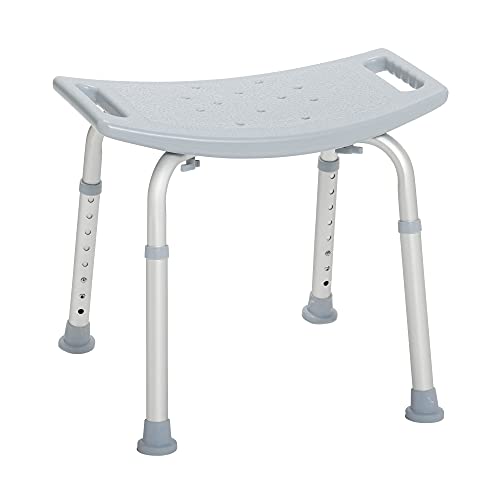
Drive Medical Adjustable Shower and Bath Chair with Suction Feet — Best Compact with Suction Feet
The grip specialist for smooth tubs, with its conditions stated.
Strengths
- Suction feet stated in the listing
- Non-slip positioning stated
- Aluminium construction stated
Trade-offs
- Suction needs a smooth tub surface to grip
- No capacity figure in the cached title — confirm on the listing page
- Suction feet must be checked before every use
Key specs (from the listing title):
- Feet: suction, non-slip stated (listing)
- Frame: aluminium (listing)
- Capacity: not stated in cached title — verify
Suction feet are a specific technology with a specific condition: they grip smooth surfaces superbly and textured surfaces barely at all, and this pick is recommended only for the first case. As with the HOMLAND pick, the cached title states no capacity, so the same instruction applies — confirm it on the listing page before ordering. Within those two honest conditions, this is the grip specialist of the guide, from the same established brand as the overall pick.
Best for: smooth-tub bathrooms wanting maximum grip / Not suited for: textured tub floors where suction cannot seal
Check the current price on Amazon

Vaunn Tool-Free Assembly Adjustable Shower Chair Spa Bathtub Seat Bench — Best Tool-Free Assembly
Tool-free assembly for hands that cannot manage tools — capacity flag included.
Strengths
- Tool-free assembly stated — kind to arthritic hands
- Adjustable height stated
- Removable back stated
Trade-offs
- No capacity figure in the cached title — confirm it on the listing page
- Tool-free joints need a pre-use firmness check
- White finish shows hard-water marks sooner
Key specs (from the listing title):
- Assembly: tool-free stated (listing)
- Back: removable (listing)
- Capacity: not stated in cached title — verify
Tool-free assembly is an accessibility feature in itself: the person who most needs a shower chair is often the person least able to wrestle an Allen key. The listing states the assembly method, the adjustability and the removable back; it does not state a capacity in the cached title, so — for the third time in this guide, deliberately — confirm that figure on the listing page before ordering. Repetition of the warning is the point: in this category, the missing number is the important one.
Best for: anyone who cannot manage tools for assembly / Not suited for: anyone who cannot first confirm the stated capacity
Check the current price on Amazon
Comparison Table
| Pick | Badge | Key spec (listing) | Best for |
|---|---|---|---|
| Drive Medical Premium Shower Chair with Back and Padded Arms | Best Overall | Supports 350 pounds stated, padded arms (listing) | most adults who want arms and a back |
| Hiqufet Shower Chair for Inside Shower, Heavy Duty | Best High Capacity | 500 lbs stated, 5 height settings, extra-wide (listing) | larger users and anyone wanting maximum stated capacity |
| DMI Tub Transfer Bench and Shower Chair | Best for Transfers | Holds up to 400 lbs stated, cut-out access (listing) | anyone who cannot safely step over a tub wall |
| HOMLAND Shower Chair for Inside Shower with Removable Back | Best Adjustable Mid-Range | Aluminium frame, height adjustable, removable back (listing) | households whose needs may change over time |
| Drive Medical Adjustable Shower and Bath Chair with Suction Feet | Best Compact with Suction Feet | Suction feet, non-slip, aluminium stated (listing) | smooth-tub bathrooms wanting maximum grip |
| Vaunn Tool-Free Assembly Adjustable Shower Chair Spa Bathtub Seat Bench | Best Tool-Free Assembly | Tool-free assembly, adjustable, removable back stated (listing) | anyone who cannot manage tools for assembly |
Key Takeaways
- Match the product to the exact job and space first; headline features come second.
- Only buy claims the listing itself states — anything unstated is unproven.
- Measure first, and re-check variant, size and configuration on the listing page.
- Care and rotation habits extend life more than any single premium feature.
How to Choose the Best Shower Safety Chairs
Name the risky moment first — sitting down, standing up, stepping over the tub wall, or simple fatigue — and buy the format that deletes it. Then apply the capacity rule: the stated capacity must exceed the user’s weight with margin, and if a listing does not state one where you can read it, that pick is not yet buyable. Finally measure the tub or stall, because the widest, strongest bench is useless in a space it does not fit.
Why This Guide Prints Some Numbers and Refuses Others
Capacities appear in this article because the listings state them as safety specifications. Prices, ratings and review counts do not appear, because they change and because they are not safety information. The line is deliberate: numbers that protect the user are quoted exactly; numbers that merely persuade are omitted entirely.
How to Set Up a Shower Chair Safely
Assemble the chair as its instructions direct, set the legs so every foot contacts the tub floor and the seat is level, and set the height so the user’s feet rest flat with knees near a right angle. Check arms, backs and suction feet for firmness before every use, position everything the user needs within reach of the seated position, and keep the floor outside the tub dry with a mat for the step out.
Care routines decide lifespan more than first impressions do. Follow the maker’s washing or spot-clean guidance, rotate or shake out the item on a regular rhythm, and store it dry and out of direct sun when it is out of rotation. Small habits — dealing with spills the day they happen, airing fibres before storage, keeping spare covers or cases washed and ready — prevent the slow build-up of odour and wear that makes people replace a sound product early. When something does wear, judge whether the worn part is replaceable before replacing the whole item.
Measure before you order, and measure the space the item will actually live in rather than the space you imagine. Door widths, bed sizes, tub footprints and foot length all punish guesswork. Write the numbers down, compare them against the dimensions stated in the listing, and leave a margin for real life: bedding that shrinks slightly, rugs that need clearance under a swinging door, chairs that need room to recline or swivel. A two-minute tape-measure check prevents most returns in this category.
Common Buying Mistakes
- Choosing a chair without reading its stated capacity.
- Assuming a capacity for a listing that does not state one.
- Setting the seat so high that the user’s feet dangle.
- Placing a suction-foot chair on a textured tub floor.
- Skipping the pre-use firmness check because it was fine yesterday.
- Buying a stool for what is actually a transfer problem.
Final Recommendation
For most households the Drive Medical Premium is the complete, stated answer; for the tub-wall problem choose the DMI transfer bench; for maximum stated capacity choose the Hiqufet. And for any pick whose capacity is flagged here, let the listing page have the final word before money changes hands.
Best Selling Transitional Chairs With Ottoman
Best Safety Treads For Tubs And Showers
Best Childrens Bath Mat For Tubs
Frequently Asked Questions
What capacity do I need?
The stated capacity must exceed the user’s weight with a sensible margin. The stated figures in this guide are 350 pounds, 500 lbs and up to 400 lbs; three picks require you to read the capacity on the listing page first.
What is a transfer bench for?
For users who cannot safely step over a tub wall: they sit on the section outside the tub and slide across. It deletes the highest-risk moment in bathing.
Do suction feet work on any tub?
They need a smooth surface to seal against. On textured tub floors they cannot grip reliably, and a standard non-slip foot design is the safer choice.
Why do three reviews tell me to check the listing page?
Because their cached titles state no weight capacity, and this guide does not invent safety specifications. The figure will be on the listing page; read it before ordering.
Can a shower chair be left in the tub permanently?
Most can, but rinsing, drying and a monthly fitting check keep any chair safe and fresh. Padded arms in particular should be dried after use.
Is a back necessary?
For longer showers and users who tire, yes — a back turns a perch into a rest. For brief seated washing in a small stall, a stool format may serve better.
A Note on Safety Information
This article is product information, not medical advice. Capacities and specifications are quoted from listings as held in this site’s verified cache; the current listing page and the manufacturer’s instructions govern safe use, and an occupational therapist can advise on individual needs.
Capacity Is a Safety Specification, Not a Statistic
This article prints weight capacities — and only from listings that state them — because in this category the number is not marketing, it is the boundary of safe use. Three picks state theirs in the cached titles: 350 pounds, 500 lbs, and up to 400 lbs, quoted in each listing’s own wording. Three picks do not state a capacity in the cached title, and in each case the review says so and directs you to the listing page rather than estimating. That asymmetry is deliberate and it is the most important editorial decision in the article. A shower chair is a safety device used by people at their least stable, wet and unclothed, and a guide that guessed a capacity to complete a table would be trading someone’s safety for tidiness. Choose a chair whose stated capacity exceeds the user’s weight with margin, set it up carefully, and treat every stated limit in the listing as absolute.
Chair, Stool, or Transfer Bench: Matching the Device to the Moment
The three formats in this guide answer three different risky moments. A chair with a back and arms answers fatigue and the sit-to-stand transition: arms give leverage, the back gives rest during a longer shower. A stool or backless configuration answers small spaces and users who mainly need a perch for washing legs and feet. A transfer bench answers the tub wall itself — the highest-risk moment — by letting the user sit outside and slide across. Work out which moment actually frightens you or your family member, honestly and specifically, and buy the format that deletes that moment. Buying a stool for a transfer problem, or a transfer bench for a fatigue problem, leaves the real risk untouched while spending the money that could have solved it.
Setup: Level, Flat Feet and the Pre-Use Check
Most shower-chair failures are setup failures. The chair must stand level — adjustable legs exist precisely because tub floors slope toward the drain — with every foot in full contact. The seat height must put the user’s feet flat and knees near ninety degrees; dangling feet mean no bracing power, and bracing power is the user’s real stability. Arms, backs and suction feet each get a firmness check before every use, a five-second ritual that should become as automatic as locking a door. Position the chair so the user can reach the shower controls and the soap without leaning beyond the base of support, and add a hand-held shower head if the fixed head forces reaching. None of this is medical advice; it is the mechanical common sense of sitting safely on a wet surface, and it is where the benefit of these products is actually realised.
Materials and Maintenance in a Wet Room
Aluminium frames recur through this guide because the listings state them and because the material suits the room: light to move for cleaning, and indifferent to the constant water that destroys lesser frames. Plastic seats and backs should be rinsed and periodically scrubbed — soap film is slippery, and a safety device with a slippery seat has defeated itself. Padded arms, a comfort on the overall pick, need drying after use to stay fresh. Suction feet need clean surfaces, theirs and the tub’s. Fittings should be re-checked monthly; a wet room loosens things quietly. Store nothing on the chair between showers, keep its feet clear of bath mats bunched beneath them, and replace any chair that develops a wobble that adjustment cannot cure — in this category, retirement is a safety decision, not an extravagance.
Buying for Someone Else: Dignity and the Conversation
Many of these chairs are bought by adult children for parents, and the purchase goes better when it is framed as equipment rather than decline: athletes use benches, spas use seats, and a shower chair is simply the right tool for a slippery room. Involve the user in the choice where you can — arm or no arm, back or no back — because a device the user helped choose gets used, and an imposed one gets quietly exiled to the garage. Measure together if possible, agree the pre-use check ritual, and revisit the setup after the first week, when real habits have replaced guesses. This guide’s role is specification honesty — stated capacities, stated materials, flagged gaps. The family’s role is the human one, and no product in this article substitutes for a conversation about what help is actually wanted.
A Longer View on Ownership Costs
Ownership cost is the purchase repeated over time. Judge value over the whole ownership period, not the first week. A cheaper option replaced twice costs more — in money, time and waste — than a mid-range option that lasts. Look for the construction details that predict longevity in the listing itself: stitching, backing, frame material, washability and whether wear parts can be replaced. Where a listing is silent on a detail that matters to you, treat that silence as information and choose a listing that states it plainly instead. Care routines decide lifespan more than first impressions do. Follow the maker’s washing or spot-clean guidance, rotate or shake out the item on a regular rhythm, and store it dry and out of direct sun when it is out of rotation. Small habits — dealing with spills the day they happen, airing fibres before storage, keeping spare covers or cases washed and ready — prevent the slow build-up of odour and wear that makes people replace a sound product early. When something does wear, judge whether the worn part is replaceable before replacing the whole item. Measure before you order, and measure the space the item will actually live in rather than the space you imagine. Door widths, bed sizes, tub footprints and foot length all punish guesswork. Write the numbers down, compare them against the dimensions stated in the listing, and leave a margin for real life: bedding that shrinks slightly, rugs that need clearance under a swinging door, chairs that need room to recline or swivel. A two-minute tape-measure check prevents most returns in this category.
Matching the Product to Your Household
Households differ in traffic, pets, children, climate and storage, and the right choice follows those facts rather than a generic ranking. Measure before you order, and measure the space the item will actually live in rather than the space you imagine. Door widths, bed sizes, tub footprints and foot length all punish guesswork. Write the numbers down, compare them against the dimensions stated in the listing, and leave a margin for real life: bedding that shrinks slightly, rugs that need clearance under a swinging door, chairs that need room to recline or swivel. A two-minute tape-measure check prevents most returns in this category. Judge value over the whole ownership period, not the first week. A cheaper option replaced twice costs more — in money, time and waste — than a mid-range option that lasts. Look for the construction details that predict longevity in the listing itself: stitching, backing, frame material, washability and whether wear parts can be replaced. Where a listing is silent on a detail that matters to you, treat that silence as information and choose a listing that states it plainly instead. Care routines decide lifespan more than first impressions do. Follow the maker’s washing or spot-clean guidance, rotate or shake out the item on a regular rhythm, and store it dry and out of direct sun when it is out of rotation. Small habits — dealing with spills the day they happen, airing fibres before storage, keeping spare covers or cases washed and ready — prevent the slow build-up of odour and wear that makes people replace a sound product early. When something does wear, judge whether the worn part is replaceable before replacing the whole item.
When to Replace Rather Than Repair
Replace when the core function has gone — support, grip, absorbency or structural soundness — rather than when the surface merely looks tired. Care routines decide lifespan more than first impressions do. Follow the maker’s washing or spot-clean guidance, rotate or shake out the item on a regular rhythm, and store it dry and out of direct sun when it is out of rotation. Small habits — dealing with spills the day they happen, airing fibres before storage, keeping spare covers or cases washed and ready — prevent the slow build-up of odour and wear that makes people replace a sound product early. When something does wear, judge whether the worn part is replaceable before replacing the whole item. Judge value over the whole ownership period, not the first week. A cheaper option replaced twice costs more — in money, time and waste — than a mid-range option that lasts. Look for the construction details that predict longevity in the listing itself: stitching, backing, frame material, washability and whether wear parts can be replaced. Where a listing is silent on a detail that matters to you, treat that silence as information and choose a listing that states it plainly instead. Measure before you order, and measure the space the item will actually live in rather than the space you imagine. Door widths, bed sizes, tub footprints and foot length all punish guesswork. Write the numbers down, compare them against the dimensions stated in the listing, and leave a margin for real life: bedding that shrinks slightly, rugs that need clearance under a swinging door, chairs that need room to recline or swivel. A two-minute tape-measure check prevents most returns in this category.
Reading a Listing Like an Inspector
Work through any listing in a fixed order: first the exact product name and what the item actually is, then the dimensions and any stated capacity, then the materials and certifications exactly as worded, and only then the marketing adjectives. Adjectives are free; stated specifications are commitments. If a feature you care about appears only in a photograph and never in words, treat it as unconfirmed. If a title is cut short in a search result or a cache, open the full listing page and read the complete title and description before deciding — the missing words are precisely the ones that change decisions.
Seasonal and Household Changes
The right product in January can be the wrong one in July, and the right product for a single adult can be wrong for a household with toddlers, teenagers or pets. Before buying, run the item mentally through your hardest season and your busiest week: the muddy month, the allergy month, the house-guest month, the month the heating runs all day. Products that offer a configuration choice — a size, a finish, a firmness, a pack quantity — usually repay choosing the configuration for your hardest case rather than your average case, because average cases forgive almost anything.
Returns, Spares and Second Purchases
Keep the packaging until the product has survived its first real week of use, photograph how it arrived, and note the exact variant you ordered so a second purchase matches the first. For consumable-adjacent products, buying a spare cover, case or second unit at the same time is often cheaper than reordering later and risking a discontinued variant. And when you do reorder, re-read the listing: manufacturers revise products under the same listing, so the title you trusted last year deserves a fresh read this year.
Testing the Product in Its First Week
Treat the first week as a structured trial rather than a honeymoon. Use the product for its hardest real job, not its easiest: the longest session, the muddiest day, the fullest load, the most sensitive sleeper. Note what you adjust, what you avoid, and what you wish were different, because those small frictions grow with time. Check fixings, seams, backs and bases again at the end of the week, while returning or exchanging is still simple. A product that passes its hardest week almost always serves for years. Measure before you order, and measure the space the item will actually live in rather than the space you imagine. Door widths, bed sizes, tub footprints and foot length all punish guesswork. Write the numbers down, compare them against the dimensions stated in the listing, and leave a margin for real life: bedding that shrinks slightly, rugs that need clearance under a swinging door, chairs that need room to recline or swivel. A two-minute tape-measure check prevents most returns in this category. Care routines decide lifespan more than first impressions do. Follow the maker’s washing or spot-clean guidance, rotate or shake out the item on a regular rhythm, and store it dry and out of direct sun when it is out of rotation. Small habits — dealing with spills the day they happen, airing fibres before storage, keeping spare covers or cases washed and ready — prevent the slow build-up of odour and wear that makes people replace a sound product early. When something does wear, judge whether the worn part is replaceable before replacing the whole item.
What Good Looks Like a Year From Now
Picture the product after a year of your real life, not a showroom life. Colours soften, fibres settle, mechanisms develop a familiar feel, and well-chosen products become invisible — they simply work every day without negotiation. That invisibility is the true test of any buying decision: not excitement at delivery, but the absence of complaints in month twelve. Choosing stated specifications over adjectives, measuring instead of guessing, and caring for the product on a simple rhythm are the three habits that separate purchases you forget about, in the best way, from the ones you replace. Judge value over the whole ownership period, not the first week. A cheaper option replaced twice costs more — in money, time and waste — than a mid-range option that lasts. Look for the construction details that predict longevity in the listing itself: stitching, backing, frame material, washability and whether wear parts can be replaced. Where a listing is silent on a detail that matters to you, treat that silence as information and choose a listing that states it plainly instead. Care routines decide lifespan more than first impressions do. Follow the maker’s washing or spot-clean guidance, rotate or shake out the item on a regular rhythm, and store it dry and out of direct sun when it is out of rotation. Small habits — dealing with spills the day they happen, airing fibres before storage, keeping spare covers or cases washed and ready — prevent the slow build-up of odour and wear that makes people replace a sound product early. When something does wear, judge whether the worn part is replaceable before replacing the whole item.
One Last Check Before You Order
Run this final pass on whichever pick you have chosen: re-read its full listing title on the listing page, confirm the size, colour and configuration in the variant selector rather than the headline, check the dimensions against the measurements you took, and confirm that every feature you are relying on is stated in words somewhere in the listing. If any answer is a guess, pause — the right response to a guess is a different, clearer listing, not optimism. Five minutes of checking is the cheapest insurance in the whole purchase. Measure before you order, and measure the space the item will actually live in rather than the space you imagine. Door widths, bed sizes, tub footprints and foot length all punish guesswork. Write the numbers down, compare them against the dimensions stated in the listing, and leave a margin for real life: bedding that shrinks slightly, rugs that need clearance under a swinging door, chairs that need room to recline or swivel. A two-minute tape-measure check prevents most returns in this category. Judge value over the whole ownership period, not the first week. A cheaper option replaced twice costs more — in money, time and waste — than a mid-range option that lasts. Look for the construction details that predict longevity in the listing itself: stitching, backing, frame material, washability and whether wear parts can be replaced. Where a listing is silent on a detail that matters to you, treat that silence as information and choose a listing that states it plainly instead.
How This Guide Handles Claims
Every product claim in this article is tied to the wording of a verified listing: the product name, the stated size or capacity, the stated materials and the stated certifications are reported as written, and anything a listing does not state is treated as not stated rather than filled in by assumption. That discipline is why some picks carry explicit honesty notes — a density that is medium rather than soft, a hypoallergenic claim that is absent rather than implied, a title that is truncated rather than completed. It is also why no prices, star ratings or review counts appear anywhere in the article: those numbers change constantly, and a guide that prints them is quietly going out of date from the day it is published. What does not change is the fit between a stated specification and a real household need, and that fit is what the recommendations here are built on. If you check only one thing before ordering, check that the listing page still matches the description quoted here — listings are revised, and the current page always outranks any guide, including this one. Judge value over the whole ownership period, not the first week. A cheaper option replaced twice costs more — in money, time and waste — than a mid-range option that lasts. Look for the construction details that predict longevity in the listing itself: stitching, backing, frame material, washability and whether wear parts can be replaced. Where a listing is silent on a detail that matters to you, treat that silence as information and choose a listing that states it plainly instead.
Putting the Whole Purchase Together
Step back and assemble the decision in the order a careful buyer actually makes it. First, the job: write down, in one sentence, what this product must do in your home and for whom — that sentence eliminates half of any catalogue immediately. Second, the space: the measurements you took, the door it must pass, the surface it will sit on, the people or animals who share it. Third, the specification: only the picks whose listings state what your first two steps require stay on the list, and between those, prefer the listing that states the most, because stated facts are the only ones you can hold anyone to. Fourth, the system around the product: the protector, the spare, the storage, the cleaning rhythm — the unglamorous purchases that decide whether the main purchase still pleases you in a year. Run those four steps honestly and the ranking in this guide becomes almost a formality: one pick will match your sentence, your space and your system, and that is the one to buy. Care routines decide lifespan more than first impressions do. Follow the maker’s washing or spot-clean guidance, rotate or shake out the item on a regular rhythm, and store it dry and out of direct sun when it is out of rotation. Small habits — dealing with spills the day they happen, airing fibres before storage, keeping spare covers or cases washed and ready — prevent the slow build-up of odour and wear that makes people replace a sound product early. When something does wear, judge whether the worn part is replaceable before replacing the whole item. Measure before you order, and measure the space the item will actually live in rather than the space you imagine. Door widths, bed sizes, tub footprints and foot length all punish guesswork. Write the numbers down, compare them against the dimensions stated in the listing, and leave a margin for real life: bedding that shrinks slightly, rugs that need clearance under a swinging door, chairs that need room to recline or swivel. A two-minute tape-measure check prevents most returns in this category.


