Disclosure: airfryerkitchensupply.com is reader-supported. When you buy through links on our site, we may earn an affiliate commission at no extra cost to you.
Where to buy
Every linked pick in this guide to the best-selling non-app home air purifiers was verified against Amazon’s catalog on 2026-11-22, so the model names below are the models you will actually land on. Start with Levoit Core 300-P Air Purifier, COWAY Mighty AP-1512HH Air Purifier, Medify MA-40 Air Purifier. Picks that could not be pinned to a verified listing are written as unlinked and flagged honestly, with no link attached. Check the current price on Amazon from any pick’s link, because finishes, bundles and filter or accessory packs rotate often.
Shoppers hunting for the best-selling non-app home air purifiers usually want one thing the smart-home crowd does not: a machine that cleans the air with a dial or buttons on the unit itself, with no account, no phone pairing, no firmware update and no app notification at 2 a.m. That preference is more reasonable than it sounds. An air purifier is a fan and a filter; everything it needs to do its job can be controlled from its own panel, and the best-selling non-app models in this guide have sold in large numbers for years precisely because they ask nothing of your Wi-Fi network.
The honest market picture is that manufacturers keep moving features into apps, so the non-app shelf is now dominated by proven designs rather than new launches. That is good news for buyers: the machines below are mature, their replacement filters are widely stocked, and their quirks are well documented by years of owners. What you give up is remote control and phone-based air-quality graphs. What you keep is a purifier that still works perfectly when the router is down, that a guest or grandparent can operate without instructions, and that never collects data about your home.
Comfort framing matters here, so it is stated plainly: these machines are bought to reduce dust, pollen, pet dander and household odours in the air and to make rooms feel fresher and easier to live in. They are household comfort appliances, not medical devices, and this guide makes no health claims for them. Judge them the way you would judge a good fan or a good vacuum: on coverage, filtration, noise, running costs and how pleasant they are to live with day after day.
In this guide
Quick Picks
Six picks made the cut for this guide. Each carries its own badge, and the same badge follows it into the full review below so you can track a recommendation from summary to verdict.
- Best Overall — Levoit Core 300-P Air Purifier: The long-running best-seller that proves a purifier needs no app: three fan speeds, a sleep mode and a filter-change reminder, all on the unit. Key spec: True HEPA 3-in-1 filter / rooms up to about 1,073 sq ft (manufacturer rating) / button controls, no app.
- Best for Large Rooms — COWAY Mighty AP-1512HH Air Purifier: A bigger, sensor-equipped step up that still keeps every control on the machine — auto mode reacts to dust events without any phone involved. Key spec: 4-stage filtration with true HEPA / rooms up to about 1,748 sq ft (manufacturer rating) / sensor-driven auto mode on the unit.
- Best for Odours and Smoke Smells — Medify MA-40 Air Purifier: A tall, furniture-style unit with a bigger carbon bed than most, aimed at homes where smells — cooking, pets, traffic, wildfire drift — are the main complaint. Key spec: HEPA filter with substantial carbon / rooms up to about 1,793 sq ft (manufacturer rating) / touch panel, no app required.
- Best Premium Build — Austin Air HealthMate Plus Air Purifier: The buy-it-for-a-decade option: a steel box, one dial, and a filter rated to last years rather than months, with zero electronics beyond the fan. Key spec: 4-stage filtration with large carbon and zeolite bed / steel body / simple rotary speed dial.
- Best for Open-Plan Homes — COWAY Airmega 400 Air Purifier (AP-2015F): A dual-intake flagship for big open-plan floors, drawing air from both sides — full control stays on the front panel. Key spec: Dual-suction HEPA filtration / very large room rating / panel controls with auto and sleep modes.
- Best Wall-Mountable Design — Rabbit Air MinusA2 SPA-780A Air Purifier: A slim, quiet panel that can hang on a wall like a picture — the design-led non-app pick for rooms where floor space is precious. Key spec: Multi-stage filtration with customisable filter choice / slim panel design, wall-mountable / remote and panel controls.
How These Picks Were Chosen
Every pick was first verified against Amazon’s catalog, so each linked model name and ASIN below is a real, current listing. The defining filter came next: the machine had to be fully operable without an app. Models whose main controls live in a phone app, or whose headline feature is Wi-Fi connectivity, were cut even when they sell well, because they fail the exact promise of this search. One or two designs offer an optional app on a sibling variant; the specific models listed here are the dial-and-button versions.
Filtration was the second filter. Each pick uses a true HEPA-grade main filter or a documented equivalent, paired with a carbon stage for odours, because a purifier that only traps dust but ignores cooking smells disappoints within a week. Coverage claims were read against room-size guidance rather than marketing maximums, and each badge below reflects the room the machine genuinely suits. Noise was weighed heavily: a purifier runs for hours, often overnight, so a loud top speed is acceptable only if the lower speeds are genuinely quiet.
Finally, running costs were checked the way owners experience them — how often the filter changes, whether replacements are easy to find, and whether the machine wastes electricity at the speeds people actually use. Popularity on its own earned nothing; a best-seller with expensive, hard-to-find filters scored below a quieter seller with cheap consumables.
One last methodological note: popularity was treated as evidence, not as a verdict. A model earns best-seller status for many reasons, including price promotions and shelf placement, so every high-selling machine still had to pass the filtration, noise and filter-cost checks above. Two widely sold app-first models failed the non-app test outright and were excluded, however strong their sales.
The 6 Best Non-App Home Air Purifiers

Levoit Core 300-P Air Purifier — Best Overall
The Core 300-P is the machine most people picture when they picture a home air purifier, and its sales history reflects that. It suits bedrooms, nurseries, home offices and mid-size living rooms — anywhere a compact cylinder can sit in a corner and quietly get on with reducing dust and everyday odours. It does not suit buyers who want whole-house coverage from one unit; no single purifier this size does that honestly.
Strengths
- Fully operable from its own panel — no account, pairing or Wi-Fi needed
- Sleep mode and a display that turns off make it genuinely bedroom-friendly
- Replacement cartridges are inexpensive and stocked everywhere
Trade-offs
- One combined cartridge means the carbon stage is modest for heavy cooking or smoke odours
- No air-quality sensor, so fan speed is your judgement rather than automatic
- Coverage rating assumes ideal conditions; large rooms need the bigger picks below
At a glance: Filtration: pre-filter, true HEPA and activated carbon in one cartridge. Controls: touch buttons on the unit. Display light can be turned off for bedrooms.
Living with it is the point. On its lowest settings it fades into background noise, the top speed clears a dusty room noticeably faster after vacuuming or a window-open afternoon, and the controls are simple enough that nobody in the house needs a manual. For the large majority of homes, this is the non-app purifier to start with, and its long sales record means filters will remain available for years.
Ownership is where the Core 300-P quietly wins friends. The cartridge change takes two minutes, the machine tells you when it is due, and because the model has sold for years, compatible stock is everywhere. Keep a spare cartridge in a cupboard and the purifier never sits idle waiting for a delivery.
Best for: bedrooms and living rooms that want set-and-forget cleaning / Not suited for: very large open-plan spaces that need commercial-grade airflow
Check on Amazon — check price on Amazon for the current finish and bundle options.

COWAY Mighty AP-1512HH Air Purifier — Best for Large Rooms
The Mighty suits households whose main living space is too big for a compact cylinder. Its sensor watches the air and adjusts fan speed itself, which is the one ‘smart’ behaviour genuinely worth having — and Coway implements it on the unit, with a colour indicator you can read across the room, rather than in an app. It does not suit minimalists in small flats, where it is simply more machine than the room needs.
Strengths
- On-unit air-quality sensor drives a genuinely useful auto mode
- Four-stage filtration handles odours better than basic 3-in-1 cartridges
- Long filter life keeps annual running costs reasonable for its size
Trade-offs
- Larger footprint and a more appliance-like look than the Levoit
- Replacement filter sets cost more than compact-cartridge models
- Ioniser stage will not be wanted by everyone, though it can be switched off
At a glance: Filtration: pre-filter, odour filter, true HEPA and ioniser stage (switchable). Controls: panel buttons with air-quality indicator light ring.
In daily use the Mighty earns its badge after cooking, after the dog comes in wet, and during dusty renovation weeks, when the sensor visibly ramps the fan and settles again. Buyers who want automation without an account or an app will find this the sweet spot of the whole guide.
One ownership note: the air-quality light ring is informative but bright for a bedroom at night, which is another reason this pick belongs in living spaces. In its intended room, though, the set-and-forget auto behaviour is the closest a non-app machine gets to invisible infrastructure.
Best for: large living rooms and open-plan spaces / Not suited for: small bedrooms where its airflow and footprint are more than needed
Check on Amazon — check price on Amazon for the current finish and bundle options.

Medify MA-40 Air Purifier — Best for Odours and Smoke Smells
The MA-40 suits households that notice smells before they notice dust. Its larger filter volume gives the carbon stage more to work with, and its tower format slides against a wall more gracefully than round machines. It does not suit buyers furnishing a tiny studio corner, and its touch panel, while entirely on-unit, is less glove-friendly than physical buttons.
Strengths
- Generous carbon capacity for a home unit at this tier
- Touch panel includes timer and child lock without any app
- Tall format fits wall spaces that round purifiers waste
Trade-offs
- Touch controls are easier to brush accidentally than dials
- Filter cartridges are model-specific; keep the exact code when reordering
- Tall body should be kept out of toddler toppling range
At a glance: Filtration: pre-filter, HEPA and carbon in a large cartridge. Controls: touch panel with timer and child lock.
Owners tend to place it where life happens — near kitchens, litter trays and entryways — and run it on medium through the day. As a comfort appliance for fresher-feeling air in busy homes, it is one of the most convincing non-app designs sold.
Budget for the cartridge when you budget for the machine. The MA-40’s filter is larger than compact rivals’, and while that is exactly why its odour control lasts, the renewal costs more than a small cartridge. Owners who cook daily or keep indoor pets consistently judge the trade worthwhile.
Best for: homes where odour control matters as much as dust / Not suited for: buyers who want the smallest possible footprint
Check on Amazon — check price on Amazon for the current finish and bundle options.

Austin Air HealthMate Plus Air Purifier — Best Premium Build
The HealthMate Plus suits people who buy appliances the way they buy furniture — once, carefully, for the long term. Its huge carbon and zeolite bed is aimed at homes near traffic, with workshops, or with strong persistent odours, and its steel case shrugs off knocks that crack plastic housings. It does not suit renters who move yearly; it is heavy, and deliberately so.
Strengths
- Filter life measured in years, not months, slashes consumable hassle
- One dial is the entire interface — nothing to pair, update or break
- Steel construction and casters suit busy, real-world rooms
Trade-offs
- Premium tier pricing and heavy to move between floors
- No sensor or auto mode — speed choice is entirely yours
- Utilitarian looks divide opinion in styled living rooms
At a glance: Filtration: pre-filter stages, carbon/zeolite bed and HEPA. Controls: one rotary dial, three speeds. Body: powder-coated steel on casters.
Judged as a long-term comfort appliance, the Austin Air justifies itself every month you do not think about it. If the app-free philosophy of this guide appeals to you at a deep level, this is its fullest expression.
Delivery day deserves a warning: arrange a second pair of hands. Once placed, though, the HealthMate Plus tends to stay in families for a very long time, and its plain dial interface means literally anyone in the house can run it without a tutorial.
Best for: buyers who hate subscriptions, apps and frequent filter changes / Not suited for: anyone who wants a light machine they can carry room to room
Check on Amazon — check price on Amazon for the current finish and bundle options.
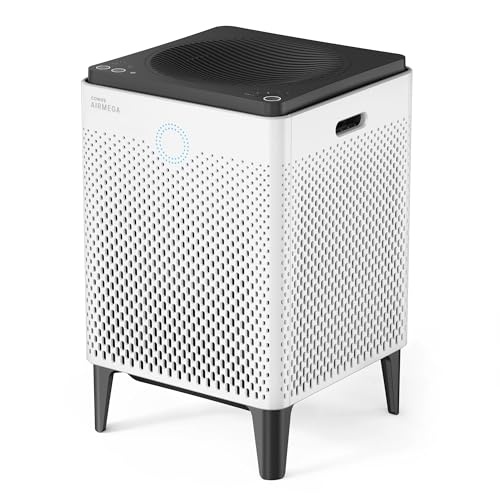
COWAY Airmega 400 Air Purifier (AP-2015F) — Best for Open-Plan Homes
The Airmega 400 suits the growing number of homes where kitchen, dining and living areas share one large volume of air. Drawing from both sides, it moves enough air to matter in spaces where compact purifiers merely stir a corner. It does not suit anyone shopping for a nightstand-adjacent bedroom machine; it is a floor appliance in size, sound at full speed and price tier.
Strengths
- Dual suction gives it genuine large-space reach from one unit
- Auto and sleep modes are built in, no app involved
- Washable pre-filters cut consumable costs over time
Trade-offs
- Big and heavy — placement is a furniture decision
- Two cartridges to replace when the time comes
- Overkill, in every sense, for ordinary bedrooms
At a glance: Filtration: washable pre-filters plus dual HEPA/carbon cartridges. Controls: front panel with air-quality indicator, timer and sleep mode.
For open-plan homes it replaces the unsatisfying ritual of moving a small purifier from room to room. Run on auto, it behaves like building services rather than a gadget, which is exactly what this category of buyer wants.
Because it draws from both sides, placement matters more than usual — give both flanks clear air rather than pushing one side against a wall. Set up thoughtfully, it conditions a whole open-plan floor in a way that makes smaller machines feel like table fans by comparison.
Best for: large open-plan living areas and lofts / Not suited for: bedrooms, where smaller quieter picks make more sense
Check on Amazon — check price on Amazon for the current finish and bundle options.
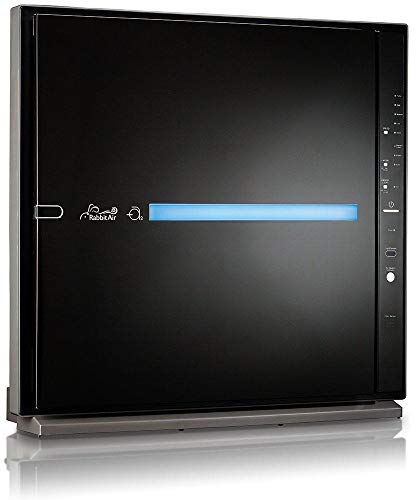
Rabbit Air MinusA2 SPA-780A Air Purifier — Best Wall-Mountable Design
The MinusA2 suits buyers who have rejected every purifier so far on looks. Its slim panel hangs on a wall or stands unobtrusively, runs very quietly at the speeds used overnight, and lets you choose a customised filter stage aimed at odours or pets. It does not suit bargain hunters: both the machine and its multi-part filter set sit in the premium tier.
Strengths
- Wall-mountable slim design disappears into a room
- Customisable filter stage targets odours or pet dander
- Among the quietest machines here at low speeds
Trade-offs
- Filter set has several parts and costs more to renew
- Wall mounting needs a stud or proper fixings and a nearby outlet
- Premium tier for coverage that cheaper picks match on paper
At a glance: Filtration: pre-filter, medium filter, HEPA, customised filter (odour or pet variants) and carbon. Controls: panel plus included remote.
As a piece of home equipment it succeeds where most purifiers fail: people stop noticing it. For design-led homes that still want honest, app-free air cleaning, it earns its place as the sixth pick.
The included remote sounds like a gimmick until the clock is wall-mounted above a sideboard; then it becomes the control you actually use. Keep spare batteries for it, and the MinusA2 remains the lowest-friction purifier in this guide to live with.
Best for: style-conscious rooms and homes short on floor space / Not suited for: buyers who want the lowest possible filter costs
Check on Amazon — check price on Amazon for the current finish and bundle options.
Comparison Table
| Pick | Badge | Key spec | Best for |
|---|---|---|---|
| Levoit Core 300-P Air Purifier | Best Overall | True HEPA 3-in-1 filter / rooms up to about 1,073 sq ft (manufacturer rating) / button controls, no app | bedrooms and living rooms that want set-and-forget cleaning |
| COWAY Mighty AP-1512HH Air Purifier | Best for Large Rooms | 4-stage filtration with true HEPA / rooms up to about 1,748 sq ft (manufacturer rating) / sensor-driven auto mode on the unit | large living rooms and open-plan spaces |
| Medify MA-40 Air Purifier | Best for Odours and Smoke Smells | HEPA filter with substantial carbon / rooms up to about 1,793 sq ft (manufacturer rating) / touch panel, no app required | homes where odour control matters as much as dust |
| Austin Air HealthMate Plus Air Purifier | Best Premium Build | 4-stage filtration with large carbon and zeolite bed / steel body / simple rotary speed dial | buyers who hate subscriptions, apps and frequent filter changes |
| COWAY Airmega 400 Air Purifier (AP-2015F) | Best for Open-Plan Homes | Dual-suction HEPA filtration / very large room rating / panel controls with auto and sleep modes | large open-plan living areas and lofts |
| Rabbit Air MinusA2 SPA-780A Air Purifier | Best Wall-Mountable Design | Multi-stage filtration with customisable filter choice / slim panel design, wall-mountable / remote and panel controls | style-conscious rooms and homes short on floor space |
Read the table by room first and badge second. Coverage figures are the manufacturers’ own room ratings, useful for comparing machines against each other rather than as promises for your exact floor plan. If your room sits between two sizes, the larger machine run on a lower, quieter speed is almost always the more pleasant purchase.
How to Choose a Non-App Air Purifier for Your Home
Start with the room, not the machine. Measure the largest room the purifier will serve and compare it with manufacturer coverage ratings, remembering those ratings assume the fan runs at a speed you may find loud. A useful rule is to buy for the room size at a medium speed: choose a machine rated noticeably above your room’s area, then run it lower and quieter. Open doorways merge rooms into one air volume, so a purifier in a hallway-adjacent living room is really serving both spaces.
Next, read the filter, not the feature list. A true HEPA main stage handles the fine particles — dust, pollen and dander — that make rooms feel stuffy, while activated carbon handles the gas-phase smells from cooking, pets and traffic. The more carbon by weight, the longer odour control lasts before the cartridge fades. Combined cartridges are cheap and convenient; separate, heavier carbon beds, like the Austin Air’s, cost more and last far longer. Neither is wrong — the right choice depends on whether smells or dust are your main complaint.
Then interrogate the controls, because ‘non-app’ covers a spectrum. The purest designs use a dial or buttons for everything. Some non-app machines still include sensors that automate fan speed on the unit — a feature most owners love, since the machine reacts to a dusty afternoon without being asked. Decide whether you want that automation on the box, and confirm that any model you shortlist can be run entirely without creating an account, because a few ‘optional app’ machines nag or limit features until you register.
Noise deserves a test of imagination: the purifier will run while you read, watch television and sleep. Look for a genuine low-speed or sleep mode and, on bedroom machines, a display that can be switched off. Finally, price the filters before the machine. Add up two years of replacement cartridges for each finalist; the cheapest purifier to buy is regularly the most expensive to own, and best-sellers with common cartridges win this calculation almost every time.
Understanding Filtration Stages Without the Marketing
Nearly every machine in this guide stacks the same stages in the same order, and knowing what each does strips away most marketing fog. The pre-filter catches hair, lint and coarse dust; it exists to protect the expensive stages behind it, and on many models it can be vacuumed or washed, which is the single easiest way to extend filter life. Keep it clean and everything downstream lasts longer.
The HEPA stage is the particle workhorse. True HEPA media traps the fine fraction — the dust you see in sunbeams, pollen grains and pet dander — as air passes through a dense fibre mat. It does not wear out so much as load up: as it fills, airflow falls and the fan works harder, which is why replacement intervals matter even when the air still smells fine. Beware of unqualified ‘HEPA-type’ or ‘HEPA-style’ wording on no-name machines; every pick in this guide uses a properly specified HEPA stage.
Carbon handles what HEPA cannot: gases and odours. Activated carbon adsorbs cooking smells, pet odours and traffic fumes onto its enormous internal surface, and when that surface is full, odour control fades even though particle cleaning continues — the classic reason a two-year-old purifier seems to ‘stop working’. Zeolite, used in the Austin Air’s bed, complements carbon for certain household chemicals and ammonia-type smells. The practical lesson is to match the stage to your problem: dusty home, prioritise HEPA capacity and airflow; smelly home, prioritise carbon weight.
Living With a Purifier: Noise, Light and Placement in Real Rooms
Specifications describe a purifier on a test bench; ownership is about a machine sharing your evenings. Noise is the first reality. Every purifier is audible on its top speed — moving that much air cannot be silent — so the meaningful question is the sound at the speed you will actually use for hours. Low speeds on the picks in this guide settle into a soft fan wash that most people stop hearing within days, and that masks household noise rather than adding to it. If you are a light sleeper, put the bedroom machine on the far side of the room and let distance do what decibel figures cannot.
Light is the second reality, and the one brochures ignore. Status LEDs and air-quality rings that look helpful in a showroom can glow like instrument panels at 3 a.m. Bedroom-bound buyers should insist on a display-off function, as the Levoit offers, or choose a sensor model whose light can be dimmed. A strip of electrical tape is the traditional fix, but you should not need it on a machine bought for a bedroom.
Placement is the third. A purifier conditions the air that reaches it, so it belongs in the room’s natural air path — near a door, not sealed behind furniture — and close to the dominant source of what you want removed: near the litter tray for pet odours, near the kitchen opening for cooking smells, beside the bed for overnight dust. Wheels and carry handles, trivial in a listing, decide whether a machine actually gets moved to where it is needed during a dusty renovation or a pollen-heavy week.
Filter Costs and Running Costs Over Three Years
The purchase price of a purifier is the down payment; filters are the mortgage. Over three years of typical use, a compact machine’s cartridges can add up to more than the machine itself, while a large-bed design like the Austin Air asks for one expensive filter near the start and then almost nothing. Neither pattern is a trap — but you should choose yours knowingly. Before buying, find the exact replacement cartridge for your shortlisted model, note its price and rated life, and do the three-year sum for the whole household, including a second machine if bedrooms will need one.
Electricity, by contrast, is a rounding error. Purifiers draw fan-level power, and even continuous running at low speed costs very little over a year compared with heating, cooling or tumble drying. The bigger hidden cost is neglect: a clogged pre-filter makes the fan work harder and shortens the main cartridge’s useful life, so the monthly two-minute vacuum of the pre-filter is the highest-value maintenance habit in this entire category.
Finally, beware of discontinued models selling cheaply. A purifier without a living supply of filters is a fan with a deadline. The best-selling, long-running models in this guide are recommended partly because their consumables ecosystem is deep — cartridges stocked by many sellers, at competitive prices, with no sign of disappearing.
Non-App or Smart: An Honest Comparison Before You Decide
It is worth stating what smart purifiers genuinely do better, because the non-app choice should be informed rather than tribal. An app earns its keep in three situations: scheduling a machine in a room you rarely enter, checking air quality in a child’s room from elsewhere in the house, and reviewing air-quality history to spot patterns — a nightly cooking spike, a weekly cleaning-day dust event. If those uses describe your household, a smart model may serve you better, and there is no virtue in refusing a tool you would actually use.
Against that, the non-app case is about everything that happens over years rather than weeks. No account means no password resets, no app redesign that moves the controls, no server shutdown that quietly bricks remote features, and no data leaving your home. On-unit controls are also shared controls: a partner, a parent, a babysitter or a guest can adjust the machine standing in front of it, without being handed a phone or a login. For rental properties, spare rooms, grandparents’ homes and holiday lets, that simplicity is not a compromise — it is the feature.
There is also a repairability angle. A dial, a fan and a filter can be understood and often serviced for a decade; a Wi-Fi board and a cloud dependency cannot. The best-selling non-app models in this guide have remained on sale, with filters stocked, across exactly the period in which several smart appliances lost app support entirely. Buyers planning to keep a purifier for five to ten years should weigh that record heavily.
The middle path exists too: sensor-driven auto mode, as on the COWAY Mighty, captures most of the practical benefit of ‘smart’ — the machine reacting to the air by itself — with none of the account infrastructure. For many households that is the real sweet spot, and it is why sensor-but-non-app machines feature so strongly in the picks above.
Where Each Type of Purifier Belongs: A Room-by-Room Guide
Bedrooms reward quiet and darkness above raw power. A compact machine with a sleep mode and a switch-off display, run continuously on low, conditions the air you breathe for the longest uninterrupted stretch of the day. Place it on the floor between the door and the bed rather than on a nightstand, where fan vibration can travel through furniture, and keep it at least an arm’s length from the wall so the intake breathes freely. If two people share the room and disagree about fan noise, the machine belongs on the side of the lighter sleeper, run one speed lower — a compromise that still cleans the shared air.
Living rooms reward airflow and odour capacity. This is where the sensor-driven and dual-suction picks earn their badges, because living rooms host cooking drift, guests, pets and open windows in the same afternoon. Position the machine near the room’s main source — the kitchen opening, the dog’s bed, the balcony door — rather than in the aesthetically perfect corner, and let auto mode handle the day’s events.
Home offices and studies are the forgotten case, and often the easiest win. A small room with a door that closes concentrates both dust and the benefit of cleaning it; even the most compact pick transforms a stuffy box room by mid-morning. Nurseries and children’s rooms add one rule: choose a machine with a child lock or a simple dial, place it out of climbing reach of temptation, and favour models whose filters change without tools, because everything in a nursery must be maintainable one-handed and half-asleep.
Hallways and landings are poor purifier locations despite their central geography — air passes through them rather than pooling, so a machine there cleans transit air while the rooms where people actually sit and sleep keep their own dust. Spend the money inside the rooms instead. Kitchens themselves rarely suit a purifier at all: grease loads filters fast, and an extractor used properly beats filtration for cooking fumes. Put the purifier in the room the cooking smells drift into, not the room they start in.
How to Set Up and Run a Non-App Air Purifier
Setup takes ten minutes and no phone. Unbox the machine and, before switching on, open the filter compartment and remove the plastic wrapping from the cartridges — the most common first-day complaint in this category is a ‘faulty’ purifier that was run with its filter still bagged. Refit the filters in the order shown in the manual, close the panel until it clicks, and plug in.
Placement decides performance. Put the purifier in the room where you spend the most time or sleep, with clear space around its intakes — a hand’s width from walls and furniture at minimum, and never boxed into a corner behind a sofa. Keep it away from direct clashes: right beside a humidifier, moisture loads the filter; directly under a dusty shelf, the pre-filter clogs early. Bedrooms benefit from placement between the door and the bed, where air naturally travels.
Run it like heating, not like a kettle. Air cleaning is cumulative, so continuous running on a low or auto setting beats blasting on turbo twice a day. Use the highest speed for events — after vacuuming, during heavy cooking, when windows have been open on a high-pollen afternoon — then return to low or auto for maintenance. Vacuum the pre-filter monthly, note the filter-change date on a calendar rather than trusting indicator lights alone, and wipe the sensor lens, on models that have one, with a dry cotton bud every few months so auto mode stays honest.
Common Buying Mistakes
Buying by room rating alone. Manufacturer coverage assumes high fan speeds and ideal placement; an undersized machine run on turbo is louder and less effective than a bigger machine cruising. Size up and slow down.
Leaving the filter wrapped. It happens constantly. If a new purifier seems to do nothing, check for plastic on the cartridge before arranging a return.
Running it only when the room feels dusty. By the time air feels stuffy, the machine has hours of catching up to do. Continuous low-speed running is the entire point of an efficient purifier.
Ignoring filter maths. A bargain machine with pricey six-month cartridges can cost more over three years than a premium machine with a multi-year filter. Price the consumables first.
Expecting medical outcomes. These are comfort appliances that reduce airborne dust, pollen, dander and odours. Anyone managing a health condition should follow their clinician’s advice rather than a buying guide, and no purifier substitutes for ventilation, cleaning and source control like fixing damp or smoking outdoors.
Hiding it in a corner. Starved intakes halve real-world performance. Give the machine air to work with.
Buying a second identical machine for every room on day one. Start with the room that matters most, live with the machine for a fortnight, and let real experience — noise, size, filter behaviour — choose the second unit. Households regularly discover the bedroom wants a different pick from the living room.
Final Recommendation
For most homes, the Levoit Core 300-P is the answer: proven, quiet, cheap to run and entirely app-free. Large rooms point to the COWAY Mighty or the dual-suction Airmega 400, odour-led homes to the Medify MA-40 or the long-life Austin Air HealthMate Plus, and design-led rooms to the wall-friendly Rabbit Air MinusA2. Whichever you choose, you are buying a machine that will work the same way in five years as it does on day one — no account required. Related reading in this program:
Start with Levoit Core 300-P Air Purifier if its badge matches your room. Start with COWAY Mighty AP-1512HH Air Purifier if its badge matches your room. Start with Medify MA-40 Air Purifier if its badge matches your room.
Best Air Purifiers For Home
Best Air Purifiers For Bedrooms
Best Air Purifiers For Pets
Best Air Purifiers For Smoke
Best Hepa Air Purifiers
Related guides
Frequently Asked Questions
What does ‘non-app’ actually mean on an air purifier?
Every function — fan speeds, timers, sleep mode, filter reminders and, on sensor models, automatic mode — is controlled on the machine itself with buttons, a dial or an included remote. There is no account to create, no Wi-Fi pairing and no phone needed at any point, including setup.
Are non-app purifiers less effective than smart models?
No. Filtration is mechanical: the same HEPA and carbon stages clean the air regardless of how the fan speed was chosen. What you give up is remote control and phone-based air-quality history, not cleaning performance.
How often do the filters need changing?
It varies by model and use: compact combined cartridges typically last six to twelve months of regular use, while large-bed designs like the Austin Air are built around multi-year filter life. Vacuum pre-filters monthly to get the full life from every stage.
Can one purifier clean a whole house?
Realistically, no. Air moves slowly between rooms, so one machine serves the room it sits in and, partially, adjoining open spaces. Most multi-room homes do better with a larger unit for living space and a compact one for the main bedroom.
Where should I place a purifier in a bedroom?
Between the door and the bed, clear of walls and curtains, so cleaned air reaches the sleeping area. Choose a model whose display can be switched off and whose lowest speed is quiet enough for your household.
Do air purifiers help with dust and odours around the home?
Yes — that is their core household job. HEPA stages reduce airborne dust, pollen and dander, and carbon stages reduce everyday odours from cooking, pets and traffic. They are comfort appliances; they do not replace cleaning, ventilation or medical advice.
Can I move one purifier between rooms instead of buying two?
You can, and many households start that way — living room by day, bedroom by night. It works if the machine is light enough that you actually do it; in practice, heavy or awkward units stop travelling within a month. If the nightly move survives a month, one machine is enough. If it does not, a second compact bedroom unit is the honest fix, and it usually costs less than upgrading the main machine to a size that serves both rooms badly.
What should I do when the filter-change light comes on?
Treat it as a prompt to inspect, not an emergency. Check the cartridge: if it is grey, loaded and airflow feels weaker, replace it and reset the indicator as the manual describes. Order the replacement by the exact cartridge code printed on the old filter, keep the spent one until the new one is fitted, and note the date — your own calendar record is more reliable than any indicator light.

