Disclosure: airfryerkitchensupply.com is reader-supported. When you buy through links on our site, we may earn an affiliate commission at no extra cost to you.
Where to buy
Each of the best searing grills below links to its verified Amazon listing, where you can check the current price on Amazon and confirm the exact model and fuel type. This guide spans charcoal, gas, infrared, and electric indoor grills, so the listing check matters more than usual: confirm you are looking at the fuel and size you intended before comparing anything else, because several of these product families sell near-identical names across fuel variants, sizes, and model years, and the differences are not cosmetic.
- Kamado Joe Classic Joe Series II 18-Inch Ceramic Grill — check price on Amazon
- Napoleon Prestige 500 RSIB Propane Gas Grill — check price on Amazon
- Char-Broil Pro Series Amplifire 3-Burner Gas Grill and Griddle Cabinet — check price on Amazon
- Weber Q 2800N+ Portable Grill — check price on Amazon
- Ninja Foodi Smart Indoor Grill FG551 — check price on Amazon
- Hamilton Beach Electric Indoor Searing Grill (25360) — check price on Amazon
The best searing grills are defined by one capability — a cooking surface hot enough, and responsive enough, to build a deep crust in the first minutes of contact — and that capability exists in every fuel, at every size, and at every tier of this category. Charcoal kamados reach it through sheer thermal mass and airflow. Gas grills reach it through infrared burners and boosted sear zones. Indoor electrics reach it through concentrated elements pressed close to the food. The best choice is therefore not a fuel argument; it is a match between a searing method and the life you will actually live with it.
This guide deliberately crosses the categories that narrower roundups keep apart, because real shoppers cross them too: the apartment dweller weighing an indoor electric against a balcony portable, the charcoal devotee comparing a kamado against an infrared gas flagship. Six picks, six different routes to a crust, each verified against Amazon’s catalog data — with temperatures and areas quoted only where the verified listings state them, and the trade-offs of each fuel stated as plainly as the strengths.
In this guide
Quick Picks
The Kamado Joe Classic II is the charcoal pinnacle, the Napoleon Prestige 500 is the gas flagship, and the Ninja Foodi FG551 brings real searing indoors. The full six, by fuel and by job, are below — each with its searing method explained, its honest costs stated, and its ideal owner named, so you can match a grill to your life rather than to a specification sheet.
- Kamado Joe Classic Joe Series II 18-Inch Ceramic Grill — Best Charcoal Searing. The charcoal pinnacle: a ceramic kamado whose insulated firebox drives lump charcoal to true steakhouse searing heat, then settles down to smoke low and slow on the same fire. Check on Amazon to check price on Amazon.
- Napoleon Prestige 500 RSIB Propane Gas Grill — Best Gas Searing. The gas flagship: a stainless Prestige 500 with infrared side and rear burners — a dedicated searing station, a rotisserie burner, and a full-size main box in one appliance. Check on Amazon to check price on Amazon.
- Char-Broil Pro Series Amplifire 3-Burner Gas Grill and Griddle Cabinet — Best Infrared for Flare-Up Haters. Whole-grate infrared in a three-burner cabinet that also carries a griddle — searing heat everywhere on the grate, virtually no flare-ups, and flat-top versatility beside it. Check on Amazon to check price on Amazon.
- Weber Q 2800N+ Portable Grill — Best Portable Searing. Proof that portable can sear: a compact Weber Q whose verified listing cites a 250–700°F temperature range with a dedicated burner for searing — plus low-temp roasting when the moment calls for it. Check on Amazon to check price on Amazon.
- Ninja Foodi Smart Indoor Grill FG551 — Best Indoor Searing. Searing moves indoors: a 6-in-1 countertop grill with a Smart Cook System and built-in thermometer that takes the guesswork out of doneness while the grill plate does the crusting. Check on Amazon to check price on Amazon.
- Hamilton Beach Electric Indoor Searing Grill (25360) — Best Budget Indoor. The honest budget sear: adjustable control up to 450°F, a removable PFAS-free nonstick grate over 118 sq in, in stainless — indoor searing fundamentals at the friendliest tier here. Check on Amazon to check price on Amazon.
How These Picks Were Chosen
We screened on demonstrated searing capability rather than marketing vocabulary. For charcoal, that meant ceramic kamado construction — the insulation and airflow that let a charcoal fire run at true searing heat and hold it. For gas, it meant a named searing system: infrared side and rear burners, or a full infrared emitter grate. For electric indoor models, it meant verified temperature figures high enough to brown rather than steam — the listings here cite ranges reaching 700°F on the portable gas pick and 450°F-plus performance in the indoor class — plus grates designed for contact marks.
Second, we required each pick to be a complete grill, not a searing accessory. Every one of the six cooks a whole meal around its crust: roasting zones, lids where the format calls for them, and capacity matched to its stated audience. A ferocious burner on an otherwise incapable appliance did not qualify.
Third, fuel honesty. Each fuel’s costs are real: charcoal asks for time and ash management; infrared gas asks for burner care; indoor electrics ask for counter space and accept a capacity ceiling. The reviews state those costs in the trade-offs rather than hiding them, because a searing grill you stop using sears nothing.
We also kept a deliberate balance across price tiers and living situations, because “best searing grill” has no honest single answer: the guide you are reading serves the kamado devotee, the gas loyalist, the balcony cook, and the apartment dweller in one list, and each pick is the strongest in its situation rather than a compromise averaged across all of them. If your situation is clear, your pick is clear — the reviews are organized so you can find it in one single honest read, without wading through picks that were never meant for your patio, your balcony, or your kitchen counter.
Every product name and ASIN was cross-checked against Amazon’s catalog, and only exact brand-and-model matches are linked. Where a verified listing states a temperature range, cooking area, or burner configuration, the spec box quotes it; where it does not, we describe the capability without inventing figures.
The 6 Best Searing Grills Across Every Fuel

Kamado Joe Classic Joe Series II 18-Inch Ceramic Grill — Best Charcoal Searing
If the question is simply “what sears hardest,” a ceramic kamado is the answer, and the Classic Joe II is the reference model. The verified listing describes the package: an 18-inch ceramic charcoal grill and smoker with cart and side shelves, stainless steel grates, and 250 square inches of cooking area. The ceramic walls trap the charcoal fire’s heat until the grate environment reaches temperatures gas grills chase with technology.
Strengths
- Ceramic insulation produces the most intense, stable searing heat in this guide
- One fire sears, roasts, bakes, and smokes — the widest range of any pick here
- Excellent fuel efficiency; a load of lump charcoal lasts through long cooks
Trade-offs
- Heat-up takes real time — charcoal is a ritual, not a weeknight shortcut
- Heavy ceramic body is a permanent patio resident, not a portable
- 250 sq in is intimate for large gatherings without tiered grates
Key specs
- Model: Kamado Joe Classic Joe II (KJ-23RHC)
- Cooking area: 250 sq in (per verified listing title)
- Fuel: Lump charcoal
- Grates: Stainless steel
The searing experience is the argument: open the vents, let the fire build, and the stainless grates over a fully developed charcoal bed produce a crust with a depth and a faint smokiness that no burner replicates. Then close the vents down and the same grill holds smoking temperatures for hours — the kamado’s party trick is not choosing between searing and smoking but doing both on one load of fuel.
The costs are the charcoal costs, honestly stated: twenty-plus minutes to searing readiness, ash to manage, and a learning curve on vent control that repays study. For the cook who treats grilling as a craft and a pleasure in itself, those costs are not overhead — they are the hobby. For the cook who wants a steak in fifteen minutes on a Tuesday, the gas and electric picks below exist — and this guide respects both readers equally.
Best for: Charcoal devotees and craft-focused cooks who want maximum heat and range / Not suited for: Weeknight speed seekers or anyone needing portability
Check on Amazon — check the current price on Amazon before you buy.

Napoleon Prestige 500 RSIB Propane Gas Grill — Best Gas Searing
The Prestige 500 RSIB is what gas searing looks like with no compromises requested. Its verified listing names the architecture: a propane grill in stainless steel with an infrared side burner and an infrared rear burner — the side station for crust-first searing, the rear for rotisserie, and a full four-burner-class main box for everything between.
Strengths
- Infrared side burner delivers the highest searing temperatures in gas grilling
- Infrared rear burner adds true rotisserie capability
- Stainless construction and flagship fit and finish throughout
Trade-offs
- Flagship pricing — the premium tier of this guide
- Large footprint; a serious patio appliance
- Infrared ceramics need the gentle care described in our maintenance section
Key specs
- Model: Napoleon Prestige 500 RSIB (P500RSIBPSS-3)
- Searing: Infrared side burner
- Extras: Infrared rear rotisserie burner
- Construction: Stainless steel
The workflow mirrors the steakhouse: steaks meet the infrared side burner for a fierce minute or two per side, then retire to the main grates to finish at a civilized temperature. Because the searing station is separate, the main box is free for vegetables, sides, and the next course — parallel cooking that in-box sear zones cannot offer. The rear infrared burner, meanwhile, is the rotisserie upgrade that actually crisps skin instead of merely warming it.
This is the pick for the gas loyalist who wants the ceiling of the category: build quality, searing violence, and range in one stainless appliance with a serious support network behind it. If its scale or tier overshoots your patio or your budget, the Rogue PRO in our searing gas grills guide applies the same architecture at a mid-size scale.
Best for: Gas-grill loyalists wanting the flagship searing experience and rotisserie / Not suited for: Small patios, small budgets, or occasional grillers
Check on Amazon — check the current price on Amazon before you buy.

Char-Broil Pro Series Amplifire 3-Burner Gas Grill and Griddle Cabinet — Best Infrared for Flare-Up Haters
The three-burner Amplifire applies Char-Broil’s infrared emitter system across the whole grate of a mid-size cabinet grill — and adds a griddle to the package, per the verified listing. It is the pick for cooks whose searing has been sabotaged by flare-ups and who want radiant intensity without a separate station.
Strengths
- Infrared emitter grate sears anywhere on the surface, not in one zone
- Drippings vaporize on the emitters instead of flaring — calm, controlled searing
- Grill-plus-griddle cabinet covers searing and flat-top cooking in one unit
Trade-offs
- Emitter plates need a cleaning routine to keep heat even
- Three burners means mid-size capacity
- Infrared character is radiant and even rather than flame-kissed
Key specs
- Model: Char-Broil Pro Series Amplifire 463365124
- Burners: 3
- System: Amplifire infrared technology
- Format: Grill and griddle cabinet, propane
Fatty cuts are this grill’s showcase. Ribeyes, skin-on chicken, and sausages sear over emitters that turn their drippings into flavor vapor instead of fireballs, so the cook watches the crust instead of fighting the flames. The included griddle extends the same cabinet to smash burgers, breakfasts, and cheesesteaks — a genuinely two-appliance footprint.
Against the four-burner Amplifire in our searing gas guide, this three-burner version trades area for a smaller footprint and tier; the infrared character is the same. Choose it if your household is mid-size and flare-ups are your nemesis; choose a sear-zone or infrared-station grill if you prefer your searing concentrated and your main box conventional.
Best for: Mid-size households that sear fatty cuts and hate flare-ups / Not suited for: Large gatherings, or open-flame flavor traditionalists
Check on Amazon — check the current price on Amazon before you buy.

Weber Q 2800N+ Portable Grill — Best Portable Searing
Portable grills usually apologize for their heat; the Q 2800N+ advertises it. The verified listing states a 250–700°F temperature range with a burner for searing — figures that put this compact grill’s top end in genuine searing territory — in the take-anywhere Q format that made Weber’s portable line a tailgating institution.
Strengths
- Verified 700°F top end — real searing heat in a portable body
- Wide range down to 250°F covers roasting as well as searing
- Compact, transportable format for balconies, camping, and tailgates
Trade-offs
- Portable capacity: searing for two to four, not a crowd
- Runs on small propane canisters or an adapter hose — plan fuel for long cooks
- No side stations or cabinet storage at this size
Key specs
- Model: Weber Q 2800N+
- Temperature range: 250–700°F (per verified listing title)
- Searing: Dedicated burner for searing (per verified listing)
- Fuel: Propane
The engineering trick is concentration: a small, well-sealed firebox and a burner sized generously for it, so the available heat lands on a modest grate instead of dissipating across a big box. The result is the rare portable that crusts a steak properly at a campsite or on a balcony — and then, turned down, roasts a chicken at the bottom of its range. Range, not just peak, is the specification to admire here.
For apartment dwellers whose rules allow a small propane grill, travelers, and tailgaters, this is the searing pick that fits the life. Its ceiling is capacity, stated plainly: when the crowd outgrows it, it becomes the second grill — the searing station beside a bigger box — a role it plays happily for years.
Best for: Balconies, campers, tailgaters, and small households wanting portable searing / Not suited for: Crowd cooking or anyone wanting a full-size primary grill
Check on Amazon — check the current price on Amazon before you buy.
Ninja Foodi Smart Indoor Grill FG551 — Best Indoor Searing
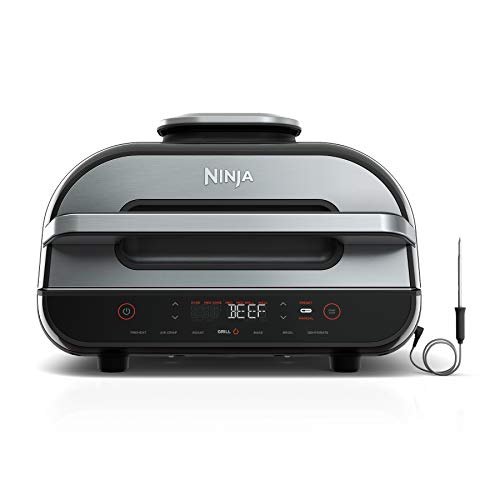
The FG551 is the indoor answer for people whose climate, building rules, or schedule keep them off the patio. The verified listing describes a 6-in-1 indoor grill and air fryer with Ninja’s Smart Cook System and a built-in thermometer — technology aimed squarely at the indoor cook’s two anxieties: will it crust, and will it be done right?
Strengths
- Built-in thermometer and Smart Cook System target doneness precisely
- Six functions — grill, air fry, and more — earn the counter space
- Indoor searing with managed smoke, in any weather, in any season
Trade-offs
- Countertop capacity is family-modest; batch cooking for crowds
- Electric indoor heat has a ceiling below kamado and infrared gas
- Another countertop appliance competing for kitchen real estate
Key specs
- Model: Ninja Foodi Smart FG551
- Functions: 6-in-1 grill and air fryer
- System: Smart Cook System with built-in thermometer (per verified listing)
- Use: Indoor, countertop
The thermometer system is the differentiator: insert the probe, select the target, and the grill manages the cook to it — a genuine quality-of-life feature for indoor cooks who cannot hover over an open flame, and one that produces reliably judged steaks while the grill plate lays down respectable marks and crust. The air-fryer function then handles the sides in the same appliance, which is how a countertop box earns permanent residence.
Set expectations by physics: no electric countertop grill matches a kamado’s ferocity, and the FG551 does not pretend to. What it delivers is the best indoor version of searing — real browning, real marks, precise doneness, zero weather — and for a large class of households that trade is not a compromise at all.
Best for: Apartments, cold climates, and tech-friendly cooks who grill indoors / Not suited for: Purists seeking maximum crust, or hosts cooking for crowds
Check on Amazon — check the current price on Amazon before you buy.

Hamilton Beach Electric Indoor Searing Grill (25360) — Best Budget Indoor
Hamilton Beach’s searing grill is the budget indoor pick done right. The verified listing states its credentials without embroidery: adjustable temperature control to 450°F, a removable nonstick grate, 118 square inches of cooking surface, PFAS-free construction, and a stainless steel body — the fundamentals of indoor searing at an entry tier.
Strengths
- Adjustable heat to a verified 450°F — enough for genuine browning and marks
- Removable grate makes the cleanup that decides indoor-grill ownership
- PFAS-free nonstick surface (per verified listing) at a budget tier
Trade-offs
- 118 sq in suits one to three people; families will batch
- Electric ceiling: browns well, but will not match infrared or kamado crust depth
- Single-purpose compared with the multi-function Ninja
Key specs
- Model: Hamilton Beach 25360
- Max temperature: 450°F (per verified listing title)
- Cooking area: 118 sq in (per verified listing title)
- Grate: Removable, PFAS-free nonstick
What 450°F buys indoors is the difference between grey and golden: at that temperature a dried, seasoned steak surface browns properly on the ridged grate, chicken skin crisps, and vegetables take char at their edges. The removable grate is the ownership feature — indoor grills die of cleaning resentment, and a grate that lifts out to the sink removes the excuse.
For a single person, a couple, a dorm-adjacent kitchen, or a household adding an indoor option beside an outdoor grill, this is the sensible spend: real searing function, honest specifications, no premium for functions you may not use. The Ninja above it is the upgrade when you want doneness automation and multi-function range in the same footprint.
Best for: Singles, couples, and budget buyers wanting genuine indoor searing / Not suited for: Families cooking in volume, or buyers wanting smart features
Check on Amazon — check the current price on Amazon before you buy.
Comparison Table
| Pick | Badge | Key spec | Best for |
|---|---|---|---|
| Kamado Joe Classic Joe Series II 18-Inch Ceramic Grill | Best Charcoal Searing | Ceramic kamado, lump charcoal, 250 sq in | Charcoal devotees and craft-focused cooks who want maximum heat and range |
| Napoleon Prestige 500 RSIB Propane Gas Grill | Best Gas Searing | Infrared side + rear burners, stainless flagship | Gas-grill loyalists wanting the flagship searing experience and rotisserie |
| Char-Broil Pro Series Amplifire 3-Burner Gas Grill and Griddle Cabinet | Best Infrared for Flare-Up Haters | Full-grate Amplifire infrared, 3 burners, griddle included | Mid-size households that sear fatty cuts and hate flare-ups |
| Weber Q 2800N+ Portable Grill | Best Portable Searing | 250–700°F range, dedicated sear burner, portable | Balconies, campers, tailgaters, and small households wanting portable searing |
| Ninja Foodi Smart Indoor Grill FG551 | Best Indoor Searing | 6-in-1 indoor, smart thermometer system | Apartments, cold climates, and tech-friendly cooks who grill indoors |
| Hamilton Beach Electric Indoor Searing Grill (25360) | Best Budget Indoor | 450°F max, 118 sq in, removable PFAS-free grate | Singles, couples, and budget buyers wanting genuine indoor searing |
The table is really a fuel map. The Kamado Joe owns the crust ceiling and the widest cooking range, at the price of time. The Napoleon Prestige owns the gas category’s ceiling, at a flagship price. The Amplifire owns the flare-up problem. The Weber Q owns portability with a verified 700°F ceiling that embarrasses full-size grills. The Ninja owns the indoor category’s intelligence, and the Hamilton Beach owns its value tier. There is no overall winner hiding in this table — there is a winner per life, and the reviews are written to help you recognize yours.
How to Choose the Best Searing Grills for Your Life
Start with where you are allowed to cook. Building rules, climate, and space eliminate fuels before preference gets a vote: many apartments permit only electric indoors or a small propane portable on the balcony; houses with patios can host anything. Run that filter first — the Ninja and Hamilton Beach exist for the electric-only life, the Weber Q for the small-space propane life — and the shortlist shrinks to the grills you can actually use weekly.
Then be honest about time. Charcoal’s crust is this guide’s ceiling and its schedule is its floor: a kamado wants a real preheat and a cook who enjoys tending. Gas infrared is the ten-minute answer with a flagship crust. Electrics are the five-minute answer with a good crust and a capacity ceiling. None of these is the “right” trade in the abstract — they are right or wrong for your Tuesdays.
Match capacity to the real crowd. Searing is batch work by nature — surfaces are hottest used a few pieces at a time — so a modest grate used in disciplined batches beats a huge grate used crowded and steamy. Buy for your typical two-to-six, and let the rare big night be a batch-cooking exercise rather than a sizing argument.
Finally, price the whole system. Kamados need charcoal and a permanent home; infrared gas needs burner care; electrics need counter space and an outlet with capacity. The grill’s price is the entry fee to a fuel-and-habit system, and the guides within this cluster — searing gas grills, searing gas charbroilers — explore the neighboring systems when you want to compare before committing.
The Physics of a Great Sear, in Plain Terms
A sear is a race between surface chemistry and interior cooking. The browning reactions that make crust and flavor need a hot, dry surface; the interior needs time to reach its target without overshooting. Win the race by making the surface hot and dry fast — that is the whole science, and every technology in this guide is a strategy for it.
Heat delivery comes in three forms, often combined. Radiation — from charcoal beds, infrared burners, and emitter plates — strikes the food directly and is the fastest crust-builder. Conduction — from a heavy, heat-soaked grate — brands and browns the contact face. Convection — hot air — is the slowest and is mostly what you are finishing with, not searing with. Great searing grills maximize the first two; mediocre ones rely on the third and steam the surface with the food’s own moisture.
Dryness is the cook’s half of the physics. A wet surface cannot exceed the boiling point of water until it dries, so it steams while the interior overcooks — the grey-steak outcome. Pat proteins dry, salt them in advance where the cut allows, preheat until the surface is fully fierce, and give each piece radiant room. Hardware supplies intensity; habits supply dryness; the crust needs both. Keep that sentence and you understand searing better than most grill marketing ever explains it — and you can judge any future grill, including the six above, by asking how it handles those two supplies.
Searing Technique by Fuel: One Goal, Four Rituals
On charcoal (the kamado): build the fire fully, vents open, until the bed is mature and the grates are heat-soaked; sear with the lid up for the first contact, then close it briefly to finish. The ritual is patience before, decisiveness during. On infrared gas: preheat the station until it glows with intent, sear in short, timed bursts per side, and finish on the main grates — the station is for crust, not for cooking through.
On emitter-plate infrared (Amplifire): preheat the whole grate, cook with the confidence that flare-ups will not interrupt, and turn once — the even radiant field rewards a single, patient contact per side. On indoor electrics: preheat completely (the ready indicator is not a suggestion), dry the protein twice as thoroughly as you think necessary, and do not crowd the plate — indoor elements recover more slowly than burners, so batches are smaller and more deliberate.
The goal never changes — hot, dry, uncrowded, brief — but each fuel reaches it by its own road, and learning your road is the difference between owning a searing grill and using one. Give any of these picks a month of cooks and the ritual becomes reflex; the crusts become the reason people request your steaks by name.
What to Cook on a Searing Grill Beyond Steak
The searing surface is a general tool that happens to be famous for steak. Seafood may benefit most of all: tuna, swordfish, salmon skin, scallops, and shrimp all want exactly what a searing grill offers — a fast, hard exterior over a barely warmed interior — and all of them punish a timid grill by cooking through before they color. Lamb chops and pork chops take the same treatment as steak with even more forgiving results, their fat crisping at the edges.
Vegetables with natural sugars — asparagus, peppers, zucchini, corn, mushrooms — char at the edges and sweeten in a way steaming and roasting never achieve, and sturdy fruit like pineapple and peaches caramelize into desserts. Bread and tortillas blister in seconds. Even cheese joins in where the format allows: thick provolone on a plancha-adjacent surface, halloumi directly on a hot grate.
Thinking of the sear as a technique rather than a steak setting doubles the value of every pick in this guide. The households that use their searing grills most are not eating more steak — they are searing everything, briefly, and wondering why they ever cooked these foods any other way.
Care and Feeding: Keeping Searing Performance Alive
Searing hardware lives at thermal extremes and asks for small, specific loyalties. Kamados: brush grates hot, manage ash so airflow stays free, and let the ceramic warm and cool without thermal shock — never douse a hot kamado. Infrared gas: keep sugary marinades off the ceramic burners, run the prescribed burn-offs, and touch the tiles only when cold and only gently. Emitter plates: brush and burn off residue so the pores stay open; a clogged emitter is a mild grill wearing an infrared costume.
Indoor electrics: the grate-out cleaning habit decides everything — removable grates and plates get washed while the memory of the meal is fresh, drip trays get emptied before they become archaeology, and the appliance gets stored dry. Across all fuels, the pattern is identical: five minutes of routine per cook, in exchange for searing performance that does not fade. The grills in this guide were chosen partly for how gracefully they accept that routine — none of them hides its wear parts or punishes its owner for maintaining it.
Searing Grill Accessories That Are Actually Worth Owning
The aftermarket is full of searing gadgets; a short list earns its drawer. A reliable instant-read thermometer is the first — searing is a two-stage craft, and the finish stage is judged by internal temperature, not by hope. A wide, stiff spatula and long tongs sized for your grill are the second: control at the surface is safety and crust preservation in one. A cast-iron press — for burgers and bacon on flat surfaces — is the legitimate third.
Heat gloves rated for real temperatures matter on kamados and around infrared stations, where adjusting grates and vents happens close to serious heat. A dedicated grate brush matched to your grate material (and replaced when its bristles tire) keeps the contact surface honest. And for charcoal cooks, a chimney starter remains the fastest, cleanest road to a mature fire — no fluids, no fuss.
What to skip: most single-purpose searing gadgets that promise to retrofit a mild grill into a fierce one. A bolt-on plate cannot change a firebox’s physics, and the money is better saved toward the grill that was engineered for the job — which is, in the end, the premise of this entire guide.
How Searing Grills Age: What Year Three Looks Like by Fuel
Buy with the third year in mind and each fuel shows its character. Kamados age gracefully: the ceramic is effectively permanent, gaskets are a consumable replaced on a cycle of years, and the fire’s performance does not fade. A well-kept kamado in year ten sears like year one, which is the deepest argument for its tier. Infrared gas grills age by their burners: kept clear and burned off on schedule, the searing station holds its ferocity; neglected, it dulls gradually — recoverable with cleaning, preventable with rhythm.
Emitter-plate systems age by their plates, which are replaceable by design — a wear part with a part number is a feature, not a flaw. Indoor electrics age by their coatings and elements: gentle utensils and prompt cleaning keep the nonstick releasing for years, while abused plates fade first and take the searing quality with them. Portables like the Q age by their burners and regulators, both orderable — Weber’s parts depth being the quiet reason its portables stay in service for a decade.
The pattern across fuels: searing performance is durable exactly where maintenance is possible and parts exist. That is why this guide weighted brands with support networks as heavily as headline heat — the crust you get in year three is the one you actually bought.
How to Sear a Steak Properly on Any Grill in This Guide
Step 1 — Prepare the steak, not just the grill. Choose a cut at least an inch thick — thin steaks cook through before they crust on any equipment. Salt it generously, ideally an hour ahead or immediately before cooking, and bring it out of the refrigerator in time to take the deep chill off. Just before cooking, pat the surface thoroughly dry; this is the single highest-value action in the entire process.
Step 2 — Preheat to genuine fierceness. Kamado fully developed, infrared station glowing, emitter grate soaked, indoor plate at its ready signal — whatever your fuel, the surface must be completely at temperature before food touches it. A steak laid on a warming surface steams in its own juice and the crust race is lost in the first minute.
Step 3 — Sear with commitment. Lay the steak down and leave it: one to three minutes per side depending on fuel and thickness, without pressing, poking, or peeking. The crust releases when it is formed. For thick cuts, finish to temperature in a gentler zone — the kamado with vents eased, the main box of the gas grill, a lower setting indoors — rather than riding maximum heat to the end.
Step 4 — Rest, slice, and learn. Rest the steak for at least five minutes, then slice against the grain where the cut has a grain. And note what happened — crust depth, timing, doneness — because searing is a repeatable craft, and each cook on your grill teaches the next one. Within a month, the method is muscle memory and the results are restaurant-legitimate. Keep a small notebook or a note on your phone for the first season — cut, thickness, fuel setting, minutes per side, result — and you will build a personal searing chart for your exact grill that no guide, including this one, can hand you ready-made.
Common Buying Mistakes
- Buying by fuel tribalism instead of by your life. The best searing grill is the one your space, rules, schedule, and crowd actually support — kamado, infrared gas, and indoor electric all crust beautifully in the right home.
- Putting wet steaks on hot grates. Surface moisture is the crust’s first enemy on every fuel. Pat dry, every time, without exception.
- Crowding the surface. Packed pieces steam each other. Searing is batch work; the surface recovers fast when you give it room to stay hot.
- Cooking thin steaks with thick-steak ambitions. Under an inch, the interior finishes before the crust forms on any grill ever made. Thickness is an ingredient.
- Riding maximum heat to doneness. Sear for crust, finish for temperature. One heat for both jobs burns the first or misses the second.
- Judging a searing grill by its first cook. Every fuel here has a learning curve measured in a few cooks — vent control on the kamado, zone geography on the gas grills, batch discipline indoors. The second month is the honest review period; the first week is tuition.
- Skipping the rest. An unrested steak floods the board with the juices that belonged in the meat. Five minutes is the cheapest quality in all of cooking.
Final Recommendation
Choose the Kamado Joe Classic II if charcoal craft and maximum heat call to you. Choose the Napoleon Prestige 500 RSIB for the gas flagship with infrared searing and rotisserie in one stainless appliance. Choose the Char-Broil Amplifire 3-Burner if flare-ups have been ruining your fatty cuts, the Weber Q 2800N+ if your searing must travel or fit a balcony, the Ninja Foodi FG551 for smart indoor searing in any weather, and the Hamilton Beach 25360 for honest indoor searing on a budget. Every route starts the same way: confirm the model and fuel on the listing, then check price on Amazon. And whichever route you take, give it the month of cooks it deserves before judging it — searing is a craft with a short apprenticeship and a long, delicious journeyman phase, and every grill in this guide rewards the cook who stays for both.
More buying guides from the wider grills cluster on this site:
- Kamado Joe Classic Joe Series II 18-Inch Ceramic Grill — check price on Amazon
- Napoleon Prestige 500 RSIB Propane Gas Grill — check price on Amazon
- Char-Broil Pro Series Amplifire 3-Burner Gas Grill and Griddle Cabinet — check price on Amazon
Best Searing Gas Grills Best Searing Gas Charbroiler Grills Best Selling Bbq Grills Best Sandwich Grills Best 10 Grills
Frequently Asked Questions
Which fuel sears best: charcoal, gas, or electric?
At the ceiling, charcoal in a ceramic kamado and infrared gas are peers — both reach temperatures that crust a steak in a couple of minutes per side. Indoor electrics sear genuinely well within a lower ceiling. The practical answer is the fuel your space and schedule support, because a used grill out-sears a perfect one that stays in the box.
What temperature does a grill need to sear properly?
The surface needs to be well beyond the point where moisture boils off instantly — in practice, grills whose listings cite ranges reaching 450°F and above can brown respectably, while the fierce end of this guide (a kamado’s charcoal bed, an infrared burner, the Weber Q’s verified 700°F top end) produces steakhouse crust. Dryness and preheat matter as much as the number.
Can an indoor electric grill really sear?
Yes, within its physics: the picks here reach temperatures that brown and mark food properly, and the Ninja adds thermometer-guided doneness. What indoor electrics cannot match is the sheer radiant violence of a kamado or infrared burner — expect excellent home searing, not steakhouse extremity, plus the freedom to grill indoors in any weather, at any hour, in any season of the year.
Is a kamado worth it if I mostly sear steaks?
If steak is the main event and you enjoy fire craft, emphatically yes — no other pick here matches its crust, and its smoking and baking range is a bonus you will end up using. If steak night is monthly and rushed, the infrared gas picks deliver most of the crust with a fraction of the ritual.
How thick should a steak be for searing?
At least an inch, and an inch and a half is better. Thickness buys time: the surface can crust deeply while the interior is still approaching its target. Thin steaks are a different technique — fast, hot, and brief — and no grill can give them a thick steak’s crust-to-center contrast.
Do I need to oil the grate or the steak?
A very light oil on the steak (or on the grate, applied with a cloth) helps release and browning; flooding either invites flare and smoke. With dry, well-seasoned surfaces and a fully preheated grate, sticking is brief — the crust releases itself when it has formed.


