Disclosure: airfryerkitchensupply.com is reader-supported. When you buy through links on our site, we may earn an affiliate commission at no extra cost to you.
Where to buy
All six of the best searing gas charbroiler grills in this guide are commercial countertop charbroilers sold on Amazon, each linked to its verified listing so you can check the current price on Amazon and — just as important — confirm the fuel type, dimensions, and gas connection requirements before ordering. These are professional appliances: listings specify natural gas or propane configurations and conversion kits, and the right choice depends on the gas supply at your installation site, so read the fuel line of the listing as carefully as the size, the footprint, and the ventilation requirements combined.
- Atosa ATCB-24 Natural Gas Lava Rock Charbroiler — check price on Amazon
- Atosa CookRite ATCB-36 Charbroiler, 105,000 BTU — check price on Amazon
- KoolMore 24-Inch Commercial Charbroiler, 60,000 BTU (KM-GCB2-24M) — check price on Amazon
- Kratos 24-Inch Commercial Gas Charbroiler, 70,000 BTU (29Y-001) — check price on Amazon
- Globe Chefmate 24-Inch Radiant Gas Charbroiler — check price on Amazon
- Vulcan VCRB36 Charbroiler, 36-Inch — check price on Amazon
The best searing gas charbroiler grills are not patio grills, and this guide will not pretend otherwise. A charbroiler is a purpose-built commercial countertop appliance — a battery of high-output burners under heavy cast-iron grates, often with lava rock or radiant plates between flame and food — built for one single purpose: putting steakhouse-quality crust on proteins, all service long, at temperatures home grills visit only briefly. Restaurants, food trucks, caterers, serious outdoor-kitchen builders, and a certain kind of home steak obsessive are its buyers.
That honesty shapes everything below. Charbroilers demand a gas line (natural gas or propane, often convertible), a counter or stand that can take the weight and heat, and — indoors — commercial ventilation; they are not appliances you wheel out for a casual Saturday, and they make no apology for it — specialization is the entire proposition. In exchange, they deliver the most intense, even, repeatable searing in gas cooking: grate surfaces that stay ripping hot through back-to-back steaks, char flavor from vaporized drippings on rock or radiants, and burner counts that scale from a two-burner 24-inch unit to 36-inch, six-burner lines. Every pick was verified against Amazon’s catalog data, with BTU figures and burner counts quoted from those listings.
In this guide
Quick Picks
The Atosa ATCB-24 is the balanced default, the KoolMore 24 is the value entry, and the Vulcan VCRB36 is the heavy-duty flagship. All six are commercial units with commercial appetites for gas and ventilation — match the size to your line or outdoor kitchen, not your patio, and match the heat medium to your menu and your cleaning crew.
- Atosa ATCB-24 Natural Gas Lava Rock Charbroiler — Best Overall. The balanced charbroiler: 24 inches, two burners, lava rock over the burners and a stainless radiant plate in the system — char flavor and even heat in the category’s most useful size. Check on Amazon to check price on Amazon.
- Atosa CookRite ATCB-36 Charbroiler, 105,000 BTU — Best 36-Inch. The volume Atosa: 36 inches, three burners, a verified 105,000 BTU, lava briquettes, and an LP conversion kit in the box for fuel flexibility. Check on Amazon to check price on Amazon.
- KoolMore 24-Inch Commercial Charbroiler, 60,000 BTU (KM-GCB2-24M) — Best Value. The accessible entry to real charbroiling: a 24-inch, two-burner, 60,000 BTU stainless unit with an ETL listing — commercial fundamentals without the flagship tier pricing. Check on Amazon to check price on Amazon.
- Kratos 24-Inch Commercial Gas Charbroiler, 70,000 BTU (29Y-001) — Best Radiant System. A radiant-heat specialist: 70,000 BTU across two burners under radiant plates that vaporize drippings and clean up faster than rock — for kitchens that prize consistency and turnover. Check on Amazon to check price on Amazon.
- Globe Chefmate 24-Inch Radiant Gas Charbroiler — Best Compact Radiant. From a long-established commercial equipment maker: a 24-inch stainless radiant charbroiler in the Chefmate line, sized and priced for cafés, delis, and compact professional lines. Check on Amazon to check price on Amazon.
- Vulcan VCRB36 Charbroiler, 36-Inch — Best Premium Heavy-Duty. The flagship: a 36-inch Vulcan with six cast-iron burners at 14,500 BTU each — the heavy-duty line equipment steakhouses build around, from the industry’s benchmark brand. Check on Amazon to check price on Amazon.
How These Picks Were Chosen
We selected for searing physics first. A charbroiler sears because its grates hold enormous heat and its burners replace that heat instantly; so burner output per inch of grate, grate mass (cast iron over thin steel, always), and the heat-spreading medium between burner and food were the primary filters. Lava rock vaporizes drippings for char flavor and evens hot spots; radiant plates do the same job with easier cleaning. Both systems appear below, and the reviews say which suits which kitchen.
Second, commercial reality: stainless construction that survives a hose-down cleaning culture, burners and grates that are replaceable parts, ETL or equivalent listings where the verified titles state them, and fuel flexibility — several picks include LP conversion kits, which matters enormously when a unit moves between a natural-gas kitchen and a propane food truck.
Third, size honesty. We spread the picks across the two countertop footprints that dominate the category — 24-inch two- and three-burner units for compact lines and serious home outdoor kitchens, and 36-inch units for volume — rather than padding the list with a token of every width. Every product name, ASIN, BTU figure, and burner count was cross-checked against Amazon’s catalog, and only exact brand-and-model matches are linked.
Finally, a deliberate exclusion: no residential patio grill appears here, however good its sear zone. Buyers type this query want charbroiler physics, and mixing categories would ill-serve both audiences. If your actual need is a backyard grill that sears well, the companion guides to searing gas grills and searing grills in this cluster are the right pages — they are linked at the end of this one.
We also screened for the category’s quiet disqualifier: units with burners and grates that are not replaceable, or with no identifiable manufacturer behind them. A charbroiler is a heat-cycling industrial tool; its second and third years are a parts story. Every pick here comes from a maker with a catalog, a parts channel, and other commercial equipment in the field — the unglamorous credential that decides whether a searing grill is an appliance or an experiment.
The 6 Best Searing Gas Charbroiler Grills for Serious Crust

Atosa ATCB-24 Natural Gas Lava Rock Charbroiler — Best Overall
The Atosa ATCB-24 is the charbroiler most buyers should start with, because it combines the category’s two heat philosophies in one unit: the verified listing describes a lava-rock grate and a stainless steel radiant plate working together over two burners in a 24-inch natural gas countertop body with an iron cooking grill. Rock for flavor and diffusion, radiant for structure — it is a thoughtful stack.
Strengths
- Lava rock plus radiant system evens heat and vaporizes drippings for char flavor
- 24-inch two-burner format fits compact lines, food trucks, and outdoor kitchens
- Atosa is a genuine commercial brand with a parts pipeline
Trade-offs
- Natural gas configuration — propane use needs the correct conversion path
- Lava rock needs periodic replacement and more cleaning than bare radiants
- Commercial ventilation required for indoor installation
Key specs
- Model: Atosa ATCB-24-NG
- Size: 24 in countertop
- Burners: 2
- Heat system: Lava rock with stainless radiant plate
On the line, the ATCB-24’s virtue is steadiness. The rock bed absorbs the burners’ raw output and returns it as an even radiant field, so the cast-iron grates sear uniformly from edge to edge — no chasing hot spots with a steak during service. Recovery after loading cold product is brisk, which is the entire commercial point: the tenth steak sears like the first.
For a home outdoor kitchen, this is the size that makes sense: wide enough for a family’s steaks plus vegetables at the margins, compact enough for a built-in counter bay, and from a brand whose burners and grates remain orderable. Pair it with a proper stand or heat-safe counter, confirm your gas supply matches the configuration, and it will out-sear every conventional grill on the patio by a margin that is not close.
Best for: Compact restaurant lines, food trucks, and serious home outdoor kitchens / Not suited for: Casual patio cooks or anyone without a gas line and ventilation plan
Check on Amazon — check the current price on Amazon before you buy.

Atosa CookRite ATCB-36 Charbroiler, 105,000 BTU — Best 36-Inch
Step up to the CookRite ATCB-36 when the 24-inch class stops keeping up. The verified listing gives the working numbers plainly: 36 inches of heavy-duty countertop charbroiler, three burners producing 105,000 BTU, lava briquettes over the burners, stainless construction — and an LP conversion kit included, which quietly makes it one of the most flexible units in this guide.
Strengths
- Verified 105,000 BTU across three burners — serious recovery power
- LP conversion kit included for natural gas or propane installations
- 36-inch width runs multiple temperature zones across the grate
Trade-offs
- Demands a 36-inch bay and the ventilation to match its output
- Briquettes need the same periodic care as lava rock
- Overwhelming overkill for household-only use
Key specs
- Model: Atosa CookRite ATCB-36
- Size: 36 in countertop
- Output: 105,000 BTU (per verified listing title)
- Fuel: Natural gas with LP conversion kit included
Three burners across 36 inches is not just more of the same — it is zoning. Run the left burner hard for steaks, the middle medium for chicken, the right low for holding and vegetables, and one appliance covers a whole grill station’s menu. The briquette bed smooths each zone’s heat, and the total output means loading a full grate of cold burgers dents the temperature briefly rather than collapsing it.
The included LP kit deserves emphasis because fuel is where commercial purchases go wrong: a natural-gas-only unit delivered to a propane site is a return, a delay, and a restocking argument. Atosa removes that failure mode. For a growing restaurant, a busy truck, or a ranch-scale outdoor kitchen that cooks for crowds, this is the guide’s volume recommendation.
Best for: Restaurants, caterers, and crowd-scale outdoor kitchens needing zones and output / Not suited for: Small lines or homes — the 24-inch class is the rational size there
Check on Amazon — check the current price on Amazon before you buy.
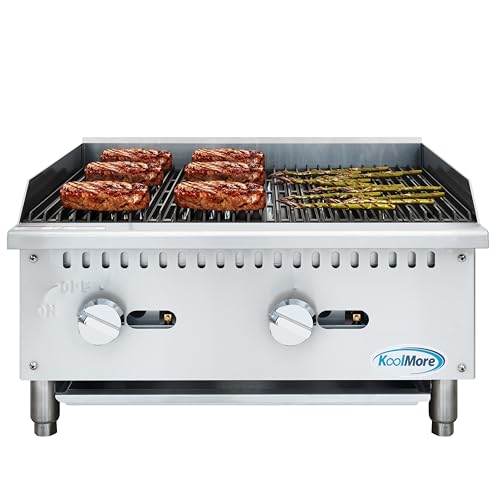
KoolMore 24-Inch Commercial Charbroiler, 60,000 BTU (KM-GCB2-24M) — Best Value
KoolMore’s 24-inch charbroiler is the value door into this category, and its verified listing states the credentials that matter: two burners, 60,000 BTU, stainless steel construction, and an ETL listing — the certification detail that separates a commercial appliance from a lookalike when inspectors and insurers enter the conversation.
Strengths
- ETL listed (per verified listing) — the commercial credential that matters
- 60,000 BTU over 24 inches is strong power density for searing
- Stainless construction at the category’s value tier
Trade-offs
- Radiant-style system gives less vaporized-dripping flavor than lava rock
- Value tier fit and finish versus Atosa and Vulcan
- Natural gas configuration; confirm conversion options for propane sites
Key specs
- Model: KoolMore KM-GCB2-24M
- Size: 24 in countertop
- Output: 60,000 BTU (per verified listing title)
- Certification: ETL listed (per verified listing title)
Sixty thousand BTU under 24 inches of grate is a power density that patio grills simply do not approach, and it shows in the sear: cast-iron grates stay hot through service, crust forms fast, and the unit shrugs off the load-and-recover cycle that defines charbroiler work. For a small restaurant, a café adding a grilled menu, or a home outdoor kitchen on a budget, the fundamentals here are entirely real.
Where the value tier shows is in the refinements — knob feel, grate finish, the elegance of the grease management — rather than the cooking. If your priority is a certified, powerful charbroiler at the lowest responsible cost, this is the pick; if your priority is a decade of heavy daily service with premium fit, the Atosa and Vulcan brackets above and below it in this list are the step-ups.
Best for: Small restaurants, cafés, and budget-conscious outdoor kitchens / Not suited for: High-volume lines that will run it at maximum for every service
Check on Amazon — check the current price on Amazon before you buy.

Kratos 24-Inch Commercial Gas Charbroiler, 70,000 BTU (29Y-001) — Best Radiant System
The Kratos 29Y-001 represents the radiant school of charbroiling at its most straightforward: the verified listing describes a 24-inch, two-burner gas radiant charbroiler in stainless steel with a 70,000 BTU output — the highest per-burner figure among the 24-inch picks here, delivered through radiant plates rather than rock.
Strengths
- 70,000 BTU in the 24-inch class — the strongest compact output here
- Radiant plates vaporize drippings for char flavor with easier cleaning than rock
- Even, repeatable heat that suits high-turnover service
Trade-offs
- Radiant flavor profile differs subtly from lava rock — purists have preferences
- No rock bed means no rock-bed heat soak effect
- Commercial installation requirements apply as with all picks here
Key specs
- Model: Kratos 29Y-001
- Size: 24 in countertop
- Output: 70,000 BTU (per verified listing title)
- Heat system: Gas radiant
Radiant versus rock is the category’s standing debate, and the Kratos makes the radiant case well. The plates shield the burners completely, so flare-ups are minimal and heat is strikingly even; drippings hit the hot radiant surface and vaporize into the food as char flavor, then the plates lift out for a scrape and wash instead of a rock replacement schedule. For a kitchen turning tables, that maintenance profile is money.
Output is the other headline: 70,000 BTU in this footprint means the grates run genuinely fierce, and delicate work — fish, vegetables — is done by zoning burners rather than by hoping for a cool corner. If your menu is steak-forward and your cleaning crew is small, the radiant Kratos may suit you better than the Best Overall pick; it is a philosophy choice, not a quality gap.
Best for: Steak-forward kitchens wanting even heat and fast cleanup / Not suited for: Lava-rock loyalists who want the rock-bed cooking character
Check on Amazon — check the current price on Amazon before you buy.

Globe Chefmate 24-Inch Radiant Gas Charbroiler — Best Compact Radiant
Globe Food Equipment has supplied commercial kitchens for generations, and its Chefmate line is the brand’s compact-equipment range. This 24-inch radiant charbroiler — stainless steel per the verified listing — is the pick for smaller professional spaces that still need genuine charbroiler searing rather than a flat-top’s gentler crust.
Strengths
- Established commercial brand with dealer and parts networks
- Radiant system for even heat and straightforward cleaning
- Compact 24-inch footprint for cafés and delis
Trade-offs
- Listing detail is sparser than rivals — confirm specs with the seller before ordering
- Chefmate is Globe’s lighter-duty line; heavy steakhouse volume belongs to bigger units
- Fewer headline features than the Atosa and Kratos picks
Key specs
- Model: Globe Chefmate 24in Radiant
- Size: 24 in countertop
- Construction: Stainless steel (SST per verified listing)
- Heat system: Radiant
The Chefmate’s appeal is institutional: Globe’s dealer network, parts availability, and service documentation are the kind of support that matters in year four, in a working kitchen, on a Friday. The charbroiler itself is a sound radiant unit — even heat, honest searing, stainless construction — sized for menus where grilled items are a section rather than the whole story.
We flag the sparse listing honestly: where rival listings state BTU and configuration outright, this one requires a confirmation step with the seller for the exact gas configuration and output before purchase. Do that homework and the Chefmate is a dependable, well-supported compact charbroiler; skip it and you are gambling on the details commercial purchases punish.
Best for: Cafés, delis, and small kitchens that value brand support networks / Not suited for: Buyers who want every spec confirmed in the listing itself
Check on Amazon — check the current price on Amazon before you buy.

Vulcan VCRB36 Charbroiler, 36-Inch — Best Premium Heavy-Duty
Vulcan is the name commercial kitchens measure other equipment against, and the VCRB36 is its 36-inch countertop charbroiler: the verified listing specifies six cast-iron burners at 14,500 BTU each — a burner-per-zone architecture that gives this unit the finest-grained heat control in the guide.
Strengths
- Six individually controlled cast-iron burners — true zone-by-zone command
- Vulcan build quality and the deepest service network in commercial cooking
- Cast-iron burner construction for longevity under daily service
Trade-offs
- Premium pricing at the top of the category
- 36-inch footprint plus full commercial ventilation requirements
- Far beyond household needs — this is professional line equipment
Key specs
- Model: Vulcan VCRB36
- Size: 36 in countertop
- Burners: 6 cast-iron, 14,500 BTU each (per verified listing title)
- Use: Commercial line
Six burners changes the cooking in kind, not just degree. Each burner governs a narrow strip of grate, so a line cook runs steaks at full ferocity on two strips, rests them on a third at holding heat, and keeps a fourth gentle for vegetables — simultaneously, on one appliance, without compromise. That granularity is why high-volume steakhouses buy burner counts, and the VCRB36 is the fullest expression of it in this guide.
The Vulcan premium buys the unglamorous things: cast-iron burners that endure, a chassis that survives a decade of nightly service, and a service network that answers in every city. If a charbroiler is the beating heart of a business, this is the rational flagship; if it is an enthusiast’s outdoor-kitchen crown, it is the extravagant one — and both buyers will find it exactly as serious as its reputation.
Best for: Steakhouses and high-volume lines; flagship outdoor kitchens / Not suited for: Homes, small cafés, or any site without commercial ventilation
Check on Amazon — check the current price on Amazon before you buy.
Comparison Table
| Pick | Badge | Key spec | Best for |
|---|---|---|---|
| Atosa ATCB-24 Natural Gas Lava Rock Charbroiler | Best Overall | 24 in, 2 burners, lava rock + radiant plate | Compact restaurant lines, food trucks, and serious home outdoor kitchens |
| Atosa CookRite ATCB-36 Charbroiler, 105,000 BTU | Best 36-Inch | 36 in, 3 burners, 105,000 BTU, LP kit included | Restaurants, caterers, and crowd-scale outdoor kitchens needing zones and output |
| KoolMore 24-Inch Commercial Charbroiler, 60,000 BTU (KM-GCB2-24M) | Best Value | 24 in, 2 burners, 60,000 BTU, ETL listed | Small restaurants, cafés, and budget-conscious outdoor kitchens |
| Kratos 24-Inch Commercial Gas Charbroiler, 70,000 BTU (29Y-001) | Best Radiant System | 24 in, 2 burners, 70,000 BTU radiant | Steak-forward kitchens wanting even heat and fast cleanup |
| Globe Chefmate 24-Inch Radiant Gas Charbroiler | Best Compact Radiant | 24 in radiant, stainless, commercial brand support | Cafés, delis, and small kitchens that value brand support networks |
| Vulcan VCRB36 Charbroiler, 36-Inch | Best Premium Heavy-Duty | 36 in, 6 cast-iron burners, zone control | Steakhouses and high-volume lines; flagship outdoor kitchens |
Read the table by architecture. The two Atosas are the rock-and-radiant all-rounders at the two working sizes, with the 36 adding the LP kit and zoning. The Kratos and Globe are the radiant specialists — the Kratos on output, the Globe on brand support. The KoolMore is the certified value door into the category. The Vulcan stands apart on burner granularity: six zones is a different instrument, priced accordingly. If you are deciding between the Atosa 24 and the Kratos 24, you are really deciding rock versus radiant; if between either 36, you are deciding three broad zones versus six fine ones. Every other difference is secondary to those two choices.
How to Choose the Best Searing Gas Charbroiler Grills
Size to the line, not the dream. A 24-inch charbroiler runs a serious grill station for a small-to-mid operation and is the largest size a home outdoor kitchen can sensibly feed with gas and ventilation. The 36-inch class is for volume — multiple zones, simultaneous menus, service that never pauses. Oversizing wastes fuel and hood capacity every single service; undersizing collapses at the Friday rush. Count your peak simultaneous portions and buy for that number.
Choose your heat medium deliberately. Lava rock and briquettes soak heat and vaporize drippings with the most traditional char character, at the cost of periodic rock replacement and deeper cleaning. Radiant plates heat evenly, resist flare-ups, and clean fast, with a slightly cleaner flavor profile. Mixed systems exist — the Best Overall pick layers both. Neither is wrong; match the medium to your menu and your cleaning crew.
Confirm fuel before anything else. Natural gas and propane configurations, conversion kits, inlet sizes, and regulator requirements are where commercial purchases fail. Verify what your site supplies, what the unit ships as, and what conversion costs — several picks here include the LP kit, which can settle the question in the box.
Budget the installation, not just the appliance. Ventilation hood capacity, a heat-safe stand or counter, gas plumbing by a licensed fitter, and clearance to combustibles are part of the true price of any charbroiler. A charbroiler bought without its installation budget is a sculpture. Plan both, and the appliance will repay the planning at every service.
Lava Rock vs Radiant Plates: The Charbroiler Heat Debate, Explained
Both systems solve the same problem — a raw burner flame is uneven and flare-prone — by interposing a hot mass between flame and food. Lava rock (and its manufactured cousin, briquettes) is a bed of porous stone over the burners. It absorbs heat, glows, and radiates it evenly at the grates; drippings that land on it vaporize instantly, bathing food in the smoky char flavor that defines charbroiling. The costs are maintenance: rock absorbs grease over time, eventually flares and crumbles, and is replaced on a schedule.
Radiant plates are angled metal sheets over each burner. They spread flame heat across their surface, shield the burner from drippings entirely, and vaporize what lands on them — delivering much of the same flavor effect with no consumable bed. Cleaning is a lift-out and a scrape. The heat character is a touch more even and a touch less wild than rock, which high-turnover kitchens experience as consistency and rock loyalists experience as a missing edge.
The pragmatic verdict: high-volume and low-labor kitchens lean radiant; flavor-first and traditional kitchens lean rock; and home outdoor kitchens do well with either, choosing by how much cleaning they will honestly do. What is not on the menu is a bare-burner unit at this level — every pick in this guide interposes rock, radiant, or both, because that interposition is what makes a charbroiler a charbroiler.
Ventilation, Gas, and Installation: What a Charbroiler Really Requires
Ventilation is non-negotiable indoors. A charbroiler produces the heat, grease vapor, and combustion products of a commercial line because it is one. Indoor installation means a properly sized commercial hood and fire-suppression compliance under local code — full stop. Outdoors, the requirement relaxes but does not vanish: install under no low overhang, keep clearances to combustibles per the manual, and never operate one in an enclosed garage or tent.
Gas work belongs to licensed fitters. Supply pressure, line sizing for outputs that can exceed a whole house’s other appliances combined, shutoff valves, and leak testing are professional work in every jurisdiction, and insurers and inspectors will ask. The conversion kits several picks include are parts, not permission — the conversion itself should be performed or verified by a qualified technician.
The stand matters. These units are heavy, hotter underneath than a patio grill, and designed for purpose-built equipment stands or rated counters. Confirm the stand’s load and heat rating, leave the manual’s clearances on every side, and route the grease drawer where it can actually be emptied. An afternoon of installation discipline is what separates a charbroiler station from a charbroiler incident.
Charbroiler Technique: Getting Steakhouse Crust at Home or on the Line
Preheat longer than feels reasonable. The grates and the rock or radiant mass must be fully heat-soaked — commercial lines run their charbroilers hot for the whole service for a reason. Give a cold unit a thorough preheat until the grates shimmer with heat; a steak on a half-hot charbroiler steams in its own juices and never crusts.
Dry protein, hot grate, patience. Pat steaks dry, season assertively, and lay them on the grate without crowding — crowding drops grate temperature and steams the batch. Then leave them alone: crust forms by contact and time, and moving a steak early tears the very surface you are building. One turn, a brief finish, and off to rest.
Use the zones. On multi-burner units, sear over the fierce zone and finish over the gentle one rather than riding a single temperature. Keep a corner of grate for vegetables and bread, which want char’s edge without its full violence. And keep the grates brushed and lightly oiled between batches — a clean grate marks cleanly, while a carbon-crusted one sticks, tears, and smokes out the room.
Charbroiler, Grill, or Griddle: Which Hot Surface Does Your Menu Need?
Commercial menus often run all three, but buyers choosing one should match the surface to the food. A charbroiler is the protein searing station: steaks, chops, chicken, burgers, and anything that wants crust, char marks, and vaporized-dripping flavor. Its open radiant heat is violent and directional, which is glory for a ribeye and misery for an egg.
A griddle (flat-top) is the contact surface: eggs, pancakes, smash burgers, cheesesteaks, and anything that cooks in its own fat or needs a spatula’s finesse. It sears by conduction alone — excellent crust on a smash burger, but no char flavor and no grill marks. A conventional grill, lidded and gentler, roasts as much as it sears; it is the home all-rounder and the professional’s third choice for pure crust.
The honest mapping: if your menu’s identity is charred protein, the charbroiler is not an upgrade to a grill, it is a different tool that happens to share a fuel. Kitchens that buy one expecting it to also roast whole chickens gently or bake are disappointed; kitchens that buy one to do the single job of searing, continuously and superbly, understand immediately why restaurants build their lines around them.
Running Costs and the Maintenance Calendar
A charbroiler’s purchase price is the beginning of its budget, and planning the rest is what separates satisfied owners from surprised ones. Fuel: outputs in this class drink gas at commercial rates; a busy service burns more in an evening than a patio grill burns in a month, and the gas supply must be sized for it. Consumables: lava rock or briquettes are replaced on a cycle measured in months of service; grates are re-seasoned continuously and replaced on a cycle of years; burners likewise.
The calendar that keeps one healthy is simple. Daily (per session): brush grates hot, scrape the crumb and grease paths, empty the grease drawer. Weekly: lift grates, inspect the rock bed or radiant plates, clear burner ports of debris, check for uneven flame patterns while cold-starting. Seasonally or quarterly: deep-clean the firebox, inspect gas connections (with a fitter where required), assess rock replacement, and re-season grates thoroughly.
None of this is exotic — it is the standard rhythm of commercial line equipment, scaled to your volume. Owners who adopt it find charbroilers to be among the longest-lived appliances in the kitchen, because the design assumes maintenance and makes every wear part reachable. Owners who treat one like a patio grill — fire it, forget it, store it damp — meet the corrosion and clogging that the calendar exists to prevent.
Reading a Charbroiler Listing Like a Professional Buyer
Commercial listings reward a different reading habit than consumer ones. Start with configuration: fuel type as shipped, voltage-free (these are gas appliances — any electrical need is the ignition, if fitted), gas inlet size, and whether a conversion kit is included or merely available. A surprising share of commercial returns are configuration mismatches that one careful minute with the listing would have prevented.
Then read dimensions like a line cook: the unit’s footprint is not the space it needs — add the manual’s clearances, the stand, the hood’s capture area, and working room for the grease drawer to slide out. Measure the bay, the door it must pass through, and the counter depth twice. Then read the wear parts: are grates, burners, rock, and radiants listed as orderable parts for this exact model? A charbroiler is a decade-scale appliance only if its consumables remain a phone call away.
Finally, read for the certification your situation requires — ETL or equivalent listings appear in several of these picks’ verified titles, and commercial sites, insurers, and inspectors care about them in a way home buyers never encounter. The professional habit is boring and total: configuration, dimensions, parts, certification — in that order, before price. This guide’s picks were screened the same way, which is why the reviews keep returning to those four words.
How to Set Up and Season a New Charbroiler
Step 1 — Install and connect professionally. Position the unit on its rated stand with the manual’s clearances, have a licensed fitter connect and leak-test the gas in the correct configuration for your supply, and confirm the ventilation is operational before the first firing. This step is not DIY territory, and treating it that way is the one mistake in this guide with consequences beyond a bad meal.
Step 2 — Burn off and inspect. Run all burners on high for a thorough burn-off period to clear manufacturing oils and coatings, watching each burner’s flame pattern: even, blue, and consistent along its length. Uneven flames at this stage mean a connection or pressure issue to resolve now, not a quirk to cook around.
Step 3 — Season the grates. With the grates hot, apply a thin coat of high-heat cooking oil with a cloth or brush and let it polymerize; repeat lightly. Cast-iron grates seasoned at birth and maintained with a brush-and-oil routine after service resist sticking and corrosion for years.
Step 3.5 — Cook a sacrificial first batch. Before the first real service or dinner, run a batch of inexpensive burgers or onions through the unit. You are calibrating yourself, not the appliance: learning where its hot strips run, how fast the grates recover, and how the zones behave with real food on them. Every charbroiler has a personality; one cheap batch teaches it without risking the steaks that matter.
Step 4 — Establish the cleaning rhythm. Brush grates while hot after every session, empty the grease drawer before it fills (charbroiler grease volume surprises everyone), and schedule the deeper clean — rock inspection or radiant plate scrape-down — on a calendar rather than a whim. Charbroilers reward rhythm: the kitchens that love them clean them like clockwork.
Common Buying Mistakes
- Buying a charbroiler for a patio without the installation plan. No gas line, no ventilation thinking, no rated stand — the appliance is the easy half of this purchase.
- Getting the fuel configuration wrong. Natural gas and propane are not interchangeable by wish. Confirm site supply, shipped configuration, and conversion path before ordering.
- Undersizing ventilation. A charbroiler under an undersized hood smokes out the space and breaches code. Hood capacity is part of the appliance’s spec.
- Cooking on a half-preheated unit. The sear lives in the heat-soaked mass. Rush the preheat and you have bought an expensive, mediocre grill.
- Letting the grease drawer overflow. Charbroilers generate serious grease volume; an overflowing drawer is a flare and fire risk, not a housekeeping detail.
- Judging by total BTU alone. Output per inch of grate and the heat mass above the burners decide searing quality; a smaller unit with dense output and heavy grates out-sears a larger, thinner one every time.
- Neglecting lava rock until it fails. Saturated, crumbling rock flares and heats unevenly. Inspect and replace on schedule — or choose radiant and trade the chore for a scrape-down.
Final Recommendation
Start with the Atosa ATCB-24 unless your volume says otherwise: it is the most complete charbroiler here at the most useful size. Step up to the CookRite ATCB-36 for zones and output with fuel flexibility included, or to the Vulcan VCRB36 if a charbroiler is the heart of a professional line and burner-by-burner control justifies the flagship tier. Radiant devotees should choose the Kratos 24 for output or the Globe Chefmate for its support network, and budget-conscious buyers get genuine commercial fundamentals from the KoolMore 24. In every case: confirm fuel, plan ventilation, then check price on Amazon.
A last word for the home buyers who brought many of you to this page: a charbroiler in a well-planned outdoor kitchen is one of the great luxuries in home cooking — the crust it produces is simply unavailable from any lidded grill at any price, and cooking over one feels like being handed the keys to a steakhouse. Respect its requirements and it will reward you at every single cook; underestimate them and it will remind you, expensively, that it is professional equipment. Choose with open eyes and it is among the most satisfying appliances in this entire grills program.
Prefer a backyard grill instead? These companion guides cover the same searing ambition in residential form, with lids, patios, and weeknight convenience fully in mind:
- Atosa ATCB-24 Natural Gas Lava Rock Charbroiler — check price on Amazon
- Atosa CookRite ATCB-36 Charbroiler, 105,000 BTU — check price on Amazon
- KoolMore 24-Inch Commercial Charbroiler, 60,000 BTU (KM-GCB2-24M) — check price on Amazon
Best Searing Gas Grills Best Searing Grills Best Selling Bbq Grills Best Selling Gas Grills Best 10 Grills
Related guides
Frequently Asked Questions
Can I use a commercial charbroiler at home?
Yes, with the installation treated seriously: a gas connection by a licensed fitter, a rated stand or counter, generous clearances, and — outdoors — a covered but open-air location. Indoors at home, commercial ventilation and local code make it a major project; most home buyers install charbroilers in outdoor kitchens.
What is the difference between a charbroiler and a regular gas grill?
A charbroiler is a commercial countertop unit with very high-output burners under heavy cast-iron grates, with lava rock or radiant plates spreading the heat. It is built to sear continuously at temperatures a lidded patio grill reaches only briefly, and it has no lid — cooking is open, radiant, and fast.
Is lava rock or radiant better for searing?
Both sear excellently. Lava rock gives the most traditional char flavor and heat soak, with periodic rock replacement as upkeep. Radiant plates heat a touch more evenly, resist flare-ups, and clean faster. Choose by whether flavor tradition or maintenance simplicity matters more to your kitchen.
How many BTUs does a charbroiler need?
Judge by output per inch and by recovery, not a single headline number. The verified picks here range from 60,000 BTU in a 24-inch value unit to six 14,500 BTU burners in the flagship 36 — all of them far exceed patio-grill power density, which is precisely what continuous searing requires.
Do charbroilers work on propane?
Many do — several picks here include LP conversion kits or propane configurations. Confirm the shipped configuration and have conversions performed or verified by a qualified technician; fuel setup is professional work, not a user adjustment.
How long do lava rocks and briquettes last?
In regular service, a rock or briquette bed typically serves for a season or two before grease saturation and crumbling degrade its heat and flavor performance; home users cooking weekly often stretch that further. The signs are persistent flare-ups, uneven glow, and off flavors. Replacement media is inexpensive — the discipline of actually replacing it is the rare part.
Why do charbroilers have no lid?
Because their cooking model is open radiant searing, not convection roasting. The grates and heat mass do the work from below, food is turned rather than covered, and a lid would trap steam against the crust the appliance exists to create. Thick items finish in a low zone or a nearby oven in professional practice.


