Disclosure: airfryerkitchensupply.com is reader-supported. When you buy through links on our site, we may earn an affiliate commission at no extra cost to you.
Where to buy
Each of the best saltwater resistant grills below links to its verified Amazon listing, where you can check the current price on Amazon and confirm the exact model, steel grade, and mount options before ordering. For saltwater use, the listing details that matter most are the stainless grade of the firebox and hardware and whether replacement burners and grates are available — check both on the listing page, because a corrosion-resistant grill with no spare parts pipeline is only resistant until something wears out.
- Kuuma 316 Elite Gas Grill — check price on Amazon
- Magma Catalina II Classic Gourmet Series Gas Grill (A10-1218-2) — check price on Amazon
- Magma Marine Kettle Gas Grill, Party Size 17-Inch (A10-215) — check price on Amazon
- Halbtrocken Marine Gas Grill with Rod Holder Mount — check price on Amazon
- Kuuma Stow N’ Go 125 Stainless Steel Gas Grill — check price on Amazon
- Napoleon Built-In 500 Series 32-Inch Grill Head, Propane (BI32PSS) — check price on Amazon
The best saltwater resistant grills share one trait that marketing language loves to blur: they are built from the right grades of stainless steel, in the places where salt actually attacks. Whether a grill lives on a boat rail, a dock, or a patio fifty yards from the surf, salt air works on it every hour of every day — pitting cheap plated grates, seizing painted hinges, and rotting burners from the inside. A grill that shrugs off a rainy inland winter can be orange with rust by its second coastal summer.
So this guide is organized around metallurgy, not features. The picks are marine grills and marine-grade built-ins whose fireboxes, lids, and hardware are stainless through and through, with the flagship pick using 316-grade stainless — the grade with added molybdenum that marine engineers specify precisely because it resists the pitting and crevice corrosion that defeat ordinary 304 stainless in salt spray. Prices span from a compact value grill to a built-in coastal kitchen head, and every pick was verified against Amazon catalog data before being linked. Read the steel grades in the spec boxes as the headline feature of each pick, because at the coast they matter more than burner counts, side shelves, and every other line on the box combined.
In this guide
Quick Picks
If you only remember one thing: steel grade beats features. These six grills are the ones whose construction gives them a fighting chance against salt — ranked from a 316-stainless boat grill to a marine-grade built-in for coastal homes.
- Kuuma 316 Elite Gas Grill — Best Overall. The flagship saltwater pick: a boat grill built around 316-grade stainless steel, the molybdenum-bearing grade specified for marine hardware because it resists chloride pitting better than any common alternative. Check on Amazon to check price on Amazon.
- Magma Catalina II Classic Gourmet Series Gas Grill (A10-1218-2) — Best Rectangular Marine Grill. A 12 x 18 inch rectangular marine grill in full stainless with a warming rack — the most capable cooker here, from the brand whose entire business is grills that live on salt water. Check on Amazon to check price on Amazon.
- Magma Marine Kettle Gas Grill, Party Size 17-Inch (A10-215) — Best Kettle for Salt Air. The round kettle format in marine-grade stainless: few seams, a lid that locks against spray and chop, and a shape that sheds both wind and water better than any box. Check on Amazon to check price on Amazon.
- Halbtrocken Marine Gas Grill with Rod Holder Mount — Best Rod-Holder Mount. A 304 stainless boat grill that drops into a standard rod holder — no rail clamp needed — with 200 sq in of cooking area, 12,000 BTU, and a cover included in the box. Check on Amazon to check price on Amazon.
- Kuuma Stow N’ Go 125 Stainless Steel Gas Grill — Best Budget. The affordable stainless option: a compact 125-class grill with a latching lid and handle that carries like a briefcase, made to be stowed out of the weather between uses. Check on Amazon to check price on Amazon.
- Napoleon Built-In 500 Series 32-Inch Grill Head, Propane (BI32PSS) — Best Built-In for Coastal Kitchens. For a permanent outdoor kitchen near the sea: a 32-inch built-in head in marine-grade stainless with four burners and heavy 7.5 mm stainless cooking grids. Check on Amazon to check price on Amazon.
How These Picks Were Chosen
We started by throwing out every grill with painted steel panels, plated cooking grates, or mild-steel burners, no matter how good its feature list looked. Salt does not care about side burners; it cares about what the firebox is made of. What survived the cut were grills whose bodies are stainless steel throughout, from brands with a marine or coastal track record.
Next we ranked by stainless grade where it is documented. 316 stainless — sometimes sold as “marine grade” — contains molybdenum, which specifically improves resistance to chloride pitting, and chloride is what salt spray delivers. 304 stainless is the respectable second tier: genuinely corrosion-resistant, but it will develop surface tea-staining in harsh coastal exposure unless rinsed and occasionally passivated. Below that, “stainless” wrapped over a painted or aluminized firebox is a label, not a defense, and none of those grills appear here.
Every product name and ASIN was cross-checked against Amazon’s own catalog, and only exact brand-and-model matches are linked. Specs quoted in the mini spec boxes come from those verified listings. Finally, we spread the picks across the real saltwater scenarios: a grill that lives on a boat, a grill that lives on a dock or beach-house deck, and a built-in head for a permanent coastal outdoor kitchen — because the right answer depends on where the salt meets the steel.
We also weighed the unglamorous details that decide longevity: whether grates are solid stainless rod or plated, whether fasteners are stainless or zinc, whether the burner is a replaceable part, and whether the design sheds water or pools it. A grill that traps salt water in a seam corrodes from that seam outward, whatever the brochure says.
One category was excluded deliberately: the many inexpensive “stainless” patio grills whose fireboxes are actually aluminized or painted steel under a stainless lid. In inland use they are fair value; at the coast they are the single most common disappointment in this product category, typically showing rust-through at the firebox seams within two to three seasons. If a grill’s construction description will not state plainly what the firebox is made of, treat that silence as the answer and shop elsewhere — every pick in this guide states its construction outright, because brands that build for salt water are proud to say so.
The 6 Best Saltwater Resistant Grills That Survive the Coast
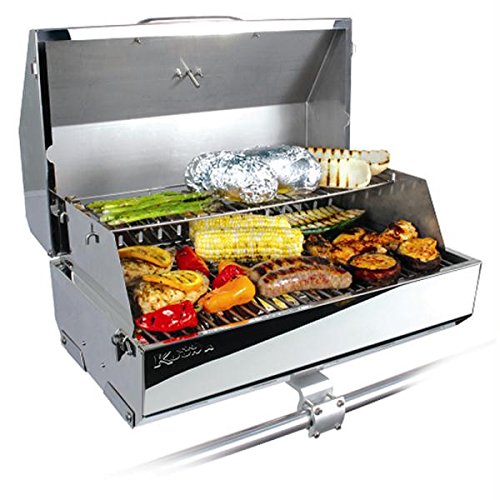
Kuuma 316 Elite Gas Grill — Best Overall
If your grill will live where salt spray lands on it daily, the Kuuma 316 Elite is the rational first choice. Its name is its specification: the construction centers on 316 stainless steel, the grade used for boat railings, rigging hardware, and dock fittings precisely because ordinary stainless eventually pits in chloride environments and 316 resists far longer.
Strengths
- 316-grade stainless construction — the strongest mainstream defense against salt pitting
- Purpose-built marine design with mounting options for rails and pedestals
- Compact footprint suits boat sterns, docks, and small coastal decks
Trade-offs
- Premium price for its size — you are paying for metallurgy, not square inches
- Smaller cooking area than the big rectangular marine grills
- Kuuma hardware refinement still trails Magma at the top end
Key specs
- Model: Kuuma 316 Elite
- Construction: 316-grade stainless steel
- Fuel: Propane (1 lb canisters / adapter)
- Use: Boat rail, pedestal, or tabletop
To understand why this grill tops a saltwater list, consider what actually kills coastal grills. It is rarely a dramatic failure; it is pitting — tiny chloride-driven craters that start at welds, fastener holes, and grate contact points, then spread under the surface. Molybdenum in 316 steel measurably slows that process, which is why the marine industry standardized on it for anything that stays wet with seawater. A grill built from it is not immortal, but its corrosion clock runs several times slower than a 304 grill’s, and an order of magnitude slower than plated or painted steel.
As a grill, not just a material, the 316 Elite is a competent compact marine unit: quick to heat, easy to mount, and sized for two to four people. It will not out-cook the Catalina II on grate space, and it is not the cheapest way to grill on a boat. It is the pick for the owner who has already watched one grill rust out and intends to buy the next one exactly once.
Best for: Boat owners and beachfront homes in direct salt spray who prioritize longevity / Not suited for: Buyers who need maximum grate area per dollar
Check on Amazon — check the current price on Amazon before you buy.

Magma Catalina II Classic Gourmet Series Gas Grill (A10-1218-2) — Best Rectangular Marine Grill
Magma builds nothing but marine grills, and the Catalina II is its full-size rectangular flagship. The stainless firebox, lid, and hardware are designed to live on a stern rail through seasons of spray, and the 12 x 18 inch grate with warming rack makes it the best pure cooker in this guide.
Strengths
- Marine-grade stainless construction from a marine-only specialist brand
- Largest rectangular grate here, with a warming rack and two-zone potential
- Deep parts and mount ecosystem — burners, grates, and mounts stay available
Trade-offs
- Needs a sturdy mount and generous stern or deck space
- Rectangular lid catches wind more than a kettle when open
- Premium pricing, and the mount is a separate purchase
Key specs
- Model: Magma A10-1218-2
- Grate size: 12 x 18 in plus warming rack
- Fuel: 1 lb disposable propane canisters
- Construction: Marine-grade stainless steel
Salt resistance is partly about what a company expects its products to endure. Magma’s design brief begins with “lives outside, on a boat, in salt air, for years,” and it shows in the details: stainless fasteners, a snap-out radiant plate you can actually clean, and a burner designed as a replaceable wear part rather than a sealed secret. When a burner does eventually succumb — all burners do, in any grill — you replace the burner, not the grill.
Cooking performance matches the brief: strong heat for a marine unit, a grate layout that supports real two-zone work, and a warming rack that earns its keep with buns and resting steaks. For a beach house with a permanent spot on the deck or a larger boat, this is the saltwater grill to beat; for a small stern rail, its size is its only real argument against itself.
Best for: Larger boats and coastal homes wanting a full-size stainless grill / Not suited for: Small boats or tight decks where its footprint crowds the stern
Check on Amazon — check the current price on Amazon before you buy.
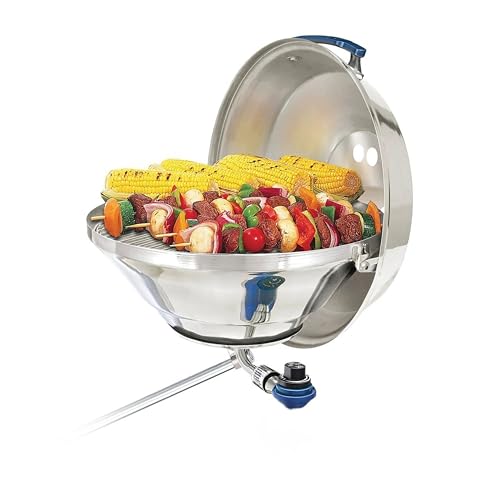
Magma Marine Kettle Gas Grill, Party Size 17-Inch (A10-215) — Best Kettle for Salt Air
There is a corrosion argument for the kettle shape itself: a smooth round bowl has fewer seams, ledges, and corners where salt water can sit and work. The 17-inch Party Size Marine Kettle wraps that shape in marine-grade stainless, adds a locking lid, and produces the most weatherproof package in this guide relative to its size.
Strengths
- Seam-light round bowl gives salt water fewer places to pool and attack
- Locking lid seals out spray when closed and keeps the grill secure under way
- Marine-grade stainless throughout, with Magma’s deep accessory support
Trade-offs
- Round grate is less convenient for rows of steaks or skewers
- Burns through 1 lb canisters quickly at full crowd-cooking output
- Mount sold separately, as with all Magma rail grills
Key specs
- Model: Magma A10-215
- Grate diameter: 17 in round kettle
- Fuel: 1 lb disposable propane canisters
- Construction: Marine-grade stainless steel
The kettle’s second weather trick is wind behavior. The deep bowl shelters the burner, and the curved lid deflects gusts that would strip heat from a flat-topped box — which is why these kettles cook evenly at breezy anchorages where lesser grills sulk. For salt specifically, the smooth exterior rinses clean in seconds: there is no control-panel seam or side-table bracket harvesting salt crystals against the metal.
Capacity suits four to six people, and the whole Magma mount family fits, from rail clamps to pedestals. If your exposure is severe — an uncovered mooring, a beach house on the front row — the kettle’s simplicity is a genuine engineering advantage: fewer parts, fewer interfaces, fewer corrosion sites. Choose it over the Catalina II when durability outranks grate geometry on your priority list.
Best for: Exposed moorings and front-row coastal homes that value simplicity / Not suited for: Cooks who need rectangular two-zone layout for big mixed grills
Check on Amazon — check the current price on Amazon before you buy.

Halbtrocken Marine Gas Grill with Rod Holder Mount — Best Rod-Holder Mount
Not every boat has a free stern rail, but most fishing boats have a spare rod holder. The Halbtrocken marine grill is built around that fact: its mount post drops into a standard rod holder, the body is 304 stainless steel, and the verified listing spells out the numbers — 12,000 BTU over a 200 square inch cooking area — plus a cover included for life between trips.
Strengths
- Rod-holder mounting needs no rail and no drilling
- 304 stainless construction with a cover included for off-duty protection
- Honest mid-size spec: 200 sq in and 12,000 BTU suits most boat crews
Trade-offs
- 304 stainless needs rinsing discipline in heavy spray — it is not 316
- Lesser-known brand, so long-term parts support is less proven than Magma or Kuuma
- Occupies a rod holder that anglers may want back while fishing
Key specs
- Model: Halbtrocken Marine Gas Grill
- Cooking area: 200 sq in
- Output: 12,000 BTU (per verified listing title)
- Construction: 304 stainless steel
The rod-holder format is genuinely liberating: the grill mounts in seconds, removes in seconds, and leaves no clamp hardware on the boat to corrode in the first place — an underappreciated corrosion strategy is simply not leaving metal outside. Stowed below or in a dock box with its cover on, this grill spends most of its life out of the spray entirely, which can matter more than the difference between steel grades.
The honest caveat is grade: 304 stainless is legitimately corrosion-resistant but will tea-stain and eventually pit if left mounted and unrinsed in direct spray. Treat this grill as a stow-after-use appliance — which its mount design encourages anyway — and it will serve well. Treat it as a permanent rail fixture in a harsh marina, and the 316 Elite above is the better tool.
Best for: Fishing boats with a spare rod holder and owners who stow gear after use / Not suited for: Owners wanting a permanent, fit-and-forget rail installation in heavy spray
Check on Amazon — check the current price on Amazon before you buy.

Kuuma Stow N’ Go 125 Stainless Steel Gas Grill — Best Budget
The Stow N’ Go 125 is the budget answer to salt, and its strategy is avoidance: a stainless body that latches shut, carries by its handle, and lives in a locker or garage rather than on a rail. A grill that spends twenty days a month indoors does not need exotic metallurgy to outlast one that never comes in.
Strengths
- Stainless construction at the lowest cost in this guide
- Latch-and-handle design stows in a locker, dock box, or garage between uses
- Pedestal-mount compatible for semi-permanent spots
Trade-offs
- Small cooking area — two people comfortably, three at a stretch
- Stainless grade is the entry tier; rinse after coastal use, no exceptions
- Basic feature set: no thermometer luxury here
Key specs
- Model: Kuuma Stow N’ Go 125
- Construction: Stainless steel
- Fuel: 1 lb disposable propane canisters
- Design: Latching lid, carry handle, folding legs
For occasional coastal use — the beach-house weekend, the trailer boat launched into salt water a dozen times a year — the economics are compelling. You get a stainless grill that cooks honestly for two, then goes back into storage where salt cannot reach it. Its total salt exposure in a year might be forty hours; a permanently mounted grill’s is eight thousand. Exposure hours, as much as steel grade, decide lifespan.
Where the 125 gives ground is capacity and hardware polish. It is a two-person grill with simple latches, and its stainless is the grade that rewards a rinse rather than forgiving neglect. If your use pattern is “out, cook, rinse, stow,” it is the smartest money in this guide. If your grill will live outside at the coast full-time, save toward the 316 Elite or a Magma instead.
Best for: Occasional coastal users who stow the grill between trips / Not suited for: Full-time outdoor storage in direct salt spray
Check on Amazon — check the current price on Amazon before you buy.

Napoleon Built-In 500 Series 32-Inch Grill Head, Propane (BI32PSS) — Best Built-In for Coastal Kitchens
Salt resistance matters on land, too. A built-in grill head in a beach-house outdoor kitchen faces the same chloride air as a boat grill, with the added stakes of being mortared into expensive masonry. Napoleon’s Built-In 500 Series head answers with marine-grade stainless construction, four main burners, and thick 7.5 mm stainless cooking grids — the verified listing says “marine grade” outright.
Strengths
- Marine-grade stainless construction specified for a permanent built-in
- Heavy 7.5 mm stainless grids resist corrosion far better than plated grates
- Four-burner layout with the capacity a fixed outdoor kitchen demands
Trade-offs
- A permanent installation — island, gas line, and ventilation all add cost
- Overkill for anyone not building a fixed coastal kitchen
- Built-in heads still need covers and rinsing at the coast; marine grade slows corrosion, it does not repeal it
Key specs
- Model: Napoleon BI32PSS
- Size: 32 in built-in head
- Burners: 4 main burners
- Grids: 7.5 mm stainless steel
The grids deserve emphasis. On most grills the cooking grate is the first corrosion casualty because it is heated, scraped, and salted daily. Solid stainless rod grids of this thickness have no plating to breach; they can be brushed, soaked, and even lightly sanded back to clean metal for decades. Paired with a stainless firebox and hood, the whole cooking system is built from the one material family that belongs at the coast.
Choose this head if you are building or rebuilding a coastal outdoor kitchen and want the grill specified to the environment from day one. Retrofitting corrosion resistance later means replacing a rusted head inside finished stonework — the most expensive way to learn the steel-grade lesson this entire guide is about.
Best for: Beach-house outdoor kitchens being built or rebuilt for the long term / Not suited for: Renters, boaters, or anyone without a permanent island to build into
Check on Amazon — check the current price on Amazon before you buy.
Comparison Table
| Pick | Badge | Key spec | Best for |
|---|---|---|---|
| Kuuma 316 Elite Gas Grill | Best Overall | 316-grade stainless steel construction | Boat owners and beachfront homes in direct salt spray who prioritize longevity |
| Magma Catalina II Classic Gourmet Series Gas Grill (A10-1218-2) | Best Rectangular Marine Grill | 12 x 18 in grate, warming rack, marine stainless | Larger boats and coastal homes wanting a full-size stainless grill |
| Magma Marine Kettle Gas Grill, Party Size 17-Inch (A10-215) | Best Kettle for Salt Air | 17 in round kettle, locking lid, marine stainless | Exposed moorings and front-row coastal homes that value simplicity |
| Halbtrocken Marine Gas Grill with Rod Holder Mount | Best Rod-Holder Mount | 200 sq in, 12,000 BTU, 304 stainless, rod-holder mount | Fishing boats with a spare rod holder and owners who stow gear after use |
| Kuuma Stow N’ Go 125 Stainless Steel Gas Grill | Best Budget | Compact stainless body, latching lid, carry handle | Occasional coastal users who stow the grill between trips |
| Napoleon Built-In 500 Series 32-Inch Grill Head, Propane (BI32PSS) | Best Built-In for Coastal Kitchens | 32 in built-in, marine-grade stainless, 7.5 mm grids | Beach-house outdoor kitchens being built or rebuilt for the long term |
The table compresses this guide’s argument into one line per grill: construction first. The Kuuma 316 Elite is the only pick whose steel grade is a full step above the field, which is why it leads despite a modest grate. The two Magmas trade on marine-grade construction plus the deepest parts support in boating. The Halbtrocken and the little Kuuma are 304-and-stow strategies — entirely sound if your routine matches. The Napoleon is the land-based counterpart: marine-grade construction at built-in scale. If you take one habit from this page, make it this — when comparing any two grills for the coast, compare steel grade and parts availability before you compare burners and square inches.
How to Choose the Best Saltwater Resistant Grills
Read the steel grade, not the adjectives. “Stainless” alone tells you almost nothing. The hierarchy that matters at the coast is: 316 stainless (best mainstream salt resistance, thanks to molybdenum) ahead of 304 stainless (good, needs rinsing discipline), ahead of everything else — and painted or plated steel is not on the list at all. When a listing will not state a grade, assume the lower tier and price accordingly.
Count exposure hours. A grill mounted outdoors at the coast accumulates roughly 8,000 hours of salt air a year. A grill stowed in a locker between weekend uses might see fifty. That arithmetic can outweigh metallurgy: a mid-grade stainless grill that lives indoors will outlast a premium grill that never comes in. Be honest about which owner you are, then buy the grade — or the stowage design — that matches.
Check the wear parts. Burners, grates, igniters, and heat plates are consumables in any grill, faster at the coast. Brands with a real parts pipeline (Magma, Kuuma/Camco, Napoleon) turn a corroded burner into a small order; no-name grills turn it into a replacement grill. For a saltwater purchase, parts availability is a corrosion feature.
Budget by lifespan, not sticker. A premium marine grill that lasts a decade costs less per year than a cheap grill replaced every second season — before counting the ruined dinners in between. The budget pick in this guide earns its place through stowage, not thin metal; that distinction is the whole game at the coast.
304 vs 316 Stainless Steel: What the Grades Actually Mean for a Grill
Both grades are chromium-nickel stainless steels, and both form the invisible chromium-oxide film that makes stainless “stainless.” The difference is that 316 adds molybdenum, an alloying element that specifically hardens that film against chlorides — the salts in seawater and coastal air. In standardized salt-spray testing and in decades of marine hardware practice, 316 resists pitting and crevice corrosion markedly longer than 304 in the same exposure.
In practice: a 304 grill at the coast will typically develop light surface discoloration — tea staining — within a season or two if unrinsed. That staining is cosmetic at first and wipes or passivates away, but left alone it marks the spots where pitting will eventually begin. A 316 grill in the same spot stays clean-looking far longer and pits far later. Neither is maintenance-free; 316 buys you margin and time, 304 buys you a lower price in exchange for a rinse routine.
Where does each belong? Direct spray, uncovered moorings, front-row beach houses: 316 earns its premium. Covered decks, stowed grills, second-row streets with a rinse habit: 304 is a rational, durable choice. What does not belong at the coast at all is the “stainless-look” grill — a thin stainless skin over painted steel — because the first chip or seam failure exposes metal with no defense at all.
How to Stop Salt From Killing Your Grill: The Maintenance Routine That Works
Rinse like you mean it. After coastal use — and weekly for any grill stored outdoors near the sea — rinse the exterior with fresh water and dry it. You are not cleaning for appearance; you are removing the chloride film before it concentrates in seams and fastener holes. A garden hose or a bucket on the dock both work. Never use steel wool or chlorinated cleaners on stainless: steel wool embeds rust-prone particles, and chloride cleaners attack the very film you are protecting.
Passivate when staining appears. Tea staining on 304 (and eventually on 316) responds to a citric-acid passivation cleaner made for stainless — it removes surface iron contamination and restores the protective oxide film. Ten minutes with the right cleaner once or twice a season keeps coastal stainless looking and behaving like stainless.
Mind the inside. Burners clog with salt crust and insect nests; clear ports with a soft brush, and run the grill hot for ten minutes after long idle periods to dry the firebox. Grease left in a tray at the coast becomes a salty, corrosive slurry — empty it. If you cover the grill, cover it clean and dry, and choose a breathable cover: a sealed plastic tarp over damp metal is a corrosion incubator, not protection.
Store smart in the off-season. The best winter home for a coastal grill is indoors. Failing that, clean it, dry it, oil the grates lightly, remove the propane canister to a vented store, and cover it. Come spring, a passivation wipe and a burner check will have it ready in fifteen minutes — while the neglected grill down the dock is being replaced.
Salt Air vs Direct Spray: Matching the Grill to Your Real Exposure
Not all coastal exposure is equal, and honest matching saves money in both directions. Direct spray — a boat underway, an uncovered mooring, a deck on the front row taking surf mist — is the harshest environment a grill can face, and it is where 316 stainless and marine-only brands justify every premium dollar. In direct spray, salt arrives as liquid, concentrates as it dries, and repeats daily; anything less than marine-grade construction is on a short clock.
Salt air — the second or third street back, a covered lanai, a marina boat under a bimini — delivers the same chlorides more slowly and mostly dry. Here a good 304 grill with a rinse habit is a fully rational choice, and the money saved versus 316 buys a cover, spare burners, and years of propane. Most coastal grill buyers actually live in this band and overspend for direct-spray metallurgy they will never need.
Intermittent exposure — the trailer boat, the beach rental’s weekend grill, the RV that visits the coast — is where stowage strategy wins outright. A modest stainless grill that lives indoors 90 percent of its life will outlast any premium grill stored outside, full stop. Match the purchase to the exposure you actually have, not the exposure in the brochure photograph, and every pick in this guide finds its right home: 316 and Magma for spray, 304-with-rinse for air, stow-away designs for the intermittent.
Parts, Burners, and the Second Five Years
Every grill in salt air eventually needs a burner, an igniter, or a grate — the question is whether that day costs a small parts order or a whole new grill. This is the hidden reason marine brands dominate this guide: Magma and Kuuma/Camco publish parts diagrams and keep burners, valves, grates, and mounts in distribution for years, and Napoleon supports its built-ins the same way. A grill you can re-burner in year six is a twelve-year grill; a grill you cannot is a five-year grill with a countdown.
When you shop, spend two minutes on the listing and the brand’s site confirming three things: that the burner is listed as a replaceable part, that replacement grates exist in the correct material (stainless, not a plated downgrade), and that mounts and covers are still sold for the model. If any of the three is missing, discount the grill’s expected life accordingly — at the coast, support is not a nice-to-have, it is the difference between maintenance and replacement.
It also pays to buy the first spares early. A spare igniter and a set of burner bolts stored dry in a labeled bag cost little, weigh nothing, and convert the most common mid-season failures into ten-minute dockside fixes. Saltwater grilling rewards the prepared with a monotony that looks, from the outside, like luck.
What About the Rest of the Grill? Grates, Burners, and Hardware Ranked by Risk
Corrosion does not attack a grill evenly, and knowing the order of vulnerability tells you where to inspect and what to upgrade. First to go: plated grates and heat plates. Any plating is a countdown — heat cycles crack it, salt enters, and the steel beneath rusts outward. This is why the strongest picks here use solid stainless rod grates, and why a plated grate on an otherwise stainless grill should be treated as a planned replacement, budgeted from day one.
Second: burners. Burner ports clog with salt crust and the thin walls of a burner in a salty firebox corrode from both sides. Stainless burners last longest; cast iron burners sear beautifully but need oiling discipline at the coast; aluminized steel burners are the budget tier and the usual first replacement. A grill whose burner swaps with two screws is a grill designed by someone who has owned a grill.
Third: fasteners, hinges, and igniters. Small parts fail quietly — a hinge pin seizes, an igniter button corrodes, a zinc screw blooms white and then red. Stainless hardware and a dab of anti-seize at assembly prevent most of it. When you inspect a coastal grill each season, work in this order — grates, burner, hardware — and you will catch every failure while it is still a parts order instead of a replacement.
How to Set Up a Grill for Life in Salt Air
Step 1 — Choose the spot with drainage and shelter in mind. Place or mount the grill where rain and spray drain away rather than pooling under it, and where a roof edge, rail position, or cover gives it some relief from direct spray. On a boat, that is the stern rail with the lid latched; on a deck, the lee side of the house beats the ocean-facing corner.
Step 2 — Assemble with corrosion in mind. As you build, dab fasteners with a marine anti-seize or a drop of corrosion inhibitor, confirm every screw is stainless (replace any that are not — mixed metals accelerate corrosion), and keep the packaging’s spare hardware somewhere dry and labeled.
Step 3 — Season and baseline. Run the grill empty on high for fifteen minutes to burn off manufacturing residue, then photograph it. That sounds excessive until the first season passes: a dated photo of “new” is the easiest way to spot early staining, a creeping mount, or a burner flame pattern changing — the small warnings that let you intervene while intervention is cheap.
Step 4 — Set the routine on day one. Rinse after use, dry before covering, passivate when staining appears, check burners monthly in season. Write it on the inside of the dock box or tape it in the lazarette if you have to. Saltwater resistance is half metallurgy and half habit; the setup is where the habit starts.
Common Buying Mistakes
- Believing “stainless” without a grade. Unspecified stainless at the coast usually means the thinnest, lowest tier. Look for 304 or 316 stated outright.
- Buying a painted-steel grill for a beach house. The first chip starts a rust bloom that spreads under the paint. One coastal season is enough.
- Covering a dirty, damp grill. A cover traps salt and moisture against the metal. Clean, dry, then cover — in that order.
- Cleaning with steel wool or bleach-based sprays. Both attack stainless’s protective film. Use a soft brush, mild detergent, and citric passivation cleaner for stains.
- Ignoring the burner until it fails. Salt crust blocks ports gradually; monthly checks and a soft brush keep heat even and prevent the uneven flames that cook like a fault.
- Mixing hardware. Replacing a lost stainless screw with a zinc or plain steel one creates a galvanic couple that corrodes both. Keep stainless spares.
Final Recommendation
If salt spray reaches your grill where it lives, buy the Kuuma 316 Elite and be done with the corrosion question for years. If you want the most capable marine cooker and accept 304-class care discipline, the Magma Catalina II is the best grill here outright, and the Marine Kettle Party Size is its weather-shedding round alternative. Fishing-boat owners should look hard at the Halbtrocken rod-holder grill, occasional coastal users at the stow-away Kuuma 125, and anyone building a beach-house kitchen at the Napoleon built-in. Every route ends at the same advice: state the grade, check the parts pipeline, then check price on Amazon.
Related guides in this cluster:
- Kuuma 316 Elite Gas Grill — check price on Amazon
- Magma Catalina II Classic Gourmet Series Gas Grill (A10-1218-2) — check price on Amazon
- Magma Marine Kettle Gas Grill, Party Size 17-Inch (A10-215) — check price on Amazon
Best Sailboat Grills Best Selling Bbq Grills Best Searing Grills Best Selling Outdoor Grills Best 10 Grills
Frequently Asked Questions
What is the most salt-resistant metal for a grill?
Of the materials grills are actually made from, 316-grade stainless steel is the most salt-resistant mainstream choice, because its molybdenum content resists chloride pitting. 304 stainless is the next tier down. Painted, plated, or aluminized steel should not be used in direct coastal exposure at all.
Will a 304 stainless grill rust at the beach?
It can develop surface tea staining and, if never rinsed, eventual pitting — but with a simple freshwater rinse routine it serves for years at the coast. 304 is a maintenance-forgiving problem, not a death sentence; the grills that die fast at the beach are painted or plated steel.
How often should I rinse a grill that lives near salt water?
Rinse the exterior after each use if it is boat- or dock-mounted, and at least weekly for a grill stored outdoors at a coastal home. The goal is removing the salt film before it concentrates in seams. Drying after rinsing matters as much as the rinse itself.
Does a grill cover protect against salt corrosion?
Only if the grill goes under it clean and dry, and the cover breathes. A cover over a salty, damp grill traps the corrosive film against the metal and can make things worse. Indoors storage beats any cover; a breathable cover over a dry grill is second best.
Are marine grills worth it for a beach house, or are they just for boats?
They are often the smartest beach-house buy, because they are engineered for exactly the exposure a coastal deck delivers — and their mounts and compact footprints suit docks and decks too. A marine-grade built-in head, like the Napoleon in this guide, is the permanent-installation equivalent.
What is tea staining on stainless steel, and should I worry?
Tea staining is the light brown surface discoloration that appears on stainless in coastal air. At first it is cosmetic and removes with a citric-acid passivation cleaner, which also restores the protective oxide film. Worry only if you ignore it for seasons: the stained spots are where pitting eventually starts.
Can I retrofit a regular grill for coastal use with a cover and spray?
Partially, and only for mild salt-air exposure. A breathable cover, a rinse routine, stainless replacement grates, and corrosion inhibitor on the hardware will extend a regular grill’s coastal life noticeably. What you cannot retrofit is the firebox material or the steel grade — if those are painted steel or low-grade stainless, the clock is still running underneath every protective habit, which is why buying the right construction first is the cheaper long-term answer.


