Disclosure: airfryerkitchensupply.com is reader-supported. When you buy through links on our site, we may earn an affiliate commission at no extra cost to you.
Where to buy
Every linked pick in this guide to the best rug pads for polyester rugs on hardwood floors was verified against Amazon’s catalog — the 8×10 pads fresh on 2026-11-22, the runner pad from this program’s verified API cache — so the constructions, thicknesses, and sizes quoted below match the listings you will land on. Start with the RUGPADUSA Dual Surface Felt + Rubber Pad if your polyester rug actively slides, the RUGPADUSA Basics 100% Felt Pad if it stays put and you mainly want cushion and floor protection, or the Mohawk Home Dual Surface Pad for the mainstream name-brand option. Check the current price on Amazon from any pick’s link, and always confirm the size variant selected matches your rug before ordering.
The best rug pads for polyester rugs on hardwood floors solve a two-sided problem that generic pad advice misses. Side one: polyester rugs are slippery guests. Their synthetic backing — often a smooth latex or plasticized finish — has little natural grip, so the rug skates on polished hardwood with every step, chair push, and dog launch. Side two: hardwood floors are unforgiving hosts. The wrong pad can do real harm over time — cheap PVC and vinyl pads are the classic offenders, because plasticizers can react with common floor finishes and leave discoloration or a ghost pattern that only appears when you finally move the rug. So this guide judges pads on both faces: how the top surface holds a polyester rug, and how the bottom surface treats a hardwood finish. A pad that wins one face and loses the other is not a recommendation; it is a delayed problem.
The good news is that the right constructions are well understood. Felt pads protect floors beautifully and cushion honestly but grip modestly. Felt-and-rubber dual-surface pads add a natural rubber gripping face that holds both the rug and the floor with friction rather than adhesive chemistry. Silicone-grip pads split the difference with a tackier synthetic face. The six picks below cover those constructions in the sizes area rugs actually come in, with the trade-offs stated plainly — including where a famous name’s pad is the safe-but-not-grippiest choice, and why two pads from the same maker appear here doing genuinely different jobs.
In this guide
Quick Picks
| Pick | Badge | Why it stands out |
|---|---|---|
| RUGPADUSA Dual Surface Rug Pad, 8’x10′, 1/4″ | Best Overall for Slippery Polyester | Felt + rubber dual surface: cushion on top, friction grip against the floor |
| RUGPADUSA Basics 100% Felt Rug Pad, 8’x10′, 1/4″ | Best Pure Felt | 100% felt, stated safe for all floors and finishes including hardwoods |
| Mohawk Home Dual Surface Rug Pad, 8′ x 10′, 1/4″ | Best Mainstream Brand | Rubber grip face, cushion, noise reduction, easy trim — from a flooring-household name |
| Deep Dream Felt and Natural Rubber Rug Pad, 8×10 | Best Natural Rubber | Felt body with natural rubber backing — grip without synthetic pad chemistry |
| Veken Non Slip Cushioned Rug Pad Gripper, 8 x 10 Ft | Best Silicone Grip | Felt with silicone backing, 1/4 inch thick, for rugs that creep rather than skate |
| GORILLA GRIP Felt Rug Pad with Rubber Backing, 2×8 Runner | Best for Runners | Felt plus rubber backing in the 2×8 runner format, 1/8 inch low profile |
Two picks come from RUGPADUSA — a 100% felt pad and a felt-and-rubber dual-surface pad. They are different constructions solving different halves of the polyester problem, and this guide flags the shared brand openly rather than disguising it; in a category this specialized, the honest comparison matters more than a forced brand count.
How These Picks Were Chosen
Every pick was cross-checked against Amazon listing data before earning a link: the five 8×10 pads were verified fresh on 2026-11-22 through this site’s own API connection, and the Gorilla Grip runner comes from the program’s verified cache dated 2026-11-22. Constructions and thicknesses quoted in this article come from those verified listing titles. Where a listing’s title is truncated in the search record, the cut-off portion is not quoted or relied on.
The criteria were specific to the polyester-on-hardwood pairing. Floor safety came first: pads whose listings state suitability for hardwood and all finishes scored; constructions known for finish reactions — cheap PVC/vinyl — were excluded by design, and this guide will say so out loud rather than quietly omitting them. Grip came second, judged by construction: rubber-faced and silicone-faced pads out-grip pure felt, and for a slippery polyester backing that difference is the whole ballgame. Cushion came third, with 1/4 inch as the working standard — enough to feel, not enough to make the rug edge a trip lip or a door problem. Finally, trimmability: every pick can be cut to fit, because rugs and their nominal sizes rarely agree to the inch.
The 6 Best Rug Pads for Polyester Rugs on Hardwood Floors

RUGPADUSA Dual Surface Rug Pad, 8’x10′, 1/4″ — Best Overall for Slippery Polyester
This is the pad built for the exact failure mode in the search: a polyester rug that will not stay where it is put. The dual-surface design puts felt against the rug — cushion, protection, and a fibrous face that a synthetic rug back can key into — and rubber against the hardwood, where friction does the holding without adhesives or plasticizer-heavy chemistry. At 1/4 inch it adds a felt-underfoot quality people describe as making an inexpensive polyester rug feel a class more expensive, while staying low enough for door clearance and chair legs. If your rug currently migrates across the room over the course of a week, start here.
Strengths
- Felt + rubber construction attacks both sides of the problem: rug grip on top, floor grip and protection below.
- 1/4 inch thickness is the practical sweet spot — real cushion, no trip edge, no door interference in most homes.
- Listing states it is safe for all floors, which is the assurance hardwood owners should demand in writing.
Trade-offs
- Costs more than a basic felt sheet — you are paying for the rubber face and the construction.
- Rubber-faced pads should still be lifted and checked periodically; no pad is a fit-and-forget product on finished wood.
- Very heavy furniture can compress felt over years, thinning the cushion in the spots that matter least visually but most physically.
Key specs (from the verified listing): dual surface rug pad; 8’x10′; 1/4″ thick; felt + rubber; non-slip backing; stated safe for all floors.
The dual-surface RUGPADUSA is the recommendation we would give a friend with a sliding polyester rug and floors they care about: it solves the slide, protects the finish, and upgrades the rug’s feel in one layer. It also anchors this guide’s central advice — match the pad’s construction to both surfaces it touches.
Best for: actively sliding polyester rugs on finished hardwood / Not suited for: buyers who only need thin floor protection under a rug that already stays put
Check on Amazon — check the current price on Amazon, and select the size that matches your rug’s true dimensions.

RUGPADUSA Basics 100% Felt Rug Pad, 8’x10′, 1/4″ — Best Pure Felt
The Basics felt pad is the purist’s answer: 100% felt, 1/4 inch thick, and a listing that states plainly what hardwood owners need to hear — protective cushioning that is safe for all floors and finishes, including hardwoods. Pure felt is the gentlest possible interface between a rug and a finish: no rubber compounds, no coatings, nothing to react. What it does not do is grip aggressively. Under a polyester rug that mostly behaves — held by furniture, in a low-traffic room — that is fine, and the felt’s cushion and sound softening are the point. Under a rug that skates, choose the dual-surface pick above instead; this guide would rather sell you the right construction than the same brand twice for no reason, and here the two RUGPADUSA models genuinely divide by need.
Strengths
- 100% felt construction is the most finish-friendly interface available — nothing to react with hardwood coatings.
- Listing explicitly states safety for all floors and finishes including hardwoods.
- Dense felt cushion quiets footfall and makes thin polyester rugs feel substantially plusher.
Trade-offs
- Grip is friction-only and modest; a truly slippery polyester back can still creep on felt in a busy lane.
- No rubber face means the pad itself can shift on very smooth floors if the rug above it is light.
- Felt absorbs spills that reach it — lift and dry the pad after any significant rug spill.
Key specs (from the verified listing): 100% felt rug pad; 8’x10′; 1/4″ thick; protective cushioning; stated safe for all floors and finishes including hardwoods.
Choose the Basics felt when your priorities run floor-first: a calm room, a rug that stays roughly in place, and a finish you intend to keep flawless for decades. It is also the safest recommendation for unusual or delicate floor finishes where any rubber contact raises questions.
Best for: low-traffic rooms, delicate finishes, cushion-first buyers / Not suited for: rugs that actively slide
Check on Amazon — check the current price on Amazon before ordering.

Mohawk Home Dual Surface Rug Pad, 8′ x 10′, 1/4″ — Best Mainstream Brand
Mohawk Home is the name most hardwood owners already trust from the flooring aisle, and its dual surface pad is the mainstream expression of this guide’s preferred construction: a rubber grip face for hold, a cushioned body for feel, and a 1/4 inch profile that trims easily to fit. The listing adds two practical virtues worth naming — noise reduction, which matters in upstairs rooms and apartments, and easy-trim sizing, because Mohawk sells this pad in many sizes and expects you to cut it. For a polyester rug, the rubber grip face does the same work as the RUGPADUSA dual-surface pick; the choice between them is about availability, size range, and which listing’s terms you prefer on the day.
Strengths
- Dual surface design with a rubber grip face — the right construction for slippery synthetic rug backs.
- Noise reduction is a real secondary benefit on hard floors, especially above another living space.
- Easy-trim format and a wide size range make exact fitting straightforward.
Trade-offs
- Cushion feel is a touch less dense than the specialist felt pads — it is a grip-first design.
- As with all rubber-faced pads, periodic lifting and inspection on finished wood is part of ownership.
- The 2×3 size of this same pad line was verified in an earlier batch of this program; the 8×10 listing here is the size verified fresh for this guide — always confirm the size variant in the listing before ordering.
Key specs (from the verified listing): dual surface rug pad; 8′ x 10′; 1/4″ thick; non-slip rubber grip; cushion; protects floors; noise reduction; easy trim.
The Mohawk is the pick for buyers who want the dual-surface answer from the biggest name in the category, with the size range to match odd rugs. It is a first-rank pad, not a compromise pick.
Best for: mainstream buyers, upstairs rooms, odd rug sizes / Not suited for: cushion purists who want maximum felt density
Check on Amazon — check the current price on Amazon, and double-check the selected size.

Deep Dream Felt and Natural Rubber Rug Pad, 8×10 — Best Natural Rubber
The Deep Dream pad makes one specific material choice the headline: natural rubber for the gripping back, under a 1/4 inch felt body. For hardwood owners, that choice matters. Natural rubber grips by friction and is the rubber most often recommended where synthetic compounds raise finish questions; it is also the material traditional rug-pad specialists have used for decades. Paired with felt’s protection and cushion, this is the construction purists describe when they say “felt and rubber” without qualifiers — and for a polyester rug, the rubber face supplies the hold that the rug’s own slippery back cannot.
Strengths
- Natural rubber backing — the grip material with the longest, safest track record on finished wood.
- Felt body delivers the cushion and floor protection that make thin polyester rugs feel substantial.
- 1/4 inch profile suits most door clearances and keeps rug edges low.
Trade-offs
- Natural rubber can have a mild initial odor that airs out after unrolling — give it a day in a ventilated room if you are sensitive.
- Less of a household name than Mohawk; you are buying the construction, not the logo.
- Like every rubber pad, it wants periodic inspection beneath the rug.
Key specs (from the verified listing): felt and natural rubber backing rug pad; 1/4″ thick; sized for 8 x 10 ft area rugs; non-slip gripper; protective cushioning for all floors per the listing.
Choose the Deep Dream if the words “natural rubber” settle the finish-safety question for you — for many hardwood owners, they do, and the felt-plus-natural-rubber formula is the category’s classic answer for good reason.
Best for: finish-safety purists and traditional felt-and-rubber shoppers / Not suited for: anyone who wants a pad with zero break-in airing
Check on Amazon — check the current price on Amazon before ordering.

Veken Non Slip Cushioned Rug Pad Gripper, 8 x 10 Ft — Best Silicone Grip
The Veken takes the third construction route in this guide: felt for cushion, silicone for grip. Silicone backing dots or coating give the pad a tackier hold than plain felt — useful for the polyester rug that does not exactly skate but creeps an inch a day until it is visibly crooked — while keeping the interface free of rubber compounds entirely, which some finish manufacturers prefer. At 1/4 inch thick with a cushioned felt body, it is a full pad, not a thin gripper sheet, and its listing positions it squarely for hardwood floors under area rugs.
Strengths
- Silicone grip face stops the slow creep that pure felt allows, without any rubber in the construction.
- Cushioned felt body at 1/4 inch — real underfoot improvement, not just a grip layer.
- A sensible middle path for owners whose floor finish guidance discourages rubber contact.
Trade-offs
- Silicone grip is strong but a step below a full rubber face against a determined slider; the worst skating rugs still belong on the dual-surface picks.
- The verified listing title is truncated in the search record, so this guide quotes only its confirmed elements — construction, size, and thickness — and nothing beyond them.
- Grip surfaces collect dust over time; lift and shake the pad out during deep cleans to restore tack.
Key specs (from the verified listing): non-slip cushioned rug pad gripper; felt and silicone backing; 8 x 10 ft; 1/4 inch thick; positioned for hardwood floors under area rugs.
The Veken is the considered middle: more hold than felt, no rubber at all, honest cushion. For creep-prone polyester rugs on finishes with rubber caveats, it may be the most precisely right answer in the guide.
Best for: creeping rugs and rubber-averse floor finishes / Not suited for: the most aggressive sliding rugs
Check on Amazon — check the current price on Amazon before ordering.
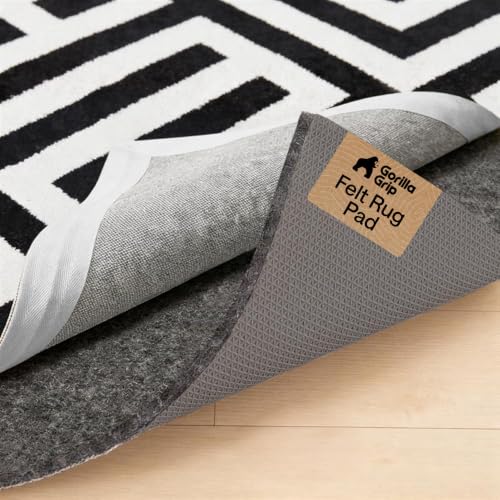
GORILLA GRIP Felt Rug Pad with Rubber Backing, 2×8 Runner — Best for Runners
Hallways and kitchen runs are where polyester runners do their worst sliding — long, narrow, and walked with momentum — and they need the format to match. The Gorilla Grip entry is a felt pad with a rubber backing in the 2×8 runner size, at a low 1/8 inch profile that keeps a runner’s edges from becoming a toe-catcher in a corridor. The listing describes it as slip resistant cushioning that stays in place and protects the floor beneath, which is the runner job description exactly. Note that this pick comes from the program’s verified cache from an earlier batch this week rather than today’s fresh search — its check date is recorded in the source file either way.
Strengths
- True runner format (2×8) with the felt-plus-rubber construction this guide recommends, no cutting down an 8×10 required.
- 1/8 inch low profile keeps corridor edges flat and doors swinging free.
- Rubber backing supplies the grip that high-momentum hallway traffic demands.
Trade-offs
- Thin profile means modest cushion — this is a grip and protection pad, not a plushness upgrade.
- Runner size only in this slot; area-rug buyers should take the 8×10 picks above.
- Verify the current listing’s size options if your runner is an unusual length.
Key specs (from the verified listing): felt rug pad with rubber backing; 2×8 ft; 1/8 inch thick; slip resistant; for hardwood floors under runners and area rugs.
For the hallway problem specifically, this is the guide’s answer: the right construction in the right shape, thin enough to disappear under a runner and grippy enough to keep it honest.
Best for: polyester runners in hallways and kitchens / Not suited for: area rugs or cushion-first buyers
Check on Amazon — check the current price on Amazon before ordering.
Comparison Table
| Pick | Badge | Key spec | Best for |
|---|---|---|---|
| RUGPADUSA Dual Surface 8’x10′ | Best Overall for Slippery Polyester | Felt + rubber, 1/4″ | Actively sliding rugs |
| RUGPADUSA Basics 100% Felt 8’x10′ | Best Pure Felt | 100% felt, 1/4″ | Delicate finishes, calm rooms |
| Mohawk Home Dual Surface 8×10 | Best Mainstream Brand | Rubber grip, 1/4″, noise reduction | Upstairs rooms, odd sizes |
| Deep Dream Felt + Natural Rubber | Best Natural Rubber | Natural rubber back, 1/4″ | Finish-safety purists |
| Veken Felt + Silicone 8×10 | Best Silicone Grip | Silicone backing, 1/4″ | Creeping rugs, rubber-averse finishes |
| GORILLA GRIP Felt + Rubber 2×8 | Best for Runners | Runner format, 1/8″ | Hallways and kitchen runs |
Read the table by failure mode: skating rugs need rubber faces, creeping rugs can be held by silicone, calm rugs on delicate finishes want pure felt, and runners want the format pick. The buying guide below explains the reasoning in full. One pattern worth noticing before you move on: four of the six picks are 1/4 inch thick, and that is not a coincidence or a copy error — it is the thickness at which cushion, door clearance, and edge behavior balance for the widest range of rooms, a point the thickness section below argues in detail. The exceptions prove the rule by their contexts: the runner goes thinner because corridors punish edges, and no pick goes thicker because living rooms punish trip lips and rocking chairs.
Know Your Rug’s Back: The Other Half of the Pairing
Flip your polyester rug over before you buy anything, because its back decides which pad family you need. Most polyester area rugs carry one of three backs. A smooth latex-style coating — the commonest — feels almost slick to the palm and is the worst slider; it wants a rubber-faced pad whose texture it can key against. A woven polypropylene-style back has visible grid texture and a little natural tooth; it behaves better on felt and well on dual-surface pads. A felted or fabric back — found on some machine-washable polyester rugs — grips the most of the three and can live happily on pure felt. Run your palm across the back with pressure: if it glides like a hand on glass, buy rubber; if it drags slightly, you have options; if it drags firmly, felt will serve. Thirty seconds of diagnosis beats a return.
One more back-related caution: some inexpensive polyester rugs have backs that shed a fine powder or flake as they age. That residue collects on the pad and reduces grip over time, and it is a rug problem, not a pad problem. If your rug back is degrading, vacuum the pad’s top face during deep cleans to restore the interface — and start budgeting for the rug’s replacement, because no pad can hold a rug that is coming apart.
How to Choose a Rug Pad for a Polyester Rug on Hardwood
First, protect the floor: the materials to avoid
The rug pad industry has one well-documented trap, and it sits at the cheapest end of the shelf: PVC and vinyl pads. Their plasticizers can migrate into common hardwood finishes over months of contact, softening or discoloring the finish in the pad’s exact footprint — damage you discover only when the rug moves. Solid PVC “waffle” grippers are the worst offenders because they are cheap, everywhere, and marketed as universal. On hardwood, universal is a warning word. The safe families are the ones in this guide: felt, felt with natural or quality rubber backing, and silicone-grip constructions. If a pad’s material is not stated, do not put it under a rug on a finished floor — the absence of a material claim is itself the answer.
Then, hold the rug: grip is a construction, not a coating
Polyester rug backs are smooth by nature, so holding them is a friction problem with two interfaces: rug-to-pad and pad-to-floor. Pure felt manages the second interface gently and the first one weakly — a polyester back can glide across felt’s surface. Rubber-faced dual-surface pads solve both: the felt top gives the rug back texture to key against, and the rubber bottom locks to the floor. Silicone sits between, gripping the floor well and the rug moderately. Diagnose your rug honestly before choosing: if it travels, buy rubber; if it creeps, silicone or rubber; if it sits still and your worry is the finish, pure felt is the kindest layer you can install.
Thickness: why 1/4 inch is the working standard
Thicker pads — 3/8 or 1/2 inch — feel luxurious in a showroom step-test and cause three problems at home: rug edges become trip lips, doors start shaving the rug, and dining chairs rock on the cushion. Thinner pads — 1/8 inch — disappear beautifully but add little feel. A quarter inch is where cushion, clearance, and edge behavior balance for most rooms, which is why five of this guide’s six picks live there; the runner pick drops to 1/8 inch because corridors punish edges more than they reward plushness. If your rug is unusually thick already, lean thinner; if it is a flat polyester weave that feels like a blanket on the floor, the full 1/4 inch earns its place. That pairing — a blanket-weight polyester rug over a real pad — is also why readers of our blanket guide land here: see Best Blankets To Use As Rugs for the top layer of that system.
Size and trimming: pads hide, rugs show
Buy the pad in your rug’s nominal size, then trim it one to two inches smaller than the rug on every side. A pad that peeks out looks sloppy and collects dust at the exposed edge; a pad trimmed inset disappears and lets the rug’s edges lie flat against the floor, which also reduces edge curl. Felt and felt-composite pads cut cleanly with heavy scissors or a utility knife and a straightedge — work on a protected surface, measure twice, and keep the offcuts: they make excellent furniture-floor protectors and under-appliance mats.
Rug Pad Materials Compared, in Depth
Felt: the protector
Felt pads are made from compressed fibers — recycled synthetics, wool blends, or mixes depending on the maker — needled or pressed into a dense sheet. Their virtues are the ones hardwood cares about: nothing to react with finishes, genuine cushion from real fiber mass, sound absorption you can hear, and a surface that will not scratch anything it touches. Their limitation is written into the physics: felt-on-smooth-floor and felt-on-smooth-rug are both low-drama, low-grip interfaces. Felt is the right answer when holding is handled by weight, furniture, or a calm room, and the wrong answer when the rug is the household’s ice rink.
Felt + rubber: the holder
Adding a rubber face converts felt from a protector into a system. The rubber keys to the floor with high friction — no adhesives, no coatings transferred — while the felt body keeps its cushion and gives the rug a fibrous surface to rest against. Natural rubber is the traditional material and the one with the deepest safety record on finishes; quality synthetic rubbers perform similarly in grip. This is the construction the industry itself recommends for slippery rugs on wood, and it is why dual-surface pads take three of the six slots in this guide: for the polyester-on-hardwood pairing, they are simply the correct default.
Silicone grip: the middle path
Silicone-backed felt pads are the newer answer for owners whose finish manufacturer discourages rubber, or who have had a rubber pad stick once and sworn off the category. Silicone’s tack is real but gentler than rubber’s lock, and it releases cleanly. The honest ranking for a determined slider is rubber first, silicone second, felt third; for a creeper on a rubber-averse finish, the ranking inverts and silicone wins. Knowing which problem you actually have — skating or creeping — is worth more than any brand loyalty here.
The materials this guide will not recommend
PVC and vinyl waffle pads, for the finish-reaction reasons already explained. Thin “gripper tape” and spray adhesives, which transfer the problem onto the floor finish itself and complicate every future cleaning. Double-sided carpet tape under area rugs on finished wood, for the same reason. And rug-on-rug layering without a pad, where a polyester rug over another rug still slides at the lower interface while adding a trip edge. A buying guide earns its keep as much by what it refuses as by what it links, and on hardwood those refusals are non-negotiable.
Special Situations: Pets, Dining Chairs, and Big Rooms
Pet households. Dogs turn area rugs into launch pads, which promotes grip from a preference to the whole point: choose a rubber-faced dual-surface pad, and size your expectations honestly — a determined seventy-pound launch can shift any unanchored system, so let furniture share the holding work. The second pet issue is accidents: any liquid that soaks a polyester rug reaches the pad, and felt holds moisture against the floor. Lift, dry, and inspect after incidents; in a chronic-accident zone, a thinner pad you replace more often beats a premium pad you keep too long.
Dining rooms. Chairs sliding in and out are a pad’s hardest mechanical test, working the rug sideways dozens of times a week. Rubber-faced pads at the full 1/4 inch handle it best; pure felt will let a dining rug walk visibly within a month. Extend the pad fully under the chair zone, not just the table footprint — a pad that ends where the chairs sit is a pad that ends exactly where the force is.
Rooms larger than 8×10. Big polyester rugs exist beyond this guide’s verified size, and pads join: two pads butted edge to edge under one rug behave as one layer if both are the same construction and thickness, with the seam placed away from the main traffic lane. What you should not do is mix a felt pad and a rubber pad under one rug — the two zones will grip differently and the rug will telegraph the boundary as a permanent wrinkle.
The economics: what the pad is actually protecting
It helps to price the decision honestly. A quality felt or dual-surface pad in 8×10 sits in a modest tier — the kind of money a household spends without a meeting. The assets it protects are a polyester rug worth several times the pad, and a hardwood floor whose refinishing is measured in the thousands and a week of displaced furniture. Against those numbers, the pad is not an accessory purchase; it is the cheapest insurance layer in the room, and the difference between the right construction and the PVC trap is small change compared with the damage gap between them. This is also why this guide does not include a bargain-bin pick: at the bottom of this category, cheap stops meaning inexpensive and starts meaning eventual.
How to Install a Rug Pad on Hardwood Floors
- Clean the floor first, properly. Sweep, then damp-mop, then let the floor dry completely. Grit trapped under a pad becomes an abrasive layer that the pad’s pressure grinds into the finish — the exact damage a pad exists to prevent.
- Unroll the pad and let it relax. Give a new pad an hour flat on the floor; natural rubber versions may carry a mild odor that airs out in this window.
- Trim before you place the rug. Lay the rug over the pad, mark the inset (one to two inches per side), remove the rug, and cut the pad on a protected surface.
- Position the pad, grip side down. On dual-surface pads the rubber or silicone face goes against the floor and the felt face up against the rug — installing it upside down forfeits most of the grip you paid for.
- Roll the rug out over the pad. Unroll rather than drag, then walk the surface from center to edges to seat it, and check every corner for pad peek or rug overhang.
- Re-seat furniture deliberately. Legs that sat on the rug before should sit on it again in the same spots; furniture weight is your ally for holding the whole sandwich still.
- Inspect on a schedule. Every few months, lift a corner and look: the pad should be clean, dry, and unmarked, and the floor beneath should look identical to the floor outside the rug. Any moisture, sticking, or discoloration means lift the whole pad and investigate immediately — early catches are cheap, late ones are refinishing.
Common Buying Mistakes
Buying the cheapest waffle gripper. The PVC trap described above is the most expensive cheap purchase in floor care. Material first, price second — always.
Assuming one pad type fits every rug. A pad chosen for a wool rug’s needs can be wrong for polyester: wool backs grip felt naturally, polyester backs skate on it. This guide exists because the pairing matters.
Going too thick. Plush step-feel seduces in the store and trips people at home. Respect the 1/4 inch standard unless you have a specific reason and the door clearance to match.
Skipping the trim. An untrimmed pad peeks, curls the rug’s edges up, and telegraphs “pad” to every eye. Ten minutes with scissors is the difference between a system and a stack.
Installing grip side up. It happens constantly and silently halves the pad’s performance. Check the faces before the rug goes down.
Never lifting the pad again. Spills migrate, moisture hides, and finishes deserve inspection. A pad is a maintained layer, not a permanent one — build the corner-lift check into your seasonal cleaning.
Final Recommendation
If your polyester rug slides — the common case — buy the RUGPADUSA Dual Surface and be done: felt for the rug, rubber for the floor, 1/4 inch of honest cushion. If natural rubber specifically settles your finish worries, the Deep Dream is the same idea with that material named. If your rug stays put and the floor is the priority, the RUGPADUSA Basics 100% Felt is the gentlest layer in the guide; if rubber is discouraged for your finish but creep is real, the Veken silicone-grip pad threads that needle. The Mohawk Home Dual Surface is the mainstream equal of the top pick, and hallway owners should go straight to the Gorilla Grip runner pad. For the broader pad landscape beyond this pairing, see Best Rug Pads To Use For Area Rugs, and if your “rug” is actually a blanket layer, Best Blankets To Use As Rugs covers the top half of that system.
A final framing before the questions people actually ask: a rug pad is the only layer in a floor system whose entire job is to be forgotten — unseen, unfelt as an object, judged purely by the absence of problems. Sliding stops. Finishes survive. A thin polyester rug feels like it cost more than it did. Every pick in this guide was chosen to disappear in exactly that way, at a different point on the grip-versus-gentleness scale. Choose the point that matches your rug’s behavior and your floor’s value, install it with the care the walkthrough describes, and the layer will do its invisible work for years.
Frequently Asked Questions
Why does my polyester rug slide so much more than my old wool rug did?
Backing friction. Wool rug backs are fibrous and grabby; polyester rug backs are smooth synthetic surfaces — often with a latex-style coating — that have little natural grip against either a pad or a polished floor. The rug is not defective; it is simply built from a slippery material, which is why the pad beneath it has to supply the grip the rug cannot.
Will a rubber-backed pad damage my hardwood finish?
Quality rubber-faced pads — natural rubber especially — have a long, safe track record on finished hardwood, and the pads in this guide state floor safety in their listings. The documented damage cases cluster around cheap PVC and vinyl pads whose plasticizers react with finishes. Whichever pad you choose, follow the inspection habit in the installation section: lift a corner every few months and confirm the finish underneath is unchanged.
Can I use a rug pad on heated hardwood floors?
Radiant heat changes the material calculus: heat accelerates exactly the chemical migration that makes PVC pads risky, and it can degrade some rubber compounds faster. Felt is the conservative choice over heated floors, and your flooring manufacturer’s guidance outranks any pad listing — check it before installing anything, and favor the 100% felt pick in this guide if the guidance is silent.
How long does a felt rug pad last?
Years, in normal service. Felt compresses slowly under heavy furniture and can thin in traffic lanes over a long life, but it does not crumble or off-gas its way into trouble the way cheap synthetic pads do. When a felt pad has compressed to paper in the lanes or absorbed a spill it cannot shake, replace it — until then, shake it out outdoors during deep cleans and it will keep doing its quiet job.
My rug is slightly smaller than 8×10. Which size pad should I buy?
Buy the 8×10 and trim. Pads are designed to be cut — every pick in this guide trims — and an inset of one to two inches per side is the correct finished state anyway. Buying a nominal size down and hoping it covers leaves the rug’s edges unsupported, which is where curling and wear begin.
How can I tell if my current pad is failing or harming the floor?
Lift a corner and read the evidence. Warning signs: the pad sticks to the floor or resists lifting; a waffle or dot pattern is visible on the finish; the pad crumbles, flakes, or leaves residue on your fingers; the floor under the rug looks duller or different in color from the surrounding boards; or the pad has compressed to a hard sheet with no spring. Any one of these means remove the pad fully, clean the floor gently per your finish maker’s guidance, and replace the pad with a felt-family construction from this guide. Caught at the pattern-just-visible stage, finishes usually recover with cleaning; left for years, the fix is sanding.
Can I wash a felt rug pad?
Shake it out outdoors and spot-clean it, yes; machine-wash it, no. Felt pads are large, dense, and heavy when wet, and agitation can break down their structure. For a full refresh, take the pad outside, shake and beat it like a rug, spot-treat any stained area, and let it dry completely — flat, in moving air — before it goes back under the rug. A pad that has absorbed a serious pet accident and still smells after that treatment has done its service; replacement is the honest answer, and it is still cheaper than the floor it was protecting.
Do I need a pad if my polyester rug is under heavy furniture?
Yes, but your priority flips: with furniture pinning the rug, grip matters less and floor protection matters more — the pad is then a barrier between rug back, grit, and finish. The 100% felt pick suits that case best. The one scenario that never needs a pad is a rug on carpet, which is a different system entirely.


