Disclosure: airfryerkitchensupply.com is reader-supported. When you buy through links on our site, we may earn an affiliate commission at no extra cost to you.
Where to buy
Every purifier below was verified through Amazon’s catalog data before earning a place here: Honeywell Air Genius 5 (HFD320) for a permanent washable charged-media filter in a large-room tower, Honeywell QuietClean Compact Tower (HFD-010) for the same permanent-filter idea in a smaller footprint, BLUEAIR Blue 211i Max for electrostatic particle charging paired with a mechanical filter across very large rooms, Nuwave Forever Smart for a washable, reusable multi-stage system built to end filter replacements, Ionic Pro Compact (CA200) for a filterless ionic collector in small rooms, and OION Technologies B-1000 for a permanent-filter ionic unit at a budget tier. Charged-media machines reward a careful read of the filter-care instructions, so check the listing’s maintenance details before you commit.
What “charged media” actually means — and an honest warning about this category
Shoppers looking for the best room air purifiers charged media filters can buy are chasing a specific technology, so let us define it plainly. In a charged-media filter, the filter material itself carries an electric charge (or sits in a strong electric field), so airborne particles are pulled onto the fibers electrostatically instead of relying only on being physically strained out of the air. The practical promises are three: strong particle capture without the dense, airflow-choking mat of a high-grade mechanical filter; quieter fans, because the fan does not fight as much resistance; and — in the best-known implementations — a permanent filter you wash instead of a cartridge you replace. Honeywell’s ifD (intense field dielectric) filters, used in its AirGenius and QuietClean lines, are the classic room-purifier example of charged media. BLUEAIR’s HEPASilent takes a cousin approach: it charges the particles first, then captures them on a comparatively open filter. Ionic collectors skip the fibrous media and catch charged particles on washable plates.
Now the honest warning, because this category needs one: “charged media” is a technology description, not a tidy retail shelf. Most purifiers sold today are conventional mechanical HEPA machines, and search results for this search are flooded with ordinary HEPA units, replacement furnace filters, and plug-in ionizers wearing the vocabulary. This guide therefore does something stricter than most: every pick below implements electrostatic charging or a permanent washable charged filter as its core design, verified from the manufacturer’s own listing — and where a listing’s data does not confirm a detail, we say so. An air purifier is also not a medical device; nothing here treats or prevents any health condition, and this guide evaluates filtration engineering, noise, coverage, and ownership cost only.
In this guide
Quick Picks
| Pick | Badge | Technology | Best for |
|---|---|---|---|
| Honeywell Air Genius 5 HFD320 | Best Overall | Permanent washable charged-media (ifD) filter | Large rooms, no replacement filters |
| Honeywell QuietClean HFD-010 | Best Compact | Permanent washable filter tower | Bedrooms and smaller spaces |
| BLUEAIR Blue 211i Max | Best Large Room | HEPASilent: charged particles + mechanical filter | Very large rooms, quiet power |
| Nuwave Forever Smart | Best Premium No-Replace | Washable & reusable multi-stage filtration | Ending filter subscriptions for good |
| Ionic Pro Compact CA200 | Best Filterless | Ionic, washable collector, no filter media | Small rooms, silent running |
| OION Technologies B-1000 | Best Budget | Permanent filter ionic with UV-C lamp | Trying charged filtration cheaply |
How These Picks Were Chosen
Verification ran through this site’s own Amazon listing data connection, with fresh searches for this exact keyword plus a sweep of prior verified catalog data. The filters were unforgiving. First, the machine had to be a complete room purifier — furnace filters and replacement cartridges that surfaced in the searches were excluded, however electrostatic they were. Second, electrostatic charging or a permanent washable charged filter had to be the machine’s core design, stated in the manufacturer’s own listing: permanent washable filters, washable and reusable filtration, HEPASilent electrostatic charging, or a washable ionic collector. Conventional HEPA-only machines, however excellent, were excluded from the picks because they are not what this search asks for. Third, we recorded each listing’s stated coverage and noise figures where given — coverage areas and decibel figures are legitimate specifications, and we print those the listings state, no more.
The six survivors split into three families, and the guide keeps the families distinct because their ownership experiences differ: charged-media permanent filters (the two Honeywells), charged-particle hybrid filtration (BLUEAIR’s HEPASilent and Nuwave’s washable multi-stage system), and ionic collectors (Ionic Pro and OION). Read the family descriptions in the buying guide before falling for any single pick — the right family matters more than the right model.
The 6 Best Room Air Purifiers with Charged Media Filters
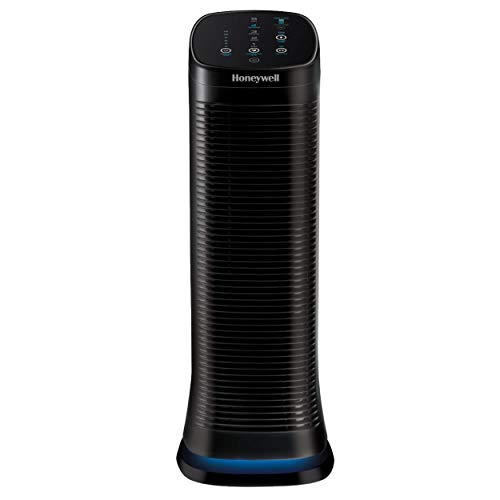
Honeywell Air Genius 5 (HFD320) — Best Overall
The Air Genius 5 is the machine this search was invented for. Its listing states the essentials plainly: an air purifier for large rooms up to 1,200 square feet, with permanent washable filters, aimed at dust, pollen, pet dander, odors, and smoke. The AirGenius line is built around Honeywell’s ifD filter — a charged-media design in which the filter’s dielectric media sits in an intense electric field and captures particles electrostatically — paired with a washable pre-filter and an odor-reducing stage. The ownership consequence is the headline: the main filter never needs replacing, only periodic washing, which removes the largest running cost of purifier ownership entirely.
Strengths
- Permanent washable main filter — no replacement cartridges to buy, ever, for the filter itself.
- Charged-media ifD filtration captures particles without a dense mechanical mat, supporting quieter airflow.
- Large-room rating to 1,200 sq ft per the listing, in a tower format that fits a corner.
Trade-offs
- Washing a filter means downtime and discipline: the machine is off while the filter dries, and skipped washes cost performance.
- The odor pre-filter is a consumable on this line — check the listing for its replacement interval and cost so “permanent” does not surprise you.
- Charged-media efficiency depends on keeping the filter clean; it rewards maintenance-minded owners and punishes neglect more than a sealed HEPA cartridge does.
Spec box: Coverage: up to 1,200 sq ft (per listing). Filter: permanent, washable (per listing); ifD charged-media design (AirGenius line). Format: tower. Colorway verified: Black. Noise figure: not stated in the listing title data.
Live with an Air Genius and the rhythm changes from “order filters” to “wash the filter”: a quarterly-ish routine (follow the manual’s interval) of rinsing, drying fully, and reseating. Owners who keep that rhythm get a large-room purifier with near-zero consumable costs; owners who will not wash a filter should buy the sealed-cartridge BLUEAIR below and accept its filter budget instead. That single self-knowledge question — will I actually wash it? — is the most reliable predictor of satisfaction with this entire category. Check the current price on Amazon.
Best for: large living rooms and owners who will wash a filter to never buy one. / Not suited for: set-and-forget owners or anyone who wants AHAM-rated mechanical HEPA specifically.

Honeywell QuietClean Compact Tower (HFD-010) — Best Compact
The QuietClean HFD-010 shrinks the permanent-filter concept into a compact tower: the listing states a permanent washable filter in a small-format machine from the same Honeywell family. It is the bedroom-and-office expression of the charged-media idea — a machine for the room where you sleep or work, where a replacement-filter habit is most annoying and where a compact footprint matters more than maximum coverage. The QuietClean name signals the line’s design priority: permanent filtration tuned for low noise in personal spaces.
Strengths
- Permanent washable filter — the no-cartridge ownership model in a compact tower.
- Small footprint suits bedrooms, nurseries’ adjacent spaces, and home offices.
- Same maintenance logic as the Air Genius: wash, dry, reseat — no filter shopping.
Trade-offs
- Compact means compact coverage: the listing title data does not state a square-foot figure, so check the product page and size it to a single room, not an open plan.
- Permanent filters still need their wash rhythm; a neglected compact performs like a neglected anything.
- Tower output is directional — placement against a wall corner matters more than with 360-degree designs.
Spec box: Filter: permanent, washable (per listing). Format: compact tower. Coverage and noise figures: not stated in the listing title data — verify on the product page. Brand line: Honeywell QuietClean.
This is the pick for the second purifier in a house — the bedroom unit bought after the living room machine proved the concept — and for apartment dwellers whose “large room” is a studio’s sleeping corner. Buy it for one defined room, keep the wash rhythm, and it will quietly do its job for years without ever asking you to subscribe to anything. If your space is genuinely large, step up to the Air Genius 5 instead of asking a compact tower to be a whole-home machine. Check the current price on Amazon.
Best for: bedrooms and home offices wanting permanent-filter ownership in a small tower. / Not suited for: open-plan spaces or buyers who need a stated coverage figure before ordering.

BLUEAIR Blue 211i Max — Best Large Room
BLUEAIR’s HEPASilent technology is the other legitimate branch of the charged-media family tree: instead of charging the filter media, it charges the incoming particles with an electrostatic chamber, then traps them on a mechanical filter that can be more open — and therefore quieter and more energy-efficient — than a comparably rated dense HEPA mat. The 211i Max listing states the results: coverage up to 3,235 square feet, WiFi with auto mode, a quiet 23 dB low end, HEPASilent filtration, AHAM verification, and a washable pre-filter. That combination — verified performance, genuine electrostatic charging in the process, and very large coverage — earns it the large-room badge.
Strengths
- AHAM Verified performance with coverage to 3,235 sq ft per the listing — the largest verified claim here.
- HEPASilent’s charged-particle design supports a 23 dB quiet floor at low speed.
- Auto mode and WiFi app control suit set-and-forget operation in big spaces.
Trade-offs
- The main filter is a replaceable cartridge — this branch of the family trades the Honeywells’ wash-and-keep model for sealed-filter convenience, at an ongoing cost.
- Premium tier pricing within this list, for both the machine and its filters.
- Its charging stage is an ionizer by design; shoppers who want zero ionization in any form should choose the washable-media Honeywell route instead — see the FAQ.
Spec box: Coverage: up to 3,235 sq ft (per listing). Filtration: HEPASilent (electrostatic charging + mechanical filter). Noise: 23 dB stated (per listing). Verification: AHAM Verified (per listing). Pre-filter: washable (per listing). Main filter: replaceable.
Choose the 211i Max when the room is genuinely large, the purifier will run around the clock, and quiet matters as much as capture — open-plan living areas, great rooms, and light sleepers’ big primary bedrooms. Its auto mode makes it the lowest-attention pick in this guide: the sensor watches the air so you do not have to. Budget honestly for its filters, and the ownership experience is the smoothest here; refuse the filter budget, and the Honeywells are your branch of the family. Check the current price on Amazon.
Best for: very large rooms, quiet round-the-clock running, and verified performance. / Not suited for: anyone committed to zero replacement filters or zero ionization.

Nuwave Forever Smart — Best Premium No-Replace
Nuwave’s Forever Smart makes the boldest ownership promise in this guide: a “never replace” filter system with patented 7-stage filtration, washable and reusable filters, coverage of large rooms up to 2,002 square feet, and an adjustable flow panel. Where the Honeywells hang the promise on one charged-media filter, Nuwave stacks multiple washable stages — the multi-stage approach lets each layer specialize, and every layer returns to service after washing instead of going to a landfill and a checkout page. It sits at this list’s premium tier, and the value argument is arithmetic: years of avoided replacement filters against a higher first cost.
Strengths
- Washable and reusable filters across a 7-stage system — the most complete no-replace design here.
- Large coverage to 2,002 sq ft per the listing.
- Adjustable flow panel lets you direct output — a rare, practical touch.
Trade-offs
- Premium tier: the highest first cost on this list, justified only if you keep the machine for years.
- Seven stages means seven things to wash on maintenance day; the routine is longer than the Honeywells’ single-filter rinse.
- The listing title data does not state a noise figure or third-party verification — check the product page for both before ordering.
Spec box: Coverage: up to 2,002 sq ft (per listing). Filtration: 7-stage, washable & reusable (per listing). Filter replacement: none by design (per listing). Noise and verification: not stated in the listing title data.
The Forever Smart is for the buyer who has done the replacement-filter math on conventional purifiers, disliked the answer, and is willing to pay up front to exit the cycle permanently. It is also the pick for large homes that would otherwise need two mid-size machines. Go in with eyes open about maintenance day — a multi-stage wash is a sink session, not a rinse — and the premium becomes a rational purchase rather than a splurge. Check the current price on Amazon.
Best for: large homes and long-term owners exiting the replacement-filter cycle. / Not suited for: tight first budgets or anyone who wants the simplest possible wash routine.
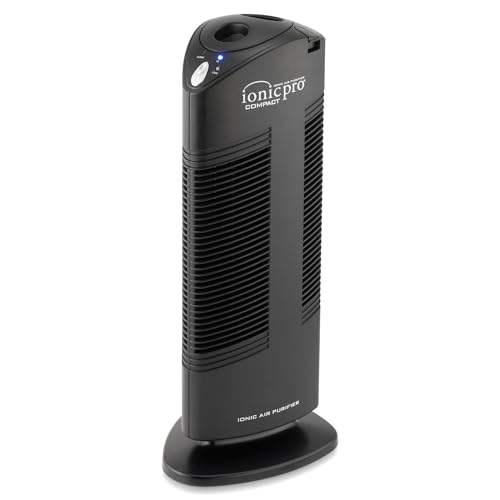
Ionic Pro Compact (CA200) — Best Filterless
The Ionic Pro takes the charged concept to its logical end: no fibrous media at all. Its listing describes a compact filterless purifier for rooms up to 300 square feet, with a washable ionic collector — particles are charged and captured on internal plates, which you periodically remove and wash — running whisper-quiet with no fan-driven filter resistance to overcome. For small rooms, that means silent, consumable-free operation in a machine the size of a small tower, from a brand that has sold this exact concept for years.
Strengths
- Truly filterless: nothing to replace, and the collector washes clean.
- Whisper-quiet per the listing — no dense filter means a gentle fan.
- Compact format for bedrooms, offices, and dorm-sized rooms to 300 sq ft.
Trade-offs
- Ionic collection is gentler than fan-and-filter machines at moving a room’s whole air volume; this is a small-room, background-duty purifier, not a smoke-event responder.
- The collector plates need regular washing to stay effective — performance fades quietly as they load.
- Ionization is inherent to the design; shoppers avoiding ionizers entirely should choose the Honeywell charged-media route.
Spec box: Coverage: up to 300 sq ft (per listing). Filtration: ionic, filterless, washable collector (per listing). Noise: described as whisper-quiet (no dB figure in title data). Model: CA200.
Set expectations correctly and the Ionic Pro is a pleasure: a silent, cost-free-to-run companion for a bedroom or a desk-side office, keeping background dust down without a whisper of consumables. Ask it to clear cooking smoke from a great room and it will disappoint — that is the BLUEAIR’s job. Small room, light duty, zero filter budget: this is the honest champion of that brief. Check the current price on Amazon.
Best for: small rooms, silent background purification, zero consumables. / Not suited for: large rooms, heavy smoke or dust loads, or ionizer-averse shoppers.
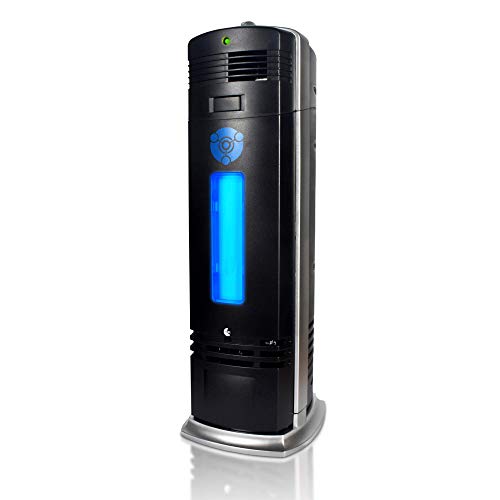
OION Technologies B-1000 — Best Budget
The OION B-1000 is the budget doorway into permanent-filter ionic purification: the listing describes a permanent filter ionic air purifier with a UV-C lamp, in a compact new-unit format. It combines charged-particle collection with a permanent filter you clean rather than replace, at the lowest tier in this guide. The UV-C lamp is part of its stated design; this guide takes no position on lamp efficacy claims and evaluates the machine on its permanent-filter ionic core, which is the feature this search is about.
Strengths
- Permanent filter — no replacement cartridges at the budget tier.
- Ionic collection runs quietly without dense-media fan resistance.
- Compact format suits a bedroom, office, or dorm as a first purifier.
Trade-offs
- Coverage and noise figures are not stated in the catalog title data available to us — check the product page and size it conservatively to one small room.
- Budget-tier build and support expectations apply; this is an experiment-friendly pick, not a decade machine.
- As with all ionic designs, the collector needs regular cleaning to maintain performance.
Spec box: Filtration: permanent filter ionic, with UV-C lamp (per listing). Coverage: not stated in listing title data. Noise: not stated in listing title data. Format: compact.
Buy the B-1000 to learn whether the permanent-filter ionic life suits you before spending Honeywell or Nuwave money: one small room, a cleaning rhythm, and a season of use will teach you more than any review. If it clicks, you will know exactly which upgrade path — charged media or hybrid — fits your home. If it does not, the experiment stayed at the budget tier where experiments belong. Check the current price on Amazon.
Best for: a first, small-room step into permanent-filter purification. / Not suited for: large rooms or buyers who need published coverage and noise specs.
The Three Charged Filtration Families, in Depth
Family one: charged-media permanent filters
This is the technology the keyword literally names. The filter media — in Honeywell’s ifD design, a dielectric material arranged in a dense field of channels — carries the electrostatic effect, and particles moving through it are pulled onto the media’s surfaces. Because the capture force is electrical rather than purely mechanical, the media can stay relatively open: air passes with less resistance, fans run slower and quieter, and fine particles still get caught. The ownership signature is the washable permanent filter. Nothing about the physics requires the filter to be disposable, so Honeywell made it a lifetime part — rinse it, dry it, and it returns to work. The weakness is symmetric with the strength: a charged-media filter’s performance is a function of its cleanliness and its charge, both of which you maintain. Treat the wash schedule as part of the product and it is arguably the most rational filtration design in the consumer market; treat it as optional and a sealed HEPA cartridge will quietly outperform your neglected machine.
Family two: charge the particles, keep a filter
HEPASilent and its hybrid cousins move the charging upstream: an electrostatic stage charges incoming particles, and a mechanical filter downstream collects them. Charged particles stick to filter fibers far more readily than neutral ones, so the filter can be less dense while capturing like a denser one — the same airflow dividend as family one, harvested differently. The ownership signature flips, though: the main filter remains a consumable with a replacement interval and a price, and what you buy with that money is indifference — no washing, no drying downtime, a fresh sealed filter on schedule. BLUEAIR adds the category’s strongest verification culture to this family, with AHAM Verified performance stated on the 211i Max’s listing. Households that know themselves — honestly, now: the filter will be changed on time, the washing would not happen — should choose this family without a flicker of guilt.
Family three: ionic collectors
The oldest charged design of all: charge the particles and collect them on oppositely charged plates, with no fibrous media anywhere. The Ionic Pro and the OION unit represent it here. Its virtues are silence and zero consumables — a gentle fan (or near-fanless airflow) and plates you wash. Its limits are throughput: moving and processing a large room’s air volume takes these machines longer, and their honest habitat is the small room run continuously in the background. Judged as background appliances for bedrooms and offices, they are excellent and nearly free to own. Judged as rapid-response cleaners for a smoky open-plan space, they are the wrong tool, and this guide has deliberately not asked them to be one.
Where washable multi-stage systems fit
Nuwave’s Forever Smart straddles the families: a stack of stages, each washable and reusable, marketed as a never-replace system. Its bet is that filtration breadth — stage after stage, each doing a different job — plus total freedom from cartridges beats any single clever filter. The cost is maintenance breadth to match: more parts to wash, more parts to dry. It is the right answer for a specific, real buyer — the large-home owner who has priced a decade of replacement filters and would rather spend that money once, up front, on a machine designed to end the cycle.
Comparison Table
| Pick | Badge | Key spec | Best for |
|---|---|---|---|
| Honeywell Air Genius 5 | Best Overall | Permanent washable filter, 1,200 sq ft | Large rooms, no filter buying |
| Honeywell QuietClean HFD-010 | Best Compact | Permanent washable filter, compact tower | Bedrooms and offices |
| BLUEAIR Blue 211i Max | Best Large Room | HEPASilent, AHAM Verified, 3,235 sq ft, 23 dB | Very large rooms |
| Nuwave Forever Smart | Best Premium No-Replace | 7-stage washable filters, 2,002 sq ft | Exiting filter costs |
| Ionic Pro Compact CA200 | Best Filterless | Filterless ionic, washable collector, 300 sq ft | Small, quiet rooms |
| OION B-1000 | Best Budget | Permanent filter ionic, UV-C lamp | A cheap first step |
How to Choose a Charged-Media Room Purifier
Pick your family first: charged media, charged particles, or ionic plates. True charged-media machines (the Honeywells) put the charge in a washable filter and ask you to wash it. Charged-particle hybrids (BLUEAIR) charge the air stream and catch particles on a replaceable filter — sealed convenience, ongoing cost. Ionic collectors (Ionic Pro, OION) catch charged particles on washable plates with the gentlest airflow of the three. Your maintenance temperament and your stance on replacement costs should choose the family; the model follows.
Size by the room you will actually close the door on. Coverage figures assume the purifier can cycle the room’s air; an open-plan space behaves like one giant room whatever the floor plan calls it. Match the listing’s stated coverage to the real space — 300 sq ft for the Ionic Pro’s bedroom, 1,200 for the Air Genius’s living room, 2,002–3,235 for the Nuwave and BLUEAIR in genuinely large areas — and remember that running a big machine slowly is quieter than running a small machine flat out.
Do the five-year filter math before the first-price comparison. A conventional purifier’s replacement filters, bought on schedule for five years, commonly rival the machine’s own price. The permanent-filter picks delete that line item in exchange for washing time; the BLUEAIR keeps it in exchange for zero washing of its main filter. Neither is free — one charges money, the other charges attention. Decide which currency you would rather spend, because that decision outlasts every other spec on this page.
Take noise figures seriously — and comparatively. A stated 23 dB low speed, like the BLUEAIR’s, is genuinely bedroom-quiet; “whisper-quiet” without a number, as on the Ionic Pro’s listing, is a description, not a measurement. Charged designs have a structural noise advantage — less filter resistance means slower, quieter fans — but compare stated decibels where they exist and treat adjectives as adjectives.
Understand what verification does and does not cover. AHAM verification, stated on the BLUEAIR’s listing, means an independent program has tested the machine’s clean-air delivery for tobacco smoke, dust, and pollen against a standard protocol — a real signal, and the strongest one available in this guide. Its absence on the other listings is not proof of poor performance; it means those manufacturers have not put those models through that program, and their coverage figures are manufacturer claims. Weigh them accordingly: a verified 3,235 square feet and a claimed 2,002 are both usable numbers, but they are not the same kind of number, and this guide has kept the distinction visible in every spec box rather than laundering claims into facts.
Decide your position on ionization.
Electrostatic charging is this category’s engine, and two of its three families involve ionizing the air stream or the particles in it. That is a design fact, not a defect — but some shoppers prefer to avoid ionizers on principle. If that is you, the washable charged-media Honeywells are your branch, and the hybrid and ionic picks should be crossed off before you fall for their coverage numbers.
How to Maintain a Charged-Media or Permanent-Filter Purifier
Wash on the manufacturer’s rhythm, not on vibes. Charged-media and permanent filters lose efficiency gradually as they load, with no dramatic failure to warn you — the machine sounds the same while capturing less. Put the wash interval from the manual into your calendar the day the machine arrives. A filter washed on schedule performs like the specification; a filter washed “when it looks dirty” has usually been underperforming for weeks.
Dry completely before reinstalling. A damp filter returned to a running machine is a musty smell generator and, in the worst case, a mold nursery. Wash, shake off, and air-dry fully — a full day is not excessive for dense media — before the machine goes back into service. Households that cannot tolerate the downtime keep a reminder of why the BLUEAIR’s sealed cartridge tempts people; plan your wash for a morning when the room can go without.
Clean collectors and pre-filters more often than main filters. Ionic plates and washable pre-filters are the cheap seats of the system: they load first and clean fastest. A monthly wipe or rinse of plates and pre-filters keeps the main stage — charged media or cartridge — working at its rated efficiency instead of compensating for a clogged front door.
Do a seasonal deep check. Once a season, beyond the routine washes: vacuum the machine’s intake grilles, wipe the sensor lens if your model has one (a dusty sensor makes auto mode stupid), inspect the permanent filter’s frame and seals for warping, and confirm the collector plates or media sit flush — a poorly reseated filter after washing is the most common self-inflicted performance loss in this category. Ten minutes, four times a year, is the entire difference between a machine that performs to its listing in year three and one that mysteriously “got worse.”
Place for airflow, not for invisibility.
Every purifier in this guide needs clearance around its intake and outlet; a machine shoved flush into a corner behind a curtain is decorating, not purifying. Give towers a hand’s breadth from walls, keep the outlet path open, and run the machine in the room where the door actually closes at night — clean air follows the machine, not the intention.
Common Buying Mistakes
Buying a furnace filter and calling it a room purifier. Charged-media technology is common in HVAC filters — several surfaced in our verification searches — but a furnace filter cleans nothing without a furnace system moving air through it. This search is about complete room machines; every pick here is one.
Assuming “permanent filter” means “no maintenance.” Permanent means washable, and washable means you are the maintenance department. The owners who love these machines are the ones who accepted that trade on day one.
Chasing the biggest coverage number for a small room. Oversizing wastes money and, at low speeds, is fine — but buyers often oversize and then run the machine on turbo out of habit, buying noise they did not need. Size to the room; run on auto or low.
Treating a purifier as a medical device. A purifier cleans air; it does not treat conditions, and no claim in this guide suggests otherwise. Buy it for dust, dander, odor, and smoke management — the jobs its listing actually describes.
Ignoring the odor stage’s consumables. On several permanent-filter machines the main filter is forever but the odor pre-filter is a periodic replacement. Read the listing’s full filter list so your “no replacement costs” plan survives contact with the manual.
Charged-Media Purifiers in Real Homes: Four Scenarios
The pet household tired of filter subscriptions. Two dogs, one cat, a purifier that eats a cartridge every few months — the math stopped being funny a year ago. The Air Genius 5 is your exit: large-room coverage, a filter that goes in the sink instead of the cart, and an odor stage for the reality of animals indoors. Put the wash dates in the family calendar and the running cost of clean air falls to electricity and the occasional odor pre-filter.
The light sleeper in a big primary suite. You need real purification at a volume you can sleep through, in a room too large for compact machines. The BLUEAIR 211i Max was specified for you: verified performance, a stated 23 dB low speed, and auto mode that throttles down as the air cleans. Its replacement filters are the price of never washing anything — a price your sleep is worth.
The studio apartment. One room that is bedroom, office, and living room in rotation, and no storage for spare cartridges. The QuietClean compact tower is the proportionate answer: permanent filter, small footprint, one defined space. If even that feels like too much machine, the Ionic Pro’s silent background duty suits a studio’s sleeping corner — with honest expectations about whole-room speed.
The whole-house planner. You are done buying disposable filtration for a large home and think in decades. The Nuwave Forever Smart is the considered purchase: premium first cost, multi-stage washable filtration, coverage that replaces two lesser machines, and a maintenance day you schedule like any other household system. Buy it as infrastructure, not as an appliance, and its economics make sense.
Final Recommendation
For the truest expression of this search — a charged-media filter you wash instead of replace, in a large-room machine — choose the Honeywell Air Genius 5. Its compact sibling, the QuietClean HFD-010, brings the same ownership model to bedrooms. If your room is very large and you prefer sealed-filter convenience with verified performance, the BLUEAIR 211i Max is the hybrid champion; if you want to exit filter purchases entirely at a premium, with multi-stage washable filtration, it is the Nuwave Forever Smart. Small quiet rooms belong to the Ionic Pro Compact, and the OION B-1000 is the budget experiment. Whichever family you choose, commit to its maintenance model — that commitment, not the badge, is what you are really buying. And keep the category’s scarcity in perspective: a short list of honest charged-media machines, each verified and each matched to the home it suits, serves you far better than a long list of ordinary HEPA boxes wearing this search as a costume.
More from the air purifiers cluster: Best Air Purifiers Below 300, Best Air Purifiers Blueair, Best Air Purifiers For Cat Dander, Best Air Purifiers For Dust And Pet Dander, Best Air Purifiers For Baby Room.
Frequently Asked Questions
What is a charged media filter in plain language?
It is a filter whose material carries an electric charge, or sits in a strong electric field, so particles are drawn onto the fibers electrostatically rather than only being strained out mechanically. Because capture does not depend entirely on a dense mat, charged-media filters can pair strong capture with freer airflow — and in designs like Honeywell’s ifD, the media is permanent and washable instead of disposable.
Are charged-media purifiers the same as ionizers?
Not exactly. A pure ionizer charges particles and lets them settle on room surfaces or a collector plate. A charged-media purifier keeps a physical filter in the air path and uses charge to make that filter capture more effectively; the particles end up in the filter, which you wash or replace. Hybrid designs like HEPASilent sit between the two ideas: charge the particles, then catch them on a real filter.
How often do permanent filters really need washing?
Follow your machine’s manual — intervals vary by design and by how dusty the room is. The important truth is that performance fades gradually as any permanent filter loads, so calendar-based washing beats waiting for a visible cue. Keep the date in your phone, wash, dry fully, and the machine will perform the way its listing describes.
Can a charged-media purifier replace a HEPA purifier?
For general household dust, pollen, dander, and odor management, a well-maintained charged-media machine is a legitimate alternative with far lower running costs. If you specifically need certified mechanical HEPA performance — for example, a clinician has directed it, or a listing-level AHAM rating for a mechanical filter is your requirement — buy the verified mechanical machine instead. This guide’s BLUEAIR pick, AHAM Verified per its listing, is the bridge option.
How long do permanent charged-media filters last?
They are designed as lifetime components of the machine rather than consumables: wash them on schedule and they should serve for the purifier’s working life. What ends their service is physical damage — a warped frame, a torn seal, media crushed by careless handling — rather than a calendar date. Treat the filter like the appliance part it is: handle it by its frame, never fold or compress the media, and let it dry in a clean place where it will not be knocked over.
Do these purifiers remove odors and smoke?
The listings for the Air Genius 5 and the BLUEAIR name odors and smoke among their targets, and odor handling generally comes from a carbon or odor-specific stage rather than from the charged media itself. Manage expectations: a purifier reduces lingering smoke odor in a room over time; it does not make a room where someone is actively smoking smell neutral. Ventilation remains the first tool; the purifier is the second.
Do charged-media filters lose their charge over time?
The electrostatic effect in designs like ifD is generated by the machine’s powered field while it runs, not stored in the media like a battery — so the practical question is not charge decay but cleanliness. A loaded, dirty filter captures less because its surfaces are coated, whatever the field is doing. That is why this guide repeats one instruction in several forms: wash on schedule. A washed charged-media filter returns to work at full effect; a neglected one is the only kind that “loses” performance.
How much does it cost to run one of these purifiers?
Two costs: electricity and consumables. Charged designs tend to sip electricity because their fans fight less filter resistance, and several picks here run at low wattage on their quiet speeds — check your listing’s stated wattage for the exact figure. Consumables are where the families diverge: the permanent-filter picks reduce them to an occasional odor pre-filter or nothing at all, while the hybrid BLUEAIR carries a real annual filter budget. Over five years, that divergence is usually larger than the difference in purchase prices — run your own household’s numbers before deciding a machine is “expensive.”
Should I worry about ozone from electrostatic purifiers?
It is a fair question to ask of any technology that charges air. Electrostatic and ionic devices can produce trace ozone as a byproduct, and regulators in some places — California most prominently — certify purifiers against ozone emission limits. The listings summarized in this guide do not state ozone figures in the catalog data available to us, so this guide makes no claim either way for any pick. If ozone is a deciding concern for your household, check the specific model’s product page and manual for an ozone emission statement or a CARB certification before ordering, and favor the washable charged-media designs, which keep the charging inside the filter rather than releasing charged air into the room.
Where should I place a tower purifier in a bedroom?
Near the bed but not against it, with the intake unobstructed and the outlet aimed into the room’s open air rather than at a wall. A hand’s breadth of clearance on the intake side, a clear path in front, and a door that closes at night will do more for your actual air quality than any single feature upgrade. Avoid tucking any purifier behind curtains or inside furniture nooks — a starved intake quietly converts a rated machine into a decorative fan.
Why are there so few true charged-media room purifiers?
Because the mainstream market standardized on replaceable mechanical HEPA cartridges — a simpler story to sell and a profitable filter aftermarket. Charged-media designs survive where a manufacturer commits to them, as Honeywell has with ifD, or where the value proposition is explicit, as with Nuwave’s never-replace system. The scarcity is exactly why this search needs a verified guide rather than a search-results roundup.


