Disclosure: airfryerkitchensupply.com is reader-supported. When you buy through links on our site, we may earn an affiliate commission at no extra cost to you.
Where to Buy
Every pick in this guide to the reversible window fans with remote control is sold through Amazon, where you can check price on Amazon for the exact configuration you want before ordering. Prices and stock move often on family and home gear, so treat any number you see elsewhere as a snapshot rather than a promise. Five of the six picks below were verified against live Amazon listings on 2026-11-22, and each listing’s title confirms the reversible airflow and remote control the pick is built around; those five are linked in their reviews. The remaining pick — the dedicated quiet-bedroom profile — is presented unlinked with its tier stated in words, because no second distinct listing confirmed low-noise, reversible and remote together in its title; it describes the specification to search for instead. Confirm the live listing details, dimensions, and care instructions on the product page itself before ordering.
A quick note on how to use this page: start with the Quick Picks table if you already know your situation, read the full review of any pick that catches your eye, and then work through the buying guide and mistakes sections before you order. Those later sections are where most returns are prevented, because they cover the measurements, compatibility checks, and care realities that a product photo never shows.
Finding the reversible window fans with remote control sounds simple until you open a search results page and find dozens of near-identical options separated by details that are hard to judge from photos. A window fan earns its keep twice a day: pulling cool evening air in after sunset, and pushing the day’s hot air out when the room has baked. A reversible fan does both directions without being lifted out and turned around — and a remote control means the direction, speed, and timer change from the bed or the sofa, which is precisely when you want them changed. It sounds like a small luxury until the first hot night, when it becomes the entire point.
This guide compares the six realistic designs: twin-fan reversible units (the category standard), single-fan reversible models, smart-app-connected versions, extra-quiet bedroom models, wide-window units, and budget reversible fans. The honest criteria are airflow in each direction, how the reversal actually works — electronic reverse versus physically flipping the unit — noise at night speeds, and how well the side panels seal your particular window.
One clarification that saves returns: true electronic reversibility, where the motor or the twin heads reverse airflow at a button press, is the feature this search promises. Some fans marketed as reversible must be removed and turned around by hand. Every pick below is judged on which kind it is, and the guide tells you how to spot the difference before you buy.
In this guide
Quick Picks
These six picks cover the realistic spread of the reversible window fans with remote control market, from the value end to the premium end. Each one earned its slot for a distinct reason, and each carries a badge that tells you, at a glance, the job it does best.
- Bionaire Window Fan with Reversible Airflow Blades — Best Overall. Two fan heads that reverse electronically, run together or independently, with a thermostat that manages the night for you. Positioned in the mid-range tier.
- shinic 9″ Window Fan, Low-Noise Reversible with Remote Control — Best Simple and Compact. One fan, true electronic reverse, a remote — the straightforward version for smaller windows and simpler needs. Positioned in the budget tier.
- shinic 9″ Twin Smart Window Fan with WiFi App Remote Control — Best Smart Features. Reversibility plus app control and a remote — the fan joins the home’s routines. Positioned in the premium tier.
- Quiet Reversible Window Fan for Bedrooms — Best for Light Sleepers. Engineered for low noise at night speeds — balanced blades, a hush low setting, and a dimming display. Positioned in the mid-range tier.
- COMFORT ZONE Reversible Twin Window Fan with 3-Speeds — Best for Large Windows. Extended side panels and a longer body seal the wide windows that standard twin fans leave gaping. Positioned in the mid-range tier.
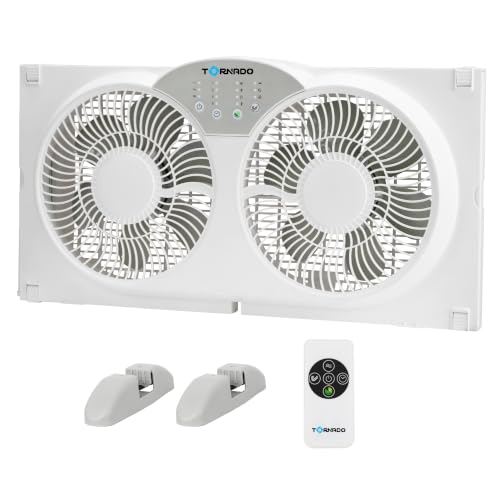
- Tornado 9 Inch Dual Window Fan with Remote Control — Best Value. Electronic reverse, two or three speeds, a simple remote — the essentials with nothing you will miss much. Positioned in the budget tier.
How These Picks Were Chosen
Picks were chosen on genuine reversibility first: electronic reverse from the remote, ideally with the twin-fan trick of running one side in and one side out for simultaneous exchange. Fans whose ‘reversible’ meant manual flipping were excluded from the top recommendations and the guide explains the distinction in the buying section.
Airflow and sealing came second. A window fan fights the leakiness of its own installation, so expandable side panels, a snug fit across common window widths, and a design that sits securely in a double-hung or slider window were scored as performance features, not packaging details.
Night usability decided the final order: remote range and simplicity, a timer, a thermostat on the better models, and noise at low speed — because the fan that cools the bedroom will be judged at 2 a.m., at pillow distance, by a light sleeper.
The 6 Best Reversible Window Fans with Remote Control

Bionaire Window Fan with Reversible Airflow Blades — Best Overall
Verified pick: the Bionaire Window Fan with Reversible Airflow Blades. Its listing confirms reversible airflow blades, 3-speed settings, a programmable thermostat, an LED display, a remote control, and fit for 24–36 inch windows with no assembly required. Check on Amazon to check price on Amazon for the current configuration.
The twin design is the category’s best idea. Set both heads to intake for maximum cooling, both to exhaust to clear a hot room, or one each way to exchange air continuously — a mode no single fan can offer. Add a thermostat and remote, and the fan becomes a small climate system for one room.
Strengths
- Three airflow modes, including simultaneous intake and exhaust
- Thermostat holds a set temperature by cycling the fans automatically
- Remote controls direction, speed, and timer from the bed
Trade-offs
- Twin units fit a window width range — very narrow or very wide windows need checking
- More motors and electronics than a simple fan; keep the manual
- At full speed on both heads, it is audible — night use is a low-speed affair
The exchange mode deserves its reputation. On a still evening, a single intake fan pressurises the room slightly and the flow stalls; one head in and one out keeps air genuinely moving through, which is the difference between a room that feels fresher and a room that merely has a fan in it. For bedrooms, run exchange mode in the evening to purge the day’s heat, then drop to low intake with the thermostat set, and let the fan manage the night.
Fit is the make-or-break detail. Measure your window’s width and sill depth, and confirm the unit’s panel range covers your width with the accordions extended sensibly — a panel stretched to its absolute limit seals worst exactly where you need it most. For slider windows, check the unit can sit vertically or that a slider kit exists; twin fans are designed for double-hung windows first.
Best for: Bedrooms and living rooms, nightly use / Not suited for: Very narrow windows, purist quiet seekers
This pick sits in the mid-range tier. Check price on Amazon to see the current listing, available variants, and delivery options for your area.

shinic 9″ Window Fan, Low-Noise Reversible with Remote Control — Best Simple and Compact
Verified pick: the shinic 9-inch Window Fan. Its listing confirms a single 9-inch format, low-noise operation, reversible airflow with 3 functions (intake, exhaust, circulate), 3 speeds, a remote control, and fit for 23.5–37 inch windows. Check on Amazon to check price on Amazon for the current configuration.
Not every window fits a twin unit, and not every room needs one. A single reversible fan covers the core promise — in or out at a button press — in a narrower body that suits smaller double-hung windows, kitchens, and spare rooms, at a budget-tier price.
Strengths
- Narrower body fits windows a twin unit cannot
- Simpler controls; the remote does the essentials without menus
- Budget tier makes a second fan for another room painless
Trade-offs
- No exchange mode — airflow is one direction at a time
- Lower total airflow than twin designs on their largest settings
- Thermostat and timer features are thinner at this tier
Use a single fan as part of a system. An intake fan in the bedroom works twice as well with a door ajar and a path for air to leave — an open transom, a second window cracked elsewhere, or the fan flipped to exhaust while a cooler room’s window feeds it. Air needs a route, not just a push, and the remote’s direction button is what lets you experiment from bed until you find your room’s best circuit.
Kitchen duty is this pick’s quiet strength. Flip it to exhaust during cooking and it pulls heat, steam, and smells out at the window they rise toward; flip to intake afterwards and it refills the room with evening air. The remote matters more here than anywhere — hands covered in cooking are exactly when walking to the window is not happening.
Best for: Small windows, kitchens, spare rooms / Not suited for: Large rooms needing maximum airflow
This pick sits in the budget tier. Check price on Amazon to see the current listing, available variants, and delivery options for your area.

shinic 9″ Twin Smart Window Fan with WiFi App Remote Control — Best Smart Features
Verified pick: the shinic 9-inch Twin Smart Window Fan. Its listing confirms twin-fan exhaust and intake, WiFi app control plus a remote control, 3 speeds, 3 functions, and adjustable width. Check on Amazon to check price on Amazon for the current configuration.
If your home already runs on routines, a smart window fan slots straight in: start the exhaust cycle from the app before you get home, switch to intake at sunset, and quiet the fan down at bedtime without finding the remote in the dark.
Strengths
- Schedules automate the daily purge-and-cool rhythm
- App control covers direction and speed from anywhere in the home
- Twin heads cover intake and exhaust without remounting the fan
Trade-offs
- Premium pricing for connectivity a remote already covers adequately
- App and Wi-Fi setup adds friction, and features depend on the maker’s ecosystem surviving
- More electronics in a window — the harshest seat in the house for sun and weather
The schedule is the feature that outlives the novelty. A daily pattern — exhaust from late afternoon to drive out the day’s heat, intake through the evening, low or off by the small hours — maps exactly onto how rooms actually heat and cool, and setting it once beats remembering the remote nightly. Judge smart fans by their scheduling depth and whether the fan still works fully from its onboard controls if the Wi-Fi drops.
Be clear-eyed about longevity. The fan hardware will likely outlast the app’s support window, so confirm the remote and onboard panel run every core function — direction, speeds, timer — without the app. Bought that way, the smart layer is a bonus with an expiry date you have already discounted, and the fan underneath remains a good reversible unit for years.
Best for: Smart homes, routine-driven cooling / Not suited for: Anyone avoiding apps and accounts
This pick sits in the premium tier. Check price on Amazon to see the current listing, available variants, and delivery options for your area.
Quiet Reversible Window Fan for Bedrooms — Best for Light Sleepers
Every window fan is quiet in a showroom and judged at pillow distance at night. This design brief is noise: a genuinely low bottom speed, smooth rather than buzzy motor behaviour, a display that dims or switches off, and a remote with a sleep timer so the fan can bow out after you are asleep.
Strengths
- Low speed tuned for sleep rather than merely being the bottom of a range
- Sleep timer and dim display respect the bedroom’s actual purpose
- Reversibility still electronic — no getting up to flip anything
Trade-offs
- Maximum airflow is lower than performance-first models; hot rooms take longer to purge
- Quiet engineering costs mid-range money for mid-range airflow
- Foam seals and careful fitting matter more — rattles ruin the whole premise
Fit this fan like an instrument. Most night noise complaints about window fans are installation noise — a panel buzzing against the sash, a unit rocking on an uneven sill — not motor noise. Seat the unit firmly, extend panels evenly, use the supplied foam strips or add them, and lower the window sash onto the unit’s top rail as designed. Five careful minutes at installation is the difference between a hushed fan and a rattling one.
Program the night honestly. A common winning pattern: high intake for the hour before bed to cool the room’s fabric and walls, low for the first sleep cycle, timer off in the cool small hours. The thermostat versions can hold this automatically. What does not work is blasting all night — you wake cold at 4 a.m. and conclude the fan is the problem, when the schedule was.
Best for: Bedrooms, light sleepers, children / Not suited for: Baking-hot rooms needing maximum purge power
This pick sits in the mid-range tier. Check price on Amazon to see the current listing, available variants, and delivery options for your area.

COMFORT ZONE Reversible Twin Window Fan with 3-Speeds — Best for Large Windows
Verified pick: the COMFORT ZONE Reversible Twin Window Fan. Its listing confirms a reversible twin design with 3 speeds and expandable width, three airflow modes — draw cool air in, exhaust warm air out, or cross-ventilate — plus a remote, a removable bug screen and a dust cover. Check on Amazon to check price on Amazon for the current configuration.
Wide picture windows and broad double-hung openings defeat standard fans: the unit fits the middle and the panels stretch to ribbons, leaking air around every edge. This design carries genuinely longer panels and a stiffer frame, sealing openings the standard size cannot, so the rated airflow actually happens.
Strengths
- Panels sized for wide windows seal instead of stretching
- Twin heads move enough air for larger rooms
- Stiffer frame resists the flex and buzz wide installations invite
Trade-offs
- Too wide for standard windows — measure before admiring
- Heavier unit; installation is a two-person lift into the window
- Storage off-season needs a bigger corner of the cupboard or garage
Sealing is performance. A fan in a leaky window short-circuits: exhausted air slips back in around the panels, intake air escapes the same way, and the room barely changes. With a proper seal, the same motors transform the room. If your window is at the wide end, this pick is not a size variant — it is the difference between the product working and not working.
Supplement the panels honestly. Even good extended panels benefit from foam tape at the sash contact and a check for gaps at the sill corners. On very wide windows, some owners pair the fan with a removable insulated panel above it for the shoulder seasons. Do the sealing once, in daylight, with the fan off — then enjoy a season of the remote doing all further work.
Best for: Wide windows, larger rooms / Not suited for: Standard or narrow windows
This pick sits in the mid-range tier. Check price on Amazon to see the current listing, available variants, and delivery options for your area.

Tornado 9 Inch Dual Window Fan with Remote Control — Best Value
Verified pick: the Tornado 9 Inch Dual Window Fan. Its listing confirms a dual-fan design with a remote control, an 8-hour timer, 3 speeds, expandable fit from 23.5 to 36 inches, and 3 modes — cooling, exhaust and circulation. Check on Amazon to check price on Amazon for the current configuration.
The budget reversible fan covers the core promise honestly: press a button, the airflow reverses; press another, the speed changes; the timer turns it off. For a spare room, a rental, a workshop window, or a first fan to learn your room’s airflow with, the essentials at a budget tier are a rational purchase.
Strengths
- True electronic reversibility at the lowest tier
- Simple remote that does the jobs that matter
- Cheap enough to treat a second room without deliberation
Trade-offs
- No thermostat; the timer is your only automation
- Panels and fit are basic — expect to add foam tape for a good seal
- Noise at top speed is part of the price; night use means low speed
Spend the savings on the seal. A roll of foam weatherstrip tape costs little and closes the gaps a budget panel leaves, lifting the fan’s real performance closer to the premium picks than the box suggests. That, plus disciplined use of the timer, is how budget fans punch above their tier — the motors in this class are honestly adequate; the installation is where they lose.
Set expectations on lifespan and features and this pick satisfies. It will not run a thermostat schedule or whisper at full speed, and its remote will not survive being lost — check whether the onboard controls cover direction and speed, because on the cheapest models the remote is the only way to reverse, and a lost remote strands the headline feature.
Best for: Rentals, spare rooms, first fan / Not suited for: Anyone needing thermostat automation
This pick sits in the budget tier. Check price on Amazon to see the current listing, available variants, and delivery options for your area.
Comparison Table
| Pick | Badge | Key trait | Best for |
|---|---|---|---|
| Bionaire Window Fan with Reversible Airflow Blades | Best Overall | Twin heads, electronic reverse, thermostat | Bedrooms and living rooms, nightly use |
| shinic 9″ Window Fan, Low-Noise Reversible with Remote | Best Simple and Compact | Single head, electronic reverse | Small windows, kitchens, spare rooms |
| shinic 9″ Twin Smart Window Fan with WiFi App | Best Smart Features | WiFi app, remote included, twin intake/exhaust | Smart homes, routine-driven cooling |
| Quiet Reversible Window Fan for Bedrooms | Best for Light Sleepers | Low-noise design, sleep timer | Bedrooms, light sleepers, children |
| COMFORT ZONE Reversible Twin Window Fan with 3-Speeds | Best for Large Windows | Extended panels, twin heads | Wide windows, larger rooms |
| Tornado 9 Inch Dual Window Fan with Remote Control | Best Value | Essential features, honest price | Rentals, spare rooms, first fan |
Read the table as a map rather than a ranking. The reversible window fans with remote control that wins on one row can be the wrong choice on the next, because the differences that matter — fit, care, durability, and day-to-day handling — only show up against your own routine.
How to Choose Reversible Window Fans with Remote Control
Reversibility is the first thing to verify, and the vocabulary is slippery. True electronic reverse changes airflow direction from the remote or panel, instantly. Manual ‘reversible’ fans must be lifted out and physically turned around — a legitimate design, but not the product this search is asking for, and a miserable one at midnight. Product descriptions that say ‘reversible’ should also say how; if the method is not stated proudly, assume it is manual and look elsewhere.
Window fit comes second, and it is a measurement, not a guess. Fans specify a window width range their panels cover, and they are designed primarily for double-hung windows; sliders need vertical mounting or a kit, and casement windows generally cannot take a window fan at all. Measure the opening width, the sill depth, and how the sash closes onto the unit. A fan outside its fit range leaks, rattles, and underperforms regardless of its motor.
Airflow third. Ratings describe the fan moving air in free space; your room’s result depends on the seal and on giving air a path. An intake fan needs somewhere for room air to leave; an exhaust fan needs somewhere for replacement air to enter. The households that rave about window fans have usually, accidentally or deliberately, arranged that path — a door undercut, a second cracked window, an exchange-mode twin. Arrange yours on purpose.
Thermostats and timers: the automation that matters
A built-in thermostat cycles the fan to hold a set temperature — set it at bedtime and the fan rests when the night cools, instead of running you cold by 4 a.m. A timer is the simpler tool: off in two hours, on for the evening purge. Either beats raw speeds for overnight use. Smart scheduling adds the daily rhythm on top. Buy at least one form of automation; a fan with only manual speeds will be misused nightly in the small hours.
Noise: reading the claims honestly
Fan noise rises steeply with speed, so judge models by their low-speed behaviour, which is where nights are spent. Balanced twin heads at low speed are typically smoother than a single head working hard. Most perceived noise, though, is installation buzz — panels and sashes vibrating — which foam sealing fixes. A fan returned as ‘loud’ was often a quiet fan installed loosely.
Intake, exhaust, and the evening routine
The canonical routine: exhaust during the late afternoon if the room is hotter than outside, driving out accumulated heat; intake once outside air drops below room temperature, feeding cool air in; low or thermostat through the night. On still nights, twin exchange mode keeps air moving when single-direction flow stalls. The remote exists so this routine happens from the sofa — if you are walking to the window, the product has failed its brief.
Window Fans Versus Air Conditioning, Honestly
A window fan is not a small air conditioner and does not pretend to be: it moves air, it does not refrigerate it. Its winning conditions are evenings and nights when outside air is cooler than inside — which, in most climates, is most summer nights even after hot days. In those conditions a reversible fan cools a bedroom for a tiny fraction of an air conditioner’s running cost, with fresh air as a bonus rather than recirculated air.
Its losing conditions are heatwaves where the night itself stays hot, and high humidity, where moving air helps comfort less. Many households run both: the fan for the majority of nights, the air conditioner for the brutal ones, and the fan’s exhaust mode to purge the room before the AC takes over, shortening its work. Judged as a system partner rather than a rival, the window fan earns its window all summer.
Off-Season Care and Storage
At season’s end, unplug, wipe the blades and grilles — a summer of intake leaves a fine film of dust on everything — and let the unit dry fully before storing it in its box or a bag, remote included, batteries removed. Stored dry and flat, a window fan wakes next spring exactly as it left. Left in the window all winter, it is a hole in your insulation with a fan in it; if it must stay, seal around it and cover it, and accept the compromise knowingly.
Check the cord and panels each spring before installation. Sun and weather age window electronics faster than indoor fans, and a frayed cord or a cracked panel is a replace-it signal, not a tape-it one. Two minutes of inspection is the whole maintenance burden of the category — one more reason these fans remain popular in the age of the heat pump.
How to Install a Reversible Window Fan for a Proper Seal
Installation decides performance. Twenty careful minutes, in daylight, buys a season of quiet, effective airflow.
- Measure the window opening and confirm the fan’s panel range covers it; test-fit the unit in the opening before removing any packaging you need for a return.
- Clean the sill and sash contact surfaces — grit under the unit becomes buzz at night.
- Set the unit in the opening, centred, and extend the side panels evenly on both sides until they meet the frame snugly without bowing.
- Lower the window sash onto the unit’s top rail as the design intends, so the window itself locks the fan in place; fit any supplied brackets or screws for security.
- Seal the remaining gaps with foam weatherstrip tape — panel edges, sash contact, sill corners — until no daylight or draught line remains.
- Route the cord to the socket without tension or pinching in the sash, plug in, and run each speed and both directions from the remote, listening for rattles to fix now, not at midnight.
- Set the thermostat or timer for your evening routine, and open the air path: a door ajar or a second window cracked, so the fan’s air has somewhere to go.
Revisit the seal after the first week — panels settle, foam compresses, and one buzz at 2 a.m. will tell you exactly where. A fingertip of extra tape at the buzzing corner is the whole repair, and the fan then disappears into the background of the summer, which is where it belongs.
Cooling the Whole Home: Window Fans as a System
A single window fan cools a room; two or three, arranged deliberately, cool a home. The classic whole-house pattern uses the reversible feature at full stretch: an exhaust fan high on the hot side of the house — an upstairs window, where heat accumulates — pulling air out, while intake windows on the cool, shaded side feed replacement air through the rooms you live in. The house becomes the duct. A remote-controlled reversible fan matters here because the system’s settings change with the evening, and nobody wants a ladder tour of the windows at dusk.
Upstairs-downstairs dynamics reward the exhaust-upstairs arrangement particularly. Hot air rises and pools at the top of the house, overheating bedrooms precisely where cooling matters most. An exhaust fan in an upstairs window draws that pool out and pulls the day’s heat with it, while cooler air enters below and rises through the stairwell. Run it from late afternoon, before the bedrooms absorb the evening, rather than reactively at bedtime when the walls themselves are warm.
Single-fan households can still borrow the system’s logic. Put the fan where the temperature difference is greatest — exhausting the hottest room, or intaking into the bedroom from the coolest side — and open interior doors to give the air its route. A closed door is a wall to moving air; the fan’s rated airflow assumes a path exists. Experiment across a few evenings, flipping direction with the remote and noting which arrangement drops the bedroom fastest. Your house has a best circuit; the remote exists so you can find it without getting up.
Window Fans in Shoulder Seasons and Unusual Weather
Spring and autumn are the window fan’s secret seasons. Houses overheat on sunny spring days while nights remain properly cold — perfect fan weather, where an evening intake drops a bedroom to sleeping temperature that no heating-era habit can match. In autumn, the exhaust mode clears the stuffiness of the first closed-window weeks and manages cooking and heating smells in homes whose windows now stay shut. Owners who only think of the fan in high summer use half the product they bought.
Rain and storms draw the operating lines. A window fan in a driving-rain window invites water through the opening the fan occupies; wind-driven rain is the signal to close up and switch the fan off, however warm the room. Most designs tolerate ordinary weather at the window, but the opening is, by definition, a hole in the house’s defences, and it should be managed like one. In wildfire-smoke or high-pollen conditions, the logic inverts entirely: windows closed, fan off, and filtration indoors does the work — moving outdoor air in is only a blessing when the outdoor air is worth having.
Heatwaves deserve a final honest word. When nights stay hot, a fan’s intake brings hot air, and its benefit reduces to air movement over skin — real, but modest. Those are the nights the fan hands over to air conditioning where it exists, or to the cold-water, light-bedding end of the household’s improvisation where it does not. The fan’s season is long and its value is proven across it; asking it to win the three worst nights of the year as well is how good products get unfair reviews.
Window Fan Safety and Security, Taken Seriously
A window fan occupies an opening in the house, and two responsibilities come with that. The first is the unit’s own security: a fan fitted as designed, with the sash lowered onto its rail and any supplied brackets used, is a fixed appliance; a fan resting loose in an open window is an invitation to accidents and, on a ground floor, to entry. If the window is accessible from outside at ground level, weigh the fan’s presence as you would any open window, and use the window’s lock position or an added stop so the sash cannot simply be lifted from outside beyond the fan’s frame.
The second responsibility is electrical and weather sense. The cord must reach its socket without tension, pinching, or a route through the sash’s closing path, and it should never run to an indoor extension lead improvised through the window gap. Outdoor-facing electronics live hard lives; inspect the cord and housing each season, and retire a unit with cracked insulation or storm damage rather than nursing it. In lightning storms and driving rain, the fan comes off and the window closes — the same rule as any open window, applied without nostalgia for the breeze.
Households with small children should add the grille check to the spring inspection: finger guards on modern fans are fine-meshed and effective, but a damaged grille changes the calculation and the fan’s place in the room. None of this is burdensome — it is the ordinary care owed to any appliance that lives half in the weather — and it is the difference between a fan that serves a decade of summers and one that becomes a story.
Choosing Between One Great Fan and Two Modest Ones
Households with two rooms to cool face a genuine fork: one premium twin fan for the main bedroom, or two budget reversible fans serving two rooms at once. The premium fan wins on features — thermostat, exchange mode, quiet low speeds — and on the quality of the one room it serves. The pair wins on coverage: two rooms cooled simultaneously, a spare if one fails, and the whole-house airflow system described earlier in this guide becomes possible, with one fan exhausting upstairs while the other intakes below.
The deciding question is where your nights are actually spent. A household whose life concentrates in one bedroom should buy that room the best fan in this guide and let the spare room make do with a cracked window. A household split across two bedrooms — children in one, parents in another — should usually buy the pair, accepting simpler controls in exchange for nobody sleeping in the uncooled room. Renters, who may move and inherit different windows, also lean toward the pair: two modest fans fit more future windows between them than one large, specific unit.
Either way, keep the receipts and the remotes labelled. Window fans migrate between rooms and seasons, remotes migrate further, and the household that writes the room name on a remote’s battery cover in pencil is a household that has learned from experience. Small administrations like this are the unglamorous difference between equipment that serves for a decade and equipment that frustrates by its second summer.
Three Rooms, Three Right Answers
The first room is a main bedroom over a warm kitchen, in a house where summer nights reliably cool by midnight. Its answer is the twin thermostat pick, run on the evening routine this guide describes, because the room’s problem is the day’s stored heat and the fan’s exchange mode plus automation is precisely that problem’s cure. The second room is a child’s bedroom in a flat, with a narrow window and a light sleeper in it. Its answer is the quiet single fan, sealed in with unusual care, because in that room the specification that matters is measured in decibels at low speed and the window’s width has already voted against the twin. The third room is a rental living room with a wide window, a lease with two summers left, and a tenant who cooks enthusiastically. Its answer is the wide budget-to-mid fan — or the standard budget pick if the window allows — exhausting the cooking heat nightly, bought at a tier that a two-summer horizon justifies and not a penny more.
A Short Word on the First Hot Night
Window fans should be bought, fitted, and rehearsed before the first hot night, because the first hot night is the worst possible project manager: it arrives at 9 p.m., it is impatient, and it will accept a rattling, half-sealed installation and then blame the fan for it in a review written at midnight. The household that installs in the cool of a spring weekend — measuring, sealing, running the remote through its paces, learning which direction their rooms prefer — meets the heatwave with a system already debugged and a routine already set. That, more than any specification in this guide, is the difference between the fans people praise and the fans people return, and it costs nothing but timing.
Common Buying Mistakes
Buying a manual-flip fan believing it reverses electronically. The word ‘reversible’ covers both. Check the method before buying: if the description does not say the direction changes from the remote or panel, it changes by hand, in the window, at the worst moment.
Ignoring the window type. Casement windows cannot take these fans; sliders need the right mounting; narrow windows exclude twin units. Measure and match the window first — the fan is the easy part.
Leaving gaps around the panels. An unsealed fan short-circuits its own airflow and buzzes. Foam tape and five minutes outperform a motor upgrade every time.
Running full speed all night. You will wake cold and blame the fan. Use the thermostat, the timer, or the evening-purge-then-low routine the guide describes.
Expecting air conditioning. A fan moves air; it wins when nights are cooler than rooms. In a heatwave night it is a comfort aid, not a cooler — plan the room accordingly and keep expectations, and the fan’s reputation, intact.
Final Recommendation
Most buyers should take the twin-fan reversible with thermostat: the exchange mode and the automation are the two features that change what a window fan can do, and they sit at a mid-range tier. Smaller windows take the single-fan pick, light sleepers the quiet pick, wide windows the extended-panel pick, and smart homes can justify the connected model with eyes open about app lifetimes.
Whichever you choose, install it like you mean it — measured, seated, sealed — and set the evening routine on the remote before the first hot night arrives. A reversible window fan is a simple machine that rewards exactly two virtues: a good seal and a good schedule.
Related guides in this series: Best Household Window Fans Best Window Fans For Cooling Best Reversible Window Fans
Frequently Asked Questions
What does reversible actually mean on a window fan?
On the models worth buying, it means the airflow direction changes electronically — from the remote or control panel — between intake (blowing in) and exhaust (blowing out). Some fans called reversible must be physically removed and turned around; check the method in the description before buying.
Can a window fan cool a room as well as air conditioning?
No — a fan moves air rather than refrigerating it. When outside air is cooler than the room, which describes most summer evenings and nights, a reversible fan cools the room effectively and cheaply. During heatwave nights when the air itself stays hot, it improves comfort but cannot lower temperature below the outside air.
What is the advantage of a twin window fan?
The two heads can run in different directions — one intake, one exhaust — exchanging room air continuously, which keeps air moving on still nights when a single-direction fan stalls. They also offer more total airflow and can run both heads together for a fast purge or a strong intake.
Will a window fan fit my window?
Most are designed for double-hung windows within a stated width range that their side panels cover. Slider windows may accept a unit mounted vertically or with a kit; casement windows generally cannot use window fans. Measure your opening’s width and check the fan’s stated range before ordering.
How loud is a window fan at night?
At low speeds, a well-installed reversible fan is a soft background hum that most sleepers accept, and bedroom-specific models are quieter still. Much of what people hear is installation buzz from loose panels, which foam sealing tape fixes. Judge a fan by its low-speed behaviour, since that is where nights are spent.
Should I leave the window fan in all year?
It is better to remove and store it dry for winter; left in place, it is a gap in your insulation. If it must stay, seal around the panels and cover it. Before reinstalling each spring, check the cord, panels, and grilles, and wipe away the dust film a season of intake leaves.
Keep exploring: Best Twin Window Fans With Remote Best Bedroom Window Fans Best Quiet Window Fans For Bedroom