Disclosure: airfryerkitchensupply.com is reader-supported. When you buy through links on our site, we may earn an affiliate commission at no extra cost to you.
Where to buy
Every fan below was confirmed through Amazon’s catalog data before earning its place, and each listing link goes to the exact model reviewed. Window fans are seasonal and sell through quickly in heat waves, so if your first choice is unavailable, the alternates in this guide are ranked to substitute cleanly.
- Lasko Electrically Reversible Twin Window Fan W09550 — Check on Amazon
- Bionaire Window Fan with Reversible Airflow Blades — Check on Amazon
- Vornado TRANSOM Window Fan — Check on Amazon
- HOLMES Dual 8-inch Twin Window Fan — Check on Amazon
- Comfort Zone Reversible Twin Window Fan — Check on Amazon
- Genesis Twin Window Fan — Check on Amazon
The best household window fans solve a problem that air conditioning solves badly and expensively: a house that holds the day’s heat long after the evening air outside has turned pleasant. A window fan exploits the daily temperature swing. It pulls cool night air in, pushes hot stale air out, and — set up across two windows — turns a whole floor into a slow, quiet wind tunnel. Done right, it can delay or replace air-conditioning for weeks of the shoulder seasons, and it costs a fraction as much to run. Done wrong — one fan, wrong direction, sealed room — it just stirs warm air and makes noise.
This guide ranks the six window fans worth buying for household use, and just as importantly, it explains the setup logic that decides whether any of them works. Direction, placement, and the second open window matter more than the difference between the top two models here. Read the picks for the hardware; read the buying guide and how-to sections for the technique that makes the hardware earn its keep. That balance — half product, half practice — mirrors how window fans actually succeed or fail in real homes, where the best-installed budget fan routinely outperforms a premium fan wedged into the wrong window with its intake side sealed shut.
In this guide
Quick Picks
- Best Overall: Lasko W09550 Twin Window Fan — electrically reversible at the touch of a remote, so intake and exhaust swap without pulling the fan from the window. Check on Amazon
- Best With Thermostat: Bionaire Window Fan — reversible blades, programmable thermostat, and a remote in a design that fits windows from 24 to 36 inches. Check on Amazon
- Best Low-Profile: Vornado TRANSOM — a sleek horizontal unit that sits in the window like an appliance, with reversible exhaust and whole-room air circulation thinking behind it. Check on Amazon
- Best Budget Twin: HOLMES Dual 8-inch Twin Window Fan — the classic twin-fan format with one-touch thermostat control, at the accessible end of the range. Check on Amazon
- Best for Cross-Ventilation: Comfort Zone Reversible Twin Window Fan — three speeds and expandable side panels, built for the intake-here, exhaust-there household setup. Check on Amazon
- Best High-Velocity Twin: Genesis Twin Window Fan — reversible high-velocity airflow with an adjustable thermostat, LED indicator lights and the maker’s Max Cool technology. Check on Amazon
How These Picks Were Chosen
Window fans were judged on the four things that decide real-world performance. First, reversibility — and how it is achieved. Fans that reverse electrically, from a button or remote, get used in both directions; fans that must be physically flipped or have their blades manually reversed mostly stay in whichever direction they were installed. Second, fit: the fan must seal into common household window widths with its side panels, because a fan blowing past large gaps is a fan ventilating its own window frame. Third, controls that support set-and-forget operation — thermostats and timers matter because the best window-fan hours are the sleeping hours. Fourth, noise honesty: every window fan is audible, and the picks below were favored for low-speed settings quiet enough for bedrooms. A fan that is technically excellent but too loud to sleep beside will be switched off by its owner, and a switched-off fan moves no air at all.
Every linked model was cross-checked against Amazon’s product data, and only confirmed models received purchase links. Every model in this guide, the Genesis included, was confirmed against its catalog entry at verification time before receiving its link. No prices or fixed ratings are printed anywhere in this guide, per house rules: check the current price on Amazon through the links provided.
The 6 Best Household Window Fans

Lasko Electrically Reversible Twin Window Fan W09550 — Best Overall
The W09550 understands the assignment. The single most valuable feature in a household window fan is changing direction without a wrestling match, and this Lasko reverses electrically from its remote control: intake on a cool evening, exhaust on a hot afternoon, swapped from the couch. The twin-fan format moves serious air for its size, and the remote means the fan you install in a bedroom window actually gets adjusted instead of endured.
Strengths
- Electric reversibility via remote — the feature that decides whether both directions ever get used.
- Twin motors can be run together for maximum exchange on the hottest evenings.
- Lasko’s household-fan distribution means replacement availability and support are as good as this category gets.
Trade-offs
- Twin-fan housings fit double-hung windows best; sliding and casement windows need improvisation.
- At full speed it is plainly audible — light sleepers will run it on low or on a timer.
- The remote is small, proprietary, and exactly the kind of thing that gets lost by August.
In practice, the W09550 is the fan for the whole-house strategy described later in this guide: one unit exhausting from the warmest upstairs window while cooler air is drawn in below. Its remote reversibility lets one fan play both roles across the day — pushing cooking heat out at dinner, pulling bedroom air cool at midnight — and that flexibility is why it leads the list despite strong competition below.
Best for: households running a deliberate intake/exhaust strategy across rooms. / Not suited for: casement windows or buyers who want a fan that disappears visually. Check on Amazon

Bionaire Window Fan with Reversible Airflow Blades — Best With Thermostat
The Bionaire takes a different engineering route: instead of reversing the motors, its blades are designed to reverse airflow, and it wraps that system in the best control set in this guide — a programmable thermostat, an LED display, a remote, and three speeds. The thermostat is the headline for real households: set a target, and the fan cycles itself through the night as outdoor air cools, instead of running flat-out until the bedroom is colder than anyone wanted.
Strengths
- Programmable thermostat enables genuine set-and-forget night cooling.
- Documented fit range of 24–36 inch windows covers most household double-hung windows.
- Remote control and LED display make adjustments from bed effortless.
Trade-offs
- Blade-reversal designs depend on correct blade orientation; read the manual once, properly.
- The control panel’s display light may bother the most light-sensitive sleepers.
- Like all twin-format rivals, it is not a subtle visual presence in the window.
Bedrooms are where the Bionaire earns its badge. Night cooling is a thermostat problem — the right airflow at 10 p.m. is too much at 3 a.m. — and this is the fan that manages that curve on its own. Pair it with a cracked door for airflow path and it will hold a bedroom in the comfort zone through most shoulder-season nights without an air conditioner’s cost or dryness.
Best for: bedrooms and anyone who wants automated night cooling. / Not suited for: buyers who prefer the simplest possible manual controls. Check on Amazon
Vornado TRANSOM Window Fan — Best Low-Profile
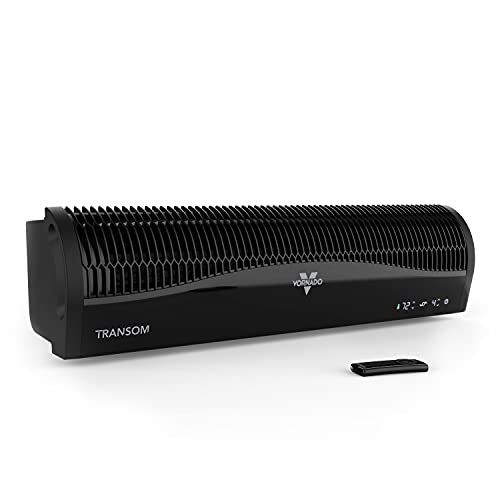
The TRANSOM is what happens when an air-circulation company redesigns the window fan as furniture. Instead of two round fans in a plastic frame, it is a long, low, black unit that sits across the window sill and looks like it belongs there. Behind the styling is Vornado’s whole-room circulation thinking: the TRANSOM is designed to move air through the room, not just through the window opening, and it offers four speeds with a reversible exhaust mode and a weather-resistant case.
Strengths
- Low-profile design preserves the window’s look and much of its light.
- Four speeds give finer control than the usual three, including a genuinely gentle low.
- Weather-resistant case suits windows that take driven rain.
Trade-offs
- It sits at the premium end of this category — you are paying for design as well as airflow.
- The horizontal format fits a wide sill line; very narrow windows should be measured twice.
- Remote-dependent controls mean a lost remote is a bigger inconvenience.
Choose the TRANSOM when the window is in a living room, a home office on video calls, or anywhere a beige twin-fan box would be an eyesore discussed daily. Its airflow philosophy also suits open-plan spaces, where pushing air across the room matters more than raw exchange at the glass. It is the fan guests do not notice, which for many households is the entire point.
Best for: living spaces where appearance matters and windows are wide. / Not suited for: tight budgets or very narrow window openings. Check on Amazon

HOLMES Dual 8-inch Twin Window Fan — Best Budget Twin
The HOLMES twin is the category’s long-running value formula: two 8-inch fans in an expandable frame, one-touch thermostat control with an LED readout, and a price position — check the current price on Amazon — that makes buying two for a cross-ventilation pair a realistic decision. That last point matters strategically: two modest fans in two windows outperform one premium fan in one window, and the HOLMES is priced for the pair strategy.
Strengths
- Thermostat control at a budget position — automation is not reserved for premium models.
- Twin 8-inch format fits the standard household window sizes the format was built around.
- Light and simple to install, move between rooms, and store off-season.
Trade-offs
- Reversal is less elegant than the Lasko’s remote electric system.
- Build feel is functional rather than premium; treat the side panels gently.
- Two smaller fans move air well but will not match a large single unit for raw exhaust in a big open space.
For renters, spare bedrooms, and anyone equipping a first apartment, the HOLMES covers the fundamentals without ceremony. It is also the sensible second fan: pair one exhausting upstairs with any intake fan below and the whole-house effect arrives at a household price.
Best for: budget buyers, renters, and the two-fan cross-ventilation strategy. / Not suited for: buyers who want premium build or one-button electric reversal. Check on Amazon

Comfort Zone Reversible Twin Window Fan — Best for Cross-Ventilation
Comfort Zone’s twin fan is built around the three jobs a window fan actually rotates through — draw cool air in, exhaust warm air out, or cross-ventilate — and gives it three speeds and expandable width panels to fit the window it lands in. It is the generalist of the list: no single headline feature, but no missing one either, and its expandable fit makes it a forgiving choice for the odd-sized windows older houses are full of.
Strengths
- Reversible operation covers intake, exhaust, and cross-ventilation roles.
- Expandable side panels adapt to varied window widths, sealing gaps that waste airflow.
- Three speeds span gentle night air to aggressive evening purge.
Trade-offs
- Controls are more manual than the thermostat-led rivals; set-and-forget is limited.
- The utilitarian design will not win a place in a styled living room.
- As with all twin fans, screens and storm windows may need attention for a clean fit.
Where the Comfort Zone shines is the upstairs hallway window or the kitchen — places where the job is moving heat out on schedule and nobody needs furniture-grade design. Its honest, mechanical approach also ages well: fewer electronics, fewer failure modes, season after season of the same reliable exchange.
Best for: older houses with varied windows and exhaust-focused jobs. / Not suited for: automation-first buyers or design-led rooms. Check on Amazon
Genesis Twin Window Fan — Best High-Velocity Twin
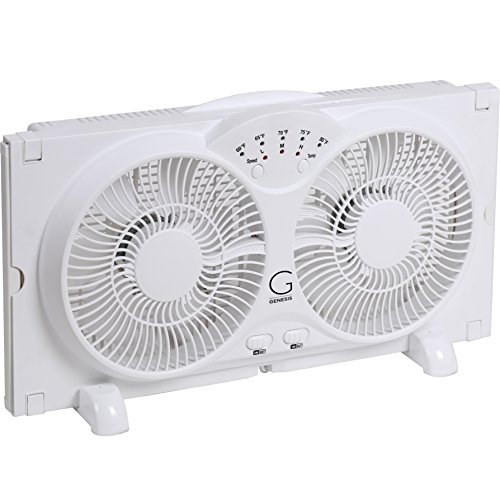
The Genesis earns its badge on airflow intent. Its confirmed listing describes a twin window fan built around high-velocity reversible airflow — intake or exhaust from the same unit — with an adjustable thermostat, LED indicator lights and the maker’s Max Cool technology, and it carries ETL certification. Where the Bionaire’s thermostat is programmable and digital, the Genesis takes the simpler adjustable route: set the dial, and the fan cycles to hold the room near your setting through the night.
Strengths
- High-velocity reversible airflow — one unit plays both the intake and exhaust roles.
- Adjustable thermostat gives set-and-forget night operation without digital menus.
- LED indicator lights make the current mode readable at a glance in a dark room.
Trade-offs
- Adjustable, not programmable: no clock-based scheduling like the Bionaire’s control set.
- High velocity means high audibility at full speed — bedrooms will live on the lower settings.
- Support and parts ecosystems are thinner than Lasko’s or Holmes’s.
The adjustable thermostat also suits the shoulder seasons, when nights swing between too warm at bedtime and genuinely cold by dawn: set it once and the Genesis cycles itself instead of running flat-out until the bedroom overshoots. That is the practical difference between its adjustable dial and a purely manual fan, and it is why this unit holds its own in a guide full of remote-controlled rivals.
Put the Genesis where maximum air exchange is the job — the upstairs exhaust window in a whole-house setup, or the kitchen window after a smoky dinner — and let its thermostat idle it down once the room reaches your setting. It is the blunt instrument of this guide, in the good sense: the fan you choose when moving air matters more than whispering.
Best for: high-volume air exchange and whole-house exhaust setups. / Not suited for: light sleepers who need the quietest possible low speed. Check on Amazon
Comparison Table
| Pick | Badge | Key spec | Best for |
|---|---|---|---|
| Lasko W09550 — Check on Amazon | Best Overall | Twin fan, electric reversal by remote | Whole-house intake/exhaust strategy |
| Bionaire Window Fan — Check on Amazon | Best With Thermostat | Reversible blades, programmable thermostat, fits 24–36in | Automated bedroom night cooling |
| Vornado TRANSOM — Check on Amazon | Best Low-Profile | 4 speeds, reversible exhaust, weather-resistant case | Design-led living spaces |
| HOLMES Dual 8-inch Twin — Check on Amazon | Best Budget Twin | Twin 8in fans, one-touch thermostat | Pairs for cross-ventilation, renters |
| Comfort Zone Twin — Check on Amazon | Best for Cross-Ventilation | 3 speeds, expandable width panels | Older houses, exhaust jobs |
| Genesis Twin — Check on Amazon | Best High-Velocity Twin | Twin fan, reversible airflow, adjustable thermostat | High-volume air exchange, exhaust setups |
How to Choose a Household Window Fan
Choose direction strategy before choosing hardware. A window fan does one of two jobs — intake (blowing outdoor air in) or exhaust (blowing indoor air out) — and the right job depends on the hour. Evenings favor intake of cool air or exhaust of the day’s accumulated heat; the strongest setups do both at once from different windows. If you will own exactly one fan, buy reversibility and prioritize the exhaust role: heat rises and collects upstairs, and a single exhaust fan high in the house pulls replacement air through every cracked window and door under it, cooling rooms that have no fan at all.
Fit is the second decision, and it is a measuring job, not a guessing job. Measure the window opening’s width and the height available in the raised sash position, then compare against the fan’s housing and its expandable panels. The panels matter as much as the fan: air takes the easiest path, and a two-inch gap beside the housing is an easier path than the fan blades. A well-sealed modest fan outperforms a powerful fan leaking around its edges. Note your window type honestly — twin fans are designed for double-hung windows; sliders need vertical mounting improvisation, and casements generally rule window fans out entirely in favor of a different fan type.
Controls come third, matched to the room. Bedrooms want thermostats and timers, because the fan’s best hours are asleep hours and the outdoor temperature keeps falling after you stop adjusting things. Kitchens and workshops want simple, grease-tolerant manual controls and maximum exhaust. Living rooms want the quietest low speed and the least visual intrusion. There is no universal winner; there is a right fan per window, which is why this guide’s badges are organized by job.
Finally, think in seasons. A window fan earns its money in the shoulder seasons and on summer nights, not in a heat wave’s peak afternoon, when outdoor air is hotter than indoor and the correct move is shades drawn and fan off or exhausting minimally. Households that understand this rhythm use window fans to cut air-conditioning runtime by weeks; households that expect a window fan to fight a 100-degree afternoon conclude wrongly that window fans do not work.
The Whole-House Setup: Intake Low, Exhaust High
The technique that separates window-fan owners from window-fan enthusiasts is the pressure setup. Hot air rises and stratifies against ceilings and in upstairs rooms. Place an exhaust fan in the highest, warmest window you have — an upstairs bedroom or hallway — and open windows on the cool, shaded side of the lower floor. The exhaust creates gentle negative pressure, and the house itself becomes the ductwork: cool air enters low, crosses the living spaces, warms, rises, and leaves through the fan. Close the doors of rooms you are not cooling so the airflow concentrates where you live and sleep.
Two refinements multiply the effect. First, open the intake windows only partway — a few inches each across several windows often beats one window wide open, because it distributes the incoming air and keeps velocities comfortable. Second, run the purge hard for the first hour of evening, when the indoor-outdoor temperature gap is largest, then throttle down to a maintenance speed for the night. Owners who master this rhythm routinely sleep in naturally cooled rooms deep into summer, running air conditioning only through genuine heat waves.
Single-fan households can approximate the setup with discipline: exhaust from the warmest room, and open exactly one intake window in the room you most want cooled, closing other windows so the replacement air is forced to travel through your living space rather than short-circuiting from the nearest opening. The principle never changes — air must be given a path that passes through the rooms you care about, or it will take a shorter one that does not.
How to Install and Run a Window Fan
Installation takes ten unhurried minutes. Raise the sash, set the fan in the opening with its side panels extended to the frame edges, and lower the sash onto the housing so the window itself locks the fan in place. Fill remaining gaps with the panels or foam weatherstripping — the seal is performance, not tidiness. Check the exterior side: screens can stay in place for most models but add resistance; a storm window left closed above the fan will defeat it entirely. Plug into the nearest outlet without extension-cord improvisation, and confirm the controls are reachable in the fan’s final orientation before the first hot night does it for you.
Running the fan well is a daily two-minute habit. At dusk, compare indoor and outdoor temperature — a phone weather reading and a room thermometer suffice — and start the purge when outdoor air drops below indoor. Set direction by job: exhaust from hot rooms, intake into bedrooms once the outdoor air is genuinely cool. Before bed, set the thermostat or timer so the fan throttles itself as the night deepens. In the morning, close windows and shades on the sun side before the day heats up; the cool you banked overnight is a resource, and open windows at noon spend it.
Maintenance is light but real. Dust loads the blades and the intake side of the housing within a season and measurably cuts airflow; a vacuum brush pass monthly and a proper wipe-down at season’s end keep performance honest. Store the fan dry and indoors over winter rather than leaving it in the window as an expensive, drafty plug — a window fan left mounted all winter leaks heat around every panel seam.
Common Buying Mistakes
Buying one fan and expecting whole-house cooling. A single fan in a single window cools that room’s air exchange only. The whole-house effect needs a path — a second opening at minimum, a second fan ideally.
Running intake at midday in a heat wave. When outdoor air is hotter than indoor, an intake fan is a heater. The correct midday move is closed shades and patience; the fan’s shift starts at dusk.
Ignoring the seal. Unsealed side gaps can waste a large share of the fan’s work. Two minutes with panels and weatherstripping outperforms a model upgrade.
Mounting in the wrong window type. Twin fans in casement windows, or units forced into sliders without a plan, end in returns. Measure and match the format to the window first.
Leaving the fan in all winter. Beyond the drafts, freeze-thaw and condensation age the unit. Store it; the window will thank you and so will the fan.
Final Recommendation
For most households the Lasko W09550 is the buy: its remote electric reversal makes the two-direction strategy effortless, and strategy is where the cooling actually comes from. No fan on this page will rescue a house whose intake windows stay shut or whose purge starts at noon — and with the path open and the dusk purge running, these fans deliver a grade of evening comfort that surprises people who have only ever cooled with refrigeration. The hardware is the smaller half of this purchase; the habit is the larger half, and it is free. Choose the Bionaire if the fan’s home is a bedroom and automated night cooling matters most, the Vornado TRANSOM if the window is on display, the HOLMES if you are buying a cross-ventilation pair on a budget, and the Comfort Zone for honest exhaust work in older houses. Choose the Genesis when the job is maximum air exchange with a thermostat to tame it overnight. Whichever fan you choose, spend the saved money and the first evening on the setup — sealed panels, a planned airflow path, a dusk purge — because that is what turns a fan in a window into a cool house. Cooling a bedroom from the hallway side? Our companion guide to Best Alarm Clocks For Completely Dark Rooms covers the other half of a good night’s sleep, and Best Air Purifiers For Small Areas pairs well for stuffy rooms that need air exchange plus filtration.
Noise, Sleep, and Running a Fan All Night
The honest truth about window fans and sleep is that the sound is part of the product. For many sleepers, a fan’s steady broadband hum is a feature — it masks traffic, neighbors, and the house’s own creaks, and it does so more evenly than most sound machines. For light sleepers, the same hum at the wrong speed is a nightly negotiation. The practical answer is speed discipline: every pick in this guide can move enough air on its lower settings for night duty, and the correct night speed is the slowest one that holds the room comfortable, not the speed that cooled it fastest at dusk.
Placement refines the sound further. A fan exhausting from a hallway or bathroom window cools a bedroom through its cracked door at a fraction of the perceived noise of a fan in the bedroom window itself. This is another quiet advantage of the two-fan strategy: the loud work happens in the purge hour and in utility spaces, and the sleeping hours run on the gentlest settings. Thermostat models like the Bionaire automate the step-down; with manual models, the habit of turning the fan down as you turn the lights out is worth building deliberately for the first week until it is automatic.
Vibration noise is the one sound that is never acceptable, because it signals a mounting problem rather than a motor. A fan that buzzes against the sash needs reseating, a foam strip under the contact points, or its side panels adjusted — not a towel wedged in a gap, which will work loose. Fix the mount once, properly, and the fan returns to the clean hum it was designed to make.
Window Fan vs. Window AC vs. Whole-House Fan
These three appliances are constantly confused, and the confusion costs buyers money in both directions. A window air conditioner manufactures cold: it refrigerates room air regardless of outdoor conditions, at significant electrical cost, and it is the only one of the three that helps at 3 p.m. in a heat wave. A window fan moves air: it is nearly free to run, silent by comparison, and entirely dependent on the outdoor temperature being useful. A whole-house fan is a window fan’s strategy industrialized — a large ceiling-mounted unit in a hallway that exhausts the entire home through the attic, requiring attic venting and a permanent installation.
The households that save the most money own the first two and use each in its window of competence: fans own the mornings, evenings, nights, and shoulder seasons; the AC owns the dangerous afternoons and the humid stretches when outdoor air brings moisture with its heat. Humidity is the window fan’s real boundary — on a muggy night, incoming air can be cooler yet leave the house feeling clammy, and the AC’s dehumidification wins outright. Judge by dew point, not just temperature, and the right appliance chooses itself most nights.
Whole-house fans deserve a sentence for homeowners: if your climate has reliably cool nights and your attic vents freely, a whole-house fan does everything this guide describes at greater scale and speed. Renters and the installation-averse get most of the same effect from the two-window strategy with the fans ranked above, with the decisive advantage that the entire system uninstalls in ten minutes on moving day.
Sizing and Placing Fans Room by Room
Bedrooms reward gentleness: a twin fan on low with a thermostat beats a large fan cycling between roaring and off. Size for the night, not the purge, and let a second fan elsewhere do the evening’s heavy exchange. Kitchens reward the opposite: cooking heat and odor are an exhaust job, and the strongest, simplest fan — the Comfort Zone profile — belongs there, running hard for the cooking hour and off by dessert. Living rooms reward discretion and distribution, which is the TRANSOM’s brief: air that crosses the room without a visual or audible announcement.
Upstairs rooms in two-story houses are where window fans change lives, because heat stratification makes them the worst rooms in the house by bedtime. An exhaust fan in the highest window is the single highest-value placement in this entire guide; it converts the staircase into a chimney working in your favor. Children’s rooms add a safety filter to every decision — secure mounting, cords out of reach, and a locking window arrangement — and a thermostat model earns its place by preventing the over-cooling that a fixed-speed fan delivers by 4 a.m.
Bathrooms and laundry rooms are exhaust-only territory, where a window fan supplements or substitutes for weak built-in ventilation after showers and wash days. Home offices sit between categories: the fan must be quiet enough for calls and strong enough for a room full of warm electronics, which points again at multi-speed models run one notch below maximum. Across every room, the measuring and sealing discipline stays identical — the room changes the badge you should buy, never the installation fundamentals.
The Seasonal Playbook: When the Fan Wins and When It Rests
Spring is the window fan’s showcase. Days warm enough to heat the house, nights still genuinely cool — the fan purges the day’s warmth in an hour and the house wakes up fresh. This is also the season to do the unglamorous work: wash the housing, check the side panels for warping, confirm the thermostat against a room thermometer, and decide which windows own which roles before the first hot night turns setup into improvisation.
Summer divides into two games. Night-game summer — most of it, in most climates — belongs to the fan: purge at dusk, maintain overnight, seal the house by morning, and let insulation and shades defend the cool until evening. Heat-wave summer belongs to the air conditioner, and the fan’s job shrinks to early-morning exhaust of any trapped hot spots before the AC takes the day. Owners who insist the fan fight the heat wave conclude it failed; owners who play the two games separately find their AC runtime — and their summer electricity story — transformed.
Autumn returns the fan to showcase duty, with one addition: it is the best tool for clearing the stale, closed-up smell of a house that has been sealed against summer, and for drying out bathrooms and basements as heating season approaches. Winter is for storage, full stop — fan out, window sealed, unit cleaned and shelved. A household that follows this calendar gets the fan’s full value: not a compromise appliance tolerated until real cooling arrives, but the primary cooling system for most of the year, with the AC demoted to a specialist for the hardest weeks.
There is a final, underappreciated benefit to the seasonal rhythm: air quality. A house ventilated nightly with outdoor air — pollen seasons excepted, and allergy households should weigh that exception seriously — simply smells and feels different from a house recirculating refrigerated air for months. Cooking odors, cleaning-product residue, and the flat staleness of sealed rooms all leave on the exhaust stream. Many owners buy a window fan for temperature and keep it for the air.
Troubleshooting: When the Fan Is Not Cooling
When a window fan disappoints, the cause is almost never the fan. Work this list in order. First, check the path: is there an open intake route on the opposite side of the living space, and are the doors along it open? An exhaust fan in a sealed house moves almost nothing — it starves within minutes and spends its effort fighting a vacuum of its own making. Second, check the seal at the fan itself: gaps beside the housing let the fan recirculate window-frame air instead of room air. Third, check direction against intention: an intake fan on the sun-baked side of the house at dusk is importing the wall’s stored heat, while the shaded side’s air is cooler by several degrees.
Fourth, check the hour. Fans started at 5 p.m. against a house full of day heat and outdoor air still near its peak will always feel useless; the same fan at 8 p.m. feels miraculous. Fifth, check the attic and ceiling: in single-story homes, a ceiling’s worth of trapped hot air radiates down for hours, and the fix is a longer purge, not a bigger fan. Sixth, check expectations against humidity: on a high-dew-point night the fan can deliver its full temperature drop and the room will still feel heavy, because moving damp air is not drying it. That night belongs to the air conditioner, and recognizing it is expertise, not surrender.
If the fan itself is the problem, the symptoms are mechanical: reduced airflow with clean blades suggests a tired motor; rattling suggests the mount; a thermostat that overshoots suggests its sensor sits in the fan’s own airstream rather than the room’s. Each has a fix short of replacement, and a fan bought from the linked picks above carries the brand support to pursue them. But run the six checks first — in practice, the path, the seal, and the hour explain nearly every “this fan doesn’t work” story ever told.
Pollen, Smoke, and City Air: The Honest Limits of Ventilation
A window fan imports the outdoors, all of it. For most households most of the year that is the point, but three situations deserve explicit judgment. Pollen season is the first: a bedroom window fan running all night is an efficient pollen delivery system, and allergy sufferers in the household should treat high-count nights as closed-window nights, leaning on filtration indoors instead. The fan is not at fault; it is doing its one job — exchanging air — in a week when exchange is the wrong goal.
Wildfire smoke and poor air-quality days are the second, and the rule is simpler: when the air quality index is in the unhealthy range, the windows close and stay closed, full stop. No comfort benefit justifies importing particulate-laden air into sleeping rooms, and the fan’s role reverses to nothing at all — it should be off and, ideally, removed or covered so its housing is not a leak path. Households in smoke-prone regions should build this switch into the seasonal playbook in advance rather than improvising it during an event.
City air is the third, milder case. Street-facing windows import traffic noise and exhaust along with the breeze, and the practical mitigations are positional: intake from the quietest, highest, or rear-facing window available, and exhaust toward the street. Upper floors breathe measurably cleaner and quieter air than ground floors on the same facade. None of this disqualifies the window fan for city homes — it argues for choosing which window gets the fan with the same care as choosing the fan itself, and for favoring models whose low speeds are genuinely quiet, since a fan competing with street noise tempts owners to run it harder than the room needs.
The through-line of this section is that ventilation is a decision renewed nightly, not a set-and-forget system. The owners who love their window fans check the evening’s temperature, humidity, pollen, and air quality the way sailors check weather — briefly, habitually, and with the willingness to keep the windows closed when the sky says no. That thirty-second habit is the difference between a tool used well all season and a tool blamed for the one bad night it was asked to work against its nature.
Frequently Asked Questions
Is a window fan better as intake or exhaust?
Exhaust, if you must pick one — especially from a high, warm room — because it pulls replacement air through the whole house. Intake is better for a single bedroom once outdoor air is cool. Reversible fans let you use each mode when it is right.
Can a window fan cool a whole house?
It can cool the rooms on its airflow path, which a good setup makes most of the house. It will not match air conditioning in a heat wave, but in shoulder seasons and summer nights it can replace it for many households.
Will a window fan work in a sliding window?
Twin fans are designed for double-hung windows. Some owners mount them vertically in sliders with added sealing, but results vary; measure carefully and expect improvisation, or choose a fan type made for sliders.
Do window fans use much electricity?
Very little compared with air conditioning — a window fan runs on a small fraction of the power of even a small window AC unit, which is the core of its value proposition across a season.
Should I remove the window screen when using a fan?
Screens add airflow resistance but keep insects out. Most households keep the screen and accept the small loss; if you remove it, weigh the bug traffic honestly, especially at night with lights on.
Can I leave a window fan running overnight?
Yes — that is its best shift. Use the thermostat or timer so it eases off as outdoor temperatures bottom out, and make sure the unit is securely seated in the window before relying on it unattended. Households with children or pets should double-check the mounting and keep the cord routed out of reach, and anyone running a fan through a thunderstorm-prone night should follow the manufacturer’s guidance on storm use. With those basics covered, overnight operation is not a compromise — it is the entire design case for the category, and the reason a modest fan can change how a house sleeps from May through September.